

Global Positioning Antenna Market Size and Forecast – 2026-2033
The global positioning antenna market is estimated to be valued at USD 3.64 Bn in 2026 and is expected to reach USD 7.76 Bn by 2033, exhibiting a compound annual growth rate (CAGR) of 11.4% from 2026 to 2033.
Key Takeaways of the Global Positioning Antenna Market
- The active antenna segment is expected to lead the market holding a share of 46% in 2026.
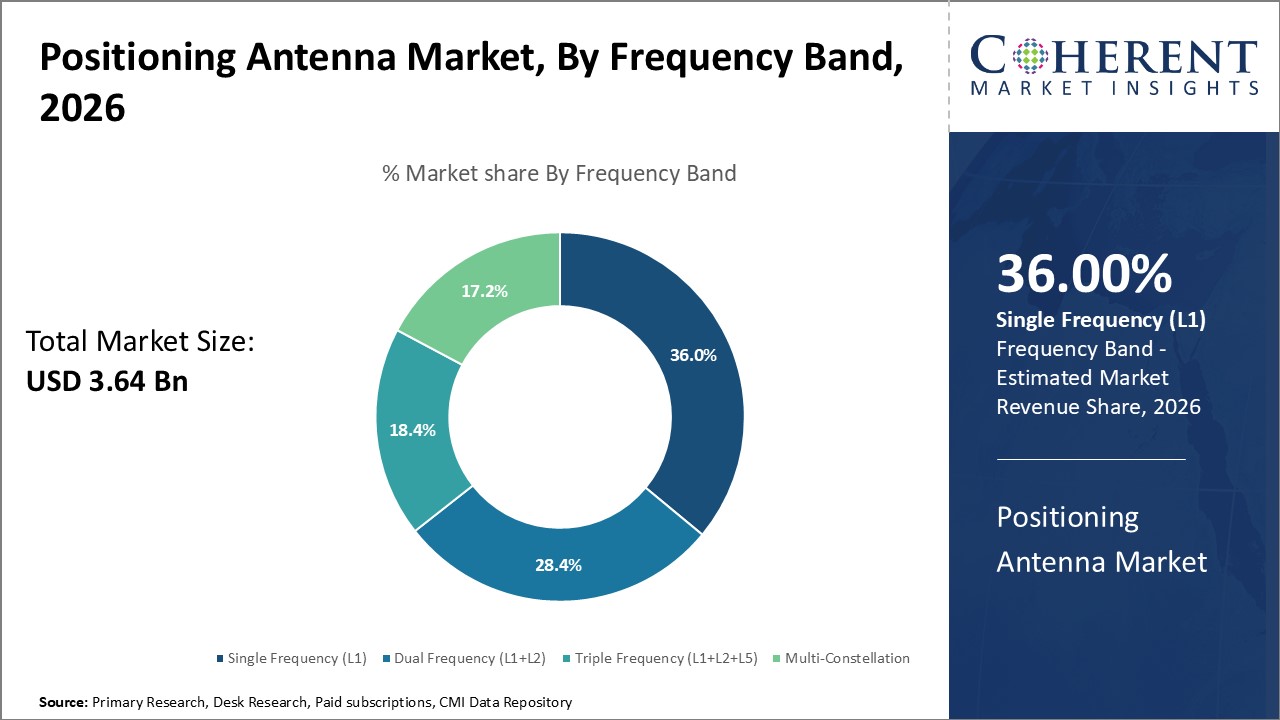
- The single frequency (L1) segment is projected to dominate with a share of 36% in 2026.
- The automotive & transportation segment leads the market holding an estimated share of 31% in 2026.
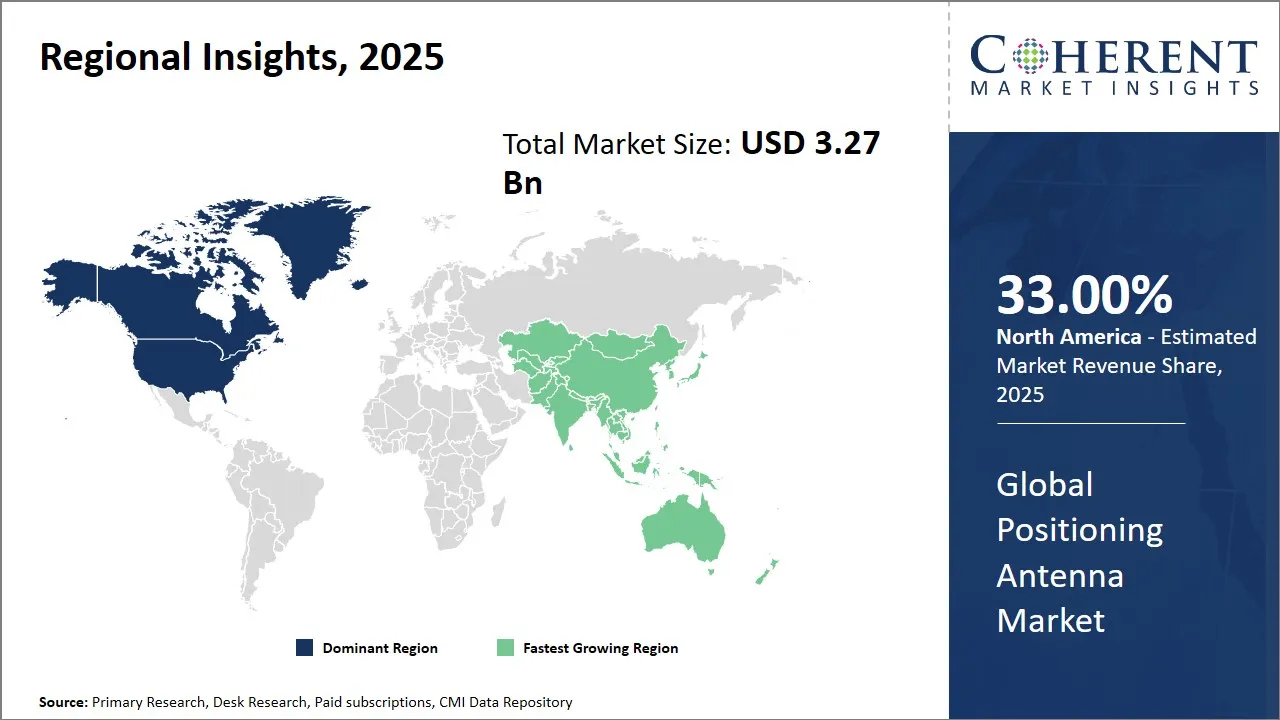
- North America, holding an estimated share of 33% in 2026, is projected to dominate the market.
- Asia Pacific, holding an expected share of 28% in 2026, shows the fastest growth in the market.
Market Overview
A key market trend is the integration of advanced Global Navigation Satellite System (GNSS) technologies with positioning antennas to improve accuracy, reliability, and real-time data processing. Also, the shift towards miniaturization and improved antenna design for applications such as drones, wearable devices, and autonomous vehicles is influencing product development. Growing government initiatives to implement smart city infrastructure and advancements in IoT connectivity also makes demand for innovative positioning antenna solutions, reinforcing strong market momentum.
Current Events and Its Impact
Current Events | Description and its Impact |
Geopolitical and Trade Developments |
|
Economic and Industrial Trends |
|
Segmental Insights
- Current Industry Events of 2026
- Market Size Estimation
- Regional Breakdown
- Competitive Landscape
- Customer Intelligence
- Segmental Analysis
- Pricing Analysis
- Key Market Drivers, Challenges & Future Trends
- Customized Insights Section
Global Positioning Antenna Market Insights, By Type – Advanced Signal Processing Powers Dominance of Active Antenna Segment
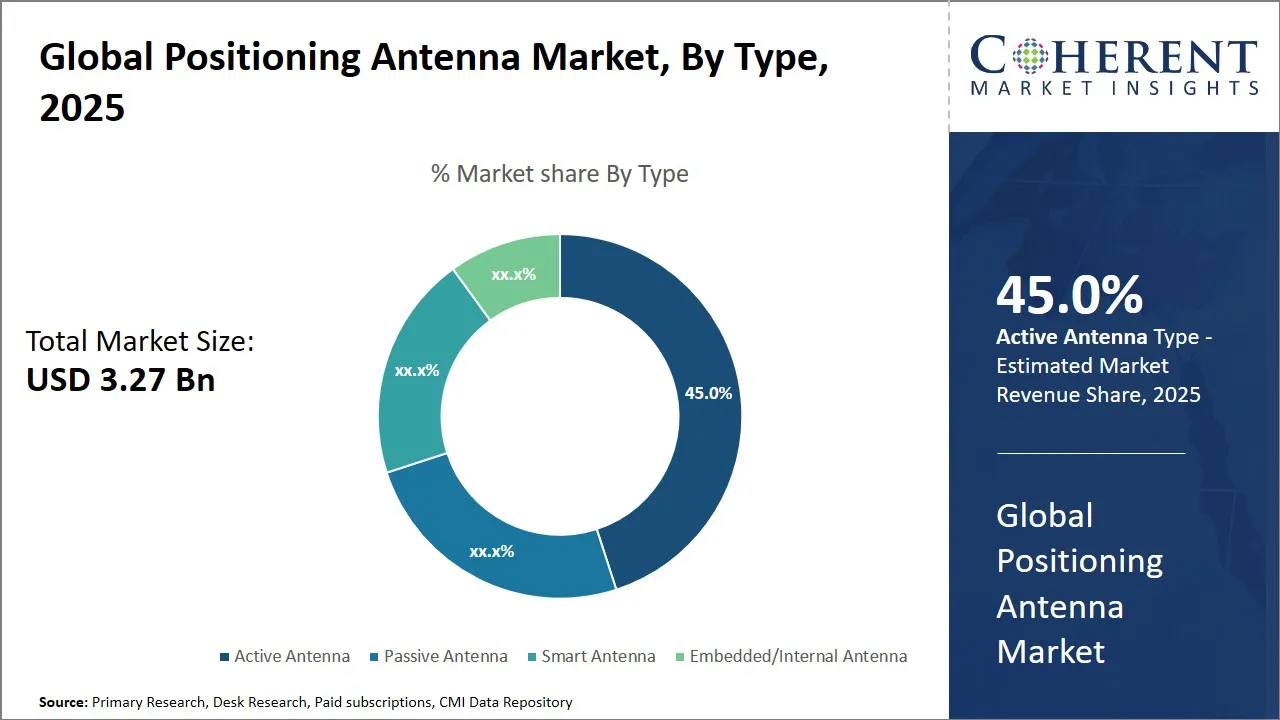
Active antennas dominate the global positioning antenna market with an estimated 46% of the market share in 2026 because they can amplify weak satellite signals and maintain accuracy in challenging environments. Their integrated Low-Noise Amplifiers (LNAs) make performance better in compact devices like wearables, smartphones, and telematics systems. Growing adoption in connected and autonomous vehicles also makes demand, as these antennas support high-precision, multi-constellation tracking. In 2024, u-blox launched its ANN-MB1 multi-band active GNSS antenna, made for automotive and industrial applications, enabling robust positioning even in dense urban areas.
Global Positioning Antenna Market Insights, By Frequency Band – Single Frequency (L1) Band Leads Due to Ubiquity and Cost-Effectiveness
The single frequency (L1) frequency band is projected to hold 36% of the market share in 2026 because of its cost-effectiveness, simplicity, and broad compatibility with global navigation systems. Widely used in smartphones, fleet trackers, and portable navigation devices, L1 antennas meet the accuracy needs of mass-market applications without requiring expensive multi-frequency configurations. Garmin’s GPSMAP 67 series, launched in 2024, uses L1-based antennas for consumer navigation devices, balancing affordability with reliable positioning performance.
Global Positioning Antenna Market Insights, By Application – Automotive & Transportation Segment Benefits from Rising Smart Mobility and Connected Vehicle Trends
The automotive & transportation segment, accounting for an estimated 31% of the market share in 2026, leads because of fast advancements in connected vehicles, ADAS, and autonomous driving. Antennas are critical for navigation, fleet management, and vehicle-to-everything (V2X) communications, ensuring precise, continuous location data for safety and efficiency. Increasing EV adoption and smart mobility infrastructure also adds to the integration of advanced GNSS antennas. Tesla filed a patent for a multi-band antenna to improve global navigation satellite system technology. This will allow cars to be more accurate in determining their location, the location of the nearest charging stations, to work more perfectly in Autopilot and Smart Summon, etc.
Pricing Analysis of the Positioning Antenna Market
Type/Segment | Example Product | Price (USD) |
Entry external active L1 antenna (basic vehicle/consumer) | GNSS Active Antenna with SMA connector | USD 3.50 |
Embedded active build-in ceramic module (IoT/locator) | GNSS Active Ceramic Positioning Antenna | USD 3.45 |
Dual-frequency L1/L5 active antenna (developer/survey) | Waveshare GNSS L1+L5 Dual‑Frequency Active Antenna | USD 18 |
Multi-band external active antenna (survey/professional) | TAOGLAS TS.125.0111 RF Antenna | USD 450 |
Survey-grade multi-band GNSS antenna (L1/L2/E5, weather-hardened) | Calian 33‑SSL990XF‑1‑28‑19 Lightweight Full‑Band GNSS Antenna | USD 460 |
Regional Insights
North America Positioning Antenna Market Analysis and Trends
North America, holding a share of 33% in 2026, is expected to dominate the global positioning antenna market because of a well-established technology ecosystem, extensive government support, and the presence of a robust defense and aerospace industry. The U.S., as the leading country in this region, sees a lot of investments in satellite navigation infrastructure and advanced research and development activities. Government agencies such as the Department of Defense and NASA actively support innovations in GPS technology, fueling advancements in antenna design to meet both military and commercial demands.
The strong presence of industry leaders like L3Harris Technologies, Raytheon Technologies, and Garmin adds to market dominance by providing cutting-edge products that cater to aviation, maritime, automotive, and consumer electronics sectors. Also, North America's sophisticated import-export framework makes possible efficient trade of advanced positioning devices and components, further consolidating its leading position.
Asia Pacific Positioning Antenna Market Analysis and Trends
The Asia Pacific region, holding a share of 28% in 2026, is projected to exhibit the fastest growth in the global positioning antenna market because of rapid urbanization, infrastructure development, and increasing adoption of GPS-enabled devices across various sectors. China, India, Japan, and South Korea are notable contributors to this surge, supported by proactive government policies aimed at expanding satellite navigation systems and indigenous antenna manufacturing capabilities.
The automotive, telecommunications, and consumer electronics industries are big growth drivers, with companies like Huawei, Samsung, and Panasonic spearheading innovation locally. Furthermore, Asia Pacific’s expanding trade networks and regional cooperation in space technology initiatives, such as China's BeiDou Navigation Satellite System, are accelerating market adoption and production capacity, making the region the fastest expanding in terms of technological deployment and market penetration.
Global Positioning Antenna Market Outlook for Key Countries
U.S. Positioning Antenna Market Analysis and Trends
The U.S. positioning antenna market sees the presence of leading technology providers, advanced manufacturing capabilities, and strong government backing. Big players like Trimble Inc., L3Harris Technologies, and Garmin make demand by developing high-precision GNSS antennas for defense, aerospace, automotive, and consumer applications. Government investments in maintaining and upgrading the GPS infrastructure add to continuous innovation, while commercial sectors rapidly adopt emerging antenna technologies. The U.S. also sees a mature supply chain and strict quality standards, securing its leadership in producing reliable and high-performance positioning antennas.
China Positioning Antenna Market Analysis and Trends
China positioning antenna market is evolving fast, with a lot of focus on indigenous development of satellite navigation systems like BeiDou and domestic antenna manufacturing. Industry giants like Huawei and NavInfo are providing integrated solutions, combining hardware and software to enhance GPS accuracy and reliability. Strong government initiatives to support space technology and smart city projects create the adoption of advanced positioning antennas. The country’s competitive manufacturing environment and huge consumer base also help scale innovations in GPS antenna technology in automotive, telecommunications, and logistics sectors.
Japan Positioning Antenna Market Analysis and Trends
Japan continues to lead because of its specialization in high-precision and miniaturized GNSS antenna technologies, enabled by a strong collaboration between industry and academia. Companies like Panasonic and Mitsubishi Electric focus on high-reliability solutions made for automotive safety systems, robotics, and industrial automation. Government programs promoting intelligent transport systems and infrastructure modernization encourage widespread use of GPS antennas.
India Positioning Antenna Market Analysis and Trends
India positioning antenna market is growing because of government initiatives like NavIC, a regional satellite navigation system designed to reduce dependence on foreign GNSS providers. Domestic companies and startups are making cost-effective and reliable antennas for agricultural, transportation, and defense applications. The country’s growing infrastructure projects and increasing smartphone penetration make demand for GPS-enabled devices. Supportive policies and partnerships with international firms boost local manufacturing and technology transfer, adding to a strong growth trajectory in the Asia Pacific region.
Germany Positioning Antenna Market Analysis and Trends
Germany positioning antenna market sees a strong automotive industry, which uses GPS antenna systems for navigation and autonomous driving technologies. Leading manufacturers like Rohde & Schwarz and Leica Geosystems offer advanced products made for precision and durability. The country’s focus on Industry 4.0 and smart mobility solutions pushes innovation in positioning technologies. Also, strong trade relations in Europe and access to EU research funding adds to the development and adoption of high-performance antennas for different commercial and industrial applications.
Market Players, Key Development, and Competitive Intelligence
Key Developments
- In September 2025, u-blox, a global provider of leading positioning and wireless communication technologies and services, announced the launch of the ANN-MB3, its latest best-in-class L1/L2/L5 triple-band RTK antenna. Designed for the u-blox F20 high precision platform and optimized for seamless integration, the ANN-MB3 delivers exceptional performance at an affordable price point.
- In March 2025, Hexagon acquired Septentrio NV, a manufacturer of GPS/GNSS positioning technology for autonomy and mission-critical applications. The acquisition of Septentrio will strengthen Hexagon’s position as the leader in the resilient, assured positioning solutions industry.
- In March 2025, Xona Space Systems, a leading pioneer of advanced commercial satellite navigation solutions announced a new collaboration with Trimble, a global leader in construction, transportation and geospatial technology. Xona and Trimble are pursuing the integration of Trimble correction services with Xona's PULSAR high-performance navigation service. Initial satellite launches are expected in late 2026 with service starting in 2027 through the PULSAR satellite network
- In December 2023, PCTEL, Inc., a global provider of wireless technology solutions, was acquired by Amphenol Corporation, one of the world’s largest providers of high-technology interconnect, sensor and antenna solutions. Following the acquisition, PCTEL is a wholly owned subsidiary of Amphenol, and PCTEL shares are no longer publicly traded.
Top Strategies Followed by Positioning Antenna Market Players
- Established players dominate the market because of high investments in research and development, aiming to make high-performance positioning antennas that offer improved accuracy, durability, and multifunctionality.
- Trimble Inc. invests a lot in high-precision GNSS and positioning R&D, evident from its 2024 collaboration with Xona Space Systems to test next-generation satellite navigation services for improved accuracy and reliability.
- Mid-level players in the positioning antenna market use a different approach by focusing on cost-effective solutions that strike a balance between quality and affordability, thus appealing primarily to price-sensitive consumers.
- Taoglas offers competitively priced multi-band antennas (e.g., its FXP and MA series) for IoT, EVs, and fleet telematics, combining affordability with reliable performance to serve mid-tier OEMs in Asia and Europe.
- Small-scale players in the global positioning antenna market make their niche by specializing in innovative products or features that address unique customer needs or emerging trends.
- Maxtena Inc. makes helical and lightweight GNSS antennas for drones and defense applications, such as its M1227HCT-A2-SMA model used in unmanned systems—serving a specialized, high-precision niche outside mainstream consumer markets.
Market Report Scope
Positioning Antenna Market Report Coverage
| Report Coverage | Details | ||
|---|---|---|---|
| Base Year: | 2025 | Market Size in 2026: | USD 3.64 Bn |
| Historical Data for: | 2020 To 2024 | Forecast Period: | 2026 To 2033 |
| Forecast Period 2026 to 2033 CAGR: | 11.4% | 2033 Value Projection: | USD 7.76 Bn |
| Geographies covered: |
| ||
| Segments covered: |
| ||
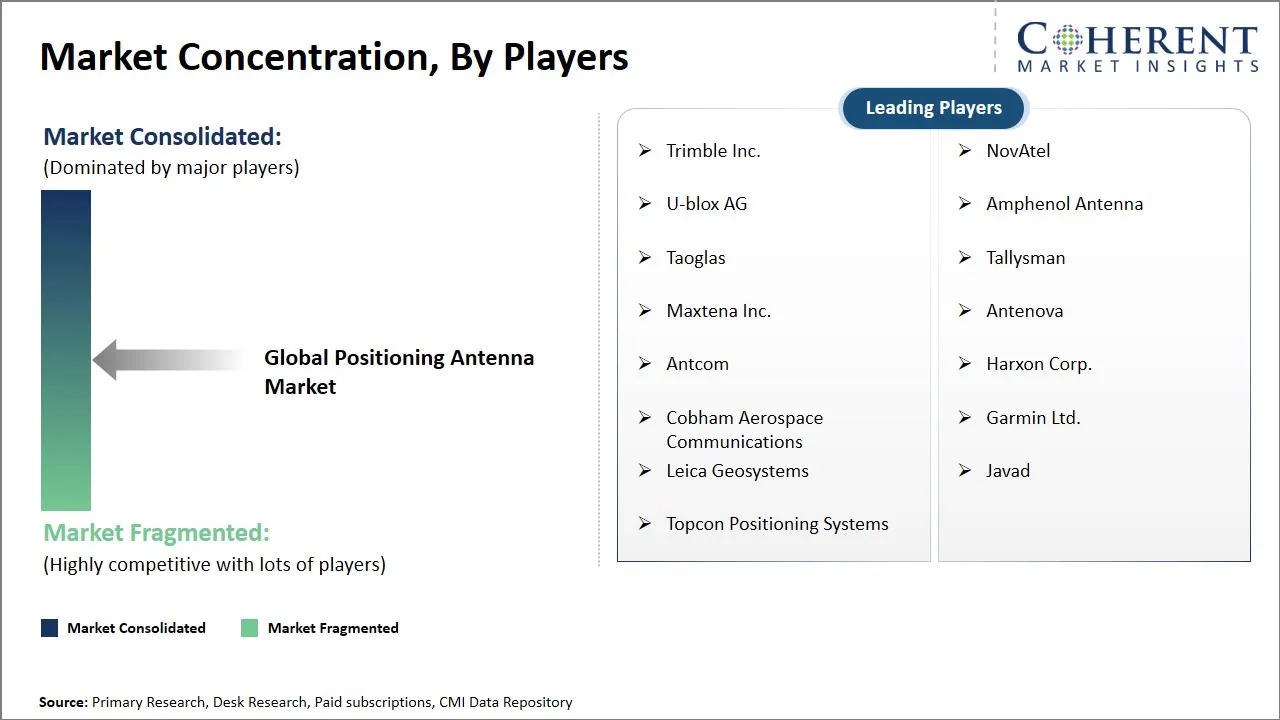
| Companies covered: | Trimble Inc., NovAtel, u-blox AG, Amphenol Antenna, Taoglas, Tallysman, Maxtena Inc., Antenova, Antcom, Harxon Corp.,Cobham Aerospace Communications, Garmin Ltd., Leica Geosystems, JAVAD, Topcon Positioning Systems | ||
| Growth Drivers: |
| ||
| Restraints & Challenges: |
| ||
Market Dynamics
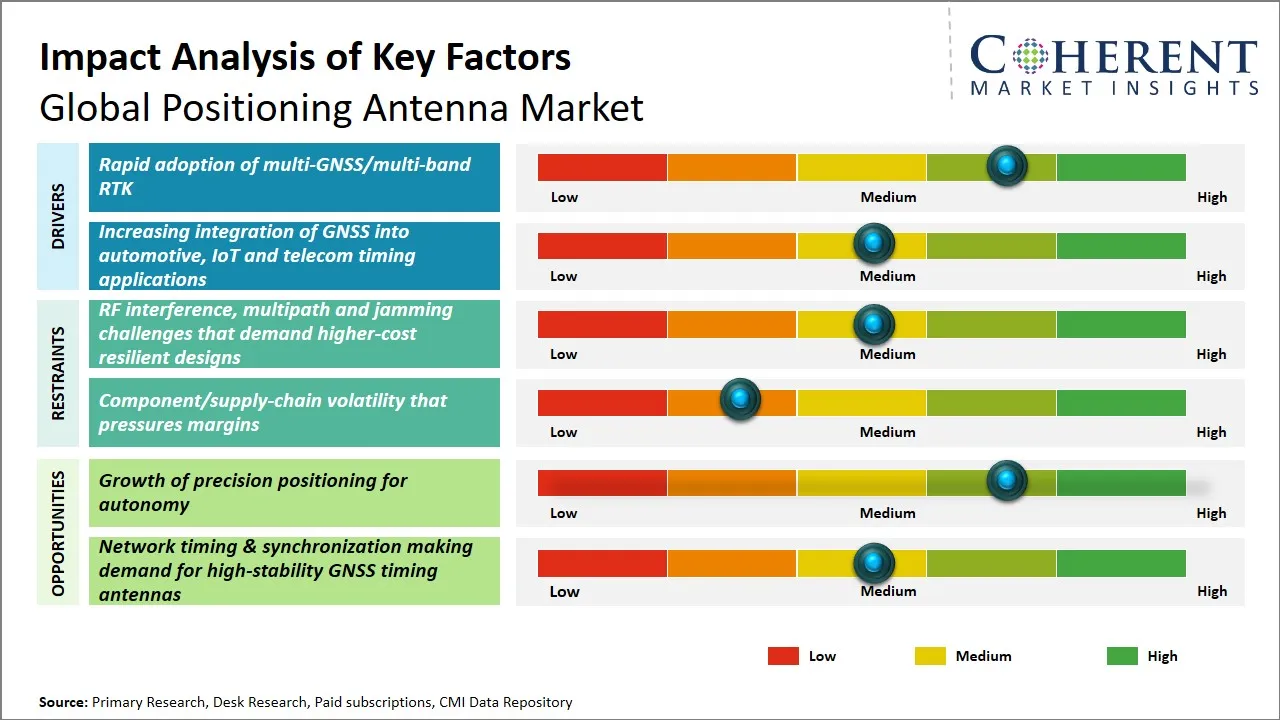
Global Positioning Antenna Market Driver - Rapid Adoption of Multi-GNSS/Multi-Band RTK
The integration of multi-GNSS and multi-band Real-Time Kinematic (RTK) technologies is a major driver for the global positioning antenna market. These systems leverage signals from multiple constellations (GPS, GLONASS, Galileo, BeiDou) and multiple frequency bands to deliver centimeter-level accuracy—essential for applications like autonomous vehicles, precision farming, and surveying. This has increased demand for antennas that support concurrent multi-frequency reception and robust interference mitigation. In 2024, Hexagon’s NovAtel launched the SMART7 and SMART2 GNSS smart antennas, supporting multi-constellation and multi-frequency RTK positioning for agriculture and construction, enabling sub-centimeter accuracy in real time.
Global Positioning Antenna Market Opportunity – Growth of Precision Positioning for Autonomy
The global shift toward autonomous technologies—from vehicles and drones to industrial robots—is creating a major opportunity for positioning antenna manufacturers. These systems rely on high-precision, low-latency GNSS antennas to ensure safe and efficient navigation. The expansion of ADAS and autonomous driving, as well as precision agriculture and smart robotics, drives innovation in antenna design focused on multi-band, high-sensitivity, and compact architectures. Tesla and Waymo have upgraded their autonomous driving platforms with multi-frequency GNSS antennas integrated into ADAS systems to improve real-time lane-level positioning, while John Deere’s StarFire 7000 receiver (launched in 2023) uses multi-band GNSS technology for 2.5 cm accuracy in autonomous farming operations.
Analyst Opinion (Expert Opinion)
- Despite advancements in multi-GNSS and multi-band antennas, achieving consistent performance in urban canyons, dense forests, and adverse weather continues to frustrate end users. The market still lacks antennas capable of delivering uninterrupted, high-accuracy signals in these challenging environments — a gap that limits adoption in mission-critical applications like autonomous navigation and precision surveying.
- The high cost of adding advanced antennas with positioning modules and real-time correction systems is a big pain point, especially for small and mid-tier OEMs. Manufacturers face significant engineering and calibration challenges when aligning antenna design with emerging GNSS standards, which makes production costs higher and constrains large-scale commercialization.
- The lack of uniform compatibility standards in satellite constellations and receiver architectures is limiting the market’s maturity. With each GNSS and RTK provider operating in its own technical framework, antenna manufacturers are forced into costly customization cycles.
Speak to the analyst
Want personalized insights?
Take the findings above to one of our principal consultants, or have the report rebuilt around the segments, geographies and competitors you actually track.
Market Segmentation
- Type Insights (Revenue, USD Bn, 2021 - 2033)
- Active Antenna
- Passive Antenna
- Smart Antenna
- Embedded/Internal Antenna
- Frequency Band Insights (Revenue, USD Bn, 2021 - 2033)
- Single Frequency (L1)
- Dual Frequency (L1+L2)
- Triple Frequency (L1+L2+L5)
- Multi-Constellation
- Application Insights (Revenue, USD Bn, 2021 - 2033)
- Automotive & Transportation
- Aerospace & Defense
- Surveying & Mapping
- Marine & Navigation
- Agriculture & Construction
- Telecommunications
- Consumer Electronics
- Regional Insights (Revenue, USD Bn, 2021 - 2033)
- North America
- U.S.
- Canada
- Latin America
- Brazil
- Argentina
- Mexico
- Rest of Latin America
- Europe
- Germany
- U.K.
- Spain
- France
- Italy
- Russia
- Rest of Europe
- Asia Pacific
- China
- India
- Japan
- Australia
- South Korea
- ASEAN
- Rest of Asia Pacific
- Middle East
- GCC Countries
- Israel
- Rest of Middle East
- Africa
- South Africa
- North Africa
- Central Africa
- North America
- Key Players Insights
- Trimble Inc.
- NovAtel
- u-blox AG
- Amphenol Antenna
- Taoglas
- Tallysman
- Maxtena Inc.
- Antenova
- Antcom
- Harxon Corp.
- Cobham Aerospace Communications
- Garmin Ltd.
- Leica Geosystems
- JAVAD
- Topcon Positioning Systems
Sources
Primary Research Interviews
Stakeholders
- GNSS Module Manufacturers
- Automotive OEMs and Tier-1 Suppliers integrating positioning antennas
- UAV and Drone Manufacturers
- Telecommunications Equipment Providers
- Precision Agriculture Equipment Manufacturers
- Surveying & Mapping Firms
- Aerospace and Defense Integrators
- IoT Device Developers and Consumer Electronics Designers
- Smart Mobility Planners and Autonomous Vehicle Researchers
- Geospatial Technology Consultants and GNSS Application Specialists
Databases
- Global Navigation Satellite System (GNSS) Data Center
- U.S. Federal Communications Commission (FCC) Equipment Authorization Database
- European GNSS Service Centre (GSC) Repository
- Japan’s QZSS Data Portal
- Indian Space Research Organization (ISRO) Navigation Services Database
- National Renewable Energy Laboratory (NREL) IoT Sensor Database
- World Telecommunication/ICT Indicators Database (ITU)
Magazines
- GPS World
- Inside GNSS Magazine
- Navigation & Geospatial World
- Satellite Today
- Smart Mobility Review
- Autonomous Vehicle International
- IoT Now
Journals
- IEEE Transactions on Antennas and Propagation
- Journal of Navigation (Cambridge University Press)
- Sensors and Actuators A: Physical
- Remote Sensing Journal
- International Journal of Applied Earth Observation and Geoinformation
- Journal of Aerospace Information Systems
Newspapers
- The Economic Times (India)
- Nikkei Asia (Japan)
- The Guardian (UK)
- The Wall Street Journal (US)
- TechCrunch Mobility Section
- SpaceNews Global Edition
Associations
- International GNSS Service (IGS)
- European GNSS Agency (GSA)
- U.S. GPS Innovation Alliance
- International Association of Geodesy (IAG)
- Institute of Navigation (ION)
- Global Spatial Data Infrastructure Association (GSDI)
- Asia-Pacific Satellite Communications Council (APSCC)
Public Domain Sources
- U.S. Geological Survey (USGS)
- EUROSTAT
- World Bank Open Data Portal
- United Nations Office for Outer Space Affairs (UNOOSA)
- International Telecommunication Union (ITU)
- ResearchGate
- NASA GNSS Technology Transfer Reports
Proprietary Elements
- CMI Data Analytics Tool, Proprietary CMI Repository of information for last 8 years
Get access to 250+ pages report
Every segment, forecast, competitor profile and data table behind the analysis above — available for instant download.
- ESOMAR Member
- ISO 9001:2015 Certified
- D-U-N-S Registered
- GDPR & CCPA Compliant
Missing comfort of reading report in your local language? Find your preferred language:
Transform your Strategy with Exclusive Trending Reports
Frequently Asked Questions
The global positioning antenna market is estimated to be valued at USD 3.64 billion in 2026 and is expected to reach USD 7.76 billion by 2033.
The CAGR of the global positioning antenna market is projected to be 11.4% from 2026 to 2033.
Rapid adoption of multi-GNSS/multi-band RTK and increasing integration of GNSS into automotive, IoT and telecom timing applications are the major factors driving the growth of the global positioning antenna market.
RF interference, multipath and jamming challenges that demand higher-cost resilient designs and component/supply-chain volatility that pressures margins are the major factors hampering the growth of the global positioning antenna market.
A positioning antenna is a device that receives satellite signals to determine accurate geographic location and timing information.
Active antennas include built-in amplifiers that enhance weak GNSS signals, providing better precision in obstructed environments.
In terms of type, the active antenna is estimated to dominate the market revenue share in 2026.