

Global Positioning Systems Market Size and Forecast – 2026-2033
The Global Positioning Systems Market is estimated to be valued at USD 136.79 Bn in 2026 and is expected to reach USD 398.43 Bn by 2033, exhibiting a compound annual growth rate (CAGR) of 16.5% from 2026 to 2033.
Key Takeaways of the Global Positioning Systems Market
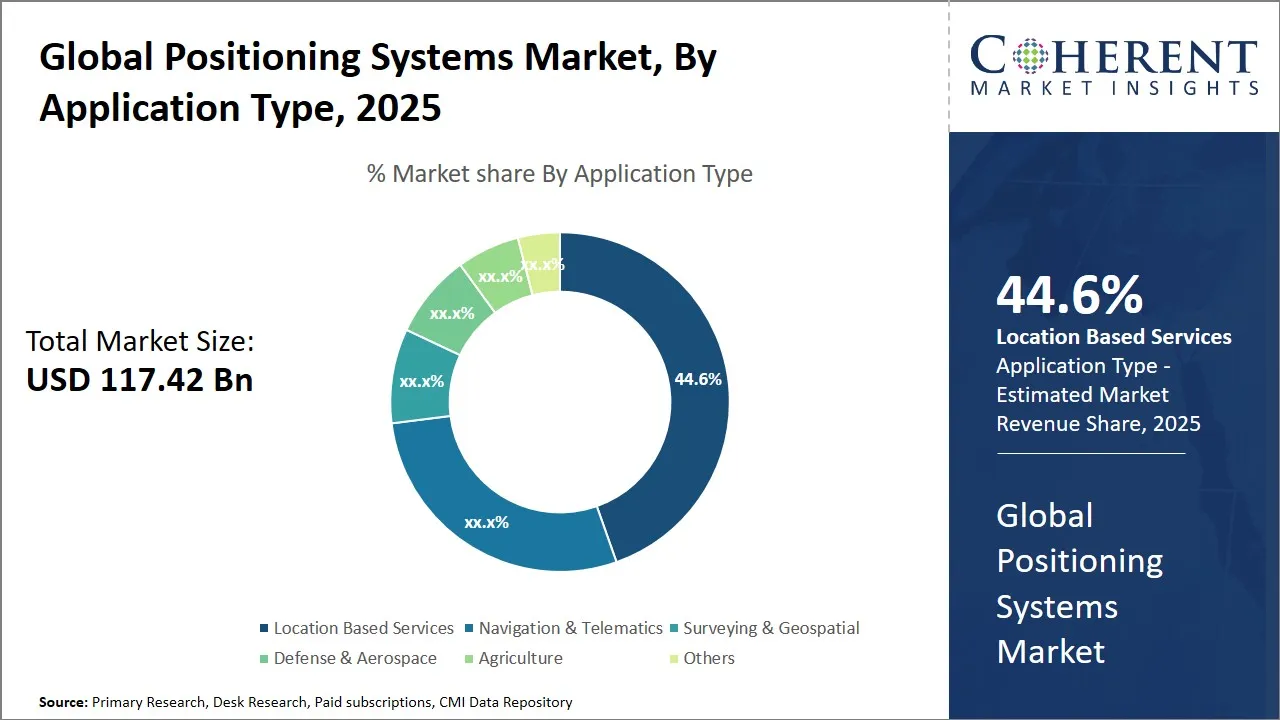
- The location based services segment leads the market holding an estimated share of 45.6 % in 2026.
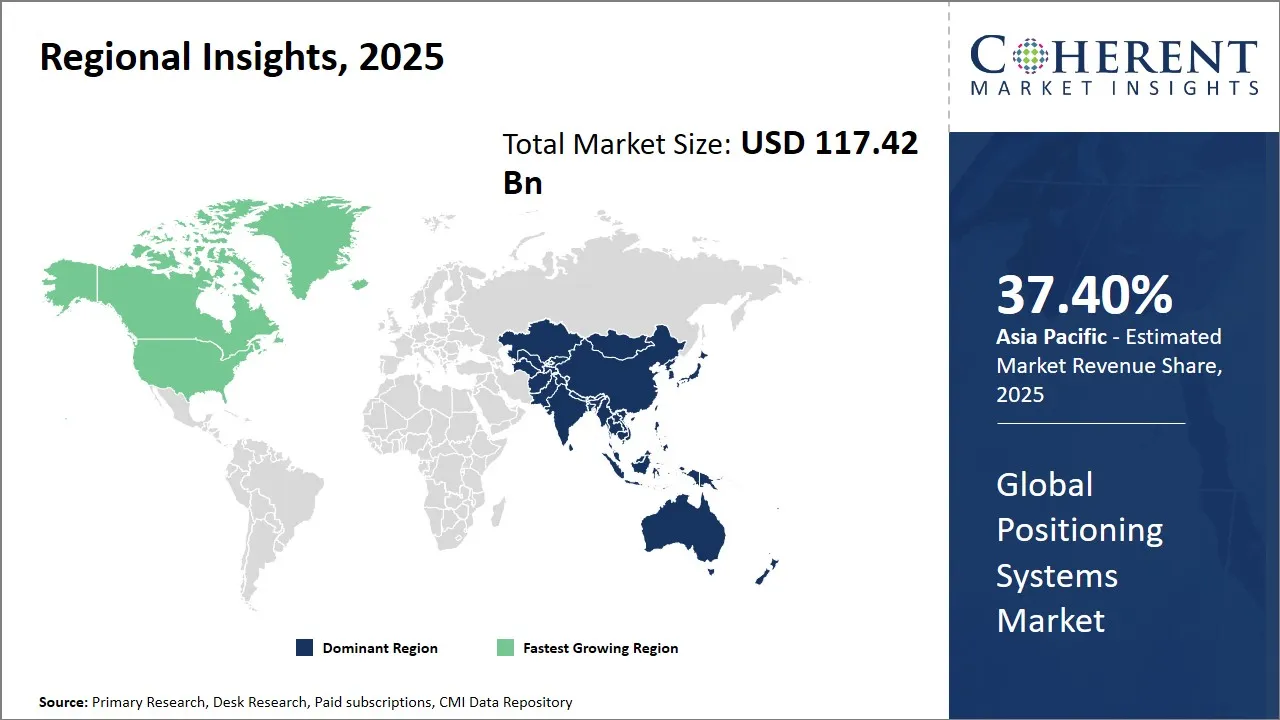
- Asia Pacific is estimated to lead the market with a share of 37.4 % in 2026.
- North America, holding a share of 30.5 % in 2026, is projected to be the fastest growing region.
Market Overview
The market trend is characterized by the rapid expansion of global positioning systems (GPS) applications in automotive, agriculture, and logistics industries, fueled by innovations such as real-time tracking and autonomous navigation. Additionally, the proliferation of IoT devices and smart city initiatives is boosting the deployment of positioning systems. Enhanced data analytics capabilities and the integration of GPS with other technologies like AI and 5G are further shaping the market, making GPS solutions more efficient, secure, and accessible across various end-use verticals.
Current Events and Its Impact
Current Events | Description and its impact |
Geopolitical and Trade Developments |
|
Economic and Infrastructure Trends |
|
Segmental Insights
- Current Industry Events of 2026
- Market Size Estimation
- Regional Breakdown
- Competitive Landscape
- Customer Intelligence
- Segmental Analysis
- Pricing Analysis
- Key Market Drivers, Challenges & Future Trends
- Customized Insights Section
Global Positioning Systems Market Insights, by Application Type – Rising Demand for Real-Time Navigation and Personalized Services Propelling Location Based Services Segment Growth
The location based services segment is expected to contribute the highest share of 45.6% in the market in 2026. The widespread adoption of smartphones and connected devices has significantly fueled the growth of this segment, as consumers and businesses alike leverage GPS technology for enhanced location accuracy and convenience. Mobile applications offering ride-hailing, food delivery, social networking, and travel assistance heavily rely on location based services to provide tailored user experiences, driving sustained demand. Governments and municipal bodies are embedding GPS-enabled services within infrastructure management, traffic control, and public safety systems to optimize resource allocation and ensure efficient mobility. Additionally, the integration of location based services with Internet of Things (IoT) ecosystems is expanding the scope of applications, such as asset tracking, fleet management, and personalized marketing, which further propels market growth.
Advancements in positioning accuracy and the availability of multi-constellation Global Navigation Satellite Systems (GNSS) enhance the reliability of location based services, encouraging broader adoption across both consumer and commercial domains. The evolution of 5G networks also contributes by enabling faster data transmission and lower latency, which are critical for real-time geospatial analytics and navigation solutions. Moreover, growing awareness regarding safety and security pushes demand for GPS-enabled tracking features, especially in logistics, personal safety apps, and emergency response services. The combination of increasing smartphone penetration, technological innovations, governmental support, and rising consumer expectations collectively establish location based services as a dominant application segment within the global positioning systems market.
Impact of AI on the Positioning Systems Market:
Artificial intelligence is reshaping the global positioning systems market through improving accuracy, reliability, and the value of location data. Machine-learning models now correct for multipath interference, urban-canyon signal loss, and atmospheric delays in real time, enabling sub-meter accuracy even in dense cities where traditional GNSS struggles. AI-driven sensor fusion also combines GPS with inertial measurement units (IMUs), camera vision, and LiDAR to provide continuous positioning when satellite signals are weak. These advancements are critical for applications, such as autonomous vehicles, precision agriculture, and smart-city infrastructure, where centimeter-level accuracy and uninterrupted coverage are essential.
A concrete example is Waymo’s autonomous vehicle fleet, which uses AI algorithms to blend GNSS data with LiDAR and onboard sensors for lane-level positioning in complex urban environments.
Regional Insights
Asia Pacific Positioning Systems Market Analysis and Trends
The Asia Pacific region, holding a share of 37.4% in 2026, is expected to dominate the global positioning systems market due to rapid urbanization, increasing smartphone penetration, and expanding automotive and transportation sectors. Countries including China, India, Japan, and South Korea are investing heavily in infrastructure modernization and smart city projects that rely extensively on GPS technologies for traffic management, fleet tracking, and location-based services.
Government initiatives encouraging domestic GPS capabilities, alongside the development of complementary satellite navigation systems like China’s BeiDou, contribute to the accelerated adoption of GPS-driven products. Important industry players such as Huawei, Samsung, and Sony are innovating in GPS chipsets and integrated solutions, while companies like NavInfo and Beijing UniStrong Science & Technology are enhancing mapping and navigation services specifically for the local markets. Trade openness and collaborations with Western technology firms facilitate technology transfer, further boosting market expansion.
North America Positioning Systems Market Analysis and Trends
North America, holding a share of 30.5% in 2026, exhibits the fastest growth in the global positioning systems market, driven by a well-established technological ecosystem and robust government support for navigation and positioning technologies. The presence of advanced research institutions, substantial defense spending, and wide adoption of GPS in sectors such as automotive, aerospace, and telecommunications fuel this market leadership.
The U.S. Department of Defense’s continuous investment in upgrading GPS infrastructure ensures superior system accuracy and reliability which benefits both military and commercial applications. Leading companies like Garmin Ltd., Trimble Inc., and Lockheed Martin play pivotal roles by developing innovative GPS hardware, software, and integration solutions. The region’s strong regulatory frameworks and early adoption of GPS-enabled products foster a mature market environment with diverse applications ranging from personal navigation devices to geospatial analytics.
Global Positioning Systems Market Outlook for Key Countries
U.S. Positioning Systems Market Analysis and Trends
The U.S. positioning systems market is characterized by exceptional technological advancements and strong federal backing. The U.S. government’s role in maintaining and upgrading the GPS constellation ensures superior service quality and broad availability for civilian and defense users. Industry giants such as Garmin, Trimble, and Honeywell are headquartered in the U.S., enabling strong innovation pipelines and extensive product portfolios across civilian navigation, aviation, and precision agriculture. The country’s well-developed automotive and logistics sectors also spur demand for GPS-based fleet management and telematics solutions, driving continuous market evolution.
China Positioning Systems Market Analysis and Trends
China positioning systems market is rapidly evolving with significant government emphasis on enhancing satellite navigation capabilities and complementing GPS with domestic systems like BeiDou. This dual approach promotes reliability and coverage while encouraging innovation in downstream applications. Local technology firms such as Huawei and NavInfo lead the development of GPS chipsets, software applications, and smart transportation solutions tailored to vast urban and rural geographies. Government cloud and big data initiatives further boost the adoption of GPS services in sectors like public safety, agriculture, and autonomous vehicles, positioning China as a critical growth engine for the global market.
Japan Positioning Systems Market Analysis and Trends
Japan continues to lead in integrating GPS technologies within the automotive, maritime, and precision agriculture sectors. Strong industrial capabilities combined with government-backed R&D encourage the creation of highly accurate and reliable GPS-based systems. Key companies including Sony and ZENRIN Co operate at the forefront of GPS mapping, navigation software, and sensor integration. Japan’s focus on disaster management and urban planning incorporates GPS infrastructure to improve resilience and efficiency. Collaboration between public and private sectors ensures the growth of niche applications such as robotic navigation and location-based services.
India Positioning Systems Market Analysis and Trends
India positioning systems market is expanding rapidly, supported by infrastructural development, rising smartphone usage, and the government’s push for smart cities and digital initiatives. The Indian Space Research Organisation (ISRO) also contributes to positioning system developments with its regional satellite navigation system IRNSS (NavIC), complementing global GPS services. Companies like Tata Elxsi and Tech Mahindra are involved in the development of GPS-enabled IoT and telematics solutions, particularly for transportation and logistics industries critical to India’s economic growth. Regulatory reforms favoring the adoption of GPS in agriculture, urban development, and e-commerce logistics provide significant momentum to market penetration.
Germany Positioning Systems Market Analysis and Trends
Germany positioning systems market benefits from its position as a European technological hub with strong automotive and manufacturing industries relying heavily on GPS for navigation, tracking, and automation. The country supports innovation through government-backed research programs aimed at improving satellite navigation and mobility solutions. Prominent companies such as Bosch and Continental drive advancements in GPS-based automotive safety systems and real-time location services. Germany’s integration with the broader European Galileo satellite system enhances precision and service reliability, fostering growth in sectors including logistics, aerospace, and public safety. Trade and technological partnerships across Europe enable German firms to lead in high-precision GPS technology development.
Market Players, Key Development, and Competitive Intelligence
Top Strategies Followed by Global Positioning Systems Market Players
- Established players in the GPS arena invest heavily in research and development (R&D) to push the boundaries of innovation, creating high-performance, reliable, and multifunctional products that cater to diverse applications ranging from automotive navigation to defense.
- Qualcomm consistently invests in advanced GNSS and sensor-fusion capabilities within its Snapdragon Automotive platforms.
- Mid-level players in the positioning systems market adopt a different strategic approach, focusing primarily on delivering cost-effective yet quality-driven solutions.
- Quectel Wireless Solutions introduced its budget-friendly LC79D dual-band GNSS module aimed at large-volume IoT deployments (asset tracking, micromobility) where low cost is crucial, enabling widespread adoption in price-sensitive emerging markets.
- Small-scale positioning systems market players differentiate themselves through a niche strategy, emphasizing specialization and innovation to carve out distinct market segments.
- Septentrio built its reputation on high-accuracy, interference-resilient GNSS receivers for surveying, UAV mapping, and scientific research, carving out a loyal customer base in professional and scientific applications despite intense competition from larger chip and module makers.
Key Developments
- In August 2025, u-blox Holding AG, a global provider of leading positioning and short-range communication technologies and services, entered into a binding transaction agreement with ZI Zenith. Under this agreement, ZI Zenith will launch a public tender offer to acquire all publicly held registered shares of u-blox.
- In March 2025, Hexagon announced the closing of the acquisition of Septentrio NV, a manufacturer of GPS/GNSS positioning technology for autonomy and mission-critical applications. The acquisition of Septentrio will strengthen Hexagon’s position as the leader in the resilient, assured positioning solutions market and provide customers greater accessibility to high-accuracy and high-performance positioning technology with the Size, Weight and Power (SWaP) optimized platform.
- In February 2025, Trimble and Platform Science announced the completion of Platform Science's acquisition of Trimble's global transportation telematics business units. The deal was first announced in September 2024 during the Trimble Insight Tech Conference in Las Vegas, U.S.
- In September 2024, u-blox, a global provider of leading positioning and wireless communication technologies and services, announced a strategic partnership with Topcon Positioning Systems, a global leader in precision measurement and workflow solutions. This collaboration is set to create one of the world’s largest high-precision GNSS positioning service offers for the mass market, giving customers across the globe a blend of performance, pricing, and delivery options.
Market Report Scope
Positioning Systems Market Report Coverage
| Report Coverage | Details | ||
|---|---|---|---|
| Base Year: | 2025 | Market Size in 2026: | USD 136.79 Bn |
| Historical Data for: | 2020 To 2024 | Forecast Period: | 2026 To 2033 |
| Forecast Period 2026 to 2033 CAGR: | 16.5% | 2033 Value Projection: | USD 398.43 Bn |
| Geographies covered: |
| ||
| Segments covered: |
| ||
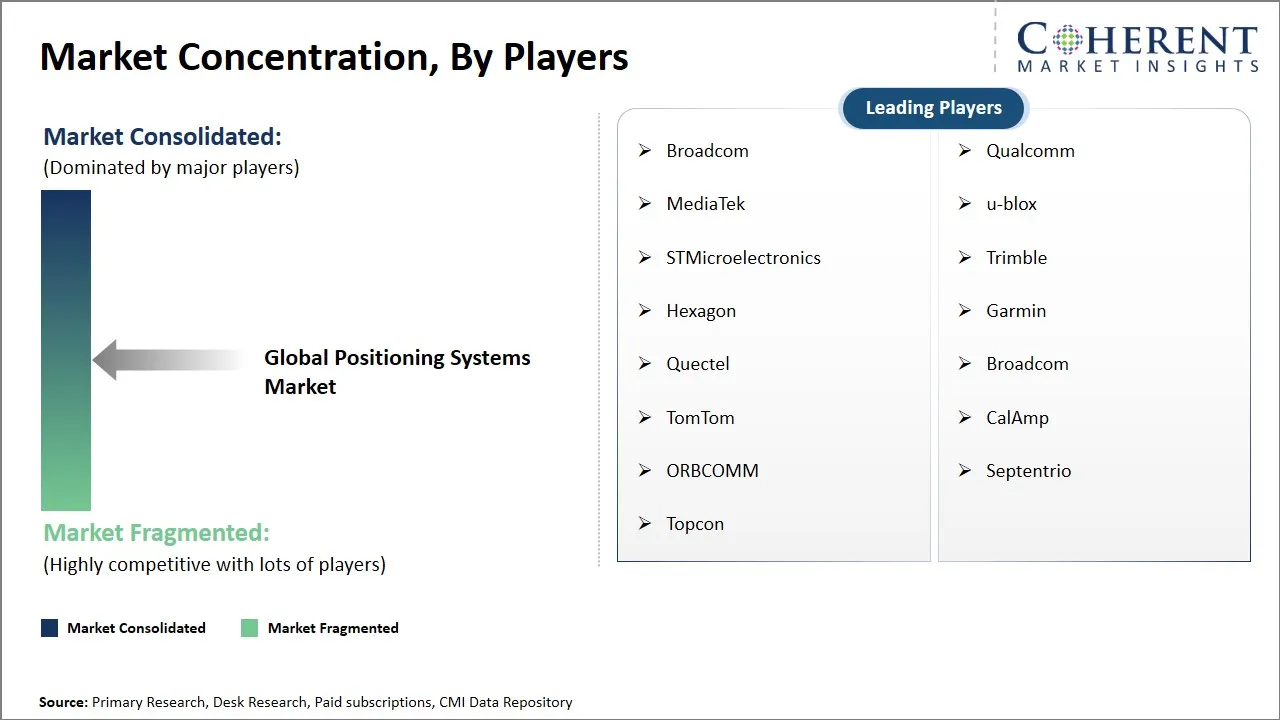
| Companies covered: | Broadcom, Qualcomm, MediaTek, u-blox, STMicroelectronics, Trimble, Hexagon, Garmin, Quectel, Broadcom, TomTom, CalAmp, ORBCOMM, Septentrio, and Topcon | ||
| Growth Drivers: |
| ||
| Restraints & Challenges: |
| ||
Market Dynamics
Global Positioning Systems Market Driver - Proliferation of Connected Vehicles & Advanced Driver Assistance
As automakers increasingly integrate advanced driver assistance systems (ADAS) such as lane-keeping assistance, adaptive cruise control, and collision avoidance technologies, the reliance on accurate and real-time positioning data becomes critical. Connected vehicles utilize GPS not only for navigation but also to enable vehicle-to-everything (V2X) communication, which enhances traffic management, safety, and overall driving experience. These vehicles continuously exchange information with surrounding infrastructure and other vehicles, leveraging GPS data to anticipate road conditions and optimize routes dynamically.
Tesla’s Full Self-Driving (FSD) and Autopilot systems integrate multi-frequency GPS/GNSS with onboard sensors to deliver lane-level positioning for navigation and autonomous driving. Moreover, the evolution of autonomous driving technologies further escalates the need for precise location tracking to ensure safety and efficiency.
Global Positioning Systems Market Opportunity – Growth of High-Precision Positioning (RTK/PPP) in Autonomy, Precision Agriculture, Construction, and Surveying
The increasing demand for high-precision positioning technologies, such as Real-Time Kinematic (RTK) and Precise Point Positioning (PPP), presents a significant growth opportunity in the global positioning systems market. RTK and PPP deliver centimeter-level accuracy, which is critical for applications requiring exact spatial data and enhanced reliability. One of the major drivers of this trend is the rapid advancement in autonomous systems, including self-driving vehicles and drones, which rely heavily on accurate and real-time geolocation data to navigate complex environments safely and efficiently.
Precision agriculture is another key sector benefiting from high-precision positioning, enabling farmers to optimize crop management, reduce input costs, and increase yields by leveraging detailed location data for planting, fertilizing, and harvesting activities. John Deere’s StarFire RTK network provides centimeter-level accuracy for precision agriculture, enabling automated steering and variable-rate planting.
In construction and surveying, RTK and PPP technologies facilitate precise site measurements, real-time machine control, and efficient project execution, thereby reducing errors and operational costs. Additionally, the integration of these high-accuracy positioning solutions with emerging technologies like the Internet of Things (IoT) and 5G connectivity is expanding their applicability and driving adoption rates across industries.
Analyst Opinion (Expert Opinion)
- Connected and autonomous vehicles remain the strongest growth engine for GPS demand. Automakers increasingly embed multi-constellation, multi-frequency GNSS to power advanced driver-assistance systems (ADAS), real-time navigation, and over-the-air telematics. Fleet operators and mobility platforms (ride-hailing, logistics) amplify this pull by requiring high-accuracy, always-on positioning.
- Precision agriculture, construction, and surveying are rapidly expanding their use of real-time kinematic (RTK) and PPP correction services. Heavy equipment guidance, automated planting, and smart-city infrastructure monitoring depend on centimeter-level accuracy, driving demand for premium GNSS receivers and subscription-based correction networks.
- Smartphones, wearables, drones, and a proliferating array of IoT trackers sustain a vast volume market. As consumers expect seamless indoor/outdoor location services and developers build location-based apps—from fitness tracking to augmented reality—device makers and module suppliers benefit from steady, high-volume orders for cost-efficient, low-power GNSS solutions.
Speak to the analyst
Want personalized insights?
Take the findings above to one of our principal consultants, or have the report rebuilt around the segments, geographies and competitors you actually track.
Market Segmentation
- Application Type Insights (Revenue, USD Bn, 2021 - 2033)
- Location Based Services
- Navigation & Telematics
- Surveying & Geospatial
- Defense & Aerospace
- Agriculture
- Others
- Regional Insights (Revenue, USD Bn, 2021 - 2033)
- North America
- U.S.
- Canada
- Latin America
- Brazil
- Argentina
- Mexico
- Rest of Latin America
- Europe
- Germany
- U.K.
- Spain
- France
- Italy
- Russia
- Rest of Europe
- Asia Pacific
- China
- India
- Japan
- Australia
- South Korea
- ASEAN
- Rest of Asia Pacific
- Middle East
- GCC Countries
- Israel
- Rest of Middle East
- Africa
- South Africa
- North Africa
- Central Africa
- North America
- Key Players Insights
- Broadcom
- Qualcomm
- MediaTek
- u-blox
- STMicroelectronics
- Trimble
- Hexagon
- Garmin
- Quectel
- Broadcom
- TomTom
- CalAmp
- ORBCOMM
- Septentrio
- Topcon
Sources
Primary Research Interviews
Stakeholders
- Automotive OEMs and Fleet Operators (e.g., Tesla, GM, Waymo, Volvo)
- GNSS Chip and Module Manufacturers (e.g., Qualcomm, Broadcom, u-blox, MediaTek)
- Surveying, Construction, and Precision Agriculture Companies (e.g., Trimble, Topcon, John Deere)
- Logistics and Asset Tracking Companies (e.g., CalAmp, ORBCOMM)
- Software & Location-Based Service Providers (e.g., Google Maps, TomTom, HERE Technologies)
- Smart City and Urban Infrastructure Consultants
- AI and Sensor-Fusion Technology Experts
Databases
- International GNSS Service (IGS) Database
- United Nations Economic Commission for Europe (UNECE) GNSS Data Repository
- Global Navigation Satellite System Data Portal (GNSS-Data.org)
- OECD Transport and Infrastructure Statistics
Magazines
- GPS World
- Inside GNSS
- Navigation Today
- Autonomous Vehicle Technology Magazine
Journals
- Journal of Navigation (Cambridge University Press)
- GPS Solutions Journal
- IEEE Transactions on Intelligent Transportation Systems
- Journal of Field Robotics
Newspapers
- The Wall Street Journal – Technology & Automotive Section
- The New York Times – Innovation and Tech Column
- Financial Times – Mobility & Infrastructure
- The Economic Times (India) – Technology and Automotive Section
Associations
- International Association of Geodesy (IAG)
- European GNSS Agency (GSA)
- Institute of Navigation (ION)
- GNSS Society of India
Public Domain Sources
- U.S. Department of Transportation (DOT) Reports
- EUROSTAT – Transport and Mobility Data
- World Bank – Smart Cities and Technology Infrastructure Reports
- ResearchGate – Academic Papers on GNSS Applications
Proprietary Elements
- CMI Data Analytics Tool, Proprietary CMI Existing Repository of information for last 8 years
Get access to 250+ pages report
Every segment, forecast, competitor profile and data table behind the analysis above — available for instant download.
- ESOMAR Member
- ISO 9001:2015 Certified
- D-U-N-S Registered
- GDPR & CCPA Compliant
Missing comfort of reading report in your local language? Find your preferred language:
Transform your Strategy with Exclusive Trending Reports
Frequently Asked Questions
The global positioning systems market is estimated to be valued at USD 136.79 billion in 2026 and is expected to reach USD 398.43 billion by 2033.
The CAGR of global positioning systems market is projected to be 16.5% from 2026 to 2033.
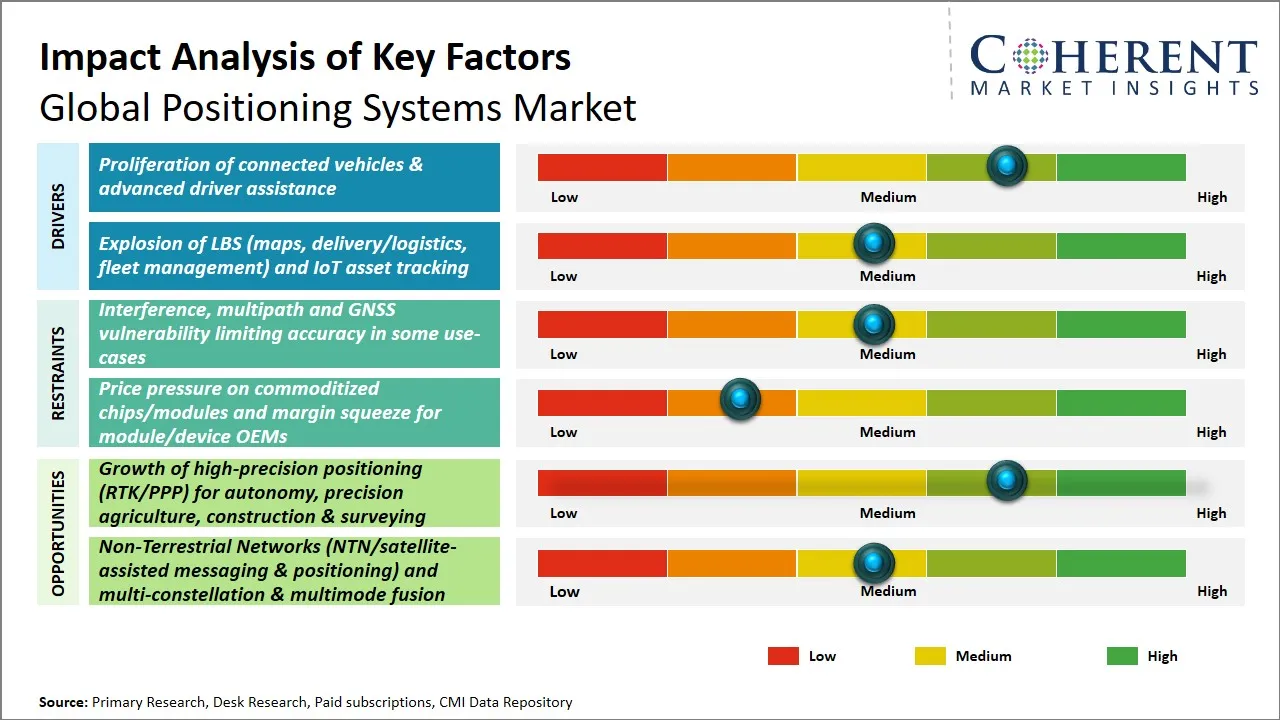
Proliferation of connected vehicles & advanced driver assistance and explosion of LBS (maps, delivery/logistics, fleet management) and IoT asset tracking are the major factors driving the growth of the global positioning systems market.
Interference, multipath and GNSS vulnerability limiting accuracy in some use-cases and price pressure on commoditized chips/modules and margin squeeze for module/device OEMs are the major factors hampering the growth of the global positioning systems market.
In terms of application type, location based services are estimated to dominate the market revenue share in 2026.
The global positioning systems market encompasses hardware (chips, modules, receivers), software (mapping, LBS), and services that provide satellite-based positioning, navigation, and timing solutions.
AI improves positioning accuracy, sensor-fusion capabilities, and real-time error correction, enabling autonomous vehicles, drones, and high-precision surveying.