

High Pressure Grinding Roller (HPGR) Market Analysis & Forecast - (2026-2033)
The Global High Pressure Grinding Roller (HPGR) Market was valued at USD 3,326.4 Mn in 2026 and is expected to reach USD 5,034.9 Mn by 2033, growing at a CAGR of 6.1% between 2026 and 2033.
Key Takeaways
- Based on Component, Stud/Pins (Studded Tire) segment is projected to dominate the global market with the largest share in 2026, due to its pivotal role in grinding efficiency and wear resistance.
- Based on Material Processed, the Ferrous Metals and Ferroalloys Processing segment is projected to acquire the 59.20% share of the market in 2026, due to its widespread use in iron and steel production.
- Based on Capacity, the Above 1000 tph segment is expected to hold the largest share of the market in 2026, driven by demand from large-scale mining operations.
- Based on Power Rating, the 2 × 1,900 kW – 2 × 3,700 kW segment is expected to hold the dominant position, driven by its efficiency in large-scale mineral processing.
- Based on Application, the Base Metal Liberation segment is projected to account for the highest share of the market in 2026, owing to high demand for efficient processing of copper, zinc, and nickel ores.
- Based on End-user, the Mining and Metallurgy segment is expected to hold the biggest share of the market in 2026, fueled by rising demand for efficient mineral processing technologies.
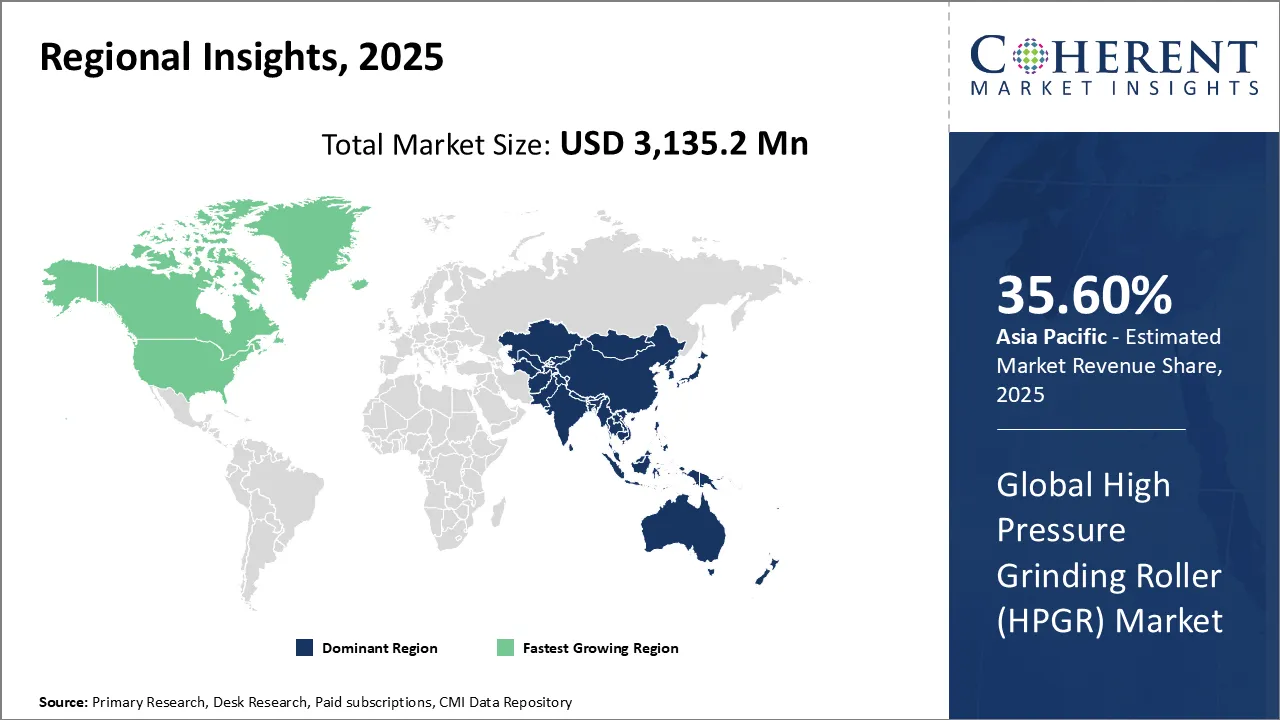
- Based on region, Asia Pacific is estimated to lead the market with a share of 35.6% in 2026. While, North America is anticipated to be the fastest growing region during the forecast period, holding 21.7% share in 2025.
Market Overview
High pressure grinding rolls (HPGR) are used for the size reduction of ores and rocks. They compress the feed material between two rotating rollers, in which one of them is in fixed position and another is in a floating. HPGR has found applications typically in diamond extraction. HPGR provides flexible crushing solutions as it is suitable for both new installations and upgrades in the mining and construction industry. Moreover, it is a highly energy-efficient technology for commination and involves short-term exposure of raw materials such as iron ore to very high pressure. This pressed material can be directly fed to a ball mill of a particular size, thereby making it possible to reduce the specific power consumption of the entire mill system and increase the throughput of the ball mill. As a result, the high pressure grinding roller (HPGR) market demand is being driven by the need for energy-efficient, high-throughput solutions across the mineral processing sector. HPGRs are expected to replace semi-autogenous (SAG) mills and ball mills in due course of time.
Current Events and their Impact on the High Pressure Grinding Roller (HPGR) Market
Current Events | Description and Its Impact |
Geopolitical Shifts in Critical Mineral Trade |
|
Technological Advancements in HPGR Systems |
|
Pricing Analysis of High Pressure Grinding Roller
Typical Price Ranges
- Smaller HPGR units (under 200 tons per hour) generally cost between $500,000 and $1.5 million.
- Medium-sized HPGRs, processing between 200 and 1,000 tons per hour, typically range from $1.5 million to $4 million.
- Large-scale HPGRs with capacity over 1,000 tons per hour can cost from $4 million up to $10 million or more.
- Current Industry Events of 2026
- Market Size Estimation
- Regional Breakdown
- Competitive Landscape
- Customer Intelligence
- Segmental Analysis
- Pricing Analysis
- Key Market Drivers, Challenges & Future Trends
- Customized Insights Section
Segmental Insights
High Pressure Grinding Roller (HPGR) Market Insights, By Component: Stud/Pins (Studded Tire) Leads Due To Its Pivotal Role in Grinding Efficiency and Wear Resistance
In terms of component, the Stud/Pins (Studded Tire) segment is expected to lead the market with the largest share in 2026, due to its critical role in ore processing and grinding efficiency. These components form the primary contact surface in HPGR systems, directly influencing throughput, wear resistance, and energy consumption. Advancements in stud design, such as tungsten carbide inserts and optimized layouts, have significantly improved durability and performance, reducing maintenance costs and downtime. Their widespread use in base and precious metal mining operations, especially in high-capacity installations, reinforces their market leadership. As demand for efficient mineral processing grows, studded tires remain the cornerstone of HPGR technology.
For instance, Zhili New Materials launched customizable HPGR grinding rollers with studded tires, designed for enhanced wear resistance and efficiency in cement, metallurgy, and mining industries. Featuring tungsten carbide studs and variable hardness profiles, the rollers offer longer service life, reduced operational costs, and improved grinding performance across diverse material applications.
-market-by-material-processed.webp "High Pressure Grinding Roller (HPGR) Market, By Material Processed")
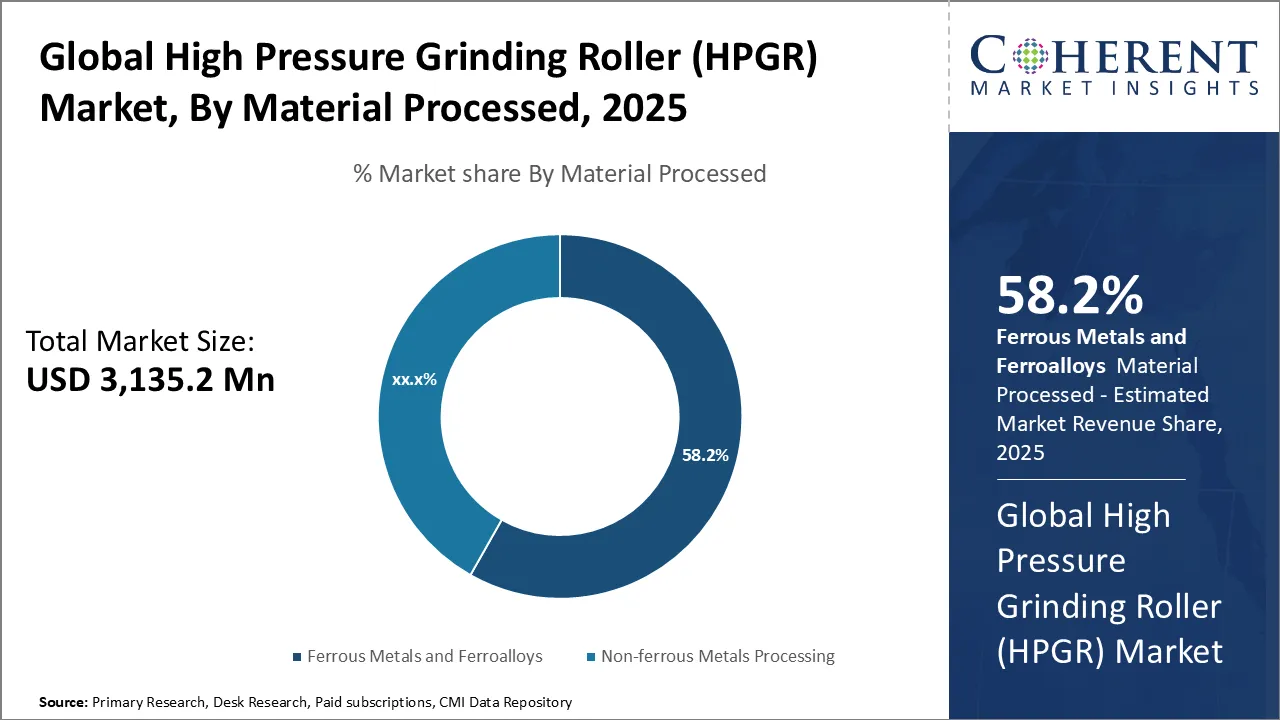
High Pressure Grinding Roller (HPGR) Market Insights, By Material Processed: Ferrous Metals and Ferroalloys Processing Dominates Due To Its Widespread Use in Iron and Steel Production
In terms of material processed, the ferrous metals and ferroalloys processing segment is expected to contribute 59.20% share in 2026. This leadership is driven by the extensive use of HPGR technology in iron ore and steel production, where high-pressure grinding enhances efficiency, reduces energy consumption, and improves particle liberation. As global demand for steel and related alloys continues to rise, especially in infrastructure and automotive sectors HPGR systems are increasingly adopted to optimize processing of ferrous materials. Their durability and cost-effectiveness in handling hard ores make them the preferred choice for large-scale mining operations worldwide.
High Pressure Grinding Roller (HPGR) Market Insights, By Capacity: Above 1000 tph Capacity Dominance Is Driven by Demand from Large-Scale Mining Operations
In terms of capacity, the above 1000 tph segment is projected to hold the highest share of the market in 2026, due to its suitability for large-scale mining operations that require high throughput and energy-efficient processing. HPGR systems with capacities above 1000 tons per hour are widely adopted in base metal and iron ore applications, where bulk material handling is critical. Their ability to reduce energy consumption, improve mineral liberation, and lower operational costs makes them the preferred choice for major mining projects. As global demand for raw materials grows, especially in Asia-Pacific and Latin America, high-capacity HPGRs continue to drive market expansion.
For instance, Metso’s HRC™e HPGR is engineered for hard rock mining and offers high throughput capacity, energy efficiency, and reduced operating costs. The HRC™e series includes models capable of processing well above 1,000 tph, especially in iron ore and gold operations. Its patented arch-frame design and intelligent flange system help maximize uptime and material intake
High Pressure Grinding Roller (HPGR) Market Insights, By Power Rating: 2 × 1,900 kW – 2 × 3,700 kW Dominance Is Driven by Its Efficiency in Large-Scale Mineral Processing
In terms of power rating, the 2 × 1,900 kW – 2 × 3,700 kW segment is expected to contribute the highest shares in the market in 2026, due to its suitability for large-scale mining operations, especially in processing low-grade ores where high throughput and energy efficiency are critical. HPGR systems within this power range offer optimal performance for base metal liberation and pellet feed preparation, making them the preferred choice in high-capacity mineral processing plants. Their ability to handle tough materials while reducing operational costs and energy consumption has driven widespread adoption across key mining regions.
High Pressure Grinding Roller (HPGR) Market Insights, By Product Type: Base Metal Liberation Dominates the overall Market Owing to High Demand for Efficient Processing of Copper, Zinc, And Nickel Ores
In terms of product type, the base metal liberation segment is expected to contribute the largest share of the market in 2026. This leadership is driven by the increasing demand for efficient processing of base metals like copper, zinc, and nickel, which are essential for infrastructure, electronics, and renewable energy technologies. HPGR systems enhance mineral recovery and reduce energy consumption, making them ideal for large-scale base metal operations.
High Pressure Grinding Roller (HPGR) Market Insights, By End User: Mining and Metallurgy Leadership is Fueled by Rising Demand for Efficient Mineral Processing Technologies
In terms of end user, the Mining and Metallurgy segment is projected t capture the greatest share of the market in 2026, driven by the growing demand for efficient mineral processing technologies. HPGR systems are widely adopted in mining operations for their ability to reduce energy consumption, improve ore recovery, and lower operational costs. These benefits are particularly valuable in the extraction of base and precious metals, where precision and throughput are critical. As global infrastructure and industrial development continue to expand, especially in regions like Asia-Pacific and Latin America, the need for advanced grinding solutions in mining and metallurgy reinforces this segment’s market leadership.
For instance, in September 2024, Pilot Crushtec International introduced the Metso HRC™ 8 high-pressure grinding roll crusher to southern Africa. Designed for manufactured sand production and pre-grinding in mining, the HRC™ 8 offers energy efficiency, reduced wear costs, and the ability to convert quarry waste into high-value products.
Regional Insights
Asia Pacific High Pressure Grinding Roller (HPGR) Market Analysis & Trends
APAC dominates the overall market with a share of 35.6%. This largely driven by countries like China, India, and Australia, which are investing heavily in mining and metallurgy. These nations have vast reserves of base and precious metals, and HPGR systems are increasingly favored for their ability to enhance ore recovery, reduce energy consumption, and lower operational costs. The region’s rapid industrialization and urbanization have also fueled demand for raw materials, prompting mining companies to adopt advanced grinding technologies to meet production targets efficiently.
For instance, in November 2024, FLSmidth is expected to deliver two of the world’s largest High Pressure Grinding Rollers (HPGRs) to a new iron ore concentrator in India. The advanced grinding technology aims to boost energy efficiency and throughput, supporting India’s growing demand for sustainable mineral processing in large-scale mining operations.
North America High Pressure Grinding Roller (HPGR) Market Analysis & Trends
North America is anticipated to be the fastest growing region during the forecast period, with 21.7% share in 2026. North America, particularly the United States and Canada, is witnessing a surge in demand for HPGR systems as mining companies seek to optimize operations and reduce energy consumption. HPGR technology is favored for its ability to enhance mineral recovery, lower operational costs, and meet sustainability goals. The region’s rich deposits of base and precious metals, such as copper, gold, and iron are driving investments in advanced grinding solutions that offer higher throughput and improved ore liberation.
High Pressure Grinding Roller (HPGR) Market Outlook Country-wise
The U.S. High Pressure Grinding Roller (HPGR) Market Trends
The United States leads HPGR market demand with a 15.2% share due to its extensive mining and cement industries. With a strong focus on energy efficiency and sustainability, American mining companies are increasingly adopting HPGR systems to reduce operational costs and improve mineral recovery. The technology’s ability to handle large-scale base and precious metal processing aligns well with the country’s industrial goals. Additionally, regulatory pressure to minimize environmental impact has accelerated the shift from traditional grinding methods to HPGR solutions.
Germany High Pressure Grinding Roller (HPGR) Market Trends
Germany’s HPGR market demands with 2.9% share is driven by its advanced engineering sector and precision-focused metallurgy applications. The country’s emphasis on high-performance industrial equipment makes HPGR systems a natural fit for pellet feed preparation and magnetite processing. German manufacturers also contribute to innovation in grinding technologies, supporting domestic and international adoption. The relatively smaller market share reflects Germany’s niche but high-value use of HPGR in specialized mineral processing operations.
China High Pressure Grinding Roller (HPGR) Market Trends
China is a major player in the HPGR market, commanding 12.2% share, fueled by its vast mining operations and aggressive infrastructure development. The country’s demand for base metals like copper and iron has led to widespread adoption of HPGR systems, which offer higher throughput and energy savings. Chinese manufacturers are also expanding their HPGR offerings, making the technology more accessible domestically. As China continues to modernize its industrial base, HPGR systems are becoming integral to efficient and sustainable mineral processing
Brazil High Pressure Grinding Roller (HPGR) Market Trends
Brazil’s HPGR market is growing rapidly with 6.4% share due to its rich iron ore reserves and strong presence in pellet feed preparation. Mining companies in Brazil are investing in HPGR technology to improve ore liberation and reduce energy consumption, especially in large-scale operations. The country’s focus on exporting high-quality iron ore and other minerals has made HPGR systems essential for maintaining competitive production standards. Additionally, diamond and magnetite processing are emerging applications contributing to market growth.
GCC Countries High Pressure Grinding Roller (HPGR) Market Trends
The Gulf Cooperation Council (GCC) countries are seeing rising HPGR demand with 5.5% share due to expanding cement production and mineral processing projects. Nations like Saudi Arabia, UAE, and Qatar are investing heavily in infrastructure, which drives the need for efficient raw material grinding. HPGR systems are favored for their energy efficiency and ability to meet environmental standards, aligning with the region’s sustainability goals. As the GCC diversifies its industrial base beyond oil, HPGR technology plays a key role in supporting new sectors.
Market Report Scope
High Pressure Grinding Roller Market Report Coverage
| Report Coverage | Details | ||
|---|---|---|---|
| Base Year: | 2025 | Market Size in 2026: | USD 3,326.4 Mn |
| Historical Data for: | 2020 To 2024 | Forecast Period: | 2026 To 2033 |
| Forecast Period 2026 to 2033 CAGR: | 6.1% | 2033 Value Projection: | USD 5,034.9 Mn |
| Geographies covered: |
| ||
| Segments covered: |
| ||
| Companies covered: | Metso, The Weir Group PLC, TAKRAF GmbH, CITIC Heavy Industries Co., Ltd., FLSmidth, Zhuzhou Hongtong Tungsten, Maxton Industrial Co., Ltd., Koppern Group, Leejun Holding (Singapore) Pte. Ltd., Sinosteel New Materials Co., Ltd., and AGICO CEMENT | ||
| Growth Drivers: |
| ||
| Restraints & Challenges: |
| ||
High Pressure Grinding Roller (HPGR) Market Driver
Increasing demand for high-efficiency and low emission comminution solutions
High‑efficiency and low‑emission comminution solutions, especially high-pressure grinding rollers (HPGRs) are gaining traction in mining and cement industries as effective alternatives to energy‑intensive ball mills. HPGRs compress feed material between counter‑rotating rollers, offering substantial energy savings of up to 40% compared to traditional milling. In 2024, companies like Weir Group implemented HPGRs in a Swiss iron‑ore pellet plant, cutting energy usage by over 40% and boosting throughput. Moreover, new roller designs featuring tungsten‑carbide coatings, smart sensors, and real‑time pressure controls are enhancing wear resistance, process optimization, and emissions control in 2025 deployments. Declining ore grades add to the urgency, as HPGRs deliver finer product sizes with mechanical activation, supporting improved downstream recovery in hard‑rock and base metal processing. These factors are driving broader adoption of HPGR technology worldwide.
Declining ore grades are expected to propel the global high pressure grinding roller market growth
Declining ore grades are a critical catalyst for the growing adoption of high-pressure grinding rollers (HPGRs) in mineral processing. As mines increasingly contend with lower-grade, harder-to-process ores, HPGR technology offers significant advantages over conventional mills. By creating intense compression and micro-cracks within ore particles, HPGRs enable more efficient liberation of minerals, enhancing recovery rates while consuming notably less energy and water. For example, studies have shown HPGR circuits can reduce power consumption by up to 25%, especially when processing low-grade or refractory ores. Moreover, HPGRs deliver a finer product with improved permeability, making downstream processes like leaching or flotation more effective and cost-efficient. As global operators strive for sustainable, low-emission practices in response to declining ore quality, investments in HPGR installations, such as recent large-scale units in Australia and China underscore their pivotal role in optimizing modern comminution.
High Pressure Grinding Roller (HPGR) Market Opportunity
Rising use of HPGR in hard rock mining can present lucrative growth opportunities
HPGR is becoming increasingly popular for hard rock treatment due to rising energy and steel media costs. Furthermore, the advent of wear abetment technology and significant design enhancements has led to successful implementations and pilot demonstrations HPGR on extremely tough ores. HPGR pilot plant demonstrations at the Newmont Lone Tree gold mine in Nevada, the U.S. the Boddington Gold Project in Western Australia, and the use of HPGR technology by the mining company Anglo American Platinum PPL at its Mogalakwena platinum mine are some such instances. These developments signal strong momentum for the high pressure grinding roller (HPGR) market forecast, as miners globally seek more energy-efficient and cost-effective alternatives to traditional milling processes for ore comminution.
Base metal liberation segment can provide major business opportunities
HPGRs are majorly operational in diamond mines and iron ores. However, it is used in combination with ball mills or as a standalone device, it can offer numerous advantages such as fineness, quality of the ultimate product, and improved throughput. Hence, the HPGR comminution solution is expected to witness significant growth in base metal liberation. It can help in mining metals such as copper, nickel, lead, and nickel.
Recent Developments
- In June 2025, Zhangjiagang Deling Machinery (China) introduced its Industrial Dual‑Axis Shredder Crusher with Double‑Roller Sand Machine, designed for large-scale crushing of stone, coal, pebbles, glass, and plastic into powder. The robust machine features high‑strength alloy cutters mounted on dual shafts powered by electric motors (2–90 kW), delivering capacities between 20 and 1,500 kg/h. Built with 304‑grade stainless steel, Siemens/ABB/Omron/FUJI controls, and automatic overload protection, the durable system supports both land and sea transport.
- In May 2025, EvoQuip, a global specialist in compact crushing and screening equipment, introduced its first trommel—the Osprey 616—targeted at small to medium-sized operations with constrained space. The unit efficiently processes materials like compost, biomass, soil, gravel, and general waste, offering strong throughput and reliability.
- In November 2024, Danish engineering giant FLSmidth has been awarded a contract to supply and install two of the world’s largest High-Pressure Grinding Roller (HPGR) units measuring 3 m in diameter and 2 m in width—for a new iron-ore concentrator in India. The agreement includes full project support, covering start-up assistance, commissioning, and service maintenance by 2026.
Analyst Opinion (Expert Opinion)
The HPGR market in 2025 is no longer a niche segment, it is a core enabler of operational transformation across the mining and cement industries. In our assessment, HPGR adoption is being driven not merely by efficiency gains, but by structural imperatives: declining ore grades, stringent energy mandates, and the growing economic viability of dry comminution processes.
The tipping point is the industry’s reckoning with energy intensity. Comminution accounts for 3–5% of global electrical energy consumption, with conventional SAG mills consuming up to 35 kWh/t for hard ores. HPGRs, by comparison, reduce this figure by 20–40%, particularly in iron ore pellet feed and gold applications. BHP’s adoption of HPGRs at its South Flank and Los Colorados operations is a strategic benchmark—delivering up to 15% higher throughput and a 17% lower unit cost.
The increasing focus on tailings reprocessing is another catalyst. Companies such as Vale and Anglo American are investing in HPGRs not for greenfield mines but for unlocking value from tailings, where HPGRs’ micro-crack generation enhances leaching recovery by over 10%. This application is rapidly scaling in Latin America and South Africa.
Critically, HPGRs align with the industry’s ESG narrative. Their dry grinding capabilities reduce water usage—vital in regions like Chile’s Atacama Desert, where water rights are more contested than mining permits. Moreover, OEMs like Weir and thyssenkrupp have integrated condition monitoring systems into their HPGRs, reducing downtime by 25% via predictive maintenance—turning CapEx-intensive assets into data-driven, resilient platforms.
From an investment standpoint, we believe HPGR adoption will continue to widen beyond hard rock to lithium spodumene and battery metals processing. The pressure exerted by OEM decarbonization targets, paired with increasing carbon taxation in Europe and parts of Canada, makes the switch to HPGRs not optional, but inevitable.
In sum, HPGRs are no longer just a tool for ore size reduction—they are a structural solution to a complex matrix of environmental, economic, and operational demands. Stakeholders not aligning with this transition risk irrelevance in the next wave of resource-sector modernization.
Speak to the analyst
Want personalized insights?
Take the findings above to one of our principal consultants, or have the report rebuilt around the segments, geographies and competitors you actually track.
Market Segmentation
- Global High Pressure Grinding Roller (HPGR) Market, By Component (Revenue, USD Mn, 2021 - 2033)
- Stud/Pins (Studded Tire)
- Hydraulic Pumps
- Pressure Relief Valves
- Cheek Plates
- Bearing System
- Drive System
- Feed Hoppers
- Control System
- Others (Seals and Gaskets, Electrical Systems and Wiring, etc.)
- Global High Pressure Grinding Roller (HPGR) Market, By Material Processed (Revenue, USD Mn, 2021 - 2033)
- Ferrous Metals and Ferroalloys Processing
- Non-Ferrous Metals Processing
- Global High Pressure Grinding Roller (HPGR) Market, By Capacity (Revenue, USD Mn, 2021 - 2033)
- Up to 500 tph
- 500–1000 tph
- Above 1000 tph
- Global High Pressure Grinding Roller (HPGR) Market, By Power Rating (Revenue, USD Mn, 2021 - 2033)
- Up to 2 x 200 kW
- 2 x 200 kW – 2 x 650 kW
- 2 x 650 kW – 2 x 1,900 kW
- 2 x 1,900 kW – 2 x 3,700 kW
- 2 x 3,700 kW and above
- Global High Pressure Grinding Roller (HPGR) Market, By Application (Revenue, USD Mn, 2021 - 2033)
- Diamond Liberation
- Base Metal Liberation
- Precious Metal Beneficiation
- Pellet Feed Preparation
- Cement Grinding
- Others
- Global High Pressure Grinding Roller (HPGR) Market, By End User (Revenue, USD Mn, 2021 - 2033)
- Mining and Metallurgy
- Cement
- Chemical
- Others
- Global High Pressure Grinding Roller (HPGR) Market, By Region (Revenue, USD Mn, 2021 - 2033)
- North America
- U.S.
- Canada
- Latin America
- Brazil
- Argentina
- Mexico
- Rest of Latin America
- Europe
- Germany
- U.K.
- Spain
- France
- Italy
- Russia
- Rest of Europe
- Asia Pacific
- China
- India
- Japan
- Australia
- South Korea
- ASEAN
- Rest of Asia Pacific
- Middle East & Africa
- GCC Countries
- Israel
- Rest of Middle East & Africa
- North America
- Key Players
- Metso
- The Weir Group PLC
- TAKRAF GmbH
- CITIC Heavy Industries Co. Ltd. (CITIC HIC)
- FLSmidth & Co. A/S
- Zhuzhou Hongtong Tungsten
- Maxton Industrial Co., Ltd.
- Koppern Group
- Leejun Holding (Singapore) Pte. Ltd.
- Sinosteel New Materials Co., Ltd.
- AGICO CEMENT
Sources
Primary Research Interviews from the following stakeholders
Stakeholders
- Interviews with mining equipment manufacturers, mineral processing engineers, plant maintenance heads, procurement managers, metallurgists, and operations heads across global and regional mining sites.
Specific stakeholders
- Process optimization managers at mining majors (e.g., BHP, Vale, NMDC, Anglo American)
- Plant heads at copper, gold, iron ore, and lithium beneficiation units
- Procurement leads at industrial conglomerates and EPC firms (e.g., Larsen & Toubro, Fluor, Bechtel)
- Maintenance managers at cement and steel plants using HPGRs (e.g., JSW Cement, Holcim, ArcelorMittal)
- Automation and digital control engineers at OEMs and plant operators
- Raw material strategy teams at battery metal refiners and green tech firms
Databases
- U.S. Geological Survey (USGS) Mineral Commodity Summaries
- International Energy Agency (IEA) Critical Minerals Data Explorer
- India Ministry of Mines Production Statistics
- Australian Bureau of Statistics – Mining and Equipment Manufacturing Data
- Eurostat – Extraction and Machinery Sector Data
- China National Bureau of Statistics – Non-ferrous Metal Processing
- Chile’s National Mining Society (SONAMI)
- Canada’s Natural Resources Statistics
Magazines
- Mining Magazine
- Cement International
- World Cement
- Mining Weekly
- Engineering & Mining Journal (E&MJ)
- International Mining
- Process Worldwide
- Industrial Heating
Journals
- Minerals Engineering (Elsevier)
- International Journal of Mineral Processing
- Mining, Metallurgy & Exploration (Springer)
- Mining Technology – Transactions of the Institute of Mining and Metallurgy
- International Journal of Mining Science and Technology
- Metals (MDPI)
Newspapers
- The Economic Times – Mining & Heavy Industries
- Business Standard – Industrial Manufacturing
- The Hindu Business Line – Commodities & Mining
- Financial Times – Metals & Mining Coverage
- Mining Journal (Global)
- Nikkei Asia – Industrial Machinery and Metals
Associations
- Society for Mining, Metallurgy & Exploration (SME)
- International Council on Mining and Metals (ICMM)
- Federation of Indian Mineral Industries (FIMI)
- World Cement Association
- Global Cement and Concrete Association (GCCA)
- Association of Equipment Manufacturers (AEM)
- Confederation of Indian Industry (CII) – Mining Equipment Division
Public Domain Sources
- Ministry of Heavy Industries, Government of India
- Indian Bureau of Mines (IBM)
- U.S. Department of Energy – Advanced Manufacturing Office
- International Renewable Energy Agency (IRENA) – Mining and Materials Reports
- World Bank – Extractive Industries Data
- UNEP – Resource Efficiency Program Reports
- Sustainable Critical Minerals Alliance (Canada)
- Reserve Bank of India – Reports on Infrastructure & Industrial Investment
Proprietary Elements
- CMI Data Analytics Tool
- Proprietary CMI Existing Repository of information for last 8 years
Get access to 250+ pages report
Every segment, forecast, competitor profile and data table behind the analysis above — available for instant download.
- ESOMAR Member
- ISO 9001:2015 Certified
- D-U-N-S Registered
- GDPR & CCPA Compliant
Missing comfort of reading report in your local language? Find your preferred language:
Transform your Strategy with Exclusive Trending Reports
Frequently Asked Questions
The Global High Pressure Grinding Roller (HPGR) Market was valued at USD 3,326.4 Mn in 2026 and is expected to reach USD 5,034.9 Mn by 2033.
The market is expected to witness a CAGR of 6.1% during the forecast period (2026-2033).
Major factor driving the growth of market during the forecast period are increasing demand for high-efficiency and low emission comminution solutions and declining ore grades.
Among regions, the APAC region held the largest share in the markets in 2026.
The market is Metso, The Weir Group PLC, TAKRAF GmbH, CITIC Heavy Industries Co., Ltd., FLSmidth, Zhuzhou Hongtong Tungsten, Maxton Industrial Co., Ltd., Koppern Group, Leejun Holding (Singapore) Pte. Ltd., Sinosteel New Materials Co., Ltd., and AGICO CEMENT.
HPGR improves ore recovery by producing micro-cracks in particles, enhancing mineral liberation and downstream leaching or flotation efficiency.
Digitalization enables real-time monitoring, predictive maintenance, and performance optimization, boosting operational efficiency and lowering downtime in HPGR systems.