

Liquid-Immersed Transformers Market Size and Forecast – 2026 to 2033
The Liquid-Immersed Transformers Market is anticipated to grow at a CAGR of 6.8% with USD 23.6 Bn share in 2026 and is expected to reach USD 33.8 Bn in 2033. Rising electricity demand, grid modernization, renewable energy integration, and expanding transmission networks are driving the liquid-immersed transformers market. Global electricity demand is expected to continue rising, with worldwide electricity consumption forecast to grow by 3.6% in 2026 and a further 3.8% in 2027.
Key Takeaways
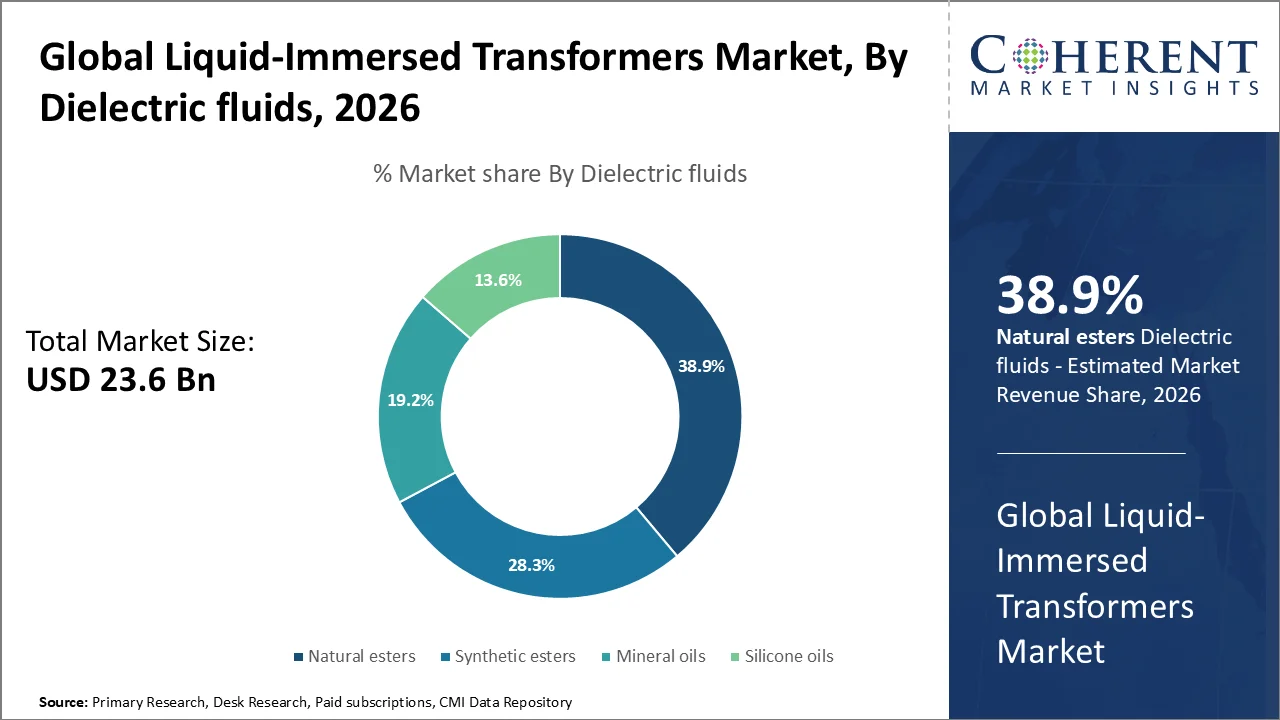
- Natural esters hold the largest market share of 38.9% in 2026 owing to its stricter fire-safety requirements.
- Power transformers expected to hold largest market share of 52.8% in 2026 owing to the grid modernization and transmission expansion.
- North America is expected to acquire the dominant share of 41.7% in 2026 owing to growing electricity generation. Between 2023 and 2050, Canada’s total electricity generation is projected to increase by more than 30% in the Lower scenario and more than double under higher-growth projections.
Current Events and Their Impact on the Liquid-Immersed Transformers Market
Current Event | Description and its Impact |
U.S. DOE Reopens Review of Distribution Transformer Energy-Efficiency Standards in 2026 |
|
U.S. 2024 Energy-Efficiency Standards for Distribution Transformers Will Apply From 2029 |
|
Segmental Insights
- Current Industry Events of 2026
- Market Size Estimation
- Regional Breakdown
- Competitive Landscape
- Customer Intelligence
- Segmental Analysis
- Pricing Analysis
- Key Market Drivers, Challenges & Future Trends
- Customized Insights Section
Why is Natural esters Acquiring the Largest Market Share?
Natural esters hold the largest market share of 38.9% in 2026. Natural esters are accelerating growth in the liquid-immersed transformers market because they offer high fire points, biodegradability, renewable sourcing, and reduced environmental impact compared with petroleum-based mineral oils. Utilities and industrial users increasingly adopt natural ester-based transformer fluids as environmental awareness rises, safety regulations tighten, and demand for sustainable grid infrastructure grows. Natural esters also suit environmentally sensitive sites and sealed transformer applications, supporting wider adoption. The IEC 62770:2024 standard further strengthens market confidence by establishing specifications and testing methods for natural ester fluids. Clariant, a leading supplier of sustainable ingredients and solutions for the industrial lubricants segment, has launched an innovative phosphate ester that delivers outstanding performance and enhanced sustainability in metalworking fluid formulations.
Power transformers expected to hold largest market share
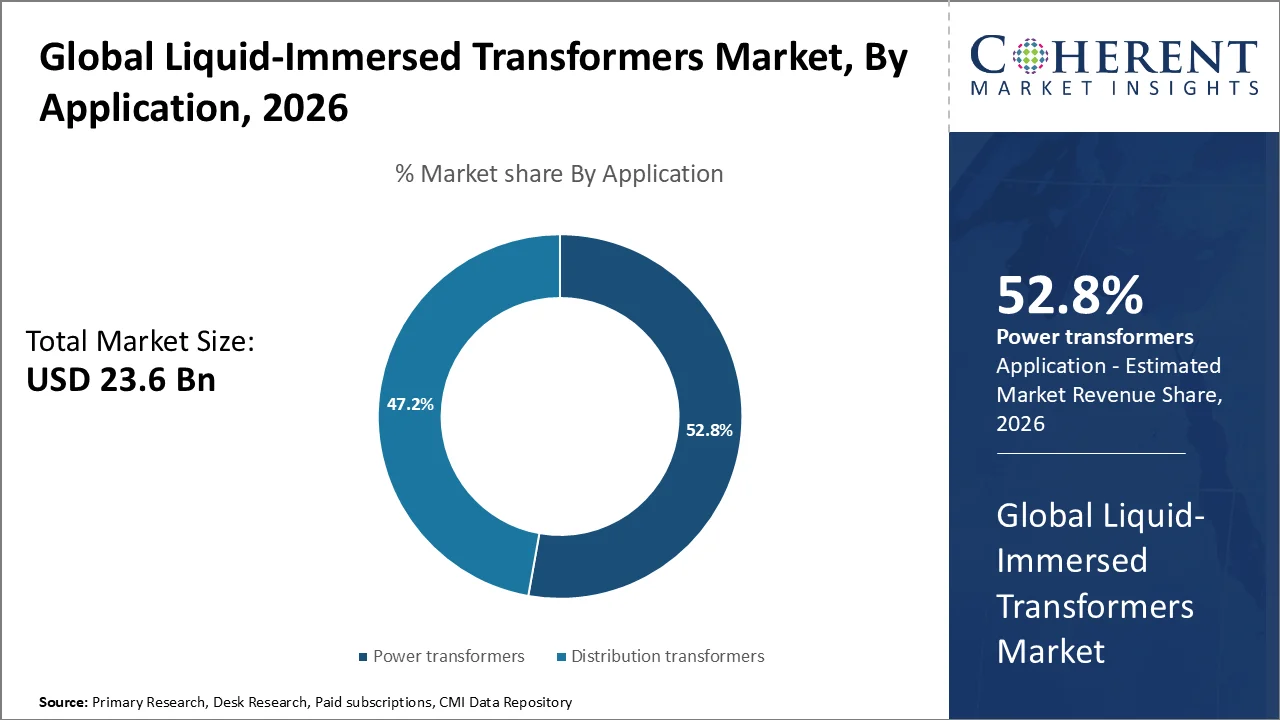
Power transformers expected to hold largest market share of 52.8% in 2026 owing to the grid reliability and resilience investments. Utilities are driving growth in the liquid-immersed transformers market by expanding and modernizing transmission networks to meet rising electricity demand. Aging grid infrastructure is also encouraging utilities to replace older equipment, while renewable-energy projects require high-capacity transformers to connect solar and wind facilities to the grid. Increasing electrification, industrial development, data-center expansion, and energy-storage deployment are strengthening demand for reliable power infrastructure. Furthermore, utilities are investing in grid resilience and efficient high-voltage transmission, which supports the adoption of liquid-immersed power transformers. Siemens has launched a dry-type pole-mounted transformer designed to meet the evolving technological needs of the American grid, offering a reliable and sustainable alternative to conventional oil-filled transformers.
Liquid-Immersed Transformers Market Trends
- Growing adoption of renewable energy projects increases demand for liquid-immersed transformers as utilities connect new generation capacity to transmission and distribution networks, supporting grid expansion and modernization. The IEA forecasts global electricity demand to grow by an average 3.6% annually from 2026 to 2030, adding approximately 1,100 TWh of electricity demand per year during this period. This expansion increases the need for additional grid infrastructure, including transformers, although the IEA figure is for electricity demand rather than transformer demand specifically.
- Smart-grid and digitalization trends encourage the integration of sensors, monitoring systems, and predictive-maintenance technologies with liquid-immersed transformers, enabling real-time condition monitoring, improved asset management, and greater grid reliability. The U.S. Department of Energy identifies distribution transformers as fundamental components of the electricity grid and is working with utilities and manufacturers on interoperability and supply-chain improvements. DOE reported that the United States has more than 80,000 different distribution-transformer varieties, highlighting the potential value of greater standardization and more efficient asset management.
- Rising electricity demand from data centers, industrial facilities, and electrification drives investment in high-capacity transformers. The IEA forecasts global electricity demand to increase by 3.6% per year on average from 2026 to 2030, with data centers, electric vehicles, industry and air conditioning among the major sources of additional demand. In the United States, electricity demand is expected to rise by more than 420 TWh between 2026 and 2030, with data centers accounting for approximately 50% of the increase.
- Replacement of aging transformer fleets remains an important trend as utilities modernize legacy grids and improve reliability. The U.S. DOE reports that distribution-transformer lead times increased from approximately 3–6 months in 2019 to 12–30 months in 2023, reflecting supply and labor constraints and material shortages. DOE also identifies more than 80,000 distribution-transformer varieties in the United States, with inconsistent specifications contributing to longer production times.
Regional Insights
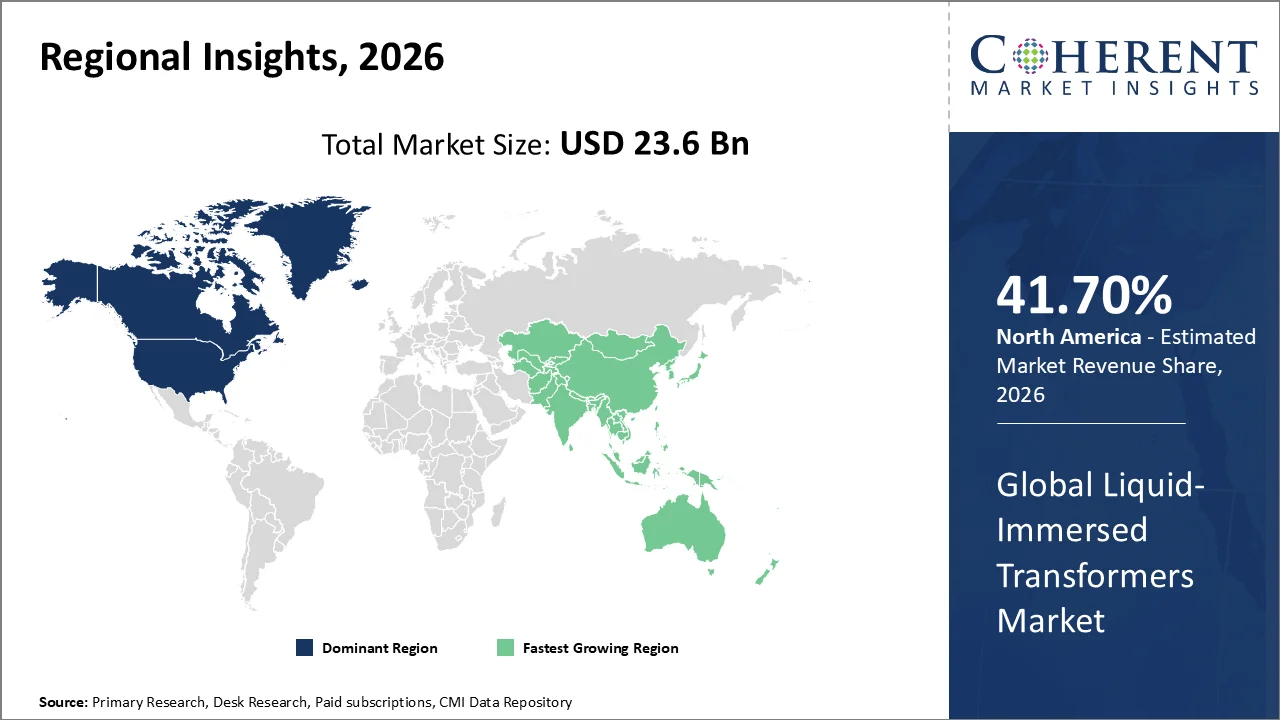
North America dominates owing to electrification and EV adoption
North America is expected to acquire the dominant share of 41.70% in 2026. North America’s liquid-immersed transformers market is expanding as utilities modernize aging grid infrastructure, meet rising electricity demand, integrate renewable energy, and expand transmission networks. Utilities are replacing older transformers and increasing capacity to serve data centers, manufacturing facilities, electric vehicles, and industrial electrification. Renewable-energy and energy-storage projects also require transformers to connect generation assets and transmit electricity efficiently. In Canada, electrification and industrial development are encouraging further infrastructure investment. Moreover, utilities are strengthening transformer capacity and reliability to address extreme weather risks and improve grid resilience. SLIM transformers are compact, liquid-immersed units designed for wind turbines, including offshore applications. They deliver reliable performance in remote wind farms exposed to harsh conditions and extreme temperatures.
Asia Pacific Liquid-Immersed Transformers Market Trends
Rapid urbanization, industrialization, and growing electricity demand across China, India, and Southeast Asia are driving the Asia Pacific liquid-immersed transformers market. Governments and utilities are expanding transmission and distribution networks, modernizing power grids, and replacing aging electrical equipment, which increases demand for these transformers. The region’s growing solar, wind, and hydropower capacity also drives adoption by requiring reliable power transmission and grid integration. Investments in smart grids, data centers, manufacturing, rural electrification, and energy-efficient technologies further support market growth, while environmental regulations promote advanced insulating fluids. Hitachi Energy has launched India’s first 400 kV three-phase synthetic ester-filled power transformer for Power Grid Corporation of India, marking a major step toward sustainable, high-performance power solutions.
United States Liquid-Immersed Transformers Market Trends
The United States liquid-immersed transformers market benefits from aging electrical infrastructure, rising electricity demand, and ongoing grid modernization. The expansion of renewable energy projects increases the need for transformers in power transmission and grid interconnection, while growing data center capacity, electric vehicle charging infrastructure, and industrial electrification raise overall power requirements. Utilities are also replacing aging transformer fleets to maintain grid reliability and efficiency. In addition, federal infrastructure investments and initiatives to strengthen domestic transformer manufacturing continue to drive market growth. The U.S. Department of Energy’s final transformer efficiency standards ease steel requirements and extend the compliance deadline to five years, offering a compromise with industry.
China Liquid-Immersed Transformers Market Trends
China’s liquid-immersed transformers market is expanding as the country modernizes its power grid, develops ultra-high-voltage transmission networks, and meets rising electricity demand from industrialization and urbanization. China is investing heavily in solar and wind energy projects, which increases the need for transformers to integrate new power generation into the grid. Utilities are replacing aging equipment, implementing smart-grid technologies, and improving energy efficiency. Industrial electrification and government-backed infrastructure projects further accelerate adoption, while growing demand for reliable and efficient power transmission and distribution continues to support the market.
Who are the Major Companies in Liquid-Immersed Transformers Industry
Some of the major key players in Liquid-Immersed Transformers are CG, ABB, Schneider Electric, GE, Siemens, Altrafo Transformers, CNC Group, CELME, Dandong Xintai Electric, China XD Group EREMU, and Elsewedy Electric.
Key News
- In April 2025, Shell added the MIDEL range of transformer insulating liquids to its transformer liquids portfolio alongside Shell Diala GTL, launching the MIDEL brand globally to drive innovation, reliability, and the energy transition.
Market Report Scope
Liquid-Immersed Transformers Market Report Coverage
| Report Coverage | Details | ||
|---|---|---|---|
| Base Year: | 2025 | Market Size in 2026: | USD 23.6 Bn |
| Historical Data for: | 2020 To 2024 | Forecast Period: | 2026 To 2033 |
| Forecast Period 2026 to 2033 CAGR: | 6.8% | 2033 Value Projection: | USD 33.8 Bn |
| Geographies covered: |
| ||
| Segments covered: |
| ||
| Companies covered: | CG, ABB, Schneider Electric, GE, Siemens, Altrafo Transformers, CNC Group, CELME, Dandong Xintai Electric, China XD Group EREMU, and Elsewedy Electric. | ||
Analyst Opinion
- Grid expansion is the core demand driver, not a short-term replacement cycle. Global electricity demand is expected to grow strongly through 2030, while renewable generation requires extensive grid connections and voltage transformation. This makes liquid-immersed transformers a critical piece of infrastructure rather than a discretionary electrical component. Their ability to handle high loads and support transmission and distribution networks keeps demand closely tied to long-term power-system investment.
- Renewable-energy deployment is creating a transformer bottleneck. The International Energy Agency estimates that global renewable capacity additions reached almost 700 GW in 2023, with solar PV accounting for the majority of new capacity. Every large solar or wind project requires transformers to step up and step down electricity before transmission and distribution. In my view, the faster pace of renewable installations is putting greater pressure on transformer procurement, manufacturing capacity, and delivery schedules, strengthening the position of established suppliers.
- Aging grids are turning transformer replacement into a strategic necessity. In the United States, the Department of Energy estimates that 70% of the nation’s power transformers are more than 25 years old. This is a particularly important signal for the liquid-immersed transformers market because utilities cannot indefinitely operate aging equipment without increasing reliability risks.
- The strongest opportunity lies in high-voltage and utility-scale applications. China continues to expand its ultra-high-voltage transmission infrastructure to move electricity across long distances from renewable-rich regions to major consumption centers. India is similarly expanding transmission capacity to integrate renewable generation into the national grid. In my assessment, these large infrastructure programs favor liquid-immersed transformer manufacturers with proven high-voltage engineering capabilities, strong utility relationships, and the ability to meet stringent reliability requirements.
- Transformer efficiency and reliability will increasingly determine purchasing decisions. Utilities are no longer evaluating transformers purely on upfront cost; they are increasingly considering lifecycle losses, maintenance requirements, fire safety, reliability, and operating performance. The growing use of biodegradable and less-flammable insulating fluids also creates opportunities for technological differentiation.
Speak to the analyst
Want personalized insights?
Take the findings above to one of our principal consultants, or have the report rebuilt around the segments, geographies and competitors you actually track.
Market Segmentation
- By Dielectric Fluids (Revenue, USD Bn, 2021-2033)
- Natural esters
- Synthetic esters
- Mineral oils
- Silicone oils
- By Application (Revenue, USD Bn, 2021-2033)
- Power transformers
- Distribution transformers
- Residential
- Commercial
- Industries
- By Region (Revenue, USD Bn, 2021-2033)
- North America
- U.S.
- Canada
- Latin America
- Brazil
- Mexico
- Argentina
- Rest of Latin America
- Europe
- Germany
- U.K.
- France
- Italy
- Spain
- Russia
- Rest of Europe
- Asia Pacific
- China
- India
- Japan
- Australia
- South Korea
- ASEAN
- Rest of Asia Pacific
- Middle East
- GCC
- Israel
- Rest of Middle East
- Africa
- South Africa
- Central Africa
- North Africa
- North America
Sources
Primary Research interviews
- Transformer manufacturers and OEM executives
- Utility and power-grid operators
- Transmission and distribution equipment procurement managers
- Renewable-energy project developers
- Electrical engineering consultants and industry specialists
- Industrial end users and large power consumers
Databases
- U.S. Energy Information Administration (EIA) databases
- International Energy Agency (IEA) databases
- World Bank DataBank
- International Renewable Energy Agency (IRENA) databases
- United Nations Data
- Eurostat databases
- U.S. Census Bureau trade databases
- UN Comtrade database
Magazines
- T&D World
- Electrical World
- POWER Magazine
- Utility Dive
- Electrical Contractor
- Transformers Magazine
Journals
- IEEE Transactions on Power Delivery
- IEEE Transactions on Power Systems
- IEEE Electrical Insulation Magazine
- IET Generation, Transmission & Distribution
- Electric Power Systems Research
- International Journal of Electrical Power & Energy Systems
- Energies
Newspapers
- Reuters
- Financial Times
- The Wall Street Journal
- The Economic Times
- The Hindu BusinessLine
- Nikkei Asia
Associations
- IEEE
- National Electrical Manufacturers Association (NEMA)
- International Electrotechnical Commission (IEC)
- CIGRE
- American Society of Electrical Engineers
- European Association of Electrical and Electronic Manufacturers (EACEM)
Public Domain sources
- U.S. Department of Energy (DOE)
- U.S. Energy Information Administration (EIA)
- International Energy Agency (IEA)
- International Renewable Energy Agency (IRENA)
- European Commission
- World Bank
- United Nations
- Government energy and electricity regulators
- National transmission and distribution utilities
- National statistical agencies
- Publicly available utility filings, annual reports, tender documents, and regulatory publications
Proprietary Elements
- CMI Data Analytics Tool
- Proprietary CMI Existing Repository of information for last 10 years
Get access to 250+ pages report
Every segment, forecast, competitor profile and data table behind the analysis above — available for instant download.
- ESOMAR Member
- ISO 9001:2015 Certified
- D-U-N-S Registered
- GDPR & CCPA Compliant
Missing comfort of reading report in your local language? Find your preferred language:
Transform your Strategy with Exclusive Trending Reports
Frequently Asked Questions
The Liquid-Immersed Transformers Market is anticipated to grow at a CAGR of 6.8% with USD 23.6 Bn share in 2026 and is expected to reach USD 33.8 Bn in 2033.
Grid modernization, rising electricity demand, renewable-energy integration, and expansion of transmission and distribution infrastructure are the primary growth drivers.
Liquid-immersed transformers provide effective insulation and heat dissipation, making them suitable for high-voltage, renewable-energy projects, and transmission networks.
The rapid deployment of solar and wind projects is increasing transformer requirements because renewable generation facilities need voltage transformation and grid interconnection equipment.
Transmission and distribution networks represent major applications, while renewable-energy plants, industrial facilities, and data centers are also contributing to demand.
Utilities are upgrading aging networks, expanding transmission capacity, integrating distributed and renewable generation, and improving grid reliability.