

Global Retail Banking Market Size and Forecast – 2026 To 2033
The global retail banking market is expected to grow from USD 2.30 Tn in 2026 to USD 3.65 Tn by 2033, registering a compound annual growth rate (CAGR) of 7% from 2026 to 2033. The global retail banking market is driven by the growing demand for personalized banking through AI and analytics. On April 22, 2026, Citi Group unveiled Citi SkySM, an always-on AI-powered member of the Citi Wealth team that was built using technology from Google Cloud and Google DeepMind. Citi Sky is aimed at reshaping how clients in the U.S. access market insights, act on opportunities, and engage with their financial advisors.
Key Takeaways of the Global Retail Banking Market
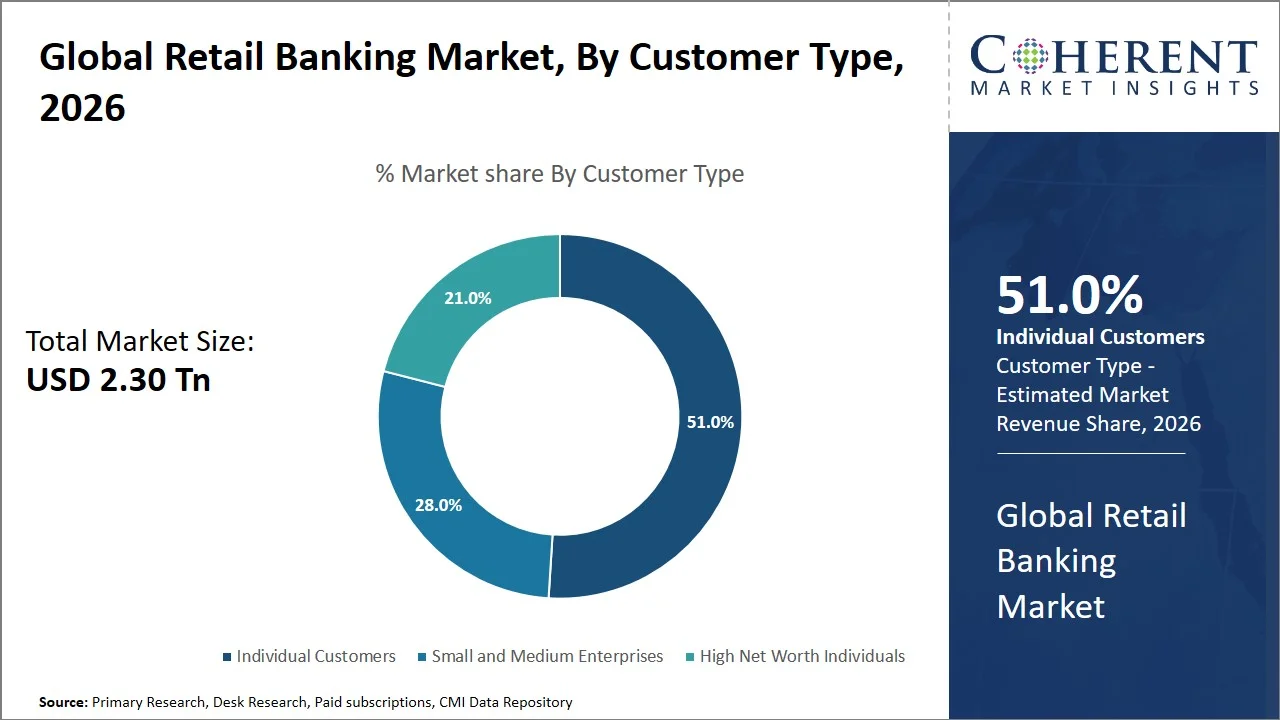
- The individual customers segment is expected to account for 51.0 % of the global retail banking market share in 2026. Expansion of cashless and digital payment ecosystems for personal transactions is driving the growth of the segment. On April 7, 2025, Revolut announced that it has received full approval from the Reserve Bank of India (RBI) to offer Prepaid Payment Instruments (PPI) in India, including prepaid cards, and prepaid wallets with UPI payments.
- The deposits segment is estimated to capture 47.0 % of the market share in 2026. Higher consumer preference for omnichannel banking experiences is a major factor driving the growth of the segment. On January 20, 2025, CrediaBank completed the integration of the digital platforms of Attica Bank and Pancreta Bank and launched in Greece its New Experience branch concept, enabling customers to move smoothly from mobile banking, internet banking and technology-enabled physical branches with personalized advisory services.
- The savings accounts segment is estimated to capture 24.0 % of the market share in 2026. Rising penetration of digital banking in emerging markets is driving the growth of the segment. On January 27, 2026, Revolut declared the conclusion of its Beta period and the full start of its banking activities in Mexico.
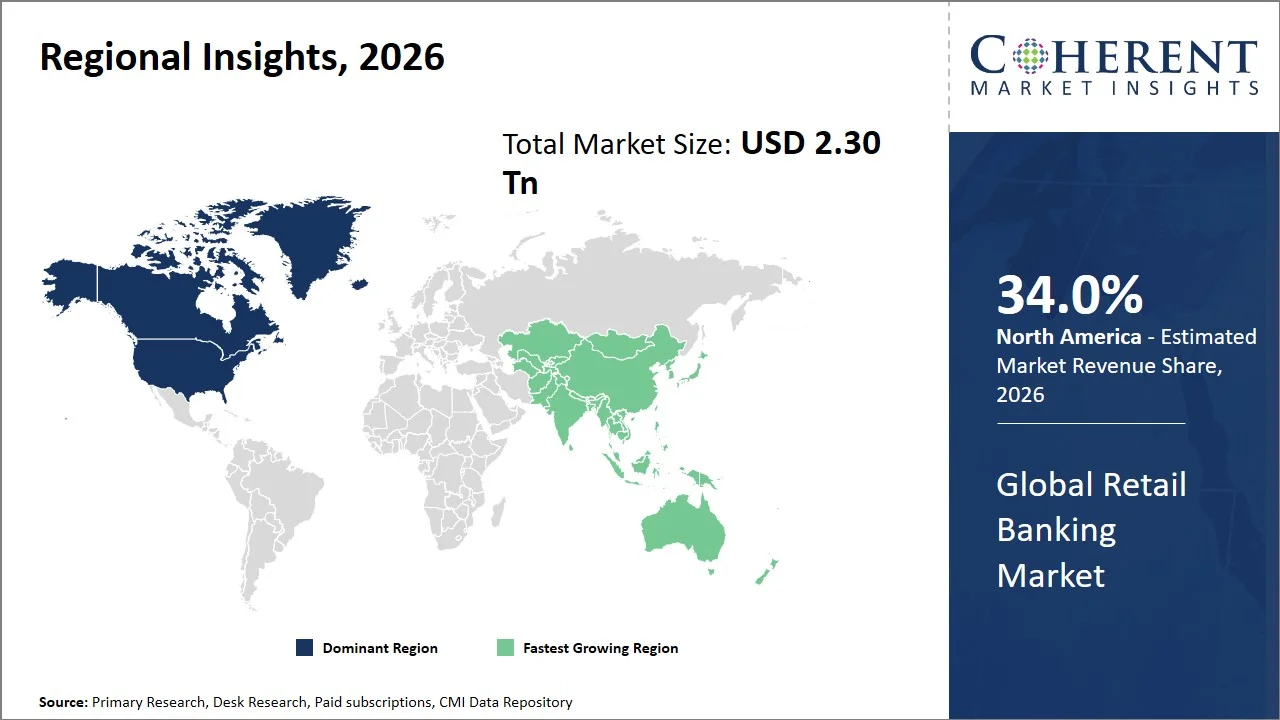
- North America is expected to dominate the retail banking market in 2026 with a market share of 34.0 %. Increasing adoption of cloud-based core banking platforms in North America is primarily driving the growth of the regional market. On April 22, 2026, Backbase launched the AI-native Banking OS, the most significant evolution in the company's 22-year history, establishing a new market category in banking technology.
- Asia Pacific is expected to account for 31.0 % of the market share in 2026 and is projected to record the fastest growth over the forecast period. Growing demand for sustainable and green retail banking products in Asia Pacific is driving the growth of the regional market. On January 20, 2026, Maybank announced its new five-year plan till 2030, ROAR30, while increasing green retail finance, sustainable wealth management products and ESG banking solutions across Southeast Asia.
- AI driven hyper personalized banking experiences: Retail banks are progressively adopting generative AI, predictive analytics and real-time consumer data systems to provide personalized financial recommendations, automated budgeting, customized lending offers and preemptive fraud alerts. Banks are utilizing AI-powered relationship management to boost client retention and simultaneously increase cross-selling opportunities and improve operational efficiencies.
- Expansion of embedded finance and Banking as a Service ecosystems: Retail banking services are being embedded into e-commerce platforms, mobility applications, healthcare services and digital marketplaces using APIs and cloud-based financial infrastructure. Financial institutions are cooperating with fintech startups and technology vendors to embed digital payments, lending, insurance and savings products directly into third-party digital platforms, opening up new sources of income outside of traditional banking channels.
Segmental Insights
Why Do Individual Customers Dominate the Global Retail Banking Market?
The individual customers segment is expected to account for 51.0% of the global retail banking market share in 2026. The individual customers category is expected to hold the highest proportion of the global retail banking market throughout the forecast period. Personal banking solutions allow ongoing and repeated contact with the client throughout the financial lifecycle of an individual. In their daily financial activities, they often use savings accounts, current accounts, mortgages, personal loans, credit cards, digital payments and investment services. These, in turn, create stable deposit bases and various sources of income for banks. Ongoing demand for these services and swift adoption of mobile and digital banking platforms have improved customer interactions and bolstered the segment’s leading position in both developed and emerging economies. On January 27, 2025, Slice Small Finance Bank announced that it will raise USD 250 million after its merger with North East Small Finance Bank to promote digital savings accounts, consumer lending and mobile-first banking products targeted at individual retail clients across India.
- Current Industry Events of 2026
- Market Size Estimation
- Regional Breakdown
- Competitive Landscape
- Customer Intelligence
- Segmental Analysis
- Pricing Analysis
- Key Market Drivers, Challenges & Future Trends
- Customized Insights Section
Why is Deposits the Most Preferred Service Type?
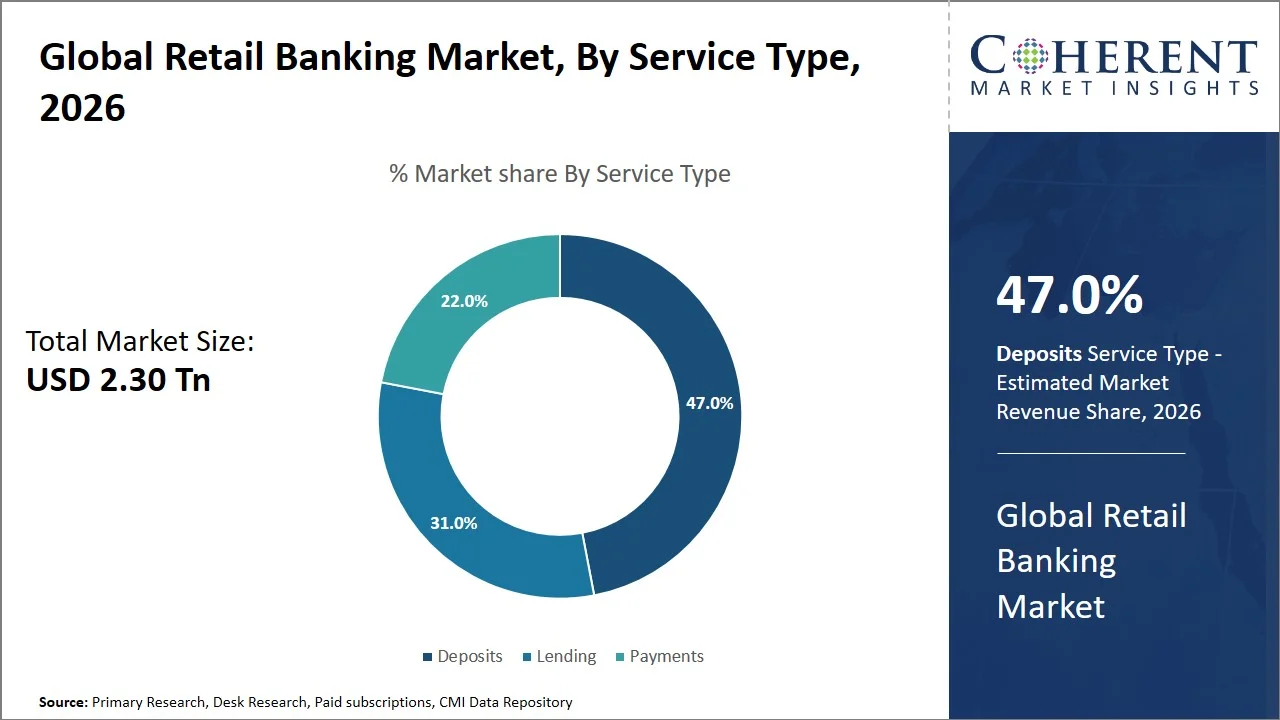
The deposits segment is expected to account for 47.0% of the global retail banking market share in 2026. Deposits are still the most popular type of service as they give banks a reliable and low-cost source of funds for lending and other financial activities. Savings accounts, current accounts, and fixed deposits have always been the mainstay for retail consumers to protect their money, maintain liquidity and preserve capital irrespective of economic conditions. That continuous influx of deposits enhances bank profitability and fortifies balance sheets, and enables institutions to promote loan expansion while satisfying regulatory liquidity requirements. On June 5, 2026, Indian Bank launched three new retail deposit products, IND Prosper, IND Grow and IND Green. It comprises of specialized fixed deposit products including a green deposit product to mobilize long term retail deposits and diversify the deposit book.
Savings Accounts Segment Dominates the Global Retail Banking Market
The savings accounts segment is expected to account for 24.0% of the global retail banking market share in 2026. Savings accounts account for the largest share of the worldwide retail banking market since they are the main entry point to long-term customer relationships with financial institutions. People hold money in savings accounts because they are safe and accessible. People use them for paying salaries, holding emergency money and for managing their money on a day to day basis. Savings accounts have become the centerpiece of the retail banking client acquisition and engagement strategy, given their ubiquitous presence, cheap account opening criteria, and integration with digital banking, payment services, and other financial products. On July 9, 2026, Lloyds Bank announced that it has been recognized in the Regular Savings category of Defaqto's Banking Award, which highlights savings accounts that have offered customers consistently competitive rates over time. More than 2,100 savings products were assessed as part of the independent review, with Lloyds one of only six providers recognized in the Regular Savings category, and the only major U.K. high street bank featured across any category.
Currents Events and their Impact
Current Events | Description and its Impact |
European Union – Instant Payments Regulation (Regulation (EU) 2024/886) |
|
United Kingdom – Data (Use and Access) Act 2025 |
|
Global Retail Banking Market Dynamics
Market Drivers
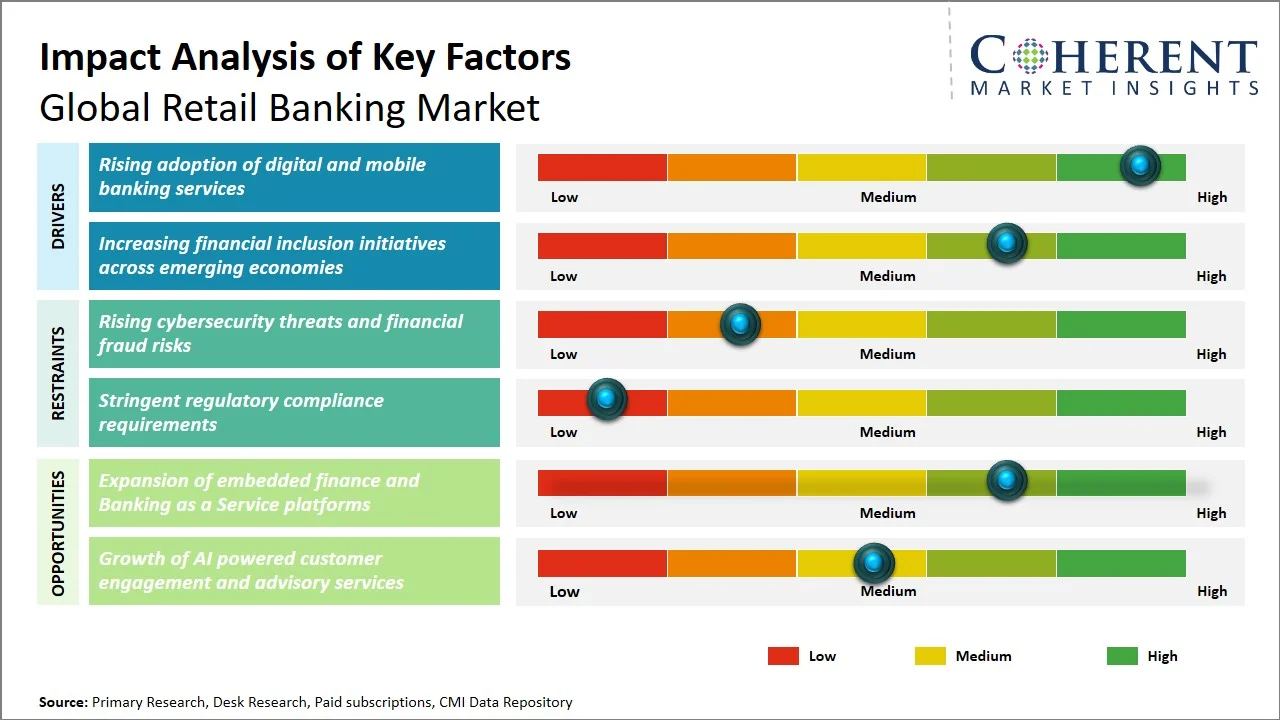
- Rising adoption of digital and mobile banking services: The worldwide retail banking business is increasing due to the increasing acceptance of digital and mobile banking services as it is changing the way clients access financial products and manage everyday transactions. Banks are also launching mobile applications that offer real-time payments, digital account opening, AI-driven financial assistance, biometric authentication and built-in personal finance management features, allowing customers to do banking operations without visiting physical offices. The rise in smartphones, high-speed internet access and contactless payment technologies have further enhanced consumer engagement, decreased operating expenses for banks and accelerated the adoption of digital-first banking models in both established and emerging nations. On May 20, 2026, JPMorganChase debuted its new digital bank Chase in Germany. Its first product is a no-fee savings account, with a leading market interest rate and a smooth digital banking experience.
- Increasing financial inclusion initiatives across emerging economies: Growing financial inclusion efforts across developing economies are rapidly expanding the retail banking customer base by bringing previously unbanked and underbanked populations into the formal financial system. Governments and central banks are backing digital identification projects, simplified account opening procedures, interoperable payment systems and programs to promote financial literacy. Banks are collaborating with fintech firms to offer low cost banking services through mobile platforms and agent networks. This is driving the demand for savings accounts, digital payments, microloans and insurance products and presenting enormous opportunity for retail banks across Asia Pacific, Africa, Latin America and portions of the Middle East. On December 22, 2025, International Finance Corporation, a member of the World Bank Group, announced an investment in BBVA Argentina aimed at expanding financing for small and medium-sized enterprises (SMEs) in the country.
Emerging Trends
- Rapid migration toward cloud native core banking platforms: Banks are moving from legacy core banking architectures to cloud-based modular designs to speed up product introduction, improve scalability, enhance cybersecurity and minimize infrastructure costs. In many markets, cloud native platforms are delivering real-time transaction processing, simple integration with fintech ecosystems and faster regulation compliance.
- Growing adoption of biometric authentication and digital identity solutions: Retail banks are using facial recognition, fingerprint authentication, behavioral biometrics, and digital identity verification technologies to improve client onboarding and transaction security. These solutions help to mitigate identity fraud, provide passwordless banking experiences and enable secure remote account opening all while satisfying stringent regulatory demands.
Global Retail Banking Market - Digital Wallet Integration in Retail Banking (2025-2026)
Integration with digital wallets is expected to be a major retail banking strategy by 2025–2026. Banks are incorporating wallet functionality into their mobile banking apps to facilitate contactless payments, peer-to-peer payments, QR code transactions, transit payments, and digital identification services. Banks are partnering with payment networks, fintech businesses and smartphone makers to provide tokenized card provisioning, biometric authentication and interoperable payment ecosystems. The emergence of bank-backed wallet platforms such as Wero across Europe, deeper integration of digital wallets with UPI in India, and the incorporation of wallet capabilities into broader digital banking ecosystems by Asian banks are expected to strengthen customer engagement while reducing reliance on physical payment instruments.
Key points include
- India: Over 700 banks are live on the UPI ecosystem, allowing simple integration of digital wallets with retail banking applications
- India: Wallet-enabled banking is the leading retail payment channel with UPI representing about 85% of India’s digital payment volume
- India: UPI transaction volume reached 2,000 crore transactions for the first time, prompting retail banks to integrate more wallets
- India: Over 440 million downloads of digital wallet apps were registered with PhonePe being the most downloaded digital wallet app globally
- Europe: Five Belgian banks to launch Wero digital wallet, expanding scope of bank-backed wallet interoperability across Belgium, France, Germany and surrounding markets
- Europe: Wero is already active with almost 40 million registered clients, allowing wallet based retail banking at partner European banks
- South Korea: Toss FacePay, with over 4.8 million users, is available at over 330,000 retail outlets, indicating rapid use of biometric wallet payment
- India: Samsung Wallet launched UPI onboarding at device setup & biometric PIN-free payments, improving wallet connectivity with retail banking services
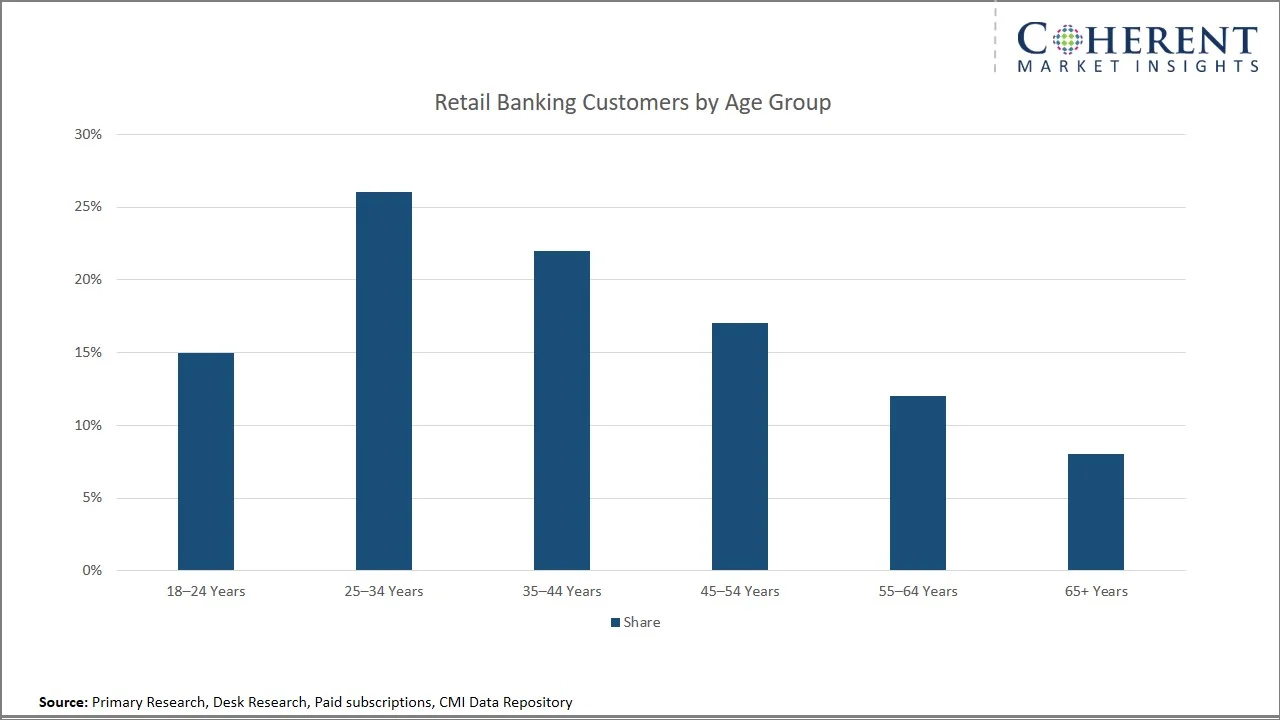
Global Retail Banking Market - Retail Banking Customers by Age Group (2025-2026)
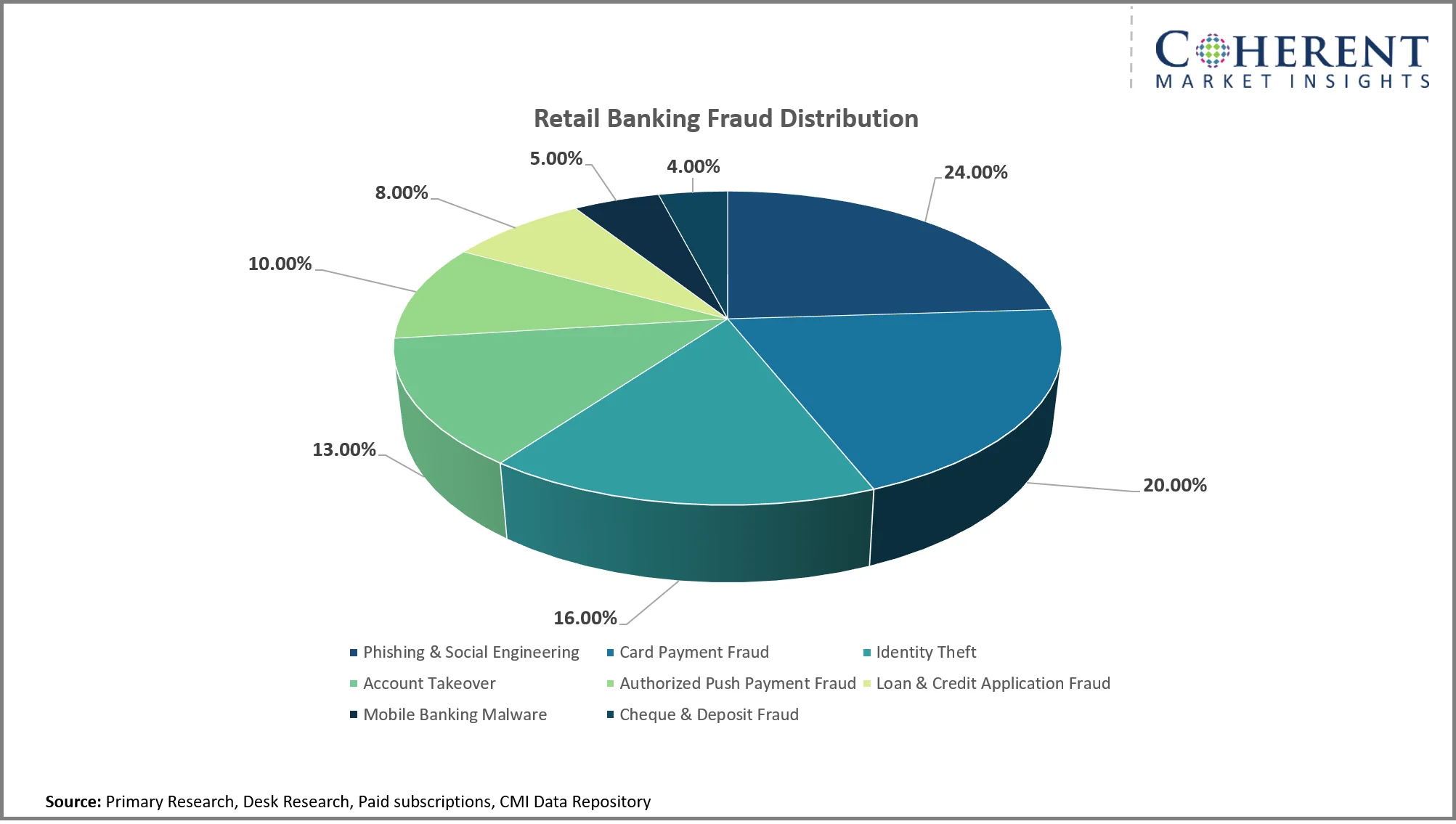
Global Retail Banking Market - Retail Banking Fraud Distribution by Fraud Category (2025-2026)
Regional Insights
Why is North America a Strong Market for Retail Banking?
North America is expected to account for a market share of 34.0% in 2026. North America is the most mature retail banking region, driven by comprehensive digital transformation, state-of-the-art payment infrastructure and continual investments in AI-enabled consumer services. Big names such as JPMorgan Chase, Bank of America, Wells Fargo, Citigroup, Royal Bank of Canada and TD Bank have rolled out generative AI assistants, personalized financial management tools and real-time fraud detection systems to their digital platforms. The U.S. Federal Reserve's FedNow instant payment service has accelerated real-time retail transactions, prompting banks to enhance payment infrastructure, strengthen real-time processing capabilities, and improve customer engagement through faster and more seamless payment experiences. Canadian banks are ramping up digital mortgage originations, embedded finance partnerships and cloud-native banking platforms, while regional banks are doubling down on cybersecurity, biometric authentication and open banking readiness to take on fintech firms such as Chime, SoFi and Revolut.
Why Does the Asia Pacific Retail Banking Market Exhibit High Growth?
Asia Pacific is projected to account for 31.0% of the global retail banking market and is expected to register the fastest growth. Driven by ubiquitous smartphone use, digital identification infrastructure and government-sponsored cashless payment programs, retail banking is expanding rapidly across Asia Pacific. Innovation is led by China, India, Singapore, Australia, Japan, South Korea and Indonesia, with AI-powered banking, QR code payments and digital lending ecosystems. DBS Bank has incorporated generative AI into its customer care and wealth management functions, while OCBC and UOB are further developing their digital-first banking capabilities across Southeast Asia. Australia’s Commonwealth Bank, NAB, ANZ and Westpac are investing in cloud-based banking modernization and real-time payment systems. In Indonesia, Bank Central Asia, Bank Mandiri and Bank Rakyat Indonesia are working to increase acceptance of mobile banking, while digital banks like KakaoBank in South Korea and WeBank in China continue to win over younger customers with app-centric banking experiences.
Global Retail Banking Market Outlook for Key Countries
Why is the U.S. Emerging as a Major Hub in the Retail Banking Market?
The U.S. retail banking industry is characterized by fast-paced technology innovation, high consumer adoption of digital banking and significant investment in AI-enabled financial services. JPMorgan Chase has expanded its AI capabilities to include customer service, fraud detection and tailored banking advice. Bank of America has been working to improve its virtual financial assistant, Erica, with more advanced conversational AI features. Wells Fargo has increased its digital account opening and payment security efforts while Citigroup is overhauling retail banking infrastructure by migrating to the cloud. Banks are fast-tracking quick payment services through the statewide FedNow rollout and collaboration with fintechs such as Plaid, Stripe, and Marqeta are boosting embedded finance and API-driven banking services.
Is China the Next Growth Engine for the Retail Banking Market?
China is among the world’s most digitally advanced retail banking economies with integrated mobile payment ecosystems and large-scale digital banking usage. Bank of China, China Construction Bank, Agricultural Bank of China and Industrial and Commercial Bank of China are investing extensively in AI-enabled client interaction, an intelligent wealth management and digital lending platform. WeBank and MYbank continue to extend their pure digital banking services to retail consumers and small businesses. The connection with Alipay and WeChat Pay has dramatically revolutionized everyday banking and payment behavior. Chinese banks are also rolling out digital yuan-enabled banking services, facial recognition verification and smart branch automation to boost efficiency and consumer comfort.
Japan Retail Banking Market Analysis and Trends
Japan has a well-established branch network, but retail banking modernization is being driven by digital transformation. Mitsubishi UFJ Financial Group, Sumitomo Mitsui Banking Corporation and Mizuho Bank are extending services for digital accounts, AI-assisted financial consulting platforms and cashless payment integration. SBI Shinsei Bank and Rakuten Bank continue to attract digitally-savvy people with their online-first banking models. Regional banks are using cloud-native core banking systems to boost operational efficiency. Also, banks are offering biometric verification, smartphone payments and personalized investment solutions to accommodate shifting consumer tastes and the country’s aging population.
U.K. Retail Banking Market Analysis and Trends
The U.K. continues to be a global leader in digital retail banking, backed by one of the most developed open banking ecosystems in the world. Barclays, Lloyds Banking Group, HSBC UK, NatWest Group and Nationwide Building Society are increasing their AI-powered customer support, embedded finance partnerships, and digital mortgage processing capabilities. App-based banking, rapid payments, budgeting tools and foreign payment services continue to be a source of competition from challenger banks such Monzo, Starling Bank and Revolut. The deployment of Smart Data projects and the continual proliferation of open banking APIs are driving interoperability between banks, fintechs and third-party financial service providers, providing an incentive for constant product innovation.
India Retail Banking Market Analysis and Trends
India has emerged as one of the fastest growing retail banking markets with extensive use of Unified Payments Interface (UPI), Aadhaar-based digital identity verification and account opening under financial inclusion programmes. State Bank of India, HDFC Bank, ICICI Bank, Axis Bank, Kotak Mahindra Bank and Punjab National Bank are ramping up their AI-enabled customer service, digital lending, video KYC and mobile banking capabilities. Banks are integrating UPI, RuPay cards, Bharat Bill Payment System and account aggregator frameworks to offer seamless digital financial services. Traditional banks are teaming up with fintech firms such as PhonePe, Paytm, Razorpay and CRED to foster innovation in embedded finance, merchant banking and consumer lending. Rural banking is on the rise through business correspondents and digital banking units.
Global Retail Banking Market - Mobile Banking Penetration Rate (2025)
Region | Mobile Banking Penetration Rate (%) |
North America | 82% |
Europe | 79% |
Asia Pacific | 76% |
Latin America | 68% |
Middle East & Africa | 57% |
Global Retail Banking Market - Branch Network Density (2025)
Country | Commercial Bank Branches (Approx.) | Branch Density (Branches per 100,000 Adults) |
India | 165,000 | 16 |
China | 225,000 | 18 |
U.S. | 72,000 | 28 |
Japan | 31,000 | 30 |
Germany | 20,000 | 24 |
U.K. | 7,500 | 14 |
Brazil | 18,000 | 13 |
France | 34,000 | 52 |
Italy | 20,500 | 35 |
South Korea | 6,700 | 16 |
How is the Expansion of Embedded Finance and Banking as a Service Platforms Creating New Growth Opportunities in the Retail Banking Market?
Embedded finance and Banking as a Service (BaaS) platforms are unlocking new development prospects by enabling retail banks to offer regulated financial products through non-banking digital ecosystems instead of through branch and mobile banking channels. Banks are teaming up with e-commerce marketplaces, ride-hailing platforms, payroll providers, healthcare apps, travel portals and enterprise software vendors to embed savings accounts, instant consumer loans, installment financing, debit cards, insurance and payment services into customer journeys using API-based infrastructure. Banks are increasingly providing fintech companies with white-label Banking as a Service capabilities to enable embedded financial solutions such as merchant financing at checkout, salary-linked financial services within human resource platforms, and embedded digital wallets for retail and subscription-based businesses.
On June 30, 2025, Natech Banking Solutions announced the successful closing of its Series B capital increase, raising approximately USD 33 million in growth finance. The cash will be used to scale the company’s embedded financial platform and its modular cloud-native core banking technology worldwide.
Market Players, Key Development, and Competitive Landscape
Key Developments
- On September 8, 2025, PNC Financial Services Group, Inc. announced a definitive agreement to acquire FirstBank Holding Company, including its banking subsidiary FirstBank, headquartered in Lakewood, U.S. The addition of FirstBank is part of PNC's strategy to scale its franchise through organic growth and strategic acquisition.
- On May 20, 2025, Revolut Group, announced as part of Choose France Summit that Paris will become home to its new Western Europe headquarters. As part of this expansion, the company will soon apply for a French banking license and is set to invest more than USD 1 billion in France over the next three years, creating over 200 jobs and marking the largest foreign investment in the French financial sector in over a decade.
Competitive Landscape
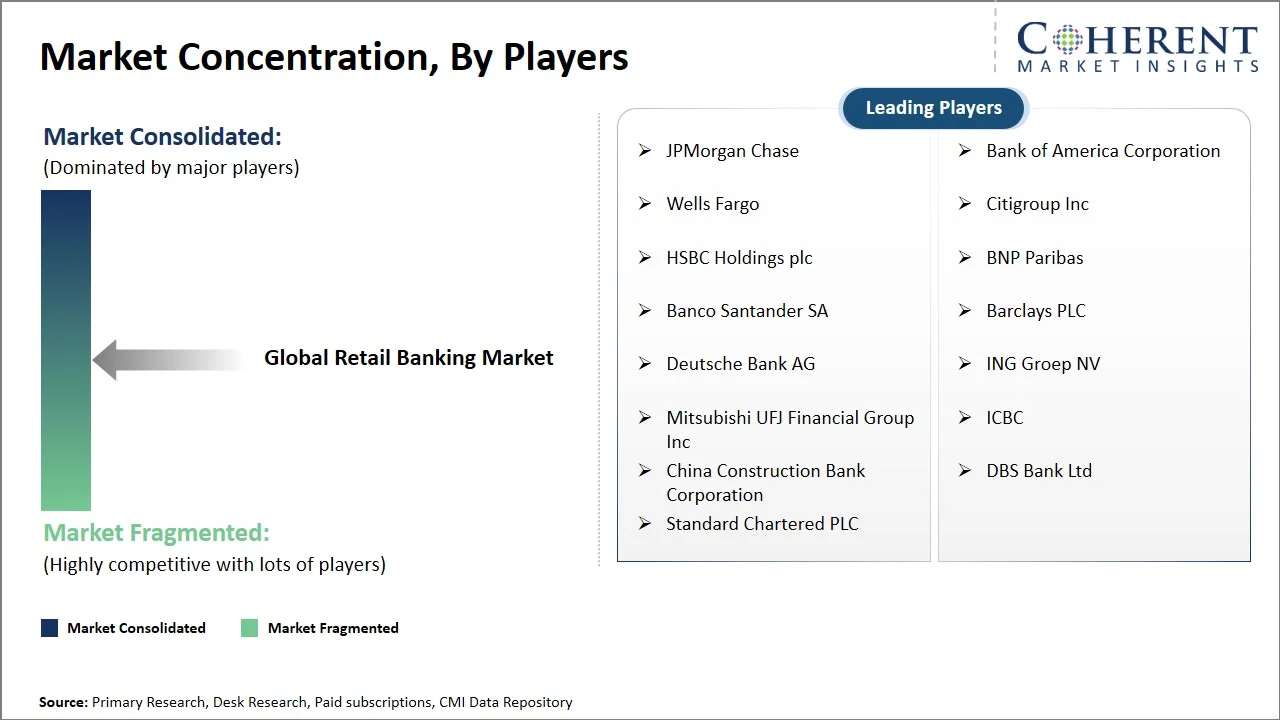
The top global retail banking market players include JPMorgan Chase, Bank of America, ICBC, China Construction Bank, HSBC, BNP Paribas, Banco Santander, DBS Bank, Mitsubishi UFJ Financial Group, and Standard Chartered. The focus of competition is not on opening more branches but on AI deployment, cloud-native core banking, embedded finance, and real-time payments. JPMorgan Chase has built its digital-only banking capabilities and included generative AI into customer care, fraud detection, software development and relationship management. Bank of America continues to improve its Erica virtual assistant and predictive financial analytics platform. DBS Bank gets accolades for its cloud-native banking architecture and AI-powered wealth management services in Southeast Asia. HSBC is supporting international digital wealth management and cross-border banking for internationally mobile customers. Openbank is executing the bank’s worldwide digital platform strategy in a number of overseas regions.
Market Report Scope
Retail Banking Market Report Coverage
| Report Coverage | Details | ||
|---|---|---|---|
| Base Year: | 2025 | Market Size in 2026: | USD 2.30 Tn |
| Historical Data for: | 2020 To 2024 | Forecast Period: | 2026 To 2033 |
| Forecast Period 2026 to 2033 CAGR: | 7% | 2033 Value Projection: | USD 3.65 Tn |
| Geographies covered: |
| ||
| Segments covered: |
| ||
| Companies covered: | JPMorgan Chase, Bank of America Corporation, Wells Fargo, Citigroup Inc, HSBC Holdings plc, BNP Paribas, Banco Santander SA, Barclays PLC, Deutsche Bank AG, ING Groep NV, Mitsubishi UFJ Financial Group Inc, ICBC, China Construction Bank Corporation, DBS Bank Ltd, and Standard Chartered PLC | ||
| Growth Drivers: |
| ||
| Restraints & Challenges: |
| ||
Analyst Opinion (Expert Opinion)
- The retail banking sector is evolving from institution-centric banking to platform-centric financial ecosystems, with banking services being increasingly offered through third-party digital environments rather than proprietary channels. The new competitive leadership is being built on control of customer data ecosystems, API infrastructure and AI decision engines, not physical branch density.
- There is a move towards contextual banking where financial solutions are given at the point of customer need using embedded finance platforms. The market is also being differentiated by investments in digital identification, behavioral biometrics, cloud-native core modernization and real-time payment orchestration that are becoming bigger competitive differentiators than traditional deposit scale.
- Autonomous banking capabilities, AI-driven financial copilots, programmable banking services and embedded banking infrastructure in non-financial industries will fuel future industry growth. Retail banks are projected to boost their spending on agentic AI to deliver automated financial planning, hyper-personalized credit underwriting, and smart consumer interaction.
- The main pillars of retail banks of the future are anticipated to include tokenized deposits, digital currency interoperability with central banks, API-first banking systems, and interoperable frameworks for digital identification. Strategic alliances between banks, fintechs, cloud providers and enterprise software players will accelerate the delivery of banking services through retail, healthcare, mobility, telecommunications and enterprise ecosystems, fundamentally changing the way financial services are distributed and consumed.
Speak to the analyst
Want personalized insights?
Take the findings above to one of our principal consultants, or have the report rebuilt around the segments, geographies and competitors you actually track.
Market Segmentation
- Customer Type Insights (Revenue, USD Trillion, 2021 – 2033)
- Individual Customers
- Small and Medium Enterprises
- High Net Worth Individuals
- Service Type Insights (Revenue, USD Trillion, 2021 - 2033)
- Deposits
- Lending
- Payments
- Product Type Insights (Revenue, USD Trillion, 2021 - 2033)
- Savings Accounts
- Current Accounts
- Fixed Deposits
- Personal Loans
- Home Loans
- Credit Cards
- Debit Cards
- Wealth Management
- Banking Channel Insights (Revenue, USD Trillion, 2021 - 2033)
- Branch Banking
- Online Banking
- Mobile Banking
- ATM Services
- Digital Wallet Banking
- Regional Insights (Revenue, USD Trillion, 2021 - 2033)
- North America
- U.S.
- Canada
- Latin America
- Brazil
- Argentina
- Mexico
- Rest of Latin America
- Europe
- Germany
- U.K.
- Spain
- France
- Italy
- Russia
- Rest of Europe
- Asia Pacific
- China
- India
- Japan
- Australia
- South Korea
- ASEAN
- Rest of Asia Pacific
- Middle East
- GCC Countries
- Israel
- Rest of Middle East
- Africa
- South Africa
- North Africa
- Central Africa
- North America
- Key Players Insights
- JPMorgan Chase
- Bank of America Corporation
- Wells Fargo
- Citigroup Inc
- HSBC Holdings plc
- BNP Paribas
- Banco Santander SA
- Barclays PLC
- Deutsche Bank AG
- ING Groep NV
- Mitsubishi UFJ Financial Group Inc
- ICBC
- China Construction Bank Corporation
- DBS Bank Ltd
- Standard Chartered PLC
Sources
Primary Research Interviews
- Retail Banking Executives & Branch Managers
- Digital Banking & Fintech Solution Providers
- Financial Regulators & Compliance Officers
- Investment & Wealth Management Advisors
Magazines
- The Banker Magazine
- Banking Technology Magazine
- American Banker Magazine
- Retail Banker International
Journals
- Journal of Banking & Finance
- Journal of Financial Services Research
- International Journal of Bank Marketing
Associations
- American Bankers Association (ABA)
- European Banking Federation (EBF)
- World Council of Credit Unions (WOCCU)
- Institute of International Finance (IIF)
Public Domain Sources
- Bank for International Settlements (BIS) Publications
- International Monetary Fund (IMF) Reports
- Federal Reserve Statistical Releases
- European Central Bank (ECB) Data Portal
Proprietary Elements
- CMI Data Analytics Tool
- Proprietary CMI Existing Repository of Information for Last 10 Years
Get access to 250+ pages report
Every segment, forecast, competitor profile and data table behind the analysis above — available for instant download.
- ESOMAR Member
- ISO 9001:2015 Certified
- D-U-N-S Registered
- GDPR & CCPA Compliant
Missing comfort of reading report in your local language? Find your preferred language:
Transform your Strategy with Exclusive Trending Reports
Frequently Asked Questions
The global retail banking market is expected to stand at USD 2.30 Tn in 2026 and is expected to reach USD 3.65 Tn by 2033.
The CAGR of the global retail banking market is projected to be 7% from 2026 to 2033.
Rising adoption of digital and mobile banking services and increasing financial inclusion initiatives across emerging economies are the major factors driving the growth of the global retail banking market.
Rising cybersecurity threats and financial fraud risks and stringent regulatory compliance requirements are the major factors hampering the growth of the global retail banking market.
Mobile banking offers instant access to payments, transfers, account management, and financial services through smartphones.
Artificial intelligence improves fraud detection, customer service, credit assessment, and personalized financial recommendations.
They enable immediate fund transfers, improve customer convenience, and support digital commerce.