

Global Retail Self-Scanning Solutions Market Size and Forecast – 2026 To 2033
The global retail self-scanning solutions market is expected to grow from USD 3,982.7 Mn in 2026 to USD 9,806.1 Mn by 2033, registering a compound annual growth rate (CAGR) of 13.7% from 2026 to 2033. The global retail self-scanning solutions market is primarily driven by the growing adoption of AI, RFID, and IoT technologies. On June 24, 2025, Walmart reinforced its commitment to provide its workforce with advanced technology and tools, announcing plans to equip store associates with a powerful new suite of AI tools designed to elevate their roles and experience.
(Source: Walmart)
Key Takeaways of the Global Retail Self-Scanning Solutions Market
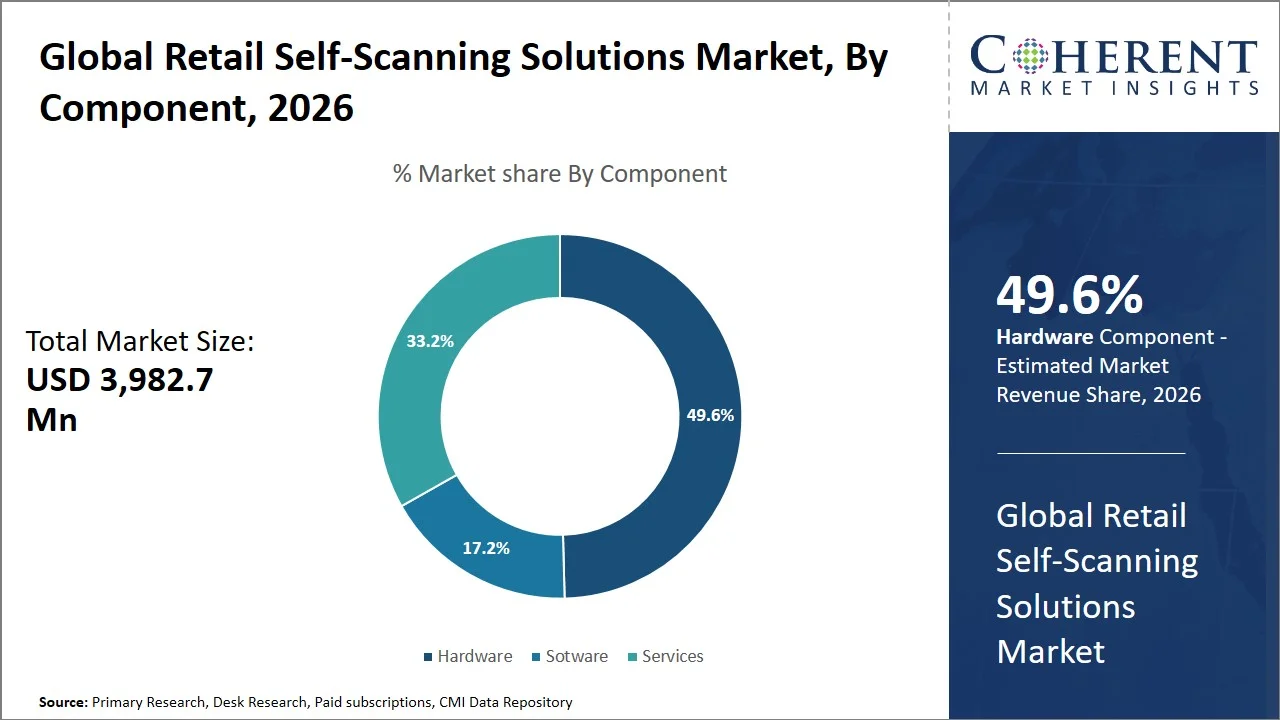
- The hardware segment is expected to account for 49.6 % of the global retail self-scanning solutions market share in 2026. Increasing integration with computer vision and smart carts are major factors driving the segment growth. On July 1, 2025, Instacart announced the launch of Caper Carts, Instacart's AI-powered smart carts, at Wegmans Dewitt in New York, U.S. (Source: Instacart)
- The fixed-position self-scanning kiosks segment is estimated to capture 86.2 % of the market share in 2026. Steady development of RFID-enabled autonomous checkout has boosted the use of fixed-position kiosks. In January 2026, Amazon announced an upgraded line of RFID checkout lanes, which can be deployed in hours, with the intent to use them for festivals, pop-up shops and other temporary retail locations. (Source: Yahoo Finance)
- The cashless model segment is projected to hold 70.3 % of the global retail self-scanning solutions market share in 2026. The increasing adoption of UPI payments and mobile wallets are pushing the demand for the cashless model. On December 8, 2025, an International Monetary Fund (IMF) report on Growing Retail Digital Payments recognized Unified Payments Interface (UPI) as the world’s largest retail fast-payment system (FPS) by transaction volume. (Source: PIB)
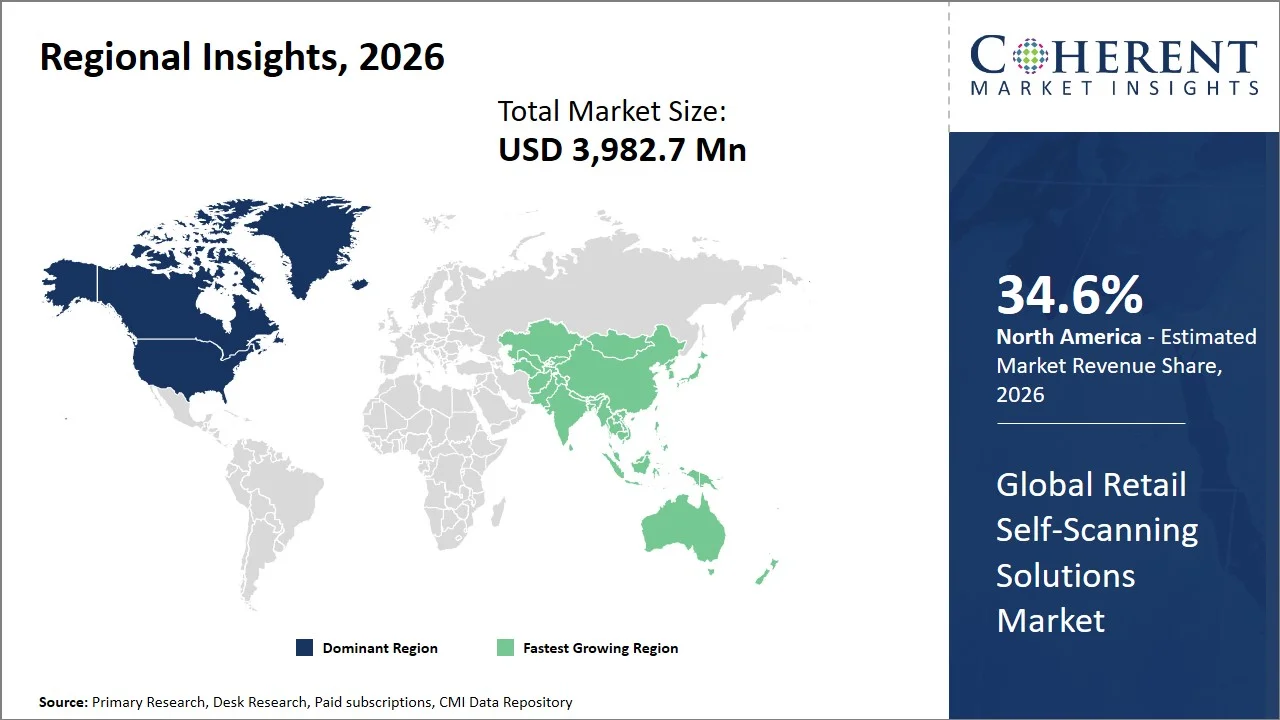
- North America is expected to account for 34.6 % share in 2026. The expansion of supermarkets in the region is a key driver. On April 16, 2026, Walmart announced a new expansion cycle that includes opening around 20 new stores in the U.S. while remodeling over 650 existing locations, marking a renewed push in physical supermarket growth after years of slower expansion. (Source: Walmart)
- Asia Pacific is expected to account for 23.4 % share in 2026 and is projected to record the fastest growth over the forecast period. Growing consumer awareness and requirement for contactless shopping is driving growth in Asia Pacific. On December 18, 2024, Lawson launched its smart stores in collaboration with Cloudpick where AI cameras track product selection, digital screens provide recommendations, and checkout is handled through automated systems and avatar-based payment assistance. (Source: Cloudpick)
- Increasing Shift Toward Cloud-Based Retail Platforms: Retailers are increasingly adopting cloud-based self-scanning and checkout management platforms to improve scalability, centralized monitoring, and data management.
- Integration of Smart Carts and RFID Technology: Smart retail carts equipped with sensors, RFID readers, and automated billing capabilities are becoming an emerging trend in modern retail stores.
Segmental Insights
Why Does the Hardware Segment Dominate the Global Retail Self-Scanning Solutions Market?
The hardware segment is expected to account for 49.6% of the global retail self-scanning solutions market share in 2026. Increasing integration and use of smart carts is expected to drive the growth of the hardware segment over the forecast period. On April 17, 2024, Amazon announced it will begin selling its smart grocery carts to other retailers, marking its latest bid to turn its Dash Cart technology into a service. Amazon launched the Dash Cart in its Fresh supermarket chain before adding it to select Whole Foods stores. They use a combination of computer vision and sensors to identify items as they’re placed in bags inside the cart. (Source: CNBC)
- Current Industry Events of 2026
- Market Size Estimation
- Regional Breakdown
- Competitive Landscape
- Customer Intelligence
- Segmental Analysis
- Pricing Analysis
- Key Market Drivers, Challenges & Future Trends
- Customized Insights Section
Why are Fixed-Position Self-Scanning Kiosks the Most Preferred Product Type?
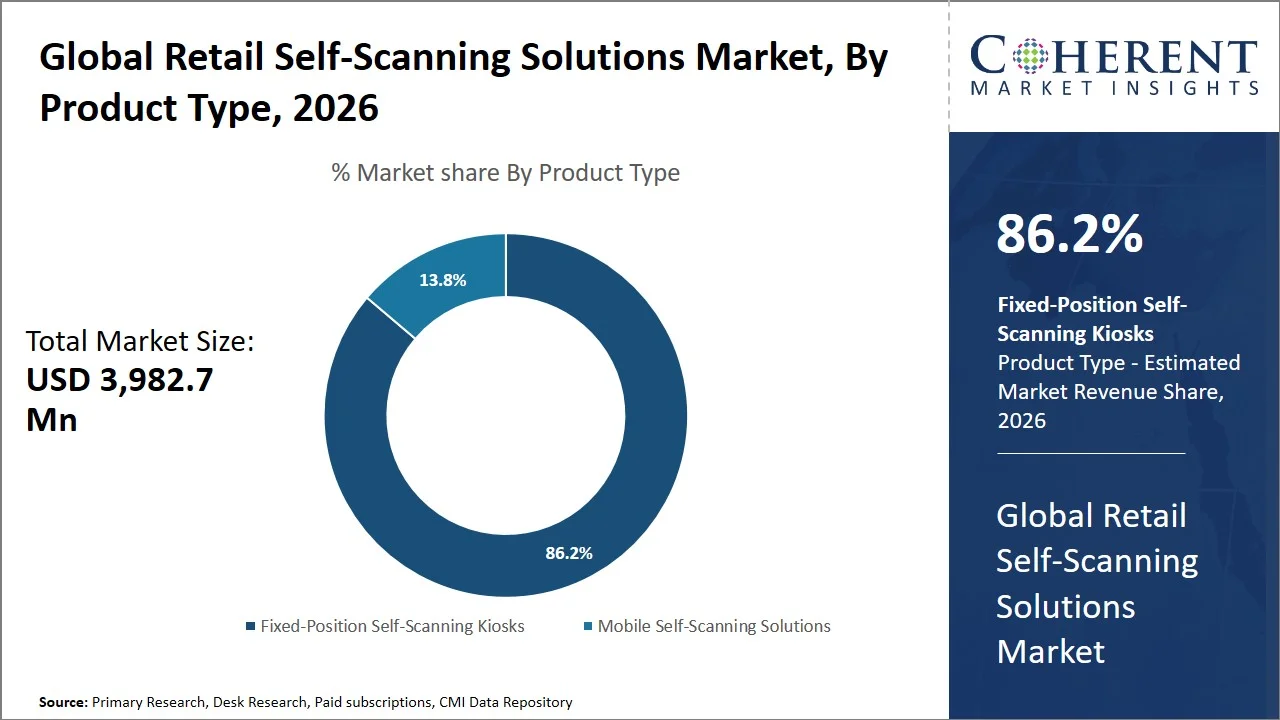
The fixed-position self-scanning kiosks segment is expected to account for 86.2% of the global retail self-scanning solutions market share in 2026. Multiple retail chains across the world have adopted the use of RFID-enable autonomous checkout systems, which, in turn, is creating demand for fixed-position self-scanning kiosks equipped with these systems. On February 3, 2026, Checkpoint announced the launch of SFERO RFID Checkout, a world first RFID Electronic Article Surveillance (EAS) antenna integrated directly into the checkout lane. The innovation expands the SFERO portfolio and extends RFID enabled protection to the point of sale, bringing deterrence and detection to the checkout area. (Source: WiOT)
Cashless Model Segment Dominates the Global Retail Self-Scanning Solutions Market
The cashless model segment is expected to account for 70.3% of the global retail self-scanning solutions market share in 2026. A considerable number of consumers across the world have shifted to UPI and digital payments. This is a major factor providing impetus to the cashless model. On April 6, 2026, a Wordline report highlighted that Indian Unified Payments Interface (UPI) processed USD 228.5 billion transactions in 2025, marking a 33% year-on-year increase.
(Source: Worldline)
Currents Events and their Impact
Current Events | Description and its Impact |
EU AI Act (European Union) |
|
(Source: EU AI ACT)
Global Retail Self-Scanning Solutions Market Dynamics
Market Drivers
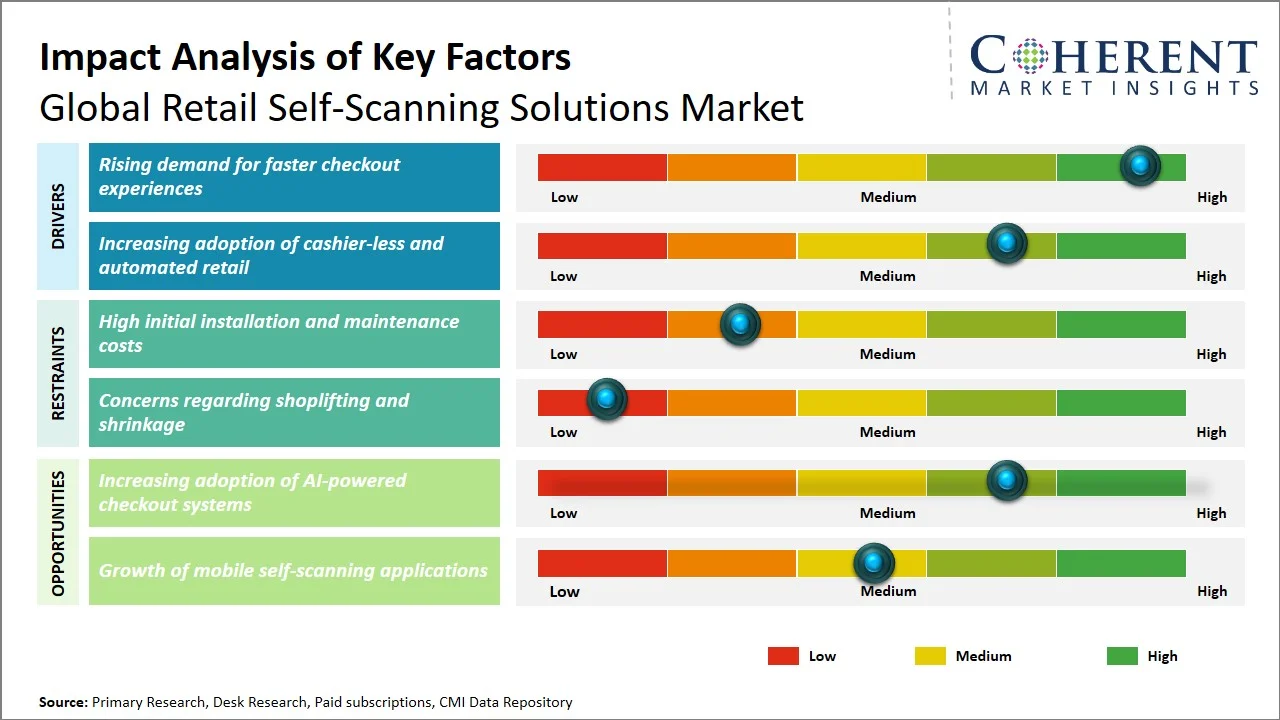
- Rising demand for faster checkout experiences: Now moving toward faster service, retail spaces adopt scanning systems to ease checkout flow. As lines form less often, customers rely on portable devices or mobile software to settle purchases mid-visit. Guided by tech-enhanced carts, individuals navigate store layouts while selections register automatically. Bypassing traditional staff-assisted lanes, some opt for machine-driven processes when traffic peaks. When machines take over scanning, work gets done faster. Owing to this, people can focus on different duties. Lines at checkout grow shorter because of these changes.
- Increasing adoption of cashier-less and automated retail: Owing to growing demand for automation, retail spaces increasingly adopt self-scanning tools that reduce reliance on traditional checkouts. With advancements in artificial intelligence alongside image detection methods, shops process purchases using fewer staff members than before. Radio-based tagging combined with sensor networks allows seamless tracking during customer visits. These setups operate efficiently due to real-time data analysis built into everyday hardware components. On January 23, 2024, 7-Eleven Singapore launched its Shop & Go cashier-less store at Esplanade MRT station, using AI, smart cameras, and multi-sensor fusion to track products and automatically charge customers as they exit without a checkout counter. (Source: The Online Citizen)
Emerging Trends
- Growing Adoption of AI and Computer Vision Technologies: Retailers are increasingly integrating artificial intelligence and computer vision into self-scanning systems to improve product recognition, automate checkout processes, and reduce theft or scanning errors.
- Expansion of Mobile Scan-and-Go Solutions: The use of smartphone-based self-scanning applications are rapidly increasing as consumers prefer convenient and contactless shopping methods. Retailers are launching mobile scan-and-go platforms that allow customers to scan products, make digital payments, and complete purchases without visiting traditional checkout counters.
Regional Insights
Why is North America a Strong Market for Retail Self-Scanning Solutions?
North America is expected to account for a market share of 34.6% in 2026. North America represents a mature and innovation-driven market for retail self-scanning solutions due to the strong presence of large supermarket chains, advanced retail infrastructure, and early adoption of automation technologies. Retailers across the region are heavily investing in AI-powered self-checkout kiosks, smart carts, and cashier-less store concepts to address rising labor costs and changing consumer shopping preferences. The region also benefits from widespread digital payment adoption and strong investment in retail analytics and cloud-based store management systems.
On April 25, 2026, Kroger announced plans to supersize three local stores into its jumbo Marketplace format, relocating and enlarging supermarkets in West Chester, Hamilton and Cold Spring, as part of its USD 129 million spending plan in suburban Cincinnati, U.S. (Source: Cincinnati)
Why Does the Asia Pacific Retail Self-Scanning Solutions Market Exhibit High Growth?
Asia Pacific is expected to account for a market share of 23.4% in 2026 and is expected to register the fastest growth rate over the forecast period. The Asia Pacific retail self-scanning solutions market is witnessing rapid expansion due to increasing urbanization, rising smartphone penetration, and the fast growth of organized retail sectors across countries such as Japan, South Korea, China, and India. Retailers in the region are increasingly introducing mobile-based scan-and-go applications and compact self-checkout systems to manage growing customer volumes efficiently. The rising popularity of smart retail stores and government support for digital transformation initiatives are further accelerating market growth across Asia Pacific.
On February 27, 2026, Fujitsu Limited and H2O Retailing Corporation announced the successful implementation of a wireless tablet POS system utilizing Fujitsu's POS solution across all 15 Hankyu Hanshin Department Stores. This initiative marks one of the largest deployments of a tablet POS system in a department store in Japan, with approximately 5,000 tablet units introduced in non-food sales areas and about 400 dedicated POS units in food sales areas. (Source: Fujitsu)
Why is the U.S. Emerging as a Major Hub in the Retail Self-Scanning Solutions Market?
The U.S. is highly advanced, with major retailers actively deploying AI-enabled self-checkout systems and autonomous retail technologies to improve operational efficiency and customer convenience. Large retail chains are integrating computer vision, RFID, and machine learning technologies to minimize shrinkage and improve transaction accuracy. The increasing demand for frictionless shopping experiences and the expansion of cashier-less convenience stores are strongly contributing to the market growth in the country.
Is China the Next Growth Engine for the Retail Self-Scanning Solutions Market?
Swift growth marks China’s path in adopting self-scan systems for retail, powered by rising numbers of smart outlets and common phone-based transactions using QR symbols. Instead of older models, major retailers partnered with technology builders prioritize funding spaces where facial recognition handles payment alongside responsive digital checkouts. Shoppers’ habits favoring virtual routes push installation of such features throughout city hubs. Since internet buying fits easily into everyday life, residents accept new scanning options without pause. Within this setting lies open space for future upgrades in scanning - guided by how people act and what support structures exist.
Germany Retail Self-Scanning Solutions Market Analysis and Trends
With efficiency at the forefront, German retailers increasingly turn to self-scanning technology. Automation being key in today's market, shops equip staff and customers with portable scanning devices along with machine-run payment systems. Customer queues shrink under these changes - still, strict privacy standards stay firmly upheld. Thus, operational improvements take shape while legal requirements hold steady. With this change underway, systems using RFID for inventory slowly become more common, offering improved oversight of products. Driven by environmental priorities, enhancements influence the development of scan tools across retail spaces.
In India, retail shops increasingly use self-scanning devices, influenced by the spread of organized chains across big cities and towns. As smartphone ownership rises, so does reliance on digital payment methods like UPI - guiding stores to link mobile scans with smooth checkout processes. This shift unfolds not just because systems improve, yet also due to evolving customer behavior - quicker service now holds greater weight. Large stores and supermarkets adjust floor plans deliberately, aiming for smoother movement and operational ease. Under such forces, forward motion emerges without fanfare, shaped by quiet accumulation rather than sudden leaps.
Global Retail Self-Scanning Solutions Market - Shrinkage, Fraud & Missed Scan Intelligence
Metric | Entity | Typical Range (Modern Retail Systems) |
Intentional theft rate (shrinkage due to fraud) | Deliberate non-scanning or switching items | ~0.3% – 1.5% of transactions in high-traffic stores |
Accidental non-scan frequency | Items missed due to user error | ~1.5% – 4% of items per basket (lower in RFID-enabled systems) |
Weight mismatch incidents | Difference between expected vs actual weight in bagging area | ~0.5% – 2% of transactions (self-checkout lanes) |
AI fraud-detection intervention rate | % of transactions flagged by AI for review | ~2% – 6% of all transactions (varies by retailer risk profile) |
Basket-risk scoring accuracy | AI confidence in predicting fraud risk | 80% – 95% classification accuracy in advanced systems |
How is Increasing Adoption of AI-Powered Checkout Systems Creating New Growth Opportunities in the Global Retail Self-Scanning Solutions Market?
As artificial intelligence appears more often at checkouts, chances grow in retail areas using self-scan systems, shopping moves faster, feels simpler. Item recognition gets better through machine learning; errors drop, theft control improves, inventory updates gain sharpness from instant analysis. In spaces where such technology works, shops either reduce cashier roles or function alone, lowering staff costs while lifting everyday output. Even as pace rises, correctness remains when smart systems manage tasks. On January 7, 2026, NCR Voyix Corp. announced the launch of its next-generation portfolio of microservices-based applications. Built on the Voyix Commerce Platform, it represents the culmination of NCR Voyix’s software modernization strategy, transforming how retail and restaurant businesses deliver seamless experiences across every channel and format. (Source: NCR Voyix)
Market Players, Key Development, and Competitive Intelligence
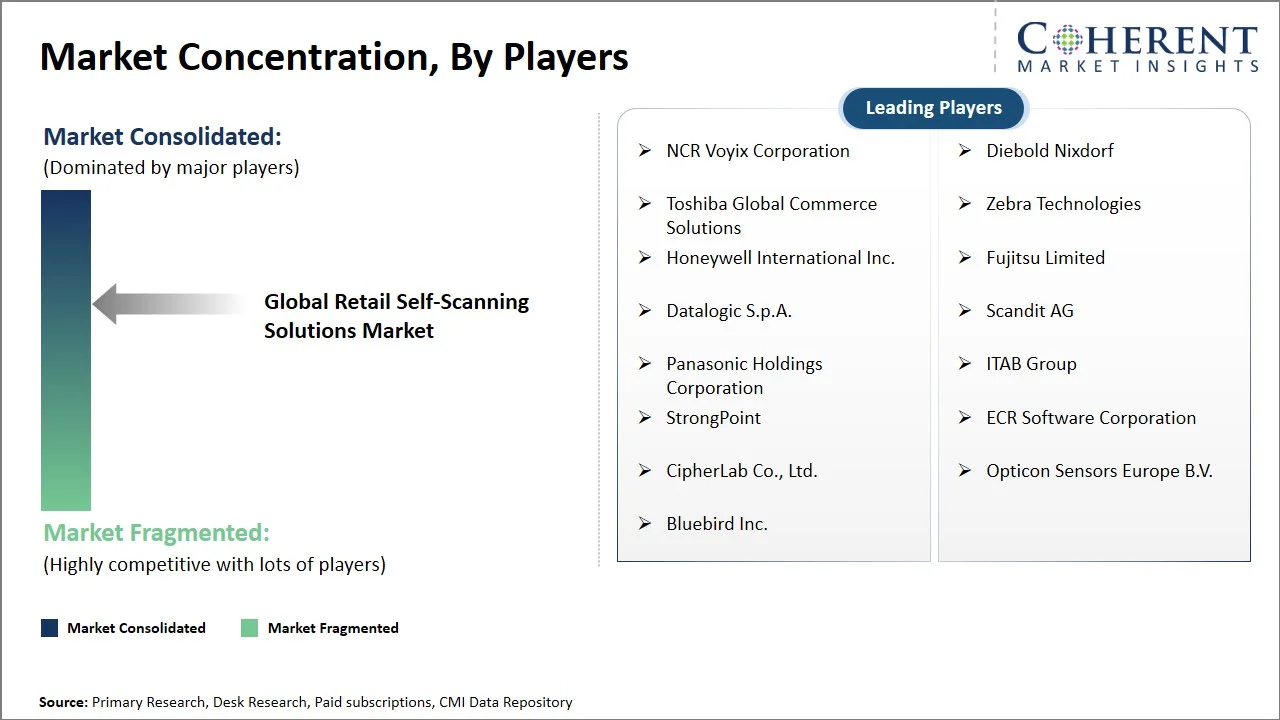
Key Developments
- On October 9, 2025, Toshiba Global Commerce Solutions announced it will showcase how technology, design, and data are reshaping the convenience retail industry, from October 14-17, 2025, at the 2025 National Association of Convenience Stores (NACS) Show, in Chicago, U.S. The portfolio includes Next-generation Point-of-Sale (POS) solutions, including the new TCx 620, TCx 820, and TCx️ Touch Displays, ELERA Loss Prevention, which gives retailers real-time insights to combat shrink and increase checkout speed and optimized self-service with the MxP Vision Kiosk for grab-and-go technology that is fast and secure.
- On August 5, 2025, Zebra Technologies Corporation announced it has entered into a definitive agreement to acquire Elo Touch Solutions, Inc., an innovator of solutions that engage customers, enhance self-service, and accelerate automation across retail, hospitality, quick service restaurants (QSR), healthcare, and industrial markets for USD 1.3 billion.
Competitive Landscape
The global retail self-scanning solutions market is highly competitive and moderately fragmented, with the presence of several international and regional technology providers competing through innovation, strategic partnerships, and product expansion. Major companies such as NCR Voyix Corporation, Diebold Nixdorf, Zebra Technologies, Fujitsu Limited, and Honeywell International Inc. are focusing on AI-enabled self-checkout systems, mobile scan-and-go platforms, and advanced loss-prevention technologies to strengthen their market positions. Companies are increasingly investing in cloud-based retail platforms, RFID integration, and smart analytics to improve customer experience and operational efficiency. Strategic collaborations, acquisitions, and continuous technological innovation remain key competitive strategies shaping the market landscape.
Market Report Scope
Retail Self-Scanning Solutions Market Report Coverage
| Report Coverage | Details | ||
|---|---|---|---|
| Base Year: | 2025 | Market Size in 2026: | USD 3,982.7 Mn |
| Historical Data for: | 2020 To 2024 | Forecast Period: | 2026 To 2033 |
| Forecast Period 2026 to 2033 CAGR: | 13.7% | 2033 Value Projection: | USD 9,806.1 Mn |
| Geographies covered: |
| ||
| Segments covered: |
| ||
| Companies covered: | NCR Voyix Corporation, Diebold Nixdorf, Toshiba Global Commerce Solutions, Zebra Technologies, Honeywell International Inc., Fujitsu Limited, Datalogic S.p.A., Scandit AG, Panasonic Holdings Corporation, ITAB Group, StrongPoint, ECR Software Corporation, CipherLab Co., Ltd., Opticon Sensors Europe B.V., and Bluebird Inc. | ||
| Growth Drivers: |
| ||
| Restraints & Challenges: |
| ||
Analyst Opinion (Expert Opinion)
- The retail self-scanning solutions market will continue to expand steadily due to the rising demand for frictionless and contactless shopping experiences. Growing labor shortages, increasing operational costs, and rapid digital transformation in the retail sector are encouraging retailers to adopt automated checkout technologies. It can be also observed that mobile-based self-scanning and AI-powered checkout solutions are becoming major trends, particularly among large retail chains and urban supermarkets. However, concerns regarding theft, cybersecurity risks, and consumer adaptation challenges may slightly limit adoption rates, prompting companies to invest heavily in smarter security and monitoring systems.
- The future of the retail self-scanning solutions market appears highly promising, supported by continuous advancements in artificial intelligence, computer vision, RFID technology, and cloud computing. The market is expected to witness strong growth as retailers increasingly deploy autonomous checkout systems, smart carts, and mobile self-scanning applications to improve convenience and reduce checkout times. Emerging economies in Asia Pacific, particularly India and China, are likely to create significant growth opportunities due to expanding retail infrastructure and increasing smartphone penetration. Additionally, the integration of advanced computer vision and deep learning technologies are expected to improve scanning accuracy, reduce shrinkage, and accelerate the development of cashier-less retail environments in the coming years.
Speak to the analyst
Want personalized insights?
Take the findings above to one of our principal consultants, or have the report rebuilt around the segments, geographies and competitors you actually track.
Market Segmentation
- Component Insights (Revenue, USD Million, 2021 - 2033)
- Hardware
- Kiosk Scanner Devices
- Single-Plane Kiosk Scanners
- Multi-Plane (Bioptic) Kiosk Scanners
- Presentation Kiosk Scanners
- Dedicated / Retailer-Supplied Mobile Devices
- Smart-Cart Units
- Kiosk Terminals / Display + Controller
- Payment Units
- Kiosk Cabinet / Enclosure
- Receipt Printer
- Others (Scale / Bagging Hardware, Power & Internal Electronics, Mounting / Wiring / Minor Internal Hardware, Embedded Scan Modules, Network & Accessories)
- Kiosk Scanner Devices
- Software
- Scanning & Decoding Software
- Computer Vision Software
- POS & Payment Integration Software
- Store Operations & Workflow Software
- Others (Analytics & Dashboard Software, etc.)
- Services
- Managed Services
- Professional Services
- Hardware
- Product Type Insights (Revenue, USD Million, 2021 - 2033)
- Fixed-Position Self-Scanning Kiosks
- Single-Plane Self-Scanning Kiosks
- Multi-Plane Self-Scanning Kiosks
- Presentation Self-Scanning Kiosks
- Mobile Self-Scanning Solutions
- Dedicated Mobile Self-Scanning Devices
- Smartphone-Based Self-Scanning
- Smart-Cart-Based Self-Scanning
- Fixed-Position Self-Scanning Kiosks
- Model Type Insights (Revenue, USD Million, 2021 - 2033)
- Cash Model
- Cashless Model
- Technology Insights (Revenue, USD Million, 2021 - 2033)
- Barcode Scanning (1D/2D)
- RFID-Based Scanning
- Computer Vision and AI Scanning
- Retail Format Insights (Revenue, USD Million, 2021 - 2033)
- Supermarkets & Hypermarkets
- Convenience Stores
- Specialty and Discount Stores
- Department Stores
- Warehouse Clubs
- Pharmacies & Drugstores
- Regional Insights (Revenue, USD Million, 2021 - 2033)
- North America
- U.S.
- Canada
- Latin America
- Brazil
- Argentina
- Mexico
- Rest of Latin America
- Europe
- Germany
- U.K.
- Spain
- France
- Italy
- Russia
- Rest of Europe
- Asia Pacific
- China
- India
- Japan
- Australia
- South Korea
- ASEAN
- Rest of Asia Pacific
- Middle East
- GCC Countries
- Israel
- Rest of Middle East
- Africa
- South Africa
- North Africa
- Central Africa
- North America
- Key Players Insights
- NCR Voyix Corporation
- Diebold Nixdorf
- Toshiba Global Commerce Solutions
- Zebra Technologies
- Honeywell International Inc.
- Fujitsu Limited
- Datalogic S.p.A.
- Scandit AG
- Panasonic Holdings Corporation
- ITAB Group
- StrongPoint
- ECR Software Corporation
- CipherLab Co., Ltd.
- Opticon Sensors Europe B.V.
- Bluebird Inc.
Sources
Primary Research Interviews
- Retail Technology Directors and IT Managers
- Self-Scanning Solution Providers and Technology Vendors
- Store Operations Managers and Customer Experience Leaders
- Retail Industry Consultants and System Integrators
Magazines
- Retail Technology Review
- Progressive Grocer
- Chain Store Age
- Retail Customer Experience Magazine
Journals
- Journal of Retailing and Consumer Services
- International Journal of Retail & Distribution Management
- Journal of Business Research
- Others
Associations
- National Retail Federation (NRF)
- Retail Industry Leaders Association (RILA)
- Food Marketing Institute (FMI)
- International Association of Department Stores (IADS)
Public Domain Sources
- Company Annual Reports and SEC Filings
- Government Statistical Offices and Trade Departments
- Industry White Papers and Case Studies
- Patent Databases and Technology Publications
Proprietary Elements
- CMI Data Analytics Tool
- Proprietary CMI Existing Repository of information for last 10 years
Get access to 250+ pages report
Every segment, forecast, competitor profile and data table behind the analysis above — available for instant download.
- ESOMAR Member
- ISO 9001:2015 Certified
- D-U-N-S Registered
- GDPR & CCPA Compliant
Missing comfort of reading report in your local language? Find your preferred language:
Transform your Strategy with Exclusive Trending Reports
Frequently Asked Questions
The global retail self-scanning solutions market is expected to stand at USD 3,982.7 Mn in 2026 and is expected to reach USD 9,806.1 Mn by 2033.
The CAGR of the global retail self-scanning solutions market is projected to be 13.7% from 2026 to 2033.
Rising demand for faster checkout experiences and increasing adoption of cashier-less and automated retail are the major factors driving the growth of the global retail self-scanning solutions market.
High initial installation and maintenance costs and concerns regarding shoplifting and shrinkage are the major factors hampering the growth of the global retail self-scanning solutions market.
In terms of component, hardware is estimated to dominate the market revenue share in 2026.
Small retailers can adopt them, although high initial investment may be a limitation.
RFID improves product tracking accuracy and speeds up the checkout process.