

Global Robot Charging Station Market Size and Forecast – 2026-2033
The Global Robot Charging Station Market is estimated to be valued at USD 1.53 billion in 2026 and is expected to reach USD 5.83 billion by 2033, exhibiting a compound annual growth rate (CAGR) of 21.1% from 2026 to 2033.
Key Takeaways of the Robot Charging Station Market:
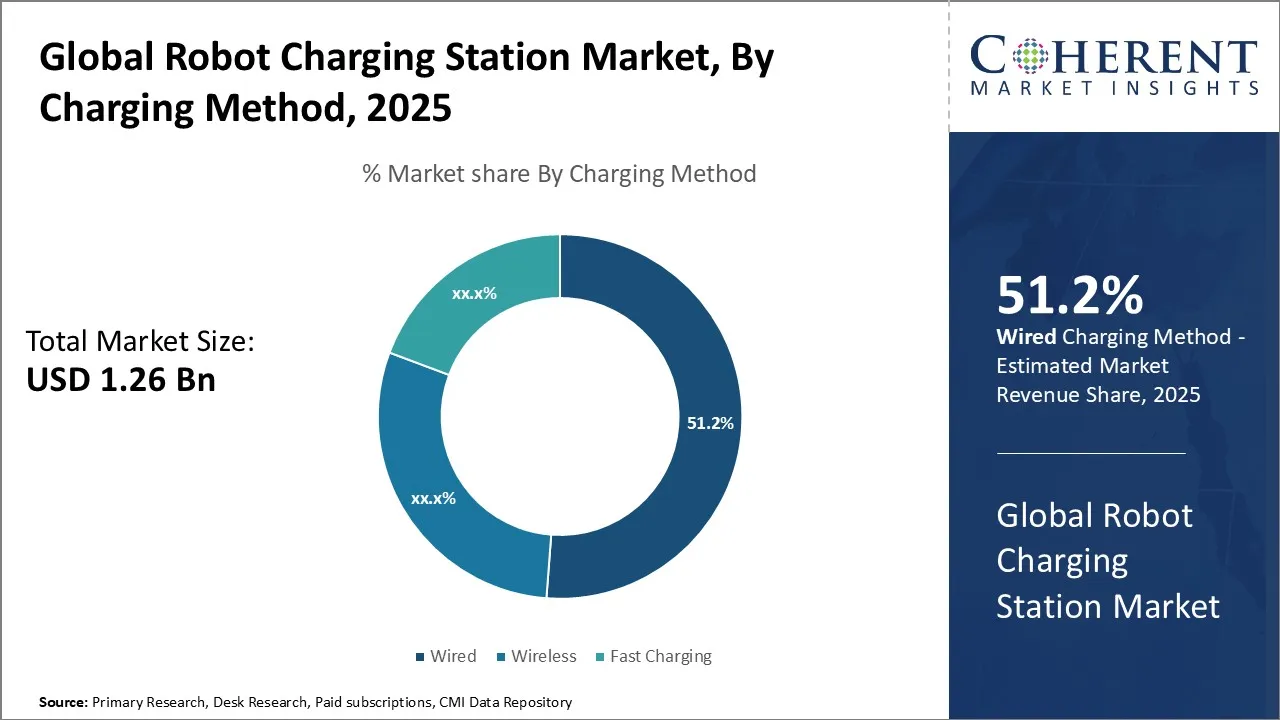
- The wired segment leads the market, holding an estimated share of 52.2% in 2026.
- Asia Pacific is estimated to lead the market with a share of 34. 8% in 2026.
- Latin America, holding a share of 10. 3% in 2026, is projected to be the fastest growing region.
- Increasing automation in logistics/manufacturing and the integration of AI technologies are major drivers for the market.
Market Overview:
The market is seeing a lot of technological advancements with the development of wireless charging solutions, fast-charging capabilities, and intelligent charging management systems. Key trends include the integration of IoT-enabled charging stations that provide real-time monitoring and predictive maintenance, and the emergence of standardized charging protocols across different robot manufacturers.
Current Events and their Impact:
Current Events | Description and its impact |
Advancements in Charging Technology Systems |
|
Government Regulatory and Policy Initiatives Supporting Robotics Infrastructure |
|
Segmental Analysis
- Current Industry Events of 2026
- Market Size Estimation
- Regional Breakdown
- Competitive Landscape
- Customer Intelligence
- Segmental Analysis
- Pricing Analysis
- Key Market Drivers, Challenges & Future Trends
- Customized Insights Section
Global Robot Charging Station Market Insights, by Charging Method – Established Infrastructure and Reliability Drive Wired Charging Dominance
The wired segment is expected to contribute the highest share of 52.2% in the robot charging station market in 2026. The primary driver behind wired charging's market leadership is its exceptional charging efficiency and consistent power delivery. Wired charging systems provide direct electrical contact, eliminating energy losses associated with electromagnetic field transmission, and leading to faster charging cycles.
Also, wired charging stations need simpler technology components and manufacturing processes compared to their wireless counterparts, resulting in lower initial investment costs for businesses. As wired systems have fewer complex electronic components that could potentially malfunction, the maintenance needed is also minimal, reducing long-term operational expenses. Also, most existing facilities already have the electrical infrastructure required to support wired charging systems, eliminating the need for extensive retrofitting or specialized installation procedures.
Impact of AI on the Robot Charging Station Market
Artificial Intelligence (AI) is significantly transforming the robot charging station market by enabling smarter, more autonomous charging systems. Traditional charging docks required manual intervention or basic scheduling, but AI allows for dynamic fleet management, where multiple autonomous robots can self-schedule charging based on task load, energy consumption, and real-time operational priorities.
WiBotic's intelligent charging platform uses AI to manage wireless charging for fleets of drones and mobile robots. Its system analyzes usage patterns and battery health to determine the optimal time and duration for charging each unit, reducing unnecessary charge cycles and maximizing uptime.
Regional Insights:
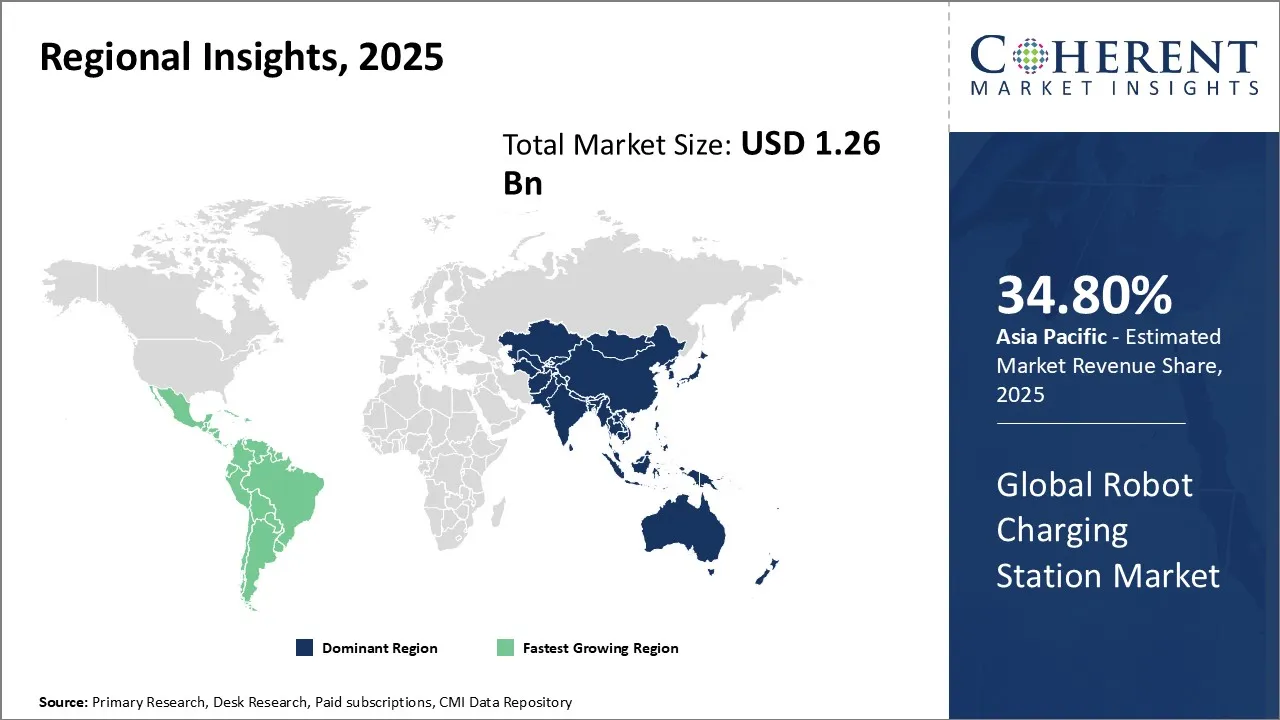
Asia Pacific Robot Charging Station Market Analysis and Trends
The Asia Pacific region, holding a share of 34.8% in 2026, is expected to exhibit the fastest growth in the Robot Charging Station Market, resulting from rapid industrialization, massive manufacturing expansions, and aggressive automation adoption across emerging economies. Government initiatives such as China's "Made in China 2026", have added to the adoption of robotics, making a lot of demand for supporting infrastructure, including charging stations.
Notable companies, including Foxconn, SoftBank Robotics, Fanuc, WiBotic, and ABB, have established strong regional presence, contributing to market growth through localized manufacturing and strategic partnerships. In Japan, researchers at Waseda University, in collaboration with global wireless charging firm, WiBotic, developed an AI-powered wireless charging system for indoor autonomous robots.
Latin America Robot Charging Station Market Analysis and Trends
Latin America, holding a share of 10.3% in 2026, is expected to exhibit the fastest growth in the robot charging station market. Expanding e-commerce operations and last-mile delivery networks are prompting regional players to adopt Autonomous Mobile Robots (AMRs) and AGVs, driving the demand for flexible and cost-effective charging infrastructure. For instance, Mercado Libre’s automated distribution centers in Brazil utilize fleets of AMRs for order fulfillment.
Governments across the region are also supporting digital transformation and Industry 4.0 initiatives through public-private partnerships and incentives for smart warehousing and automation projects. Companies such as Smartech Automation (Brazil) are innovating with AI-driven autonomous docking platforms for indoor and outdoor mobile robots, enabling efficient and affordable charging in facilities with limited infrastructure. Multinational firms like ABB and Siemens are increasingly collaborating with local integrators to deploy tailored robotic charging systems in industrial zones, further catalyzing market development across Latin America.
Robot Charging Station Market Outlook for Key Countries
U.S. Robot Charging Station Market Analysis and Trends
The U.S. shows high industrial automation adoption and a lot of investments in robotic infrastructure. Major players, including Tesla, Amazon, and Honeywell, have established comprehensive charging solutions catering to diverse industrial applications. The country's focus on reshoring manufacturing activities has added to this automation adoption, creating demand for reliable charging infrastructure. Also, tax incentives and research grants by governments has encouraged innovation in wireless charging technologies and smart energy management systems.
China Robot Charging Station Market Analysis and Trends
China is supported by massive manufacturing capabilities and government-backed automation initiatives. Companies like BYD, Geely, and numerous local robotics manufacturers have developed cost-effective charging solutions tailored to domestic market needs. The country's focus on becoming a global robotics leader has resulted in substantial investments in charging infrastructure across manufacturing, logistics, and service sectors. China's Belt and Road Initiative has created additional opportunities for charging station deployment in international projects.
Germany Robot Charging Station Market Analysis and Trends
Germany has a strong industrial base and shows emphasis on Industry 4.0 initiatives. Companies such as Siemens, Bosch, and KUKA have developed sophisticated charging solutions integrated with advanced manufacturing systems. The country leads the automotive, pushing innovation in robotic charging technologies, particularly for assembly line applications.
Market Players, Key Development, and Competitive Intelligence:
Key Developments:
- In March 2024, Autocar, LLC, a manufacturer of severe-duty vocational trucks carrying the first specialized truck brand in North America, announced its collaboration with Rocsys, the charging platform globally transforming mobility, to bring hands-free charging capabilities for Autocar’s electric terminal tractors. This strategic alliance marks an industry first with the operational deployment of terminal tractors powered by hands-free charging at distribution centers, inland ports, and other logistics facilities.
- In July 2022, Ford started testing a prototype robot charging station aimed at making the top-up process easier for folks with limited mobility
Top Strategies Followed by Global Robot Charging Station Market Players
- Established Players: Leading companies in the robot charging station market prioritize substantial research and development investments to maintain their competitive edge.
- ABB Ltd has invested heavily in developing autonomous robotic solutions, including smart charging arms integrated with AI and computer vision, enabling hands-free EV and robot charging in industrial setups.
- Mid-Level Players: Mid-tier companies focus on delivering quality charging solutions at competitive price points to capture price-sensitive market segments.
- EVAR Inc., a South Korean startup spun off from Samsung C-Lab, introduced compact, portable robot charging units with real-time monitoring, priced lower than global offerings.
- Small-Scale Players: Smaller players carve out market positions by focusing on specialized applications such as medical robots, agricultural automation, or specific industrial processes.
- WiBotic, a U.S.-based but globally operating company with deployments in Asia Pacific, specializes in wireless charging systems for drones and autonomous underwater robots.
Market Report Scope
Robot Charging Station Market Report Coverage
| Report Coverage | Details | ||
|---|---|---|---|
| Base Year: | 2025 | Market Size in 2026: | USD 1.53 Bn |
| Historical Data for: | 2020 To 2024 | Forecast Period: | 2026 To 2033 |
| Forecast Period 2026 to 2033 CAGR: | 21.1% | 2033 Value Projection: | USD 5.83 Bn |
| Geographies covered: |
| ||
| Segments covered: |
| ||
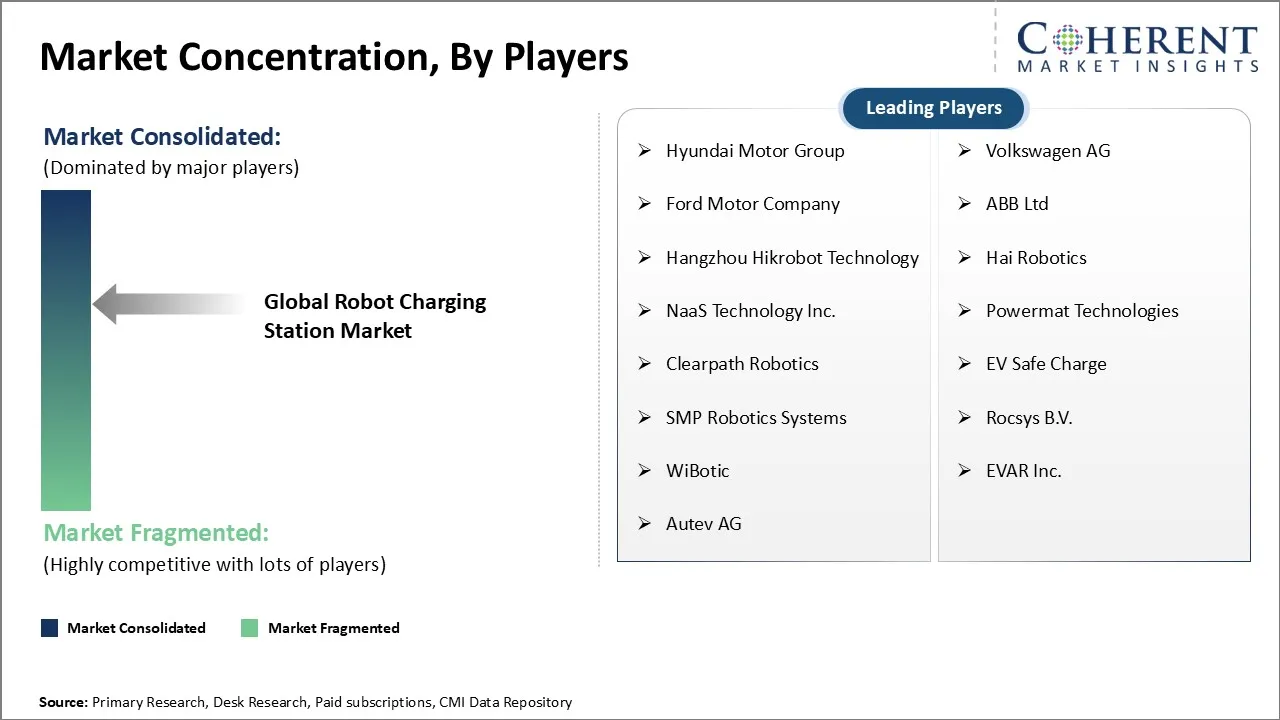
| Companies covered: | Hyundai Motor Group, Volkswagen AG, Ford Motor Company, ABB Ltd, Hangzhou Hikrobot Technology, Hai Robotics, NaaS Technology Inc., Powermat Technologies, Clearpath Robotics, EV Safe Charge, SMP Robotics Systems, Rocsys B.V., WiBotic, EVAR Inc., and Autev AG | ||
| Growth Drivers: |
| ||
| Restraints & Challenges: |
| ||
Market Dynamics
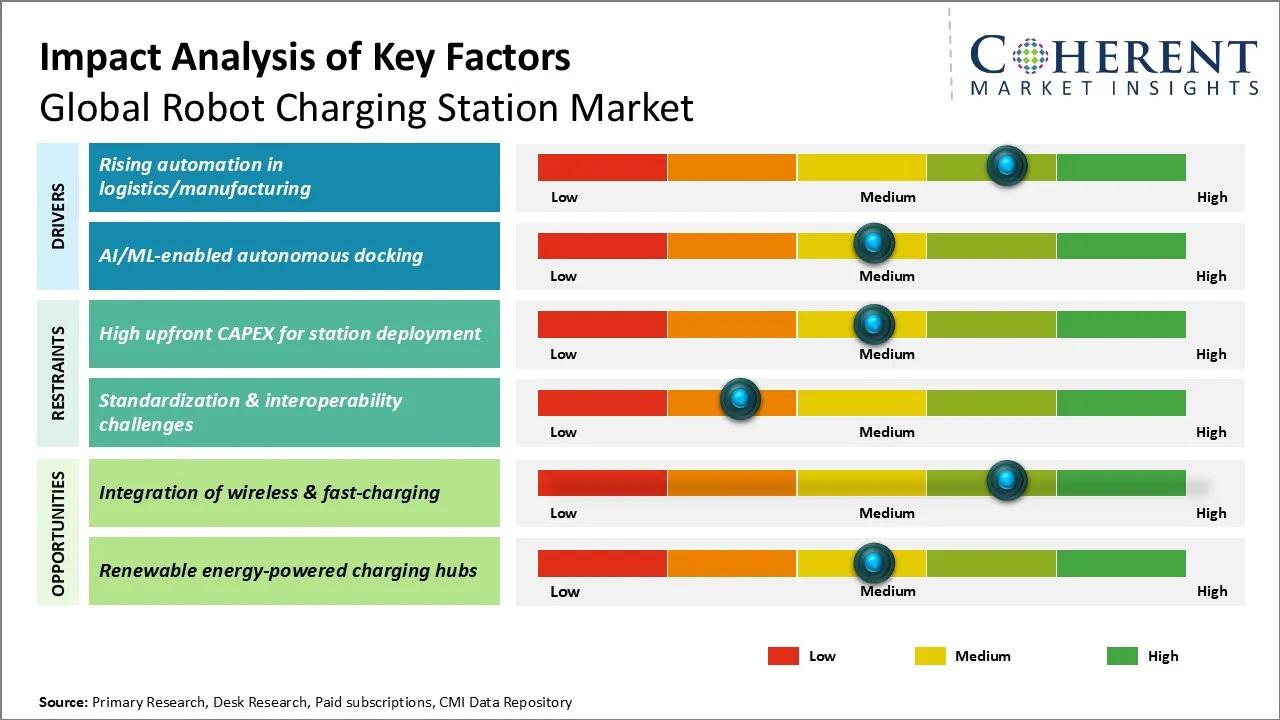
Global Robot Charging Station Market Driver - Rising Automation in Logistics/Manufacturing
Companies are using autonomous mobile robots (AMRs), automated guided vehicles (AGVs), and collaborative robots to streamline warehouse operations, optimize material handling, and improve production line efficiency. Amazon Robotics has rapidly scaled its deployment of Autonomous Mobile Robots (AMRs) across fulfillment centers globally, with over 750,000 robots in operation as of 2024. Manufacturing facilities are using robotic systems for assembly, packaging, and quality control processes, while logistics centers use autonomous robots for inventory management, order fulfillment, and goods transportation. Modern industrial environments are becoming complex, creating a need for sophisticated charging stations to accommodate different robot types.
Global Robot Charging Station Market Opportunity – Integration of Wireless & Fast-Charging Technologies
Wireless charging technology removes physical connector wear, reduces maintenance requirements, and makes possible seamless autonomous charging without human intervention. Fast-charging helps maintain critical operational continuity concerns by minimizing robot downtime, enabling higher fleet utilization rates, and supporting continuous manufacturing processes. This technological combination opens new market segments, including outdoor robotics, healthcare automation, and logistics applications, where frequent charging cycles are essential.
Market leaders investing in wireless fast-charging solutions can capture premium pricing opportunities while differentiating their offerings in an increasingly competitive landscape. Rocsys B.V., in collaboration with Port of Rotterdam, has deployed robotic arms with wireless and automated fast-charging capabilities for port logistics vehicles and autonomous robots. The technology advancement also enables innovative charging station designs, including embedded floor systems and mobile charging units, expanding deployment possibilities across diverse operational environments. Furthermore, the integration supports Industry 4.0 initiatives by enabling intelligent charging management, predictive maintenance, and real-time fleet optimization.
Analyst Opinion (Expert Opinion):
- Advanced AI integration is revolutionizing charging logistics by enabling robots to independently schedule, locate, and dock at charging stations based on predictive energy analytics. This shift is critical for scaling AMR fleets in high-throughput environments like e-commerce warehouses and smart factories.
- As operations move toward flexibility and uninterrupted workflows, wireless and inductive charging technologies are emerging as key differentiators. Companies like WiBotic and Rocsys are setting the pace with scalable, interference-free systems that reduce mechanical wear and maximize uptime.
- The integration of edge computing with charging stations allows for real-time monitoring, load balancing, and anomaly detection. These capabilities, combined with IoT sensors, enable dynamic fleet energy management and open doors to grid-integrated robotic ecosystems in smart cities.
Speak to the analyst
Want personalized insights?
Take the findings above to one of our principal consultants, or have the report rebuilt around the segments, geographies and competitors you actually track.
Market Segmentation
- Charging Method Insights (Revenue, USD Bn, 2021 - 2033)
- Wired
- Wireless
- Fast Charging
- Regional Insights (Revenue, USD Bn, 2021 - 2033)
- North America
- U.S.
- Canada
- Latin America
- Brazil
- Argentina
- Mexico
- Rest of Latin America
- Europe
- Germany
- U.K.
- Spain
- France
- Italy
- Russia
- Rest of Europe
- Asia Pacific
- China
- India
- Japan
- Australia
- South Korea
- ASEAN
- Rest of Asia Pacific
- Middle East
- GCC Countries
- Israel
- Rest of Middle East
- Africa
- South Africa
- North Africa
- Central Africa
- North America
- Key Players Insights
- Hyundai Motor Group
- Volkswagen AG
- Ford Motor Company
- ABB Ltd
- Hangzhou Hikrobot Technology
- Hai Robotics
- NaaS Technology Inc.
- Powermat Technologies
- Clearpath Robotics
- EV Safe Charge
- SMP Robotics Systems
- Rocsys B.V.
- WiBotic
- EVAR Inc.
- Autev AG
Sources
Primary Research Interviews:
Stakeholders:
- Robotics OEMs and Automation Integrators (e.g., system engineers, product developers)
- Robot Fleet Operators and Warehouse Automation Managers (e.g., Amazon, JD Logistics, Flipkart)
- Charging Station Technology Providers and Engineering Leads
- Industrial Facility Managers in Logistics, Healthcare, and Manufacturing
- AI and IoT Integration Consultants
- Electrical Infrastructure and Energy Storage Experts
- Government Smart City Project Planners
Databases:
- Robotics Deployment Tracker – Asia Robotics Alliance
- Global Industrial Automation Dashboard (GIAD)
- Smart Factory Data Repository – Korea Smart Manufacturing Council
- U.S. Energy & Industrial Efficiency Index
- Latin American Robotics Growth Outlook Database (LARGOD)
Magazines:
- Robotics & Autonomous Systems Digest
- Smart Automation World
- Mobile Robotics News Weekly
- Charging Infrastructure Today
- NextGen Logistics Review
Journals:
- Journal of Robotics and Autonomous Systems
- Journal of Intelligent Transportation and Mobility Systems
- International Journal of Industrial Automation and Control
- Robotics and Smart Infrastructure Review
- Journal of Wireless Power and Charging Systems
Newspapers:
- The Robotics Times (Singapore)
- The Santiago Industry Daily (Chile)
- Nikkei Robotics & AI Insights (Japan)
- The Economic Chronicle (India)
- Global Automation News (U.K.)
Associations:
- International Federation of Robotics (IFR)
- Asia-Pacific Automation Alliance (APAA)
- Latin American Smart Logistics Association (LASLA)
- Global Autonomous Vehicle Charging Network (GAVCN)
- Wireless Power Consortium for Robotics (WPCR)
Public Domain Sources:
- U.S. Census Bureau
- EUROSTAT
- World Bank
- United Nations Industrial Development Organization (UNIDO)
- ResearchGate
Proprietary Elements:
- CMI Data Analytics Tool, Proprietary CMI Existing Repository of Information for Last 8 Years
Get access to 250+ pages report
Every segment, forecast, competitor profile and data table behind the analysis above — available for instant download.
- ESOMAR Member
- ISO 9001:2015 Certified
- D-U-N-S Registered
- GDPR & CCPA Compliant
Missing comfort of reading report in your local language? Find your preferred language:
Transform your Strategy with Exclusive Trending Reports
Frequently Asked Questions
The global robot charging station market is estimated to be valued at USD 1.53 billion in 2026 and is expected to reach USD 5.83 billion by 2033.
The CAGR of the global robot charging station market is projected to be 21.1% from 2026 to 2033.
Rising automation in logistics/manufacturing and AI/ML-enabled autonomous docking are the major factors driving the growth of the global robot charging station market.
High upfront CAPEX for station deployment and standardization & interoperability challenges are the major factors hampering the growth of the global robot charging station market.
In terms of charging method, the wired segment is estimated to dominate the market revenue share in 2026.
Hyundai Motor Group, Volkswagen AG, Ford Motor Company, ABB Ltd, Hangzhou Hikrobot Technology, Hai Robotics, NaaS Technology Inc., Powermat Technologies, Clearpath Robotics, EV Safe Charge, SMP Robotics Systems, Rocsys B.V., WiBotic, EVAR Inc., and Autev AG are the major players operating in the global robot charging station market.
Asia Pacific is expected to lead the global robot charging station market in 2026.