

Sapphire Ingot Market Size and Share Analysis- 2026 To 2033
The Sapphire Ingot Market is expected to grow at a CAGR of 5.0%, to reach USD 5.63 Bn in 2026 and is anticipated to reach USD 7.94 Bn by 2033. Some of the key factors driving the market are increasing demand for sapphire substrates in LED manufacturing, growing adoption of sapphire components in smartphones, smartwatches and other consumer electronics, expanding applications in semiconductor manufacturing and increasing demand for high-performance optical materials in aerospace, defense, and medical industries. According to Kyocera Corporation, single-crystal sapphire is widely used as a substrate material for blue, green, ultraviolet and white LEDs because of its excellent thermal and chemical stability and suitability for gallium nitride (GaN) deposition, creating growth opportunities in advanced electronics, optoelectronics, semiconductor devices and precision optical applications.
Key Takeaways
- The ultraviolet grade (UV) sapphire ingot segment is estimated to dominate the market with a share of 58% in 2026. The segment’s growth is backed by growing demand for UV-compatible optical components, high purity sapphire substrates, semiconductor processing equipment and advanced sensing applications. Kyocera Corporation says that single-crystal sapphire has high optical transmission over UV and IR wavelengths, and that specialized products are available to maintain stable transmission under deep-UV exposure, and can be used in optical sensing and precision instrumentation.
- The smartphones segment is expected to hold an estimated share of 46% by 2026. The segment growth is driven by the demand for scratch resistant camera protection components, durable display-related materials, premium smartphone designs and high strength optical components. Global smartphone shipments in 2025 were around 1.25 Bn units, a 2% increase from the previous year and the highest annual shipment volume since 2021.
- Asia Pacific is expected to account for a significant 43% share of the sapphire ingot market in 2026. Regional growth is supported by the concentration of LED manufacturing, semiconductor fabrication, consumer electronics production, and sapphire crystal processing facilities in China, Japan, South Korea, and Taiwan. According to PwC’s Semiconductor and Beyond 2026 report, Asia Pacific is projected to account for approximately 69% of global semiconductor equipment spending during 2024–2030, with China, Taiwan, South Korea, and Japan collectively representing around USD 746 Bn in investments.
Market Drivers
Growing Adoption of Advanced LED Technologies is Driving the Sapphire Ingot Market
The global sapphire ingot market is witnessing steady growth owing to increasing demand for high-quality sapphire substrates used in LED manufacturing, optoelectronics, and advanced display technologies. Sapphire substrates offer excellent thermal stability, optical transparency, and mechanical strength, making them suitable for gallium nitride (GaN)-based LED production. The growing adoption of Mini LED and Micro LED technologies across televisions, automotive displays, smartwatches, and other electronic devices is creating opportunities for sapphire ingot manufacturers.
In February 2026, global Micro LED display revenue is projected to increase from USD 52.4 million in 2025 to USD 105.4 million in 2026, representing approximately 100% annual growth. This expansion in advanced LED technologies is expected to support demand for suitable crystal substrates, including sapphire, particularly where GaN-on-sapphire manufacturing processes are used.
Expansion of Semiconductor Manufacturing and Advanced Electronics is Supporting the Sapphire Ingot Market
The sapphire ingot market is benefiting from increasing investment in semiconductor manufacturing, industrial electronics, and high-performance optical components. Sapphire's electrical insulation, chemical resistance, and mechanical durability make it suitable for selected semiconductor equipment components, specialized electronic substrates, and precision optical applications. Rising investments in advanced manufacturing facilities and growing demand for high-purity materials are encouraging sapphire ingot manufacturers to improve crystal growth technologies and production efficiency.
According to SEMI's July 2026 forecast, global semiconductor manufacturing equipment sales are projected to reach USD 165.9 billion in 2026, increasing by 23.2% year-over-year. Also, wafer fabrication equipment sales are projected to reach USD 143.9 billion by 2026, driven by investments in advanced memory, logic fabrication and AI-related semiconductor infrastructure.
Additionally, in April 2026, SEMI stated that global semiconductor equipment sales increased 15% to USD 135.1 billion in 2025 compared to USD 117.1 billion in 2024. The increase is a result of continued investment in semiconductor production capacity and technology upgrades. These developments should create opportunities for sapphire ingots for use in specialized semiconductor processing equipment, insulating components and optical systems, although sapphire is not the primary substrate material for mainstream silicon chip fabrication.
Current Events and Their Impact on the Sapphire Ingot Market
Current Event | Description and its Impact |
India Expands Electronics Component Manufacturing Scheme with INR 40,000 Crore Allocation (2026) |
|
European Commission Proposes Chips Act 2.0 to Strengthen Semiconductor Manufacturing and Supply Chain Resilience (June 2026) |
|
- Current Industry Events of 2026
- Market Size Estimation
- Regional Breakdown
- Competitive Landscape
- Customer Intelligence
- Segmental Analysis
- Pricing Analysis
- Key Market Drivers, Challenges & Future Trends
- Customized Insights Section
Segmental Insights
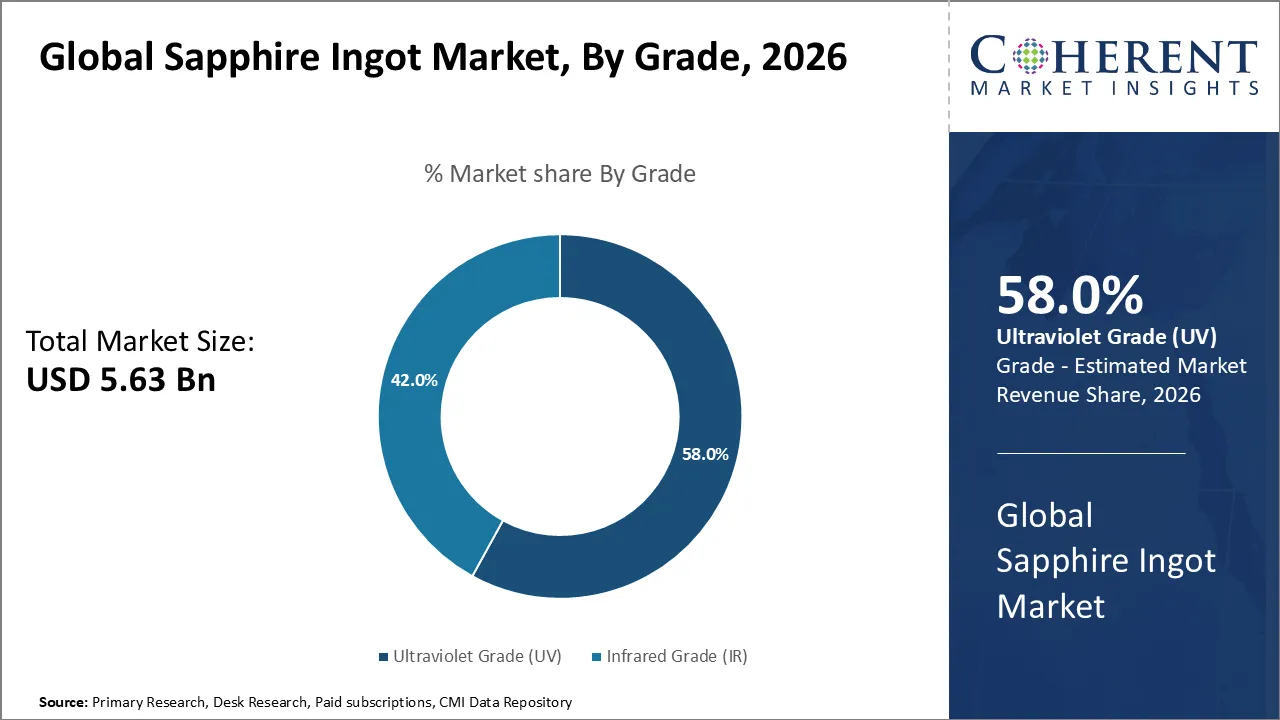
Why is Ultraviolet Grade (UV) Acquiring the Largest Market Share?
On the basis of grade, UV grade segment is anticipated to hold the largest sapphire ingot market share of 58% in 2026 (estimated). The segment is expected to drive high purity optical substrates, UV spectroscopy equipment, semiconductor lithography components, and precision optical instruments. UV grade sapphire boasts high mechanical strength, chemical stability and optical transmission for applications requiring reliable performance under ultraviolet exposure.
In May 2025, KYBURZ SAPPHIRE is used in precision measurement and optical analysis applications operating between 200 and 280 nanometers UV-optimized sapphire. The company tested two types of sapphire materials with cylindrical samples 29 mm in diameter. The company notes that the purity of the crystals and precision polishing are critical for deep-UV transmission.
In August 2026, Meller Optics announced advanced sapphire lenses, windows and prisms for directed-energy laser weapons and military electro-optical systems. The newly introduced sapphire components are anti-reflection coated on both side and provide up to 99% optical transmission over UV to IR wavelengths.
Why Does the Smartphones Segment Hold the Largest Market Share?
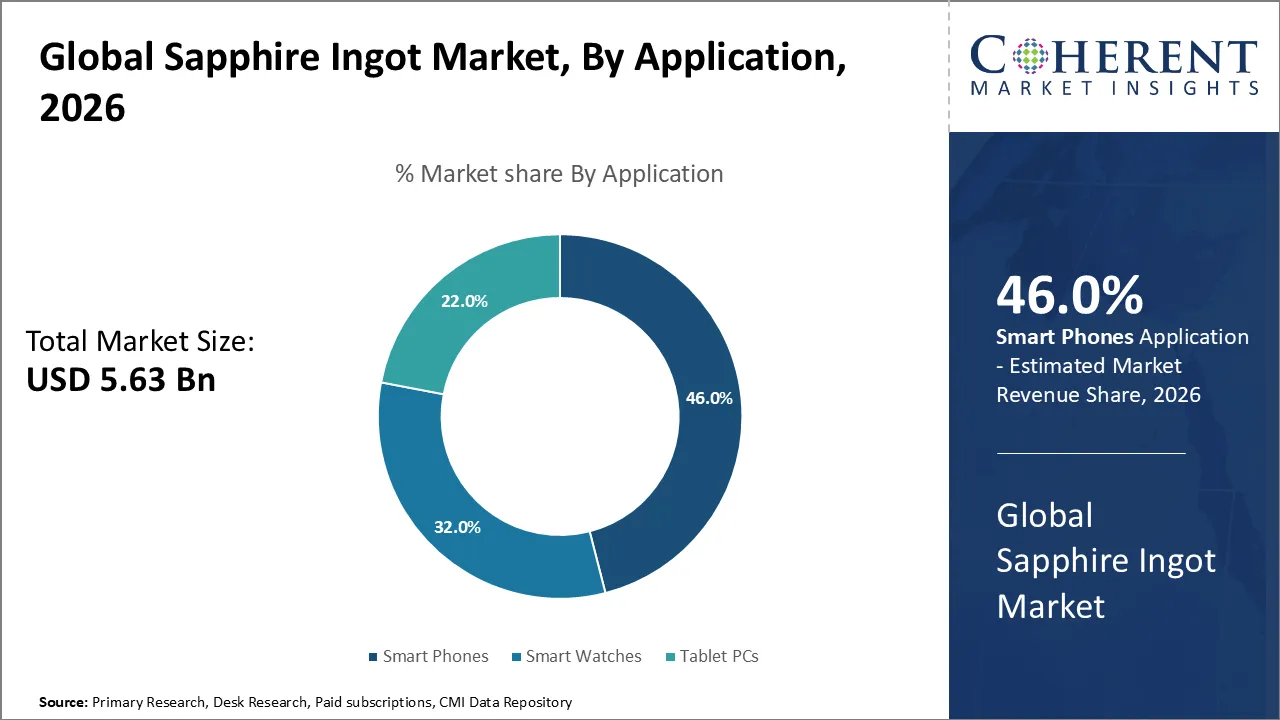
On the basis of application, the smartphones segment is projected to lead the sapphire ingot market with an estimated 46% share in 2026. The segment’s growth is supported by increasing adoption of scratch-resistant camera lens covers, premium smartphone components, and advanced optical protection materials. Sapphire's high hardness, transparency, and durability make it suitable for protecting smartphone camera systems from scratches and everyday wear.
According to Apple's September 2026 technical specifications, the newly introduced iPhone 18 Pro and iPhone 18 Pro Max feature sapphire crystal lens covers alongside advanced 48MP main, ultra-wide, and telephoto camera systems. This demonstrates the continued adoption of sapphire components in premium smartphones despite advancements in alternative display protection materials.
In September 2026, iKKO showcased its MindOne Pro smartphone at IFA 2026, featuring a sapphire crystal-protected AMOLED display. The smartphone incorporates a 4-inch AMOLED screen with a 90Hz refresh rate, sapphire glass protection, and a 50MP Sony camera with 180-degree rotation.
Sapphire Ingot Market Trends
- The rising adoption of high-purity sapphire substrates in LED manufacturing and advanced semiconductor applications is encouraging manufacturers to improve crystal quality, wafer uniformity, and production efficiency. According to Kyocera Corporation, sapphire substrates used for gallium nitride (GaN) crystal growth are available in sizes of up to 6 inches, supporting the industry's focus on larger substrates for LED production.
- The growing emphasis on large-diameter sapphire crystal manufacturing is accelerating technological innovation and improving the scalability of sapphire ingot production. In August 2026, China's Jingsheng Electromechanical developed the capability to produce 1,000-kilogram-class synthetic sapphire crystals using the Kyropoulos method, following earlier developments involving 300 kg, 450 kg, and 750 kg crystals. This advancement highlights the industry's transition toward larger crystal sizes and integrated processing capabilities.
- The increasing focus on domestic sapphire manufacturing and semiconductor material localization is strengthening regional production capabilities. In July 2026, Polymatech Electronics commissioned a sapphire ingot crystal-growth puller in Chennai, India, designed to produce 100 mm diameter sapphire ingots. The company indicated a potential output of approximately 18,000 epi-ready sapphire wafers annually per puller, subject to successful qualification and full-capacity operations.
Regional Insights
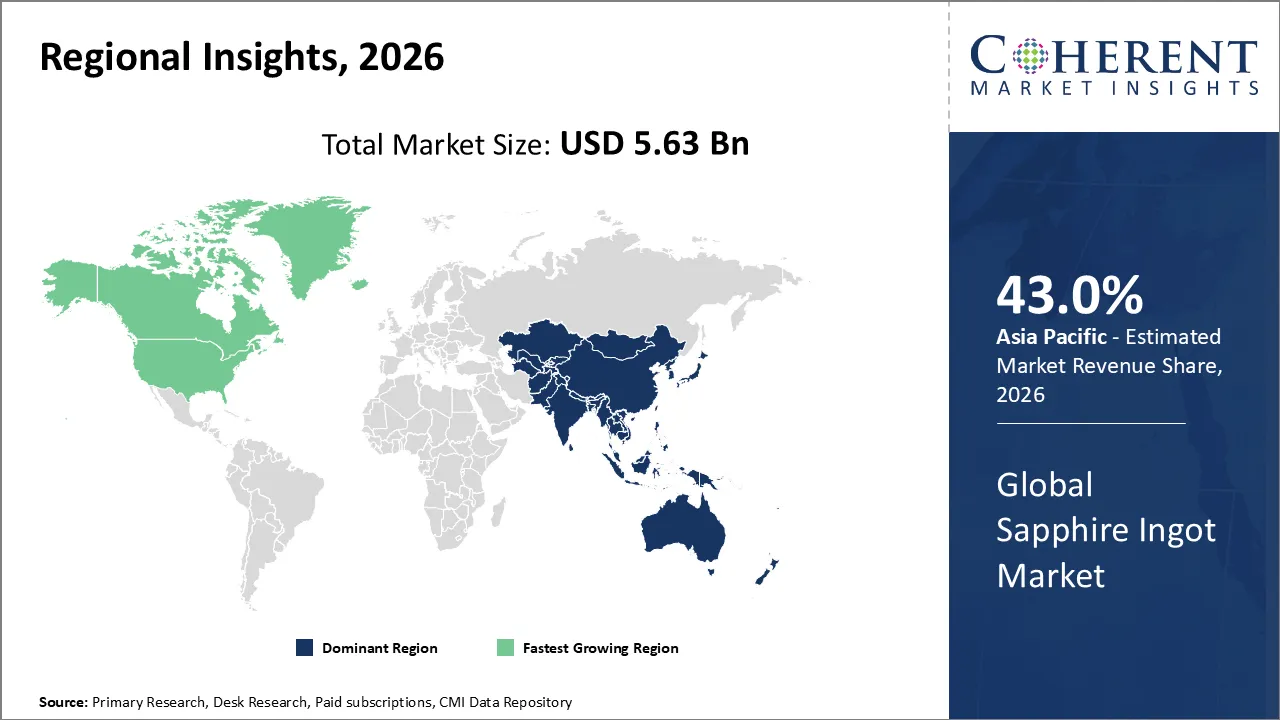
Asia Pacific Dominates Owing to Strong Sapphire Manufacturing and Expanding Electronics Production
The Asia Pacific region is expected to account for the largest sapphire ingot market share of 43% in 2026. The region’s dominance is driven by extensive sapphire crystal manufacturing capabilities, rising demand for LED substrates, and expanding semiconductor and consumer electronics production across China, Japan, South Korea, Taiwan, and India. Increasing investments in high-purity crystal growth technologies and advanced electronics manufacturing are strengthening the region's position in the global sapphire ingot market.
According to China's National Bureau of Statistics, in February 2026, the country produced approximately 484.28 billion integrated circuits in 2025, registering 10.9% year-over-year growth. This expansion highlights China's large-scale electronics manufacturing ecosystem, creating indirect opportunities for specialized sapphire materials used in optoelectronic devices and semiconductor processing equipment.
In October 2026, Australia-based Alpha HPA Limited announced progress in its Alpha Sapphire project, including additional orders for 200 mm sapphire wafers for gallium nitride (GaN)-on-sapphire semiconductor qualification.
North America Sapphire Ingot Market Trends
North America is positioned as the fastest-growing region in the proposed sapphire ingot market forecast for 2026–2033. The region's potential growth is supported by increasing adoption of high-performance sapphire optical materials in aerospace, defense, semiconductor equipment, and advanced sensing technologies. The growing emphasis on domestic specialty-material manufacturing and resilient supply chains is encouraging investment in sapphire crystal processing and precision optical components.
According to the Semiconductor Industry Association (SIA), U.S.-based semiconductor companies invested about USD 76.8 billion in standard 2025, highlighting the industry’s strong commitment to cutting-edge materials, semiconductor technologies and manufacturing innovation. These investments support opportunities for specialized sapphire components used in semiconductor equipment and optical systems.
In addition, SIA said the U.S. semiconductor industry had about USD 425 billion in sales in 2025, or 53.4% of the global semiconductor market. The extensive electronics and semiconductor technology base offers opportunities to suppliers of high-purity sapphire materials for precision optical systems, semiconductor processing equipment and specialized industrial applications.
Strong Defense and Precision Optical Manufacturing Infrastructure is Driving the Sapphire Ingot Market in the United States
The U.S. sapphire ingot market is seeing steady growth, driven by rising demand for high-purity sapphire crystals in aerospace, defense, semiconductor processing, and precision optics applications. The country’s established advanced materials manufacturing ecosystem and increasing focus on domestic sourcing of key optical components are creating opportunities for sapphire ingot suppliers. Sapphire has high mechanical strength, optical transparency and resistance to extreme temperatures, making it suitable for military surveillance systems, laser equipment and advanced sensors.
According to Guild Optical Associates, a U.S.-based precision optical manufacturer, says its 25,000-square-foot manufacturing facility can produce sapphire optical windows from 1 mm up to 17 inches in diameter. The company also makes spherical optical lenses as small as 10 mm, showing a domestic ability to precisely process sapphire for aerospace, defense and industrial applications.
Additionally, the U.S. sapphire production facility in Murrieta, California has enjoyed over seven years of manufacturing development and government-supported capability building, including work that supports the F-35 aircraft program. This underscores the existing domestic manufacturing base for defense-grade sapphire materials.
China Sapphire Ingot Market Trends
China is expected to witness significant growth in the sapphire ingot market during the forecast period. The country's growth is supported by established sapphire crystal manufacturing facilities, expanding LED production, and growing demand for optical components used in consumer electronics, industrial equipment, and precision manufacturing. Increasing emphasis on integrated crystal growth, cutting, polishing, and coating operations is strengthening China's position in the global sapphire supply chain.
According to Baoshi Optical Technology's 2026 company information, the China-based sapphire component manufacturer operates a 12,000-square-meter manufacturing facility in Qingyuan, Guangdong, with more than 200 employees and annual production exceeding 5 million sapphire components.
Additionally, according to China Daily, in August 2026, Chinese sapphire manufacturers are advancing larger-diameter substrate production. Jingsheng Electromechanical has developed sapphire substrates measuring up to 12 inches, alongside commercial production of 4-inch to 8-inch substrates. The development of larger substrates is expected to improve material utilization and support applications requiring larger sapphire wafers.
Who are the Major Companies in Sapphire Ingot Industry
Some of the major key players in Sapphire Ingot Market are Rubicon, Crystal Systems, GTAT, Monocrystal PLC., Saint-Gobain Crystals, Crystal Q, Exiton, Aurora Optoelectronics, Trinity, Silian, Kyocera, and Namiki.
Key News
- In February 2026, Excelitas Technologies announced the completion of its acquisition of Luxium Solutions, a successor business associated with Saint-Gobain Crystals. Luxium specializes in high-performance single-crystal materials, including sapphire and garnet substrates used in precision optics and power electronics.
Market Report Scope
Sapphire Ingot Market Report Coverage
Report Coverage | Details | ||
Base Year: | 2025 | Market Size in 2026: | USD 5.63 Bn |
Historical Data for: | 2020 to 2024 | Forecast Period: | 2026 to 2033 |
CAGR: | 5.0% | 2033 Value Projection: | USD 7.94 Bn |
Geographies covered: |
| ||
Segments covered: |
| ||
Companies covered: | Rubicon, Crystal Systems, GTAT, Monocrystal PLC., Saint-Gobain Crystals, Crystal Q, Exiton, Aurora Optoelectronics, Trinity, Silian, Kyocera, and Namiki. | ||
Growth Drivers: |
| ||
Restraints & Challenges: |
| ||
Analyst Opinion
- Increasing investments in domestic crystal manufacturing and semiconductor material localization are strongly supporting the growth of the sapphire ingot market. Artificial Electronics Intelligent Material Limited, in February 2025, signed an MoU with the Maharashtra Government to establish a sapphire ingot and wafer manufacturing facility in Nagpur with a proposed investment of INR 10,000 crore over a period of five years. This development is indicative of growing industry interest in integrated sapphire production capabilities and reduced dependence on imported semiconductor materials.
- Government-backed semiconductor initiatives and the rising demand for advanced optical materials are driving long-term opportunities for sapphire ingot manufacturers. The government announced Semiconductor Mission 2.0 in 2026 with a focus on semiconductor equipment, materials, research and domestic manufacturing capabilities, the Press Information Bureau of India said. These initiatives are expected to encourage investment in high-purity sapphire crystals for specialized applications in electronics, optical systems and semiconductor processing.
- Advancements in crystal growth technologies and expanding aerospace and defense applications are strengthening long-term commercialization opportunities for sapphire ingot manufacturers. Industry participants, including Kyocera, Rubicon Technology, and Crystal Systems, are involved in sapphire materials and precision optical applications. Sapphire's high hardness, thermal stability, and ultraviolet-to-infrared optical transmission make it suitable for laser systems, infrared sensors, semiconductor equipment, and aerospace components, supporting opportunities for high-performance sapphire crystals.
Speak to the analyst
Want personalized insights?
Take the findings above to one of our principal consultants, or have the report rebuilt around the segments, geographies and competitors you actually track.
Market Segmentation
- By Grade (Revenue, USD Bn, 2021-2033)
- Ultraviolet Grade (UV)
- Infrared Grade (IR)
- By Application (Revenue, USD Bn, 2021-2033)
- Smart Phones
- Smart Watches
- Tablet PCs
- By Region (Revenue, USD Bn, 2021-2033)
- North America
- U.S.
- Canada
- Latin America
- Brazil
- Mexico
- Argentina
- Rest of Latin America
- Europe
- Germany
- U.K.
- France
- Italy
- Spain
- Russia
- Rest of Europe
- Asia Pacific
- China
- India
- Japan
- Australia
- South Korea
- ASEAN
- Rest of Asia Pacific
- Middle East
- GCC
- Israel
- Rest of Middle East
- Africa
- South Africa
- Central Africa
- North Africa
- North America
Sources
Primary Research Interviews
- Sapphire ingot manufacturers and crystal growth technology developers
- Sapphire substrate and wafer processing companies
- Materials scientists and single-crystal sapphire researchers
- R&D heads from sapphire manufacturing and optoelectronics companies
- LED and semiconductor substrate manufacturing experts
- Smartphone, smartwatch, and consumer electronics component procurement managers
- Aerospace, defense, and precision optics industry procurement managers
- Key opinion leaders (KOLs) in sapphire crystal growth and advanced optical materials
Databases
- United Nations Comtrade Database (UN Comtrade)
- World Bank
- United States Geological Survey (USGS)
- National Institute of Standards and Technology (NIST)
- International Trade Centre (ITC Trade Map)
- European Commission – Eurostat
- U.S. International Trade Commission (USITC)
- U.S. Geological Survey – Mineral Commodity Summaries
Magazines
- Semiconductor Today
- Semiconductor Digest
- Compound Semiconductor
- Photonics Spectra
- Laser Focus World
- LED Professional
- Electronic Design
Journals
- Journal of Crystal Growth
- Crystal Research and Technology
- Crystals
- Journal of Materials Science
- Optical Materials
- Materials Science in Semiconductor Processing
- Journal of the American Ceramic Society
- Applied Surface Science
Newspapers
- The Wall Street Journal
- Financial Times
- The Economic Times
- Nikkei Asia
- China Daily
- The Business Times
- The Hindu BusinessLine
Associations
- SEMI – Semiconductor Equipment and Materials International
- International Society for Optics and Photonics (SPIE)
- Optica (formerly Optical Society of America)
- Semiconductor Industry Association (SIA)
- IEEE Photonics Society
- European Photonics Industry Consortium (EPIC)
- Japan Electronics and Information Technology Industries Association (JEITA)
- American Ceramic Society (ACerS)
Public Domain Sources
- Company Annual Reports and Investor Presentations
- Government Semiconductor Manufacturing and Electronics Policy Publications
- Sapphire Crystal Growth and Substrate Manufacturing Research Publications
- University Research Publications on Sapphire Crystal Growth Technologies
- Patent Databases such as WIPO, USPTO, and Google Patents
- Publicly Available LED, Semiconductor, and Optoelectronics Industry Reports
- International Trade Statistics for Synthetic Sapphire, Corundum, and Related Materials
- Regulatory and Standards Publications Related to Optical Materials and Semiconductor Substrates
- Company Product Catalogs, Technical Specifications, and Manufacturing Capacity Announcements
- Government Research and Innovation Publications on Advanced Crystal Materials
Proprietary Elements
- CMI Data Analytics Tool
- Proprietary CMI Existing Repository of Information for the Last 10 Years
Get access to 250+ pages report
Every segment, forecast, competitor profile and data table behind the analysis above — available for instant download.
- ESOMAR Member
- ISO 9001:2015 Certified
- D-U-N-S Registered
- GDPR & CCPA Compliant
Missing comfort of reading report in your local language? Find your preferred language:
Transform your Strategy with Exclusive Trending Reports
Frequently Asked Questions
The Sapphire Ingot Market is expected to reach USD 7.94 Bn in 2033.
Major players operating in the global Sapphire Ingot Market include Rubicon, Crystal Systems, GTAT, Monocrystal PLC., Saint-Gobain Crystals, Crystal Q, Exiton, Aurora Optoelectronics, Trinity, Silian, Kyocera, and Namiki.
High initial investment costs, complex crystal growth processes, high energy consumption, and the availability of alternative substrate materials are the key factors hampering market growth.
The increasing demand for sapphire substrates in LED manufacturing, rising adoption of sapphire components in smartphones and smartwatches, and expanding applications in semiconductor manufacturing and precision optical systems are boosting demand for sapphire ingots.
The Sapphire Ingot Market is anticipated to grow at a CAGR of 5.0% between 2026 and 2033.
Among regions, Asia Pacific is expected to account for the largest market share of approximately 43% in 2026, while North America is projected to witness strong growth during the forecast period.
A sapphire ingot is a large, synthetically grown single crystal of aluminum oxide (Al₂O₃) produced using specialized crystal growth techniques. These ingots are processed into sapphire wafers, substrates, optical windows, and other components used in electronics, semiconductor devices, and precision optical applications.