

Global Optoelectronics Market Size and Forecast – 2026 To 2033
The global optoelectronics market is expected to grow from USD 89 Bn in 2026 to USD 165 Bn by 2033, registering a compound annual growth rate (CAGR) of 9.1% from 2026 to 2033. The global optoelectronics market is driven by the expansion of AI data centers requiring optical interconnects. On March 18, 2024, NVIDIA announced a new wave of networking switches, the X800 series, designed for massive-scale AI. (Source: NVIDIA)
Key Takeaways of the Global Optoelectronics Market
- The LED segment is expected to account for 31.0 % of the global optoelectronics market share in 2026. Rising investments in medical imaging and diagnostic equipment is driving the growth of the LED segment. On February 26, 2025, GE HealthCare unveiled Freelium, a next-generation sealed magnet platform, that aims to enable high-quality Magnetic Resonance (MR) imaging with less than 1% of helium used in conventional magnet technology to help support diagnostic accuracy and sustainability goals. (Source: GE Healthcare)
- The silicon segment is estimated to capture 33.0 % of the market share in 2026. Growing demand for energy-efficient materials for consumer electronics is majorly driving the growth of the segment. On October 9, 2025, Intel revealed the architectural details for the company’s next generation client processor Intel Core Ultra series 3, code-named Panther Lake. (Source: Intel)
- The consumer electronics segment is estimated to capture 27.0 % of the market share in 2026. Increasing deployment of image sensors in smartphones is driving the growth of the segment. On April 10, 2025, OMNIVISION launched its new OV50X CMOS image sensor with the mobile phone industry’s highest dynamic range, for movie-grade video capture. (Source: OMNIVISION)
- Asia Pacific is expected to dominate the optoelectronics market in 2026 with a market share of 45.0 %. Rising adoption of optical communication in hyperscale data centers in Asia Pacific is driving the growth of the regional market. On January 13, 2026, NTT DATA, Sumitomo Corporation and JA Mitsui Leasing, Ltd. announced that they will establish a new company, Intra-Asia Marine Networks Co., Ltd. (I-AM NW), to construct and operate a large-scale communication cable, Intra-Asia Marine Cable (I-AM Cable), connecting Japan, Malaysia and Singapore, with additional connectivity to South Korea, the Philippines and Taiwan.
- North America is expected to account for 27.0 % share in 2026 and is projected to record the fastest growth over the forecast period. Growth of autonomous vehicles and advanced driver assistance systems in North America is driving the growth of the regional market. On June 24, 2026, Zoox announced it would ramp up production of its bespoke robotaxis to as many as 100 vehicles a week at its California plant to enable expansion into more U.S. cities.
- Increasing adoption of Hall current sensors in high-voltage electric vehicle platforms: The shift to 800 V and higher-voltage electric vehicle architectures is the driving demand for Hall current sensors that offer accurate, electrically isolated current measurement in high-power operating conditions. Manufacturers are designing sensors with increased bandwidth, thermal stability, and functional safety characteristics to enable traction inverters, onboard chargers, DC-DC converters, and battery management systems.
- Growing use of coreless and compact Hall current sensor technologies: Manufacturers are launching coreless Hall current sensors that eliminate the need for magnetic cores and provide excellent measurement accuracy and fast response times. Their compact designs result in smaller size, lower weight and less manufacturing complexity, making them more suited for applications such as automotive electronics, industrial motors, renewable energy converters and space-constrained power electronic systems.
Segmental Insights
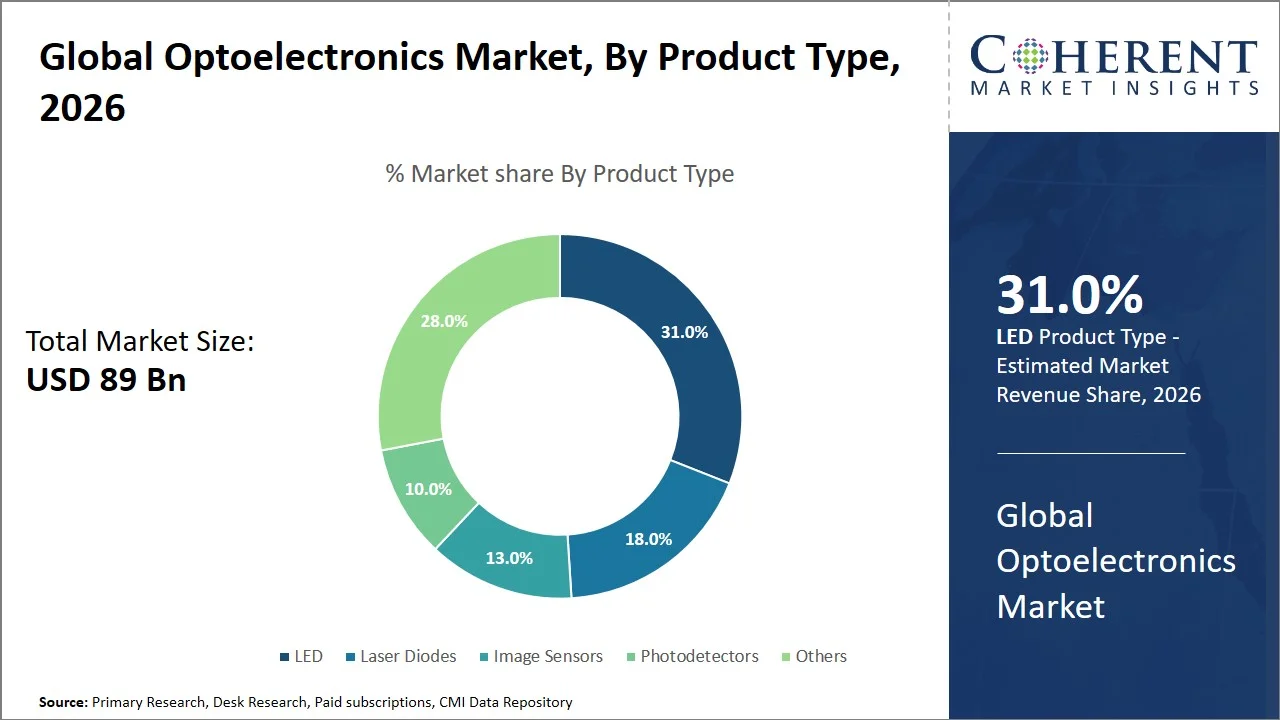
Why Does LED Dominate the Global Optoelectronics Market?
The LED segment is expected to account for 31.0% of the global optoelectronics market share in 2026. LED technology has become widely adopted, mainly because of its better energy efficiency and long lifespan, compared to traditional lighting technologies. LEDs consume much less electricity and provide excellent luminous efficacy, less heat generation and maintenance free performance for longer working times therefore making them a favored choice for residential, commercial, industrial and outdoor lighting applications. Their compatibility with smart lighting systems, small size and ability to allow sophisticated features such as dimming, color tuning and intelligent controls further enhance their adoption in infrastructure projects, automotive lighting, consumer electronics and display technologies. On June 12, 2026, Signify announced the expansion of its professional lighting line with outdoor specification luminaires.
- Current Industry Events of 2026
- Market Size Estimation
- Regional Breakdown
- Competitive Landscape
- Customer Intelligence
- Segmental Analysis
- Pricing Analysis
- Key Market Drivers, Challenges & Future Trends
- Customized Insights Section
Why is Silicon the Most Preferred Material Type?
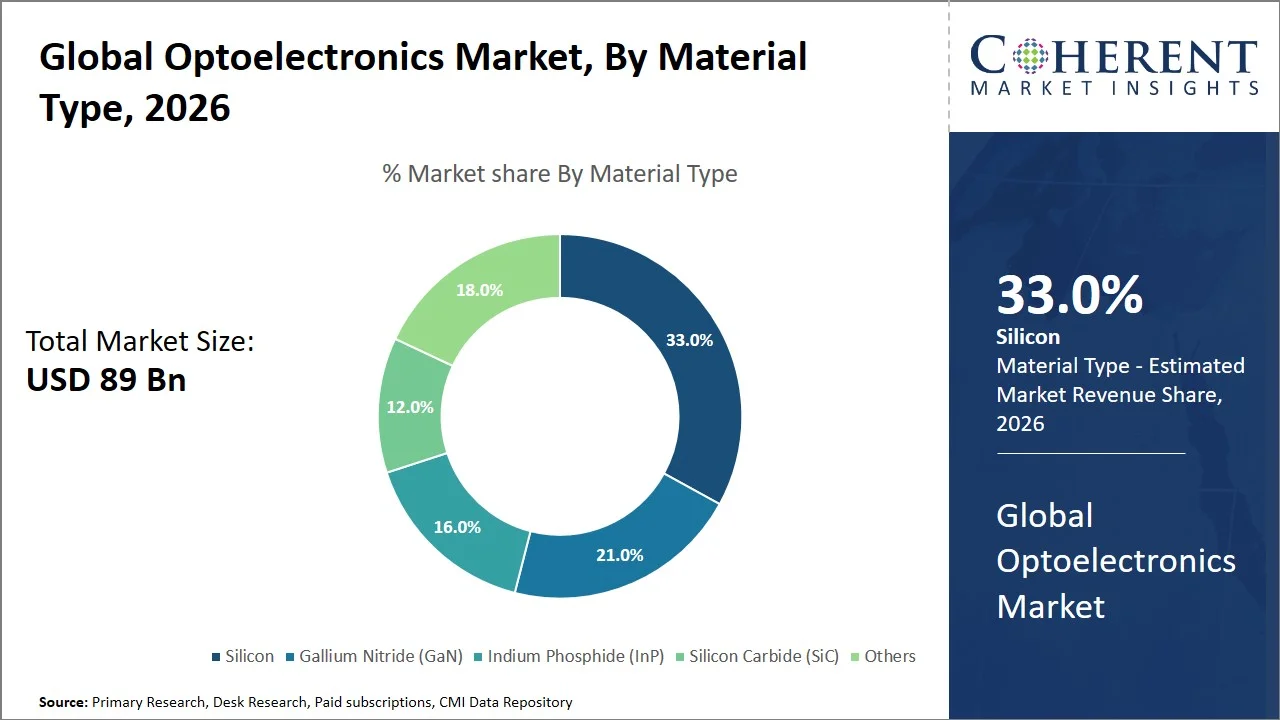
The silicon segment is expected to account for 33.0% of the global optoelectronics market share in 2026. Silicon dominates the optoelectronics market due to its unrivaled compatibility with established semiconductor manufacturing techniques and its ability to support cost-effective, high-volume production. Silicon-based devices can be manufactured utilizing the well-established complementary metal-oxide-semiconductor manufacturing infrastructure, which enables the easy integration of optoelectronic components with electronic circuits, lowering the complexity of production and the overall cost. Silicon is the material of choice for consumer electronics, automotive systems, data centers and industrial devices, due to its excellent electrical properties and the fact that it is readily available. Silicon is suitable for applications such as image sensors (Sony Exmor CMOS Sensor), photodetectors, optical communication components and integrated photonics.
Consumer Electronics Dominates the Global Optoelectronics Market
The consumer electronics segment is expected to account for 27.0% of the global optoelectronics market share in 2026. The consumer electronics industry is principally driven by the ongoing integration of optoelectronic components into smartphones, tablets, wearable devices, televisions, computers and augmented and virtual reality goods. They employ large quantities of LEDs, image sensors, laser diodes, infrared sensors and display technologies to allow high-resolution imagery, enhanced biometric identification, gesture, face recognition and energy-efficient displays. The fast product replacement cycle, constant technology innovation and increasing customer demand for feature rich and compact electronic gadgets like Tile Mate continue to drive the broad scale use of optoelectronic components in the global consumer electronics sector.
Currents Events and their Impact
Current Events | Description and its Impact |
European Chips Act (European Union, 2025 implementation) |
|
U.S. CHIPS and Science Act |
|
Optoelectronics Market Dynamics
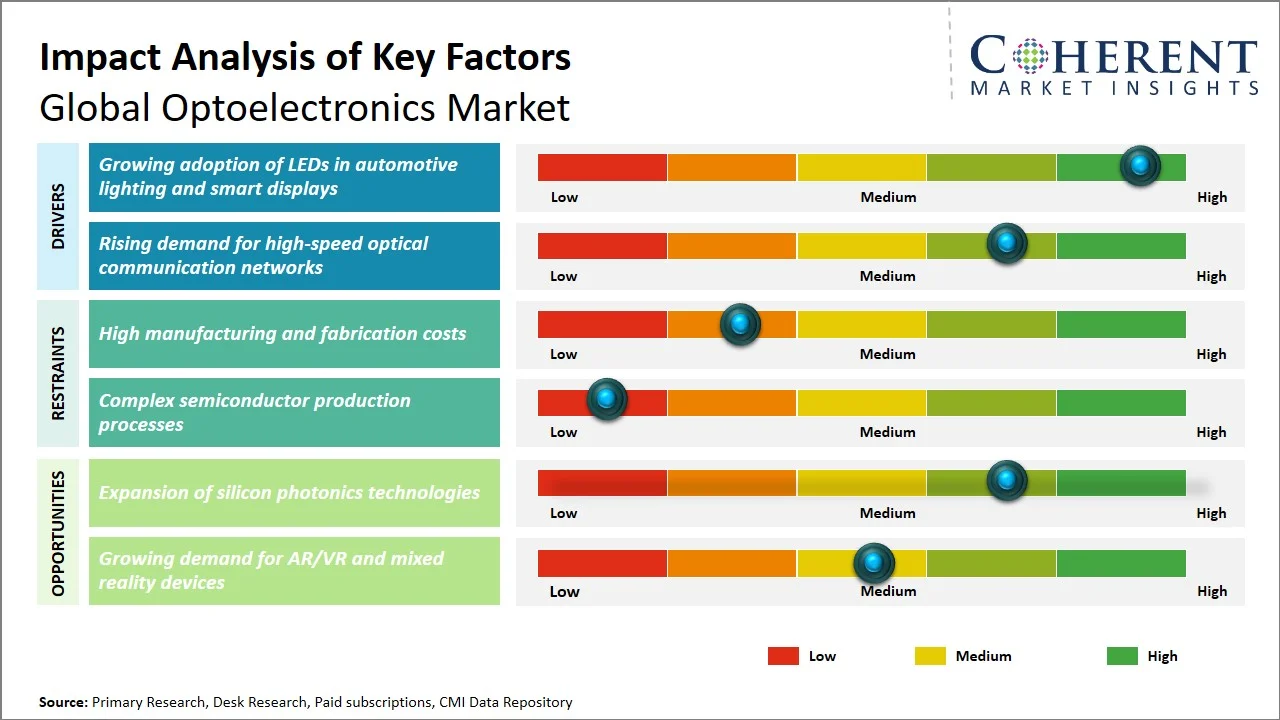
Market Drivers
- Growing adoption of LEDs in automotive lighting and smart displays: The increasing adoption of LEDs in automotive lighting and smart displays is emerging as a key driver for the global optoelectronics market, due to the rising demand for energy-efficient, durable, and high-performance lighting solutions. Vehicle safety, design flexibility, and energy efficiency have all been improved by automakers’ extensive use of LED technology in headlamps, daytime running lights, adaptive lighting systems, and interior ambient lighting. Meanwhile, the sharp growth of smart displays in smartphones, televisions, wearable devices, digital signage, and automotive infotainment systems is boosting the use of advanced LED technologies such as mini-LED and micro-LED, which offer better brightness, contrast, color accuracy, and less power consumption. These advancements are driving ongoing innovation in optoelectronic components and enabling the creation of next-generation connected cars and smart consumer electronics. On January 6, 2026, OSRAM announced the development of its 2nd generation VEGALED platform. The platform combines high-performance automotive LED lighting with direct Time-of-Flight (dToF) sensing for adaptive headlights and next-generation exterior lighting in autonomous vehicles.
- Rising demand for high-speed optical communication networks: The global optoelectronics market is being driven by the rising demand for high-speed optical communication networks as the increasing cloud computing, artificial intelligence, 5G networks, hyperscale data centers, and edge computing require faster, higher-capacity, and low-latency data transmission. Optoelectronics uses components like laser diodes, photodetectors, optical transceivers and silicon photonics to efficiently transmit large volumes of data over fiber-optic networks with minimal signal loss and power consumption. Additional investments in fiber-to-the-home (FTTH) infrastructure, submarine communication cables and next-generation optical networking technologies are further accelerating the adoption of advanced optoelectronic devices in telecommunications, enterprise networking and data center applications. On March 19, 2025, Alphabet subsidiary X Development split off its Taara project into a stand-alone firm. Series X Capital sponsored an investment round for the company, which raised an undisclosed amount of capital to develop and scale their approach to wireless optical communications.
Emerging Trends
- Expansion of Hall current sensing in renewable energy and battery energy storage systems: The rapid deployment of solar photovoltaic plants, wind power installations, and battery energy storage systems is increasing the integration of Hall current sensors into inverters, bidirectional converters, and grid interface equipment. These sensors enable accurate current monitoring, system protection, and efficient energy management while supporting grid stability and renewable energy integration.
- Integration of intelligent diagnostics and digital communication capabilities: Hall current sensors are increasingly being supplied with integrated diagnostics, self-calibration features, and digital communication interfaces to enable smart industrial equipment and connected power electronics. These innovations increase measurement reliability, simplify predictive maintenance, and enable seamless interaction with industrial IoT platforms, smart grids, and sophisticated automation systems.
Regional Insights
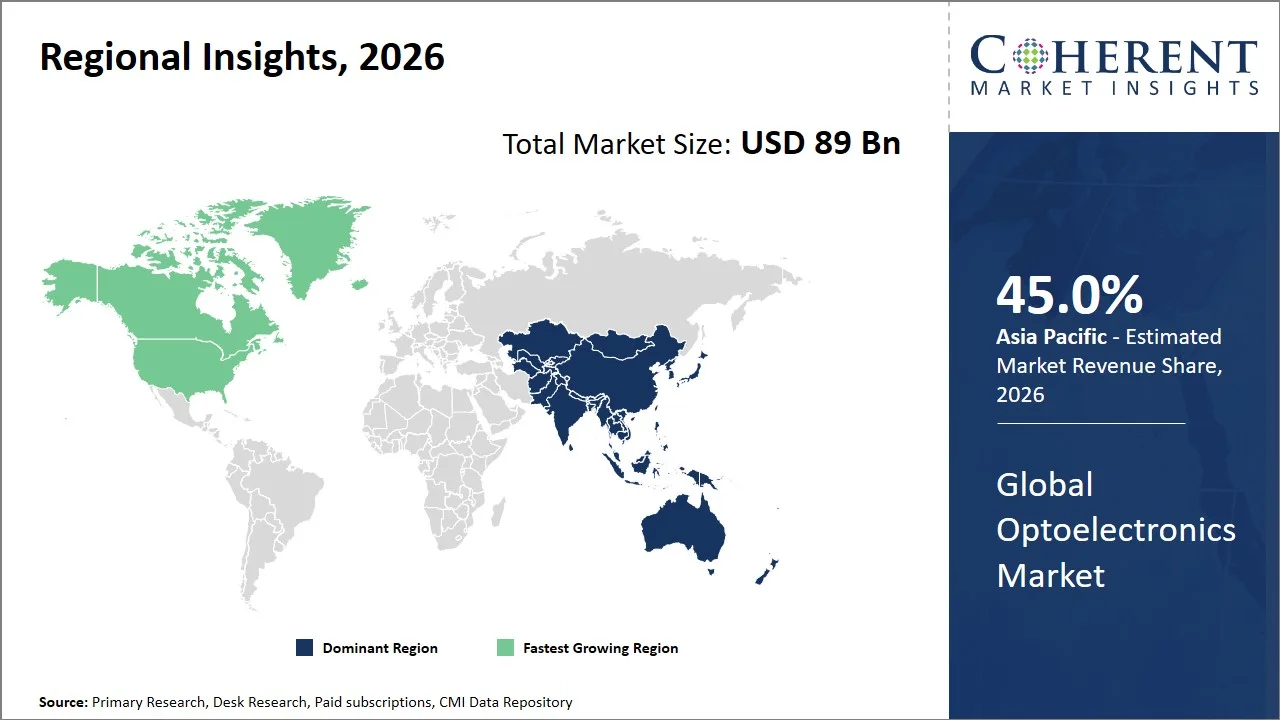
Why is Asia Pacific a Strong Market for Optoelectronics?
Asia Pacific is expected to account for a market share of 45.0% in 2026. Asia Pacific serves as the worldwide manufacturing center for optoelectronic components, supported by huge production ecosystems across China, Japan, South Korea, and Taiwan. Companies such as TSMC, Samsung Electronics, Sony Semiconductor Solutions, BOE Technology, and AUO make image sensors, OLED panels, LEDs, laser diodes, and silicon photonic components for worldwide markets. The region is also leading the implementation of micro-LED displays, electric vehicle lighting systems, and optical communication equipment, with governments actively supporting semiconductor manufacturing and photonics research through national industrial development initiatives.
Why Does the North America Optoelectronics Market Exhibit High Growth?
North America is projected to account for 27.0% of the global optoelectronics market and is expected to register the fastest growth. North America continues to be a technology-driven market with a strong focus on silicon photonics, optical networking and advanced sensing technologies. Companies including Coherent, Lumentum Holdings, Broadcom, Intel, and Amphenol are providing optical transceivers, photonic integrated circuits, and laser technologies for hyperscale AI data centers and cloud computing infrastructure. Further, the region is experiencing the deployment of more LiDAR, advanced driver assistance systems and medical imaging equipment, supported by ongoing investments in semiconductor production through the CHIPS project.
Global Optoelectronics Market Outlook for Key Countries
Why is China Emerging as a Major Hub in the Optoelectronics Market?
China is solidifying its position by producing LEDs, display panels, optical communication equipment and solar gadgets at home. BOE Technology Group is increasing its output of OLED and micro-LED display products, while Huawei is advancing its silicon photonics and optical transmission technologies for next-generation communication networks. San’an Optoelectronics is still one of the largest producers of compound semiconductor materials and LED chips and its products are used in everything from vehicle lighting to industrial automation and consumer electronics.
Is the U.S. the Next Growth Engine for the Optoelectronics Market?
The U.S. is the world leader in innovation in photonic integrated circuits, optical interconnects and advanced semiconductor technologies. Intel is driving silicon photonics development for AI server connectivity, while Coherent and Lumentum Holdings continue to roll out high-performance lasers and optical components for telecoms and industrial applications. Apple has also extended the application of sophisticated image sensing and LiDAR technologies throughout its product portfolio, fueling the demand for high-performance optoelectronic components made within the domestic technological ecosystem.
Germany Optoelectronics Market Analysis and Trends
Germany is a major European center for automotive and industrial optoelectronics. ams-OSRAM continues to develop adaptive LED lighting, infrared emitters and laser technologies for intelligent vehicles, while TRUMPF delivers industrial laser systems for precision manufacturing and semiconductor fabrication. German car makers are adding more matrix LED headlamps, interior ambient lighting and optical sensor technologies to premium vehicle platforms, furthering innovations in automotive optoelectronics.
Japan Optoelectronics Market Analysis and Trends
Japan is the leader in image sensors, optical materials and precision photonics. Sony Semiconductor Solutions continues to provide innovative CMOS image sensors for smartphones, automotive vision systems and industrial cameras, and Nichia continues to be a global leader in high-brightness LEDs and laser diodes. Hamamatsu Photonics is advancing photonic technology for medical diagnostics, research instruments and equipment for the inspection of semiconductors, enhancing Japan’s position in high-value optoelectronic production.
South Korea Optoelectronics Market Analysis and Trends
South Korea is leading the world in sophisticated display technologies and semiconductor-based optoelectronics. Samsung Electronics is increasing its research of OLED and micro-LED displays for consumer electronics and automotive applications, and LG Display continues to commercialize next-generation OLED panels for televisions, monitors and vehicle displays. The country’s semiconductor ecosystem is also supporting the development of image sensors, optical modules and AI-oriented photonic technologies, enhancing South Korea’s position in providing advanced optoelectronic components to global electronics makers.
Global Optoelectronics Market - Optical I/O Adoption in AI Servers
Country | Optical I/O Adoption in Newly Deployed AI Servers (2026) |
U.S. | 14% |
China | 11% |
Japan | 9% |
South Korea | 8% |
Taiwan | 8% |
Global Optoelectronics Market - Industrial Optical Sensor Installations
Industry | Estimated Annual Industrial Optical Sensor Installations (Million Units, 2026) |
Manufacturing & Factory Automation | 48.0 |
Automotive & EV Manufacturing | 26.5 |
Electronics & Semiconductor Manufacturing | 21.5 |
Logistics, Warehousing & E-commerce | 18.5 |
Food & Beverage Processing | 13.0 |
How is the Expansion of Silicon Photonics Technologies Creating New Growth Opportunities in the Optoelectronics Market?
The development of silicon photonics technologies is providing considerable growth prospects in the optoelectronics industry by allowing quicker, energy-efficient and highly integrated optical communication solutions for data-intensive applications. Silicon photonics combines optical and electronic operations in a single silicon chip, enabling the construction of compact and high-performance optical transceivers, switches and photonic integrated circuits using existing semiconductor manufacturing processes. Artificial intelligence workloads, hyperscale data centers, cloud computing, 5G infrastructure and high-performance computing are all evolving rapidly. That’s driving faster adoption of silicon photonics to overcome bandwidth bottlenecks and cut the power consumption of traditional electrical interconnects. As technology companies continue to invest in next-generation optical networking and co-packaged optics, the need for silicon-based lasers, modulators, photodetectors and integrated photonic devices is likely to generate significant opportunities for optoelectronics makers. On May 28, 2025, AMD acquired Enosemi, a silicon photonics startup, to expedite its portfolio of co-packaged optical interconnects and speed up development of high-bandwidth, low-power AI infrastructure solutions for hyperscale data centers.
Market Players, Key Development, and Competitive Intelligence
Key Developments
- On March 13, 2025, Applied Optoelectronics, Inc. entered into a long-term strategic supply agreement with Amazon that includes an equity investment option linked to purchases of optical networking products. The agreement expands Applied Optoelectronics' role in supplying high-speed optical transceivers for AI infrastructure and hyperscale cloud data centers.
- On September 26, 2024, Canon Inc. announced that it will ship its most advanced lithography platform, the FPA-1200NZ2C nanoimprint lithography (NIL) system for semiconductor manufacturing, to the Texas Institute for Electronics (TIE), a Texas-based semiconductor consortium.
Competitive Landscape
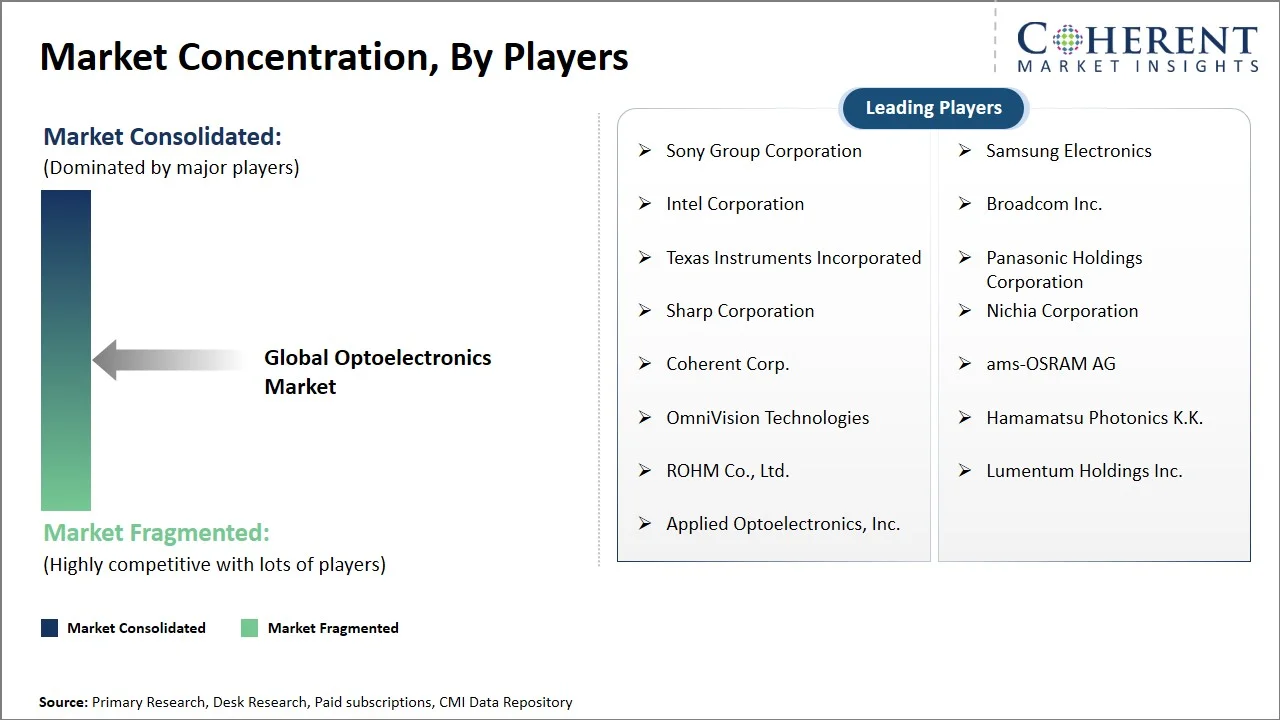
The global optoelectronics industry is highly competitive, with existing producers of semiconductor, photonics, and display technology aggressively competing to increase their market share. These companies are continually investing in product innovation, factory expansion, and strategic partnerships. Top companies such as Sony Semiconductor Solutions, Samsung Electronics, LG Display, Coherent Corp., Lumentum Holdings, ams-OSRAM, Nichia Corporation, Broadcom, Intel and Hamamatsu Photonics are all using advancements in image sensors, LEDs, laser diodes, silicon photonics, OLED displays and optical communication components to strengthen their market positions. The competition is increasingly focused on the development of high efficiency devices, improvements in manufacturing yields, expansion of production capacity, and meeting the growing demands of artificial intelligence infrastructure, electric vehicles, industrial automation, healthcare, and next-generation communication networks.
Market Report Scope
Optoelectronics Market Report Coverage
| Report Coverage | Details | ||
|---|---|---|---|
| Base Year: | 2025 | Market Size in 2026: | USD 89 Bn |
| Historical Data for: | 2020 To 2024 | Forecast Period: | 2026 To 2033 |
| Forecast Period 2026 to 2033 CAGR: | 9.1% | 2033 Value Projection: | USD 165 Bn |
| Geographies covered: |
| ||
| Segments covered: |
| ||
| Companies covered: | Sony Group Corporation, Samsung Electronics, Intel Corporation, Broadcom Inc., Texas Instruments Incorporated, Panasonic Holdings Corporation, Sharp Corporation, Nichia Corporation, Coherent Corp., ams-OSRAM AG, OmniVision Technologies, Hamamatsu Photonics K.K., ROHM Co., Ltd., Lumentum Holdings Inc., and Applied Optoelectronics, Inc. | ||
| Growth Drivers: |
| ||
| Restraints & Challenges: |
| ||
Analyst Opinion (Expert Opinion)
- The continued technical innovation and more integration of optical components across a number of high-growth industries is anticipated to drive the optoelectronics market. As the global digital transition accelerates, more attention is being paid to energy-efficient LEDs, silicon photonics, sophisticated image sensors, micro-LED displays and high-speed optical communication technologies. More investment in semiconductor manufacturing, R&D, and sophisticated packaging technologies is expected to enhance supply chain resilience and bolster long-term industry growth.
- The proliferation of artificial intelligence infrastructure, hyperscale data centers, autonomous vehicles, smart manufacturing and improved medical imaging systems are likely to drive future trends in the global optoelectronics market. The increasing commercialization of silicon photonics, micro-LED displays, quantum photonics and next generation optical sensing-technologies is expected to open new application areas while improving the device performance and energy efficiency. The market is expected to benefit from sustained innovation, wider commercialization of advanced optoelectronic devices and growing demand from both consumer and industrial sectors. Governments and private companies continue to invest in semiconductor manufacturing, optical communication infrastructure and photonics research.
Speak to the analyst
Want personalized insights?
Take the findings above to one of our principal consultants, or have the report rebuilt around the segments, geographies and competitors you actually track.
Market Segmentation
- Product Type Insights (Revenue, USD Billion, 2021 - 2033)
- LED
- Laser Diodes
- Image Sensors
- Photodetectors
- Others
- Material Type Insights (Revenue, USD Billion, 2021 - 2033)
- Silicon
- Gallium Nitride (GaN)
- Indium Phosphide (InP)
- Silicon Carbide (SiC)
- Others
- Application Insights (Revenue, USD Billion, 2021 - 2033)
- Consumer Electronics
- Automotive
- Telecommunications
- Industrial Automation
- Healthcare
- Aerospace and Defense
- Energy and Power
- Data Centers
- Regional Insights (Revenue, USD Billion, 2021 - 2033)
- North America
- U.S.
- Canada
- Latin America
- Brazil
- Argentina
- Mexico
- Rest of Latin America
- Europe
- Germany
- U.K.
- Spain
- France
- Italy
- Russia
- Rest of Europe
- Asia Pacific
- China
- India
- Japan
- Australia
- South Korea
- ASEAN
- Rest of Asia Pacific
- Middle East
- GCC Countries
- Israel
- Rest of Middle East
- Africa
- South Africa
- North Africa
- Central Africa
- North America
- Key Players Insights
- Sony Group Corporation
- Samsung Electronics
- Intel Corporation
- Broadcom Inc.
- Texas Instruments Incorporated
- Panasonic Holdings Corporation
- Sharp Corporation
- Nichia Corporation
- Coherent Corp.
- ams-OSRAM AG
- OmniVision Technologies
- Hamamatsu Photonics K.K.
- ROHM Co., Ltd.
- Lumentum Holdings Inc.
- Applied Optoelectronics, Inc.
Sources
Primary Research Interviews
- Optoelectronics Device Manufacturers
- Semiconductor Component Suppliers
- Photonics Technology Integrators
- Telecom & Data Communication End-Users
Magazines
- Photonics Spectra
- Laser Focus World
- Compound Semiconductor Magazine
- IEEE Spectrum
Journals
- Journal of Lightwave Technology
- Optics Express (OSA Publishing)
- IEEE Journal of Quantum Electronics
Associations
- Optoelectronics Industry Development Association (OIDA)
- Photonics21 (European Photonics Association)
- SEMI (Semiconductor Equipment and Materials International)
- International Society for Optics and Photonics (SPIE)
Public Domain Sources
- U.S. Department of Energy – Office of Scientific and Technical Information (OSTI)
- European Commission – Photonics Unit Publications
- World Trade Organization (WTO) – Trade Data on Electronic Components
- U.S. Patent and Trademark Office (USPTO) – Optoelectronics Patents Database
Proprietary Elements
- CMI Data Analytics Tool
- Proprietary CMI Existing Repository of Information for Last 10 Years
Get access to 250+ pages report
Every segment, forecast, competitor profile and data table behind the analysis above — available for instant download.
- ESOMAR Member
- ISO 9001:2015 Certified
- D-U-N-S Registered
- GDPR & CCPA Compliant
Missing comfort of reading report in your local language? Find your preferred language:
Transform your Strategy with Exclusive Trending Reports
Frequently Asked Questions
The global optoelectronics market is expected to stand at USD 89 Bn in 2026 and is expected to reach USD 165 Bn by 2033.
The CAGR of the global optoelectronics market is projected to be 9.1% from 2026 to 2033.
In terms of product type, the LED segment is estimated to dominate the market revenue share in 2026.
Silicon photonics enables faster data transmission with lower power consumption and higher bandwidth.
LEDs offer greater energy savings, longer operational life, and lower maintenance requirements.
High manufacturing and fabrication costs and complex semiconductor production processes are the major factors hampering the growth of the global optoelectronics market.
Growing adoption of LEDs in automotive lighting and smart displays and rising demand for high-speed optical communication networks are the major factors driving the growth of the global optoelectronics market.