

Global Screen Printing Glass Market Size and Forecast – 2026 To 2033
The global screen printing glass market is expected to grow from USD 4.20 Bn in 2026 to USD 6.85 Bn by 2033, registering a compound annual growth rate (CAGR) of 4.7% from 2026 to 2033. The global screen printing glass market is driven by the growing expansion of solar photovoltaic glass manufacturing. On January 9, 2025, Borosil Renewables approved a 50% expansion of its solar glass manufacturing capacity, increasing output from 1,000 tons per day to 1,500 tons per day.
Key Takeaways of the Global Screen Printing Glass Market
- The ceramic screen printing segment is expected to account for 52.0 % of the global screen printing glass market share in 2026. Increasing use of ceramic inks with high durability is driving the growth of the segment. In February 2025, Dip-Tech launched its Generation 7 digital ceramic ink platform for architectural and automotive glass, featuring enhanced UV stability, scratch resistance, and color permanence after tempering.
- The architectural glass segment is estimated to capture 31.0 % of the market share in 2026. Growth in premium interior glass applications is majorly driving the growth of the segment. On April 18, 2024, Saint-Gobain Glass India introduced SGG Colormaxx lacquered glass for premium residential and commercial interiors, targeting luxury kitchens, wardrobes, feature walls, and office spaces.
- Asia Pacific is expected to dominate the screen printing glass market in 2026 with a market share of 43.0 %. Expansion of photovoltaic module production in Asia Pacific is driving the growth of the regional market. On April 17, 2025, Emmvee Group inaugurated its fifth photovoltaic module manufacturing plant near Bengaluru, India, increasing its total module manufacturing capacity to 6.6 GW while supporting growing domestic and export demand for TOPCon solar modules.
- North America is expected to account for 26.0 % of the market share in 2026 and is projected to record the fastest growth over the forecast period. Technological advancements in eco-friendly ceramic inks in North America is driving the growth of the regional market. In April 2025, Vibrantz Technologies introduced upgraded low-emission ceramic ink systems optimized for high-speed digital glass printing lines.
- Increasing Adoption of High Performance Ceramic Ink Printing: Manufacturers are turning to sophisticated ceramic ink formulations that offer superior UV resistance, scratch resistance and long-term color stability. These inks enable durable decorative and functional printing on architectural facade systems, automotive glazing and solar glass, while also supporting higher production efficiency and longer product life.
- Growing Integration of Screen Printed Glass in Smart and Sustainable Buildings: The construction industry is witnessing a growing use of screen printed glass in energy-efficient commercial buildings, airports, hospitals and mixed-use developments. Screen printed glass is being used to improve solar shading, cut glare, improve privacy and attain unique architectural aesthetics while meeting green and smart building certification standards.
Segmental Insights
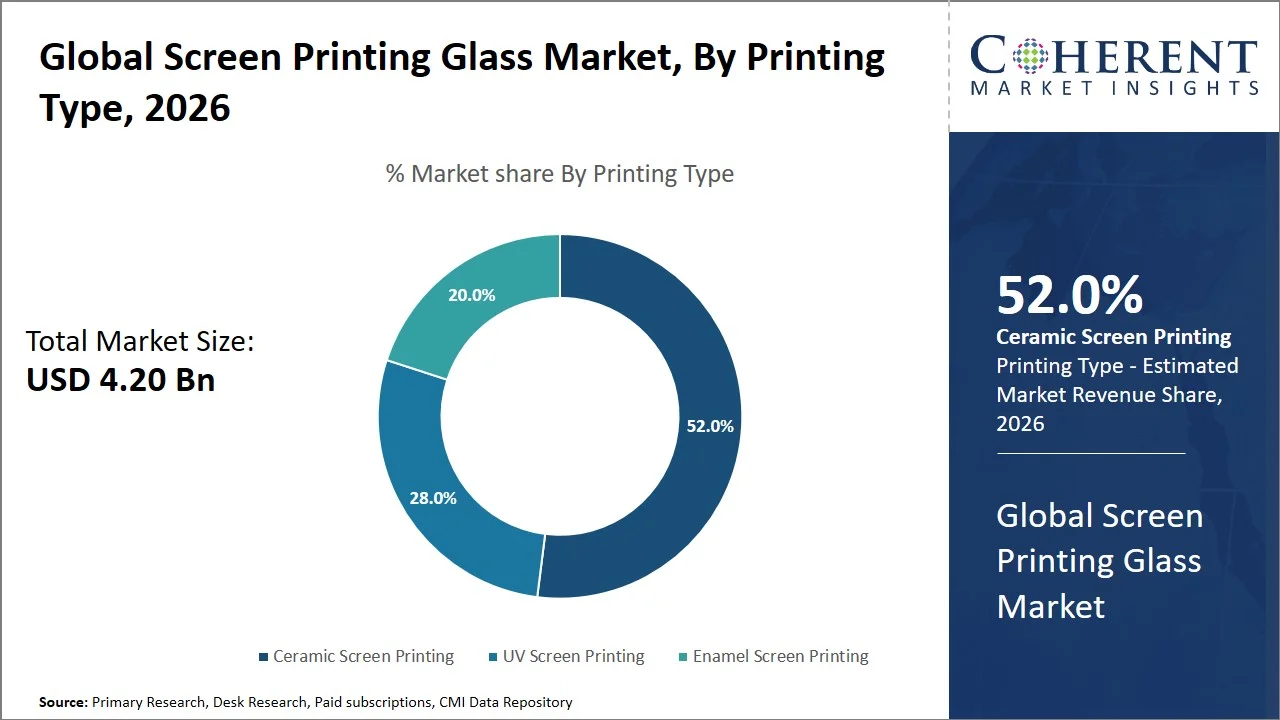
Why Does Ceramic Screen Printing Dominate the Global Screen Printing Glass Market?
The ceramic screen printing segment is expected to account for 52.0% of the global screen printing glass market share in 2026. Ceramic screen printing is very popular as it provides very durable prints that are permanently fused with the glass surface during the tempering process. This provides amazing resistance to ultraviolet radiation, abrasion, chemicals, moisture, and severe temperature such that the printed glass will look and perform for decades. Therefore, it is the material of choice for demanding applications such as architectural facades, automotive glazing and solar panels where long-term performance and low maintenance are critical. On March 26, 2025, Corning Incorporated announced the introduction of Corning Gorilla Glass Ceramic, an innovative, transparent, and strengthenable glass ceramic material to help bring advanced toughness to more mobile devices. Gorilla Glass Ceramic significantly improves drop performance on rough surfaces compared to competitive aluminosilicate glasses.
- Current Industry Events of 2026
- Market Size Estimation
- Regional Breakdown
- Competitive Landscape
- Customer Intelligence
- Segmental Analysis
- Pricing Analysis
- Key Market Drivers, Challenges & Future Trends
- Customized Insights Section
Why is Architectural Glass the Most Widespread Application?
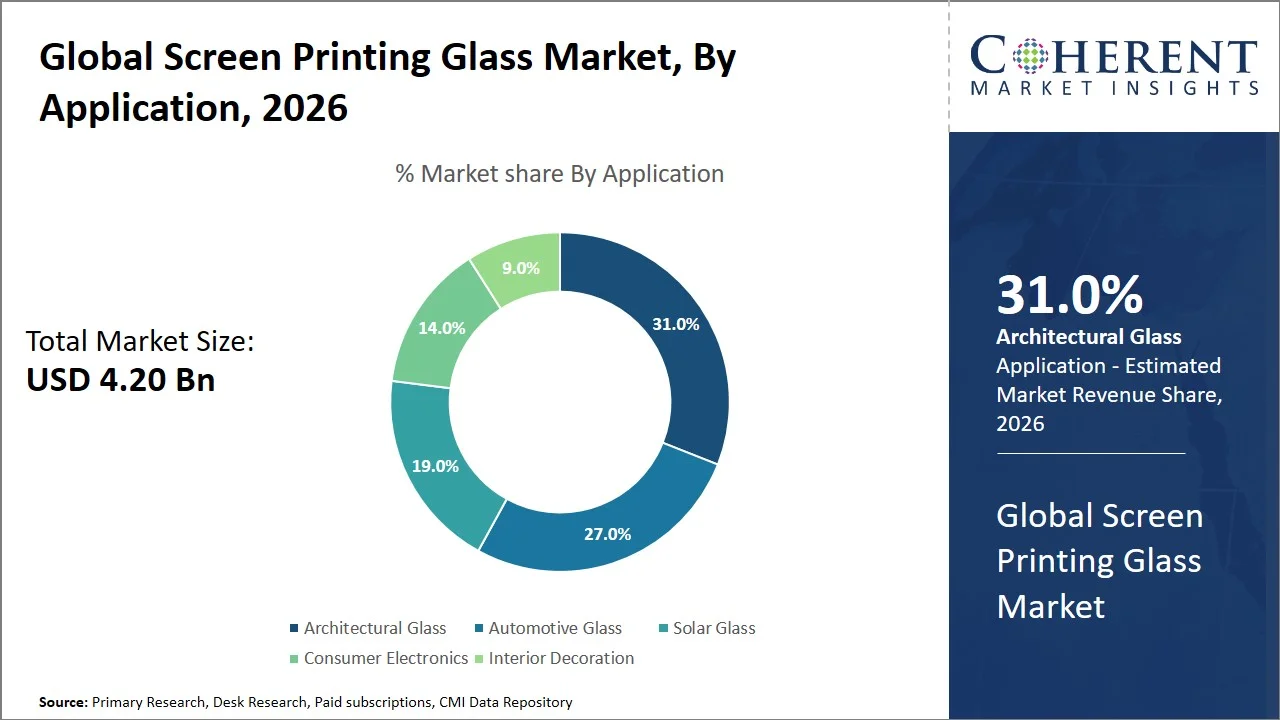
The architectural glass segment is expected to account for 31.0% of the global screen printing glass market share in 2026. Architectural glass is widely utilized since modern commercial and residential construction is demanding more and more materials that can satisfy the needs of both aesthetics and practical performance. Screen printed glass enables architects to add beautiful patterns, solar shading, privacy, glare reduction and branding to buildings without affecting durability or structural integrity. It is a favored choice for façades, curtain walls, partitions, skylights and other high-visibility construction applications due to its design flexibility and long-term weather resistance. On April 22, 2025, General Glass International (GGI) celebrated its 125th anniversary with a demonstration of extended use of its Alice digital direct-to-glass printing technology for decorative façades, interior partitions and custom architectural glazing projects.
Currents Events and their Impact
Current Events | Description and its Impact |
U.S. - EPA National Emission Standards for Hazardous Air Pollutants (NESHAP) Compliance Updates (2025) |
|
China - Mandatory National Standard for Building Energy Efficiency GB 55015-2021 Implementation Expansion (2025) |
|
Screen Printing Glass Market Dynamics
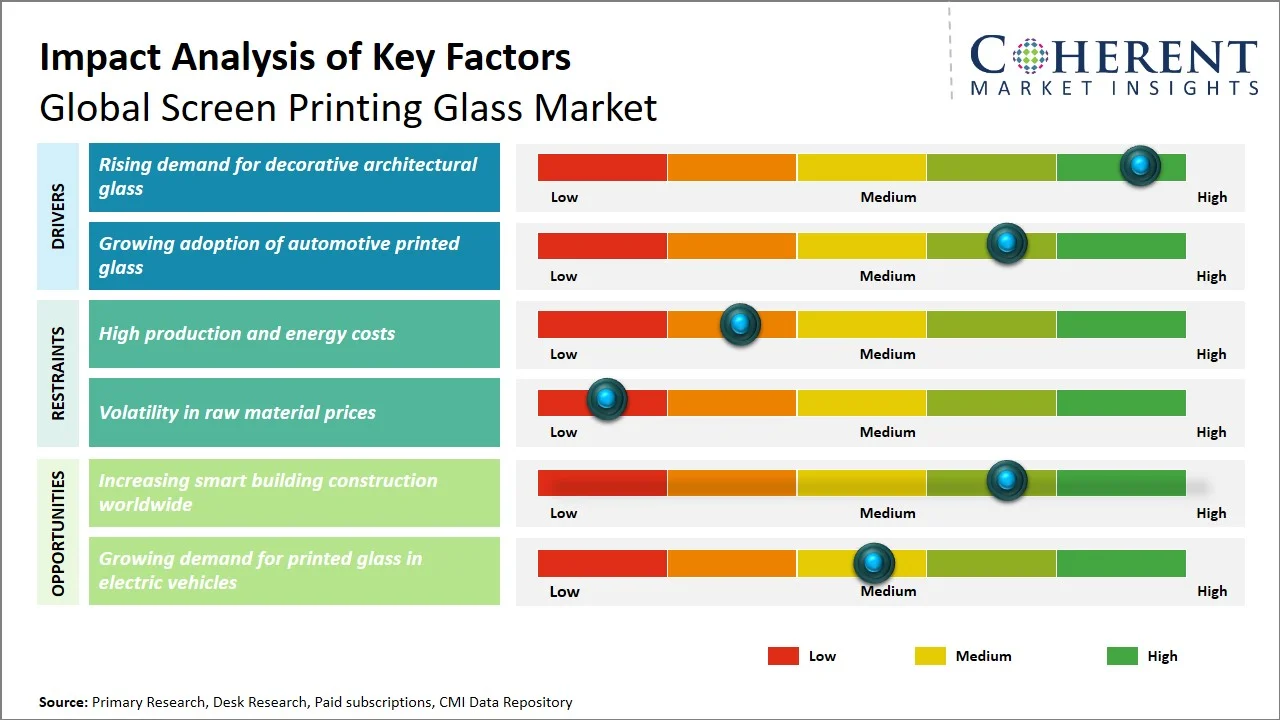
Market Drivers
- Rising demand for decorative architectural glass: Commercial, residential, hospitality and institutional construction projects are seeing increased demand for decorative architectural glass due to the growing focus on visually unique and energy-efficient structures. Screen printed glass can be designed with unique patterns, colors, gradients, and privacy elements. Plus, it has exceptional durability and weather resistance. Printed façades, curtain walls, skylights, partitions and balustrades that combine aesthetics with solar shading and glare reduction are being specified more and more by architects. Screen printed glass is fast becoming the solution of choice for modern architectural designs. On July 22, 2025, Asahi India Glass Ltd. (AIS), India’s leading integrated glass and window solutions company, launched the 7th edition of its national-level design competition, the AIS Design Olympiad (ADO) 2025-26. It is open to architecture students across institutions in India.
- Growing adoption of automotive printed glass: Screen printed glass is being used more and more by automobile makers to enhance both the functioning and design of the car. Blackout boundaries, protection of adhesives from UV radiation, integration of heating elements and antennas, and assistance in sensor placement for advanced driver assistance systems are among the many applications of ceramic screen printing on windshields, rear windows, side windows and panoramic roofs. Increasing demand for high-quality printed automotive glass that delivers durability, precision and long-term performance is being further driven by the rapid manufacturing of electric and premium vehicles. On January 8, 2025, Hyundai Mobis revealed the world’s first Full-Windshield Holographic Display at CES 2025, transforming future in-vehicle display technology. This state-of-the-art invention runs without physical screens whereas conventional systems depend on traditional screen-based components. This is a next-generation approach to information presentation in vehicles.
Emerging Trends
- Expansion of Printed Glass Applications in Electric Vehicles and Advanced Mobility: Screen printed glass is being increasingly used by automotive manufacturers for panoramic roofs, rear windows, side glazing, and windshield components. Screen printing enables embedding of heating elements, antenna integration, sensor protection, and decorative black masking, making it an essential technology for next-generation electric and connected vehicles.
- Rising Investments in High Precision Automated Screen Printing Lines: Glass manufacturers are investing in automated printing equipment with robotic handling, digital inspection systems and precision registration technologies. These production upgrades improve printing consistency, reduce material waste, increase throughput and enable large-scale manufacturing of complex glass designs for architectural, automotive and solar applications.
Regional Insights
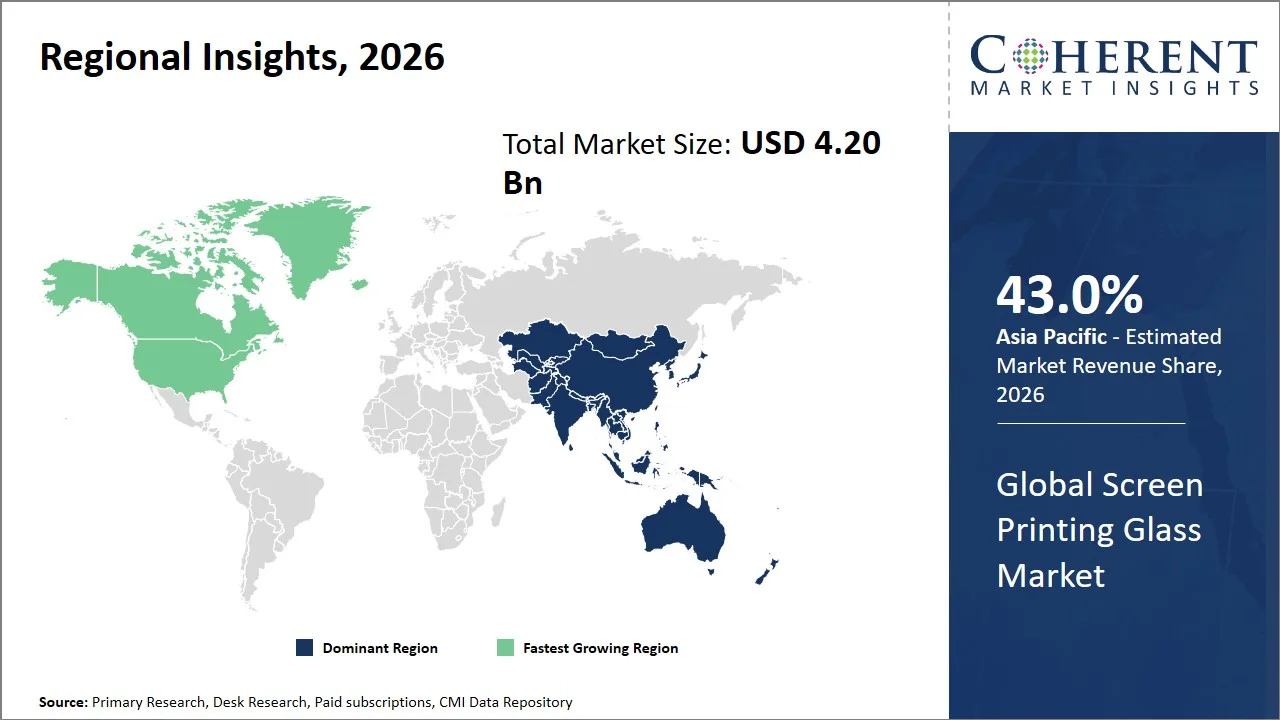
Why is Asia Pacific a Strong Market for Screen Printing Glass?
Asia Pacific is expected to account for a market share of 43.0% in 2026. Asia Pacific is the production hub for screen printing glass. The demand for screen printing glass in the region is expected to be driven by the concentration of float glass manufacturers, solar module makers and automobile OEMs across Asia Pacific. China, Japan, India and South Korea continue to increase their use of ceramic screen printed glass for solar modules, high-rise commercial buildings and electric vehicles. Major producers including Xinyi Glass, AGC, NSG Group and Fuyao Glass have expanded regional manufacturing capacities to supply decorative façade glass, automotive glazing and solar glass for fast-growing infrastructure and renewable energy projects.
Why Does the North America Screen Printing Glass Market Exhibit High Growth?
North America is projected to account for 26.0% of the global screen printing glass market and is expected to register the fastest growth. Strong glass screen printing demand is driven by North American commercial construction and premium car manufacture. The U.S. and Canada are requiring more and more printed architectural glass for airports, hospitals, educational campuses and office buildings to improve sun control and building aesthetics. Guardian Glass, Vitro Architectural Glass and Cardinal Glass Industries have expanded their lines of ceramic fritted glass for curtain wall and insulated glazing systems. Automotive manufacturers are continuing to add printed windshields and panoramic roof glass to electric and luxury vehicle platforms.
Global Screen Printing Glass Market Outlook for Key Countries
Why is China Emerging as a Major Hub in the Screen Printing Glass Market?
China is the world’s biggest producer of screen printing glass owing to its massive industrial ecosystem that supplies the construction, automobile and photovoltaic industries. Xinyi Glass, Kibing Group, CSG Holding and Fuyao Glass, among others, have invested in modern automated screen printing machines that can produce high-volume architectural and solar glass with complicated ceramic designs. The country’s rapid rollout of utility-scale solar projects and massive urban reconstruction plans is fueling the continuing need for high-performance printed glass for solar shading and cosmetic purposes.
Is the U.S. the Next Growth Engine for the Screen Printing Glass Market?
Demand for energy efficient commercial buildings and technologically sophisticated automobile glazing propel the U.S. market. Architectural projects are increasingly using ceramic screen printed glass in façades, skylights, transit stations and institutional buildings to increase lighting control and prevent heat gain. Domestic manufacturers, such as Guardian Glass and Vitro Architectural Glass, continue to innovate customized printed glass solutions that meet exacting building performance criteria while enabling innovative architectural concepts.
Germany Screen Printing Glass Market Analysis and Trends
Germany is a technology-driven market with significant demand for screen printed glass in eco-friendly construction and premium vehicle production. SCHOTT AG and Saint-Gobain are examples of companies that make high-end printed glass for building facades, interior walls and specific industrial applications that require extreme durability and precision. Automotive manufacturers such as BMW, Mercedes-Benz and Volkswagen are increasingly integrating ceramic printed glazing for panoramic roofs, heated rear windows and sensor regions for advanced driver assistance systems.
Japan Screen Printing Glass Market Analysis and Trends
Japan continues to be a major player in the production of specialized glass and automobile glazings, due to ongoing innovation. AGC Inc. and NSG Group developed a suite of very accurate ceramic screen printing techniques for car windshields, display glass and architectural applications that require outstanding optical quality. Demand is also being driven by earthquake resistant commercial buildings and high end residential constructions where printed glass is used in facades, partitions and decorative interior installations.
India Screen Printing Glass Market Analysis and Trends
The use of screen printing glass is rising rapidly in India, spurred by the construction of commercial buildings, metro rail projects, airports and rise in domestic vehicle production. Asahi India Glass has enhanced its ceramic printed architectural and automotive glass capabilities to satisfy the demand from infrastructure developers and vehicle makers. Further, the adoption of energy efficient building designs under green construction programs and the increasing production of passenger automobiles are contributing to the use of durable printed glass in construction and automotive industries.
Global Screen Printing Glass Market - Screen Printed Glass Production Capacity By Country (2025)
Country | Screen Printed Glass Production Capacity (Million Sq. Meters/Year) |
China | 180 |
India | 55 |
U.S. | 48 |
Germany | 42 |
Japan | 38 |
South Korea | 30 |
Italy | 24 |
France | 22 |
Taiwan | 18 |
Turkey | 15 |
How is Increasing Smart Building Construction Worldwide Creating New Growth Opportunities in the Screen Printing Glass Market?
The rise in construction of smart buildings globally is generating major potential prospects for the screen printing glass market by boosting the demand for multifunctional glazing solutions that offer aesthetics, energy efficiency, and enhanced building performance. Screen printed glass is gaining popularity in intelligent facades, curtain walls, skylights and internal partitions to provide for solar shading, glare reduction, privacy and unique architectural patterns while enabling automated building management systems. Governments and developers are focusing on sustainable commercial complexes, smart offices, healthcare facilities, airports and educational campuses. Manufacturers are increasing their portfolio of high-performance ceramic printed glass with integrated solutions for insulated glazing, low-emissivity coatings and smart façade technology, creating new opportunities for innovation and future market expansion. On July 8, 2025, Singtel and Lendlease officially broke ground on the new USD 2.30 Million Comcentre which is slated to be Singapore’s first end-to-end carbon neutral development, from the design to construction to operations.
Market Players, Key Development, and Competitive Landscape
Key Developments
- On February 12, 2025, AGC Glass and Saint-Gobain officially inaugurated the Volta production line in the presence of local authorities, stakeholders and representatives of both companies. Volta, at the AGC Barevka plant in Teplice, is a breakthrough pilot project aiming to significantly reduce CO₂ emissions and support the transition to sustainable flat glass production.
- On September 24, 2024, AGC Glass Europe and ROSI entered into a strategic partnership agreement. By drawing on AGC Glass Europe’s extensive glassmaking experience and ROSI’s expertise in transforming end-of-life photovoltaic modules into high-purity raw materials, this partnership will contribute to more circular, low carbon production practices and the long-term success of both industries.
Competitive Landscape
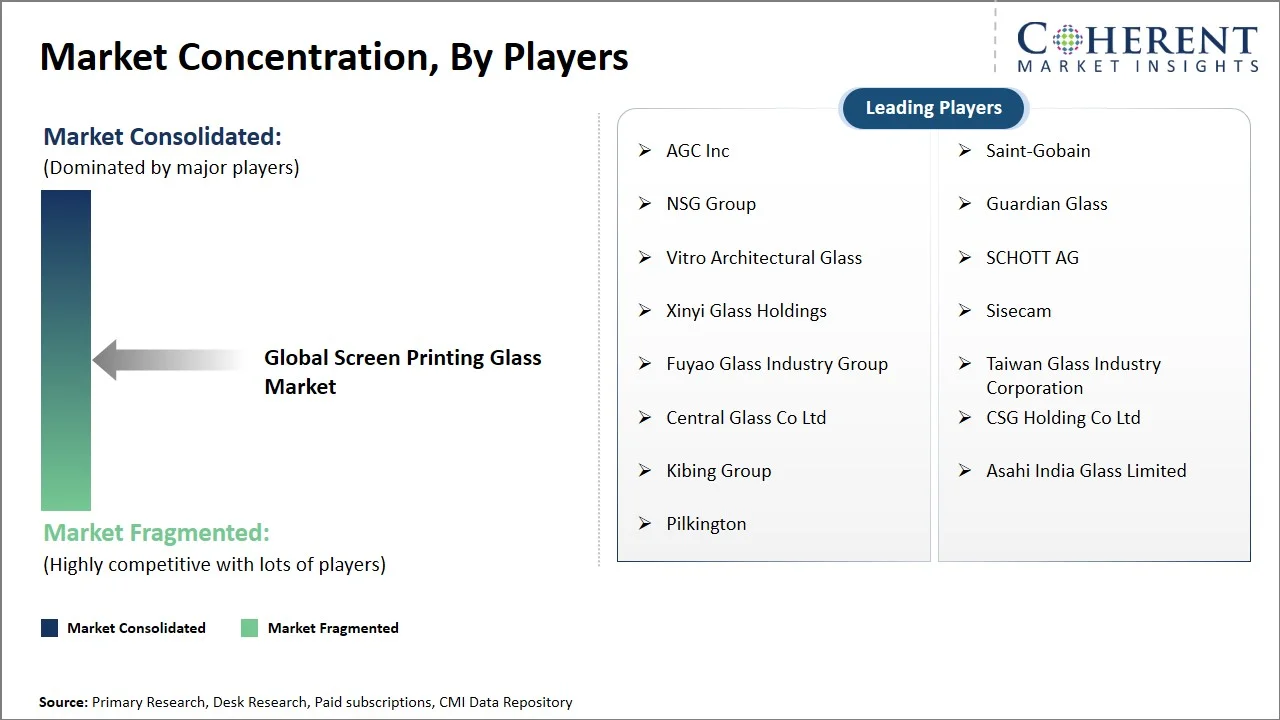
Globally, the market for screen printing glass is competitive, with competition centering around printing precision, ceramic ink technology, optical quality, large-format processing capabilities and vertical integration with float glass manufacturing. Major players such as AGC Inc, Saint-Gobain, NSG Group, Guardian Glass, SCHOTT AG, Xinyi Glass and Fuyao Glass are turning to automated screen printing lines, robotic handling systems and high-resolution inspection technologies to increase production uniformity and cut flaws. In addition, they are increasing their custom printing capacities in sectors like architectural facades, photovoltaic glass, automotive glazing and strengthening collaborations with construction companies, automotive OEMs and solar module manufacturers to secure long-term supply contracts for application-specific projects.
Market Report Scope
Screen Printing Glass Market Report Coverage
| Report Coverage | Details | ||
|---|---|---|---|
| Base Year: | 2025 | Market Size in 2026: | USD 4.20 Bn |
| Historical Data for: | 2020 To 2024 | Forecast Period: | 2026 To 2033 |
| Forecast Period 2026 to 2033 CAGR: | 4.7% | 2033 Value Projection: | USD 6.85 Bn |
| Geographies covered: |
| ||
| Segments covered: |
| ||
| Companies covered: | AGC Inc, Saint-Gobain, NSG Group, Guardian Glass, Vitro Architectural Glass, SCHOTT AG, Xinyi Glass Holdings, Sisecam, Fuyao Glass Industry Group, Taiwan Glass Industry Corporation, Central Glass Co Ltd, CSG Holding Co Ltd, Kibing Group, Asahi India Glass Limited, and Pilkington | ||
| Growth Drivers: |
| ||
| Restraints & Challenges: |
| ||
Analyst Opinion (Expert Opinion)
- The screen printing glass market is increasingly being differentiated by the capacity to manufacture multipurpose printed glass rather than ornamental glass alone. Manufacturers are concentrating on merging ceramic printing with low-emissivity coatings, solar glazing, bird-friendly designs, electromagnetic shielding and antenna-compatible automobile glass so one glass panel can be used for many purposes without further processing. The change is expected to enhance the value proposition of screen printing technology for premium construction and mobility applications.
- Leadership in the competition is expected to be based on process precision, not production volume. Investment is also being made in ultra-fine mesh screens, automated optical inspection, AI-assisted print registration and high-temperature ceramic ink formulas to ensure color uniformity across big size glass panels. Companies who can customize for the project with minimum dimensional variation and great optical uniformity are projected to win premium contracts in landmark architectural projects, innovative electric vehicles and next generation solar glass manufacture.
- The screen printing glass market will trend towards highly designed screen printed glass for both decorative and functional performance for smart buildings, electric vehicles and renewable energy systems. Development of ceramic materials, precise printing technology and automated manufacturing will allow for more complex printed patterns with enhanced durability and manufacturing efficiency. Continued demand for energy efficient façades, integrated solar systems and advanced automotive glazing is likely to boost the position of manufacturers with strong technical knowhow, tailored production and vertically integrated operations in the worldwide market.
Speak to the analyst
Want personalized insights?
Take the findings above to one of our principal consultants, or have the report rebuilt around the segments, geographies and competitors you actually track.
Market Segmentation
- Printing Type Insights (Revenue, USD Billion, 2021 - 2033)
- Ceramic Screen Printing
- UV Screen Printing
- Enamel Screen Printing
- Application Insights (Revenue, USD Billion, 2021 - 2033)
- Architectural Glass
- Automotive Glass
- Solar Glass
- Consumer Electronics
- Interior Decoration
- Regional Insights (Revenue, USD Billion, 2021 - 2033)
- North America
- U.S.
- Canada
- Latin America
- Brazil
- Argentina
- Mexico
- Rest of Latin America
- Europe
- Germany
- U.K.
- Spain
- France
- Italy
- Russia
- Rest of Europe
- Asia Pacific
- China
- India
- Japan
- Australia
- South Korea
- ASEAN
- Rest of Asia Pacific
- Middle East
- GCC Countries
- Israel
- Rest of Middle East
- Africa
- South Africa
- North Africa
- Central Africa
- North America
- Key Players Insights
- AGC Inc
- Saint-Gobain
- NSG Group
- Guardian Glass
- Vitro Architectural Glass
- SCHOTT AG
- Xinyi Glass Holdings
- Sisecam
- Fuyao Glass Industry Group
- Taiwan Glass Industry Corporation
- Central Glass Co Ltd
- CSG Holding Co Ltd
- Kibing Group
- Asahi India Glass Limited
- Pilkington
Sources
Primary Research Interviews
- Glass Manufacturers & Fabricators
- Screen Printing Ink & Material Suppliers
- Automotive & Architectural Glass Producers
- Electronics & Display Glass Manufacturers
Magazines
- Glass Magazine
- Screen Printing Magazine
- Glass International
- Surface World Magazine
Journals
- Journal of Coatings Technology and Research
- Journal of Materials Processing Technology
- Glass Technology: European Journal of Glass Science and Technology
Associations
- Glass Association of North America (GANA)
- Specialty Graphic Imaging Association (SGIA)
- European Glass Federation (Glass for Europe)
- American Glass Research (AGR)
Public Domain Sources
- U.S. Geological Survey (USGS) – Mineral Resources Program
- European Commission – Industrial Sector Reports
- United Nations Comtrade Database
- World Bank Open Data
Proprietary Elements
- CMI Data Analytics Tool
- Proprietary CMI Existing Repository of information for last 10 years
Get access to 250+ pages report
Every segment, forecast, competitor profile and data table behind the analysis above — available for instant download.
- ESOMAR Member
- ISO 9001:2015 Certified
- D-U-N-S Registered
- GDPR & CCPA Compliant
Missing comfort of reading report in your local language? Find your preferred language:
Transform your Strategy with Exclusive Trending Reports
Frequently Asked Questions
The global screen printing glass market is expected to stand at USD 4.20 Bn in 2026 and is expected to reach USD 6.85 Bn by 2033.
The CAGR of the global screen printing glass market is projected to be 4.7% from 2026 to 2033.
It is used for blackout borders, heating elements, antenna integration, and decorative glazing on vehicle windows.
Yes, it reduces solar heat gain and glare while supporting energy-efficient building designs.
High production and energy costs and volatility in raw material prices are the major factors hampering the growth of the global screen printing glass market.
Rising demand for decorative architectural glass and growing adoption of automotive printed glass are the major factors driving the growth of the global screen printing glass market.
In terms of printing type, the ceramic screen printing segment is estimated to dominate the market revenue share in 2026.