

Seasoning Market Size and Share Analysis- 2026 To 2033
The Seasoning Market size is anticipated to grow at a CAGR of 5.1%, with a market value of USD 49.3 Bn in 2026 and is expected to reach approximately USD 69.8 Bn by 2033. The primary growth drivers are largely defined by increasing demand for convenient and flavorful food products, rising consumption of processed and ready-to-eat foods, growing foodservice activity, and increasing consumer preference for natural, clean-label, and reduced-sodium seasoning formulations. According to the USDA, U.S. spending on food eaten away from home reached USD 1.41 trillion in 2025, representing 56.3% of total food spending.
Key Takeaways
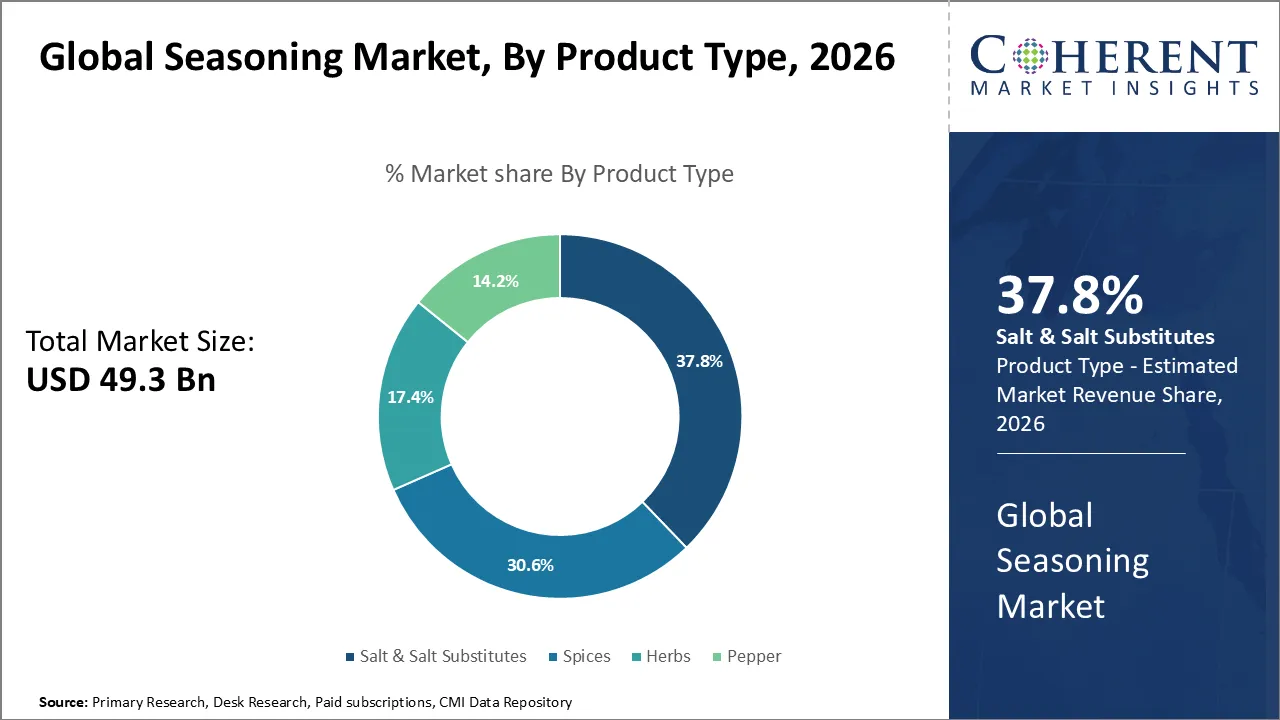
- The salt & salt substitutes segment is expected to lead the market with a 37.8% share in 2026 due to its wide use in foods and growing demand for low-sodium options. The U.S. FDA’s Phase II sodium-reduction targets cover 163 categories of commercially processed, packaged, and prepared foods and are designed to help reduce average sodium intake to around 2,750 mg per day.
- The industrial segment is set to lead with 48.6% in 2026. The segment’s growth is owing to the high consumption of seasoning ingredients in snacks, ready meals, sauces, processed meat, bakery products, and other packaged foods. According to the USDA Economic Research Service, U.S. food-at-home expenditures reached USD 1.10 trillion in 2025, while total food spending reached USD 2.51 trillion, reflecting the large scale of the packaged and retail food ecosystem.
- The pouches segment is estimated to hold the leading packaging share of 41.5% in 2026. The segment’s growth is owing to lightweight construction, lower material requirements, resealability, ease of storage, and suitability for retail spice and seasoning products. Broader retail demand also remains strong, with USDA reporting that U.S. grocery-store food sales reached USD 617 Bn in 2025, while warehouse clubs and supercenters generated USD 289 Bn, supporting continued demand for convenient packaged seasoning formats.
- Asia Pacific is expected to acquire the prominent share of 34.8% in 2026. The region’s growth is owing to its large spice-production base, high household consumption, established seasoning-processing industry, and strong export activity led by countries such as India. According to the Press Information Bureau, Government of India, India’s spice exports reached USD 4.45 Bn in FY 2024–25, while export volume increased 88% and export value increased 97% between FY 2013–14 and FY 2024–25.
Market Drivers
Expanding Foodservice and Convenience Food Consumption is Accelerating Seasoning Demand
The Seasoning Market is gaining momentum from increasing consumption of restaurant meals, ready-to-eat foods, snacks, sauces, and other convenience-oriented products. Seasonings help maintain consistent taste and quality in large-scale food production and foodservice. Growth in these industries is therefore increasing demand for seasonings.
The growth of limited-service restaurants is increasing demand for standardized seasoning blends. According to the USDA, restaurant sales increased from USD 273.8 billion in 1997 to USD 516.1 billion in 2025, increasing demand for seasoning blends and savory flavors.
Current Events and Their Impact on the Seasoning Market
Current Event | Description and its Impact |
WHO Strengthens Global Sodium-Reduction Policy Framework (2026) |
|
U.S. FDA Advances Phase II Voluntary Sodium-Reduction Targets |
|
- Current Industry Events of 2026
- Market Size Estimation
- Regional Breakdown
- Competitive Landscape
- Customer Intelligence
- Segmental Analysis
- Pricing Analysis
- Key Market Drivers, Challenges & Future Trends
- Customized Insights Section
Segmental Insights
Why are Salt & Salt Substitutes Acquiring the Largest Share?
On the basis of product type, the salt & salt substitutes segment is projected to account for the largest Seasoning Market share of 37.8% in 2026. The segment’s growth is owing to the universal use of salt as a seasoning and preservation ingredient, combined with increasing development of potassium-based and other lower-sodium substitutes for household and industrial food applications.
WHO estimates that 1.7 million deaths in 2023 were associated with excessive sodium consumption. The public-health burden is driving governments and food producers to speed up sodium-reduction efforts, which is boosting the demand for potassium-based and other lower-sodium salt alternatives.
In May 2026, Griffith Foods launched “Craveable Impact: Sodium Solutions,” a new sodium-reduction platform designed for food manufacturers. The company states that the solutions can deliver up to 70% sodium reduction while maintaining taste and in-market product performance.
Why does the Industrial Segment Hold the Largest Market Share?
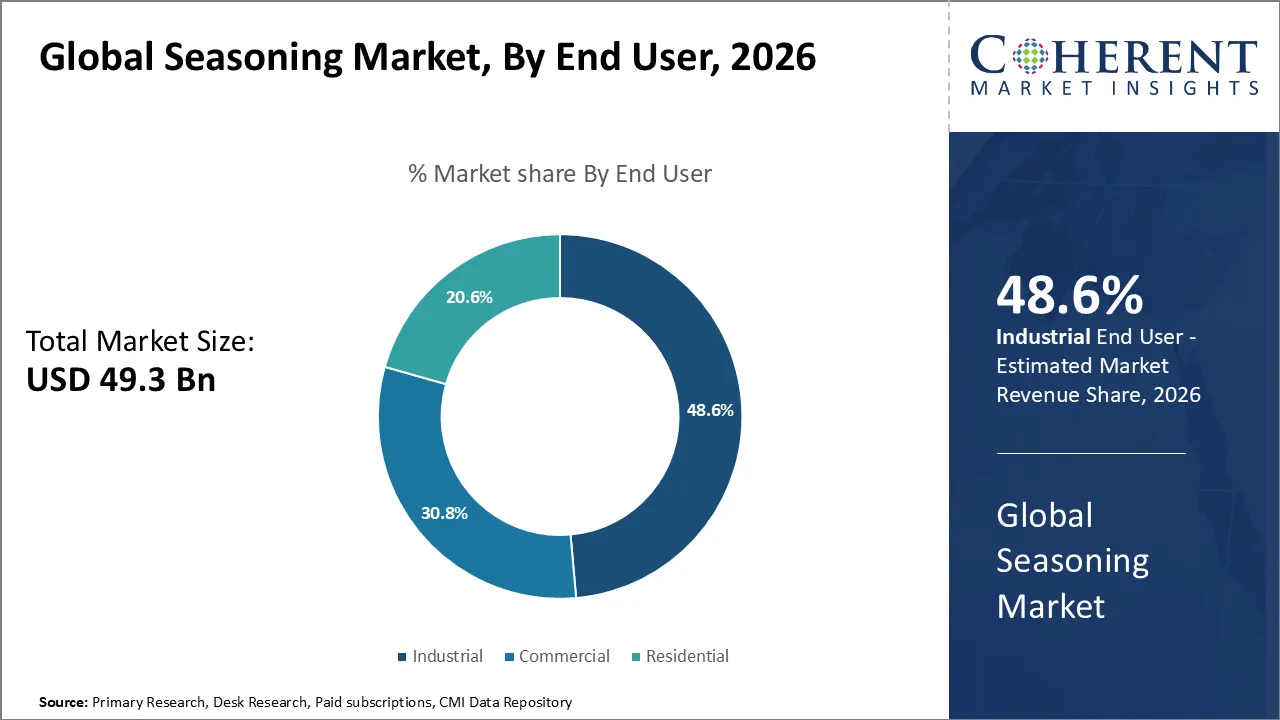
On the basis of end-use industry, the industrial segment is set to lead with a 48.6% share in 2026. The segment’s growth is owing to large-volume seasoning consumption by snack, convenience-food, sauce, meat-processing, ready-meal, and packaged-food manufacturers, which require standardized flavor profiles and consistent ingredient functionality across production batches. In 2025–26, India exported 1.734 million metric tons of spices and spice products worth USD 4.43 billion, showing the large scale of the country’s spice industry and export supply chain.
Why are Pouches Acquiring the Largest Packaging Share?
On the basis of packaging, the pouches segment is estimated to hold the largest Seasoning Market share of 41.5% in 2026. The segment’s growth is owing to its lightweight structure, lower transportation burden, resealable formats, reduced storage requirements, portion flexibility, and suitability for both powdered and granular seasoning products.
According to the Flexible Packaging Association’s 2025 Economic Impact Analysis, the U.S. flexible packaging industry contributes more than USD 151 billion to the U.S. economy and supports nearly 400,000 jobs, demonstrating the scale and maturity of the flexible-packaging ecosystem that supports formats such as stand-up, flat, and resealable pouches.
Seasoning Market Trends
- The growing enthusiasm for bold and internationally inspired flavors is driving companies to develop new seasoning blends for snacks, sauces, ready meals, and foodservice options. Kerry's 2026 Taste Charts highlight flavors such as hot honey, Indian masala, chiltepin chili, and shawarma, signaling a growing consumer passion for spicy and international dishes.
- The rise in demand for clean-label products and simple ingredients is encouraging food producers to use more herbs, spices, and natural seasonings. Ingredion's 2025 research, which surveyed 29 countries, reveals that 75% of consumers prioritize ingredient quality, sustainability, health, and nutrition over price when buying food and beverages.
- Demand for processed seasoning ingredients is increasing as food manufacturers use more spice oils, oleoresins, curry powders, and pastes. As reported by the Spices Board, spice oils and oleoresins made up 12% of the export value, whereas curry powders and pastes represented 6%.
Regional Insights
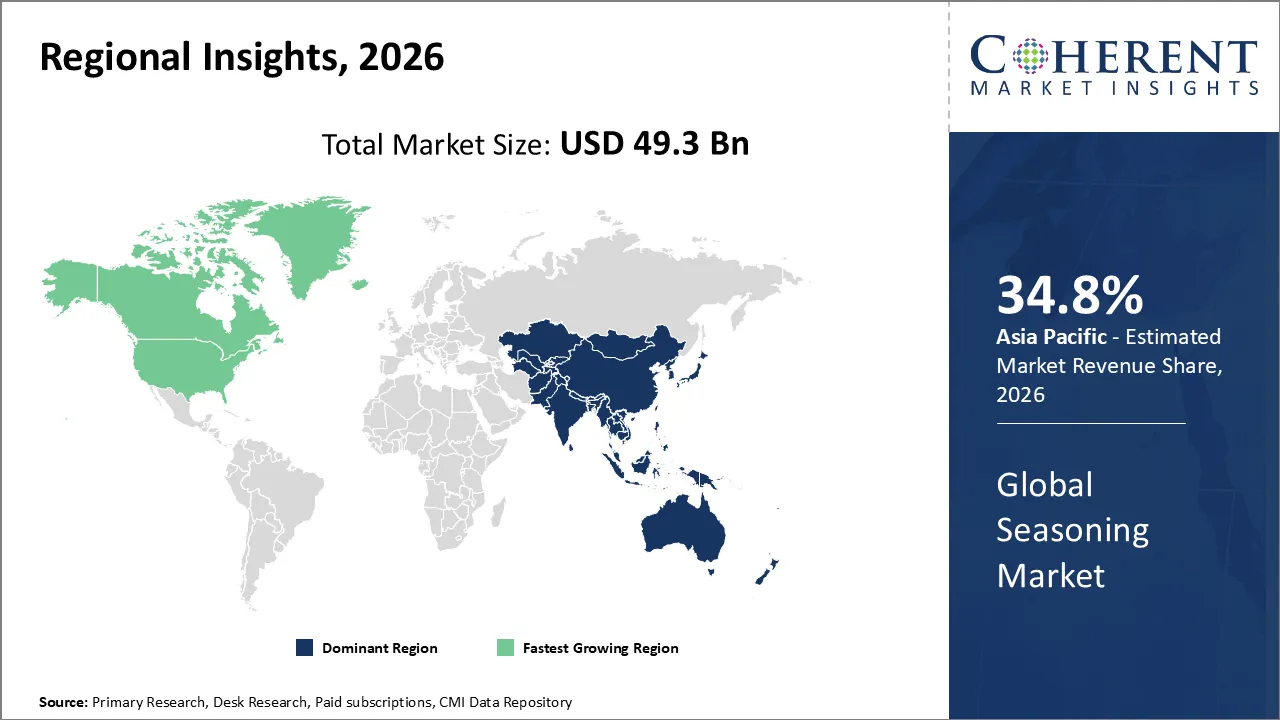
Asia Pacific Dominates Owing to its Strong Spice Production Base and Expanding Regional Consumption
Asia Pacific is expected to account for the largest Seasoning Market share of 34.8% in 2026. The region’s dominance is owing to its large spice-producing base, extensive culinary use of herbs and spices, expanding processed-food manufacturing, and strong supply networks across India, China, Vietnam, Indonesia, and other Asian countries.
In 2025, Vietnam exported 247,482 tons of pepper worth a record USD 1.66 billion, with export value increasing 26% from the previous year. This shows the strong role of Vietnam and the Asia Pacific region in supplying spices for local seasoning production and global exports.
In June 2026, Ajinomoto proposed investing approximately JPY 24.2 billion to make Ajinomoto (Malaysia) Berhad a wholly owned subsidiary. The Malaysian business manufactures and sells umami and flavor seasonings and operates a halal-certified manufacturing system that also serves export markets.
North America is Expected to Witness the Fastest Growth Owing to Increasing Demand for Diverse and Imported Flavor Profiles
North America is expected to witness the fastest growth in the Seasoning Market over the forecast period. The region’s growth is owing to increasing consumer demand for international cuisines, premium seasoning blends, spicy and savory flavors, clean-label products, and greater experimentation with Asian, Latin American, Middle Eastern, and African flavor profiles.
According to the USDA Economic Research Service, the growing ethnic diversity and rising purchasing power of U.S. consumers have resulted in a food basket containing a greater share of tropical products, spices, and imported gourmet foods.
In February 2026, PS Seasoning introduced four new seasoning blends in the U.S. for meat processors. The launch shows growing demand for international, comfort-style, and sweet-spicy flavors in processed meat products.
Growing Imported Spice Demand and Flavor Diversification are Accelerating the Seasoning Market in the United States
The U.S. Seasoning Market is growing as consumers demand more international flavors, premium spice blends, clean-label ingredients, and new taste options in snacks, sauces, prepared foods, and foodservice products.
According to the USDA, U.S. agricultural imports grew from USD 43 billion in 2001 to USD 212 billion in 2025. Demand for spices, tropical foods, and gourmet products is rising as consumers look for more variety and new flavors.
In February 2025, the USDA estimated that U.S. agricultural imports from India would reach USD 3.7 billion, driven partly by higher imports of spices and food ingredients. This strengthens the supply base for ethnic, premium, and internationally inspired seasoning formulations in the U.S. market.
China Seasoning Market Trends
China is expected to witness strong growth in the Seasoning Market owing to its large food-processing industry, extensive consumption of compound seasonings, expanding convenience-food demand, and development of highly specialized seasoning manufacturing clusters.
According to the National Bureau of Statistics of China, value added from the processing of food from agricultural and sideline products increased 5.6% year-on-year in 2025, while overall manufacturing value added grew 6.4%.
At the company level, Anji Food Co., Ltd. had developed a portfolio of more than 500 seasoning and condiment SKUs by 2024, led by curry-based seasonings and meat-flavored compound seasonings. Its expanding compound-seasoning portfolio reflects rising Chinese demand for convenient, standardized, and value-added flavor solutions.
Who are the Major Companies in Seasoning Industry
Some of the major key players in Seasoning Market are McCormick & Company, Nestle, Ajinomoto Co., MDH Spices, Everest Spices, DS Group, Unilever, Kraft Foods, Ariake Japan Company, Associated British Foods, Kerry Group Plc., Olam International Limited.
Key News
- In March 2026, McCormick launched Sweet & Smoky Naturally Flavored Black Currant Seasoning and Black Currant Finishing Sugar after naming black currant its 2026 Flavor of the Year.
- In August 2025, Ajinomoto announced an approximately JPY 23.8 billion investment in a new factory in the Philippines that will manufacture flavored seasonings and breading mixes, including AJI-GINISA and Crispy Fry products.
Market Report Scope
Seasoning Market Report Coverage
Report Coverage | Details | ||
Base Year: | 2025 | Market Size in 2026: | USD 49.3 Bn |
Historical Data for: | 2020 to 2024 | Forecast Period: | 2026 to 2033 |
CAGR: | 5.1% | 2033 Value Projection: | USD 69.8 Bn |
Geographies covered: |
| ||
Segments covered: |
| ||
Companies covered: | McCormick & Company, Nestle, Ajinomoto Co., MDH Spices, Everest Spices, DS Group, Unilever, Kraft Foods, Ariake Japan Company, Associated British Foods, Kerry Group Plc., Olam International Limited. | ||
Growth Drivers: |
| ||
Restraints & Challenges: |
| ||
Analyst Opinion
- The Seasoning Market is increasingly being shaped by rapid flavor-cycle innovation rather than only basic household spice demand. Kerry’s 2026 Global Taste Charts draw on the work of more than 1,300 scientists and 100 flavorists, reflecting the scale of industry investment in tracking and commercializing emerging flavor profiles. This supports continued product turnover across snacks, sauces, ready meals, and foodservice seasonings.
- Demand for industrial seasonings remains strong as food companies use more processed spice ingredients. In 2025–26, India exported USD 4.43 billion worth of spices and spice products, including oils, oleoresins, curry powders, and pastes.
- Consumers prefer simple and familiar ingredients, encouraging seasoning companies to use more herbs, spices, and clear ingredient labels. The 2025 IFIC Food & Health Survey found that 80% of Americans consider whether a food is processed before purchasing it, while familiarity with the term “ultraprocessed food” increased from 32% in 2024 to 44% in 2025. This creates a stronger commercial incentive for seasoning suppliers to support clean-label reformulation while maintaining flavor intensity.
Speak to the analyst
Want personalized insights?
Take the findings above to one of our principal consultants, or have the report rebuilt around the segments, geographies and competitors you actually track.
Market Segmentation
- By Product Type (Revenue, USD Bn, 2021-2033)
- Salt & Salt Substitutes
- Pepper
- Herbs
- Spices
- By End User (Revenue, USD Bn, 2021-2033)
- Industrial
- Commercial
- Residential
- By Packaging (Revenue, USD Bn, 2021-2033)
- Sachets
- Bottles
- Pouches
- By Region (Revenue, USD Bn, 2021-2033)
- North America
- U.S.
- Canada
- Latin America
- Brazil
- Mexico
- Argentina
- Rest of Latin America
- Europe
- Germany
- U.K.
- France
- Italy
- Spain
- Russia
- Rest of Europe
- Asia Pacific
- China
- India
- Japan
- Australia
- South Korea
- ASEAN
- Rest of Asia Pacific
- Middle East
- GCC
- Israel
- Rest of Middle East
- Africa
- South Africa
- Central Africa
- North Africa
- North America
Sources
Primary Research Interviews
- Seasoning and spice manufacturers
- Food flavor and seasoning formulation specialists
- R&D heads from food and beverage companies · Food processing and product development managers
- Industrial seasoning and ingredient suppliers
- Foodservice and restaurant procurement managers
- Spice exporters, importers, and distributors
- Key opinion leaders (KOLs) in food science and flavor technology
Databases
- World Bank
- Food and Agriculture Organization (FAO) – FAOSTAT
- United Nations Comtrade Database
- United States Department of Agriculture (USDA)
- International Trade Centre (ITC) – Trade Map
- Eurostat
- U.S. Food and Drug Administration (FDA)
Magazines
- Food Business News
- Food Ingredients First
- FoodNavigator
- Food Processing Magazine
- Prepared Foods Magazine
- Food Technology Magazine
Journals
- Food Chemistry
- Journal of Food Science
- Food Research International
- Trends in Food Science & Technology
- Journal of Food Engineering
- International Journal of Food Science & Technology
Newspapers
- The New York Times
- The Wall Street Journal
- Financial Times
- The Economic Times
- The Guardian
- Reuters
Associations
- American Spice Trade Association (ASTA)
- European Spice Association (ESA)
- International Organization of Spice Trade Associations (IOSTA)
- Spices Board India
- Institute of Food Technologists (IFT)
- International Food Information Council (IFIC)
- Seasoning and Spice Association of Japan
Public Domain Sources
- Company Annual Reports and Investor Presentations
- Government Food Safety and Regulatory Publications
- USDA Agricultural Production and Trade Reports
- FAO Agricultural and Food Commodity Statistics
- Spices Board India Production and Export Reports
- Publicly Available Food Industry and Consumer Surveys
- Academic Research Publications on Spices and Seasoning Formulations
- Food Labeling and Ingredient Safety Regulations
- Company Product Launches and Manufacturing Expansion Announcements
Proprietary Elements
- CMI Data Analytics Tool
- Proprietary CMI Existing Repository of Information for the Last 10 Years
Get access to 250+ pages report
Every segment, forecast, competitor profile and data table behind the analysis above — available for instant download.
- ESOMAR Member
- ISO 9001:2015 Certified
- D-U-N-S Registered
- GDPR & CCPA Compliant
Missing comfort of reading report in your local language? Find your preferred language:
Transform your Strategy with Exclusive Trending Reports
Frequently Asked Questions
The Seasoning Market is expected to reach approximately USD 69.8 Bn in 2033.
Major players operating in the global Seasoning Market include McCormick & Company, Nestle, Ajinomoto Co., MDH Spices, Everest Spices, DS Group, Unilever, Kraft Foods, Ariake Japan Company, Associated British Foods, Kerry Group Plc., and Olam International Limited.
The volatility in raw material prices and supply chain disruptions are key factors hampering growth of the market.
The increasing demand for convenient and ready-to-eat foods and growing consumption of processed and packaged foods are key factors driving growth of the Seasoning Market.
The Seasoning Market is anticipated to grow at a CAGR of 5.1% between 2026 and 2033.
Among regions, Asia Pacific is expected to account for the largest market share of 34.8% in 2026 in the global Seasoning Market.
Seasoning refers to ingredients or blends such as salt, salt substitutes, pepper, herbs, and spices used to enhance the flavor, aroma, and overall sensory profile of food products.