

Global Semantic Web Market Size and Forecast – 2026 To 2033
The global semantic web market is expected to grow from USD 12.75 Bn in 2026 to USD 41.60 Bn by 2033, registering a compound annual growth rate (CAGR) of 13% from 2026 to 2033. The global semantic web market is driven by the increasing demand for linked data integration. On May 20, 2025, Cohere announced a partnership with SAP to bring its comprehensive suite of enterprise-grade AI models to SAP customers. Cohere’s models will be embedded into SAP Business Suite to enable secure agentic AI capabilities for SAP customers.
Key Takeaways of the Global Semantic Web Market
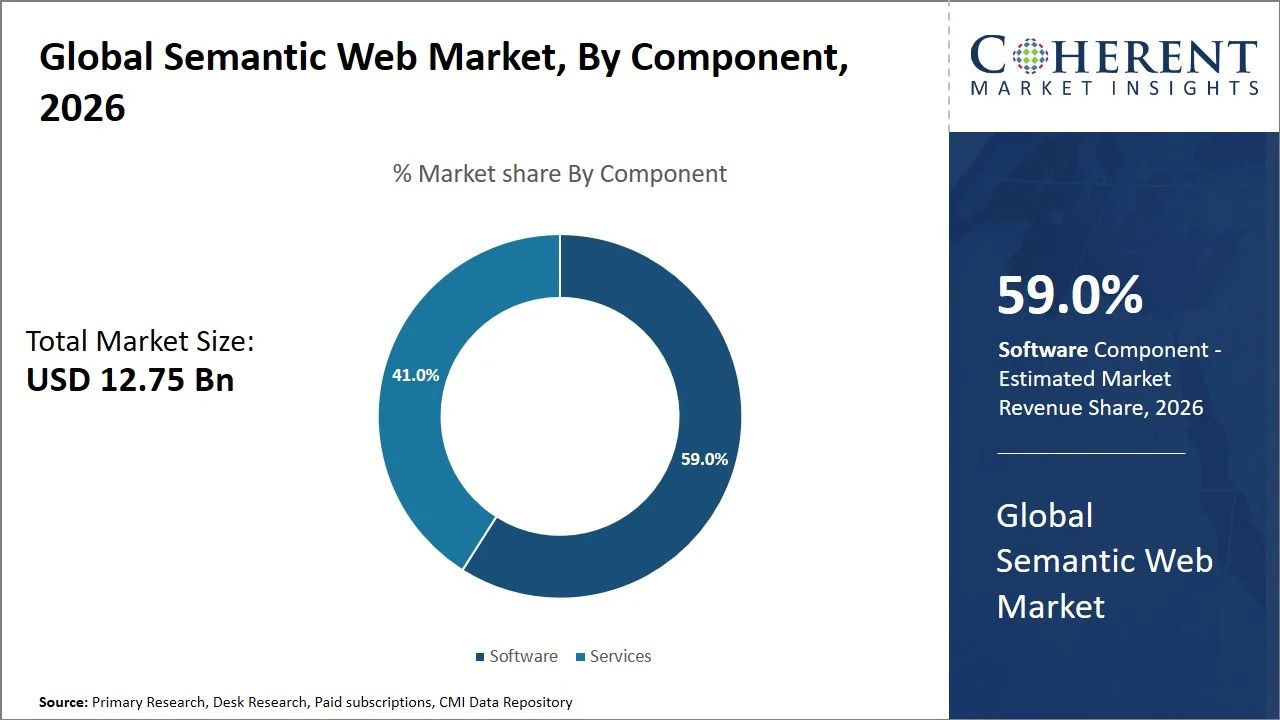
- The software segment is expected to account for 59.0 % of the global semantic web market share in 2026. Expansion of enterprise data management initiatives is driving the growth of the segment. On July 30, 2024, Tamr introduced Tamr RealTime, enabling enterprises to continuously synchronize and manage master data across operational systems using AI driven entity resolution.
- The cloud segment is estimated to capture 67.0 % of the market share in 2026. Increasing use of semantic web in financial fraud detection is majorly driving the growth of the segment. On May 15, 2025, Mashreq, one of the leading financial institutions in the MENA region, announced a strategic partnership with Clari5, a global leader in real-time financial crime management, to launch Clari5 Genie, a next-generation, Gen AI-powered fraud detection and investigation platform.
- The RDF segment is estimated to capture 37.0 % of the market share in 2026. Expansion of smart manufacturing and Industry 4.0 applications is driving the growth of the segment. On May 12, 2025, Schneider Electric announced that it will present its latest innovations in open, software-defined automation and advanced technologies at Automate 2025. The company will demonstrate how it is enhancing the competitiveness and resilience of the U.S. industry through state-of-the-art robotics, industrial AI, and digitalization.
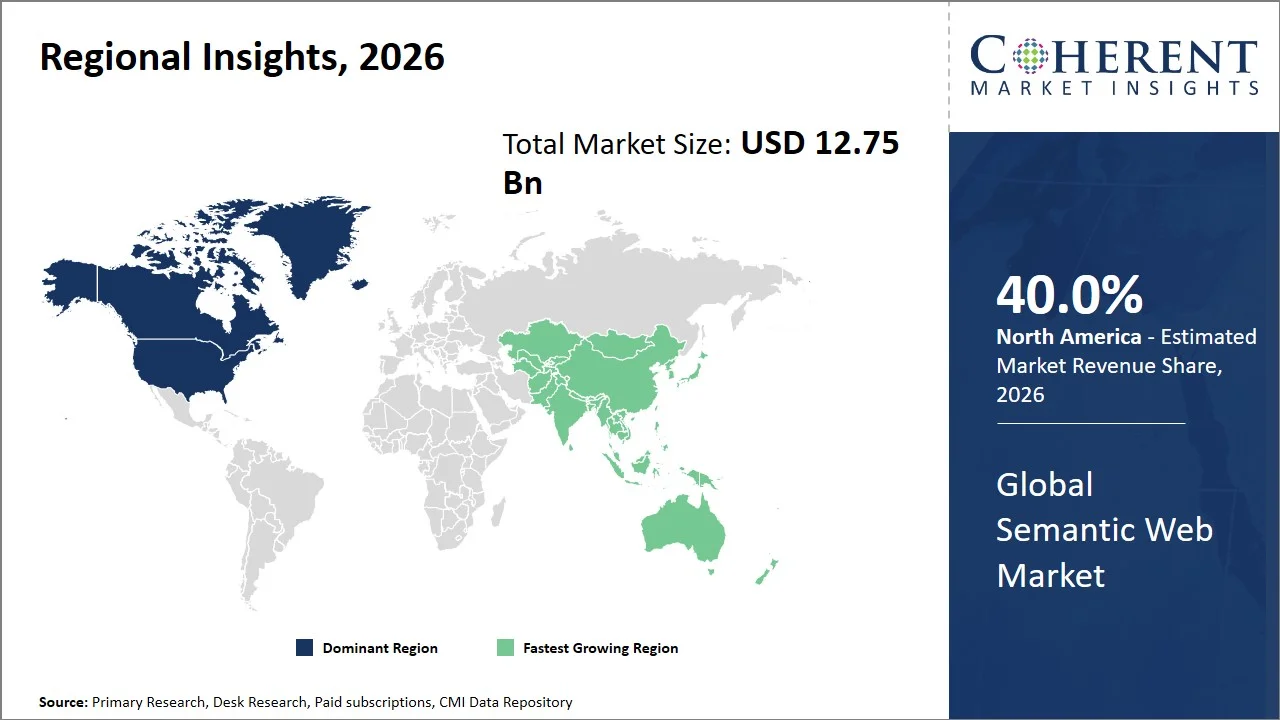
- North America is expected to dominate the semantic web market in 2026 with a market share of 40.0 %. Higher adoption of semantic technologies in healthcare and life sciences in North America is driving the growth of the regional market. On May 27, 2025, John Snow Labs, the AI for healthcare company, announced the acquisition of WiseCube, a pioneer in biomedical knowledge graphs and AI-powered literature analysis. The acquisition strengthens the company’s mission to deliver responsible, accurate, and explainable healthcare AI solutions enhanced by WiseCube’s billion-scale knowledge platform.
- Asia Pacific is expected to account for 28.0 % share in 2026 and is projected to record the fastest growth over the forecast period. Emerging adoption in digital government and smart city initiatives in Asia Pacific is driving the growth of the regional market. On June 2, 2024, NEC Corporation introduced an enhanced digital government platform integrating generative AI, knowledge management, and semantic data integration to help local governments automate citizen services, document processing, and cross department information sharing.
- Rapid Integration of Semantic Knowledge Graphs with Generative AI: An increasing number of companies are combining semantic knowledge graphs with large language models to improve contextual reasoning to reduce AI hallucinations, enable explainable AI outputs, and offer more accurate enterprise search and decision support.
- Growing Adoption of Industry Specific Semantic Ontologies: Manufacturing and life sciences organizations are developing domain-specific ontologies to standardize data, improve interoperability, simplify regulatory compliance, and improve cross-platform information exchange.
Segmental Insights
Why Does Software Dominate the Global Semantic Web Market?
The software segment is expected to account for 59.0% of the global semantic web market share in 2026. The software segment is estimated to spearhead the semantic web market, providing the fundamental platforms required to create, manage and analyze semantic data across the organizational environment. Semantic software helps enterprises establish ontologies, knowledge graphs, linked data repositories, and semantic search to increase data interoperability and AI-driven decision making. Companies’ continued focus on digital transformation and intelligent data management is driving investment in scalable software platforms that can be integrated with existing business applications and cloud infrastructure, sustaining the demand for semantic web software solutions. On April 24, 2025, Progress Software upgraded its Semaphore semantic AI platform after the addition of MarkLogic technology, which will enable organizations to construct and enrich knowledge graphs, automate metadata management and boost semantic search across massive enterprise content repositories.
- Current Industry Events of 2026
- Market Size Estimation
- Regional Breakdown
- Competitive Landscape
- Customer Intelligence
- Segmental Analysis
- Pricing Analysis
- Key Market Drivers, Challenges & Future Trends
- Customized Insights Section
Why is Cloud the Most Preferred Deployment Type?
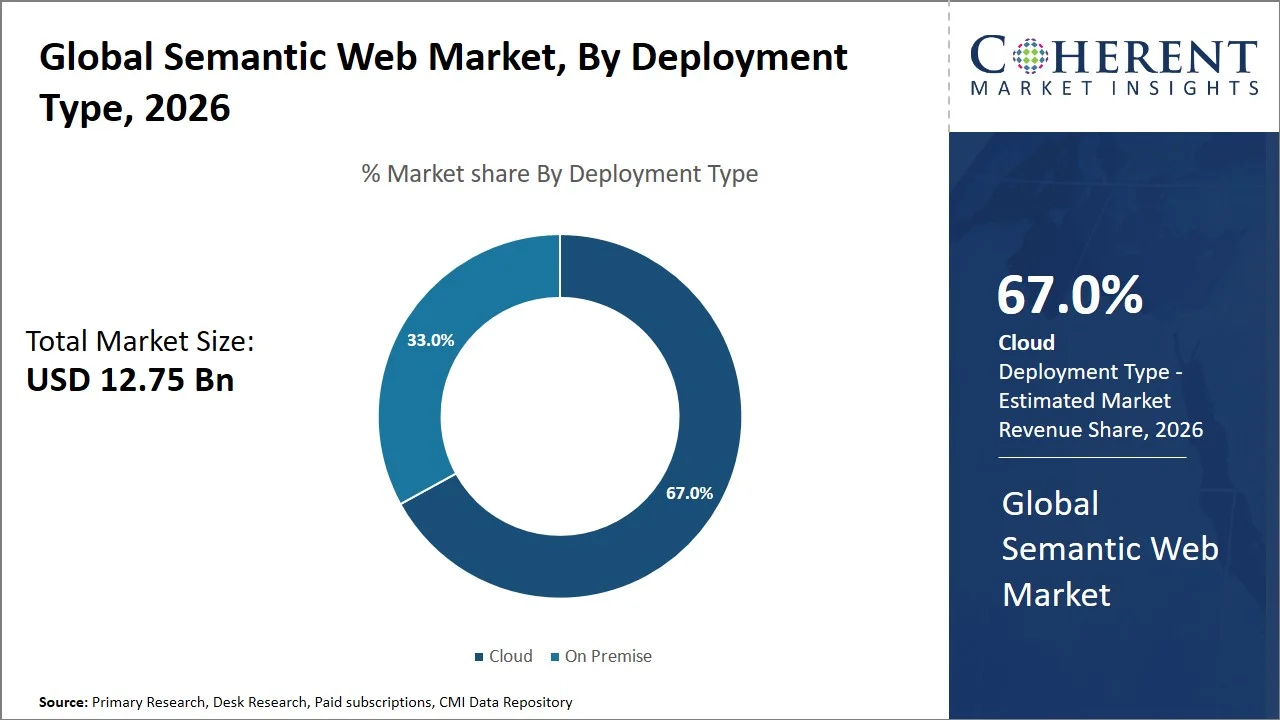
The cloud segment is expected to account for 67.0% of the global semantic web market share in 2026. Cloud implementation is widely selected because to the scalability it gives to process and integrate massive amount of distributed semantic data without any upfront infrastructure expenditure. Semantic databases, knowledge graphs and AI driven analytics can be placed into service by organizations in short order, benefitting from elastic compute resources, automatic software updates and seamless connection with cloud-based corporate apps. This flexibility allows companies to quickly scale semantic web activities across locations, cutting operational complexity and IT expenses. On June 12, 2025, Databricks announced a new strategic product partnership with Google Cloud to make the latest Gemini models available as native products within the Databricks Data Intelligence Platform. This partnership empowers organizations to build, deploy and scale AI agents using Google Gemini’s advanced capabilities directly on their enterprise data, securely and with unified governance, within their Databricks environment.
RDF Dominates the Global Semantic Web Market
The RDF segment is expected to account for 37.0% of the global semantic web market share in 2026. RDF is widely used, as it provides a common framework to describe and interconnect data from different sources in a machine accessible format. Its standardized data model enables seamless interoperability and efficient information exchange across diverse enterprise systems, making it easier for enterprises to combine structured and unstructured information across enterprise applications. This standardized approach forms the basis for the development of knowledge graphs, semantic search, and artificial intelligence applications, making RDF the core technology behind most semantic web implementations. On December 22, 2025, SAP released a native capability in SAP HANA Cloud that converts Property Graphs directly into RDF knowledge graphs in a single workflow. This improvement allows organizations to develop standards based semantic knowledge graphs using current graph data models which greatly accelerates the RDF adoption in enterprise AI and linked data applications.
Current Events and their Impact
Current Events | Description and its Impact |
European Union - Artificial Intelligence Act (AI Act) |
|
U.S. - Executive Order on Safe, Secure, and Trustworthy Artificial Intelligence |
|
Global Semantic Web Market Dynamics
Market Drivers
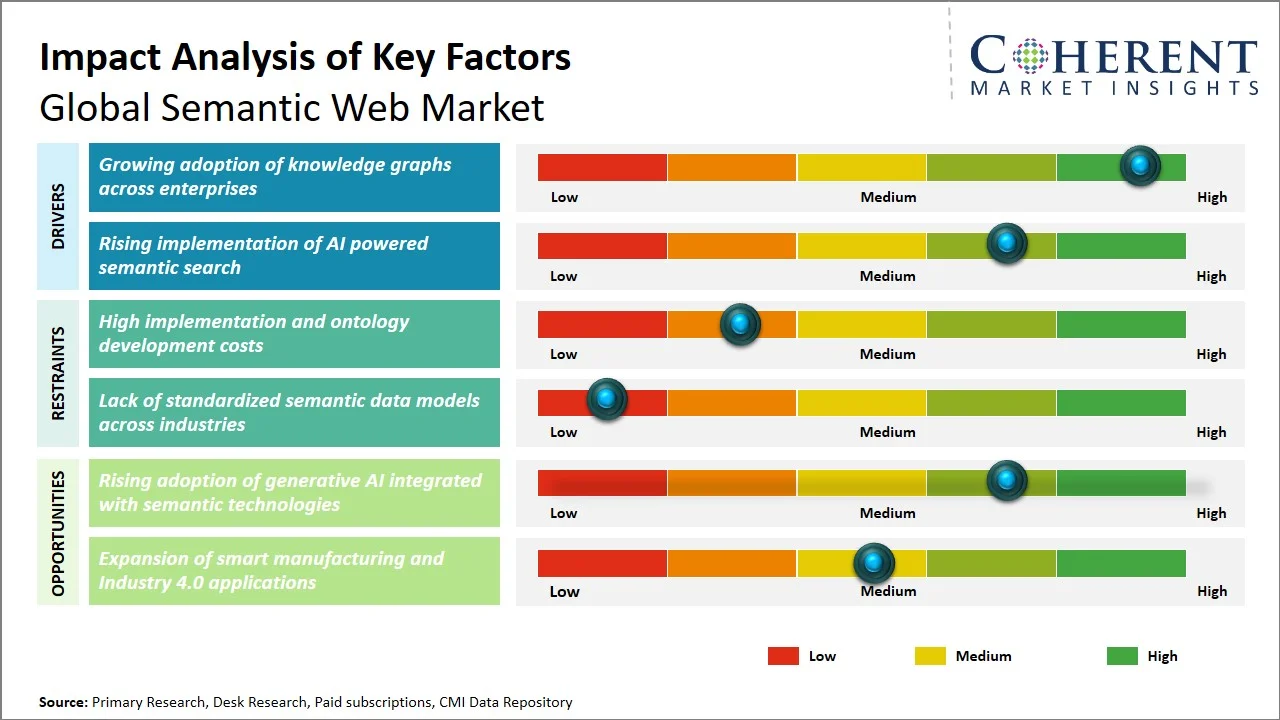
- Growing adoption of knowledge graphs across enterprises: Enterprises are increasingly adopting knowledge graphs to combine structured and unstructured data into a single semantic framework that enhances business intelligence and operational efficiency. Knowledge graphs map relationships between consumers, goods, suppliers, documents and business processes to improve the accuracy of search, contextual analytics, fraud detection and decision support. They are converging with enterprise resource planning, customer relationship management, and data lake platforms to help organizations break down data silos, improve interoperability, and build trusted data foundations for advanced artificial intelligence applications. On June 23, 2025, The Graph announced it is organizing the world’s public data, securely, transparently, and at scale. With the launch of GRC-20 and Geo, the protocol is taking the next big step in organizing public knowledge.
- Rising implementation of AI powered semantic search: The adoption of AI-powered semantic search is growing as companies look for search capabilities that understand user intent, context and relationships and not just keyword matching. Semantic search engines use natural language processing, machine learning, ontologies and knowledge graphs to generate highly relevant results from the huge amounts of enterprise content. That capacity increases staff productivity, customer experience and information discovery, while powering generative AI assistants, intelligent document management and conversational enterprise applications. On February 11, 2025, Cerebras Systems announced its pivotal role in powering Sonar, a groundbreaking model optimized for Perplexity search. Built on the robust foundation of Llama 3.3 70B, Sonar represents a significant advancement in answer quality, factuality, and readability, setting new standards for user satisfaction in search technology.
Emerging Trends
- Expansion of Semantic Data Fabrics for Enterprise Data Integration: Enterprises are adopting semantic data fabric architectures to integrate structured and unstructured data from disparate enterprise systems to enable real-time analytics, unified governance and rapid access to business intelligence.
- Increasing Deployment of Semantic Technologies in Digital Twins and Intelligent Automation: Semantic web technologies are being integrated with digital twins, IoT platforms and intelligent automation solutions to improve machine understanding, asset relationships, optimize predictive maintenance and enable autonomous operational decision making.
Regional Insights
Why is North America a Strong Market for Semantic Web?
North America is expected to account for a market share of 40.0% in 2026. North America represents the largest regional market for the semantic web, driven by the widespread adoption of enterprise knowledge graphs, semantic AI platforms, and linked data technologies by leading cloud service providers and enterprise software companies. Microsoft is embedding semantic indexing, Microsoft Graph and knowledge retrieval into Microsoft 365 Copilot and Azure AI Foundry, while Google is expanding the use of its Knowledge Graph across Search, Workspace and Gemini AI services. Amazon Web Services has Amazon Neptune for RDF and property graph applications to provide fraud detection, recommendation engines and supply chain intelligence across companies.
Healthcare organizations are rapidly adopting semantic interoperability using HL7 FHIR standards. Providers like Mayo Clinic and Cleveland Clinic are leveraging ontology driven data integration for clinical research and patient data interchange. The United States Department of Defense and NASA continue to use semantic knowledge management frameworks for mission planning, engineering documentation, and digital twins, while financial institutions employ semantic technologies for anti-money laundering, risk analytics, and regulatory reporting.
Why Does the Asia Pacific Semantic Web Market Exhibit High Growth?
Asia Pacific is projected to account for 28.0% of the global semantic web market in 2026 and is expected to register the fastest growth. Asia Pacific is experiencing rapid expansion driven by national artificial intelligence strategies, industrial digitalization, and large scale smart manufacturing initiatives. Chinese technology leaders such as Alibaba Cloud, Huawei Cloud, Tencent Cloud and Baidu AI Cloud are starting to embed semantic knowledge graphs into industrial internet platforms, smart cities and government data exchanges in China. Japan is developing semantic interoperability in manufacturing by combining digital twins and ontology based asset management across automotive and electronics manufacturing. South Korea is using semantic technologies in smart factories as part of its Manufacturing Innovation agenda, Singapore is promoting linked data standards through its Smart Nation digital services. Australia is broadening the scope of semantic data integration across geospatial information systems and research organizations and India is witnessing growing adoption of semantic search and enterprise knowledge management in banking, information technology services and digital public infrastructure initiatives.
Global Semantic Web Market Outlook for Key Countries
Why is the U.S. Emerging as a Major Hub in the Semantic Web Market?
The U.S. is the most developed national market, with the concentration of the leading semantic technology providers such as Google, Microsoft, Oracle, IBM, Amazon Web Services, Stardog, Cambridge Semantics, and Franz. Google Knowledge Graph uses trillions of entity relationships to power search relevance and generative AI responses, while Microsoft Graph connects hundreds of millions of organizational resources across Microsoft 365 environments. Amazon Neptune is a graph database used by enterprises for fraud detection, cyber security, and recommendation engines. Federal agencies are increasingly using semantic standards through efforts such as Data.gov and the National Institutes of Health, which use biomedical ontologies for research interoperability. Stanford University and Carnegie Mellon University continue to be world leaders in ontology engineering, linked data research, and the development of semantic artificial intelligence.
Is China the Next Growth Engine for the Semantic Web Market?
Strong government support for artificial intelligence, industrial internet and digital government platforms has made China one of the fastest growing markets. Baidu has constructed large-scale knowledge graphs to enhance the performance of the Ernie foundation model and intelligent search services, and Alibaba Cloud has incorporated graph databases and semantic data services into its enterprise cloud platforms. Huawei deploys semantic technology for telecommunication network management, digital twins and industrial intelligence solutions. Tencent leverages semantic knowledge graphs in healthcare, fintech, and content recommendation services. Government-backed digital city projects are progressively using semantic interoperability frameworks to integrate transportation, healthcare, utilities and public administration datasets, thus boosting the adoption of linked data technologies across the country.
Germany Semantic Web Market Analysis and Trends
Germany continues to lead the European semantic web business with a significant focus on Industry 4.0, factory digitalization and industrial data spaces. Industrial companies like Siemens, Bosch, SAP and Siemens Healthineers are embedding semantic models, digital twins and ontology based asset management into factory automation and engineering platforms. SAP Business Technology Platform uses semantic knowledge graphs to enhance enterprise analytics, master data management, and business process intelligence. Germany is also a pioneer in the International Data Spaces Association, which is setting standards for semantic interoperability that will make secure industrial data sharing across manufacturing supply chains possible. Automotive manufacturers are increasingly relying on semantic data integration for connected vehicles, predictive maintenance and product lifecycle management.
U.K. Semantic Web Market Analysis and Trends
The U.K. has established a strong semantic web ecosystem through its leadership in life sciences, financial services and public sector digital transformation. The BBC still uses semantic metadata and linked data technology to organize digital media material and enhance content discovery across its platforms. The National Health Service is facilitating semantic interoperability through the use of the SNOMED CT clinical terminology and FHIR based healthcare data exchange, which facilitates the standardization of electronic health records across healthcare providers. Financial institutions in London are increasingly adopting knowledge graphs to detect fraud, understand their customers and maintain regulatory compliance. Research institutions such as the University of Oxford and the University of Southampton continue to make important contributions to semantic web standards, ontology engineering and linked data innovation.
Japan Semantic Web Market Analysis and Trends
The semantic web market in Japan is driven by sophisticated manufacturing, robotics, automotive engineering and smart infrastructure development. Toyota embeds semantic knowledge models into connected vehicle ecosystems and mobility data platforms. Hitachi leverages ontology-driven asset management across industrial digital twins and railway infrastructure. Fujitsu creates semantic AI solutions for enterprise knowledge management, healthcare and public administration, while NEC applies semantic analytics for cybersecurity and smart city operations. Japanese manufacturers are increasingly leveraging semantic technologies with industrial IoT, robotics and predictive maintenance systems to enhance production efficiency. National efforts to support Society 5.0 continue to promote semantic interoperability across transportation, healthcare, energy, and government digital services.
Global Semantic Web Market - Enterprise Metadata Management Adoption (2025)
Industry | Enterprise Metadata Management Adoption (%) |
Banking, Financial Services & Insurance (BFSI) | 86% |
Healthcare & Life Sciences | 82% |
Information Technology & Telecom | 80% |
Manufacturing | 76% |
Retail & E-commerce | 72% |
Government & Public Sector | 69% |
Energy & Utilities | 66% |
Media & Entertainment | 63% |
Transportation & Logistics | 61% |
Education & Research | 58% |
How is the Rising Adoption of Generative AI Integrated With Semantic Technologies Creating New Growth Opportunities in the Global Semantic Web Market?
By combining generative AI and semantic technologies, large language models can use structured enterprise knowledge instead of just statistical predictions, opening up new opportunities to grow. Increasingly, enterprises are building retrieval augmented generation pipelines that connect knowledge graphs, RDF datasets, ontologies, and vector databases to deliver real-time verified responses with source attribution. Microsoft is combining Microsoft Graph with Microsoft 365 Copilot to integrate AI-generated responses with organizational data. Google is combining its Knowledge Graph with Gemini models to improve contextual reasoning across Search and Workspace.
Pharmaceutical companies are using semantic knowledge graphs to link clinical trial data, scientific literature and molecular databases, allowing generative AI systems to speed up drug discovery and research analysis. Financial institutions are adopting graph-based semantic models to enable AI assistants that interpret complex regulatory documents, detect relationships between entities involved in financial crime, and generate compliance reports with significantly improved accuracy. These enterprise deployments are driving the demand for semantic web platforms capable of delivering trusted, explainable, and continuously updated knowledge for next generation AI applications.
On July 14, 2025, Metaphactory announced the release of metaphactory 5.8, which introduces many new features to metaphactory, including new AI assistance to metaphactory’s semantic modeling capabilities, a Vocabulary Mapping Editor, and improvements to the ontology review process.
Market Players, Key Development, and Competitive Landscape
Key Developments
- On March 26, 2025, Siemens announced that it has completed the acquisition of Altair Engineering Inc. for an enterprise value of approximately USD 10 billion. With this acquisition, Siemens extends its leadership in simulation and industrial artificial intelligence (AI) by adding new capabilities in mechanical and electromagnetic simulation, high-performance computing (HPC), data science and AI.
- On October 23, 2024, Semantic Web Company and Ontotext announced that the two companies have merged to become the leading Graph AI provider, Graphwise. Semantic Web Company brings expertise in knowledge engineering, semantic AI and intelligent document processing, while Ontotext brings the most versatile graph database engine and state-of-the-art AI models for linking and unifying information at scale.
Competitive Landscape
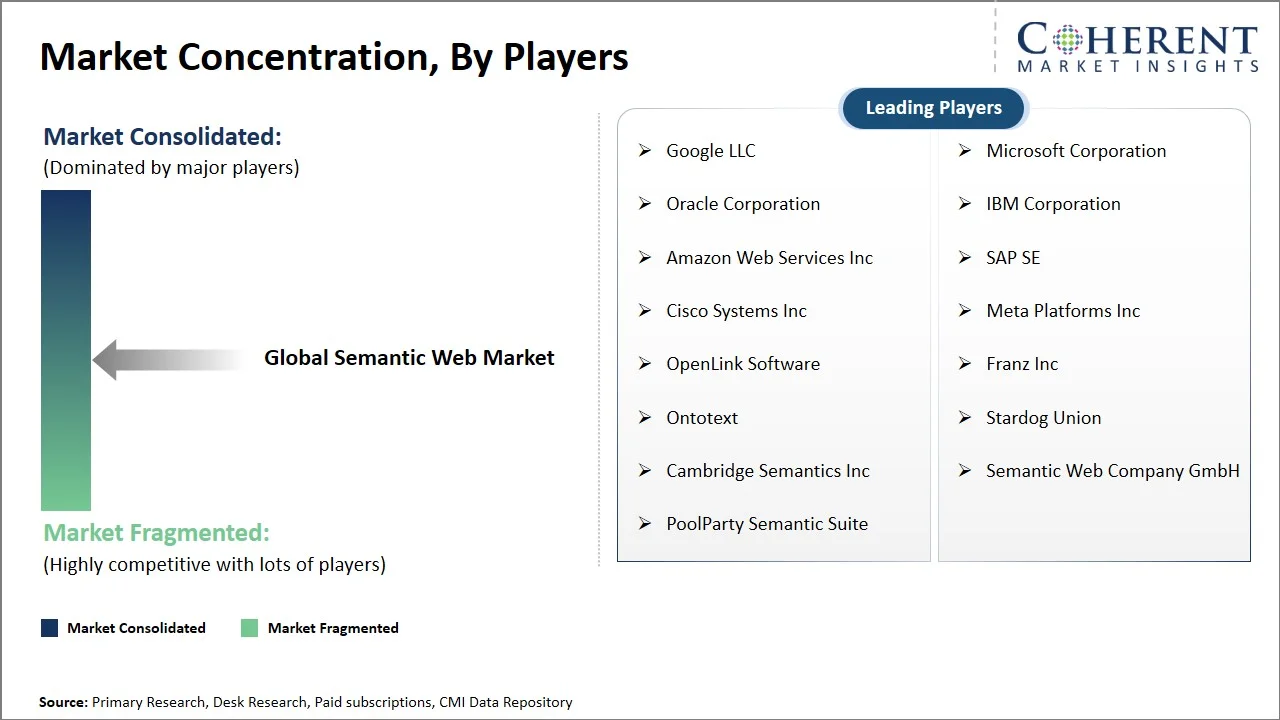
Competition in the global semantic web market is led by Google, Microsoft, Amazon Web Services, Oracle, IBM, SAP, Stardog, Ontotext, Franz, and Cambridge Semantics, with differentiation centered on enterprise knowledge graphs, graph databases, semantic AI integration, and cloud native data platforms rather than standalone ontology tools. Google continues to enhance its Knowledge Graph capabilities for Gemini and Search, while Microsoft is integrating Microsoft Graph, Azure AI Foundry and Microsoft 365 Copilot for enterprise semantic retrieval and retrieval augmented generation solutions. Amazon Web Services has its eyes on graph analytics via Amazon Neptune, which is aimed at fraud detection, supply chain intelligence and recommendation engines.
IBM’s watsonx adds semantic technologies for controlled enterprise. AI SAP’s Business Technology Platform embeds knowledge graph capabilities to better master data management and business process intelligence. Specialist vendors such as Stardog, Ontotext, and Cambridge Semantics are expanding partnerships with healthcare, defense, and financial services organizations by offering ontology driven knowledge graph platforms designed for explainable AI, regulatory compliance, and large scale enterprise data integration.
Market Report Scope
Semantic Web Market Report Coverage
| Report Coverage | Details | ||
|---|---|---|---|
| Base Year: | 2025 | Market Size in 2026: | USD 12.75 Bn |
| Historical Data for: | 2020 To 2024 | Forecast Period: | 2026 To 2033 |
| Forecast Period 2026 to 2033 CAGR: | 13% | 2033 Value Projection: | USD 41.60 Bn |
| Geographies covered: |
| ||
| Segments covered: |
| ||
| Companies covered: | Google LLC, Microsoft Corporation, Oracle Corporation, IBM Corporation, Amazon Web Services Inc, SAP SE, Cisco Systems Inc, Meta Platforms Inc, OpenLink Software, Franz Inc, Ontotext, Stardog Union, Cambridge Semantics Inc, Semantic Web Company GmbH, and PoolParty Semantic Suite | ||
| Growth Drivers: |
| ||
| Restraints & Challenges: |
| ||
Analyst Opinion (Expert Opinion)
- The next phase of industry growth is expected to be driven by the convergence of semantic web technologies with generative AI, where knowledge graphs will become the preferred foundation for enterprise retrieval augmented generation architectures. Organizations will increasingly prioritize semantic data layers that improve factual accuracy, reduce hallucinations, and enable explainable artificial intelligence across mission critical business applications.
- The strongest commercial opportunity is expected to emerge from knowledge graph software deployed through cloud platforms for financial services and healthcare in the U.S., followed by industrial semantic digital twins for manufacturing in Germany and enterprise AI knowledge management platforms in Japan. These segments combine stringent data governance requirements with high investments in artificial intelligence, creating sustained demand for advanced semantic technologies.
- Market participants should invest in automated ontology development, graph enhanced big language model integration and native support for open standards like as RDF, OWL, SPARQL and FHIR to increase competitive posture. Increasing strategic partnerships with hyperscale cloud providers, enterprise software vendors and industry specific AI developers while providing prebuilt semantic models for regulated industries will provide a significant competitive advantage versus vendors providing only general purpose graph database capabilities.
Speak to the analyst
Want personalized insights?
Take the findings above to one of our principal consultants, or have the report rebuilt around the segments, geographies and competitors you actually track.
Market Segmentation
- Component Insights (Revenue, USD Billion, 2021 - 2033)
- Software
- Services
- Deployment Type Insights (Revenue, USD Billion, 2021 - 2033)
- Cloud
- On Premise
- Technology Insights (Revenue, USD Billion, 2021 - 2033)
- RDF
- OWL
- SPARQL
- Linked Data
- Knowledge Graphs
- Application Insights (Revenue, USD Billion, 2021 - 2033)
- Enterprise Knowledge Management
- Data Integration
- Information Retrieval
- Semantic Search
- Content Management
- Customer Analytics
- Risk and Compliance
- End User Insights (Revenue, USD Billion, 2021 - 2033)
- BFSI
- Healthcare
- Retail and E Commerce
- IT and Telecommunications
- Government
- Manufacturing
- Media and Entertainment
- Education
- Regional Insights (Revenue, USD Billion, 2021 - 2033)
- North America
- U.S.
- Canada
- Latin America
- Brazil
- Argentina
- Mexico
- Rest of Latin America
- Europe
- Germany
- U.K.
- Spain
- France
- Italy
- Russia
- Rest of Europe
- Asia Pacific
- China
- India
- Japan
- Australia
- South Korea
- ASEAN
- Rest of Asia Pacific
- Middle East
- GCC Countries
- Israel
- Rest of Middle East
- Africa
- South Africa
- North Africa
- Central Africa
- North America
- Key Players Insights
- Google LLC
- Microsoft Corporation
- Oracle Corporation
- IBM Corporation
- Amazon Web Services Inc
- SAP SE
- Cisco Systems Inc
- Meta Platforms Inc
- OpenLink Software
- Franz Inc
- Ontotext
- Stardog Union
- Cambridge Semantics Inc
- Semantic Web Company GmbH
- PoolParty Semantic Suite
Sources
Primary Research Interviews
- Semantic Web Technology Developers & Solution Providers
- Enterprise Data Integration & Linked Data Specialists
- Ontology & Knowledge Graph Architects
- AI & Machine Learning Integration Consultants
Magazines
- IEEE Spectrum (Semantic & Web Technology Coverage)
- Wired (AI & Emerging Web Technologies)
- InformationWeek (Enterprise Data & Knowledge Management)
- MIT Technology Review
Journals
- Journal of Web Semantics (Elsevier)
- Semantic Web Journal (IOS Press)
- Journal of Artificial Intelligence Research (JAIR)
Associations
- World Wide Web Consortium (W3C)
- Semantic Web Science Association (SWSA)
- International Association for Ontology and its Applications (IAOA)
- Open Geospatial Consortium (OGC)
Public Domain Sources
- World Wide Web Consortium (W3C) Official Publications & Standards Documentation
- U.S. National Institute of Standards and Technology (NIST) Reports
- European Commission – Digital Single Market & AI Policy Reports
- United Nations Conference on Trade and Development (UNCTAD) – Digital Economy Reports
Proprietary Elements
- CMI Data Analytics Tool
- Proprietary CMI Existing Repository of Information for Last 10 Years
Get access to 250+ pages report
Every segment, forecast, competitor profile and data table behind the analysis above — available for instant download.
- ESOMAR Member
- ISO 9001:2015 Certified
- D-U-N-S Registered
- GDPR & CCPA Compliant
Missing comfort of reading report in your local language? Find your preferred language:
Transform your Strategy with Exclusive Trending Reports
Frequently Asked Questions
The global semantic web market is expected to stand at USD 12.75 Bn in 2026 and is expected to reach USD 41.60 Bn by 2033.
The CAGR of the global semantic web market is projected to be 13% from 2026 to 2033.
Growing adoption of knowledge graphs across enterprises and rising implementation of AI powered semantic search are the major factors driving the growth of the global semantic web market.
High implementation and ontology development costs and lack of standardized semantic data models across industries are the major factors hampering the growth of the global semantic web market.
In terms of component, the software segment is estimated to dominate the market revenue share in 2026.
Knowledge graphs connect related data to improve search accuracy, analytics, and AI reasoning.
Semantic search understands user intent and contextual relationships instead of matching only keywords.