

Global Shock Absorbers Market Size and Forecast – 2026-2033
The Global Shock Absorbers Market is estimated to be valued at USD 17.24 Bn in 2026 and is expected to reach USD 24.74 Bn by 2033, exhibiting a compound annual growth rate (CAGR) of 5.3% from 2026 to 2033.
Key Takeaways of the Global Shock Absorbers Market
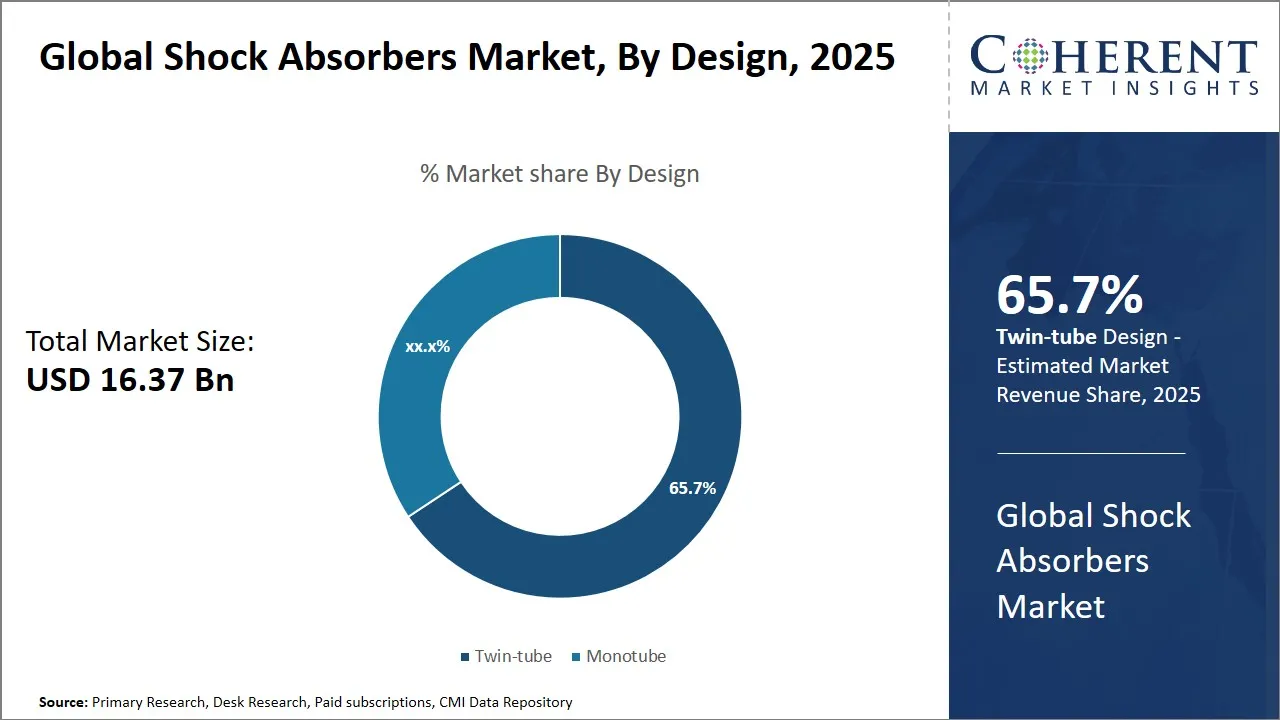
- The twin-tube segment leads the market holding an estimated share of 66.7% in 2026.
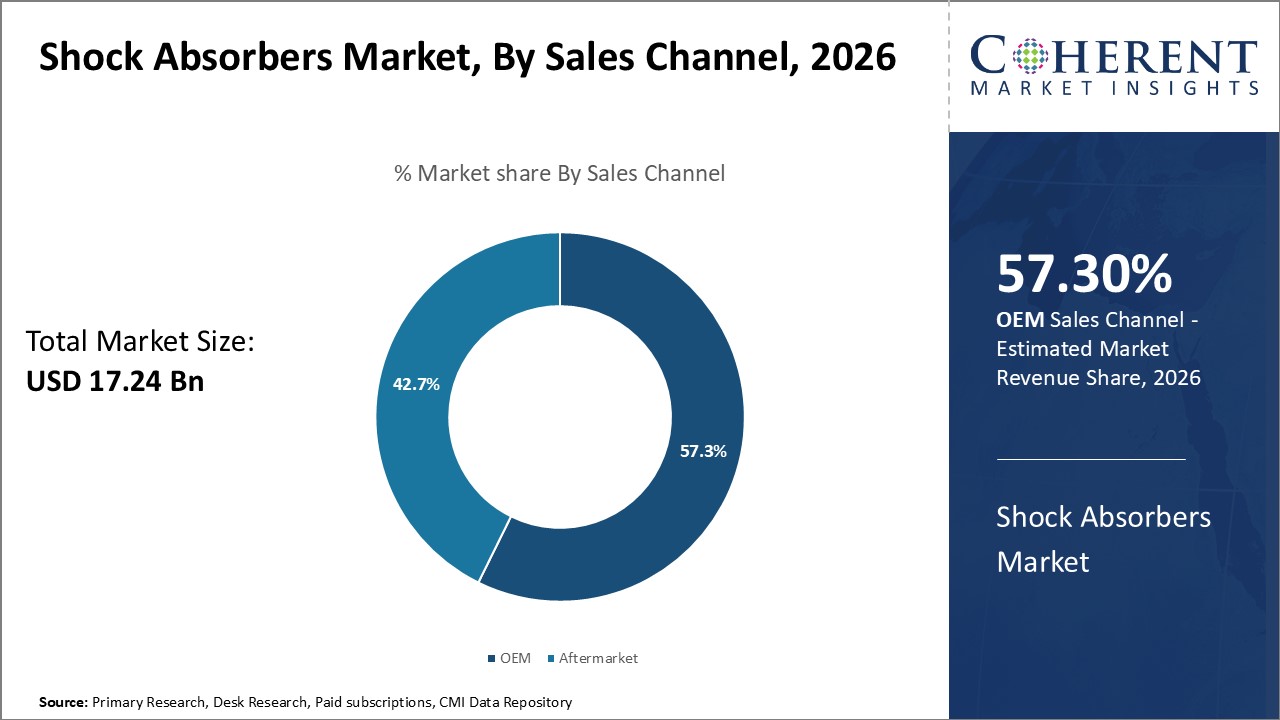
- The OEM segment leads the market holding an estimated share of 57.3% in 2026.
- The passenger vehicles segment leads the market holding an estimated share of 74.3% in 2026.
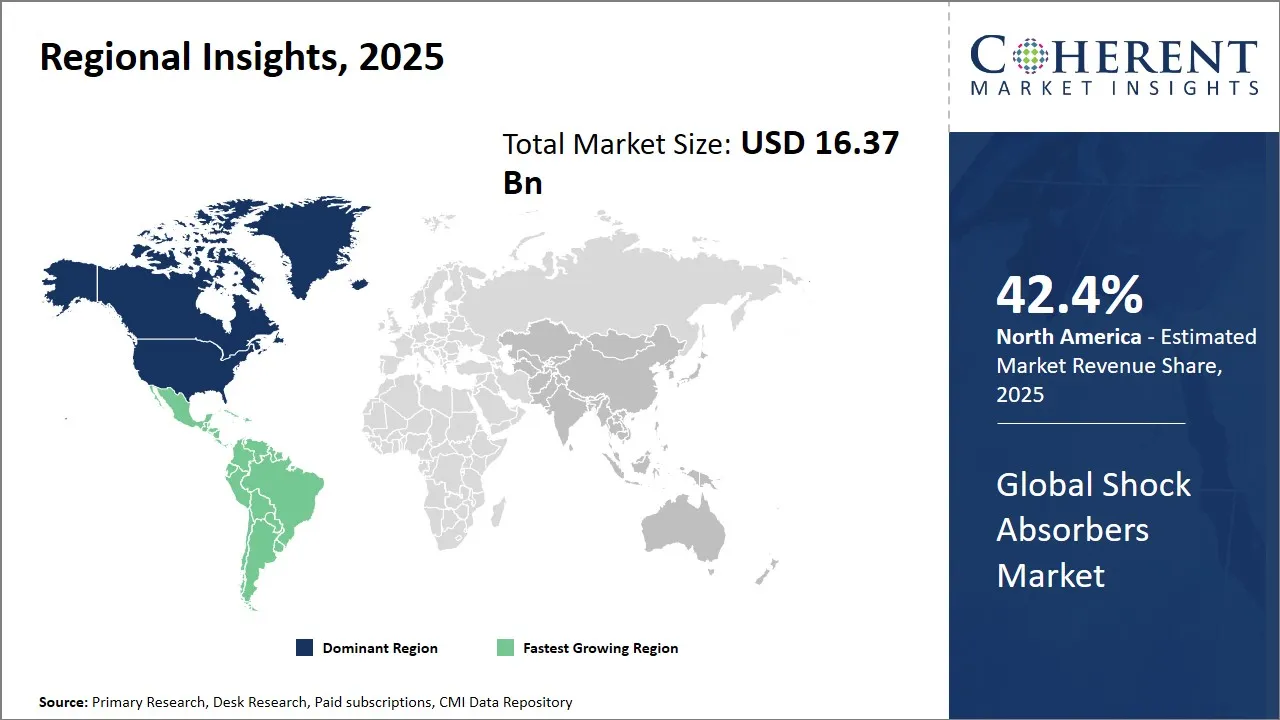
- North America is estimated to lead the market with a share of 42.4% in 2026.
- Latin America, holding a share of 7.1% in 2026, is projected to be the fastest growing region.
Market Overview
The market is seeing a move towards smart and adaptive shock absorbers using advanced sensors and electronic controls to give real-time responsiveness. Also, the adoption of lightweight materials is growing in order to improve fuel efficiency and reduce emissions. The rise in electric and autonomous vehicles adds to innovation, while strict governmental regulations on vehicle safety standards boost the demand for high-performance shock absorber systems globally.
Current Events and Its Impact
Current Events | Description and its impact |
Geopolitical and Trade Developments |
|
Economic and Industrial Trends |
|
Segmental Insights
- Current Industry Events of 2026
- Market Size Estimation
- Regional Breakdown
- Competitive Landscape
- Customer Intelligence
- Segmental Analysis
- Pricing Analysis
- Key Market Drivers, Challenges & Future Trends
- Customized Insights Section
Global Shock Absorbers Market Insights, By Design – Twin-tube Leads Because of its Cost-Effectiveness and Versatile Performance
The twin-tube segment is expected to hold the largest share of 66.7% in the global shock absorbers market in 2026 because of its high adoption in different automotive applications. A big factor is its cost-effectiveness compared to other designs like monotube and remote-reservoir shock absorbers. The simple construction of twin-tube shock absorbers helps manufacturers produce them at a lower cost, making them an economical choice for many passenger vehicles and light trucks.
Also, the twin-tube design offers a mix of comfort and performance, which attracts a big range of vehicle manufacturers targeting everyday driving conditions. It can provide consistent damping over different road surfaces, and can absorb shocks effectively, which improves ride comfort and vehicle stability. This supports high usage in both front and rear suspension systems, making it a suited option for standard vehicles.
Another factor propelling the twin-tube segment’s dominance is its maintenance-friendly nature. The design permits easier repairs and part replacements, which is attractive for aftermarket services and cost-conscious fleet operators. Furthermore, improvements in materials and manufacturing techniques have steadily enhanced the durability and performance characteristics of twin-tube shock absorbers, enabling them to compete effectively with more specialized designs in terms of longevity.
Global Shock Absorbers Market Insights, By Sales Channel – OEM Leads Because of the Integration of Suspension Systems in New Vehicle Production
The OEM segment, holding a share of 57.3% in 2026, is expected to dominate the global shock absorbers market because of the use of suspension systems in new vehicle production. Automotive OEMs need high-quality shock absorbers to meet safety, ride comfort, and regulatory standards. The segment sees long-term contracts with tier-1 suppliers, making steady demand and pushing manufacturers to invest in research and development for next-generation products.
KYB Corporation is a leading supplier of OEM shock absorbers for manufacturers like Toyota, Honda, and Ford, providing twin-tube, monotube, and electronic suspension systems for new passenger and commercial vehicles.
The OEM segment also experiences growth due to the rising adoption of electric vehicles (EVs) and autonomous vehicles, which demand lightweight and electronically adaptive shock absorbers to optimize ride quality, handling, and energy efficiency. As vehicle manufacturers focus on reducing emissions and improving vehicle dynamics, OEMs continue to invest in advanced suspension technologies, making their leading position stronger.
Global Shock Absorbers Market Insights, By Vehicle Type – Passenger Vehicles Leads Because of Rising Consumer Demand for Comfort and Safety
The passenger vehicles segment, holding an estimated share of 74.3% in 2026, is the largest and fastest-growing sub-segment of the shock absorbers market, accounting for a significant portion of both OEM and aftermarket sales. This growth is driven by increasing vehicle production, rising consumer focus on ride comfort and safety, and the expanding penetration of SUVs, sedans, and compact cars worldwide. Shock absorbers for passenger vehicles range from standard twin-tube designs for mass-market cars to advanced semi-active and fully active systems for premium vehicles, meeting diverse consumer needs.
Tenneco Inc. supplies high-performance shock absorbers for models like Chevrolet Silverado, Ford F-150, and Honda Accord, addressing both OEM integration and aftermarket replacement needs. Additionally, Bilstein Group provides monotube and adjustable shocks for performance-oriented sedans and SUVs, including Porsche and BMW models, demonstrating the emphasis on ride quality, handling, and premium driving experience.
Passenger vehicles also add to technological adoption in the market, as automakers add semi-active and fully active dampers to improve comfort. With growing urbanization and higher disposable income in regions, such as Asia Pacific and Europe, the passenger vehicles segment continues to lead demand, supporting both volume and high-value product growth in the shock absorbers market.
Pricing Analysis of the Shock Absorbers Market
Segment | Typical unit price (USD) | Price range (USD) |
Aftermarket — commodity twin-tube passenger shock (popular replacement brands: KYB Excel-G, Monroe) | USD 30 | USD 20 – USD 90 |
Aftermarket — monotube/high-pressure gas shock (performance OE replacement) | USD 110 | USD 60 – USD 350 |
Aftermarket — premium coilover/performance assemblies (per corner) | USD 450 | USD 250 – USD 1,200 |
Aftermarket — heavy-duty/truck shocks (single) | USD 140 | USD 70 – USD 500 |
OE (OEM) — conventional passive shock absorber (estimated supplier ASP per unit for mainstream passenger vehicles) | USD 25 | USD 12 – USD 55 |
OE (OEM) — semi-active/electronically controlled damper (estimated supplier ASP per unit) | USD 180 | USD 90 – USD 600 |
OE (OEM) — fully active suspension dampers (incl. actuator/electronics) | USD 600 | USD 300 – USD 2,000+ |
Electronic damper controller/module (aftermarket controllers/bypass modules) | USD 320 | USD 100 – USD 1,500 |
Two-wheeler/motorcycle shock (single) | USD 85 | USD 30 – USD 450 |
Air-suspension strut/module (aftermarket/re-manufactured) | USD 420 | USD 200 – USD 1,400 |
Replacement kit (shock + mount + boot — plug-and-play aftermarket kit) | USD 95 | USD 45 – USD 220 |
Electronic bypass/retrofit kits (convert passive to adaptive behavior) | USD 340 (kit) | USD 80 – USD 1,200 |
Regional Insights
North America Shock Absorbers Market Analysis and Trends
North America, holding a share of 42.4% in 2026, is projected to dominate the shock absorbers market, driven by rising demand for lightweight yet durable automotive components and increased investments in aftermarket vehicle upgrades. The adoption of advanced, electronically controlled shock absorbers in passenger cars, SUVs, trucks, and commercial vehicles is adding to technological innovation in the region.
Supportive government regulations related to vehicle safety standards, emissions reduction, and fleet modernization encourage the replacement and adoption of modern shock absorber systems, particularly in the U.S. and Canada. Industry giants such as Tenneco Inc., Monroe (a division of Tenneco), and Dana Incorporated strengthen the market through ongoing innovation and wide distribution networks. Additionally, North America benefits from strong R&D initiatives, a mature aftermarket ecosystem, and well-established supply chains, which collectively accelerate the introduction and adoption of next-generation shock absorbers across multiple vehicle types, including electric and performance-oriented vehicles.
Latin America Shock Absorbers Market Analysis and Trends
Latin America, holding an estimated share of 7.1% in 2026, is seeing the fastest growth in the shock absorbers market, because of increasing vehicle production, expanding urbanization, and rising consumer awareness about vehicle safety and ride comfort. Countries such as Brazil, Mexico, and Argentina host a growing automotive manufacturing base and a developing aftermarket segment, which fuels the demand for both OEM and replacement shock absorbers.
Manufacturers like KYB Corporation, Tenneco (Monroe), and Mando are offering high-quality shock absorber products to meet regional demand, including both standard twin-tube units for cost-sensitive vehicles and performance-oriented monotube systems for premium segments. Government policies supporting local automotive production, trade facilitation, and infrastructure development also add to market growth. Additionally, the expanding aftermarket network, coupled with increasing adoption of modern suspension technologies, is gradually improving product penetration, especially in urban centers and commercial vehicle fleets.
Shock Absorbers Market Outlook for Key Countries
China Shock Absorbers Market Analysis and Trends
China shock absorbers market grows because of its position as the world’s largest automotive manufacturer and huge investments in commercial vehicle and electric vehicle sectors. Chinese manufacturers are expanding their shock absorber production capabilities, supported by local firms such as ZF (with plants in China) and domestic enterprises pushing innovations in suspension systems. Government emphasis on improving vehicle safety and infrastructure development boosts demand not only for new vehicles but also replacement parts. The competitive landscape is enhanced by partnerships between global suppliers and regional OEMs, enabling advanced product penetration.
Japan Shock Absorbers Market Analysis and Trends
Japan leads in the global shock absorbers market because of focus on precision engineering and high-quality manufacturing. It has big companies like KYB Corporation and uses strong R&D capabilities to develop cutting-edge suspension technologies. These include electronically controlled and adaptive shock absorbers aligned with the country’s advanced automotive industry, which uses hybrid and electric vehicle production. Government policies supporting energy efficiency and vehicle safety standards also fuel demand in the market.
U.S. Shock Absorbers Market Analysis and Trends
The U.S. shock absorbers market sees a mature automotive industry and a big aftermarket segment, boosting the demand for shock absorbers. The presence of big players like Tenneco, Monroe, and Bilstein supports a wide product range including conventional and electronically controlled dampers. Regulatory frameworks encouraging vehicle safety, emissions control, and consumers’ preference for upgrading suspension systems lead to sustained replacement sales and new vehicle integration. Also, innovation hubs and collaborations with tech companies add to development in smart shock absorbing systems that can work with autonomous driving technologies.
Germany Shock Absorbers Market Analysis and Trends
Germany shock absorbers market reflects its status as Europe’s automotive powerhouse, with leading OEMs such as Volkswagen, BMW, and Mercedes-Benz driving the demand for high-performance shock absorbers. German suppliers like ZF Friedrichshafen and Bilstein play prominent roles providing advanced damping solutions made for luxury and performance segments. The focus on sustainability and electrification because of strict EU vehicle regulations, forms a supportive environment for innovation in shock absorber technologies. A strong export-oriented manufacturing ecosystem also adds to Germany’s big role in the market.
India Shock Absorbers Market Analysis and Trends
India's fast growing automotive sector and infrastructural growth add to the increasing demand for shock absorbers with improved durability and ride comfort made for different road conditions. Domestic manufacturers, alongside established suppliers like Gabriel India and international entities such as KYB and Showa, are scaling up production capabilities. Government support through initiatives like “Make in India” and improvements in highway networks add to both OEM and aftermarket demand segments. Also, the rising adoption of two-wheelers and commercial vehicles makes the market’s scope bigger in India, showing its growth potential.
Market Players, Key Development, and Competitive intelligence
Key Developments
- In October 2024, goods were delivered by electric truck for the first time to the Bilstein Group's logistics center in Gelsenkirchen, Germany. The Mercedes-Benz eACTROS 600 delivered clutches with a total weight of 44 tons from the Bilstein Group's Clutch Competence Centre.
- In September 2024, Tenneco launched a new website, www.monroeridesolutions.com, featuring the company’s full range of electronic and passive suspension technologies chosen by many of the world’s premier light vehicle and commercial truck manufacturers. The Monroe Ride Solutions business is part of Tenneco’s global performance solutions segment.
- In August 2024, the North American arm of KYB Corp., a Japan-based company engaged in the manufacture and sale of hydraulic equipment and hydraulic shock absorbers, announced that its range of shock assemblies will soon be available for a wide range of vehicles that use rear shock mount technology for easier installs
- In January 2024, KYB unveiled a new environment-friendly hydraulic fluid called SustainaLub. This new fluid contributes to carbon neutrality by switching from petroleum derived base oil to naturally derived base oil. It absorbs CO2 from the atmosphere during cultivation of the plants used for the base oil raw materials, also reducing CO2 emissions during transportation.
Top Strategies Followed by Shock Absorbers Market Players
- Established players dominate the landscape by leveraging substantial investments in research and development (R&D) to pioneer high-performance, durable, and energy-efficient shock absorbers.
- ZF Friedrichshafen AG has made its Continuous Damping Control (CDC) and sMOTION active suspension systems, using smart sensors for adaptive ride comfort in premium vehicles.
- Mid-level players in the shock absorbers market use a strategy that focuses on balancing quality with cost-efficiency.
- HL Mando Corporation (South Korea) provides electronically-controlled suspension systems at a lower cost than premium European suppliers, targeting Asian and mid-range vehicle manufacturers.
- In contrast, small-scale and regional players make their niches by focusing on specialized product features and localized market needs.
- KONI specializes in adjustable and racing shock absorbers, including the “Special ACTIVE” and GTS coilover lines for performance vehicles and motorsports.
Market Report Scope
Shock Absorbers Market Report Coverage
| Report Coverage | Details | ||
|---|---|---|---|
| Base Year: | 2025 | Market Size in 2026: | USD 17.24 Bn |
| Historical Data for: | 2020 To 2024 | Forecast Period: | 2026 To 2033 |
| Forecast Period 2026 to 2033 CAGR: | 5.3% | 2033 Value Projection: | USD 24.74 Bn |
| Geographies covered: |
| ||
| Segments covered: |
| ||
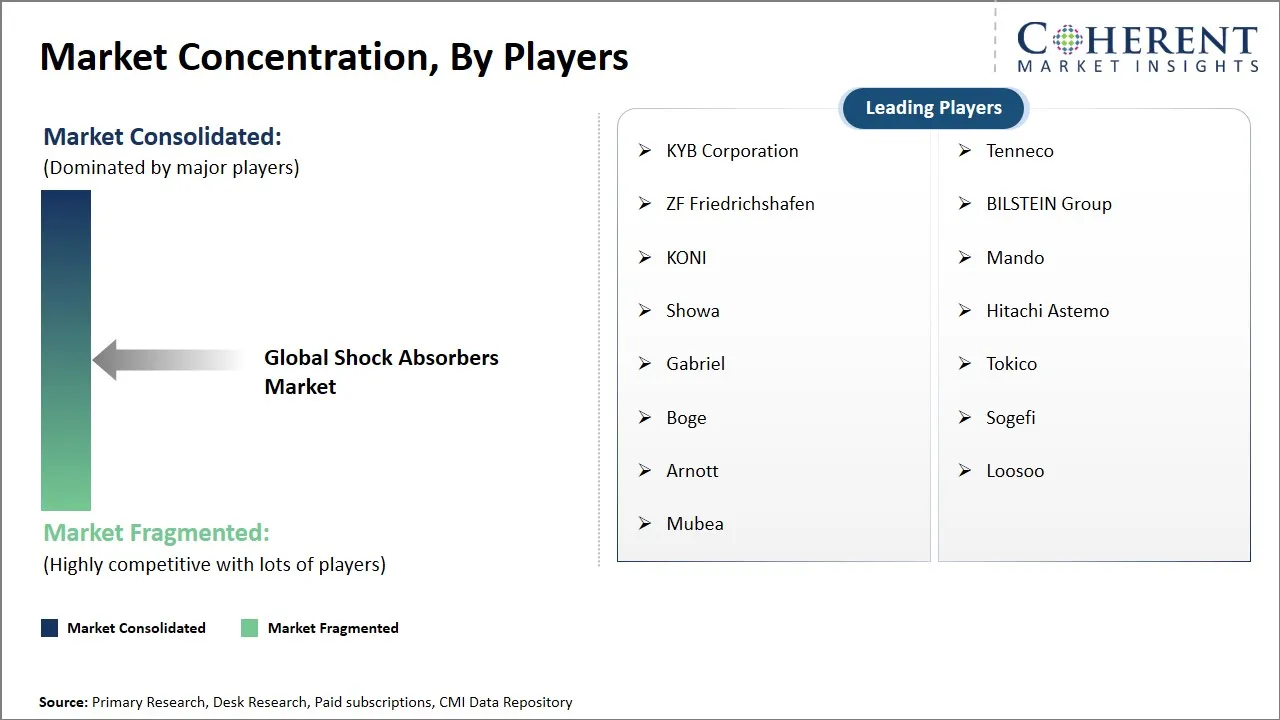
| Companies covered: | KYB Corporation, Tenneco, ZF Friedrichshafen, BILSTEIN Group, KONI, Mando, Showa, Hitachi Astemo, Gabriel, Tokico, Boge, Sogefi, Arnott, Loosoo, and Mubea | ||
| Growth Drivers: |
| ||
| Restraints & Challenges: |
| ||
Market Dynamics
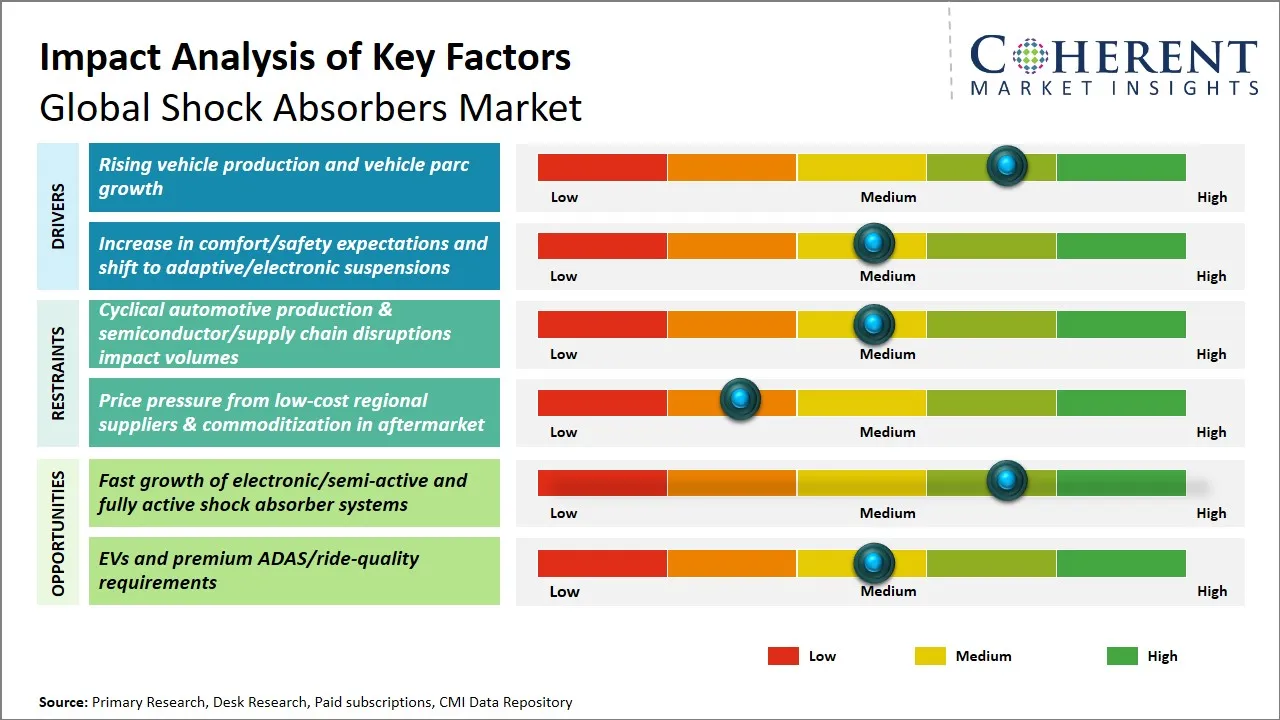
Global Shock Absorbers Market Driver - Rising Vehicle Production and Vehicle Parc Growth
The surge in global vehicle production is a pivotal factor driving the demand for shock absorbers across various automotive segments. As manufacturers ramp up the production of passenger cars, commercial vehicles, and two-wheelers to meet increasing consumer demand and urbanization trends, the requirement for reliable suspension components like shock absorbers concurrently escalates. Additionally, the continuous growth of the vehicle parc—the total number of registered vehicles in use—significantly influences replacement demand for shock absorbers due to wear and tear over time.
Older vehicles often require maintenance or upgrading of suspension systems to ensure ride comfort and safety, further bolstering aftermarket sales. Moreover, shifts toward heavier vehicle designs and advancements in automotive technologies that focus on enhanced driving dynamics and passenger comfort also necessitate improved shock absorber products, reinforcing the importance of this component in both new vehicle assembly and aftermarket segments globally. KYB Corporation, a leading shock absorber supplier, reported increased orders in 2024 from OEMs such as Toyota and Honda for twin-tube and monotube shock absorbers to support expanded production of compact cars and SUVs in Asia Pacific and North America.
Global Shock Absorbers Market Opportunity – Fast Growth of Electronic/Semi-Active and Fully Active Shock Absorber Systems
The global shock absorbers market is witnessing a significant opportunity driven by the fast growth of electronic, semi-active, and fully active shock absorber systems. Increasing demand for advanced vehicle suspension technologies is propelling the adoption of these smart systems, which offer superior ride comfort, enhanced vehicle handling, and improved safety compared to traditional passive shock absorbers.
Electronic and semi-active shock absorbers utilize sensors and algorithms to continuously adjust damping characteristics in real-time based on road conditions and driving behavior, providing optimal performance across varying terrains. Fully active shock absorber systems take this further by integrating actuators that actively control suspension dynamics, enabling precise vibration control and minimizing body roll, pitch, and bounce. This technological evolution is especially relevant in the context of rising consumer preference for luxury and performance vehicles, along with growing development of electric and autonomous vehicles that require sophisticated suspension systems to ensure stability and passenger comfort.
Tenneco Inc. (Monroe brand) has consistently seen aftermarket growth in the U.S. and Canada, driven by aging fleet vehicles in urban and commercial fleets requiring shock absorber replacement.
Additionally, stringent automotive regulations focusing on vehicle safety and emissions indirectly fuel the transition toward these advanced shock absorber solutions, as they contribute to improved fuel efficiency by reducing vehicle weight and enhancing suspension response. Such innovations not only cater to passenger vehicles but also find application in commercial vehicles, motorcycles, and off-road vehicles, broadening the market horizon and creating substantial growth prospects for manufacturers investing in R&D and production of electronic and active suspension systems.
Analyst Opinion (Expert Opinion)
- Shock absorbers in passenger cars and SUVs are increasingly being designed for superior ride comfort, noise reduction, and stability. Automakers are adopting adaptive and electronically controlled dampers in mid- and high-end models to meet growing consumer expectations for smoother driving dynamics and enhanced handling safety.
- In heavy-duty trucks, buses, and logistics fleets, demand is shifting toward high-strength, gas-charged, and monotube dampers that can withstand continuous operation under heavy loads. Fleet operators prioritize long-life and maintenance-free shock absorber systems to reduce downtime and total cost of ownership.
- Two-wheelers, particularly in Asia Pacific, favors low-cost twin-tube shocks optimized for affordability and road irregularities. Meanwhile, off-road and motorsport applications increasingly rely on advanced monotube and remote-reservoir shocks with adjustable damping to ensure superior traction, heat dissipation, and performance customization.
Speak to the analyst
Want personalized insights?
Take the findings above to one of our principal consultants, or have the report rebuilt around the segments, geographies and competitors you actually track.
Market Segmentation
- Design Insights (Revenue, USD Bn, 2021 - 2033)
- Twin-tube
- Monotube
- Sales Channel Insights (Revenue, USD Bn, 2021 - 2033)
- OEM
- Aftermarket
- Vehicle Type Insights (Revenue, USD Bn, 2021 - 2033)
- Passenger Vehicles
- Commercial Vehicles
- Regional Insights (Revenue, USD Bn, 2021 - 2033)
- North America
- U.S.
- Canada
- Latin America
- Brazil
- Argentina
- Mexico
- Rest of Latin America
- Europe
- Germany
- U.K.
- Spain
- France
- Italy
- Russia
- Rest of Europe
- Asia Pacific
- China
- India
- Japan
- Australia
- South Korea
- ASEAN
- Rest of Asia Pacific
- Middle East
- GCC Countries
- Israel
- Rest of Middle East
- Africa
- South Africa
- North Africa
- Central Africa
- North America
- Key Players Insights
- KYB Corporation
- Tenneco
- ZF Friedrichshafen
- BILSTEIN Group
- KONI
- Mando
- Showa
- Hitachi Astemo
- Gabriel
- Tokico
- Boge
- Sogefi
- Arnott
- Loosoo
- Mubea
Sources
Primary Research Interviews
Stakeholders
- Automotive OEMs and Tier-1 Suppliers
- Aftermarket Shock Absorber Manufacturers and Distributors
- Vehicle Fleet Operators
- Automotive Engineers and Suspension System Designers
- Motorsports Teams and Performance Vehicle Tuning Experts
- Sustainability and EV Integration Consultants (for adaptive and energy-efficient suspension systems)
Databases
- Automotive Industry Statistics Database (AIDB)
- Global Vehicle Production Data Hub (GVPDH)
- International Automotive Component Registry (IACR)
- OECD Vehicle and Transport Statistics
Magazines
- Automotive Components Today
- Suspension & Chassis Magazine
- AutoTech Engineering Review
- Vehicle Dynamics Monthly
Journals
- Journal of Vehicle Engineering and Dynamics
- International Journal of Automotive Technology and Management
- Vehicle Systems and Suspension Engineering Journal
- Journal of Intelligent Transportation Systems
Newspapers
- Automotive News International
- Transport & Fleet Daily
- The Motor Review (U.K.)
- The Economic Times Auto Section (India)
Associations
- International Automotive Suspension Association (IASA)
- Society of Automotive Engineers (SAE International)
- European Vehicle Component Manufacturers Association (EVCMA)
- National Automotive Aftermarket Association (NAAA)
- Electric Vehicle and Mobility Association (EVMA)
Public Domain Sources
- International Organization of Motor Vehicle Manufacturers (OICA)
- United Nations Vehicle & Transport Statistics (UNVTS)
- World Bank Transport & Vehicle Data Portal
- ResearchGate (automotive and suspension research papers)
Proprietary Elements
- CMI Data Analytics Tool, Proprietary CMI Existing Repository of information for last 8 years
Get access to 250+ pages report
Every segment, forecast, competitor profile and data table behind the analysis above — available for instant download.
- ESOMAR Member
- ISO 9001:2015 Certified
- D-U-N-S Registered
- GDPR & CCPA Compliant
Missing comfort of reading report in your local language? Find your preferred language:
Transform your Strategy with Exclusive Trending Reports
Frequently Asked Questions
The global shock absorbers market is estimated to be valued at USD 17.24 billion in 2026 and is expected to reach USD 24.74 billion by 2033.
The CAGR of the global shock absorbers market is projected to be 5.3% from 2026 to 2033.
Rising vehicle production and vehicle parc growth and increase in comfort/safety expectations and shift to adaptive/electronic suspensions are the major factors driving the growth of the global shock absorbers market.
Cyclical automotive production & semiconductor/supply chain disruptions impact volumes and price pressure from low-cost regional suppliers & commoditization in aftermarket are the major factors hampering the growth of the global shock absorbers market.
A shock absorber is a suspension component that controls unwanted spring motion, improving vehicle stability, comfort, and tire contact with the road.
The rise of semi-active and fully active suspension systems integrated with electronic control units and sensors are shaping the market.
In terms of design, twin-tube is estimated to dominate the market revenue share in 2026.