

Signal Generator Market Size and Share Analysis – Growth Trends and Forecasts (2026–2033)
The global Signal Generator Market is expected to grow at a CAGR of 5.5%, increasing from USD 1.70 Bn in 2026 to USD 2.47 Bn by 2033. The major growth drivers include increasing demand for advanced testing and measurement solutions, rapid growth of 5G and emerging 6G communication technologies, increasing adoption of signal generators in aerospace and defense applications, and increasing use of electronic testing equipment in the automotive and semiconductor industries. According to Ericsson’s Mobility Report of June 2026, the worldwide 5G subscriptions have crossed 3 Bn in the first quarter of 2026, and are expected to hit 6.4 Bn by 2031, accounting for roughly two-thirds of the global mobile subscriptions.
Key Takeaways
- The radio frequency signal generators segment is anticipated to hold 43.0% market share in 2026. The segment is expected to grow due to the increasing demand for high-frequency signal testing, growing 5G infrastructure and increasing adoption of RF testing equipment in semiconductor manufacturing and wireless communication systems. According to World Semiconductor Trade Statistics (WSTS) reported that global semiconductor sales were USD 795.6 Bn in 2025, a 26.2% year-over-year increase, supporting demand for advanced electronic testing and signal generation equipment.
- The testing segment is anticipated to dominate the market with 38.0% in 2026. The growing complexity of electronic components, increasing demand for precision testing in the aerospace & defense industry, and the rising need for signal integrity verification and equipment performance validation are boosting the growth of the segment. According to the Stockholm International Peace Research Institute (SIPRI), global military expenditure was USD 2,887 Bn in 2025, up 2.9% in real terms from 2024, supporting investment into cutting-edge defense electronics and radar testing systems.
- The telecommunication segment is expected to hold the largest end-user market share of 27.0% in 2026. The growth in this segment is being driven by the higher demand for RF signal validation and network equipment testing, rollout of 5G networks and adoption of sophisticated wireless communication technologies. According to the Global mobile Suppliers Association (GSA), the number of mobile operators that have launched 5G networks worldwide has risen by 14% between March 2025 and April 2026, to reach 392 operators.
- The North America is expected to account for 37.5% share in 2026. The region’s growth is supported by established aerospace and defense industries, growing semiconductor research and development, and the presence of major electronic test equipment manufacturers. A March 2026 report by CTIA found U.S. wireless operators invest more than 2.5 times as much as their European counterparts.
Market Drivers
Rapid Advancement in 5G-Advanced and 6G Technologies is Accelerating Signal Generator Market Growth
The global Signal Generator Market is witnessing significant growth owing to the rapid advancement of wireless communication technologies, increasing adoption of 5G-Advanced networks, and growing research into next-generation 6G communication systems. Signal generators are increasingly used for radio frequency (RF) testing, signal modulation, frequency characterization and validation of wireless communication equipment.
According to the Global mobile Suppliers Association (GSA), 39 mobile network operators were investing in 5G-Advanced public networks by August 2026, of which seven were already live. The evolution of these networks is causing greater complexity in testing wireless equipment and supporting demand for high performance RF and microwave signal generators.
In February 2026, Rohde & Schwarz announced the developments in AI-driven radio access network testing through its partnership with NVIDIA. To simulate realistic wireless propagation conditions for 5G-Advanced and 6G base stations, the test platform integrates the R&S SMW200A vector signal generator with dynamic channel emulation capabilities.
Increasing Semiconductor Complexity and Electronic Device Testing Requirements are Driving Market Expansion
The Signal Generator Market is growing strongly, driven by the increasing complexity in semiconductor design, the rising output of electronic components, and the growing demand for accurate testing and measurement solutions. High-frequency integrated circuits, advanced processors, wireless communication chips, and sophisticated electronic systems require accurate signal generation for component characterization, performance validation, and troubleshooting. Manufacturers are reaching for programmable and high-frequency signal generators to improve testing accuracy, reduce measurement uncertainty and enhance product reliability.
According to the Semiconductor Industry Association’s 2026 State of the Industry Report, sales by U.S.-headquartered semiconductor companies totaled USD 425 Billion in 2025, approximately 53.4% of the global semiconductor market. The large scale of semiconductor development and commercialization is supporting demand for advanced electronic measurement instruments such as RF, microwave and arbitrary waveform signal generators.
In September 2026 Keysight Technologies launched a dual-channel analog signal generator for testing advanced devices. The instrument is suitable for precision signal generation and testing applications where high signal purity and accurate characterization of electronic components is needed.
Current Events and Their Impact on the Signal Generator Market
Current Event | Description and its Impact |
U.S. FCC Expands 900 MHz Spectrum Access for Private Wireless Broadband Networks (February 2026) |
|
European Commission Updates Radio Equipment Harmonized Standards and Strengthens Compliance Requirements (September 2026) |
|
- Current Industry Events of 2026
- Market Size Estimation
- Regional Breakdown
- Competitive Landscape
- Customer Intelligence
- Segmental Analysis
- Pricing Analysis
- Key Market Drivers, Challenges & Future Trends
- Customized Insights Section
Segmental Insights
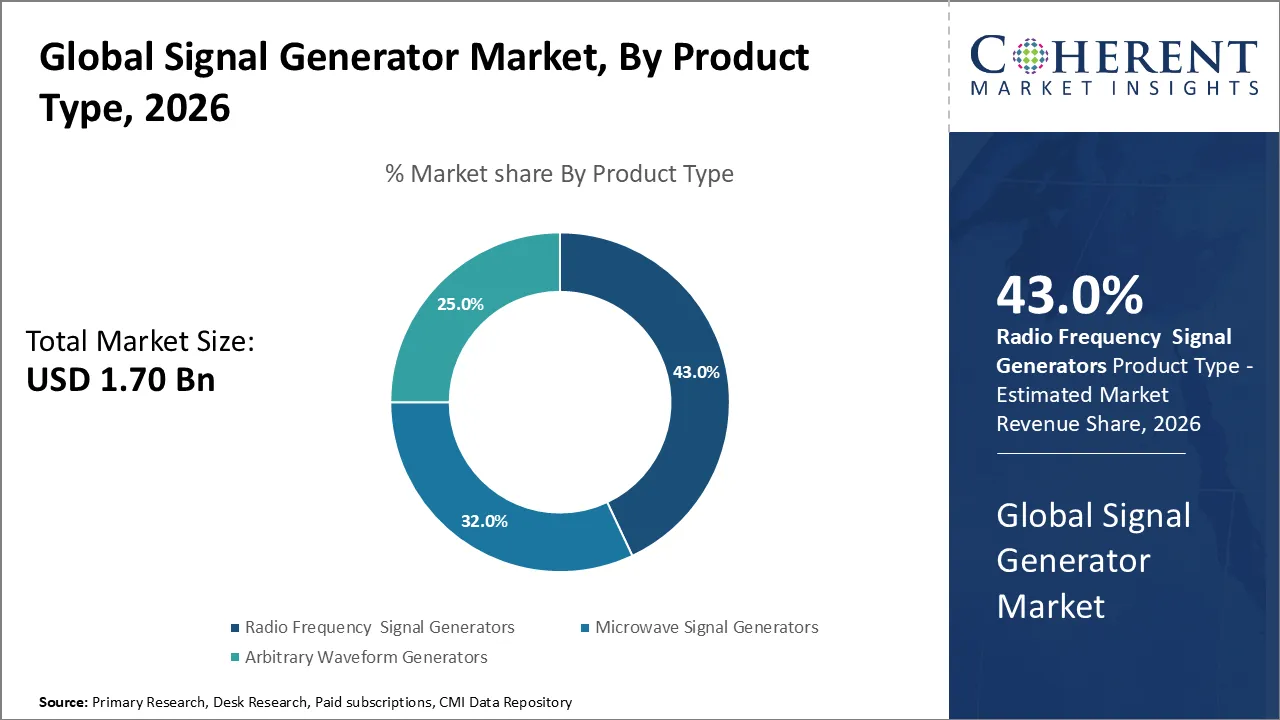
Why are Radio Frequency (RF) Signal Generators Acquiring the Largest Market Share?
On the basis of product type, the radio frequency (RF) signal generators segment is estimated to account for the largest Signal Generator Market share of 43.0% in 2026. The segment’s growth is driven by increasing deployment of high-frequency wireless communication technologies, rising demand for precision RF testing, and growing utilization of signal generators in semiconductor characterization, aerospace radar systems, and satellite communication equipment. RF signal generators are indispensable for modern electronic testing and measurement applications, offering stable frequency output, low phase noise, and precise signal simulation.
According to Rohde & Schwarz’s product specification from March 2026 indicates that the R&S SMA100B RF and microwave signal generator can operate in the frequency range of 8 kHz to 67 GHz with overrange up to 72 GHz. These capabilities illustrate the increasing technical requirements for generating high-frequency signals in advanced telecommunications, radar and electronic component testing applications.
Additionally, Keysight Technologies’ advanced analog signal generator portfolio provides frequency coverage up to 67 GHz, extendable to 1.1 THz with a frequency extender. These advances support next-generation 6G research, millimeter-wave testing and high-frequency aerospace applications, underpinning the long-term demand for RF signal generation technologies.
Why is the Testing Segment Holding the Largest Market Share?
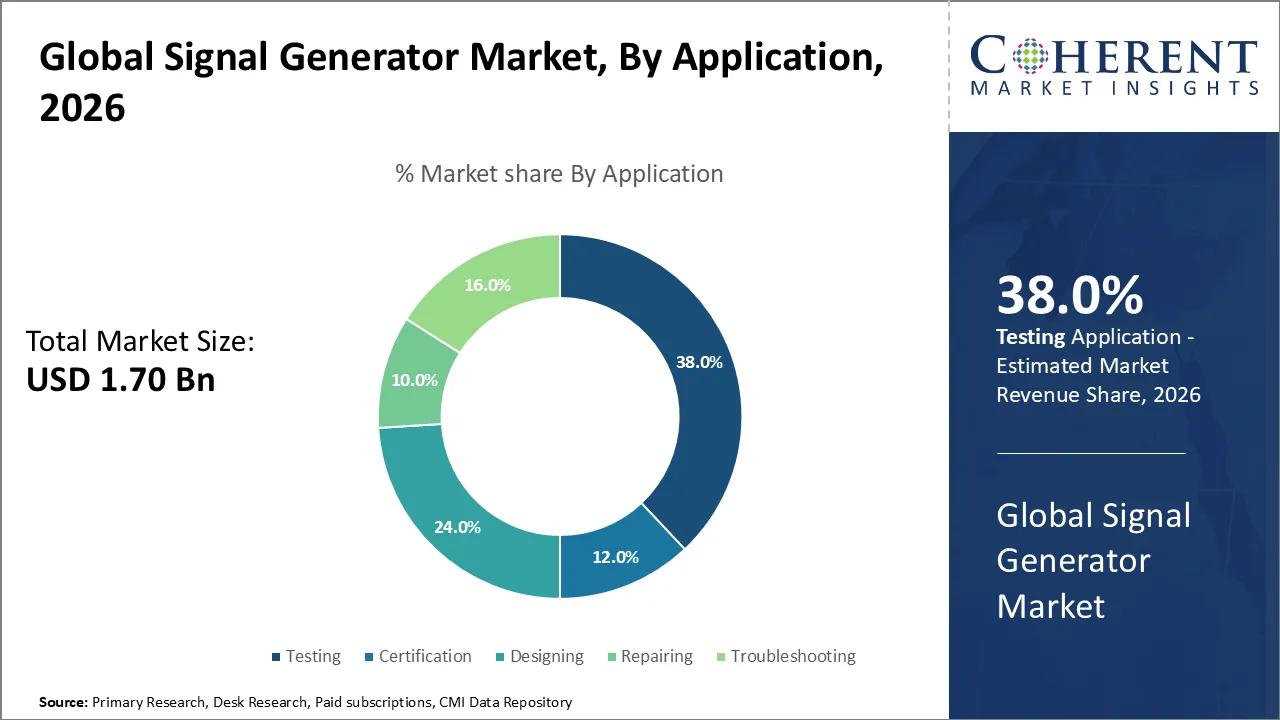
On the basis of application, the testing segment is estimated to dominate the Signal Generator Market with a share of 38.0% in 2026. The segment’s growth is attributed to increasing complexity of electronic components, stringent product performance requirements, and rising adoption of automated testing solutions in telecommunications, semiconductor manufacturing, and aerospace industries. Signal generators are widely used to verify the operation of equipment, to analyze signal integrity, to test receiver sensitivity and to test electronic equipment under simulated operating conditions.
According to the Global mobile Suppliers Association (GSA), as of December 2025, 3,658 of the 4,058 announced 5G devices were commercially available, which is around 90.1% of the identified devices and a 27.7% increase in commercial device availability compared to the previous year. The expanding availability of 5G-enabled devices creates additional testing and validation requirements across wireless equipment manufacturing and development.
Why is the Telecommunication Segment Dominating the Signal Generator Market?
On the basis of end user, the telecommunication segment is estimated to account for the largest Signal Generator Market share of 27.0% in 2026. The segment’s growth is driven by rapid expansion of fixed wireless access networks, increasing development of advanced cellular communication equipment, and growing demand for reliable RF signal testing solutions. Signal generators are essential for evaluating network equipment performance, assessing wireless receiver sensitivity, and validating communication devices operating across multiple frequency bands.
According to the Global mobile Suppliers Association (GSA) reported that as of June 2026, 295 mobile operators around the world were investing in 5G fixed wireless access (FWA) services, of which 274 had commercially launched services. This expansion is creating opportunities for RF signal generators used in the development of telecommunications equipment, network testing, and wireless broadband infrastructure validation.
Furthermore, GSA’s September 2026 Fixed Wireless Access CPE Market Survey predicts that 5G-enabled devices will represent 69% of global FWA customer-premises equipment shipments in 2026, up from 60% in 2025. The increasing uptake of 5G compatible equipment will likely boost the demand for signal generation, frequency testing and communication protocol validation solutions in telecommunications infrastructure and device manufacturing.
Regional Insights
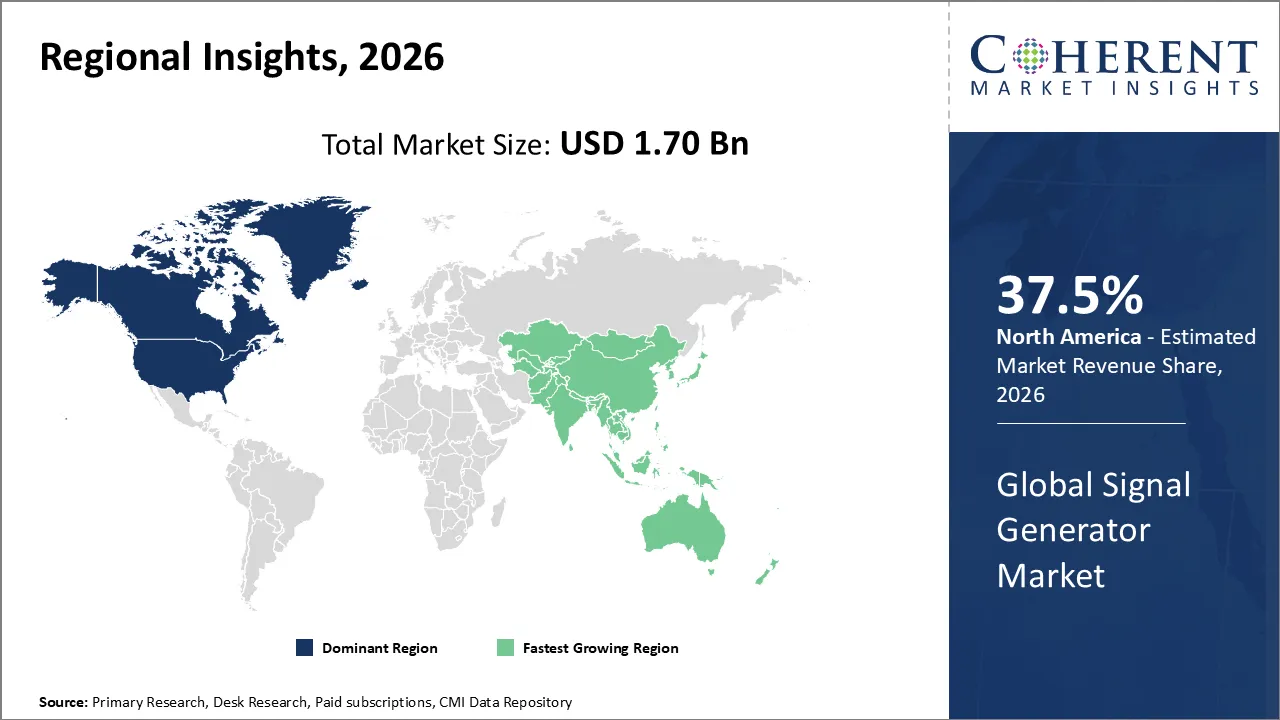
North America Dominates Owing to Advanced Wireless Infrastructure and Strong Semiconductor Research Capabilities
North America is estimated to have the largest share of 37.5% of the Signal Generator Market by 2026. The region is growing due to its advanced telecommunications infrastructure, strong aerospace and defense industry, growing semiconductor manufacturing capabilities and presence of leading test and measurement equipment makers. The increasing investment in wireless communication networks, high-frequency electronic systems and advanced semiconductor technologies are driving the demand for RF, microwave and vector signal generators across the United States and Canada.
According to CTIA’s 2026 Wireless Affordability Tracker shows the United States added 3.4 million new 5G home internet subscriptions in 2025, highlighting the ongoing expansion of fixed wireless broadband services. This growth is fueling demand for RF signal generators for developing wireless equipment, testing network performance and frequency validation.
In January 2026, the U.S. Department of Commerce announced a trade and investment agreement with Taiwan, including commitments for at least USD 250 Billion in credit guarantees to support additional investment by Taiwanese enterprises in the U.S. semiconductor supply chain.
Asia Pacific Signal Generator Market Trends
Asia Pacific is expected to emerge as the fastest-growing region in the Signal Generator Market during the forecast period. Regional growth is driven by expanding semiconductor manufacturing activities, increasing deployment of 5G communication networks, rapid development of consumer electronics manufacturing, and growing investments in automotive electronics and industrial automation. China, India, Japan, South Korea, and Taiwan are boosting their electronics manufacturing and research capabilities. This is driving the demand for advanced signal generation and test equipment.
According to the Semiconductor Industry Association (SIA) reported that semiconductor sales in the Asia Pacific/All Other region increased 45.0% year-over-year to USD 255.6 billion in 2025, reflecting strong growth in regional semiconductor demand. This expansion allows opportunities for precision RF and microwave signal generators used in semiconductor design verification, integrated circuit characterization, and electronic component testing.
Additionally, according to the GSMA's report for October 2026, India had around 450 million 5G connections and 1.2 billion active mobile connections. As the nation’s wireless infrastructure grows and the telecommunications ecosystem expands, the need for RF signal testing, network equipment validation, and advanced communication measurement technologies is on the rise.
Federal Investment in Next-Generation Wireless Technologies is Accelerating the U.S. Signal Generator Market
The U.S. Signal Generator Market is witnessing strong growth on the back of increasing government spending in next-generation wireless communication technologies, growing semiconductor research capabilities and increasing demand for advanced electronic testing and measurement solutions. The country’s established aerospace and defense industries, leading telecommunications equipment manufacturers, and strong research ecosystem are supporting the adoption of RF, microwave, and vector signal generators.
In October 2026, the U.S. National Science Foundation (NSF) announced an investment of more than USD 110 Million across 49 research teams under its Verticals-enabling Intelligent NEtwork Systems (VINES) initiative. The program supports fundamental research, technology development, demonstration, and commercialization activities focused on advanced wireless communication and intelligent network systems.
China Signal Generator Market Trends
Demand for signal generation and testing equipment is being fueled by the country’s burgeoning telecommunications infrastructure, a robust ecosystem for electronics manufacturing, increasing semiconductor research activities, and government support for advanced wireless technologies. RF, microwave, and vector signal generators are finding opportunities in the testing of telecommunications equipment, characterization of semiconductor devices and validation of wireless devices due to rapid adoption of 5G-Advanced networks, industrial IoT applications and high frequency communication systems.
According to China’s Ministry of Industry and Information Technology (MIIT) anounced it had deployed around 5.10 million 5G base stations by June 2026, including 2.25 million 5G Reduced Capability (RedCap) base stations. The growing scale and technical complexity of wireless infrastructure are supporting demand for advanced signal generators used in frequency validation, interference testing, and network equipment performance evaluation.
Who are the Major Companies in Signal Generator Industry
Some of the major key players in Signal Generator Market are Keysight Technologies Inc., Rohde & Schwarz Gmbh & Co Kg, National Instruments Corporation, Anritsu Corporation, Tektronix Inc., Teledyne Technologies Incorporated, B&K Precision Corporation, Keithley Instruments Inc., Fluke Corporation, Stanford Research Systems, Good Will Instrument Co. Ltd., and Yokogawa Electric Corporation.
Key News
- In April 2026, Rohde & Schwarz announced the introduction of Pulsar satellite navigation signal simulation capabilities for its R&S SMBV100B and R&S SMW200A vector signal generators. The new software option enables manufacturers to simulate signals from Xona's low Earth orbit (LEO) navigation constellation and test receiver compatibility, accuracy, and performance.
- In June 2026, Emerson announced an expansion of the NI PXI Vector Signal Transceiver portfolio with new NI PXI Core VST instruments. The systems combine RF signal generation and analysis capabilities to provide more accessible high-performance testing solutions for cost-sensitive applications, including medical device development, electronics validation, and production testing.
Market Report Scope
Signal Generator Market Report Coverage
Report Coverage | Details | ||
Base Year: | 2025 | Market Size in 2026: | USD 1.70 Bn |
Historical Data for: | 2020 to 2024 | Forecast Period: | 2026 to 2033 |
CAGR: | 5.5% | 2033 Value Projection: | USD 2.47 Bn |
Geographies covered: |
| ||
Segments covered: |
| ||
Companies covered: | Keysight Technologies Inc., Rohde & Schwarz Gmbh & Co Kg, National Instruments Corporation, Anritsu Corporation, Tektronix Inc., Teledyne Technologies Incorporated, B&K Precision Corporation, Keithley Instruments Inc., Fluke Corporation, Stanford Research Systems, Good Will Instrument Co. Ltd., and Yokogawa Electric Corporation. | ||
Growth Drivers: |
| ||
Restraints & Challenges: |
| ||
Analyst Opinion
- The Signal Generator Market is expected to benefit from increasing investments in semiconductor testing and advanced electronic manufacturing. The growing use of integrated circuits, high frequency electronic components and semiconductor devices is driving the need for precision signal generation and automated validation solutions. SEMI's July 2026 forecast predicts global semiconductor test equipment sales will increase 31.0% to USD 15.3 Billion in 2026 after 55.3% growth in 2025.
- The development of international 6G standards will provide long-term growth opportunities for signal generator manufacturers. Increasing requirements for higher frequency communication, wider bandwidths, more sophisticated modulation and precise signal characterization are driving the development of advanced RF and vector signal generation technologies. In February 2026, the International Telecommunication Union (ITU) completed work on technical performance requirements for IMT-2030 (6G), establishing 20 technical performance requirements for next-generation radio interfaces.
- The growth of private wireless networks and industrial connectivity is creating new applications for signal generation and test gear. The growing use of private 5G networks in manufacturing, logistics, transportation and industrial automation is driving the need for reliable communication systems, interference testing and validation of wireless equipment performance. According to the Global mobile Suppliers Association (GSA), 2,031 organizations across 88 countries were identified as deploying private LTE or 5G mobile networks valued at more than EUR 100,000 as of September 2026.
Speak to the analyst
Want personalized insights?
Take the findings above to one of our principal consultants, or have the report rebuilt around the segments, geographies and competitors you actually track.
Market Segmentation
- By Product Type (Revenue, USD Bn, 2021-2033)
- Microwave Signal Generators
- Radio Frequency Signal Generators
- Arbitrary Waveform Generators
- By Application (Revenue, USD Bn, 2021-2033)
- Certification
- Designing
- Repairing
- Testing
- Troubleshooting
- By End User (Revenue, USD Bn, 2021-2033)
- Electronics
- Aerospace and Defense
- Telecommunication
- Industrial
- Manufacturing
- Medical Sector
- Automotive
- Educational Sector
- Others
- By Region (Revenue, USD Bn, 2021-2033)
- North America
- U.S.
- Canada
- Latin America
- Brazil
- Mexico
- Argentina
- Rest of Latin America
- Europe
- Germany
- U.K.
- France
- Italy
- Spain
- Russia
- Rest of Europe
- Asia Pacific
- China
- India
- Japan
- Australia
- South Korea
- ASEAN
- Rest of Asia Pacific
- Middle East
- GCC
- Israel
- Rest of Middle East
- Africa
- South Africa
- Central Africa
- North Africa
- North America
Sources
Primary Research Interviews
- Signal generator manufacturers and technology developers
- RF and microwave engineering experts
- Electronic test and measurement equipment manufacturers
- R&D heads from semiconductor and electronics manufacturing companies
- Telecommunications and wireless communication technology experts
- Aerospace, automotive, and defense industry procurement managers
- Key opinion leaders (KOLs) in electronic testing and signal generation technologies
Databases
- World Bank
- Organisation for Economic Co-operation and Development (OECD)
- National Science Foundation (NSF)
- World Semiconductor Trade Statistics (WSTS)
- International Telecommunication Union (ITU)
- U.S. Federal Communications Commission (FCC)
- National Institute of Standards and Technology (NIST)
Magazines
- Microwave Journal
- Microwave & RF
- Electronic Design
- Electronics Weekly
- EE Times
- Evaluation Engineering
- Electronic Products
Journals
- IEEE Transactions on Instrumentation and Measurement
- IEEE Transactions on Microwave Theory and Techniques
- IEEE Transactions on Communications
- IEEE Transactions on Electromagnetic Compatibility
- IEEE Transactions on Wireless Communications
- Measurement
- International Journal of RF and Microwave Computer-Aided Engineering
Newspapers
- The New York Times
- The Wall Street Journal
- Financial Times
- Reuters
- Bloomberg
- The Economic Times
Associations
- Institute of Electrical and Electronics Engineers (IEEE)
- IEEE Microwave Theory and Technology Society (IEEE MTT-S)
- International Telecommunication Union (ITU)
- Global mobile Suppliers Association (GSA)
- Semiconductor Industry Association (SIA)
- SEMI
- 3rd Generation Partnership Project (3GPP)
Public Domain Sources
- Company Annual Reports and Investor Presentations
- Government Telecommunications and Semiconductor Industry Publications
- University Research Publications and Technical Reports
- Patent Databases such as WIPO, USPTO, and Google Patents
- Publicly Available RF and Microwave Testing Research Reports
- Regulatory and Standards Publications Related to Wireless Communication and Electronic Testing
- Company Product Launch Announcements, Technical Datasheets, and Press Releases
- Government Spectrum Allocation and Wireless Infrastructure Development Reports
Proprietary Elements
- CMI Data Analytics Tool
- Proprietary CMI Existing Repository of Information for the Last 10 Years
Get access to 250+ pages report
Every segment, forecast, competitor profile and data table behind the analysis above — available for instant download.
- ESOMAR Member
- ISO 9001:2015 Certified
- D-U-N-S Registered
- GDPR & CCPA Compliant
Missing comfort of reading report in your local language? Find your preferred language:
Transform your Strategy with Exclusive Trending Reports
Frequently Asked Questions
The global Signal Generator Market is expected to reach USD 2.47 Bn in 2033, increasing from USD 1.70 Bn in 2026.
Major players operating in the global Signal Generator Market include Keysight Technologies Inc., Rohde & Schwarz Gmbh & Co Kg, National Instruments Corporation, Anritsu Corporation, Tektronix Inc., Teledyne Technologies Incorporated, B&K Precision Corporation, Keithley Instruments Inc., Fluke Corporation, Stanford Research Systems, Good Will Instrument Co. Ltd., and Yokogawa Electric Corporation.
High initial investment costs, expensive maintenance and calibration requirements, increasing technological complexity, and a shortage of skilled professionals are the key factors hampering market growth.
The increasing deployment of 5G and emerging 6G communication technologies, rising demand for advanced electronic testing and measurement solutions, and growing adoption of signal generators in aerospace, defense, semiconductor, and automotive industries are driving market growth.
The Signal Generator Market is anticipated to grow at a CAGR of approximately 5.5% between 2026 and 2033.
North America is estimated to account for the largest share of the global Signal Generator Market, holding approximately 37.5% in 2026. Meanwhile, Asia Pacific is expected to witness the fastest growth during the forecast period.
A signal generator is an electronic testing instrument that produces electrical signals with specified frequencies, amplitudes, and waveforms. It is widely used for designing, testing, troubleshooting, and validating electronic devices and communication systems.