

Global Soccer Camera Market Size and Forecast – 2026-2033
The global soccer camera market is estimated to be valued at USD 27.35 Bn in 2026 and is expected to reach USD 81.12 Bn by 2033, exhibiting a compound annual growth rate (CAGR) of 16.8% from 2026 to 2033.
Key Takeaways of the Global Soccer Camera Market
- The fixed soccer cameras segment is expected to lead the market holding a share of 44.7 % in 2026.
- The HD (720p–1080p) segment is projected to dominate with a share of 55.6 % in 2026.
- The live broadcasting & streaming segment leads the market holding an estimated share of 34.2 % in 2026.
- North America, holding a projected share of 36.2 % in 2026, and dominate the market.
- Europe, holding an estimated share of 24.3 % in 2026, and shows the fastest growth in the market.
Market Overview
The market trend is strongly influenced by the integration of AI and Augmented Reality (AR) technologies, enabling enhanced player tracking and immersive fan experiences. Additionally, the adoption of high-definition and 360-degree cameras in live matches is transforming soccer coverage, providing detailed analytics and more engaging content for viewers. These advancements are fueling investments from broadcasters and sports organizations, positioning the soccer camera market for robust expansion in the coming years.
Current Events and Its Impact
Current Events | Description and its Impact |
Geopolitical and Trade Developments |
|
Economic and Industrial Trends |
|
Segmental Insights
- Current Industry Events of 2026
- Market Size Estimation
- Regional Breakdown
- Competitive Landscape
- Customer Intelligence
- Segmental Analysis
- Pricing Analysis
- Key Market Drivers, Challenges & Future Trends
- Customized Insights Section
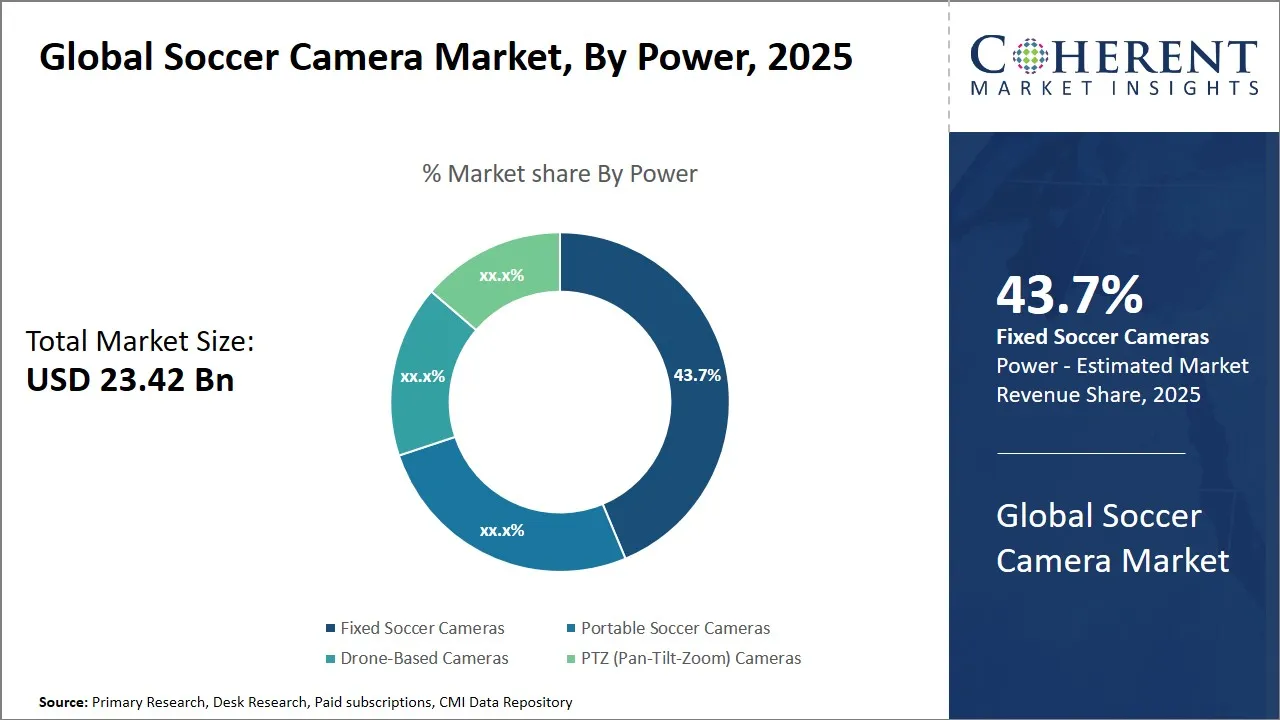
Global Soccer Camera Market Insights, By Power – Fixed Soccer Cameras lead Because of their Unmatched Stability and Precision in Capturing Live Game Footage
The fixed soccer cameras segment is expected to dominate the market with a 44.7% share in 2026. Strategically installed around stadiums and training grounds, these cameras provide uninterrupted views, ensuring consistent framing and reducing complications associated with portable or drone-based solutions. Their stability is very important for broadcasters and clubs requiring high-quality video feeds for tactical analysis and fan engagement. For instance, Pixellot's fixed camera systems are widely adopted for their reliability and integration capabilities.
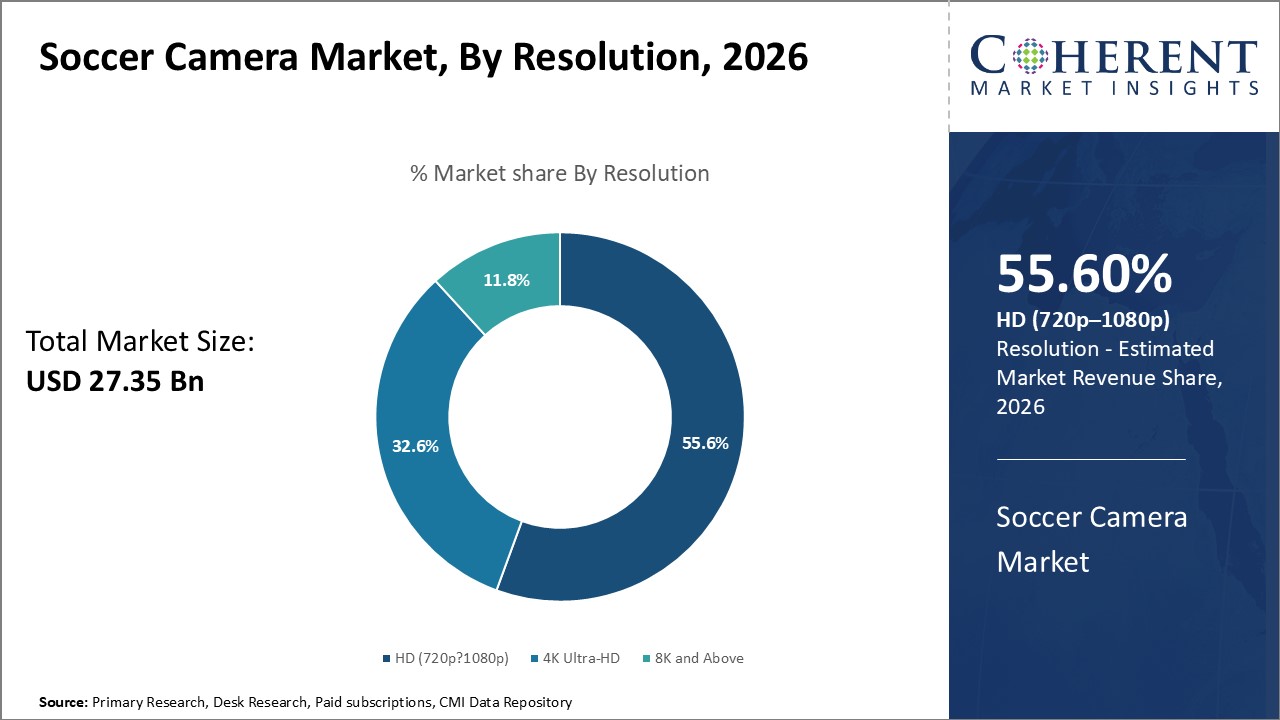
Global Soccer Camera Market Insights, By Resolution – HD (720p–1080p) Leads Because of the Essential Role they Play in Maximizing the Value Derived from Soccer Camera Systems
The HD (720p–1080p) segment is projected to hold a high market share of 55.6% in 2026. These cameras offer a balance between high-definition quality and affordability, making them useful for both professional and amateur applications. Their high adoption can be seen in different leagues and training academies looking for quality footage without the high costs associated with 4K systems. For instance, Veo Cam 3 is used by grassroots clubs and youth academies to capture 1080p footage without the high cost of 4K systems.
Global Soccer Camera Market Insights, By Application – Live Broadcasting & Streaming Lead Because of Increasing Demand for Live Sports Content
The live broadcasting & streaming segment is estimated to hold a share of 34.2% in 2026 because of the increasing demand for real-time sports content. Technologies like Pixellot's AI-powered systems make possible seamless live streaming, catering to broadcasters and streaming platforms seeking efficient solutions for wide-scale coverage. This trend is also supported by the rise of digital platforms and the growing popularity of sports streaming services.
Impact of AI on the Soccer Camera Market
Event Recognition Success Rates
- A recent system called MatchVision was tested on identifying 24 different match events (goals, fouls, tactical moves, etc.). It reached up to 84% accuracy in recognizing game events.
- In a survey of deep learning models applied to broadcast-style soccer footage, typical detection accuracy for specific actions: Goals ≈ 90%, Passes ≈ 92%, Fouls ≈ 85%, Tackles ≈ 88%.
- Another study using elite-level soccer video achieved 74-89% accuracy for event detection (corners, free kicks, penalties, etc.) depending on the number of event types in the model.
These success rates mean AI in soccer cameras is now good enough for many broadcast/analysis use-cases, especially for automatic highlight generation, referee assistance, or post-match analytics. There still remain challenges in edge cases: overlapping players, occlusion, poor lighting, and unusual camera angles tend to degrade accuracy.
Player Detection & Tracking Accuracy
- In “A Review of Computer Vision Technology for Football Videos”, the combination of detection + tracking + classification modules achieved average Intersection over Union (IoU) of ~84.68% for YOLOv2, ~86.47% for Mask R-CNN on player/ball detection tasks. The tracking metric MOTA (Multiple Object Tracking Accuracy) for DeepSORT on this dataset was ~76.59%.
- Another method using Graph Convolutional Networks reported ~91% object (player) detection accuracy, ~90% tracking + action recognition accuracy, and ~92% for speed/trajectory estimation in benchmark datasets.
Frame-level detection is highly reliable in controlled settings (good lighting, standard camera angles, less occlusion). In live matches with complex scenes, the detection/ tracking accuracy tends to drop somewhat, especially when players crowd together or when the ball is small relative to frame size. The reported ~90-95%+ detection accuracy in many papers is encouraging, but real-world implementation often sees lower numbers due to environment noise, motion blur, etc.
Pricing Analysis of the Global Soccer Camera Market
Camera Model | Price Range (USD) |
Veo Cam 3 | USD 1,199 – USD 1,499 |
Veo Cam 3 5G | USD 1,499 |
Pixellot Air NXT | USD 949 – USD 1,199 |
Hudl Focus Flex | USD 1,999 |
Trace Camera | USD 1,195 (lease) |
Trace Camera (Outright Purchase) | USD 3,000 – USD 3,500 |
Veo Go (iPhone-based) | USD 0 (free app) |
Pixellot Show S3 | Custom Pricing |
Hudl Focus (Indoor) | USD 2,499 |
Hudl Focus (Outdoor) | USD 2,999 |
Regional Insights
North America Soccer Camera Market Analysis and Trends
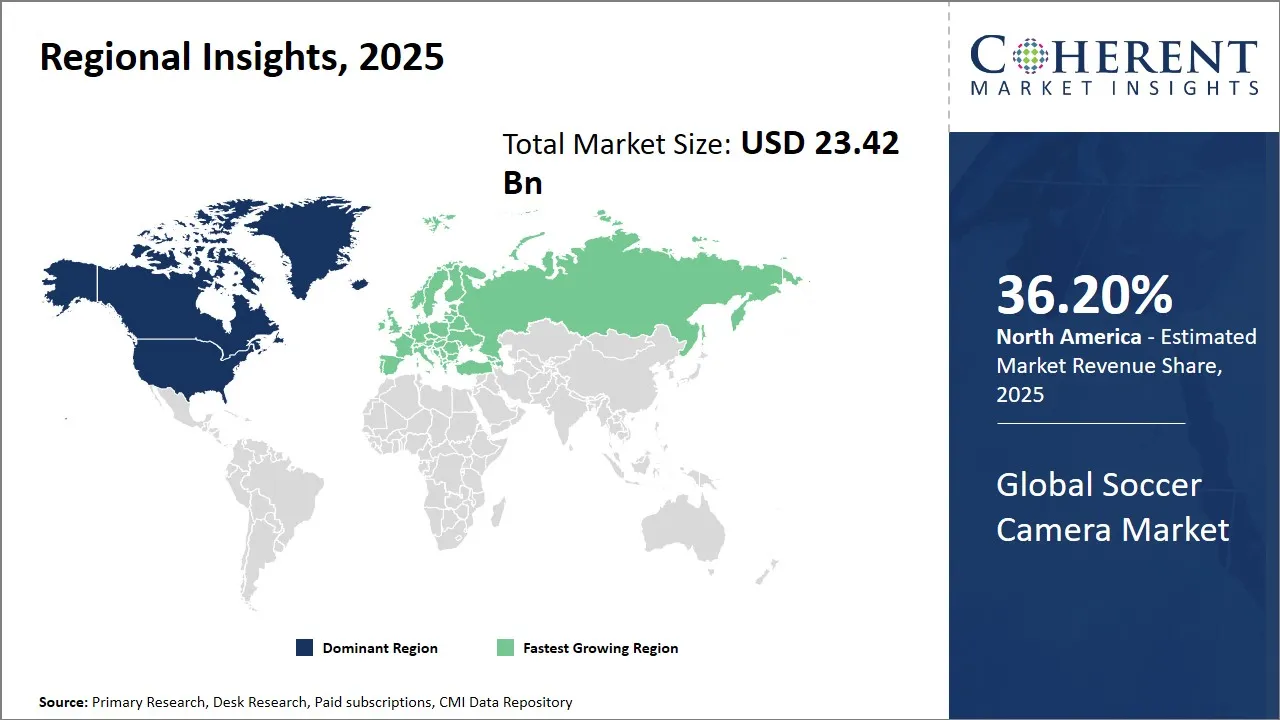
North America, holding a projected share of 36.2% in 2026, dominates the global soccer camera market because of a mature technological ecosystem and strong industry presence. The region sees advanced infrastructure, widespread adoption of high-definition broadcasting technologies, and the presence of big professional soccer leagues that demand cutting-edge live coverage solutions. U.S. and Canadian markets have a lot of government support for sports technology innovation, facilitating research and development initiatives.
The presence of global leaders like Sony Corporation, Canon Inc., and GoPro Inc. has made North America’s position stronger by introducing innovative camera technologies made for professional sports broadcasting and fan engagement. Strong trade agreements and an efficient supply chain network also support the distribution and use of soccer camera products in the region.
Europe Soccer Camera Market Analysis and Trends
Europe is expected to exhibit the fastest growth in the market contributing 24.3% share in 2026 because of well-established professional leagues, advanced stadium infrastructure, and widespread adoption of broadcast and AI-powered camera technologies. Countries like the U.K., Germany, France, Spain, and Italy account for a high market share because of high investments by top-tier clubs and broadcasters in cutting-edge sports capture solutions.
Government support for sports development, coupled with strong partnerships between local technology providers and international players like Sony, Pixellot, and Veo, has made a strong ecosystem for innovation. The prevalence of multi-camera stadium setups, AI-assisted analysis, and live streaming solutions adds to Europe's leadership, while continuous upgrades to existing infrastructure add to market dominance.
Global Soccer Camera Market Outlook for Key Countries
U.S. Soccer Camera Market Analysis and Trends
The U.S. sees sophisticated broadcasting requirements because of major leagues such as MLS and the growing prominence of soccer as a mainstream sport. Industry giants like Sony and Canon lead in supplying high-end broadcast cameras, while innovations in drone and 360-degree camera technology by companies such as GoPro enhance fan experience and engagement. The regulatory landscape supports sports technology use, and progressive digital infrastructure allows the deployment of advanced camera systems in stadiums and training facilities.
China Soccer Camera Market Analysis and Trends
China soccer camera market grows because of government-driven sports development programs and a rapidly expanding soccer fan base. The adoption of smart stadium technologies and increasing domestic manufacturing capabilities help accelerate the market penetration. Big players including DJI have made their presence by providing innovative drone and stabilized camera systems made for large-scale sporting events. Partnerships between international camera manufacturers and local distributors make cutting-edge camera technologies more accessible in the country’s booming sports arenas.
Japan Soccer Camera Market Analysis and Trends
Japan continues to lead because of a well-established technological foundation and commitment to sports innovation. Companies like Panasonic and Sony offer sophisticated camera solutions made for 4K and 8K broadcasts, meeting the exacting demands of domestic leagues and international tournaments hosted in the region. Strong government support for technology export and sports media infrastructure adds to market development.
India Soccer Camera Market Analysis and Trends
India soccer camera market is fast growing, supported by rising soccer viewership and increased investment in sports broadcasting infrastructure. The growing network of sports channels looks for enhanced camera technologies to elevate broadcast quality and viewer engagement. International companies like Canon and Sony are growing their footprints, collaborating with local broadcasters and technology integrators. Government policies focused on digital transformation make advanced camera equipment more accessible.
Germany Soccer Camera Market Analysis and Trends
Germany soccer camera market sees a strong sports culture and advanced manufacturing capabilities. With a globally renowned soccer league system, there is a lot of demand for high-end camera technology for live broadcast and training analysis. Leading companies such as Bosch and Leica (via partnerships and technological contributions) participate in producing precision optics and camera modules tailored for sports applications. Supportive trade policies and a strong industrial base ensure continuous innovation and integration of soccer camera systems across the country’s sports venues.
Regional Demand and Installation
Region | Estimated registered teams | Estimated soccer-camera installations | Cloud storage price (USD) & cost per 1080p recording hour | Key government/federation digital sports initiatives |
North America | 300,000 | 45,000 | USD 0.023/GB/month & USD 0.08/recording hour | U.S. Soccer — “Soccer Forward”/World Cup legacy & digital initiatives (2024–26 legacy platform) |
Asia Pacific (APAC) | 2,000,000 | 160,000 | USD 0.02645/GB/month & USD 0.10/recording hour | AFC/national federations — expansion of digital assets, AFC Live app and club competition digital strategies; national stadium modernization programs. |
Europe | 800,000 | 160,000 | USD 0.0253/GB/month & USD 0.09/recording hour | UEFA Innovation Hub; national federations and league digital programs (European clubs and leagues investing in automated capture/club academies) |
Latin America | 500,000 | 50,000 | USD 0.02875/GB/month & USD 0.10/recording hour | CONMEBOL digital & commercial initiatives; IMG/CONMEBOL partnership and regional broadcasting modernization. |
Middle East | 80,000 | 9,600 | USD 0.0276/GB/month & USD 0.10/recording hour | National sports modernization & mega-event legacies (stadium upgrades in Gulf states; national federation tech adoption) |
Africa | 700,000 | 35,000 | USD 0.0299/GB/month. & USD 0.11/recording hour | CAF digital & media initiatives (media rights deals, tournament digital platforms, AFCON tech/engagement programs). |
End User Adoption Analysis
End User Adoption & Subscription Renewal — Global Soccer Camera Market
End User Type | Adoption (share of installed camera base) | Typical Use Case | Estimated Annual Subscription Renewal Rate |
Amateur / Community Clubs | 55.00% | Largest installed base globally — many clubs use affordable AI/automated systems (Pixellot, Veo, Trace) for match streaming, coaching and monetization. Pixellot cites deployments across 10,000+ clubs/teams and many leagues; Veo and Hudl serve large grassroots bases as well. Estimate driven by vendor claims of broad club penetration and the sheer number of amateur teams worldwide. | 62% — mid-range renewal: clubs often renew when they monetize streams or rely on analytics; price sensitivity causes some churn. |
Schools / Colleges / Youth Academies | 30.00% | Heavy adoption in school athletic departments via bundled solutions (Hudl athletic department packages; Veo sold to many school programs). Schools value ease of use, departmental licensing and teacher/coach workflows. Hudl reports vast team coverage and specific school packages. | 78% — relatively high: institutional purchasing (school/college budgets) and multi-team packages reduce churn; renewals more stable than pure grassroots clubs. |
Professional Teams & Leagues | 15.00% | High penetration of broadcast-grade and hybrid AI systems in pro clubs, leagues and broadcasters. Pro teams often use multiple systems (broadcast cameras + AI units) and integrate analytics into sporting operations. Examples: league/association partnerships and federation rollouts (e.g., regional partnerships with Veo/Pixellot). | 92% — very high: renewals driven by mission-critical use for performance, scouting, media rights and sponsor obligations; switching costs are high. |
Market Players, Key Development, and Competitive Intelligence
Key Developments
- In July 2025, Pixellot partnered with TPE to enable the capture of high-quality video into analytics tools without delays, manual uploads, or technical headaches. The new integration allows game footage captured by Pixellot’s AI-powered Air cameras to flow directly into the TPE platform.
- In April 2025, NFL announced that beginning with the 2025 season, it will use Sony’s Hawk-Eye Virtual Measurement Technology as the primary method for measuring the line to gain. The technology will accelerate game administration.
- In July 2024, The National Football League and Sony announced a partnership naming Sony as an official technology partner of the NFL, as well as the new official headphones of the NFL.
- In February 2024, Veo launched the new Veo Cam 3. It is an upgrade to their line of cameras that automatically record and analyze sports without a camera operator.
Top Strategies Followed by Soccer Camera Market Players
- Established industry leaders make a lot of investments in research and development to innovate high-performance soccer cameras that deliver superior image quality, durability, and advanced features such as real-time analytics and AI integration.
- Veo Technologies invested a lot in developing the Veo Cam 3, featuring 1080p HD recording, AI auto-tracking, and 5G connectivity.
- Mid-level players in the soccer camera market adopt a different competitive stance, emphasizing cost-effective solutions that strike a balance between quality and affordability.
- The Pixellot Air NXT is a portable AI-powered camera priced at approximately USD 949. This device offers dual 4K 12MP cameras and is designed for budget-conscious teams seeking professional-quality footage
- Small-scale players, often startups or niche manufacturers, differentiate themselves in the competitive soccer camera market by focusing on specialized features or highly innovative products tailored to distinct consumer needs.
- Trace targets youth and amateur leagues with its Trace Camera, available for lease at USD 95/month or an outright purchase of USD 1,500. The camera offers AI auto-tracking and cloud-based analytics, catering to the specific needs of smaller clubs and individual players seeking affordable and specialized solutions.
Market Report Scope
Soccer Camera Market Report Coverage
| Report Coverage | Details | ||
|---|---|---|---|
| Base Year: | 2025 | Market Size in 2026: | USD 27.35 Bn |
| Historical Data for: | 2020 To 2024 | Forecast Period: | 2026 To 2033 |
| Forecast Period 2026 to 2033 CAGR: | 16.8% | 2033 Value Projection: | USD 81.12 Bn |
| Geographies covered: |
| ||
| Segments covered: |
| ||
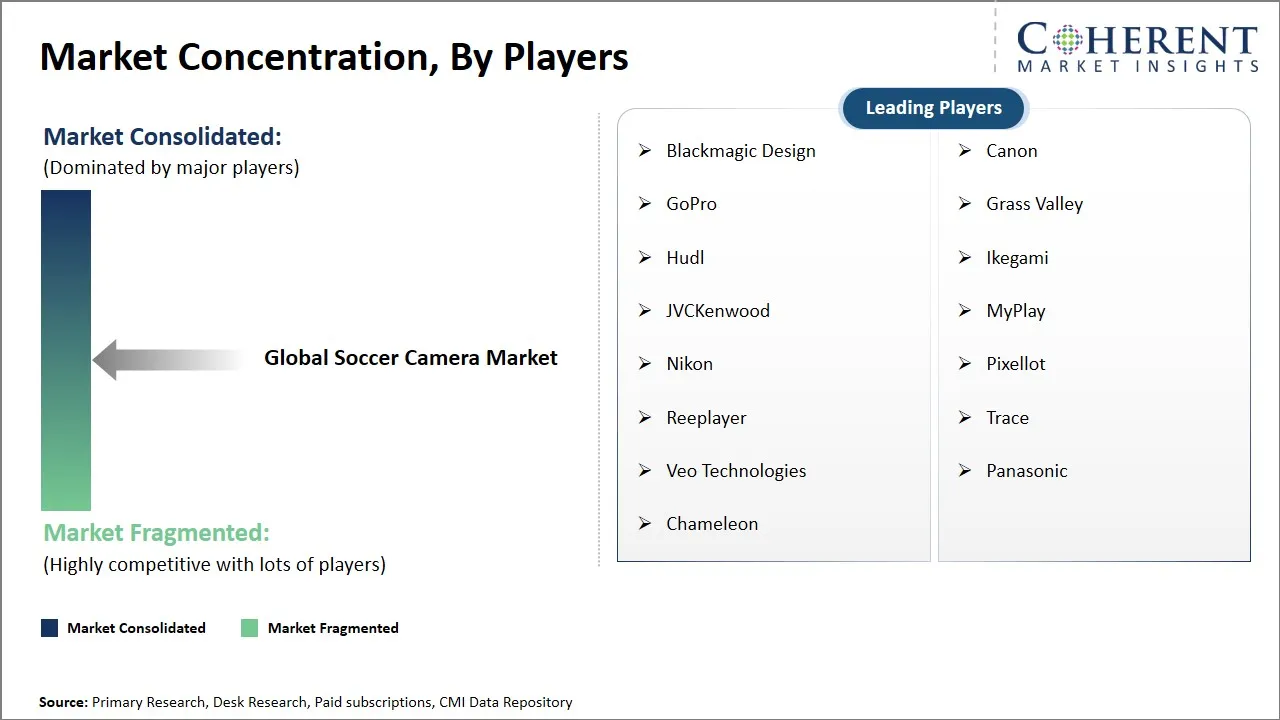
| Companies covered: | Blackmagic Design, Canon, GoPro, Grass Valley, Hudl, Ikegami, JVCKenwood, MyPlay, Nikon, Pixellot, Reeplayer, Trace, Veo Technologies, Panasonic, and Chameleon | ||
| Growth Drivers: |
| ||
| Restraints & Challenges: |
| ||
Market Dynamics
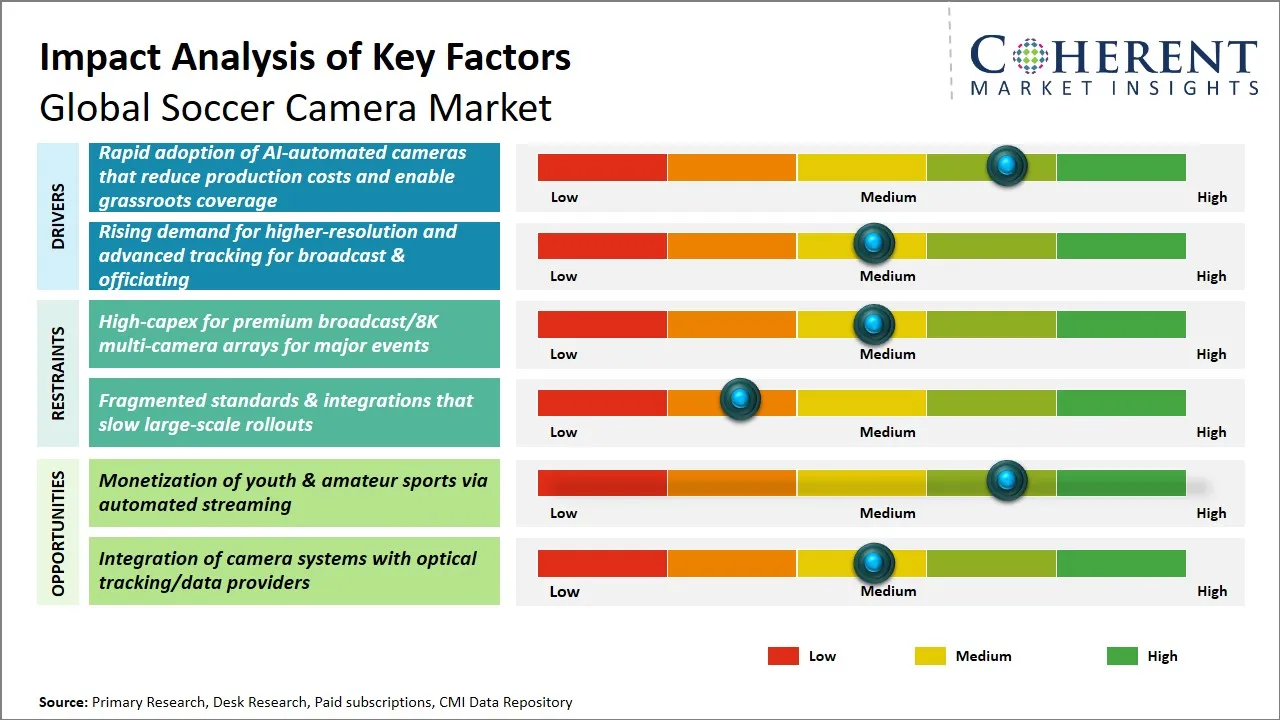
Global Soccer Camera Market Driver – Rapid Adoption of AI-Automated Cameras that Reduce Production Costs and Enable Grassroots Coverage
The global soccer camera market is increasingly driven by the widespread integration of AI-powered automated cameras, revolutionizing how matches are recorded and broadcasted. These advanced cameras significantly reduce the reliance on manual operators by employing intelligent tracking systems that follow the ball and players in real-time, capturing dynamic footage without human intervention.
This automation notably decreases production costs by limiting the need for extensive camera crews and post-production editing, making professional-level coverage more accessible, especially for grassroots and amateur leagues. Consequently, smaller clubs, local tournaments, and community soccer events can afford high-quality video capture, expanding the scope of recorded content beyond elite competitions. Furthermore, AI-driven camera systems streamline live streaming and highlight generation, enabling faster content delivery and enhancing fan engagement.
Global Soccer Camera Market Opportunity – Monetization of Youth & Amateur Sports via Automated Streaming
The global soccer camera market stands to benefit significantly from the burgeoning opportunity presented by the monetization of youth and amateur sports through automated streaming technology. With growing participation rates in grassroots soccer worldwide and increasing consumer interest in localized sporting events, there is an untapped demand for accessible, high-quality live coverage beyond professional leagues. Automated soccer cameras, equipped with AI-driven tracking and smart zoom capabilities, enable real-time streaming of matches without the need for costly manual operation. This technology facilitates scalable content delivery for youth leagues, amateur tournaments, and local clubs, allowing them to broadcast games to family members, scouts, and enthusiasts globally.
Additionally, enhanced visibility through streaming fosters player exposure, sponsorship opportunities, and community engagement, driving further investment in amateur soccer ecosystems. Market players offering integrated solutions combining hardware, software, and cloud-based platforms are positioned to capitalize on this trend by delivering turnkey automated streaming services tailored to the needs of grassroots organizations. Consequently, the convergence of youth sports growth and innovative camera technologies is poised to unlock substantial commercial potential within the global soccer camera market.
Patent & Innovation Landscape for the Global Soccer Camera Market
Patent-filing trends
Year | Estimated number of niche patent publications/priority filings | Trend note & drivers |
2020 | 18 | Early surge in automated production patents (examples: Pixellot filings; legacy systems) |
2021 | 26 | Increased filings as AI/video analytics diffusion accelerates (Maiden AI single-camera 3D tracking family emerges) |
2022 | 34 | Peak R&D activity — vendors and new entrants file for auto-production, event detection, edge AI, and cloud integration patents. |
2023 | 30 | High activity continues through macro headwinds slow some filings (WIPO reports global filing softening in 2023). |
2024 | 28 | Sustained attention on 5G, low-latency streaming, energy-efficient edge inference; continued portfolio extensions by incumbents. Example Pixellot and Veo family updates. |
R&D pipeline — timeline of innovations (what happened/when → what’s next)
Time window | Major innovation/R&D focus | Instance(s) & impact |
Pre-2020 – 2020 | Foundations: multi-camera ball tracking & automated production | Established systems and early patents for multi-camera ball tracking and automated production (classic patents and early Pixellot filings). Example: Pixellot patent family on automatic video production. |
2020 – 2021 | Single-camera 3D estimation & affordable automated capture | Maiden AI and related families published single-camera 3D trajectory/automated recording methods (Maiden AI patents/Brizi patents). This enabled lower-cost automated setups (no multi-camera rig). |
2021 – 2022 | AI event detection & cloud automated highlights | R&D concentrated on action/event classifiers (goals, passes, fouls), highlight extraction and cloud workflows. Academic & commercial models report ~80–90% success rates on key events in controlled datasets. |
2022 – 2023 | Edge AI + on-device inference, 5G streaming readiness | Vendors moved inference to edge devices to reduce latency and bandwidth. Patents and product launches reflect hybrid edge/cloud architectures. (Vendor filings & IBC/industry demos). |
2023 – 2024 | Integration with optical tracking & officiating tech (SAOT/VAR) | Collaborations and systems integrating video AI with optical tracking (Hawk-Eye/Sony & league pilots for offsides and line-to-gain). Premier League/Hawk-Eye implementations are real instances. |
2024 - 2026 (near term) | Higher-fidelity multi-angle synthesis, real-time analytics for broadcasting, energy efficiency | Expected product rollouts: multi-sensor fusion (combine panoramic AI cams + PTZ feeds), live augmented stats overlays, lower-power SoCs for longer battery life. Patent filings in 2024 show focus on such features (vendor family continuations). |
2026 - 2028 (mid-term) | Wider adoption of predictive analytics & federated learning; sustainability focus | R&D expected to prioritize federated on-device model updates (privacy), carbon-aware processing, standardized APIs for league data exchange; patent activity may shift from core detection to value-added analytics and integration patents. (Trend inferred from AI patents & industry direction). |
Analyst Opinion (Expert Opinion)
- AI-driven cameras like the Veo Cam 3 and Pixellot Air NXT are integral to modern soccer analytics. However, the environmental impact of their AI processing is significant. Training large AI models can emit substantial CO₂, with estimates suggesting that a single query to an AI model can have a carbon footprint comparable to driving several miles in a gasoline-powered car. This highlights the need for manufacturers to optimize AI algorithms for energy efficiency and consider the environmental impact of their AI operations.
- The Pixellot Air NXT features a battery capable of recording up to 5 hours of video and supports fast charging, reducing downtime between games. Similarly, the Veo Cam 3 offers up to 6.5 hours of recording time on a full charge. These advancements not only enhance usability but also contribute to sustainability by reducing the frequency of battery replacements and minimizing electronic waste.
- Companies like Hudl and Veo provide extended product lifecycles through software updates and robust customer support. For instance, Veo's storage policy allows users to retain recordings for up to 12 months, depending on the subscription plan. Such practices encourage users to maximize the lifespan of their devices, thereby reducing the environmental impact associated with manufacturing and disposal.
Speak to the analyst
Want personalized insights?
Take the findings above to one of our principal consultants, or have the report rebuilt around the segments, geographies and competitors you actually track.
Market Segmentation
- Power Insights (Revenue, USD Bn, 2021 - 2033)
- Fixed Soccer Cameras
- Portable Soccer Cameras
- Drone-Based Cameras
- PTZ (Pan-Tilt-Zoom) Cameras
- Resolution Insights (Revenue, USD Bn, 2021 - 2033)
- HD (720p–1080p)
- 4K Ultra-HD
- 8K and Above
- Application Insights (Revenue, USD Bn, 2021 - 2033)
- Live Broadcasting & Streaming
- Performance Analysis & Coaching
- Player Scouting & Recruitment
- Fan Engagement & Replay Analytics
- Referee Assistance & VAR Support
- Regional Insights (Revenue, USD Bn, 2021 - 2033)
- North America
- U.S.
- Canada
- Latin America
- Brazil
- Argentina
- Mexico
- Rest of Latin America
- Europe
- Germany
- U.K.
- Spain
- France
- Italy
- Russia
- Rest of Europe
- Asia Pacific
- China
- India
- Japan
- Australia
- South Korea
- ASEAN
- Rest of Asia Pacific
- Middle East
- GCC Countries
- Israel
- Rest of Middle East
- Africa
- South Africa
- North Africa
- Central Africa
- North America
- Key Players Insights
- Blackmagic Design
- Canon
- GoPro
- Grass Valley
- Hudl
- Ikegami
- JVCKenwood
- MyPlay
- Nikon
- Pixellot
- Reeplayer
- Trace
- Veo Technologies
- Panasonic
- Chameleon
Sources
Primary Research Interviews
Stakeholders
- Broadcasters and Sports Networks
- Soccer Camera Manufacturers and Solution Providers
- Professional Soccer Clubs and League Officials
- Stadium Operators and Facility Managers
- Sports Technology Integrators and AV Consultants
- Sustainability Experts focusing on energy-efficient electronics and sports technology
Databases
- FIFA Digital Sports Insights Database
- UEFA Sports Technology Statistics
- Global Sports Analytics Repository
- International Broadcasting Union (IBU) Data Hub
Magazines
- Sports Technology Today
- Broadcast Pro Magazine
- Soccer Analytics Review
- Stadium & Arena Technology Magazine
Journals
- Journal of Sports Engineering and Technology
- International Journal of Sports Analytics
- Sports Video Production and Technology Journal
- Journal of Performance Analysis in Sport
Newspapers
- The Sports Business Times
- ESPN Tech News
- The Guardian (UK) – Sports Tech Section
- The Economic Times (India) – Sports Technology Coverage
Associations
- International Sports Technology Association (ISTA)
- World Football Technology Federation (WFTF)
- National Association of Sports Broadcasters (NASB)
- Global Soccer Technology Consortium (GSTC)
- AI in Sports Technology Alliance
Public Domain Sources
- FIFA Technical Reports
- UEFA Annual Technology Review
- United Nations Office on Sport for Development (UNOSD)
- World Bank – Sports Infrastructure and Development Reports
- ResearchGate – Sports Technology Publications
Proprietary Elements
- CMI Data Analytics Tool, Proprietary CMI Existing Repository of information for last 8 years
Get access to 250+ pages report
Every segment, forecast, competitor profile and data table behind the analysis above — available for instant download.
- ESOMAR Member
- ISO 9001:2015 Certified
- D-U-N-S Registered
- GDPR & CCPA Compliant
Missing comfort of reading report in your local language? Find your preferred language:
Transform your Strategy with Exclusive Trending Reports
Frequently Asked Questions
The global soccer camera market is estimated to be valued at USD 27.35 billion in 2026 and is expected to reach USD 81.12 billion by 2033.
The CAGR of the global soccer camera market is projected to be 16.8% from 2026 to 2033.
Rapid adoption of AI-automated cameras that reduce production costs and enable grassroots coverage and rising demand for higher-resolution and advanced tracking for broadcast & officiating are the major factors driving the growth of the global soccer camera market.
High-capex for premium broadcast/8K multi-camera arrays for major events and fragmented standards & integrations that slow large-scale rollouts are the major factors hampering the growth of the global soccer camera market.
In terms of power, the fixed soccer cameras are estimated to dominate the market revenue share in 2026.
AI cameras automate tracking and analytics, making them ideal for small clubs and teams, while standard cameras rely on manual operation and are more suited for professional broadcasts.
Yes, soccer cameras can be used indoors. Proper lighting is important—indoors may require higher ISO settings or LED lighting to maintain video quality.