

Global Social Commerce Market Size and Forecast – 2026 To 2033
The global social commerce market is expected to grow from USD 1.50 Tn in 2026 to USD 5.65 Tn by 2033, registering a compound annual growth rate (CAGR) of 12% from 2026 to 2033. The global social commerce market is driven by the growing influence of social media creators and influencers. On April 22, 2026, Meta expanded its Creator Marketplace by introducing artificial intelligence-powered creator discovery and content recommendation tools, enabling brands to identify influencers more efficiently and launch data-driven campaigns across Instagram and Facebook.
Key Takeaways of the Global Social Commerce Market
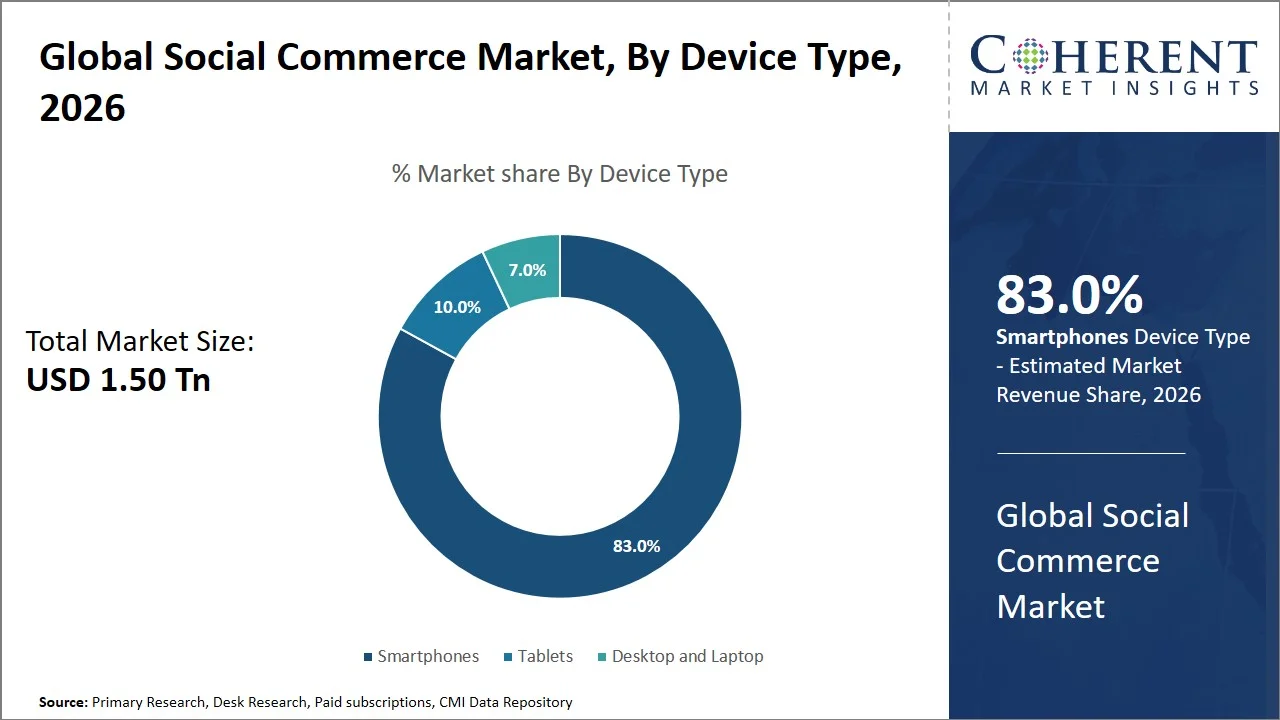
- The smartphones segment is expected to account for 83.0 % of the global social commerce market share in 2026. Expansion of integrated digital payment solutions is driving the growth of the segment. On July 23, 2025, PayPal unveiled a series of global partnerships that will connect many of the world’s largest payment systems and digital wallets on a single platform, starting with interoperability with PayPal and Venmo.
- The business to consumer segment is estimated to capture 67.0 % of the market share in 2026. Continuous improvements in social commerce platform features is majorly driving the growth of the segment. On January 11, 2026, Shopify unveiled the Universal Commerce Protocol (UCP), a new open standard co-developed with Google to bring commerce to agents at scale.
- The social networking platforms segment is estimated to capture 43.0 % of the market share in 2026. Rising Gen Z and millennial engagement across social platforms is driving the growth of the segment. On April 8, 2025, Meta expanded Teen Accounts to Facebook and Messenger, adding new Instagram safeguards.
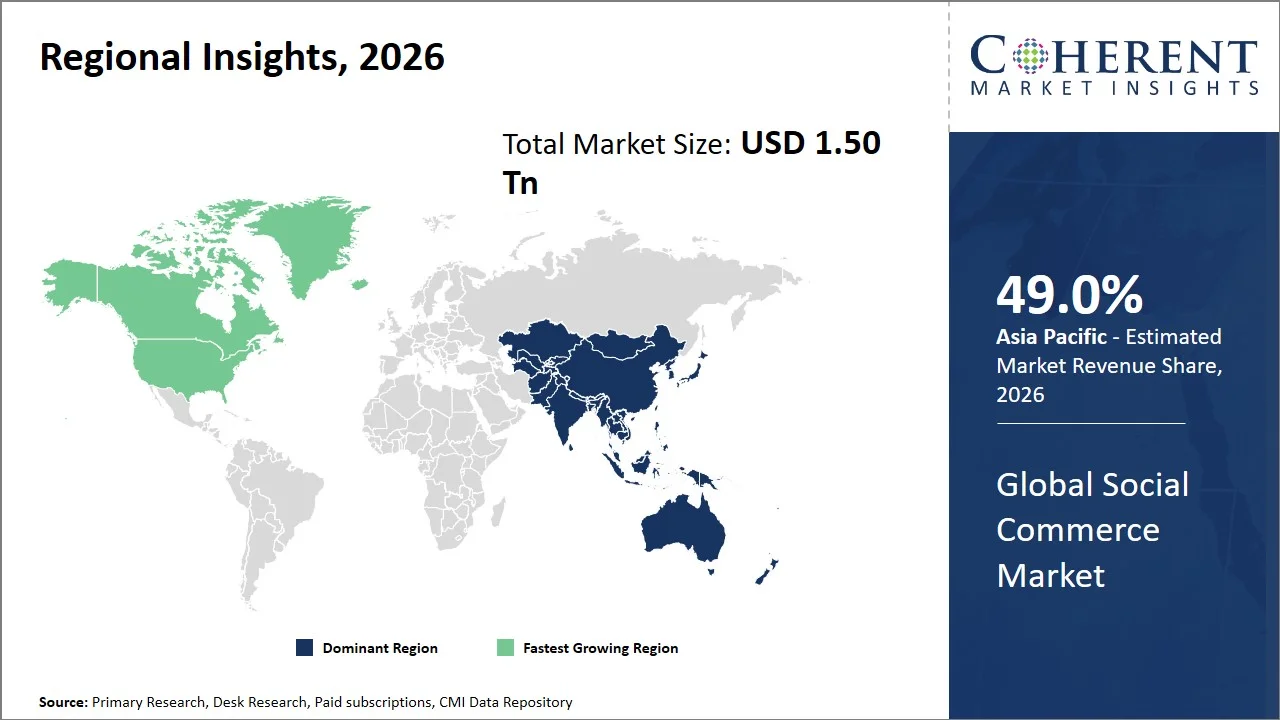
- Asia Pacific is expected to dominate the social commerce market in 2026 with a market share of 49.0 %. Increasing adoption of embedded fintech and buy now pay later services in Asia Pacific is driving the growth of the regional market. On January 13, 2026, Southeast Asia’s leading digital finance platform, Atome announced the successful close of the renewal and upsized USD 345 million syndicated debt facility, a significant increase from the USD 200 million secured in 2024.
- North America is expected to account for 24.0 % share in 2026 and is projected to record the fastest growth over the forecast period. Growth of augmented reality and virtual try-on technologies in North America is driving the growth of the regional market. On May 6, 2025, SpreeAI accelerated the deployment of its photorealistic AI virtual try-on platform for apparel retailers, enabling consumers to visualize garments on their own digital avatars before purchasing.
- AI driven hyper personalized shopping experiences are becoming a competitive differentiator: Social commerce platforms are increasingly deploying generative AI, predictive analytics and recommendation engines to deliver individual product recommendations, AI shopping assistants, dynamic pricing and personalized content feeds. These capabilities are boosting client engagement, driving higher conversion rates, and enabling merchants to refine marketing campaigns based on real-time consumer insights.
- Live commerce and creator led shopping ecosystems are expanding rapidly: Brands are moving away from traditional internet storefronts to interactive live shopping events with influencers, creators and brand ambassadors. Real time demos, audience interactivity, rapid purchasing and integrated payment capabilities are turning livestream shopping into a major income channel across fashion, beauty, electronics and leisure categories.
Segmental Insights
Why Do Smartphones Dominate the Global Social Commerce Market?
The smartphones segment is expected to account for 83.0% of the global social commerce market share in 2026. Smartphones have become the major gateway for product discovery, engagement and purchasing across social commerce platforms with the broad availability of mobile first social media applications. Consumers may explore tailored content, connect with producers via live streams, get real-time product recommendations, make safe in-app payments, and track orders from a single device. The combination of convenience, always-on connectivity and embedded purchasing capabilities has greatly improved purchase frequency and consumer interaction, making smartphones the device of choice for social commerce transactions. Moreover, the segment growth is also being driven by the availability of many tech accessories with cellphones. For instance, on June 16, 2026, Snap Inc. officially unveiled its sixth-generation augmented reality glasses, officially branded simply as Specs.
- Current Industry Events of 2026
- Market Size Estimation
- Regional Breakdown
- Competitive Landscape
- Customer Intelligence
- Segmental Analysis
- Pricing Analysis
- Key Market Drivers, Challenges & Future Trends
- Customized Insights Section
Why is Business to Consumer the Most Preferred Business Model?
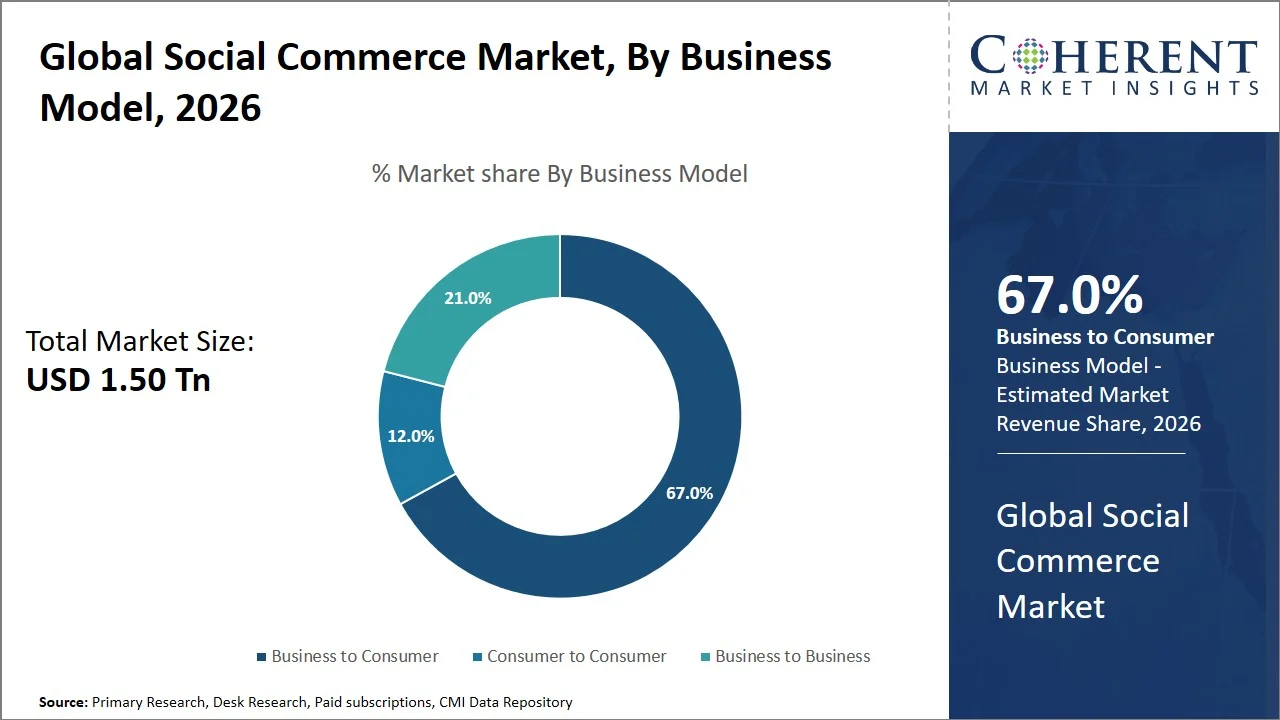
The business to consumer segment is expected to account for 67.0% of the global social commerce market share in 2026. The primary factor supporting the preference for the business-to-consumer model is the ability of businesses to manage the entire customer journey through integrated social commerce platforms. Businesses may connect consumers directly with personalized content, influencer collaborations, targeted advertising, live shopping events, and frictionless in app checkout while gathering important customer data to fine tune marketing efforts. This direct engagement helps to boost conversion rates, strengthens brand loyalty and allows quicker response to changing customer preferences, making the business to consumer model the most effective way for social commerce. On March 25, 2026, YouTube announced a major expansion of its Shopping Affiliate Program by relaxing the qualifying requirements for producers to have at least 500 subscribers and be a member of the YouTube Partner Program (YPP).
Social Networking Platforms Dominate the Global Social Commerce Market
The social networking platforms segment is expected to account for 43.0% of the global social commerce market share in 2026. The major reason social networking platforms are leading in social commerce is because they get lots of people to utilize their social networking sites every day. Consumers spend more time looking at personalized feeds, connecting with producers, sharing suggestions and discovering products through organic content as opposed to traditional ads. Integrated shopping features, influencer driven marketing, user content creation, and seamless in-app purchasing combine to provide a highly engaging buying environment that encourages frequent product discovery and greater conversion rates. On May 27, 2026, TikTok Shop announced that it is expanding rapidly across Europe. On June 15, 2026, the platform will launch in Austria, Belgium, the Netherlands, and Poland.
Currents Events and their Impact
Current Events | Description and its Impact |
European Union Digital Services Act (DSA) - Fully Enforced for Online Platforms (2025) |
|
United Kingdom Online Safety Act Implementation (2025-2026) |
|
Global Social Commerce Market Dynamics
Market Drivers
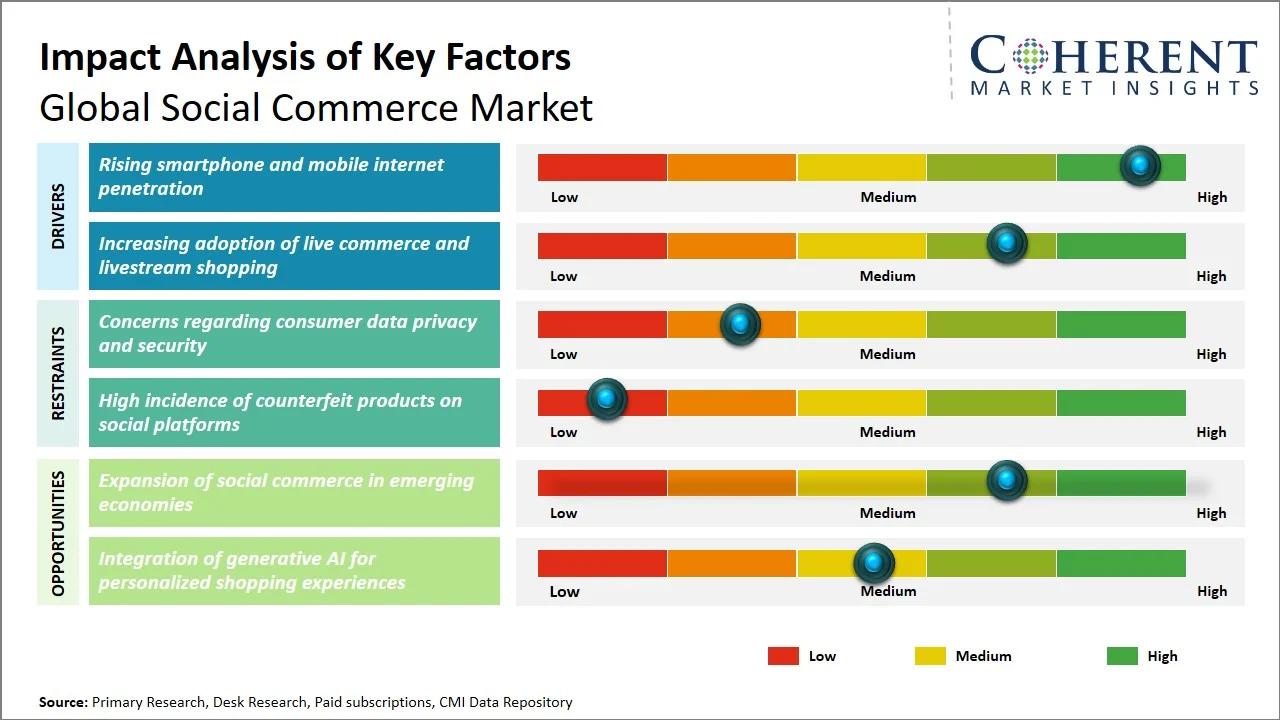
- Rising smartphone and mobile internet penetration: The rapid increase of smartphone ownership and high speed mobile internet connectivity is greatly propelling the growth of the social commerce market by providing customers access to purchasing experiences anytime and anywhere. Lower prices for smartphones and mobile data and increased availability of better 4G and 5G network coverage have driven more engagement on social media platforms, where consumers can find products, connect with brands, see personalized recommendations and buy within social apps. Mobile access has become ubiquitous, and that has widened the consumer base and volume of transactions for social commerce in developed and emerging nations. On August 19, 2025, Reliance Jio declared that it is aggressively extending its 5G network in India using a Standalone (SA) 5G architecture. Jio has successfully transferred millions of people to its 5G network resulting in the rapid rise of the country’s 5G subscriber base.
- Increasing adoption of live commerce and livestream shopping: The growing popularity of live commerce and livestream shopping is revolutionizing digital retail by providing highly participatory and interesting buying experiences. Brands, retailers and influencers utilize live broadcasts to showcase items, answer customer queries in real-time, give time-limited specials, and enable fast in-app transactions, resulting in increased consumer trust and better conversion rates. Livestream shopping is one of the fastest expanding sales channels across fashion, cosmetics, consumer electronics and lifestyle product categories, due to its blend of entertainment, real time engagement and seamless checkout capability. On January 26, 2025, Amazon announced that it is launching Watch and Shop, a new interactive experience that allows customers in India to shop while watching interactive video content. Watch and Shop aims to transform how customers discover and purchase products across all categories, from electronics to fashion and home essentials.
Emerging Trends
- Social commerce is increasingly integrating immersive shopping technologies: Augmented reality virtual try-ons, AI generated product visualization, 3D product displays and virtual storefronts are becoming commonplace across top platforms. These technologies are cutting buy uncertainty, enhancing customer confidence, lifting sales conversion and reducing product returns.
- Cross border social commerce and embedded financial services are accelerating market expansion: Social platforms are embedding localized payment solutions, digital wallets, Buy Now Pay Later services, automated currency conversion, and cross border logistics partnerships to make international transactions easier. This trend is enabling retailers to access global audiences, while giving consumers a seamless purchase experience across numerous markets.
Regional Insights
Why is Asia Pacific a Strong Market for Social Commerce?
Asia Pacific is expected to account for a market share of 49.0% in 2026. China, India, South Korea and Southeast Asian economies, where buying is integrated into digital lifestyles, are leading the way for social commerce innovation in Asia Pacific. Alibaba’s Taobao Live, Douyin, Xiaohongshu, WeChat Channels, Shopee Live and TikTok Shop have turned livestream shopping into a mainstream retail channel, with regional firms increasingly partnering with creators for product debuts and flash discounts. The use of digital wallets such as Alipay, WeChat Pay, PhonePe, Google Pay, Paytm, Kakao Pay and GrabPay has made it easier to make payments directly in social platforms. Fashion, cosmetics, consumer electronics and fast moving consumer goods are the largest in terms of transaction volumes, with creator-driven campaigns and short video commerce continuing to grow fast across the area.
Why Does the North America Social Commerce Market Exhibit High Growth?
North America is projected to account for 24.0% of the global social commerce market and is expected to register the fastest growth. North America has emerged as a mature social commerce ecosystem, powered by platform innovation, influencer marketing and integrated checkout capabilities. Nike, Sephora, Walmart, Target and L’Oréal are among the firms that now include Instagram Shop, Facebook Marketplace, TikTok Shop, Pinterest shopping features and YouTube Shopping as significant customer acquisition platforms. Shopify has improved integrations with Meta, TikTok and YouTube allowing businesses to sync inventories and execute transactions without leaving the social apps. Retailers are increasingly leveraging artificial intelligence to provide personalized suggestions, and collaborating with creators to develop exclusive product lines that drive high engagement through livestream events.
Global Social Commerce Market Outlook for Key Countries
Why is China Emerging as a Major Hub in the Social Commerce Market?
In China, the world’s most advanced social commerce ecosystem, livestream shopping, social interaction and digital payments all exist in one digital environment. Douyin, Taobao Live, Kuaishou, WeChat Channels, Xiaohongshu and Pinduoduo often include creator-led shopping festivals with companies such as Huawei, Xiaomi, Perfect Diary, Proya and Li Ning. Alibaba and JD.com are continuing to add AI-powered shopping assistants and virtual presenters to livestream sessions and Tencent is evolving commerce features within WeChat ecosystems. Alipay and WeChat Pay are now often used for seamless purchase and social commerce has become the primary retail channel instead of a supplementary sales channel.
Is the U.S. the Next Growth Engine for the Social Commerce Market?
The U.S. is continuing to grow social commerce with high adoption of creator economy marketing and integrated shopping technology. TikTok Shop has attracted thousands of domestic merchants and direct to consumer companies and Meta is making improvements to Instagram Shopping and Facebook Marketplace with artificial intelligence-powered product discovery and targeted advertising. Amazon has grown collaborations with social creators through the Amazon Influencer Program and creative marketplaces, and Pinterest is focused on visual discovery for home décor, fashion and beauty companies. Retailers such as Walmart, eBay, Etsy and Shopify are strengthening collaborations with social platforms to better omnichannel commerce strategies and connect with customers more effectively.
India Social Commerce Market Analysis and Trends
India is now one of the fastest expanding social commerce economies, fueled by inexpensive cellphones, extensive adoption of the Unified Payments Interface and rapid growth in regional language digital content. The likes of Meesho, Flipkart, Myntra, GlowRoad and TikTok are more reliant on creator-led product recommendations and community selling models to reach out to consumers in tier two and tier three cities. Reliance Retail has furthered the integration of digital commerce within its retail ecosystem, while Meta platforms continue to be key avenues for small company marketing and consumer acquisition. Beauty, fashion, home essentials and personal care products create a lot of interaction through influencer campaigns and short form video content.
U.K. Social Commerce Market Analysis and Trends
The U.K. has evolved a complex social commerce landscape where luxury brands, independent merchants and digital-first firms are increasingly combining influencer marketing with integrated purchasing features. Brands like ASOS, Boots, Marks & Spencer, Charlotte Tilbury and Gymshark regularly introduce items and connect with consumers through creator partnerships using Instagram Shopping, TikTok Shop, Pinterest and YouTube Shopping. With greater online safety and seller verification regulations in place, platforms have been pushed to invest in fraud detection, transparent advertising practices, and increased consumer protection while enabling the further rise of social shopping.
South Korea Social Commerce Market Analysis and Trends
South Korea’s digital populace is extremely linked, and commerce is integrated with social and messaging platforms in a sophisticated manner. KakaoTalk, Kakao Shopping Live, Naver Shopping Live, Instagram and YouTube have become key platforms for beauty, fashion, consumer electronics and entertainment merchandise, with companies including Amorepacific, Samsung Electronics, LG Electronics, Musinsa and Olive Young actively leveraging livestream commerce and creator partnerships. It is among the top innovators in social commerce, thanks to high speed mobile connectivity, the prevalence of digital wallets such as Kakao Pay and Naver Pay and significant acceptance of real time interactive buying by consumers.
Global Social Commerce Market - Regional Differences in Social Commerce Maturity
Country/Region | Social Commerce Maturity Level | Consumer Adoption Characteristics | Key Maturity Indicators |
Asia Pacific | Highly Mature | Social commerce integrated into daily shopping behavior with strong livestream and creator selling adoption | Around 59% of consumers in Asia Pacific use social commerce, supported by strong adoption of livestream shopping, creator-led selling, and integrated digital payment ecosystems |
China | Most Advanced Global Market | Frequent use of social platforms for product discovery entertainment reviews and direct purchasing | China has the highest level of social commerce maturity globally, with livestream commerce becoming a mainstream shopping channel through platforms such as Douyin, Taobao Live, Kuaishou, and Xiaohongshu |
North America | Advanced but Developing | Increasing discovery through influencers short videos and social advertising | North America has a strong creator-driven commerce ecosystem, with approximately one-third of consumers engaging in social commerce through platforms such as TikTok Shop, Instagram Shopping, YouTube Shopping, and Pinterest |
U.S. | Advanced Growth Stage | Brands mainly use platforms for discovery influencer marketing and customer engagement | The United States market is characterized by rapid growth in shoppable content formats, including influencer storefronts, affiliate commerce, livestream product demonstrations, and short-form video shopping |
Europe | Developing to Advanced | Growing adoption with emphasis on trust privacy and verified sellers | Europe is experiencing steady social commerce adoption, supported by increasing usage of influencer marketing, verified seller ecosystems, privacy-compliant shopping models, and fashion-focused digital commerce |
India | Rapid Expansion Stage | Increasing use of social platforms for affordable products regional content and creator recommendations | India is showing accelerated social commerce adoption, driven by high smartphone usage, UPI-based digital payments, regional language content, and increasing participation of small businesses on platforms such as Meesho, Instagram, and YouTube |
Southeast Asia | Fast Growing Mature Stage | Wide adoption through livestreaming community selling and marketplace-based shopping | Southeast Asia demonstrates strong livestream commerce penetration, with platforms such as TikTok Shop, Shopee Live, and Lazada Live enabling creators and small merchants to directly engage consumers |
South Korea | Highly Developed Digital Commerce Market | Combination of social discovery advanced payments and influencer-led purchasing | South Korea has an advanced digital shopping ecosystem, supported by high smartphone penetration, strong influencer culture, livestream shopping platforms, and integrated mobile payment infrastructure |
Latin America | Emerging Growth Stage | Increasing adoption through influencers messaging platforms and mobile payments | Latin America is emerging as a high-growth social commerce region, with increasing adoption of influencer-driven selling, WhatsApp commerce, digital wallets, and mobile-first shopping behavior |
Middle East and Africa | Early Expansion Stage | Developing through mobile platforms influencer marketing and messaging-based selling | Middle East and Africa are in early adoption stages, with growth supported by expanding smartphone connectivity, rising digital payment usage, and increasing influence of social media-based product discovery |
How is the Expansion of Social Commerce in Emerging Economies Creating New Growth Opportunities in the Social Commerce Market?
The emergence of social commerce in emerging markets has huge potential as millions of first-time digital buyers are joining social platforms due to affordable smartphones, better mobile internet connectivity and the rise of digital payment methods. In countries like India, Indonesia, Vietnam, Brazil and Mexico, creator-driven commerce, community-based selling and livestream purchasing are rapidly growing, allowing brands and small companies to access consumers outside of traditional retail channels. The availability of localized language material, integrated digital wallets, various payment alternatives and last mile logistical networks is helping retailers to service previously underserved populations more efficiently. This rising consumer base is pushing global platforms and regional retailers to engage in localized shopping experiences, creator alliances, artificial intelligence powered suggestions, and cross border commerce capabilities, offering ongoing potential for market expansion.
On May 5, 2026, TikTok Shop partnered with the ASEAN Foundation to extend SOAR Together program to help Southeast Asian MSMEs. The initiative trains youth and women entrepreneurs on core digital marketing, e-commerce operations and live selling.
Market Players, Key Development, and Competitive Landscape
Key Developments
- On April 28, 2026, Snap Inc. introduced AI Sponsored Snaps, a new way for brands to show up in Chat through AI agents that Snapchatters can interact with directly. Building on the momentum of Sponsored Snaps, which already drive 22% more conversions with nearly 20% lower cost per action, and 2x more conversions per full-screen ad view compared to other inventories, this new format enables brands to engage Snapchatters through personalized, AI-powered interactions.
- On June 11, 2025, Pinterest introduced AI-powered Auto-Collages and an enhanced Shopping Trends platform, allowing advertisers to automatically convert product catalogs into shoppable collages while using predictive shopping insights to improve campaign performance.
Competitive Landscape
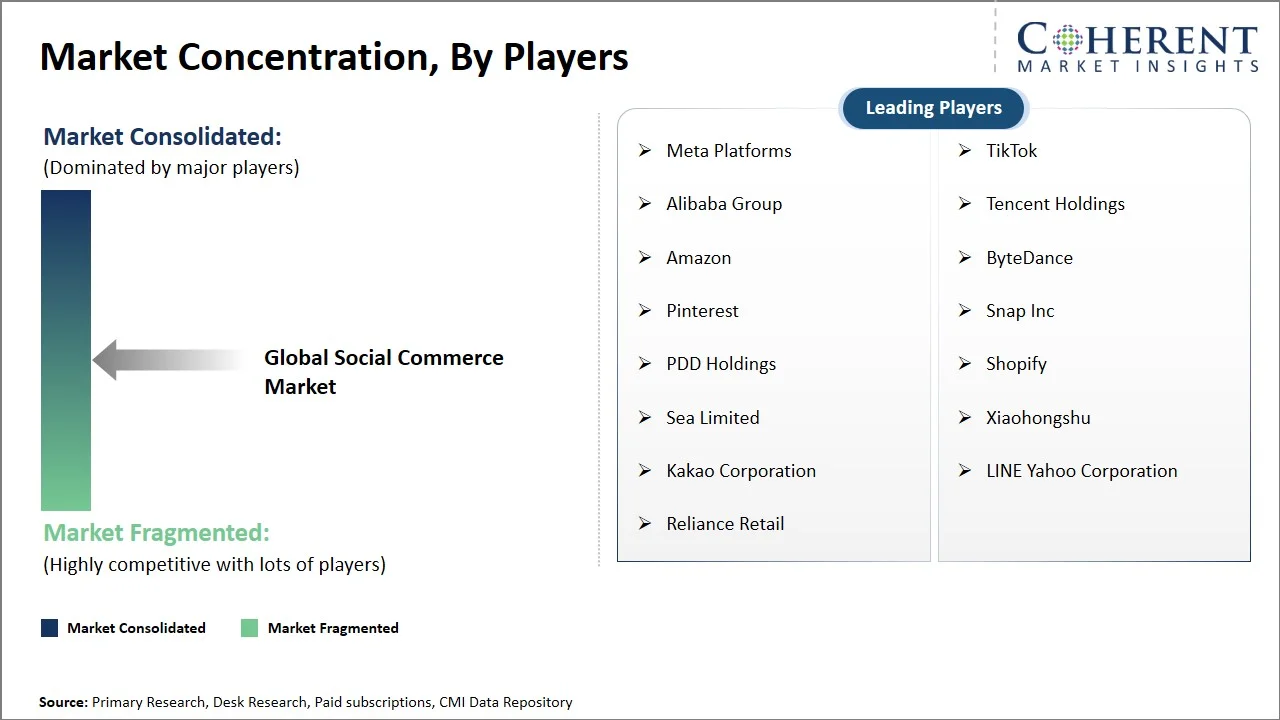
Social commerce industry competition is being shaped by the continued convergence of social engagement, content creation, digital payments and commerce infrastructure inside unified digital ecosystems. Social applications are progressively incorporating AI-enabled shopping assistants, generative content creation tools, multilingual product discovery and automated customer assistance to shorten the process from product discovery to purchase. Livestream commerce is evolving to include virtual hosts, interactive auctions and real time inventory synchronization, as augmented reality based virtual try on experiences become standard across beauty, fashion and eyewear categories. Social platforms are adding loyalty programs, affiliate commerce, creative storefronts, subscription purchasing and cross-border fulfillment capabilities, allowing for seamless buying experiences without redirecting users to external websites.
Market Report Scope
Social Commerce Market Report Coverage
| Report Coverage | Details | ||
|---|---|---|---|
| Base Year: | 2025 | Market Size in 2026: | USD 1.50 Tn |
| Historical Data for: | 2020 To 2024 | Forecast Period: | 2026 To 2033 |
| Forecast Period 2026 to 2033 CAGR: | 12% | 2033 Value Projection: | USD 5.65 Tn |
| Geographies covered: |
| ||
| Segments covered: |
| ||
| Companies covered: | Meta Platforms, TikTok, Alibaba Group, Tencent Holdings, Amazon, ByteDance, Pinterest, Snap Inc, PDD Holdings, Shopify, Sea Limited, Xiaohongshu, Kakao Corporation, LINE Yahoo Corporation, and Reliance Retail | ||
| Growth Drivers: |
| ||
| Restraints & Challenges: |
| ||
Analyst Opinion (Expert Opinion)
- The social commerce market is being redefined by the evolution of social platforms as full scale digital retail ecosystems rather than promotional channels. More weight will be given to creator owned stores, artificial intelligence generated product discovery, predictive shopping feeds and conversational commerce powered by intelligent virtual assistants.
- Short video commerce, livestream transactions and embedded payment platforms are slowly but surely breaking down the walls between entertainment, community interaction and online purchase. Also, a positive trend is emerging in localized language commerce, virtual influencers, social search optimization and integrated logistics visibility, which indicates platform intelligence and ecosystem integration will matter more than traditional e commerce features for long term market positioning.
- The social commerce market will transform into highly automated and immersive shopping environments with artificial intelligence agents helping consumers with product discovery, price comparisons, purchasing decisions, and post-purchase assistance all within social apps. Augmented reality, three dimensional product visualization, wearable device integrations and mixed reality retail experiences are expected to expand spatial commerce and change the way consumers participate.
Speak to the analyst
Want personalized insights?
Take the findings above to one of our principal consultants, or have the report rebuilt around the segments, geographies and competitors you actually track.
Market Segmentation
- Device Type Insights (Revenue, USD Trillion, 2021 - 2033)
- Smartphones
- Tablets
- Desktop and Laptop
- Business Model Insights (Revenue, USD Trillion, 2021 - 2033)
- Business to Consumer
- Consumer to Consumer
- Business to Business
- Platform Type Insights (Revenue, USD Trillion, 2021 - 2033)
- Social Networking Platforms
- Video Sharing Platforms
- Messaging Platforms
- Live Streaming Platforms
- Product Type Insights (Revenue, USD Trillion, 2021 - 2033)
- Fashion and Apparel
- Beauty and Personal Care
- Consumer Electronics
- Home and Living
- Food and Beverages
- Health and Wellness
- Others
- Payment Type Insights (Revenue, USD Trillion, 2021 - 2033)
- Digital Wallets
- Credit and Debit Cards
- Bank Transfers
- Buy Now Pay Later
- Others
- End User Insights (Revenue, USD Trillion, 2021 - 2033)
- Individual Consumers
- Small and Medium Enterprises
- Large Enterprises
- Regional Insights (Revenue, USD Trillion, 2021 - 2033)
- North America
- U.S.
- Canada
- Latin America
- Brazil
- Argentina
- Mexico
- Rest of Latin America
- Europe
- Germany
- U.K.
- Spain
- France
- Italy
- Russia
- Rest of Europe
- Asia Pacific
- China
- India
- Japan
- Australia
- South Korea
- ASEAN
- Rest of Asia Pacific
- Middle East
- GCC Countries
- Israel
- Rest of Middle East
- Africa
- South Africa
- North Africa
- Central Africa
- North America
- Key Players Insights
- Meta Platforms
- TikTok
- Alibaba Group
- Tencent Holdings
- Amazon
- ByteDance
- Snap Inc
- PDD Holdings
- Shopify
- Sea Limited
- Xiaohongshu
- Kakao Corporation
- LINE Yahoo Corporation
- Reliance Retail
Sources
Primary Research Interviews
- Social Commerce Platform Executives & Product Managers
- Retail & E-commerce Brand Strategists
- Digital Marketing & Influencer Marketing Professionals
- Payment Gateway & Fintech Solution Providers
Magazines
- Forbes – Technology & Commerce Insights
- Business Insider – Digital Retail & Social Media Trends
- Retail Dive – E-commerce & Social Selling Coverage
- Adweek – Social Media Marketing & Commerce Trends
Journals
- Journal of Marketing Research – Consumer Behavior & Digital Commerce Studies
- Journal of Retailing and Consumer Services – Social Commerce Trends & Analysis
- International Journal of Electronic Commerce – Digital & Social Commerce Research
Associations
- National Retail Federation (NRF) – Retail & E-commerce Industry Standards
- Interactive Advertising Bureau (IAB) – Digital Advertising & Social Commerce Data
- eCommerce Europe – European Social Commerce Market Insights
- Social Media Advertising Consortium (SMAC) – Social Media Commerce Trends
Public Domain Sources
- U.S. Securities and Exchange Commission (SEC) – Company Filings & Financial Reports
- World Trade Organization (WTO) – Global Digital Trade Data
- European Commission – Digital Economy & Society Reports
- United Nations Conference on Trade and Development (UNCTAD) – E-commerce & Social Commerce Statistics
Proprietary Elements
- CMI Data Analytics Tool
- Proprietary CMI Existing Repository of Information for the Last 10 Years
Get access to 250+ pages report
Every segment, forecast, competitor profile and data table behind the analysis above — available for instant download.
- ESOMAR Member
- ISO 9001:2015 Certified
- D-U-N-S Registered
- GDPR & CCPA Compliant
Missing comfort of reading report in your local language? Find your preferred language:
Transform your Strategy with Exclusive Trending Reports
Frequently Asked Questions
The global social commerce market is expected to stand at USD 1.50 Tn in 2026 and is expected to reach USD 5.65 Tn by 2033.
The CAGR of the global social commerce market is projected to be 12% from 2026 to 2033.
Rising smartphone and mobile internet penetration and increasing adoption of live commerce and livestream shopping are the major factors driving the growth of the global social commerce market.
Concerns regarding consumer data privacy and security and high incidence of counterfeit products on social platforms are the major factors hampering the growth of the global social commerce market.
In terms of device type, the smartphones segment is estimated to dominate the market revenue share in 2026.
Digital wallets enable faster and more secure in app payment experiences.
Social commerce enables consumers to discover and purchase products without leaving social media platforms.