

LoRaWAN Market Analysis & Forecast - 2026 to 2033
LoRaWAN Market is estimated to be valued at USD 6.70 Bn in 2026 and is expected to reach USD 54.62 Bn in 2033, exhibiting a compound annual growth rate (CAGR) of 34.9% from 2026 to 2033.
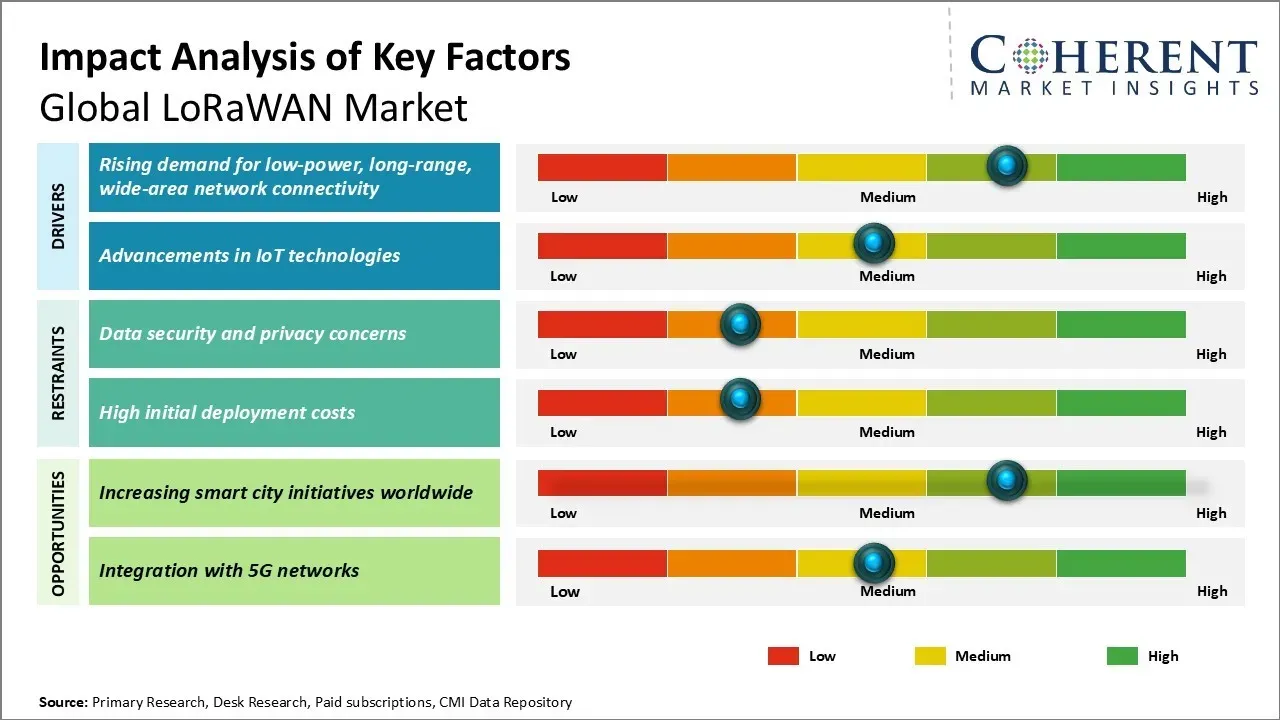
Key Takeaways
- According to component, the hardware category is anticipated to account for the largest share of 47.7% for the LoRaWAN market in 2026. As LoRaWAN hardware is affordable and enables widespread deployments, it appeals to sectors with limited funding.
- According to deployment mode, the public segment is anticipated to hold major share of the LoRaWAN market in 2026. The public approach streamlines connectivity for a variety of dispersed IoT use cases by removing the requirement for enterprises to install separate gateways.
- According to region, North America holds the largest market share of 31.70% for LoRaWAN market growth by 2026. The region has a strong IoT ecosystem due to large investments in innovation, infrastructure, and legal frameworks that facilitate broad implementation.
- Asia Pacific is considered to be the most largest region by 2026 for LoRaWAN market. Some of the biggest LoRaWAN installations in the world have occurred in the APAC region, supporting applications in energy management, leak detection, environmental monitoring, street lighting, and water and gas metering.
- Europe is considered to be the third dominating region for LoRaWAN market by 2026, a thriving ecosystem of network operators, device makers, and technology providers is projected to help Europe continue to dominate the worldwide LoRaWAN industry.
Market Overview
The LoRaWAN Market Size is expanding quickly because to the growing use of IoT solutions in sectors which includes smart cities, industrial automation, healthcare, and agriculture. The increasing adoption of smart city projects around the world is enabling the deployment of a larger number of IoT devices that utilize low power wide area networks for connectivity. These networks help connect devices reliably over long ranges with low power consumption which is fueling the growth of this market.
For instance, in March 2025, Semtech Corporation, a high-performance semiconductor, IoT systems and cloud connectivity service provider, introduced the LR2021, the first chip in the LoRa Plus family.
Current Events and Its Impact on the LoRaWAN Market
Event | Description and Impact |
Surge in Smart City Investments |
|
Adoption of AI and Machine Learning in Automation |
|
Role of Technologies like AI and Blockchain in the LoRaWAN Market
Artificial intelligence (AI) and blockchain are playing transformative roles in the evolution of the LoRaWAN market. AI integration enables advanced real-time data analytics, predictive maintenance, and optimized resource management. This enhances operational efficiency across sectors such as smart cities, utilities, and industrial IoT, where AI-driven insights improve traffic flow, air quality, and energy usage, while also supporting automated decision-making and reducing operational costs.
Blockchain technology, meanwhile, is emerging as a key enabler for secure and transparent data transactions within IoT ecosystems. The adoption of blockchain in LoRaWAN networks strengthens data integrity, supports decentralized device authentication, and ensures secure communication, particularly important for critical infrastructure and regulatory compliance. Together, these technologies are accelerating innovation, expanding the scope of LoRaWAN applications, and driving market growth.
- Current Industry Events of 2026
- Market Size Estimation
- Regional Breakdown
- Competitive Landscape
- Customer Intelligence
- Segmental Analysis
- Pricing Analysis
- Key Market Drivers, Challenges & Future Trends
- Customized Insights Section
Pricing Analysis
- Pricing in the LoRaWAN market is shaped by several factors, including hardware costs, network deployment scale, and service models.
- The hardware segment comprising gateways, sensors, and end devices accounts for the largest share of market spending due to the foundational role these components play in establishing LoRaWAN networks.
- As infrastructure deployment scales up, especially with the expansion of smart city and industrial projects, economies of scale are expected to gradually lower unit costs.
Segmental Insights
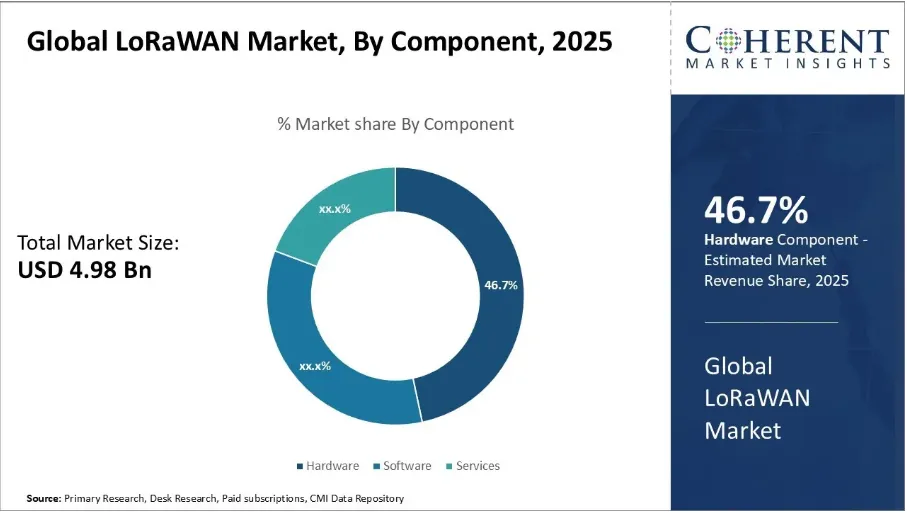
LoRaWAN Market Insights, By Component
The hardware segment is expected to hold the largest share of 47.7% in the global LoRaWAN market in 2026. This can be attributed to the rising deployment of LoRaWAN networks for enabling IoT services across various industry verticals worldwide. As LoRaWAN gateways and end-point devices form the basic infrastructure for establishing a LoRaWAN network, hardware sees the maximum demand.
With growing IoT applications in areas, such as smart manufacturing, supply chain management, asset tracking, etc., the requirement for LoRaWAN infrastructure is increasing rapidly. Governments of various countries are also actively working towards developing smart cities with integrated IoT infrastructure, which involves large-scale installation of LoRaWAN hardware.
Moreover, telecom operators and industry players are continuously expanding their LoRaWAN networks to facilitate mass IoT adoption. This stimulates greater consumption of hardware components such as end-point modules, routers, and gateway devices. Furthermore, existing deployments also require upgraded and substituted hardware periodically to support the increasing number of connections.
Low-cost and easy to use LoRaWAN technology has become the preferred IoT connectivity option compared to traditional cellular networks, driving extensive rollout of associated hardware infrastructure globally. Widespread infrastructure development efforts are expected to boost the hardware segment's dominance in the LoRaWAN market over the forecast period.
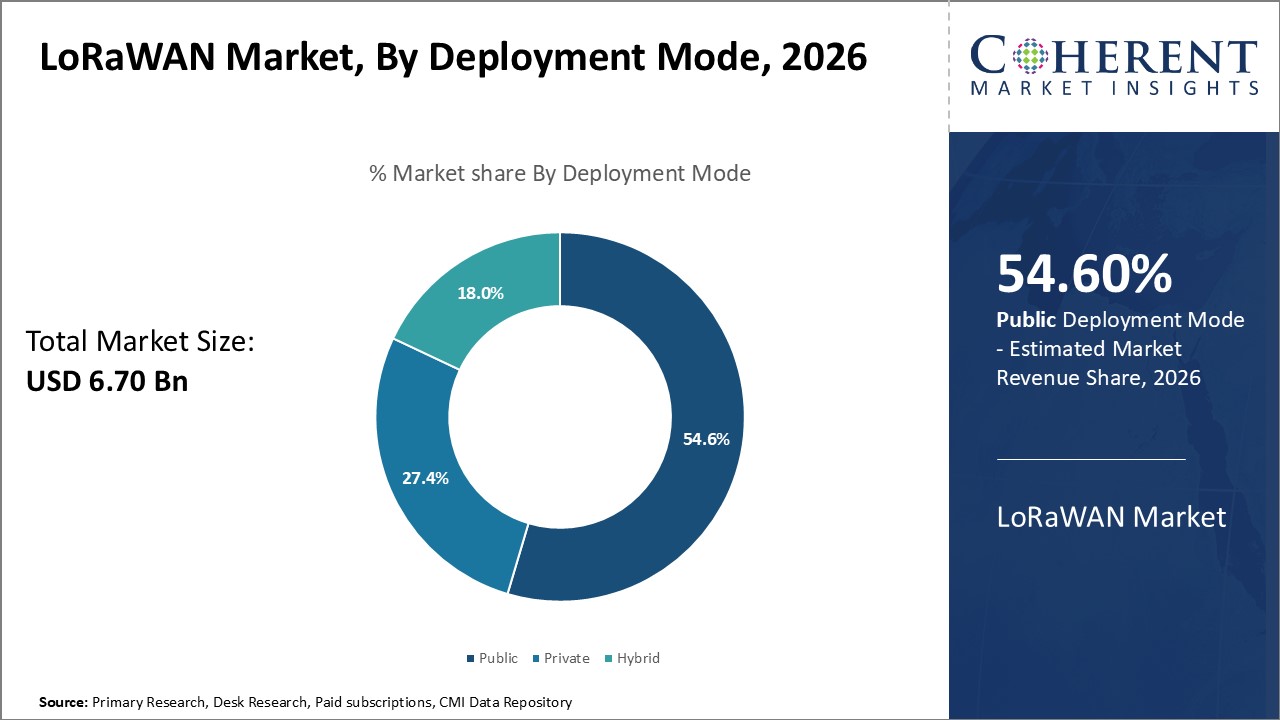
LoRaWAN Market Insights, By Deployment Mode
The public segment is expected to hold the highest revenue share of 54.6% in the global LoRaWAN market in 2026. This can be mainly attributed to its ability to cover extensive geographic areas, making it ideal for large-scale IoT adoption. Public LoRaWAN networks are owned and operated by telecom carriers and network providers to offer connectivity as a service.
Their wide-ranging coverage allows devices to connect from practically anywhere within the spectrum range. This makes public networks suitable for IoT applications across smart cities, industrial premises, agriculture, logistics, etc. that require connectivity across large premises or regions.
Moreover, public LoRaWAN gateways are usually deployed at strategic high points for optimal propagation such as cell towers, rooftops, and CCTV poles. This broadcast-style architecture provides blanket radio signals without any single point of failure. It negates the need for individual private gateways in each unit or facility. As a result, organizations can leverage public LoRaWAN networks in a more cost-effective pay-as-you-go model rather than setting up separate dedicated infrastructure.
These advantages of wide-scale access have led to public deployment gaining higher popularity over private and hybrid modes for most IoT use cases. This factor is expected to help public deployment drive the overall LoRaWAN market growth going ahead.
Regional Insights
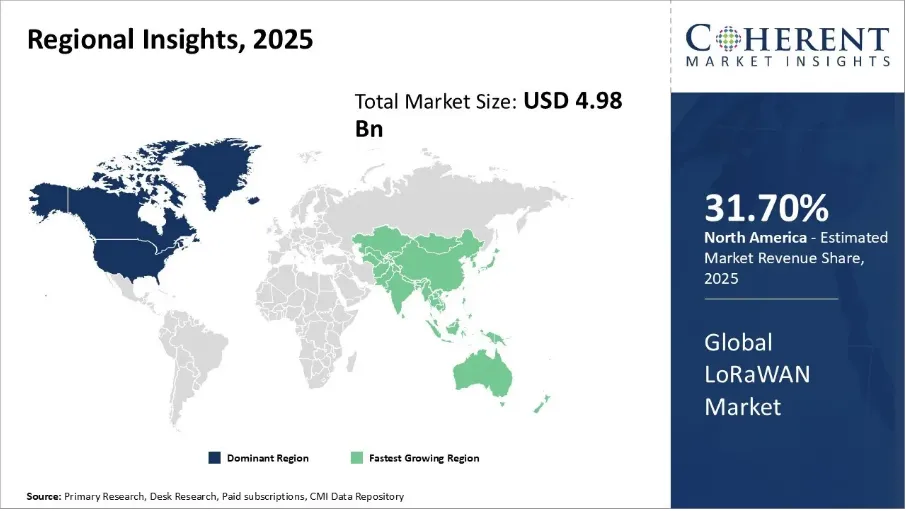
North America LoRaWAN Market
North America is expected to dominate the LoRaWAN market, holding a share of 31.70% in 2026. This lead can be attributed to supportive government policies promoting IoT adoption and the presence of major network providers. Countries like the U.S. and Canada have invested heavily in developing smart infrastructure and creating an ecosystem conducive for IoT technologies to thrive.
Asia Pacific LoRaWAN Market
The Asia Pacific region, holding a share of 27.4% in 2026, is expected to exhibit the fastest growth, driven by emerging economies embracing digital transformation at an unprecedented rate. Rapid urbanization and government initiatives to upgrade infrastructures have boosted IoT spending.
LoRaWAN Market In Europe
Significant investments in smart city projects, industrial automation, and the digital transformation of important industries are driving the fast growth of the LoRaWAN market in Europe. LoRaWAN networks are being used more and more for applications including public safety, energy management, intelligent transportation, and environmental monitoring, with Germany, the UK, and France dominating the regional market.
In contrast to Bluetooth and Zigbee, which are less efficient for wide-area coverage, the technology's long-range, low-power, and affordable connection makes it perfect for extensive Internet of Things (IoT) deployments.
LoRaWAN Market Dominating Countries
U.S LoRaWAN Market
The U.S. LoRaWAN market is leading global innovation, driven by the rapid adoption of IoT applications across industries such as smart cities, utilities, and industrial automation. Major players like Semtech and Cisco are expanding network coverage and capabilities, ensuring seamless integration with enterprise solutions.
Companies like Senet and machineQ (a Comcast subsidiary) are actively deploying nationwide LoRaWAN infrastructure, enabling large-scale applications such as smart metering, asset tracking, and environmental monitoring.
Additionally, strong government support and public-private partnerships are accelerating adoption, positioning the U.S. as a key driver of LoRaWAN advancements and future technological breakthroughs.
India LoRaWAN Market
India LoRaWAN market is witnessing an exponential uptake, driven by its affordability and suitability for large-scale applications in agriculture, logistics, and smart city projects. As the government continues to push for digital transformation under initiatives like Smart Cities Mission and Digital India, LoRaWAN’s low-cost, long-range, and low-power capabilities make it an ideal choice for rural and urban connectivity.
Local companies such as Tata Communications, SenRa, and Reliance Jio are playing a critical role in deploying and expanding LoRaWAN networks across the country. These players are working with municipalities, agritech startups, and logistics firms to enhance real-time monitoring, asset tracking, and environmental sensing, ensuring that IoT adoption is accessible even in remote areas.
With a growing ecosystem of startups and government-backed pilot projects, India is poised to become a leading market for LoRaWAN applications in the coming years.
LoRaWAN Market In China
China LoRaWAN market is experiencing aggressive expansion, fueled by the country’s nationwide push for smart manufacturing and industrial automation. The Chinese government’s focus on Industry 4.0 and the integration of IoT into various sectors has created a strong demand for LoRaWAN-based solutions. In addition to international giants like Semtech and Cisco, local providers such as Alibaba Cloud, ZTE, and Tencent are playing a crucial role in expanding the ecosystem.
These companies are developing customized solutions tailored to China’s diverse industrial landscape, from factory automation to environmental monitoring. The availability of affordable domestic hardware and network infrastructure further accelerates LoRaWAN adoption, making China one of the most significant contributors to global market growth.
Market Report Scope
LoRaWAN Market Report Coverage
| Report Coverage | Details | ||
|---|---|---|---|
| Base Year: | 2025 | Market Size in 2026: | USD 6.70 Bn |
| Historical Data for: | 2020 To 2024 | Forecast Period: | 2026 To 2033 |
| Forecast Period 2026 to 2033 CAGR: | 34.9% | 2033 Value Projection: | USD 54.62 Bn |
| Geographies covered: |
| ||
| Segments covered: |
| ||
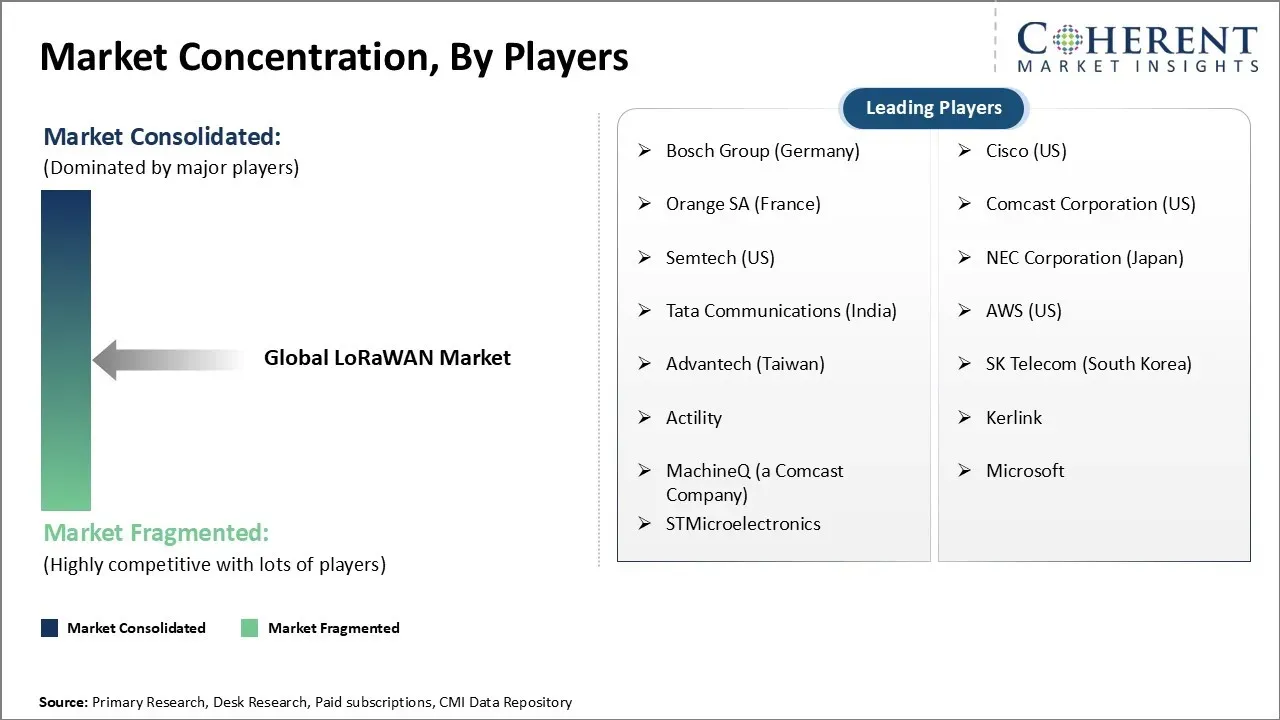
| Companies covered: | Bosch Group (Germany), Cisco (US), Orange SA (France), Comcast Corporation (US), Semtech (US), NEC Corporation (Japan), Tata Communications (India), AWS (US), Advantech (Taiwan), SK Telecom (South Korea), Actility, Kerlink, MachineQ (a Comcast Company), Microsoft, and STMicroelectronics | ||
| Growth Drivers: |
| ||
| Restraints & Challenges: |
| ||
LoRaWAN Market: Growth Drivers
- Rising demand for low-power, long-range, wide-area network connectivity
With the rise of IoT, more and more devices are being connected that transmit data over long ranges while operating for extended periods on battery power. This is creating a growing need for network infrastructures that can support such low-power, long-range communications in a cost-effective way. LoRaWAN has emerged as an ideal solution for these types of IoT use cases due to its ability to transmit data over distances of 10–15 km for city applications and 30–50 km in rural areas while consuming very little battery power. Devices can remain completely passive for months or years between transmissions on just a single battery charge.
LoRaWAN's long transmission ranges mean networks can cover wide areas with fewer base stations compared to traditional cellular systems. This helps operators lower capital and operating expenses. With limited infrastructure requirements, LoRaWAN networks can also be easily deployed even in remote or hard to reach locations that cellular may not support cost effectively.
Its ability to handle thousands of endpoints per base station also makes it highly scalable for large IoT projects. All these characteristics have resulted in LoRaWAN gaining popularity for various applications that need to communicate sporadically over long distances from rural, urban, and underground locations.
Use cases driving the adoption of LoRaWAN include smart utility metering, smart city applications, supply chain tracking, industrial asset monitoring, environmental sensors, agricultural monitoring, tank and pipeline monitoring, and others. As more devices and use cases emerge that require long battery life and can tolerate slower speeds for upstream communication over large areas, deployments of LoRaWAN networks are expected to continue increasing to cater to this growing demand.
LoRaWAN Market: Trends
Currently, a number of significant developments are propelling the LoRaWAN market's explosive growth both internationally and in Europe. The growing investment in smart city initiatives, where LoRaWAN networks facilitate applications like intelligent traffic control, intelligent garbage collection, environmental monitoring, and public safety systems, is a significant trend.
These initiatives require long-range, dependable, low-power connection, which LoRaWAN efficiently delivers, encouraging broad adoption. The combination of cutting-edge digital technologies like machine learning (ML) and artificial intelligence (AI) with LoRaWAN networks is another noteworthy trend. Across industrial IoT and smart infrastructure applications, this integration improves operational efficiency, predictive maintenance, and real-time data analytics.
LoRaWAN Market: Opportunities
- Increasing smart city initiatives worldwide
The market is witnessing new growth opportunities due to increasing smart city initiatives being undertaken globally. As urban local bodies aim at improving public services and infrastructure, there is a rising focus on deploying smart solutions for areas like waste management, traffic management, water distribution, environment monitoring, etc.
These smart city applications require connectivity of a large number of sensors and devices in a wide geographic area. LoRaWAN technology is ideally suited for such IoT connectivity needs due to its long-range capabilities and low power consumption features. The cost-effectiveness of LoRaWAN networks also makes it an attractive proposition.
With more and more governments allocating budgets for development of smart infrastructure, opportunities will emerge for LoRaWAN vendors and service providers to partner with smart city projects worldwide. This will significantly help in expanding the reach and penetration of LoRaWAN technology.
Market Players, Key Devlopment, and Competitive Intelligence
Top Strategies Followed by Global LoRaWAN Market Players
- Established Players: Leading companies like Semtech, Actility, and Microchip focus extensively on research and development to improve product performance and innovate new solutions. They invest over 10% of their annual revenues in R&D to strengthen their foothold in the market. Major players partner with other global technology giants, mobile network operators, and chip manufacturers to share technical expertise.
- Mid-Level Players: Companies like MultiTech and EMnify offer affordable hardware and connectivity options to address the needs of price-sensitive consumers. Their low-cost gateways and sensors have helped gain new customers. Players like Senet and Thingworks cooperate with system integrators, solution providers, and regional Internet service providers to enhance production and market reach. Their collaborations facilitate go-to-market strategies.
- Small-Scale Players: New entrants focus on niche areas, targeting specific verticals like agriculture, utilities, and industrial IoT. Companies specialize in developing products tailored for specialized applications. Startups embrace emerging technologies to differentiate their offerings. Some have incorporated AI, Blockchain, and cloud computing frameworks to address new demands.
LoRaWAN Market: Key Developments
- March 2025, Sweden-based Netmore Group, the last operator attempting to build a global LoRaWAN network, has expanded into South America, starting in Brazil, following completion of its acquisition of Dutch operator Everynet. It will pitch to local enterprises in the energy, agriculture, transportation, and logistics markets, it said. Meanwhile, the firm has launched a new metering-as-a-service (MaaS) offer for water and gas utilities, offering an alternative to traditional capex-heavy advanced metering infrastructure (AMI) deployments.
- April 2024, the LoRa Alliance®, the global association of companies backing the open LoRaWAN® standard for the internet of things (IoT) low-power wide-area networks (LPWANs), today launched its formal roadmap, which highlights LoRaWAN’s evolution from building and interconnecting networks through its focus on making the technology faster and easier to deploy, work that has successfully made LoRaWAN the leading LPWAN with the most deployments supporting IoT’s active scaling across numerous end markets.
- September 2024, The Things Industries, a leading provider of IoT solutions, is proud to announce the launch of The Things Indoor Gateway Pro, the next-generation managed LoRaWAN Gateway. This product is designed to enable seamless LoRaWAN network installation. Integrated with The Things Stack, it offers unparalleled connectivity flexibility and resilience, zero-touch provisioning and comprehensive cloud management.
Analyst Opinion
- The LoRaWAN market is witnessing rapid expansion, particularly in the Asia Pacific region, due to large-scale IoT deployments in sectors like utilities, manufacturing, and smart cities.
- Challenges such as data security and high initial deployment costs may hinder the market growth.
- North America is expected to maintain its dominance in the LoRaWAN market, attributed to the strong presence of major market players and a tech-savvy consumer base.
Speak to the analyst
Want personalized insights?
Take the findings above to one of our principal consultants, or have the report rebuilt around the segments, geographies and competitors you actually track.
Market Segmentation
- Component Insights (Revenue, USD Bn, 2021 - 2033)
- Hardware
- Software
- Services
- Deployment Mode Insights (Revenue, USD Bn, 2021 - 2033)
- Public
- Private
- Hybrid
- Regional Insights (Revenue, USD Bn, 2021 - 2033)
- North America
- U.S.
- Canada
- Latin America
- Brazil
- Argentina
- Mexico
- Rest of Latin America
- Europe
- Germany
- U.K.
- Spain
- France
- Italy
- Russia
- Rest of Europe
- Asia Pacific
- China
- India
- Japan
- Australia
- South Korea
- ASEAN
- Rest of Asia Pacific
- Middle East
- GCC Countries
- Israel
- Rest of Middle East
- Africa
- South Africa
- North Africa
- Central Africa
- Key Players Insights
- Bosch Group (Germany)
- Cisco (US)
- Orange SA (France)
- Comcast Corporation (US)
- Semtech (US)
- NEC Corporation (Japan)
- Tata Communications (India)
- AWS (US)
- Advantech (Taiwan)
- SK Telecom (South Korea)
- Actility
- Kerlink
- MachineQ (a Comcast Company)
- Microsoft
- STMicroelectronics
Sources
Primary Research interviews
- CTOs/Heads of IoT at Telecom Operators (e.g., Vodafone, Orange)
- Network Infrastructure Vendors (e.g., Cisco, Semtech engineers)
- Smart City Project Leads in Government Bodies
- IoT Device Manufacturers (e.g., smart meters, asset trackers)
Databases
- IEEE Xplore Digital Library
- Scopus
- ScienceDirect
- SpringerLink
- ProQuest
- JSTOR
Magazines
- IoT Now
- IoT Business News
- Electronic Design
- Embedded Computing Design
- FierceWireless
- Network World
- Microwave Journal
Journals
- IEEE Internet of Things Journal
- Sensors (MDPI)
- Journal of Network and Computer Applications
- ACM Transactions on Internet Technology
- Ad Hoc Networks (Elsevier)
- Wireless Networks Journal
- Computer Networks Journal
Newspapers
- The Economic Times (Tech/Telecom section)
- The Hindu BusinessLine
- Mint
- Financial Times
- The Wall Street Journal
- Nikkei Asia
- South China Morning Post
- The Times of India
Associations
- LoRa Alliance
- IEEE Communications Society
- Internet of Things Consortium
- Industrial Internet Consortium
- ETSI (European Telecommunications Standards Institute)
- GSMA
- ITU (International Telecommunication Union)
- Wireless Broadband Alliance
Proprietary Elements
- CMI Data Analytics Tool
- Proprietary CMI Existing Repository of information for last 8 years
Definition: LoRaWAN is an open wireless networking protocol designed specifically for low-power, wide-area network (LPWAN) applications in the Internet of Things (IoT) ecosystem. It enables devices to communicate over long distances using minimal power, making it ideal for battery-operated sensors and actuators that transmit small amounts of data intermittently.
Get access to 250+ pages report
Every segment, forecast, competitor profile and data table behind the analysis above — available for instant download.
- ESOMAR Member
- ISO 9001:2015 Certified
- D-U-N-S Registered
- GDPR & CCPA Compliant
Missing comfort of reading report in your local language? Find your preferred language:
Transform your Strategy with Exclusive Trending Reports
Frequently Asked Questions
The global LoRaWAN market size is estimated to be valued at USD 4.98 Bn in 2025 and is expected to reach USD 40.07 Bn by 2032.
The CAGR of the global LoRaWAN industry is projected to be 34.7% from 2025 to 2032.
Rising demand for low-power, long-range, wide-area network connectivity and advancements in IoT technologies are the major factors driving the growth of the global LoRaWAN industry.
Data security and privacy concerns and high initial deployment costs are the major factors hampering the growth of the global LoRaWAN industry.
In terms of component, the hardware segment is estimated to dominate the market revenue share in 2025.
Bosch Group (Germany), Cisco (US), Orange SA (France), Comcast Corporation (US), Semtech (US), NEC Corporation (Japan), Tata Communications (India), AWS (US), Advantech (Taiwan), SK Telecom (South Korea), Actility, Kerlink, MachineQ (a Comcast Company), Microsoft, and STMicroelectronics are the major players.
North America is expected to lead the global market in 2025, holding a share of 31.7%.