

Soft Contact Lenses Market Size and Forecast – 2026-2033
The Global Soft Contact Lenses Market is estimated to be valued at USD 11.50 Bn in 2026 and is expected to reach USD 20.03 Bn by 2033, exhibiting a compound annual growth rate (CAGR) of 8.3% from 2026 to 2033. The demand for soft contact lenses is growing owing to the increasing prevalence of ocular disorders and rising awareness regarding vision correction.
Key Takeaways of the Global Soft Contact Lenses Market:
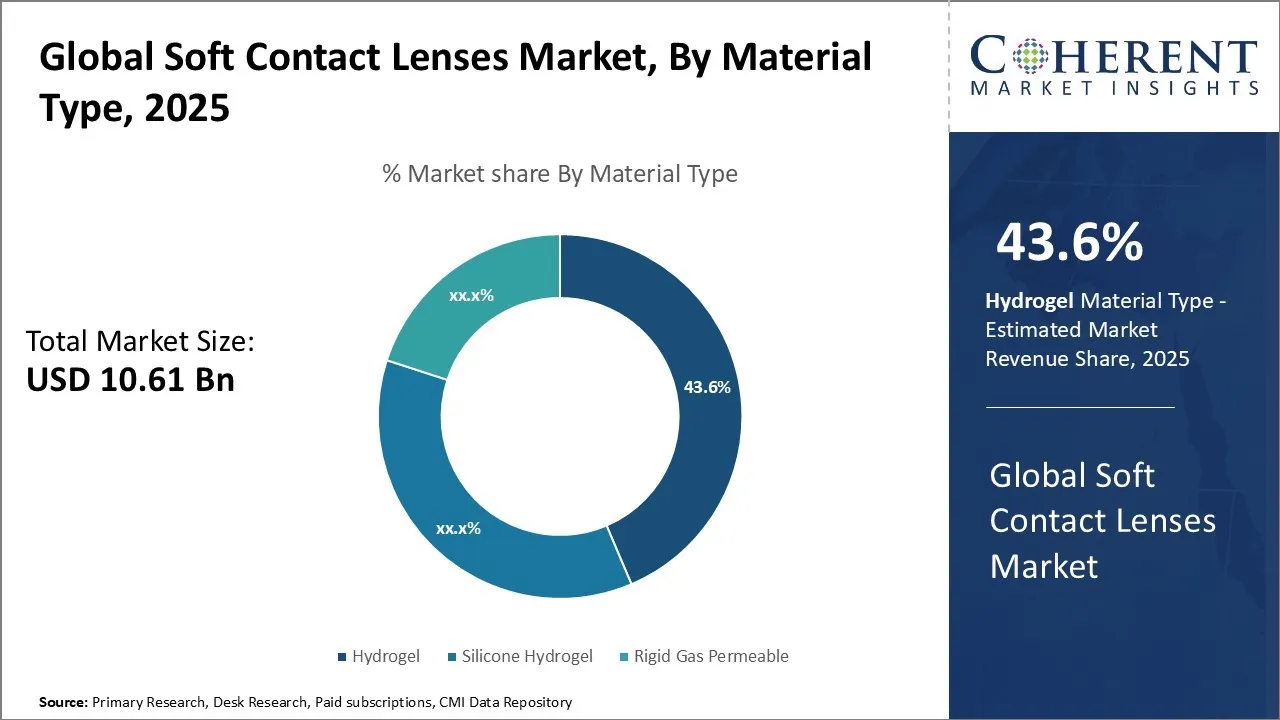
- By material type, the hydrogel segment is projected to hold the largest share of the global soft contact lenses market in 2026, accounting for 44.6%, driven by its comfort and safety features.
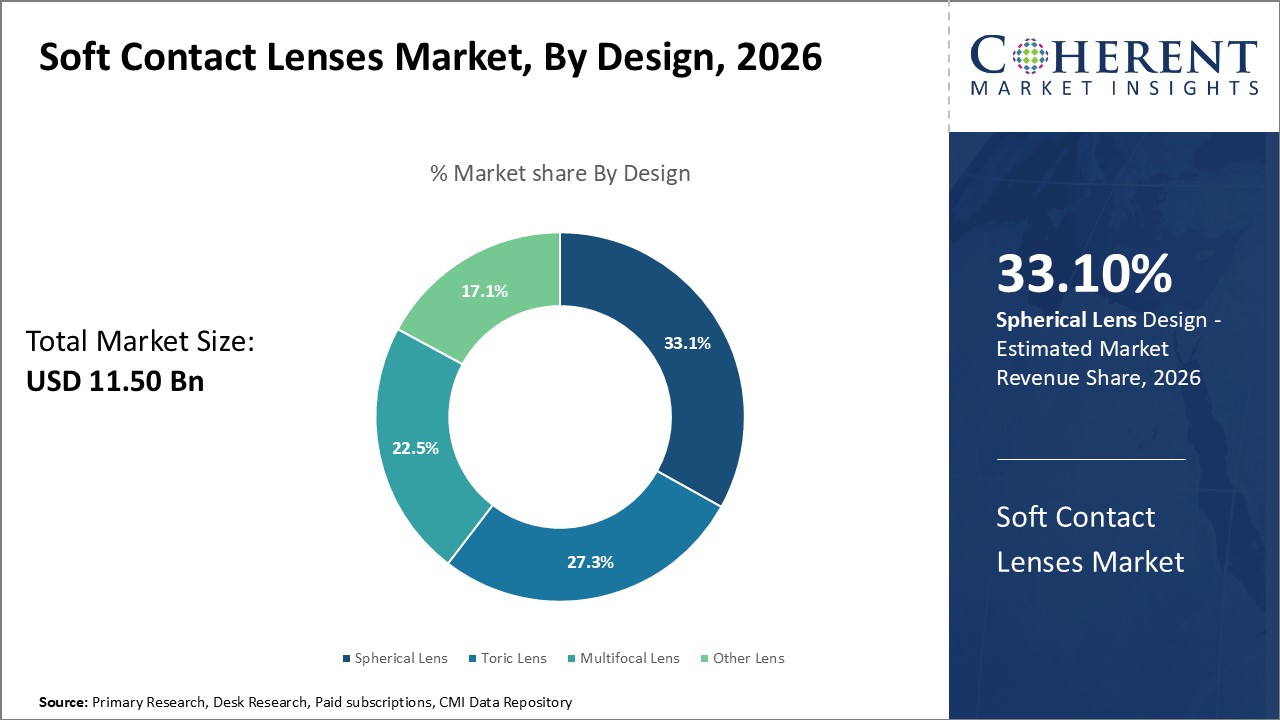
- By design, the spherical lens segment is expected to dominate, contributing 33.1% of the market share in 2026, due to their effectiveness in correcting common vision problems.
- By age group, the children segment is anticipated to represent the largest user group, with a 43.1% market share in 2026, attributed to the ease and convenience soft lenses offer for active lifestyles.
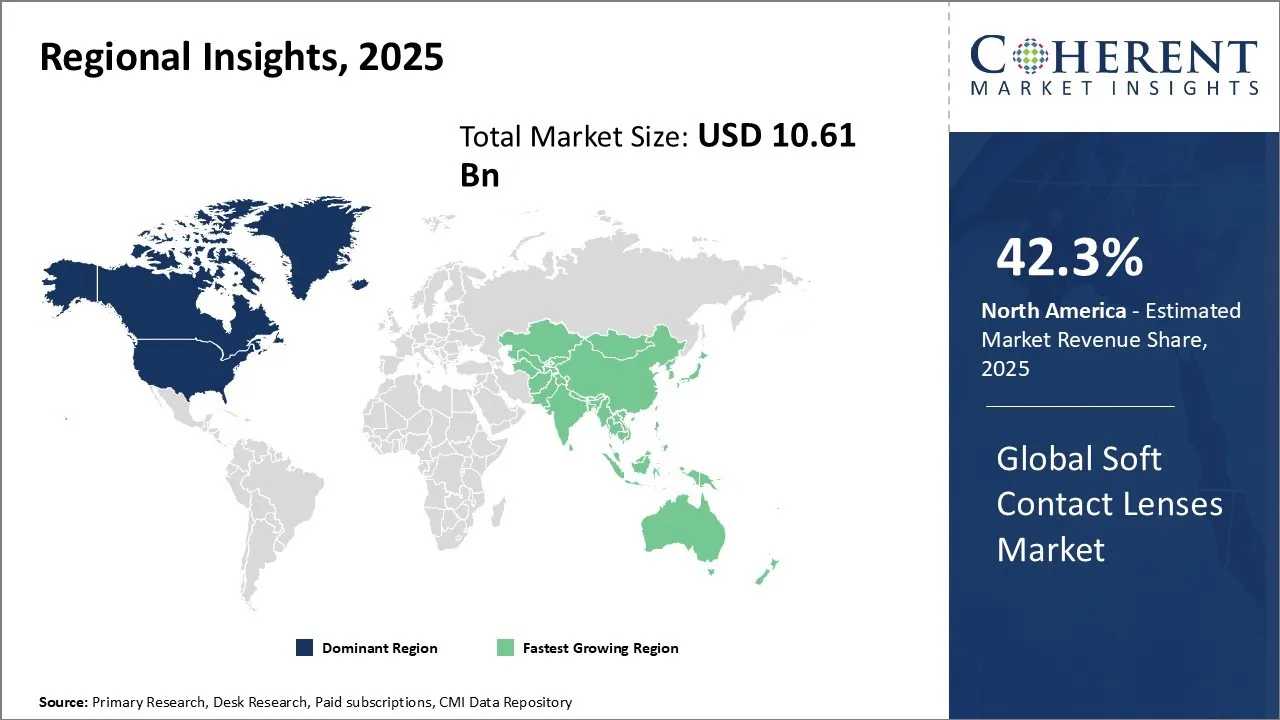
- By region, North America is expected to lead the market with a 42.3% share in 2026, while Asia Pacific is projected to be the fastest-growing region, capturing 32.4% of the market share in 2026.
Market Overview:
The global soft contact lenses market is witnessing positive trends with growing demand amongst youth and working population. Rise in usage of technologically advanced lenses along with rise in disposable income levels in developing regions is also fueling market growth. Increased focus of manufacturers on product innovation and launch of new advanced lenses is further supporting the market expansion.
Currents Events and Their Impact
Current Events | Description and its impact |
Shift Towards Daily Disposable Lenses |
|
Introduction of Smart Contact Lenses |
|
Segmental Analysis
- Current Industry Events of 2026
- Market Size Estimation
- Regional Breakdown
- Competitive Landscape
- Customer Intelligence
- Segmental Analysis
- Pricing Analysis
- Key Market Drivers, Challenges & Future Trends
- Customized Insights Section
Soft Contact Lenses Market Insights, By Material Type - Convenience and Safety Drive the Demand for Hydrogel Contact Lenses
In terms of material type, the hydrogel segment is expected to contribute the highest share of the global soft contact lenses market with 44.6% in 2026 owing to its comfort and safe nature. Hydrogel lenses are made from a material that is over 90% water, making them extremely breathable and comfortable for extended wear. Their high-water content allows oxygen to pass through the lens much like regular eyeglass lenses, providing the eye with healthy levels of oxygen. This property reduces the risk of eye irritation, itchy eyes, and other common issues associated with conventional silicone hydrogel and rigid gas permeable lenses.
Hydrogel lenses are also gentle on eyes. They flex easily with eye movement and do not cause friction, as can be the case with stiffer alternatives. This makes them suitable for both daily and extended wear use. Their thin and lightweight nature enhances wearing comfort.
Soft Contact Lenses Market Insights, By Design - Precise Vision Drives the Demand for Spherical Contact Lenses
In terms of design, the spherical lens segment is expected to contribute the highest share of the global soft contact lenses market with 33.1% in 2026 owing to their ability to effectively correct common vision issues. Spherical lenses are the most basic and widely prescribed contact lenses. They are effective for treating myopia (near-sightedness), hyperopia (farsightedness), or mixed nearsighted-farsighted astigmatism of mild to moderate degrees.
Spherical lenses have a single curve on the front surface to help focus all light onto the retina. This single-vision design precisely corrects the majority of common refractive errors. Spherical lenses can be worn comfortably for extended periods and provide clear, natural quality vision at any distance. Their simple yet effective design meets the vision correction needs of a large population worldwide suffering from mild to moderate eyesight issues.
Soft Contact Lenses Market Insights, By Age Group - Convenience Drives Demand Among Children
In terms of age group, the children segment is expected to contribute the highest share of the global soft contact lenses market with 43.1% in 2026 due to the convenience they offer for active lifestyles. Contact lenses are a preferable vision correction solution for children compared to eyeglasses as they do not interfere with sports, extracurricular activities or simply running around and playing. Lenses are also less prone to getting lost, damaged, or broken during energetic play unlike eyeglasses.
Contact lenses allow children to enjoy an unrestricted range of vision without limits. They empower kids to participate confidently in Physical Education classes and after-school sports. Lenses are preferred by many families and school administrations alike as they reduce injuries and accidents that can occur from broken or lost eyewear during active periods.
Pricing Analysis on Global Soft Contact Lenses Market:
The global soft contact lenses market shows a wide pricing range, largely influenced by lens type and user needs. Daily disposables cost approximately USD600–USD900 per year, while biweekly lenses range from USD270–USD450 annually, and monthly lenses from USD180–USD300 annually. Specialized lenses, such as those for astigmatism and presbyopia, are priced higher at around USD300–USD800 per year. Colored soft lenses can reach up to USD1,000 annually. Overall, daily lenses are the most expensive due to convenience, while monthly lenses offer more economical options. Pricing trends reflect growing demand for comfort, customization, and advanced material technologies.
Regional Insights
North America Soft Contact Lenses Market Analysis and Trends
North America is projected to be the dominant region in the global soft contact lenses market in 2026, capturing a significant 42.3% market share. This leadership is attributed to the region’s advanced healthcare infrastructure, high rate of vision correction adoption, and strong presence of leading contact lens manufacturers. Additionally, increasing awareness about eye health and access to innovative lens technologies further reinforce North America’s prominent position in the market.
Asia Pacific Soft Contact Lenses Market Analysis & Trends
Asia Pacific is expected to be the fastest-growing region in the soft contact lenses market with a share of 32.4% in 2026, driven by increasing awareness about vision correction, rising eye health concerns, and a growing population with changing lifestyle habits. The region benefits from expanding access to eye care services, rapid urbanization, and evolving consumer preferences, especially among younger demographics. Additionally, the adoption of digital technologies and online retail platforms is further accelerating market growth across key countries in the region.
Market Outlook for Key Countries
U.S. Soft Contact Lenses Market Trends
The U.S. market for soft contact lenses is driven by increasing awareness about vision health and the prevalence of refractive errors. For instance, according to the Centers for Disease Control and Prevention (CDC), in May 2024, in the U.S., around 12 million people aged 40 and above had vision impairment, including 1 million who are blind. Vision issues are rising due to an aging population and chronic conditions like diabetes. Among children, 6.8% have diagnosed eye conditions, with nearly 3% experiencing vision impairment.
Germany Soft Contact Lenses Market Trends
Germany contacts lenses market is shaped by the growing burden of myopia, aligning with broader European trends where prevalence rates are notably high—especially among young adults. According to report by National Library of Medicine in March 2021, Myopia affects a significant portion of the population, particularly in the 25–29 age group, driving increased demand for vision correction solutions like contact lenses. While the prevalence of high myopia remains comparatively low, the rising need for effective and convenient vision correction is fueling the adoption of soft and specialty contact lenses.
India Soft Contact Lenses Market Trends
India soft contact lenses market is experiencing rapid growth, fueled by urbanization, evolving lifestyles, and a rising incidence of myopia, especially among children and young adults. While the market remains highly price-sensitive, there is a growing preference for quality and reliable products. Affordability and accessibility continue to be key growth drivers, prompting companies to offer cost-effective yet high-performance lens options. For instance, in March 2024, Alcon, an eye care device company, strengthened its footprint in the Indian eye care sector with the launch of its Clareon intraocular lenses, further enhancing its market presence.
Canada Soft Contact Lenses Market Trends
The soft contact lenses market in Canada is experiencing steady growth, fueled by the rising prevalence of myopia, growing preference for daily disposable lenses, and advancements in multifocal and toric lens technologies. Demand for silicone hydrogel lenses is on the rise due to their superior comfort and oxygen permeability. Moreover, the expansion of e-commerce and subscription-based services is improving accessibility. Supportive regulatory frameworks from Health Canada promote both product safety and innovation, while increasing awareness about eye health continues to drive market development.
Market Players, Key Developments, and Competitive Intelligence
Key Developments:
- In June 2024, Kits Eyecare Ltd., an eyecare provider, launched its affordable KITS Daily Silicone Hydrogel contact lenses, priced at USD 28 for a 30-pack—significantly below market rates. Made from third-generation silicone hydrogel, these lenses offer high oxygen permeability for enhanced comfort. With silicone hydrogel lenses dominating the contact lens market, KITS plans to expand its product line further to meet growing demand.
- In February 2023, Alcon, a global leader in eye care, launched TOTAL30 and DAILIES TOTAL1 for Astigmatism in Canada, expanding its toric lens offerings. With toric lenses being the fastest-growing segment in the contact lens market and only 10% of the 47% of patients needing astigmatic correction actually wearing them, this launch presents a significant opportunity.
- In January 2023, CooperVision, Inc., a global leader in soft contact lenses, acquired SynergEyes, Inc., a company known for its specialty hybrid lenses. This acquisition strengthened CooperVision’s product portfolio, particularly enhancing its Onefit scleral lenses for patients with complex vision needs.
- In August 2022, Bausch + Lomb, a global healthcare company, launched Revive, a new line of customizable soft contact lenses available in spherical, toric, multifocal, and multifocal toric options. Made from a non-ionic material that resists protein deposits, Revive lenses offer up to three months of daily wear. Customizable features include lens diameter, base curve, and power. The toric versions use “dual elliptical stabilization” for improved orientation and stability, while multifocal lenses feature adjustable near-zone diameters to suit individual patient needs.
Top Strategies Followed by Global Soft Contact Lenses Market Players
- Established players in the global soft contact lenses market focus heavily on research and development to drive innovation. Manufacturers like Johnson & Johnson and Bausch & Lomb invest in greater percentage of annual revenue into R&D. This allows them to continuously launch new products with improved features like better comfort, enhanced vision correction, and advancements in material science. Leading companies also form strategic partnerships to expand their capabilities. For example, CooperVision has partnerships with optometry practices and independent eye care professionals to distribute products and educate customers.
- Mid-sized companies look to cost-effective solutions as a key strategy. Brands such as Alcon and Essilor offer quality daily and two-week lenses that are priced 20-30% lower than premium options. This allows them to target price-sensitive consumers, especially in emerging markets.
- For instance, in March 2024, Menicon, a leading Japan-based contact lens manufacturer, announced plans to develop advanced materials aimed at recycling plastic waste and enhancing sustainability in lens production. Alongside this initiative, there is growing demand in Japan for lenses designed to reduce digital eye strain due to increased screen time. Additionally, colored and cosmetic contact lenses are becoming increasingly popular among consumers.
- Small players in the global soft contact lenses market are leveraging niche innovations and agility to compete with established brands. Key strategies include focusing on technological differentiation, such as smart contact lenses with augmented reality features, as seen with startups like XPANCEO.
- For instance, in October 2023, XPANCEO, a deep tech startup focused on wearable technology innovation, raised USD 40 million in a seed funding round led by Opportunity Ventures (Asia Pacific). The funds will support the development of augmented reality (AR) contact lenses, integrating multiple features into a single prototype aimed at redefining the future of smart eyewear.
Market Report Scope
Soft Contact Lenses Market Report Coverage
| Report Coverage | Details | ||
|---|---|---|---|
| Base Year: | 2025 | Market Size in 2026: | USD 11.50 Bn |
| Historical Data for: | 2020 To 2024 | Forecast Period: | 2026 To 2033 |
| Forecast Period 2026 to 2033 CAGR: | 8.3% | 2033 Value Projection: | USD 20.03 Bn |
| Geographies covered: |
| ||
| Segments covered: |
| ||
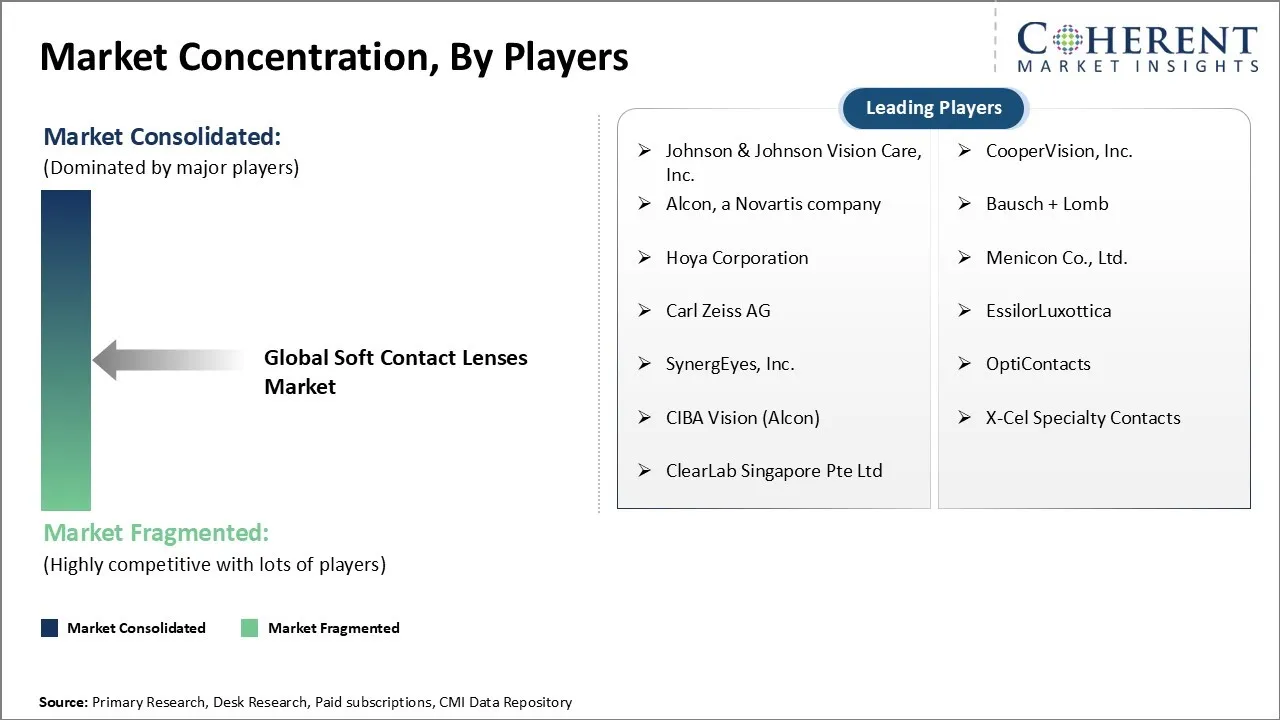
| Companies covered: | Johnson & Johnson Vision Care, Inc., CooperVision, Inc., Alcon, a Novartis company, Bausch + Lomb, Hoya Corporation, Menicon Co., Ltd., Carl Zeiss AG, EssilorLuxottica, SynergEyes, Inc., OptiContacts, CIBA Vision (Alcon), X-Cel Specialty Contacts, and ClearLab Singapore Pte Ltd | ||
| Growth Drivers: |
| ||
| Restraints & Challenges: |
| ||
Soft Contact Lenses Market Dynamics
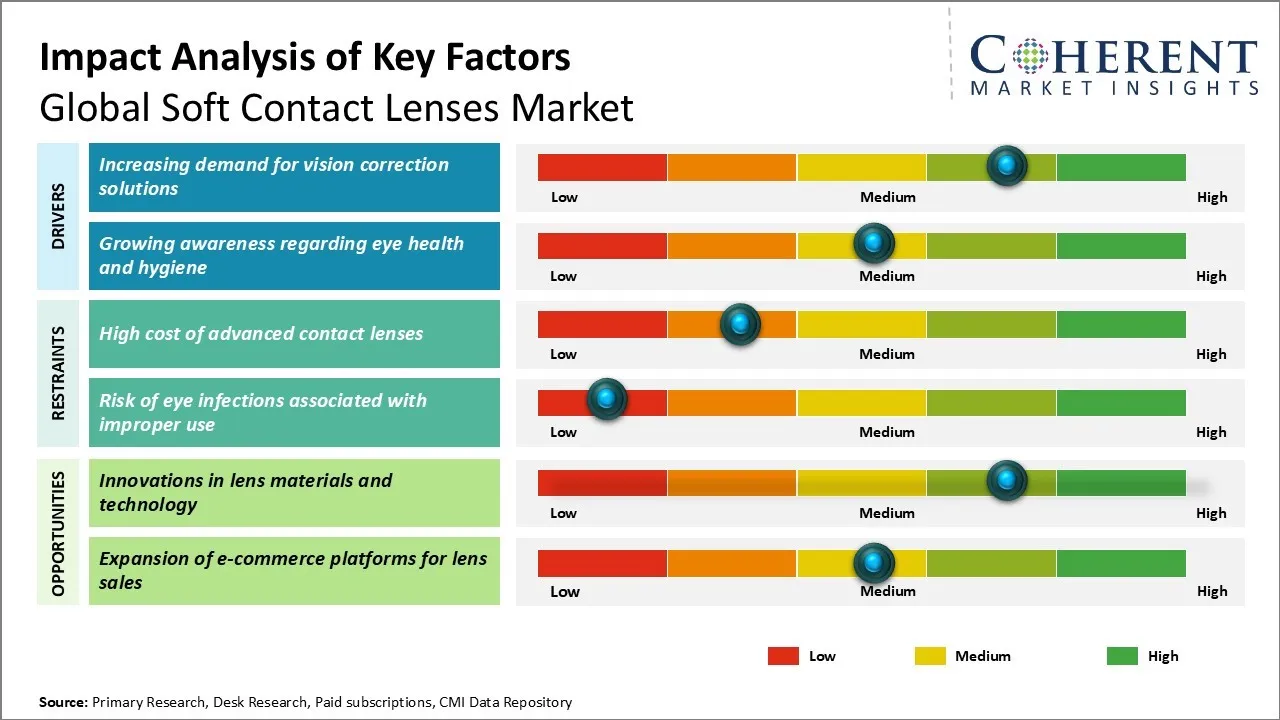
Soft Contact Lenses Market Driver - Increasing Demand for Vision Correction Solutions
There is a growing demand of vision correction solutions across the globe due to the rising prevalence of vision related issues such as short-sightedness and long-sightedness. Soft contact lenses have emerged as a popular and preferred choice among people for correcting refractive errors as compared to traditional vision correction methods like spectacles and hard contact lenses. Soft contact lenses provide better vision, comfort and are more convenient to use on a daily basis. Moreover, increasing awareness about the various vision correction options available and the need for a normal lifestyle without dependence on spectacles is driving more people to adopt soft contact lenses.
According to WHO reports published in August 2023, more than 2.2 billion people worldwide suffer from near or distance vision impairment, with at least 1 billion cases being preventable or left untreated. The main global causes of vision loss are refractive errors and cataracts. However, only 36% of those with distance vision impairment due to refractive error and 17% with cataract-related vision loss have received appropriate treatment. Vision impairment affects all age groups but is most common in people over 50. It also imposes a heavy financial burden, with global productivity losses estimated at USD 411 billion annually.
Soft Contact Lenses Market Opportunity - Innovations in Lens Materials and Technology
The global soft contact lenses market is benefiting significantly from ongoing innovations in lens materials and technologies. Continuous R&D efforts are expanding possibilities for design and application of soft lenses. Advanced biocompatible materials with enhanced oxygen permeability are allowing daily and extended wear lenses with improved comfort. New lens designs are addressing previously untreatable vision conditions like astigmatism through toric lenses. Advances are also being made in developing lenses that not only correct refractive errors but also slowdown myopia progression in children. Such innovations are expanding the addressable market scope and fueling demand. If successful, they have potential to shift existing paradigms and bring about new growth opportunities in the soft contact lenses industry.
Analyst Opinion (Expert Opinion)
- The global soft contact lenses market is experiencing robust growth driven by increasing demand for vision correction solutions and a growing awareness of eye health. The rising prevalence of myopia and presbyopia, particularly among younger populations, is fueling the adoption of soft contact lenses. Additionally, innovations in lens technology, such as improved materials and enhanced comfort features, are attracting consumers.
- However, the market faces challenges, including high costs associated with advanced lens types and potential risks of eye infections linked to improper usage. Regulatory barriers also pose difficulties, as companies must navigate stringent approval processes for new products.
- Emerging opportunities lie in the development of specialized lenses, such as those designed for dry eyes and extended wear. The expansion of e-commerce platforms presents another avenue for growth, enabling wider accessibility for consumers. Furthermore, supportive government initiatives promoting eye health awareness and regular eye examinations are likely to bolster market growth.
- As the industry evolves, companies must focus on innovation and consumer education to address challenges and leverage opportunities in this dynamic market landscape. Overall, the future of the soft contact lenses market appears promising, with significant potential for advancements and growth.
Speak to the analyst
Want personalized insights?
Take the findings above to one of our principal consultants, or have the report rebuilt around the segments, geographies and competitors you actually track.
Sources
Primary Research Interviews:
- Industry Stakeholders:
- Manufacturers
- Suppliers of Raw Materials
- Technology Providers
- End users
- Optometrists and Eye Care Professionals
- Retailers and Distributors
- Consumers
Databases:
- Biospace
- Others
Magazines:
- Contact Lens Spectrum
- Vision Monday
- Optometry Times
- Contact Lens & Anterior Eye
- Eye Care & Contact Lens Review
Journals:
- The Eye & Contact Lens Journal
- Cornea
- British Journal of Ophthalmology
- International Contact Lens Journal
- Journal of Optometry & Vision Science
Associations:
- Contact Lens Manufacturers Association (CLMA)
- International Association of Contact Lens Educators (IACLE)
- American Optometric Association (AOA)
- European Society of Contact Lens Research (ESCLR)
- Contact Lens Society of America (CLSA)
Public Domain Sources:
- World Health Organization (WHO)
- U.S. Food and Drug Administration (FDA)
- European Medicines Agency (EMA)
- Centers for Disease Control and Prevention (CDC)
- National Institutes of Health (NIH)
Proprietary Elements:
- CMI Data Analytics Tool: Proprietary analytics tool to analyze real-time market trends, consumer behavior, and technology adoption in dark factories.
- Proprietary CMI Existing Repository of Information for Last 8 Years
Market Segmentation
- Material Type Insights (Revenue, USD Bn, 2020 - 2032)
- Hydrogel
- Silicone Hydrogel
- Rigid Gas Permeable
- Design Insights (Revenue, USD Bn, 2020 - 2032)
- Spherical Lens
- Toric Lens
- Multifocal Lens
- Other Lens
- Age Group Insights (Revenue, USD Bn, 2020 - 2032)
- Children
- Adult
- Seniors
- Product Type Insights (Revenue, USD Bn, 2020 - 2032)
- Daily Disposable
- Bi-Weekly Disposable
- Monthly Disposable
- Extended Wear
- Distribution Channel Insights (Revenue, USD Bn, 2020 - 2032)
- Online Retail
- Offline Retail
- Application Insights (Revenue, USD Bn, 2020 - 2032)
- Corrective
- Therapeutic
- Cosmetic
- Prosthetic
- Lifestyle-oriented
- Regional Insights (Revenue, USD Bn, 2020 - 2032)
- North America
- U.S.
- Canada
- Latin America
- Brazil
- Argentina
- Mexico
- Rest of Latin America
- Europe
- Germany
- U.K.
- Spain
- France
- Italy
- Russia
- Rest of Europe
- Asia Pacific
- China
- India
- Japan
- Australia
- South Korea
- ASEAN
- Rest of Asia Pacific
- Middle East
- GCC Countries
- Israel
- Rest of Middle East
- Africa
- South Africa
- North Africa
- Central Africa
- North America
- Key Players Insights
- Johnson & Johnson Vision Care, Inc.
- CooperVision, Inc.
- Alcon, a Novartis company
- Bausch + Lomb
- Hoya Corporation
- Menicon Co., Ltd.
- Carl Zeiss AG
- EssilorLuxottica
- SynergEyes, Inc.
- OptiContacts
- CIBA Vision (Alcon)
- X-Cel Specialty Contacts
- ClearLab Singapore Pte Ltd
Get access to 250+ pages report
Every segment, forecast, competitor profile and data table behind the analysis above — available for instant download.
- ESOMAR Member
- ISO 9001:2015 Certified
- D-U-N-S Registered
- GDPR & CCPA Compliant
Missing comfort of reading report in your local language? Find your preferred language:
Transform your Strategy with Exclusive Trending Reports
Frequently Asked Questions
The global soft contact lenses market is estimated to be valued at USD 10.61 Bn in 2025 and is expected to reach USD 18.27 Bn by 2032.
The CAGR of global soft contact lenses market is projected to be 8.07% from 2025 to 2032.
Increasing demand for vision correction solutions and growing awareness regarding eye health and hygiene are the major factors driving the growth of the global soft contact lenses market.
High cost of advanced contact lenses and risk of eye infections associated with improper use are the major factors hampering the growth of the global soft contact lenses market.
In terms of material type, the hydrogel segment is estimated to dominate the market revenue share in 2025.
Johnson & Johnson Vision Care, Inc., CooperVision, Inc., Alcon, a Novartis company, Bausch + Lomb, Hoya Corporation, Menicon Co., Ltd., Carl Zeiss AG, EssilorLuxottica, SynergEyes, Inc., OptiContacts, CIBA Vision (Alcon), X-Cel Specialty Contacts, and ClearLab Singapore Pte Ltd are the major players.
North America is expected to lead the global soft contact lenses market in 2025.