

Global Space Battery Market Size and Forecast – 2026-2033
The global space battery market is estimated to be valued at USD 4.68 Bn in 2026 and is expected to reach USD 7.76 Bn by 2033, exhibiting a compound annual growth rate (CAGR) of 7.5% from 2026 to 2033.
Key Takeaways of the Space Battery Market
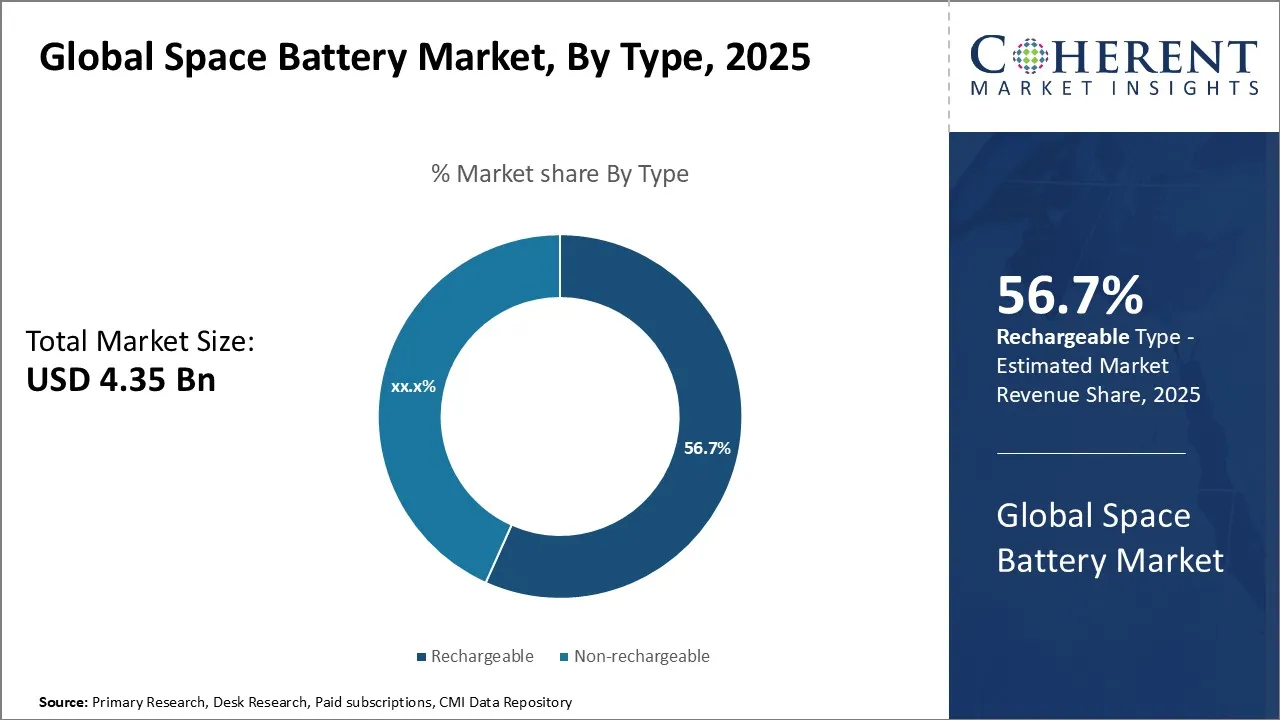
- The rechargeable segment is expected to capture 57.7% of the market share in 2026.
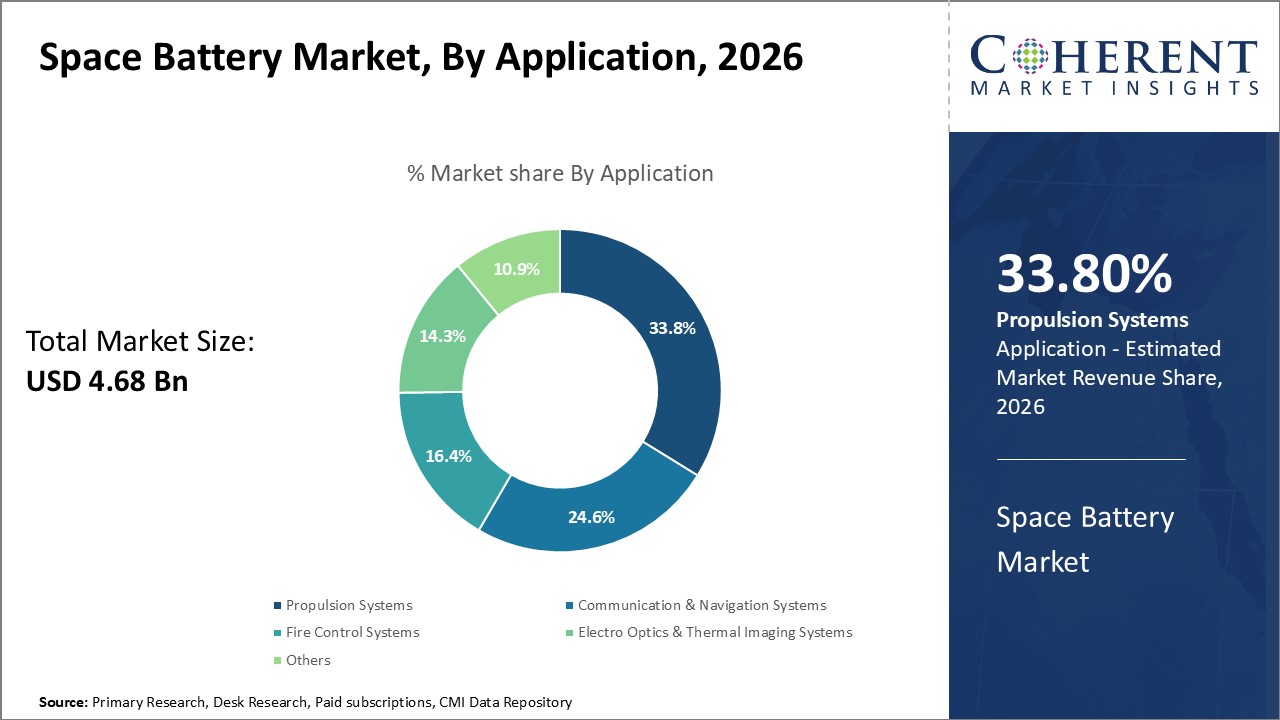
- The propulsion systems segment is projected to account for 33.8% of the market share in 2026.
- The aviation segment is expected to dominate the market with 28.8% share in 2026.
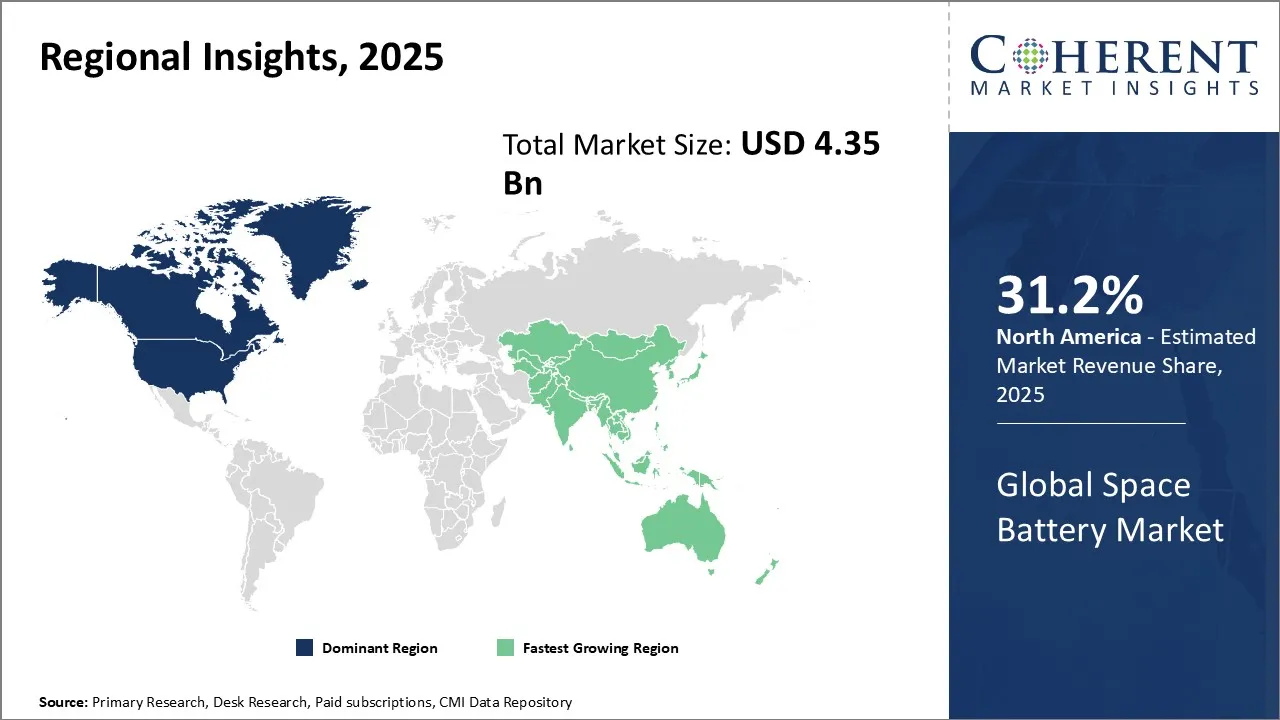
- The North America is set to be led space battery market in 2026 with a 31.2% share. The Asia Pacific region, with a 22.5% share, will emerge as the fastest-growing market.
Market Overview
Market trends indicate a significant shift towards high-energy-density and long-life batteries, such as lithium-ion and solid-state technologies, to support extended missions and harsh space environments. Additionally, the rise of small satellites (small sats) and mega-constellations is fueling the need for compact, efficient, and lightweight batteries. Furthermore, partnerships between aerospace companies and battery manufacturers are accelerating innovation, enhancing performance, and reducing costs in the space battery sector.
Current Events and Its Impact
Current Events | Description and its Impact |
Waaree Energies' USD 36.1 Mn Investment in Battery Cell Plant |
|
CATL's Support for European EV Battery Start-Ups Amidst Geopolitical Tensions |
|
Segmental Insights
- Current Industry Events of 2026
- Market Size Estimation
- Regional Breakdown
- Competitive Landscape
- Customer Intelligence
- Segmental Analysis
- Pricing Analysis
- Key Market Drivers, Challenges & Future Trends
- Customized Insights Section
Space Battery Market Insights, by Type – Rechargeable Segment Dominates the Market due to its Superior Efficiency and Sustainability Benefits
The rechargeable segment is projected to hold 57.7% of the market share in 2026, driven by their enhanced performance characteristics and adaptability, which are crucial for the demanding conditions of space missions. Rechargeable batteries, including lithium-ion and nickel hydrogen, have a major benefit with regard to longevity and energy density when compared to non-rechargeable alternatives. This has seen them used in preference in long duration space applications where weight reduction and power efficiency are critical.
For instance, the use of lithium-ion rechargeable batteries in NASA's Mars Perseverance rover mission exemplifies the preference for rechargeable technology. These batteries have been instrumental in providing the rover with consistent power throughout its mission, ensuring long-term operational capability for more than a year on the surface of Mars. This application underscores the importance of rechargeable batteries in powering space exploration vehicles and equipment.
Space Battery Market Insights, by Application - Propulsion Systems Segment Dominates the Market due to the Critical Demand for Reliable, High-Capacity Energy Sources in Spacecraft Mobility
The propulsion systems segment is expected to capture 33.8% share in 2026, due to the fact that propulsion requires high performance and reliable sources of power that can support the continuous thrust and maneuvers. Electric propulsion systems, e.g., ion thrusters, Hall effect thrusters, use energy-dense batteries to make sure spacecrafts are able to move efficiently and keep the orbital positions, which is of the essence to mission success.
Propulsion is the most critical aspect of launch, in-orbit corrections, and landing, which explains the need to have batteries that do not only produce high energy but should also discharge rapidly without undermining safety and reliability. Propulsion systems require batteries that must work flawlessly in extreme loading conditions and therefore the engineering of the battery is meticulous in dealing with the thermal and electrical stresses.
Space Battery Market Insights, by Platform – Aviation Segment Dominates the Market Driven by the Increasing Demand for Efficient Power Solutions in Aerospace Missions
The aviation segment is projected to account for 28.8% of the market share in 2026, provided by the high demand of high reliability sources of power in aerospace and space-bounded vehicles. The aviation sector requires aircraft and spacecraft with batteries that can withstand high flight conditions, which involve fast changes in temperature, high vibration and high safety of operation.
The rise in the use of electric and hybrid propulsion systems in commercial and military aerospace is also among the key factors driving the popularity of aviation. These systems place a lot of reliance on rechargeable and high density batteries in order to provide efficient and sustainable power to support takeoff, cruising, and landing processes. Moreover, the next-generation electric vertical takeoff and landing vehicles that are currently becoming popular in the context of urban air mobility also drive the need to develop advanced battery technology to a considerable extent.
Regional Insights
North America Space Battery Market Analysis and Trends
The North America region is projected to lead the market with a 31.2% share in 2026, driven by a robust aerospace and defense ecosystem, extensive government investment in space exploration, and a strong presence of leading battery manufacturers. As a world leader in space technologies, the U.S. can rely on the support of such agencies as NASA and the Department of Defense which invest in the development of innovative technologies of space-grade power sources.
The mature industry philosophy has companies like EaglePicher Technologies and Saft America who bring in lithium-ion and primary battery technology innovation aimed at sustaining in the harsh environment of space. The trade relations benefit the dominance of North America because of strategic alliances and cooperation with the private space companies such as SpaceX and Boeing which also support the market leadership.
Asia Pacific Space Battery Market Analysis and Trends
The Asia Pacific region is expected to exhibit the fastest growth in the market contributing 22.5% share in 2026, due to accelerated innovation in technology, higher statistical government expenditures in space missions, and increased involvement of the players. The countries such as China and India are increasing their satellite missions and deep space missions, which are increasing demands of high performance and reliable battery solutions.
The local market is enjoying the fact that there are more local manufacturers and with the efforts by the government to improve the indigenous capabilities in the aerospace components, the regional market is gaining. Other key stores such as Chinas Contemporary Amperex Technology Co. Limited (CATL) and Indias Bharat Electronics Limited (BEL) have done much in terms of coming up with space-qualified battery systems. Moreover, trade accords and increasing export of aerospace parts in the region has enhanced the market position and upward growth of the Asia Pacific’s.
Global Space Battery Market Outlook for Key Countries
U.S. Space Battery Market Analysis and Trends
The market of the U.S. space batteries is supported by a well-developed aerospace industry and by a solid state of the governmental support, and the current missions to the space by NASA stimulating the necessity to use the latest battery technologies. Other companies such as EaglePicher Technologies and Northrop Grumman are in the business of lithium primary and rechargeable batteries adapted to satellite uses and space exploration. This fact is supplemented by the existence of businesses in the commercial space, like SpaceX, which increases demand even more, thus promoting constant innovation and growth in the market of the United States.
China Space Battery Market Analysis and Trends
China space battery market has surged due to its ambitious space programs led by the China National Space Administration (CNSA). Major domestic manufacturers such as CATL and CALB (China Aviation Lithium Battery Co.) are instrumental in developing batteries capable of enduring extreme space conditions. China’s strategic focus on self-reliance and technological advancement supports local industry growth, while successful satellite launches and lunar missions have heightened the demand for advanced battery systems.
India Space Battery Market Analysis and Trends
India continues to lead with its expanding space ambitions under the Indian Space Research Organization (ISRO), which has intensified efforts in lunar and interplanetary missions. Local industry contributors like Bharat Electronics Limited (BEL) and Exide Industries focus on manufacturing high-efficiency space batteries essential for mission-critical applications. Government policies promoting space research and increased collaboration with private enterprises are pivotal in driving innovation and growing the market domestically.
Japan Space Battery Market Analysis and Trends
Japan space battery market benefits from its well-established electronics industry and advanced technological infrastructure. Companies such as GS Yuasa Corporation and Panasonic have long been involved in producing reliable batteries for space applications, including satellites and deep-space probes. Government support through the Japan Aerospace Exploration Agency (JAXA), coupled with participation in international space missions, reinforces Japan’s position as a key player in the space battery market.
Macro and Micro Economic Factors Impacting on Space Battery Market Growth
Macroeconomic Factors
- Government Space Programs and Budgets: Increased funding for national space programs in the U.S., China, Europe, and India boosts demand for advanced, reliable batteries for satellites, probes, space stations, and launch vehicles.
- Global Economic Stability: Stable global economic environments sustain long-term investments in space exploration and private satellite deployment, positively impacting battery market growth.
- Strategic Defense Initiatives: Space batteries support military and security satellite networks, and shifting defense priorities among major economies drive R&D investment in battery resilience and energy density.
- Emerging Private Space Sector: The ongoing commercialization of space by companies like SpaceX, Blue Origin, and satellite telecom providers drives competition, with a direct impact on the market for high-performance batteries.
- International Collaboration and Regulatory Climate: Treaties and international cooperation on space missions can foster technology sharing and market access, while export controls and satellite launch regulations may restrict market entry for some companies.
Microeconomic Factors
- Advanced Battery Chemistry Innovation: Rapid R&D on lithium-ion, lithium-polymer, solid-state, and silver-zinc batteries enhances energy density, safety, and cycle life, which is critical for missions spanning years without maintenance.
- Product Differentiation: Space battery manufacturers compete on cycle life, weight, radiation tolerance, and performance in extreme conditions, influencing purchasing decisions of satellite builders and mission planners.
- Supplier Ecosystem: The market depends on a specialized supply chain for rare materials (e.g., lithium, cobalt, silver), custom cells, and aerospace certifications, affecting segment competitiveness and pricing.
Market Players, Key Development, and Competitive Intelligence
Key Development
- On September 25, 2025, Orano and Zeno Power are in a major agreement to utilize space batteries by using recycled nuclear material. According to this arrangement, U.S.-based Zeno Power will invest in the multi-million dollars in order to gain privilege access to americium-241 materials produced by Oranos La Hague recycling plant in France. The collaboration between NASA and Zeno Power is the development of radioisotope power systems that are fuelled by americium-241 that is planned to serve lunar rovers, landers and future infrastructure installation on the moon.
Top Strategies Followed by Global Space Battery Market Players
- The existing market leaders normally put a lot of investments in research and development to ensure innovation in their product so that they could be able to come up with high performance, durable, and efficient battery solutions that fit the harsh space mission requirements. Also, these established players are targeting global expansion, through intensifying and expanding the networks, which enables them to access emerging markets of space in Asia-Pacific, Latin America and the Middle East where more governments and the private sector are investing in space exploration and satellite technologies.
- An example is NASA and Lockheed Martin have cooperated in next generation battery technology such as advanced lithium-ion and solid-state batteries, which guarantee mission critical reliability to their space exploration programs.
- Mid-level players in the space battery market have slightly different strategy, in their quest to establish their niche by providing affordable and quality solutions in their functions in terms of battery. This will enable them to reach price-sensitive clients, such as academic institutions, smaller satellite manufacturers, and upcoming space agencies that aim at energy solutions that are reliable yet cost-effective. In an attempt to increase their competitiveness, mid-tier companies usually enter into business partnerships, relationships, and joint production dealings with technology providers as well as manufacturing experts.
- For example, Bluebird International offers low-priced lithium-ion batteries to new customers and institutions to provide low-cost energy solutions to small-scale satellite missions such as CubeSats. Such businesses usually engage in partnerships and joint ventures with bigger manufacturers and technological companies to augment on their products.
- Smaller space battery market actors are more likely to be niche players, with their niche potentially being a particular battery chemistry, a low-weight design, or mission-specific products like CubeSats or deep-space probes. To stay ahead of its competitors, these smaller companies often cash in on the latest and new technologies such as solid-state batteries, new nanomaterials or additive manufacturing process. Their swiftness enables them to innovate at a fast rate, and address certain customer needs that a larger player could have missed.
- For example, Orbital Systems that specializes in solid-state batteries in the CubeSats and other miniaturized spacecrafts. These batteries are characterized by increased energy density and higher durability and suit the small power, low-energy requirements of miniaturized satellites.
Market Report Scope
Space Battery Market Report Coverage
| Report Coverage | Details | ||
|---|---|---|---|
| Base Year: | 2025 | Market Size in 2026: | USD 4.68 Bn |
| Historical Data for: | 2020 To 2024 | Forecast Period: | 2026 To 2033 |
| Forecast Period 2026 to 2033 CAGR: | 7.5% | 2033 Value Projection: | USD 7.76 Bn |
| Geographies covered: |
| ||
| Segments covered: |
| ||
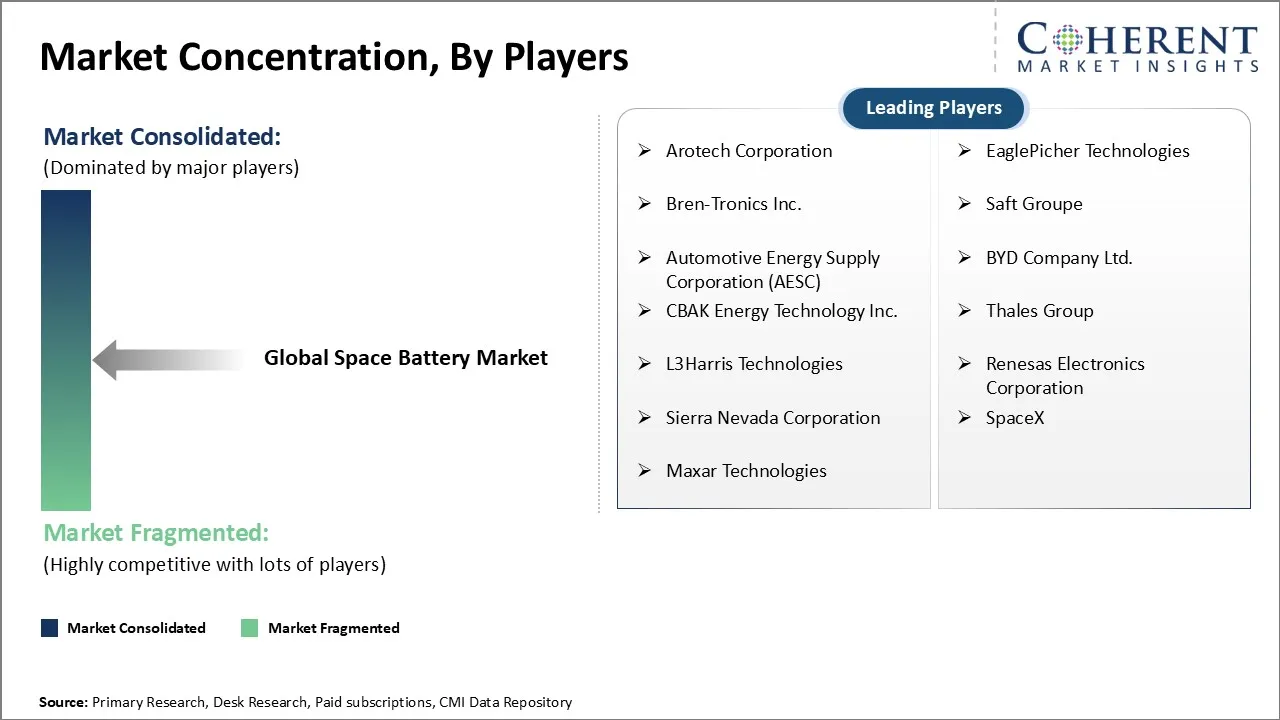
| Companies covered: | Arotech Corporation, EaglePicher Technologies, Bren-Tronics Inc., Saft Groupe, Automotive Energy Supply Corporation (AESC), BYD Company Ltd., CBAK Energy Technology Inc., Thales Group, L3Harris Technologies, Renesas Electronics Corporation, Sierra Nevada Corporation, SpaceX, and Maxar Technologies | ||
| Growth Drivers: |
| ||
| Restraints & Challenges: |
| ||
Space Battery Market Dynamics
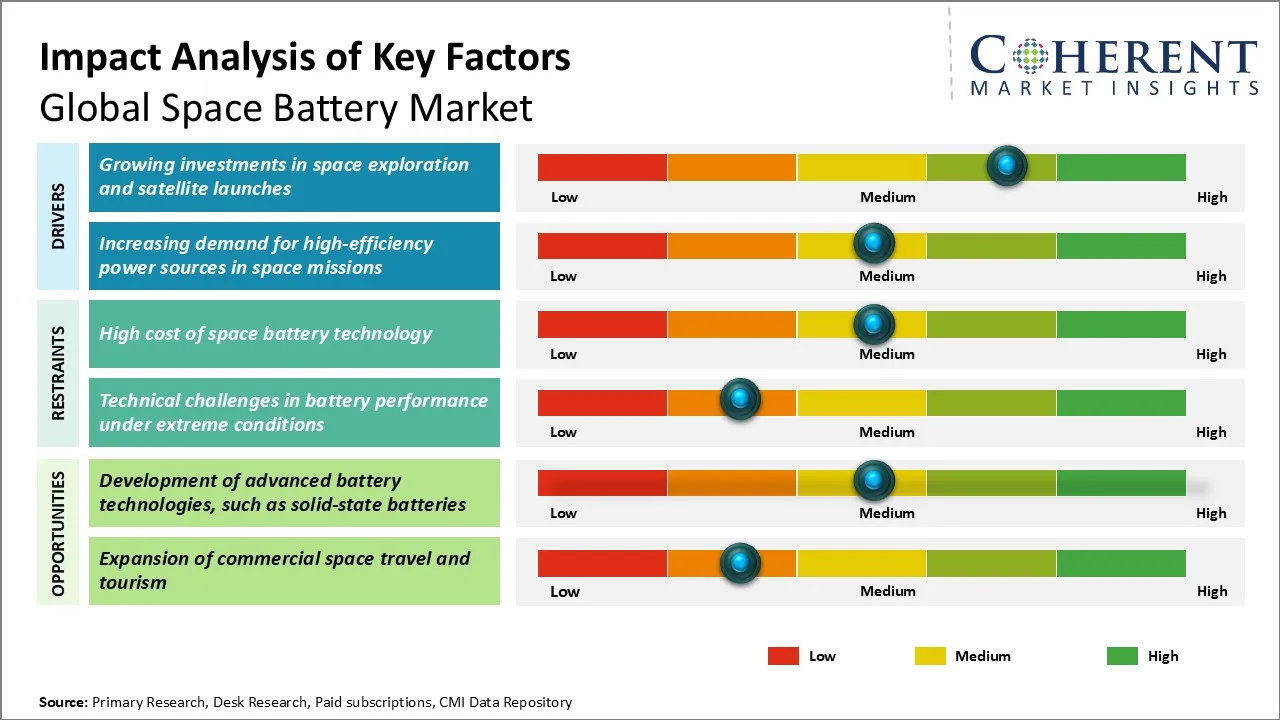
Space Battery Market Driver - Growing Investments in Space Exploration and Satellite Launches
The inflation in investments that are channeled towards space exploration and the launch of satellites is playing a great role in boosting the demand of advanced space batteries. However, with intensified efforts by governments, individual businesses, and multinational consortia to create lunar bases, interplanetary missions and satellite constellations to support communications, navigation and earth observation, the demand to create high-performance energy storage options and rely on them has become essential. Such missions to space also involve a type of battery that can be used in circumstances of extreme environmental limits as these missions require high temperatures, radiation, and also extended time without sunlight.
Indicatively, the Artemis program by NASAs which is to send human beings back to the Moon by the year 2025 demands space batteries that can withstand harsh lunar environments. Likewise, SpaceX and other small space corporations are launching the Starlink project wherein vast numbers of satellites are deployed into orbit, which means they need to have energy storage systems that can function effectively in the high-temperature, low-pressure conditions of low Earth orbit (LEO).
Space Battery Market Opportunity - Development of Advanced Battery Technologies, such as Solid-State Batteries
The global space battery market is a great opportunity as the advancement of a new generation of battery technology, especially solid-state battery, that could be a revolution of energy storage methods in the space field. Although conventional lithium-ion batteries are prevalent, they are limited with regard to energy density, safety, as well as longevity which is paramount in extreme conditions in space. Solid-state batteries with solid, rather than liquid, electrolytes are considered safer, as they do not have any flammable elements, and therefore, the possibility of thermal runaway is minimized, which is an essential factor in both manned and unmanned missions to space.
For example, lithium-ion batteries, which are practical on land, may fail in the harsh environment, such as in the vacuum of space and a wide range of temperatures, causing their degradation and, consequently, low life cycle and performance.
Analyst Opinion (Expert Opinion)
- The space battery market is about to witness a revolution in the world's market as the market requires more sophisticated energy products in the sphere of space exploration and satellite technology. The experience of the International Astronautical Congress (2023) and Space Battery Technology Conference (2022) put some insightful information forward, and such companies as NAS as Jet Propulsion Laboratory and Mitsubishi Electric are on the forefront of advancing battery technology.
- The latest development of lithium-sulfur batteries by NASA is pointing to the strategic move to greater energy densities and less weight, needed in deep-space missions. At these conferences it was noted that reliability and performance under extreme conditions was of the utmost importance and that sustainable practices in battery manufacturing are increasingly becoming important.
- It was observed that the challenges like high costs of research and development and the international cooperation to establish uniformity of technologies were the possible obstacles. The companies that are oriented at some innovative materials and recycling techniques will be likely to have a competitive advantage. Also, the partnerships with the aerospace agencies to implement new technologies into practice will be essential.
Speak to the analyst
Want personalized insights?
Take the findings above to one of our principal consultants, or have the report rebuilt around the segments, geographies and competitors you actually track.
Market Segmentation
- Type Insights (Revenue, USD Bn, 2021 - 2033)
- Rechargeable
- Non-rechargeable
- Application Insights (Revenue, USD Bn, 2021 - 2033)
- Propulsion Systems
- Communication & Navigation Systems
- Fire Control Systems
- Electro Optics & Thermal Imaging Systems
- Others
- Platform Insights (Revenue, USD Bn, 2021 - 2033)
- Aviation
- Land
- Marine
- Space
- Munitions
- Regional Insights (Revenue, USD Bn, 2021 - 2033)
- North America
- U.S.
- Canada
- Latin America
- Brazil
- Argentina
- Mexico
- Rest of Latin America
- Europe
- Germany
- U.K.
- Spain
- France
- Italy
- Russia
- Rest of Europe
- Asia Pacific
- China
- India
- Japan
- Australia
- South Korea
- ASEAN
- Rest of Asia Pacific
- Middle East
- GCC Countries
- Israel
- Rest of Middle East
- Africa
- South Africa
- North Africa
- Central Africa
- North America
- Key Players Insights
- Arotech Corporation
- EaglePicher Technologies
- Bren-Tronics Inc.
- Saft Groupe
- Automotive Energy Supply Corporation (AESC)
- BYD Company Ltd.
- CBAK Energy Technology Inc.
- Thales Group
- L3Harris Technologies
- Renesas Electronics Corporation
- Sierra Nevada Corporation
- SpaceX
- Maxar Technologies
Sources
Primary Research Interviews
- CTO – Major Space Battery Manufacturer
- Procurement Lead – Space Launch Services Provider
- Product Development Scientist – Satellite Systems Integrator
- Program Director – Aerospace Battery Certification Agency
Stakeholders
- Manufacturers
- End Use Sectors:
- Spacecraft and Satellites (LEO, GEO, CubeSat Platforms)
- Launch Vehicle Integrators and Space Agencies (NASA, ESA, ISRO)
- Defense and Deep Space Exploration (Rovers, Space Stations)
- Commercial Space Companies (Private Satellite Operators)
- Regulatory and Certification Bodies (NASA, ESA, AS9100, ISO)
- E-commerce & Distribution Platforms for Aerospace Components
- Technology Integration Players: Battery Management System (BMS) and AI-powered monitoring providers
Databases
- UN Comtrade Database – International trade flows for lithium-ion, nickel-cadmium, and specialized space batteries
- NASA Technology Transfer Database – Battery innovations for space applications
Magazines
- Space News – Coverage of satellite and launch tech including batteries
- Aerospace Manufacturing Magazine – Battery technology for aerospace applications
- SatellitePro – Trends and developments in space energy storage
- SpaceTech Review – Market innovations in spacecraft power systems
Journals
- Journal of Power Sources – Performance and design of batteries for space
- Acta Astronautica – Energy storage and battery technology in spacecraft
- IEEE Transactions on Aerospace and Electronic Systems – Battery systems in spaceflight hardware
- Aerospace Science and Technology – Advances in space battery design
Newspapers
- The Financial Times – Investment and market growth of space batteries
- Space Daily – News updates on space power systems
- The New York Times – Coverage on commercial satellite launches and battery tech
- The Economic Times – India’s market for satellite batteries and space missions
Associations
- International Astronautical Federation (IAF)
- Battery Technology Consortium (BTC)
- Aerospace Industries Association (AIA)
- European Space Agency (ESA)
- National Aeronautics and Space Administration (NASA)
- International Electrotechnical Commission (IEC)
Public Domain Sources
- NASA – Battery safety and performance standards for space hardware
- European Space Agency (ESA) – Guidelines for spacecraft battery selection
- Federal Aviation Administration (FAA) – Satellite and spacecraft battery regulations
- World Health Organization – Lithium safety protocols in workplace contexts
Proprietary Elements
- CMI Data Analytics Tool, Proprietary CMI Existing Repository of information for last 8 years.
Get access to 250+ pages report
Every segment, forecast, competitor profile and data table behind the analysis above — available for instant download.
- ESOMAR Member
- ISO 9001:2015 Certified
- D-U-N-S Registered
- GDPR & CCPA Compliant
Missing comfort of reading report in your local language? Find your preferred language:
Transform your Strategy with Exclusive Trending Reports
Frequently Asked Questions
The global space battery market is estimated to be valued at USD 4.68 Bn in 2026 and is expected to reach USD 7.76 Bn by 2033.
The CAGR of the global space battery market is projected to be 7.5% from 2026 to 2033.
Growing investments in space exploration and satellite launches and increasing demand for high-efficiency power sources in space missions are the major factors driving the growth of the global space battery market.
High cost of space battery technology and technical challenges in battery performance under extreme conditions are the major factors hampering the growth of the global space battery market.
In terms of type, the rechargeable segment is estimated to dominate the market revenue share in 2026.
Arotech Corporation, EaglePicher Technologies, Bren-Tronics Inc., Saft Groupe, Automotive Energy Supply Corporation (AESC), BYD Company Ltd., CBAK Energy Technology Inc., Thales Group, L3Harris Technologies, Renesas Electronics Corporation, Sierra Nevada Corporation, SpaceX, and Maxar Technologies are the major players.
North America is expected to lead the global space battery market in 2026.