

Global Space Tourism Market Size and Forecast – 2026-2033
The Global Space Tourism Market is estimated to be valued at USD 1.86 Bn in 2026 and is expected to reach USD 5.82 Bn by 2033, exhibiting a compound annual growth rate (CAGR) of 17.7% from 2026 to 2033.
Key Takeaways of the Space Tourism Market
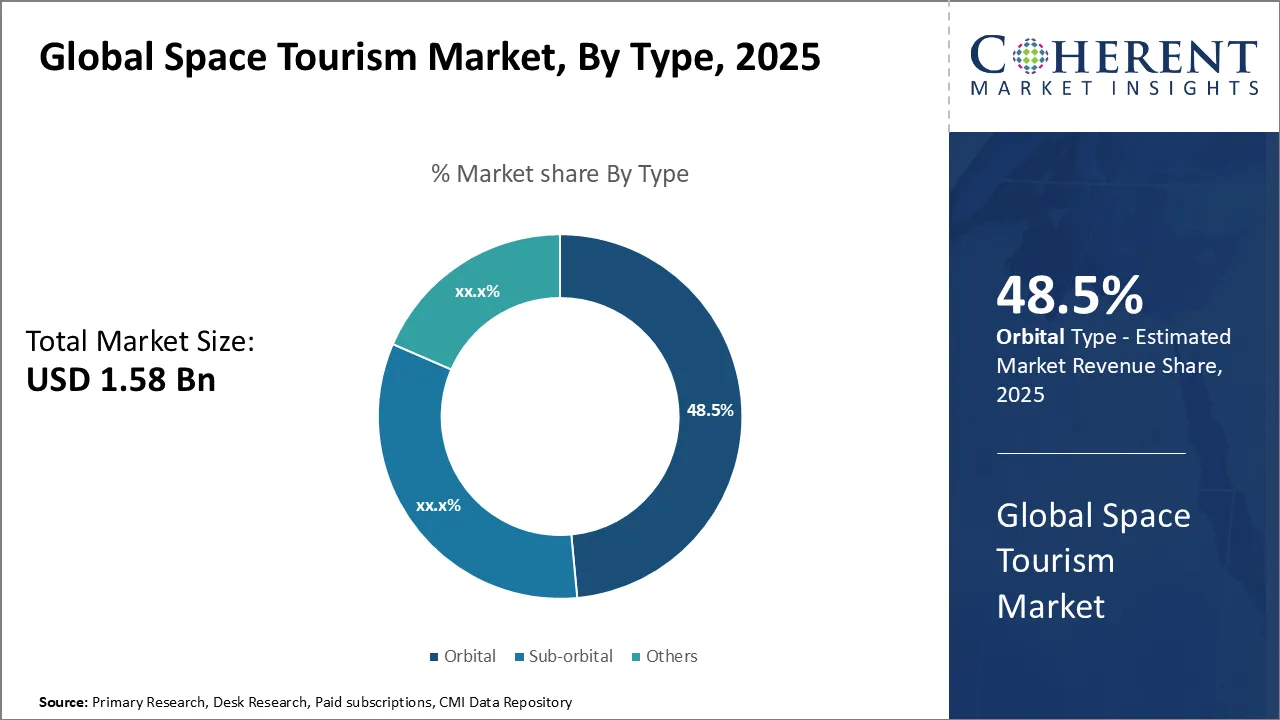
- The orbital segment is expected to hold 49.5 % share of the market in 2026, driven by the growing demand for extensive space exploration and immersive low-Earth orbit experiences.
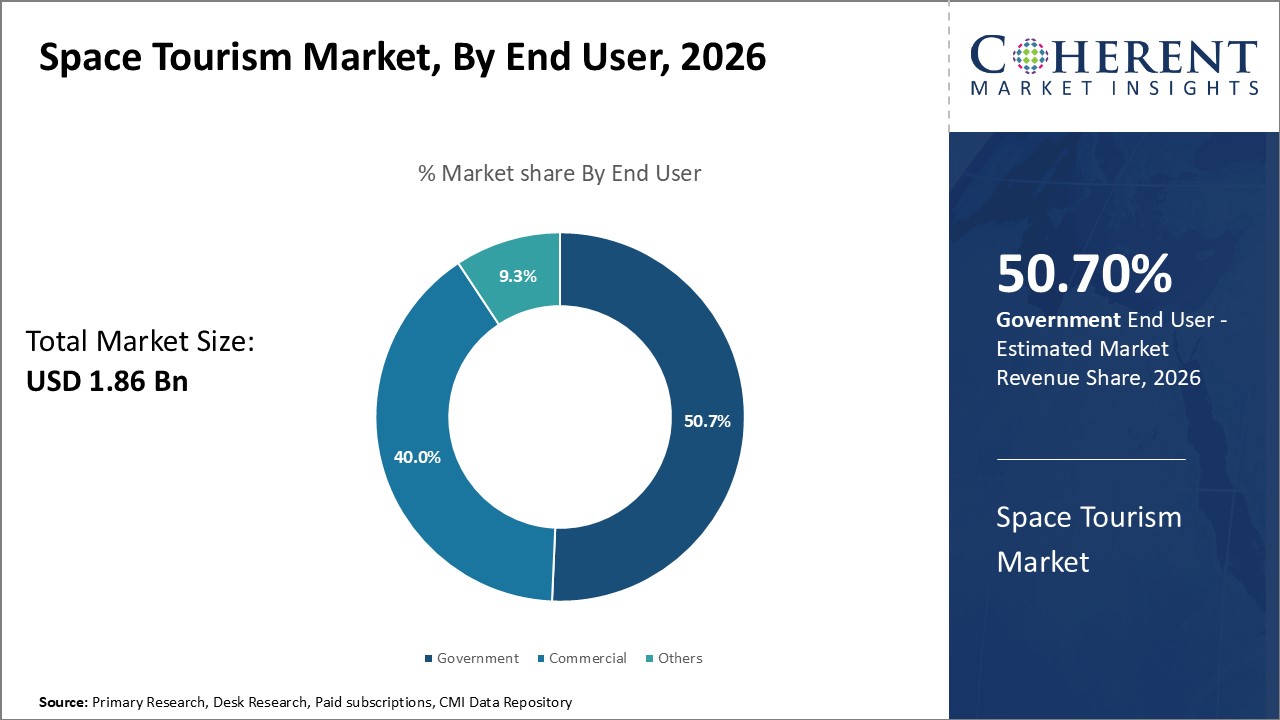
- The government segment is projected to account for 50.7 % of the market in 2026, driven by its crucial role in funding and leading space tourism infrastructure and research initiatives.
- The civilians segment is expected to represent 40.8 % of the market in 2026, fueled by the increasing public interest in space exploration and the rise of space travel as an accessible luxury experience for private individuals.
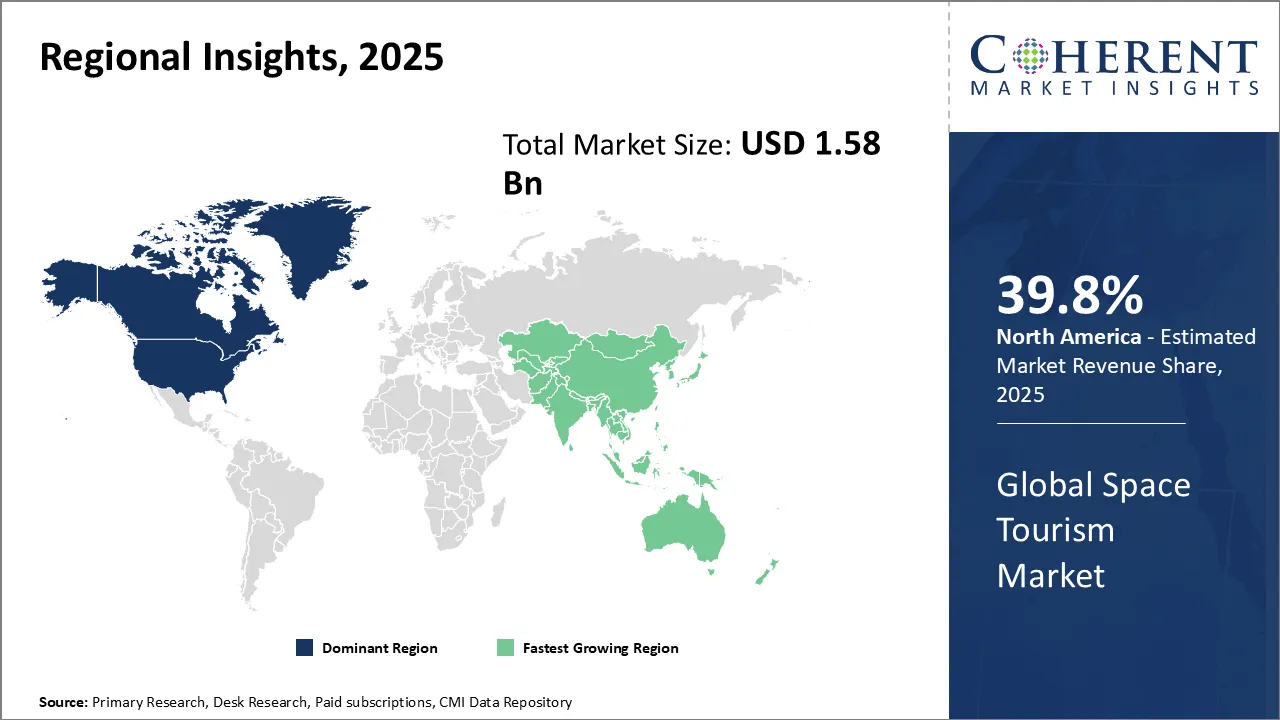
- North America is set to lead the global space tourism market in 2026 with a 39.8 % share, driven by significant investments in space exploration and the growing interest in private space travel. Asia Pacific, with a 21.5% share, will be the fastest-growing region, fueled by advancements in space technology, rising disposable incomes, and increasing government support for space exploration.
Market Overview
The market trend highlights a shift toward more sustainable, cost-efficient, and culturally immersive space travel options, with companies focusing on reusable launch vehicles, enhanced safety protocols, and sustainable tourism practices. Additionally, growing consumer demand for unique, experiential travel, along with the integration of cultural tourism elements, is fueling innovation and collaboration within the industry. Expanding regulatory support is also contributing to the industry's growth. This trend reflects a broader movement toward the commercialization and democratization of space exploration, blending the appeal of space tourism with sustainability and cultural enrichment. These factors are setting the stage for a booming space tourism ecosystem in the coming decade.
Current Events and Its Impact
Current Events | Description and its impact |
Emergence of Lunar and Orbital Tourism Alongside Suborbital Flights |
|
Expansion of Online Booking and Personalization Technologies for Space Tourism (2025) |
|
Segmental Insights
- Current Industry Events of 2026
- Market Size Estimation
- Regional Breakdown
- Competitive Landscape
- Customer Intelligence
- Segmental Analysis
- Pricing Analysis
- Key Market Drivers, Challenges & Future Trends
- Customized Insights Section
Space Tourism Market Insights, By Type – Orbital Segment Dominates the Market due to Growing Interest in Space Exploration and Adventure, Fueled by Technological Advancements and The Rise of Private Spaceflights, Making Orbital Travel More Accessible to Affluent Consumers
Orbital segment is expected to contribute 49.5% share of the market in 2026, owing to the increasing demand for extensive space exploration and immersive low-earth orbit experiences. Orbital space tourism offers passengers the opportunity to spend extended time in space, orbiting the Earth, which provides a unique and unparalleled experience compared to shorter sub-orbital flights. This segment’s growth is driven by advancements in spacecraft technology that enable longer, safer missions with improved life-support systems and in-flight comfort. High-profile missions involving orbital tourism have captured public imagination, fostering aspirational interest among affluent customers who seek not just brief glimpses of space, but a profound encounter with planet Earth from orbit.
Space Tourism Market Insights, By End User – Government Segment Dominates the Market due To Strong Investments in Space Exploration, Government-Led Infrastructure Development, and Increasing Global Collaborations to Expand Space Capabilities
Government segment is projected to contribute 50.7% share of the market in 2026, due to its pivotal role in funding and spearheading space tourism infrastructure and research initiatives. Governments worldwide are investing in space tourism as an extension of space policy goals that include technology innovation, international collaboration, and national prestige in aerospace capabilities. Many government agencies fund and coordinate with private space firms to develop orbital platforms, reusable launch vehicles, and regulations that underpin the viability and safety of space tourism missions.
Government involvement in space tourism also aligns with strategic objectives such as promoting STEM education, inspiring the next generation of scientists and engineers, and leveraging space tourism as a tool for soft power and diplomatic engagement. Additionally, public sector investment has catalyzed partnerships with commercial players to accelerate efforts in building advanced spacecraft and orbital stations.
Space Tourism Market Insights, By Customers – Civilians Segment Dominates the Market due to Increased Interest in Luxury Space Travel among Affluent Individuals and Technological Advancements Making Space Tourism More Accessible
Civilians segment is expected to contribute 40.8% share of the market in 2026, driven primarily by growing public fascination with space exploration and the emergence of space travel as an attainable luxury experience for private individuals. The civilian sector includes high-net-worth tourists, adventure seekers, and enthusiasts eager to experience the novelty and prestige associated with traveling beyond Earth. Increasing media attention, celebrity endorsements, and successful high-profile private spaceflights have helped demystify space travel for civilians, making it a desirable goal rather than a distant dream.
Technological advancements that lower the barrier to entry, such as reusable rockets and standardized crewed capsules, have made commercial spaceflight more accessible to civilians with sufficient financial resources. Moreover, evolving customer preferences focusing on experiential luxury tourism, combined with exclusive opportunities like personalized orbit tours or zero-gravity activities, are propelling civilian demand. Space tourism companies are tailoring their marketing and training programs specifically to civilian customers, offering in-depth pre-flight experiences and simulators to ensure participants feel prepared and confident. These efforts have expanded the civilian base from traditional aerospace enthusiasts to a diverse range of consumers who view space tourism not only as entertainment but also as a symbol of status and human achievement.
Regional Insights
North America Space Tourism Market Analysis and Trends
The North America region is projected to lead the market with an estimated 39.8% share in 2026, driven by a robust ecosystem that integrates well-established aerospace industries, advanced technological infrastructure, and strong private sector involvement. The U.S., as the key player in this region, benefits from supportive government policies such as NASA’s partnerships and regulatory frameworks that encourage private investments in commercial space ventures.
Additionally, significant trade dynamics allowing collaboration between startups and veteran aerospace giant’s further amplify market strength. Leading companies like Blue Origin, Virgin Galactic, and SpaceX have pioneered commercial spaceflights, contributing innovative technologies and high-profile missions that have solidified North America’s leadership position. The combination of deep venture capital pools and cutting-edge research institutions enables continuous advancements in space tourism offerings.
Asia Pacific Space Tourism Market Analysis and Trends
The Asia Pacific region is expected to exhibit the fastest growth in the market contributing 21.5% share in 2026, fueled by increasing government interest, rising disposable incomes, and rapid industrialization in countries such as China, India, and Japan. Governments across the region are implementing policies to boost their presence in space exploration and commercial spaceflight, often positioning space tourism as a strategic long-term economic initiative.
This region’s growth is supported by emerging companies like China’s CAS Space and Japan’s PD Aerospace that are developing innovative, cost-effective space tourism technologies. Trade liberalization and international partnerships also facilitate technology transfer and resource sharing, which speed up development cycles. The region’s expanding middle and upper classes create a growing customer base eager for novel luxury experiences, driving demand.
Global Space Tourism Market Outlook for Key Countries
U.S. Space Tourism Market Trends
The U.S. space tourism market is the epicenter of space tourism innovation, anchored by industry leaders such as SpaceX, Blue Origin, and Virgin Galactic. These companies have conducted the majority of commercial suborbital and orbital tourist flights, pioneering reusable rocket technologies and customer experience design. Government agencies like NASA and the FAA have fostered an environment where regulatory pathways and public-private partnerships abound. This enables ongoing research in safety, propulsion, and life support systems critical for sustainable growth. The U.S. space tourism market’s influencer status also attracts international clientele and investment, solidifying its global dominance.
China Space Tourism Market Trends
China’s space tourism market benefits from strong governmental backing through the China National Space Administration (CNSA) and strategic national initiatives focusing on space exploration commercialization. Domestic companies, including CAS Space, are developing competitive spacecraft and space hotel concepts aimed at both domestic and international space tourists. China's centralized industrial planning and large talent pool facilitate rapid progress in space technology. Moreover, China’s ambition to become a key global player in space tourism is supporting intensified R&D efforts and infrastructure development, such as spaceports and training centers, which swiftly shape the market landscape.
India Space Tourism Market Trends
India’s space tourism market is emerging rapidly due to its broad-based space program led by the Indian Space Research Organisation (ISRO) and an expanding private space sector. Recent policy reforms encouraging private participation and foreign investments have spurred startups to explore the commercial potential of space tourism. Companies such as Skyroot Aerospace and AgniKul Cosmos are beginning to develop launch systems targeting customers seeking suborbital flights. Growing domestic wealth and increasing adventure tourism trends further complement the market dynamics. India aims to balance cost-efficient space technologies with innovative service offerings to carve out a niche in the global space tourism market.
Japan Space Tourism Market Trends
Japan's space tourism market leverages advanced technological capacity and a well-established aerospace industry supported by organizations like Japan Aerospace Exploration Agency (JAXA). Domestic companies such as PD Aerospace and Interstellar Technologies are focusing on developing suborbital spacecraft and spaceplane technology intended to capture new segments of space tourism consumers. Japan’s government shows strong commitment through favorable regulations and funding grants to promote space commercial ventures. The country’s affluent and technology-savvy population, combined with a strong culture of luxury travel, positions Japan as a significant regional player with expanding global outreach.
U.K. Space Tourism Market Trends
The U.K. space tourism market benefits from a vibrant innovative startup ecosystem and government initiatives aimed at expanding the commercial space sector under agencies such as the UK Space Agency. Companies such as Virgin Galactic, founded by U.K.-born entrepreneur Mr. Richard Branson, have paved the way for space tourism development. The U.K. focuses heavily on infrastructure development, including spaceports and launch facilities, and fostering collaborations with international partners. Educational institutions contribute cutting-edge aerospace research, and government policies emphasize creating an ecosystem conducive to innovation, safety, and commercial viability.
End User Feedback and Unmet Needs in the Space Tourism Market
- A notable instance of end-user satisfaction is observed among luxury space travelers who highly value advanced safety features and customized experiences enabled by cutting-edge integrated technologies. For example, companies like SpaceX and Virgin Galactic leverage AI-driven platforms to personalize passenger experiences, including tailored in-space activities and real-time health monitoring, which enhance safety and comfort during missions.
- This integration of AI and big data analytics not only improves spacecraft performance reliability through predictive maintenance but also delivers unique value propositions such as weightlessness and Earth observation, driving strong demand and resonance with high-net-worth individuals (HNWIs) prioritizing exclusivity and safety.
- The unmet needs in the space tourism market are multifaceted. A critical technological gap is the need for more reliable, scalable spacecraft capable of accommodating larger groups of passengers. Current spacecraft, such as Virgin Galactic’s VSS Unity or Blue Origin’s New Shepard, typically carry between four to eight passengers, limiting the market’s scalability. Addressing this gap by developing spacecraft with larger capacities could reduce ticket prices through economies of scale, making space tourism more accessible to a wider audience.
Market Players, Key Development, and Competitive Intelligence
Key Developments
- On August 1, 2025, Mr. Jeff Bezos' Blue Origin announced the upcoming launch of its next space tourism mission, scheduled for August 3, 2025. This mission, dubbed NS-34, marks the 34th overall flight of Blue Origin's New Shepard suborbital vehicle. The mission is a significant step in the company's continued efforts to expand its space tourism offerings. If all goes according to plan, this flight will further demonstrate Blue Origin's capabilities in commercial space travel, reinforcing its position in the growing space tourism market.
- In July 2025, Eos X Space, a Spain-based aerospace company, acquired its American competitor Space Perspective, marking a significant step in the evolution of balloon-based space tourism. This acquisition breathes new life into the vision of peaceful, high-altitude tourist trips to the edge of space using balloon transportation. With this strategic buyout, Eos X Space aims to transform the future of space tourism, offering individuals the opportunity to witness Earth's curvature without the need for rocket launches. The move positions Eos X Space as a key player in the burgeoning sector of high-altitude, non-rocket space travel.
- In March 2024, Blue Origin successfully demonstrated the operational capabilities of its Blue Ring spacecraft during the Defense Innovation Unit's DarkSky-1 mission. This public-private partnership validated the spacecraft's flight systems and in-space processing, supporting the objective of enhancing Blue Ring’s multi-orbit access. The mission launched on an unnamed National Security Space Launch provider’s upper stage, though the exact timing of the event remains undisclosed.
- In October 2023, Blue Origin launched Blue Ring, a spacecraft platform designed to provide comprehensive in-space logistics and delivery services to both commercial and government clients. Operating from medium Earth orbit to the Cislunar region, Blue Ring offers a range of services, including payload hosting, transport, refueling, data transmission, logistics, and cloud computing. With a payload capacity exceeding 3,000 kg, Blue Ring enhances mission flexibility, potentially reducing costs and simplifying planning for a diverse range of customers.
- In June 2023, Virgin Galactic began its commercial spaceflight operations, launching its inaugural flight, 'Galactic 01,' between June 27 and June 30, 2023. A second commercial spaceflight, 'Galactic 02,' was scheduled for early August 2023, with plans for monthly spaceflights as part of their ongoing commercial activities.
Top Strategies Followed by Global Space Tourism Market Players
- Established industry giants dominate through substantial investments in research and development (R&D), driving continuous innovation aimed at enhancing the performance, safety, and customer experience of their space travel offerings. These companies allocate significant resources to create cutting-edge spacecraft, life-support systems, and propulsion technologies, ensuring their products remain at the forefront of the industry. Such alliances not only consolidate their market position but also enable them to tap into complementary strengths, accelerating product development and time to market.
- For instance, SpaceX has revolutionized space exploration with its Starship program, which aims to make space travel more affordable and accessible. The company has invested heavily in advanced spacecraft, life-support systems, and propulsion technologies to ensure a seamless experience for astronauts and space tourists alike.
- Mid-level players in the space tourism sector adopt a distinctly pragmatic approach by prioritizing cost-effective solutions that strike a balance between quality and affordability. Recognizing the price sensitivity of a broader consumer segment interested in space experiences, these companies design offerings that reduce financial barriers without compromising essential safety and performance standards. This focus allows them to carve out a significant market share among customers eager to participate in space travel but deterred by the premium pricing of established market leaders.
- For example, Virgin Galactic, a prominent player in the space tourism industry, began offering tickets at USD 250,000 per seat for suborbital flights, where passengers would briefly reach space before returning to Earth. This pricing was seen as more accessible compared to the auction-based models used by competitors, making it an appealing option for potential space tourists. However, due to the high demand for these unique experiences, early reservations were quickly filled, highlighting the strong interest in space tourism despite the premium cost.
- Small-scale entrants in the global space tourism market differentiate themselves by embracing specialization and innovation to build competitive advantages within niche segments. These players often focus on developing highly specialized features or unique aspects of space travel, such as microgravity research opportunities, personalized experience modules, or eco-friendly propulsion alternatives.
- For example, Space VR, which focuses on providing virtual reality (VR)-enhanced space travel experiences, allowing users to "experience" space travel without leaving Earth.
Market Report Scope
Space Tourism Market Report Coverage
| Report Coverage | Details | ||
|---|---|---|---|
| Base Year: | 2025 | Market Size in 2026: | USD 1.86 Bn |
| Historical Data for: | 2020 To 2024 | Forecast Period: | 2026 To 2033 |
| Forecast Period 2026 to 2033 CAGR: | 17.7% | 2033 Value Projection: | USD 5.82 Bn |
| Geographies covered: |
| ||
| Segments covered: |
| ||
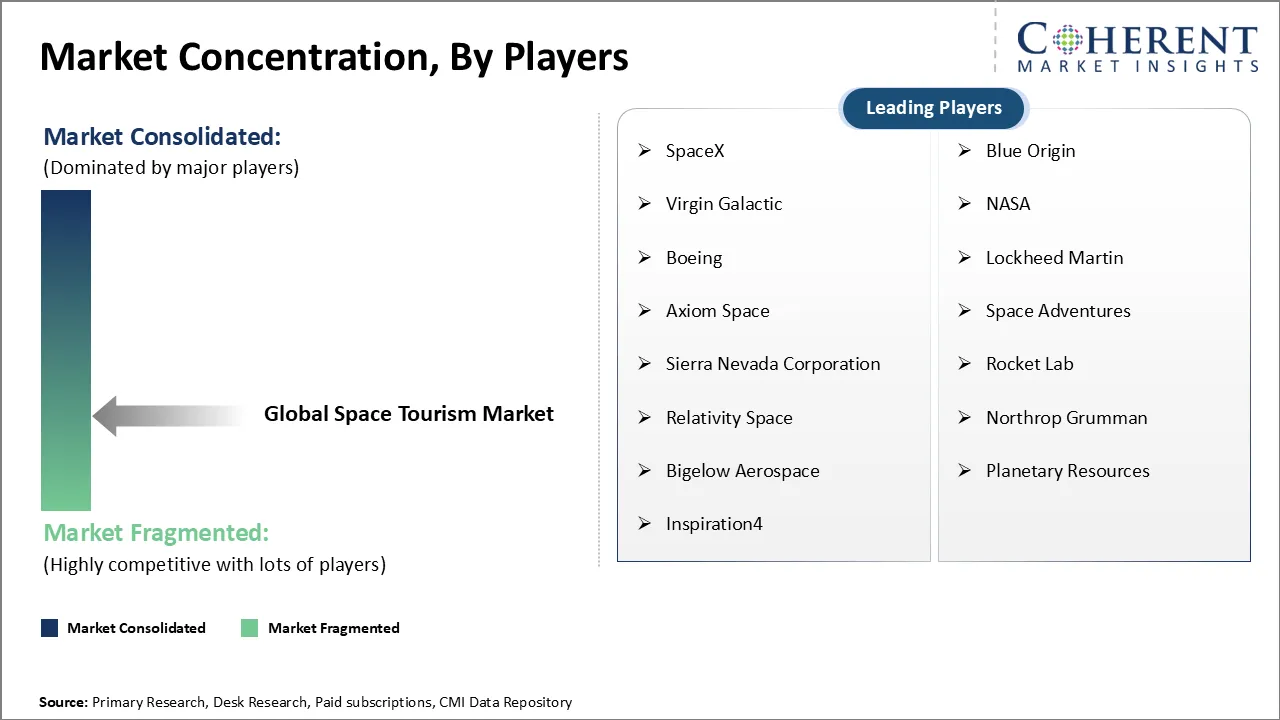
| Companies covered: | SpaceX, Blue Origin, Virgin Galactic, NASA, Boeing, Lockheed Martin, Axiom Space, Space Adventures, Sierra Nevada Corporation, Rocket Lab, Relativity Space, Northrop Grumman, Bigelow Aerospace, Planetary Resources, and Inspiration4 | ||
| Growth Drivers: |
| ||
| Restraints & Challenges: |
| ||
Space Tourism Market Dynamics
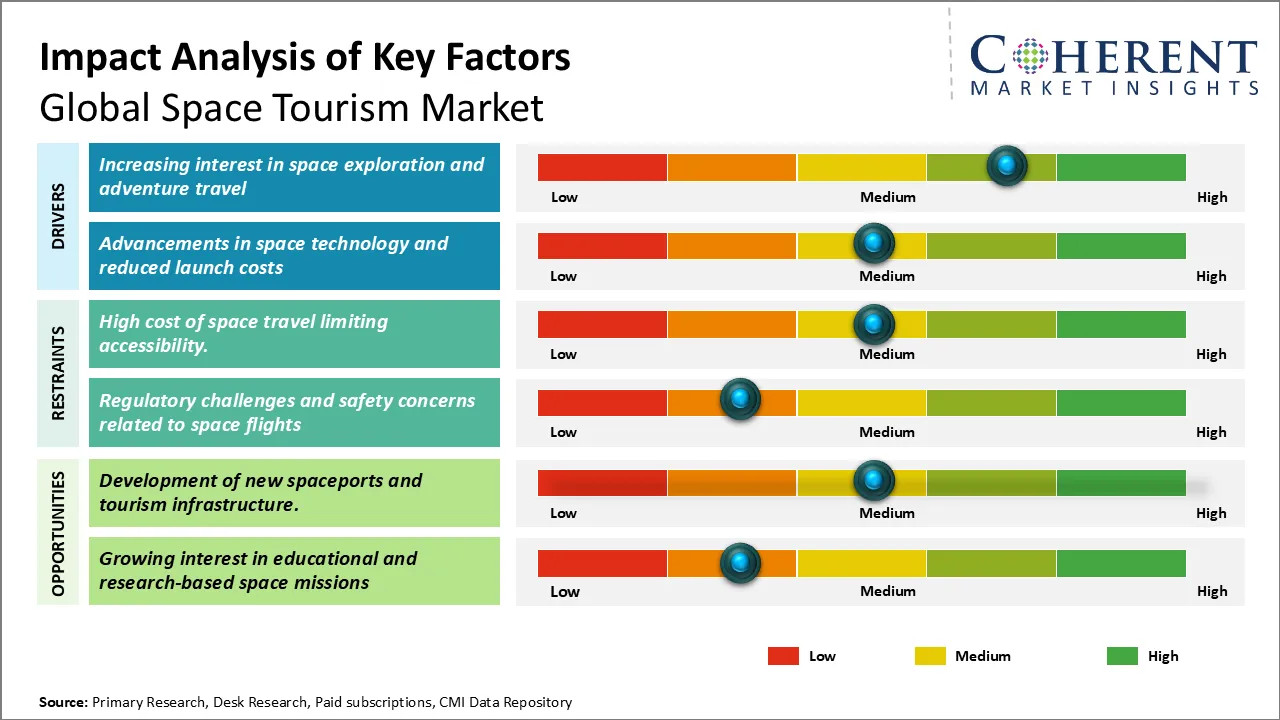
Space Tourism Market Driver - Increasing Interest in Space Exploration and Adventure Travel
The growing fascination with space exploration and adventure travel has become a significant driver propelling the global space tourism market forward. As technological advancements make space experiences more accessible, a broader segment of affluent consumers is increasingly drawn to the idea of venturing beyond Earth’s atmosphere for leisure and unique experiences. This surge in interest is fueled by widespread media coverage of space missions, celebrity endorsements, and successful private sector spaceflights that have captured public imagination.
Blue Origin, founded by Amazon's Jeff Bezos, is an excellent example of a company offering space travel to cater to the growing interest in space tourism. Through its suborbital spaceflights with the New Shepard rocket, Blue Origin offers customers a chance to experience weightlessness and view Earth from space. The company’s successful flights, which include both commercial and celebrity passengers, have been highly publicized, contributing to the growing excitement around space tourism.
Space Tourism Market Opportunity - Development of New Spaceports and Tourism Infrastructure
The expanding interest and investment in space tourism present a significant opportunity through the development of new spaceports and tourism infrastructure worldwide. As commercial space travel evolves from experimental to more commercially viable operations, there is an increasing need for dedicated facilities that can support frequent spaceflights and accommodate a growing number of tourists. Developing new spaceports in strategic locations not only improves accessibility but also enhances the overall customer experience by reducing travel time and logistical complexities. These spaceports are expected to integrate advanced launch and recovery systems, customized passenger terminals, training centers, and safety protocols tailored specifically for space tourists.
For instance, in 2023, SpaceX announced plans to develop a new commercial spaceport in Brownsville, Texas, as part of its broader strategy to increase the frequency of spaceflights. This new facility, expected to be operational by 2025, will feature cutting-edge infrastructure, including specialized passenger terminals, improved launch systems, and recovery facilities.
Analyst Opinion (Expert Opinion)
- The global space tourism market is on the verge of a breakthrough, fueled by significant investments and technological advancements from companies like Virgin Galactic and Blue Origin. Recent discussions at the Space Tourism Conference (2023) and the International Astronautical Congress (2022) highlighted the increasing viability of commercial space travel.
- Virgin Galactic's successful suborbital flights have not only captured public imagination but also validated the business model, showcasing the potential for luxury experiences in space. For instance, their partnership with leading travel agencies is paving the way for curated space travel packages, appealing to affluent consumers seeking unique adventures. Meanwhile, Blue Origin's focus on reusable rocket technology is set to lower costs and increase accessibility, a critical factor for market growth.
- The emphasis on safety and regulatory frameworks is shaping industry standards, as highlighted in panel discussions at recent conferences. As consumer interest surges, companies that prioritize innovation, safety, and unique experiences will likely lead the charge, ultimately transforming space tourism from a niche market into a mainstream industry, with the potential for exponential growth in the coming years.
Speak to the analyst
Want personalized insights?
Take the findings above to one of our principal consultants, or have the report rebuilt around the segments, geographies and competitors you actually track.
Market Segmentation
- Type Insights (Revenue, USD Bn, 2021 - 2033)
- Orbital
- Sub-orbital
- Others
- End User Insights (Revenue, USD Bn, 2021 - 2033)
- Government
- Commercial
- Others
- Customers Insights (Revenue, USD Bn, 2021 - 2033)
- Civilians
- Enterprise
- Others
- Regional Insights (Revenue, USD Bn, 2021 - 2033)
- North America
- U.S.
- Canada
- Latin America
- Brazil
- Argentina
- Mexico
- Rest of Latin America
- Europe
- Germany
- U.K.
- Spain
- France
- Italy
- Russia
- Rest of Europe
- Asia Pacific
- China
- India
- Japan
- Australia
- South Korea
- ASEAN
- Rest of Asia Pacific
- Middle East
- GCC Countries
- Israel
- Rest of Middle East
- Africa
- South Africa
- North Africa
- Central Africa
- North America
- Key Players Insights
- SpaceX
- Blue Origin
- Virgin Galactic
- NASA
- Boeing
- Lockheed Martin
- Axiom Space
- Space Adventures
- Sierra Nevada Corporation
- Rocket Lab
- Relativity Space
- Northrop Grumman
- Bigelow Aerospace
- Planetary Resources
- Inspiration4
Sources
Primary Research Interviews
- Space Tourism Director – Leading Space Tourism Operator
- Market Analyst – Space Industry Research Firm
- Operations Manager – Space Tourism Company
- Marketing Head – Space Tourism Branding and Experience Agency
Stakeholders
- Manufacturers (Spacecraft and Equipment Providers)
- End-use Sectors:
- Private Tourists (Space Travelers)
- Corporate and Government Space Tour Operators
- Aerospace and Defense Contractors
- Regulatory Bodies:
- Federal Aviation Administration (FAA)
- European Union Aviation Safety Agency (EASA)
- National Aeronautics and Space Administration (NASA)
- Technology Integration Players:
- Space Tourism Experience Platforms (Virtual Reality/Augmented Reality Experiences)
- Spacecraft Manufacturers (e.g., Blue Origin, Virgin Galactic, SpaceX)
Databases
- UN Comtrade Database – Global Space Tourism Export and Import Data
- National Space Data Centers – Spacecraft Launch and Space Tourism Data
- FAA Database – Spaceflight Licensing and Safety Data
Magazines
- Space Tourism Today – Trends in Space Tourism
- Aerospace and Technology Journal – Innovations in Space Tourism
- The Space Economy – Commercial Growth and Investment in Space Tourism
- Cosmic Exploration – Private Sector Developments in Space Tourism
- Space Business News – Market Updates on Space Tourism
Journals
- Space Science Review – Scientific Research on Space Tourism and Spaceflight Safety
- Journal of Aerospace Engineering – Technological Advancements in Spacecraft Design for Tourism
- Journal of Commercial Space Exploration – Market Dynamics and Economic Impact of Space Tourism
- Astronautics & Space Exploration – Space Tourism Experiences and Health Risks for Tourists
Newspapers
- The New York Times – Consumer Trends and Regulatory Impact on Space Tourism
- The Financial Times – Space Tourism Market Growth and Investment Trends
- Space News – Commercial Spaceflight Developments and Space Tourism Market Insights
- The Guardian – Policy Impact and Growth of Space Tourism Industry
Associations
- Space Data Association (SDA)
- International Association of Space Tourism (IAST)
- Commercial Spaceflight Federation (CSF)
- European Space Agency (ESA)
- Aerospace Industries Association (AIA)
- National Aeronautics and Space Administration (NASA)
Public Domain Sources
- Federal Aviation Administration (FAA) – Regulatory Guidelines for Commercial Spaceflight and Space Tourism
- European Space Agency (ESA) – Safety Standards for Space Tourism in Europe
- United Nations Office for Outer Space Affairs (UNOOSA) – International Agreements and Space Tourism Regulations
- World Trade Organization (WTO) – International Trade and Space Tourism Market Insights
Proprietary Elements
- CMI Data Analytics Tool, Proprietary CMI Existing Repository of information for last 8 years.
Get access to 250+ pages report
Every segment, forecast, competitor profile and data table behind the analysis above — available for instant download.
- ESOMAR Member
- ISO 9001:2015 Certified
- D-U-N-S Registered
- GDPR & CCPA Compliant
Missing comfort of reading report in your local language? Find your preferred language:
Transform your Strategy with Exclusive Trending Reports
Frequently Asked Questions
The global space tourism market is estimated to be valued at USD 1.86 Bn in 2026 and is expected to reach USD 5.82 Bn by 2033.
The CAGR of global space tourism market is projected to be 17.7% from 2026 to 2033.
Increasing interest in space exploration and adventure travel and advancements in space technology and reduced launch costs are the major factors driving the growth of the global space tourism market.
High cost of space travel limiting accessibility and regulatory challenges and safety concerns related to space flights are the major factors hampering the growth of the global space tourism market.
In terms of type, orbital is estimated to dominate the market revenue share in 2026.
Space tourism costs vary widely: suborbital flights with Virgin Galactic or Blue Origin range from USD 200,000 to USD 600,000, while orbital missions with SpaceX or Axiom Space can exceed USD 70 million.
The limitations of space tourism include high costs, limited accessibility, health risks from space travel, environmental impact, and the current lack of infrastructure for mass tourism in space.