

Global Spices and Seasonings Market Size and Forecast – 2026-2033
The Global Spices and Seasonings Market is estimated to be valued at USD 35.8 Bn in 2026 and is expected to reach USD 56.7 Bn by 2033, exhibiting a compound annual growth rate (CAGR) of 6.80% from 2026 to 2033. The rising demand for ethnic and natural flavor, growing preference for convenience foods and growing applications in the global foodservice and packaged foods industries are driving the growth of the global spices and seasonings market.
In December 2025, ofi (olam food ingredients) launched its first spices sustainability strategy, Spice Maps, focusing on traceable and responsibly sourced spices as demand for plant-based and natural ingredients accelerates. This development highlights how large ingredient suppliers are strengthening sustainable sourcing, quality assurance, and supply chain transparency to meet evolving buyer expectations in the global spices and seasonings market. (Source: Ofi)
Key Takeaways of the Global Spices and Seasonings Market
- The spices segment is expected to dominate with 43.6% of the market share in 2026, supported by their broad use across household cooking, packaged foods, sauces, and foodservice menus. In January 2025, McCormick launched its Aji Amarillo Seasoning as part of its 2025 Flavor Forecast, reinforcing commercial focus on distinctive spice-led innovation.
- The powder segment is expected to hold 46.8% of the market share in 2026, as powdered spices and seasonings offer easier blending, dosing consistency, and suitability for packaged foods, snacks, marinades, and home cooking. In February 2025, Newman’s Own launched 10 new seasoning blends, including curry, Cajun, adobo, and taco variants, highlighting continued demand for easy-to-use dry seasoning formats.
- Conventional is expected to dominate with 78.3% share in 2026, as mass-market spice buyers, food processors, foodservice operators, and retail brands continue to prefer cost-effective, widely available, and scalable conventional spices and seasoning blends. The segment benefits from established sourcing networks, bulk procurement, and stronger price competitiveness compared to organic alternatives. In January 2025, International Spice invested in advanced machinery to improve spice packing efficiency and scale operations, reflecting continued investment in high-volume conventional spice processing and packaging.
- Asia Pacific is expected to lead with 31.9% of the market share in 2026, supported by its strong spice-producing base, large domestic consumption, and well-established processing and export network across countries such as India, China, Vietnam, Indonesia, and Sri Lanka. In May 2025, India’s Press Information Bureau (PIB) reported that India retained its position as the leading global spice exporter, with FY 2024–25 exports reaching USD 4.45 Bn.
- Europe is expected to be the fastest-growing region with 28.4% of the market share in 2026, supported by demand for premium herbs, ethnic flavors, cleaner labels, and high-quality imported ingredients. In February 2026, Central Bank of Ireland (CBI) noted that European spice and herb imports are expected to grow gradually, with Rotterdam, Hamburg, Antwerp, and other ports remaining key import hubs.
- Clean Label and Natural Flavor Positioning: Clean label positioning is a major strategic lever with the food industry making products with familiar ingredients, and better flavor. Spices and seasonings are being used more and more as a natural way to enhance the taste of foods, allowing manufacturers to minimize the need for artificial additives and still keep the intensity of the taste, differentiation and consumer confidence in all retail and processed food
- Premiumization Through Global Flavor Innovation: Global flavor experimentation is transforming product pipelines, as brands experiment with flavors from different regions, fusion, and chef-inspired combinations. This trend enables premium pricing, accelerated rotation rates and enhanced brand communique, especially in the snacks and sauces, ready meals and foodservice sectors where customers are looking for restaurant experience at home.
Segmental Insights
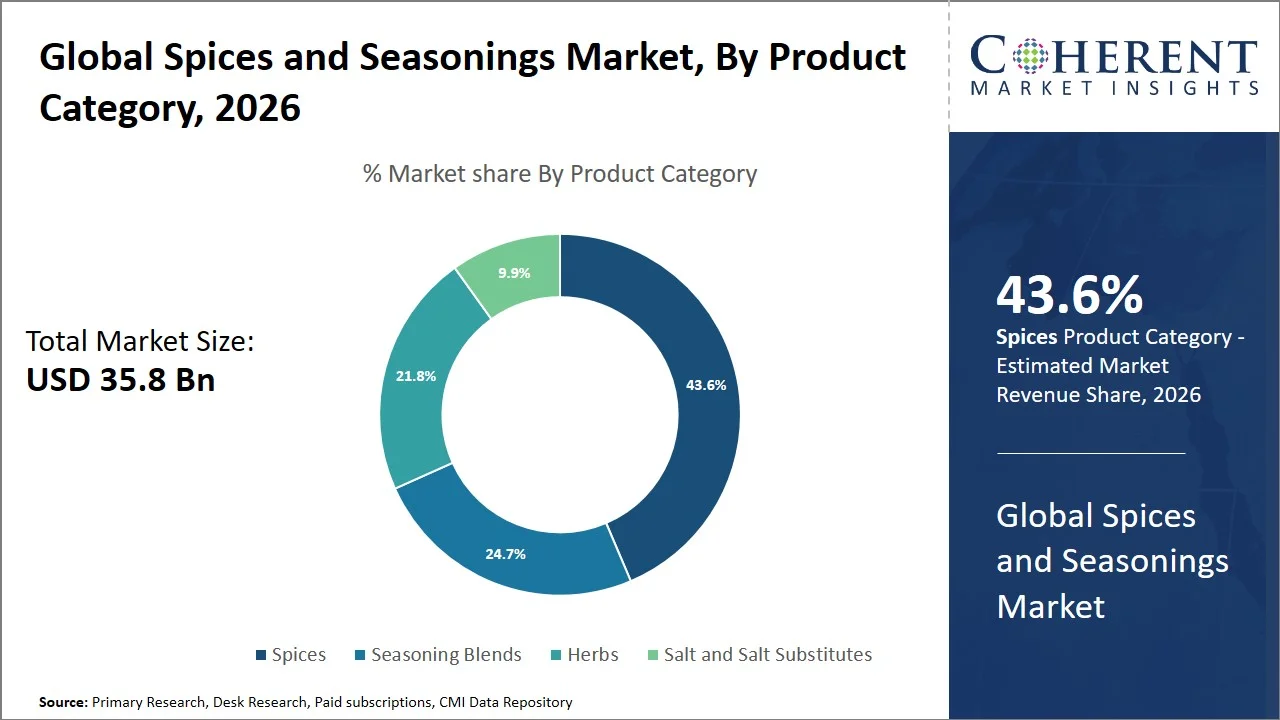
Why Does the Spices Segment Dominate the Global Spices and Seasonings Market?
The spices segment is expected to dominate the global spices and seasonings market with 43.6% share in 2026, as they remain the most versatile product category across traditional cooking, packaged foods, sauces, marinades, meat preparations, and snack flavoring. The segment benefits from strong repeat consumption, wide cultural acceptance, and the ability to deliver heat, aroma, color, and functional taste enhancement without complex formulation. On the supply side, large-scale cultivation of chili, turmeric, pepper, cumin, coriander, and cardamom supports consistent raw material availability and broad processor participation. Food manufacturers prefer spices because they can be adapted into regional, ethnic, and premium recipes. In May 2026, ITC reported that its Sunrise spices portfolio added offerings such as Sunrise Prawn Curry Masala and Sunrise Chicken Tikka Masala to improve relevance among new-age consumers.
- Current Industry Events of 2026
- Market Size Estimation
- Regional Breakdown
- Competitive Landscape
- Customer Intelligence
- Segmental Analysis
- Pricing Analysis
- Key Market Drivers, Challenges & Future Trends
- Customized Insights Section
Why Does Powder Represent the Largest Form Segment in the Global Spices and Seasonings Market?
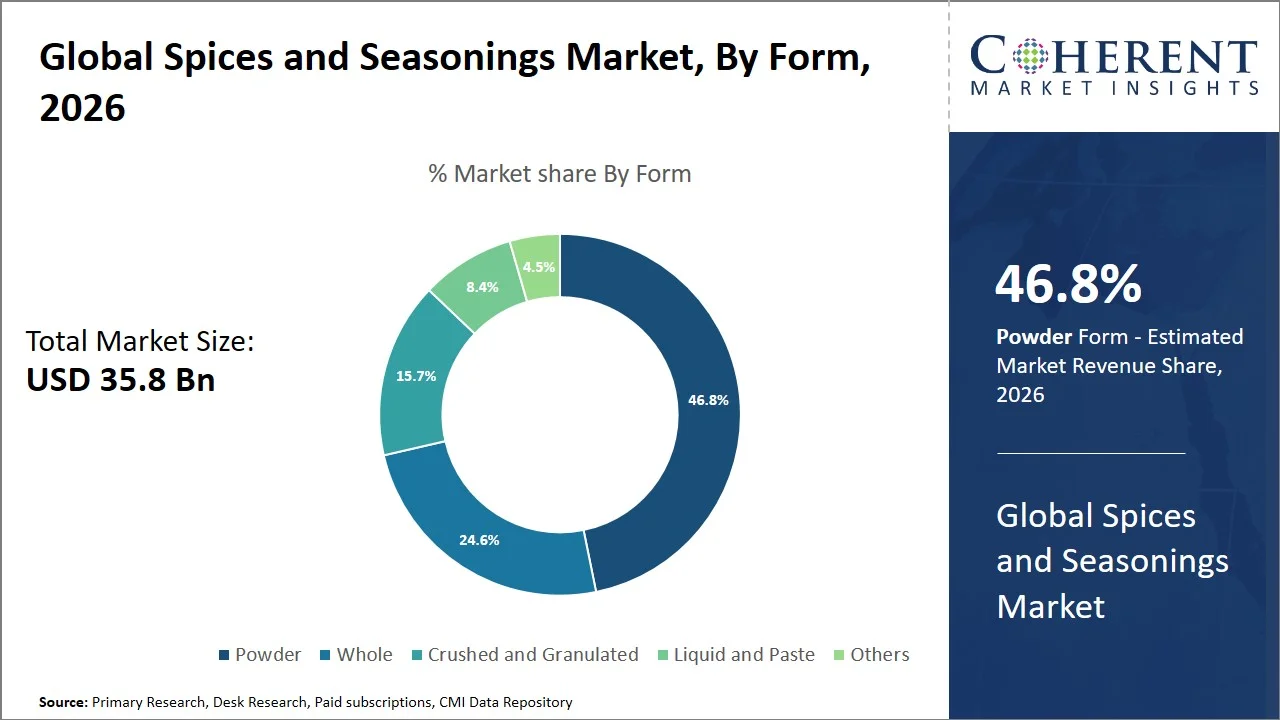
The powder segment is expected to represent the largest form segment with 46.8% of the market share in 2026, owing to its superior convenience, faster flavor release, uniform blending, and compatibility with automated food production lines. Powdered spices are preferred by households for daily cooking and by food processors for snack coatings, instant mixes, sauces, soups, frozen meals, bakery seasonings, and ready-to-cook products. The format also supports standardized dosing, private-label packaging, and lower handling complexity compared with whole spices. From a supply perspective, grinding, sieving, sterilization, and moisture-control technologies improve shelf stability and consistency for bulk buyers. In December 2025, From Byadgi launched its flagship Byadgi Chili Powder in the U.S., positioning the product for retail consumers, chefs, foodservice distributors, and food manufacturers requiring traceable, high-quality Chili powder. (Source: Specialty Food Association, Inc)
Why Does Conventional Dominate the Global Spices and Seasonings Market?
The conventional segment is expected to dominate with 78.3% of the market share in 2026, primarily because they offer stronger price competitiveness, wider retail availability, and easier large-volume procurement than certified organic alternatives. The segment is deeply embedded in mass-market packaged foods, quick-service restaurants, institutional kitchens, and everyday household cooking, where consistent taste and cost control are critical. Conventional supply chains also benefit from larger farmer bases, established trading networks, processor capacity, and mature quality-testing infrastructure. For manufacturers, conventional inputs provide greater formulation flexibility across value, mid-tier, and mainstream premium products without certification-related cost pressure. In March 2026, Acomo reported record 2025 performance in its Spices & Nuts segment and stated its ambition to build scale across conventional and organic specialty ingredient markets. (Source: Acomo)
Global Spices and Seasonings Market Dynamics
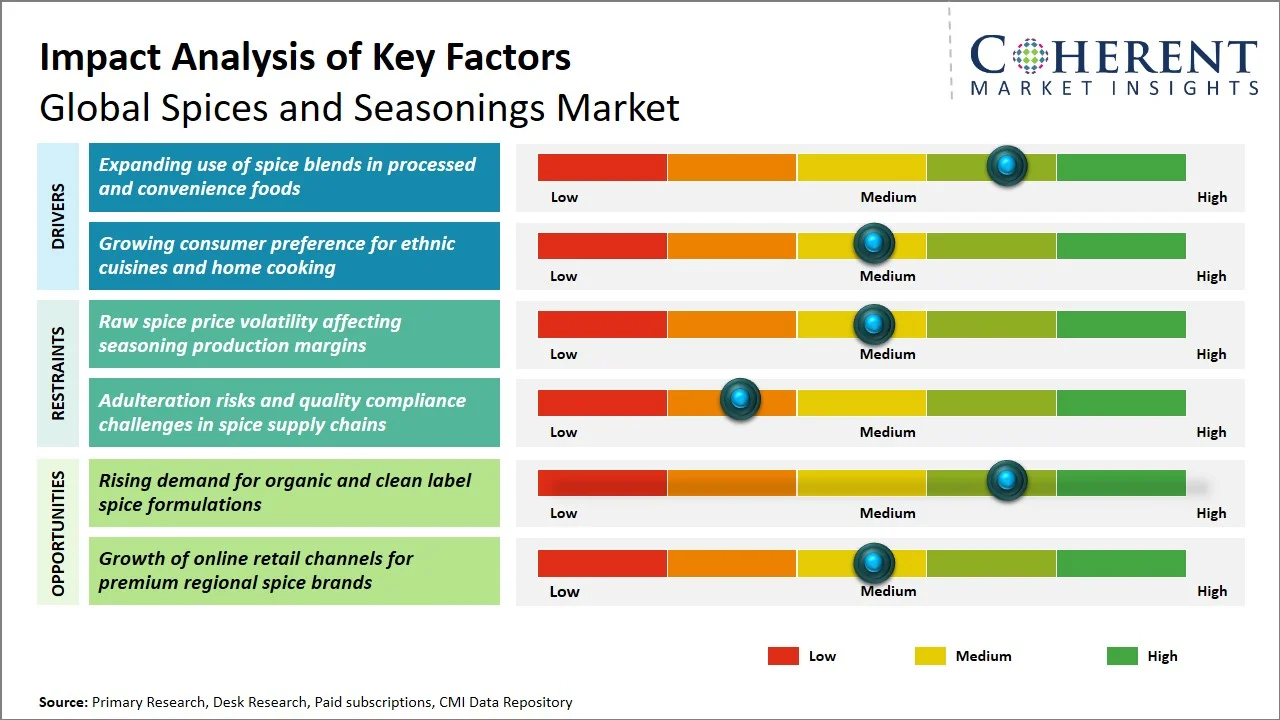
Key Market Drivers
- Expanding Use of Spice Blends in Processed and Convenience Foods
The growing role of spice blends in processed and convenience foods is strengthening demand across snacks, instant meals, sauces, marinades, and ready-to-eat products. Food manufacturers are using seasoning systems to create differentiated taste profiles, improve consumer recall, and support faster product rotation in crowded retail categories. This driver is especially relevant for snacks and convenience foods, where flavor innovation often determines repeat purchase and premium shelf positioning. In August 2025, Kellanova announced six new Pringles flavors, including smoky, cheddar, cinnamon-sugar, and jalapeño-queso variants, showing how snack brands are using complex seasoning profiles to expand consumption occasions and retailer interest. (Source: Kellanova)
- Growing Consumer Preference for Ethnic Cuisines and Home Cooking
As consumers show greater interest in ethnic cuisines and home cooking, spice blends are becoming increasingly important for businesses seeking to offer convenient, authentic, and differentiated flavor solutions. Blended spices make them easy to prepare, assist consumers to recreate regional taste and increase the penetration of premium spices in the pantry. This driver not only represents retail and direct-to-consumer brands, but consumers are looking for experiences that are curated, chef-led and rooted in culture, without having to purchase multiple individual spices. It also enhances the adoption rates of younger households that cook selectively but seek greater taste authenticity. Spicewalla introduced its Made With Love in Asheville Collection in June 2025, which is a limited-edition 10 pack of collaborative spice blends with chefs and local food institutions, and also positioned its small-batch products for home cooks and professional chefs. (Source: Spicewalla)
Emerging Market Trends
- Clean-Label Seasoning Systems for Better-for-You Food Reformulation
Clean-label seasoning systems are a growing strategy as food companies seek to optimize their product formulations with familiar ingredients, fewer artificial additives and enhanced sensory properties. Spices and seasonings can be used to boost the intensity of flavors and to help reduce sodium, sugar, plant based formulations and natural positioning for manufacturers. This applies to snack, sauces, soups, frozen foods and meat alternatives – where taste is still the primary issue affecting repeat purchases. Brands are also adding herbs, peppers, garlic, turmeric, cumin and botanical mixes to deliver "functional value" in a way that doesn't necessarily evoke a health claim. This trend drives the need for formulation skills, contaminant control, allergen management and blending for specific applications in the supplier's field.
- Origin-Led Premiumization and Traceable Spice Sourcing
Origin-led positioning is moving spices and seasonings beyond commodity pricing toward premium, story-based differentiation. Buyers are increasingly valuing traceability, harvest quality, single-origin identity, and controlled processing because these factors influence aroma, color, purity, and regulatory acceptance. This trend is commercially important for pepper, turmeric, chili, cinnamon, vanilla, cardamom, coriander, and specialty herbs where provenance can support higher margins. Traceable sourcing also helps exporters and brand owners reduce risks linked to adulteration, pesticide residues, microbial contamination, and inconsistent grades. As retailers and food manufacturers tighten supplier qualification, companies with verified sourcing networks, batch-level documentation, and transparent quality systems are better positioned to win long-term contracts.
Current Events and their Impact
Current Events | Description and its Impact |
FSSAI Enforcement Drive on Whole and Powder Spices, October 2025 |
|
Codex Maximum Lead Levels for Cinnamon and Dried Culinary Herbs, November 2025 |
|
EU Alert & Cooperation Network Report Highlights Herb and Spice Risks, June 2026 |
|
Regional Insights
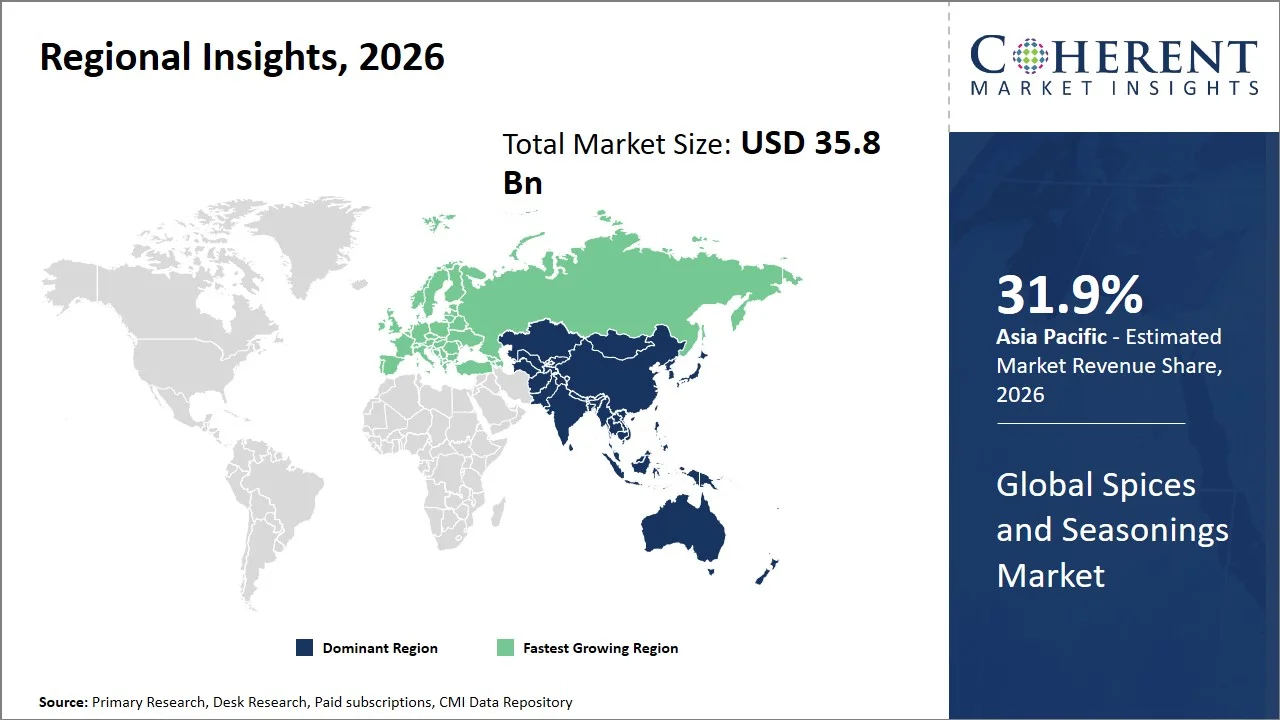
Why Does Asia Pacific Dominate the Global Spices and Seasonings Market?
Asia Pacific is expected to dominate the global spices and seasonings market with 31.9% share in 2026, supported by its strong cultivation base, deep culinary dependence on spices, and large-scale consumption across India, China, Southeast Asia, and Japan. The region benefits from integrated supply chains covering farming, primary processing, grinding, blending, export packaging, and domestic retail distribution. High use of Chili, turmeric, pepper, ginger, garlic, cumin, coriander, and regional masala blends supports both household and industrial consumption. Asia Pacific also remains important for global sourcing, as food processors and seasoning formulators rely on the region for raw spice availability and cost-efficient processing. In February 2026, International Spice Conference 2026 concluded in Kochi with a focus on resilient, innovative, and future-ready spice ecosystems. (Source: International Spice Conference)
Why is Europe Emerging as the Fastest-Growing Region in the Global Spices and Seasonings Market?
Europe is expected to emerge as the fastest-growing region with 28.4% share in 2026, supported by premiumization, rising demand for ethnic cuisines, clean-label food reformulation, and strong uptake of herbs, spice mixes, and natural flavoring ingredients. European buyers increasingly prioritize traceability, sustainability, pesticide control, allergen management, and food safety documentation, which is shifting demand toward higher-quality and certified suppliers. The region’s processed food, bakery, sauces, ready-meals, meat alternatives, and foodservice sectors also create strong demand for standardized seasoning systems. In December 2024, Eurostat reported that EU imports of spices from extra-EU countries reached 339,800 tons in 2023, with turmeric and ginger imports more than doubling compared with 2013, reflecting broader demand for diverse spice categories. (Source: Eurostat)
Global Spices and Seasonings Market Outlook for Key Countries
Why is the U.S. a Key Market for the Global Spices and Seasonings Market?
The U.S. is a key market for spices and seasonings due to its large packaged food industry, high foodservice penetration, multicultural food consumption, and strong demand for convenient flavor solutions. U.S. consumers regularly use spices across grilling, snacks, sauces, frozen foods, ethnic meals, and home cooking, while manufacturers require consistent seasoning systems for large-scale product formulations. The country is also a major import-dependent market, which increases the importance of supplier compliance, documentation, contaminant control, and shipment-level quality assurance. In October 2025, the U.S. FDA announced that, effective October 31, 2025, import certification would be required for shrimp and spices from certain regions of Indonesia due to potential Cesium-137 contamination risk. This highlights how import safety controls influence U.S. spice sourcing and supplier qualification.
Why is India Important in the Global Spices and Seasonings Market?
India is important in the global spices and seasonings market because it combines large-scale production, high domestic consumption, value-added processing, and export leadership. The country supplies a broad basket of spices including Chili, cumin, turmeric, cardamom, pepper, coriander, ginger, spice oils, oleoresins, curry powders, and pastes. Domestic demand is supported by everyday cooking, packaged masalas, snacks, foodservice, and ready-to-cook products, while export demand benefits processors, traders, and branded spice companies. India’s strength lies in product diversity and established processing infrastructure, although quality consistency and residue compliance remain critical for premium markets. In 2025–26, Spices Board reported that India exported USD 0.18 Mn tons of spices and spice products valued at US$ 4,430.90 million, confirming its continued role as a global sourcing hub.
Why Does China Support Growth in the Global Spices and Seasonings Market?
China supports growth in the global spices and seasonings market through its large consumer base, regional culinary diversity, strong food manufacturing capacity, and role as both supplier and buyer of key spice ingredients. Demand is supported by Sichuan, Hunan, Cantonese, hotpot, noodle, sauce, and convenience food applications, where Chili, garlic, ginger, peppercorn, star anise, cinnamon, onion, and seasoning blends are widely used. China also acts as a strategic processing and trading market for natural spices, spice extracts, dehydrated ingredients, and foodservice seasoning systems. In November 2025, the 2025 China Spice Conference was scheduled in Chongqing, alongside the Yulin Spice Expo, covering products such as pepper, star anise, cinnamon, Chili, garlic, onion, Chinese prickly ash, and dried ginger.
Why is Germany a Strategic Country in the Global Spices and Seasonings Market?
Germany is a strategic country in the global spices and seasonings market because it acts as a premium European consumption, processing, and distribution hub. The country has strong demand from processed foods, meat products, bakery, sauces, ready meals, organic retail, private-label products, and foodservice. German buyers typically emphasize traceability, residue compliance, allergen control, food safety certification, and consistent sensory quality, which supports premium and specification-driven spice procurement. Its central location also strengthens distribution into wider European markets. In March 2025, USDA FAS reported that Germany’s food processing industry produced US$ 252.1 billion in processed food and drinks in 2023, highlighting the scale of downstream demand for ingredients such as spices, herbs, seasoning blends, and food preparations.
Why is Brazil an Important Growth Market for the Global Spices and Seasonings Market?
Brazil is an important growth market for spices and seasonings due to its large consumer base, strong food processing sector, regional cuisine diversity, and strategic position in Latin American food distribution. Domestic consumption is supported by meat preparations, sauces, snacks, ready meals, bakery, foodservice, and traditional cooking formats. Brazil is also relevant on the supply side, particularly in black pepper, where export compliance and quality documentation are important for access to premium markets. The country’s food industry increasingly requires stable seasoning inputs that can support local taste preferences and modern packaged food innovation. In March 2026, Brazil’s Ministry of Agriculture updated its guidance page for black pepper exporters to the European Union, reinforcing the importance of registered supply chains and compliance with EU requirements.
Technology Adoption Landscape in the Global Spices and Seasonings Market
Technology | Adoption Level | Key Application Area | Business Impact |
Steam Sterilization and Dry Heat Treatment | High | Microbial load reduction in spices and herbs | Improves food safety, extends shelf stability, and supports compliance for export and industrial buyers |
Cryogenic and Low-Temperature Grinding | Medium | Powdered spices with volatile oil retention | Preserves aroma, color, and flavor strength, enabling premium positioning in retail and foodservice |
Optical Sorting and AI-Based Defect Detection | Medium | Foreign matter removal, color grading, and quality sorting | Reduces contamination risk, improves grade consistency, and lowers rejection rates |
LC-MS/MS and GC-MS Testing | High | Pesticide residue, adulterant, volatile oil, and contaminant analysis | Supports regulatory compliance, supplier qualification, and premium export acceptance |
Automated Blending and Dosing Systems | High | Seasoning blends, snack coatings, marinades, and bulk food processing | Ensures batch consistency, reduces formulation errors, and improves scalability |
QR-Based Traceability and Digital Batch Records | Medium | Origin verification, recall management, and B2B documentation | Builds buyer confidence, improves transparency, and supports clean-label and premium claims |
How are Clean-Label Blends, Ethnic Meal Solutions, and Traceable Supply Chains Creating New Growth Opportunities in the Global Spices and Seasonings Market?
Clean-label blends, ethnic meal solutions, and traceable supply chains are creating strong growth opportunities by shifting spices and seasonings from basic pantry ingredients to value-added formulation platforms. Today's consumers are demanding convenience with flavors that not only minimize preparation time but also capture the true essence of the region. This leaves room for masala blends, taco seasonings, Asian flavors, barbecue blends, curry seasoning blends, herb blends, and sodium reduction blends. Manufacturers have an opportunity to create application specific products for snack, sauce, ready meal, plant protein, meat processing, and food service kitchens. Finally, traceability enhances commercial value by addressing buyer concerns regarding inconsistent quality of origin, microbial safety, pesticide residues and adulteration. Businesses with sensory innovation and certified sourcing, clean processing and flexible pack formats can benefit from improved pricing power and increased access to modern retail, e-commerce, foodservice and industrial customers.
Market Players, Key Development, and Competitive Intelligence
Key Developments
- In March 2026, McCormick introduced Sweet & Smoky Naturally Flavored Black Currant Seasoning and Black Currant Finishing Sugar after naming black currant its 2026 Flavor of the Year. This development highlights how leading seasoning brands are converting flavor forecasts into retail-ready products, supporting premiumization, seasonal usage, and innovation-led consumer engagement.
- In February 2026, PepsiCo launched Doritos Protein tortilla-style chips, combining functional snacking with the brand’s established bold-flavor positioning. The move reflects how seasoning intensity is becoming central to better-for-you snacks, where brands must balance health claims with strong taste delivery to maintain repeat purchase.
Competitive Landscape
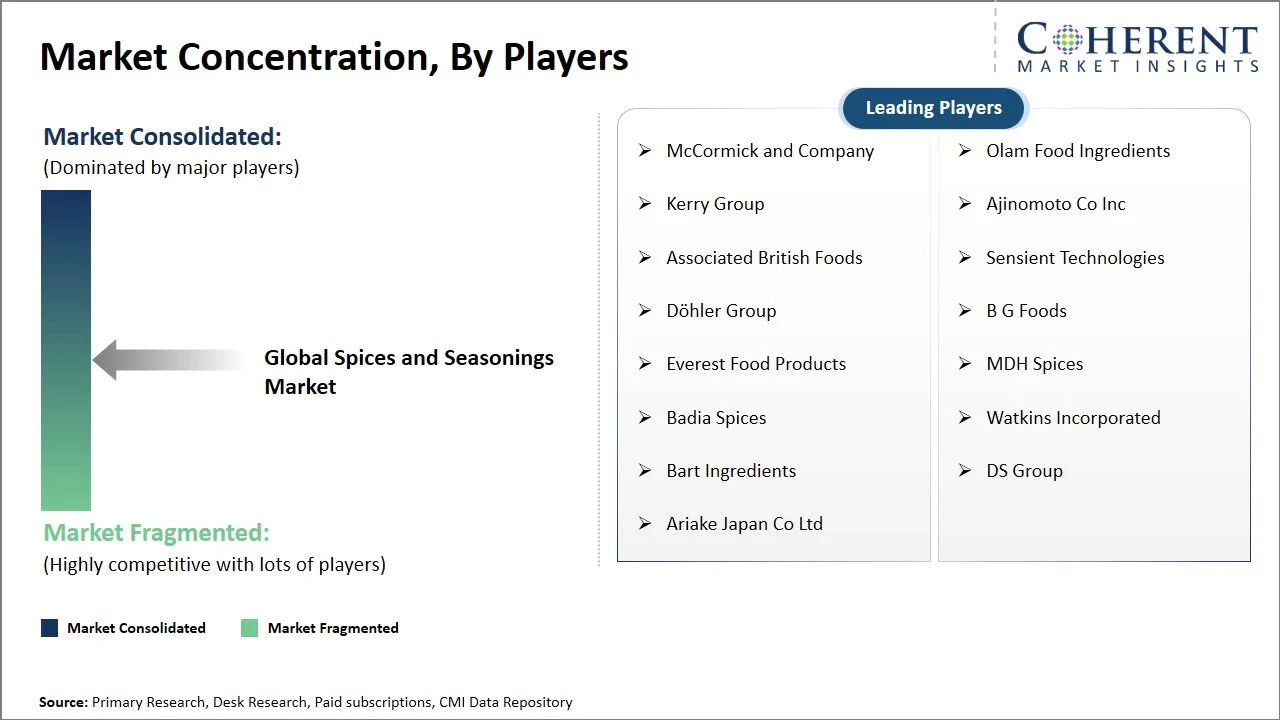
The global spices and seasonings market is not consolidated, and there is competition among the multinational spice ingredient suppliers, regional spice processors, branded spice retail companies, private label manufacturers, exporters, and specialty seasoning formulators. As competition moves away from price-led supplier, it is gaining momentum in areas of product consistency, safety compliance, flavor innovation, origin credibility and reach to channels.
Key focus areas include:
- Product quality and differentiation: Players compete on aroma retention, color intensity, purity, freshness, and application-specific taste performance.
- Technology adoption and process efficiency: Advanced grinding, sterilization, blending, and testing systems support consistency and scalable production.
- Pricing and cost competitiveness: Conventional spices remain price-sensitive, making procurement efficiency and yield management important.
- Capacity expansion and supply reliability: Large buyers prefer suppliers with stable sourcing, multi-origin procurement, and dependable delivery cycles.
- Certifications and quality control: Food safety, organic, halal, kosher, allergen, and export certifications influence institutional and international contracts.
- Distribution network and customer reach: Retail presence, foodservice distribution, B2B supply, and online availability shape competitive access.
- Format and specification differentiation: Powder, whole, crushed, liquid, paste, low-sodium, organic, and custom blends help target different end users.
- Specialty and sustainable positioning: Clean-label, traceable, single-origin, and responsibly sourced products support premium margins.
Market Report Scope
Spices and Seasonings Market Report Coverage
| Report Coverage | Details | ||
|---|---|---|---|
| Base Year: | 2025 | Market Size in 2026: | USD 35.8 Bn |
| Historical Data for: | 2020 To 2024 | Forecast Period: | 2026 To 2033 |
| Forecast Period 2026 to 2033 CAGR: | 6.80% | 2033 Value Projection: | USD 56.7 Bn |
| Geographies covered: |
| ||
| Segments covered: |
| ||
| Companies covered: | McCormick and Company, Olam Food Ingredients, Kerry Group, Ajinomoto Co Inc, Associated British Foods, Sensient Technologies, Döhler Group, B G Foods, Everest Food Products, MDH Spices, Badia Spices, Watkins Incorporated, Bart Ingredients, DS Group, and Ariake Japan Co Ltd | ||
| Growth Drivers: |
| ||
| Restraints & Challenges: |
| ||
Analyst Opinion (Expert Opinion)
- The market outlook remains positive as spices and seasonings are becoming central to flavor innovation across packaged foods, foodservice, and home cooking. Product categories with strong repeat usage, broad culinary relevance, and easy integration into convenience foods are expected to remain commercially attractive.
- The strongest growth pockets are likely to emerge in seasoning blends, powdered formats, organic and clean-label products, food processing applications, and Europe-led premium demand. Asia Pacific will continue to remain strategically important due to strong production ecosystems, culinary depth, and export relevance.
- Key risks include raw material price volatility, pesticide residue concerns, heavy-metal contamination, microbial risks, adulteration, and inconsistent quality across fragmented supply chains. Companies should focus on traceability, testing infrastructure, supplier audits, application-specific blends, and premium packaging to strengthen competitive advantage.
Speak to the analyst
Want personalized insights?
Take the findings above to one of our principal consultants, or have the report rebuilt around the segments, geographies and competitors you actually track.
Market Segmentation
- Product Category Insights (Revenue, USD Bn, 2021 - 2033)
- Spices
- Seasoning Blends
- Herbs
- Salt and Salt Substitutes
- Form Insights (Revenue, USD Bn, 2021 - 2033)
- Powder
- Whole
- Crushed and Granulated
- Liquid and Paste
- Others
- Nature Insights (Revenue, USD Bn, 2021 - 2033)
- Conventional
- Organic
- Application Insights (Revenue, USD Bn, 2021 - 2033)
- Food Processing
- Household and Retail Cooking
- Foodservice
- Snacks and Convenience Foods
- Others
- Distribution Channel Insights (Revenue, USD Bn, 2021 - 2033)
- Offline
- Online
- Regional Insights (Revenue, USD Bn, 2021 - 2033)
- North America
- U.S.
- Canada
- Latin America
- Brazil
- Argentina
- Mexico
- Rest of Latin America
- Europe
- Germany
- U.K.
- Spain
- France
- Italy
- Russia
- Rest of Europe
- Asia Pacific
- China
- India
- Japan
- Australia
- South Korea
- ASEAN
- Rest of Asia Pacific
- Middle East
- GCC Countries
- Israel
- Rest of Middle East
- Africa
- South Africa
- North Africa
- Central Africa
- North America
Sources
Primary Research Interviews
- Spice and seasoning manufacturers
- Seasoning blend formulators and R&D managers
- Procurement heads of food processing companies
- Foodservice chain sourcing managers
- Spice exporters, importers, and distributors
- Retail category managers for spices, herbs, and seasonings
- Quality assurance and food safety managers in spice processing units
Stakeholders
- Spice processors and seasoning blend manufacturers
- Herb, spice, and salt substitute producers
- Food processing companies
- Snack and convenience food manufacturers
- Quick-service restaurants and foodservice operators
- Retail chains, supermarkets, and grocery stores
- E-commerce grocery platforms
- Spice exporters, importers, and trading companies
- Packaging, grinding, sterilization, and testing service providers
Databases
- UN Comtrade Database
- ITC Trade Map
- FAOSTAT
- Eurostat
- USDA Foreign Agricultural Service
- U.S. International Trade Commission
- India Spices Board export database
- FAO Food Price and Agricultural Trade Statistics
Magazines / Industry Publications
- Food Business News
- Food Ingredients First
- The World of Food Ingredients
- Spice Business Magazine
- Food Processing Magazine
- Prepared Foods
- Baking & Snack
- Specialty Food Magazine
Journals
- Food Chemistry
- Journal of Food Science
- Trends in Food Science & Technology
- Food Control
- Journal of Food Composition and Analysis
- International Journal of Food Microbiology
- LWT – Food Science and Technology
Newspapers
- The Economic Times
- Financial Times
Associations
- American Spice Trade Association
- European Spice Association
- Spices Board India
- International Pepper Community
- International Organization of Spice Trade Associations
- Seasoning and Spice Association
- Specialty Food Association
- Institute of Food Technologists
Public Domain Sources
- FDA – food safety, import alerts, labeling, and contaminant guidance
- FSSAI – spice standards, enforcement drives, and food safety regulations
- EFSA – food safety and risk assessment
- Codex Alimentarius – global spice and herb safety standards
- FAO – spice trade, agriculture, and food safety data
- WHO – food safety and contaminant guidelines
- European Commission RASFF / Alert and Cooperation Network
- USDA – agricultural trade and food processing reports
Proprietary Elements
- CMI Data Analytics Tool
- Proprietary CMI Existing Repository of information for last 10 years.
Get access to 250+ pages report
Every segment, forecast, competitor profile and data table behind the analysis above — available for instant download.
- ESOMAR Member
- ISO 9001:2015 Certified
- D-U-N-S Registered
- GDPR & CCPA Compliant
Missing comfort of reading report in your local language? Find your preferred language:
Transform your Strategy with Exclusive Trending Reports
Frequently Asked Questions
The CAGR of the global spices and seasonings market is projected to be 6.80% from 2026 to 2033.
Clean-label seasonings, ethnic flavors, and natural spice blends are the major trends.
Organic spices, premium blends, and ready-to-cook seasoning mixes offer major growth opportunities.
The global spices and seasonings market is estimated to be valued at USD 35.8 Bn in 2026 and is expected to reach USD 56.7 Bn by 2033.
Expanding use of spice blends in processed and convenience foods and growing consumer preference for ethnic cuisines and home cooking are the major factors driving the growth of the global spices and seasonings market.
Raw spice price volatility affecting seasoning production margins and adulteration risks and quality compliance challenges in spice supply chains are the major factors hampering the growth of the global spices and seasonings market.
In terms of product category, spices,= is estimated to dominate the market revenue share in 2026.