

Algal DHA and ARA Market Size and Share Analysis 2026 - 2033
The global algal DHA and ARA market was valued at USD 738.20 Mn in 2026 and is forecast to reach a value of USD 1,137.90 Mn by 2033 at a CAGR of 7.47% between 2026 and 2033.
Key Takeaways
- Based on Form, the oil segment is expected to hold 60% share of the market in 2026.
- Based on Application, the infant formula segment is expected to lead the market with 40% share in 2026.
- Based on Region, North America is set to lead the algal DHA and ARA market with 39% share in 2026. While, Asia Pacific is anticipated to be the fastest growing region.
Market Overview
DHA (Docosahexaenoic Acid) and ARA (Arachidonic Acid) are types of fatty acids which are found in some of the foods like fish and eggs but are mostly found in breast milk. Both DHA and ARA are special type of fatty acids called polyunsaturated fatty acids. DHA and ARA are naturally present in the breast milk which in turn has many health benefits. It is to be believed by experts that child which feed breast milk has greater IQ and eye power because DHA and ARA helps in building nervous system as well as eye power. Due to this Supplementary Formula are nowadays adding DHA and ARA separately to provide health benefits.
Current Events and their Impacts on the Algal DHA and ARA Market
Current Event | Description and its Impact |
Regulatory Changes in Infant Formula Standards |
|
Technological Advancements in Algal Cultivation |
|
Why Does Algal DHA Cost Up to 8 Times More Than Fish Oil, and Why Is ARA Even Pricier?
Cost Drivers
- Algal DHA oil
- Price range: USD 180–220/kg.
- Higher costs stem from fermentation technology, controlled bioreactors, and purification processes.
- Production is capital-intensive, requiring sterile conditions and high energy input.
- Despite the cost, algal DHA offers sustainability and vegetarian suitability, which justify premium pricing in nutraceuticals and infant formula.
- Fish oil DHA
- Price range: USD 25–40/kg.
- Lower costs due to established supply chains and large-scale extraction from anchovies, sardines, and other fish.
- However, prices are volatile, influenced by fishing quotas, climate change, and marine resource depletion.
- Increasing consumer preference for non-marine, plant-based sources is gradually shifting demand toward algal DHA despite higher costs.
- ARA oil
- Price range: USD 250–300/kg.
- Produced mainly via fungal fermentation (Mortierella alpina).
- Niche demand, primarily in infant formula, keeps prices high.
- Limited global suppliers (DSM, Cargill, and a few Asian producers) create a supply bottleneck, sustaining premium pricing.
- Current Industry Events of 2026
- Market Size Estimation
- Regional Breakdown
- Competitive Landscape
- Customer Intelligence
- Segmental Analysis
- Pricing Analysis
- Key Market Drivers, Challenges & Future Trends
- Customized Insights Section
Segmental Insights
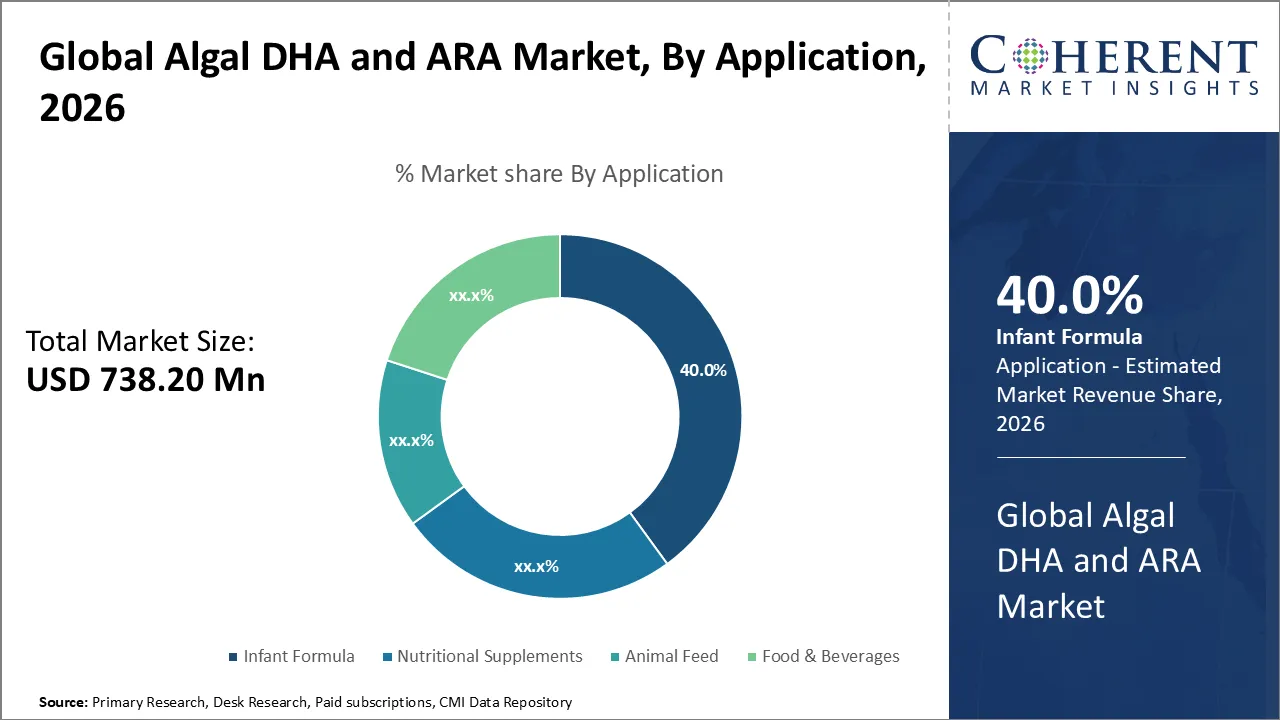
Algal DHA and ARA Market Insights, By Application: Infant formula dominates, driven by essential DHA/ARA benefits and regulatory approvals
In terms of application, the infant formula segment is expected to lead the market with 40% share in 2026. DHA and ARA are important for the growth of babies' brains and eyes, so most formulas around the world include them. Regulatory approvals, premiumization of baby nutrition, and rising demand in Asia-Pacific reinforce infant formula’s dominance in this market.
Algal DHA and ARA Market Insights, By Form: Oil leads due to superior bioavailability and easy integration into nutrition products
In terms of form, the oil segment is expected to hold 60% share of the market in 2026. Oils perform better as they are more bioavailable, easier to mix into baby formula and supplements, and stable in liquid forms. Manufacturers prefer oils due to their high quality, which leads to strong demand around the world.
For instance, in December 2025, GC Rieber Vivomega has released Algae 1060 TG Premium, a high-concentration omega-3 ingredient made from algae. It is made for supplements and functional foods, and it has a higher purity and potency than other plant-based DHA. This new product meets the growing demand for vegan nutrition solutions and strengthens Vivomega's position in the high-end.
Regional Insights
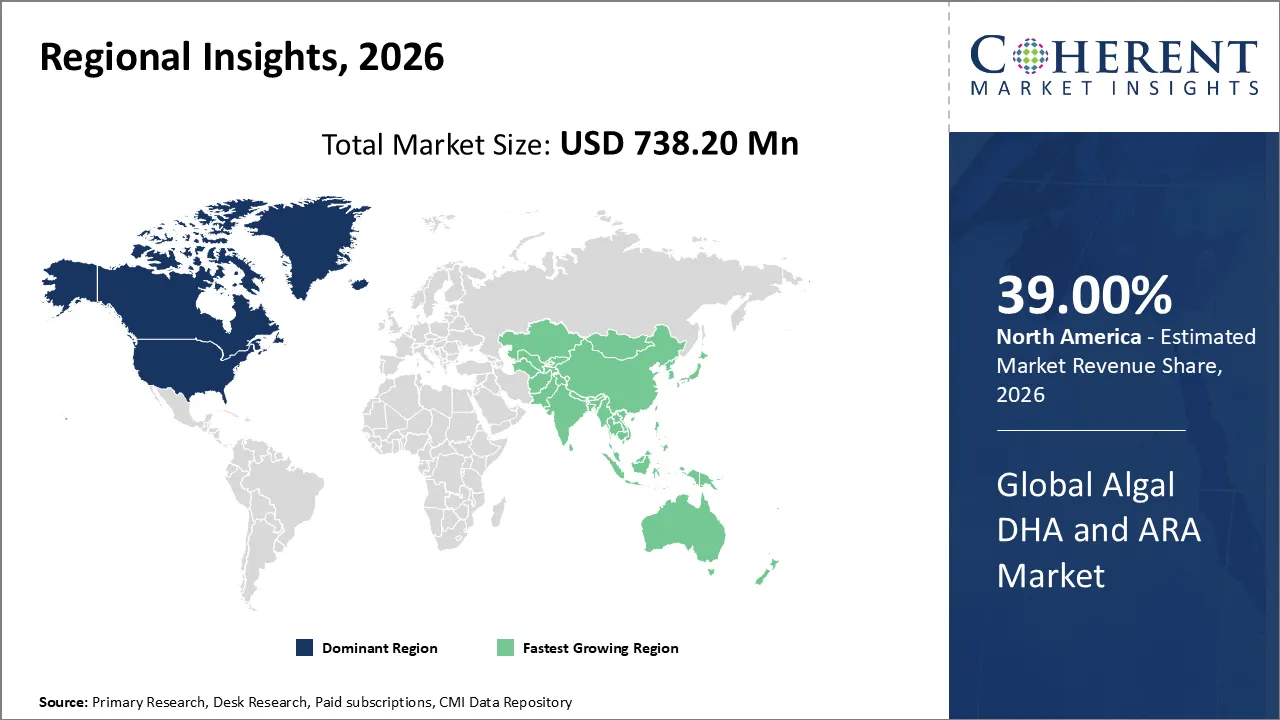
North America Algal DHA and ARA Market Analysis & Trends
North America is expected to lead the algal DHA and ARA market with 39% share in 2026, due to strong consumer awareness, infant formula is currently popular, and the nutraceutical sector is strong. Regional dominance is further fueled by trends toward sustainability, a preference for clean-label products, and advanced supply chains. This guarantees steady growth and market leadership.
For instance, in July 2025, Mara Renewables, a Canadian biotech company, got $9.1 million to increase the production of algae-based omega-3 DHA. The company wants to grow its research and development (R&D) and global manufacturing with the help of S2G Investments. Its fish-free solution meets growing consumer demand while also addressing concerns about sustainability by providing high-quality omega-3s without relying on overfished areas.
Asia Pacific Algal DHA and ARA Market Analysis & Trends
Asia Pacific is anticipated to be the fastest growing region, due to rising baby’s birth rate, expanding middle class population, and growing awareness of infant and maternal nutrition. The Asia-Pacific region is growing the fastest considering more people are choosing plant-based diets and the government is supporting sustainable food solutions.
For instance, in January 2026, Aker BioMarine is growing its omega-3 business in India, as shown at Vitafoods India 2026. It will work with G.C. Chemie Pharmie to send krill oil and algae-based DHA all over the country. The company focuses on eco-friendly, vegetarian options and has introduced Revervia, a DHA derived from algae that has a high in concentration, to meet India's growing need for plant-based food.
Algal DHA and ARA Market Outlook Country-Wise
The U.S. Algal DHA and ARA Market Trends
In 2026, the Algal DHA and ARA Market is highly demanding in the US because strong consumer awareness, infant formula is already widely used, and the nutraceutical industry is doing well. Trends toward sustainability, a preference for clean-label products, and advanced supply chains all increase demand, making the US a major market driver around the world.
China Algal DHA and ARA Market Trends
In 2026, the Algal DHA and ARA Market is extremely popular in China because of rising birth rates, high demand for infant formula, and the government's focus on child nutrition. China is a major growth driver because of rising middle-class incomes, a preference for high-quality health products, and a growing awareness of plant-based, sustainable alternatives.
For instance, in July 2025, Corbion has secured approval from China's General Administration of Customs to sell its algae-based omega-3 DHA products, AlgaPrime™ DHA and AlgaVia™ DHA. These long-lasting solutions focus on China's growing markets for human and animal nutrition. They do this by meeting the demand for high-quality, plant-based nutrition while using fewer marine resources.
Market Report Scope
Algal DHA and ARA Market Report Coverage
| Report Coverage | Details | ||
|---|---|---|---|
| Base Year: | 2025 | Market Size in 2026: | USD 738.20 Mn |
| Historical Data for: | 2020 To 2024 | Forecast Period: | 2026 To 2033 |
| Forecast Period 2026 to 2033 CAGR: | 7.47% | 2033 Value Projection: | USD 1,137.90 Mn |
| Geographies covered: |
| ||
| Segments covered: |
| ||
| Companies covered: | Koninklijke DSM N.V., Cabio Bioengineering (Wuhan) Co., Ltd., Corbion N.V., Lonza Group, Algisys, LLC, and Cargill, Incorporated. | ||
| Growth Drivers: |
| ||
| Restraints & Challenges: |
| ||
Algal DHA and ARA Market Driver
Rising demand for infant formula
The infant formula market has a big impact on the Algal DHA and ARA Market share because it uses more than half of the DHA in the world. DHA and ARA are important for the development of babies' brains and eyes, and more parents are becoming aware of this, which has led to a rise in demand for fortified formulas. Regulatory approvals in different areas make this trend even stronger and make sure that it is adopted consistently. As birth rates level off in developed countries but rise in developing countries, infant nutrition remains the biggest factor in market growth.
Growth in nutraceuticals and dietary supplements
The algal DHA and ARA market demand is rising in nutraceuticals and dietary supplements, driven by consumers want for plant-based omega-3s that are good for their hearts, brains, and immune systems. Algal-derived DHA is especially appealing to vegetarians, vegans, and people who don't want to take fish oil because they are worried about its purity and sustainability. As diseases related to lifestyle become more common, supplements with DHA and ARA are being marketed as ways to stay healthy. This trend among consumers is making it possible for more uses, such as adult wellness and clinical nutrition, to be added to infant formula.
For instance, in August 2025, Naturmega has opened the first Supercritical Fluid Fractionation Facility in South America in Barranquilla, Colombia. The plant will make ultra-pure omega-3 concentrates, such as DHA and EPA, from fish and algae. This new product makes the nutraceutical and supplement markets stronger by providing long-lasting, high-quality omega-3 ingredients.
Algal DHA and ARA Market Opportunity
Expansion in Plant-Based Nutrition
The Algal DHA and ARA Market forecast shows that there are significant opportunities in plant-based nutrition because growing awareness for vegan and sustainable diets. Algal-derived DHA and ARA are marketed as eco-friendly alternatives to fish oil, which appeals to people who care about their health and the environment. In North America and Europe, where plant-based lifestyles are growing quickly, the demand for clean-label and sustainable products is expanding quickly. This change not only helps the market grow, but it also opens up new uses for supplements, functional foods, and fortified drinks.
Analyst Opinion (Expert Opinion)
The market for algal DHA (docosahexaenoic acid) and ARA (arachidonic acid) is growing in response to increasing demand from the infant nutrition, dietary supplements, and functional food industries. According to estimates from the industry, the ability to make algal DHA has grown a lot because big companies have expanded their fermentation facilities to meet global demand. Algal sources are now known to provide a large part of the DHA used in baby formula. To follow nutritional guidelines that stress long-chain polyunsaturated fatty acids, top nutrition companies are adding microalgae-derived DHA to their products.
Strong demand in infant nutrition applications, where DHA and ARA are added to help with early cognitive and visual development, is driving market activity. Formulation data from both regulatory and industry sources show that most commercial infant formulas sold in major markets in North America, Europe, and Asia contain DHA. ARA is also commonly added to established brands. Algal DHA is being used increasingly in dietary supplements and fortified foods, in addition to baby food. This shows that people are more interested in brain and heart health. Analytical reviews of product launches reveal a notable rise in algal-based omega-3 supplements marketed for adult wellness.
The algal DHA and ARA market is growing in size, finding new uses in more nutritional areas, and seeing consumers move toward health ingredients that are backed by science and are good for the environment.
Speak to the analyst
Want personalized insights?
Take the findings above to one of our principal consultants, or have the report rebuilt around the segments, geographies and competitors you actually track.
Recent Developments
- In December 2025, MiAlgae has started building a new plant in Grangemouth, Scotland, to make eco-friendly algal omega-3 oils for pet food. The company will increase production of fish-free DHA using by-products from the whisky industry. This will help pets stay healthy, reduce the need for marine resources, and encourage circular economy practices.
- In October 2025, AAK has introduced AkoVita OptiSyn in India, South Asia, and Sub-Saharan Africa. This mix of omega-3 DHA and phosphatidylcholine helps DHA get into cell membranes better, which is good for metabolic and immune health. It is a sustainable alternative to fish and algal oils in emerging markets for functional foods and supplements.
Market Segmentation
- By Form
- Powder
- Oil
- By Application
- Infant Formula
- Nutritional Supplements
- Animal Feed
- Food & Beverages
- By Region
- North America
- U.S.
- Canada
- Latin America
- Brazil
- Argentina
- Mexico
- Rest of Latin America
- Europe
- Germany
- U.K.
- Spain
- France
- Italy
- Russia
- Rest of Europe
- Asia Pacific
- China
- India
- Japan
- Australia
- South Korea
- ASEAN
- Rest of Asia Pacific
- Middle East & Africa
- GCC Countries
- Israel
- Rest of Middle East & Africa
- North America
- Key Players
- Koninklijke DSM N.V.
- Cabio Bioengineering (Wuhan) Co., Ltd.
- Corbion N.V.
- Lonza Group
- Algisys, LLC
- Cargill, Incorporated.
Sources
Primary Research Interviews
- Algal DHA & ARA Manufacturers
- Microalgae Cultivation Technology Providers
- Fermentation & Bioprocess Equipment Suppliers
- Infant Formula Manufacturers
- Dietary Supplement & Nutraceutical Companies
- Functional Food & Beverage Manufacturers
- Contract Manufacturing Organizations (CMOs)
- Distributors & Raw Material Suppliers
- Regulatory & Quality Assurance Consultants
- Others
Databases
- Bloomberg Terminal
- Thomson Reuters Eikon
- IHS Markit
- UN Comtrade Database
- FAOSTAT
- Others
Magazines
- NutraIngredients
- FoodNavigator
- Nutritional Outlook Magazine
- Functional Foods & Nutraceuticals Magazine
- Food Technology Magazine
- Others
Journals
- Journal of Applied Phycology
- Algal Research
- Marine Drugs
- Journal of the American Oil Chemists’ Society
- Food Chemistry
- Lipids Journal
- Others
Newspapers
- Financial Times
- The Wall Street Journal
- Reuters
- Bloomberg News
- The Economic Times
- Others
Associations
- Global Organization for EPA and DHA Omega-3s (GOED)
- Algae Biomass Organization (ABO)
- Council for Responsible Nutrition (CRN)
- International Society for the Study of Fatty Acids and Lipids (ISSFAL)
- Food and Agriculture Organization (FAO)
- Others
Public Domain Sources
- U.S. Food and Drug Administration (FDA)
- European Food Safety Authority (EFSA)
- Food and Agriculture Organization (FAO)
- World Health Organization (WHO)
- UN Comtrade
- World Bank Open Data
- Others
Proprietary Elements
- CMI Data Analytics Tool
- Proprietary CMI Existing Repository of Information for the Last 8 Years
- CMI Industry Expert Panel Review
- CMI Market Modeling & Forecasting Framework
Get access to 250+ pages report
Every segment, forecast, competitor profile and data table behind the analysis above — available for instant download.
- ESOMAR Member
- ISO 9001:2015 Certified
- D-U-N-S Registered
- GDPR & CCPA Compliant
Missing comfort of reading report in your local language? Find your preferred language:
Transform your Strategy with Exclusive Trending Reports
Frequently Asked Questions
The global algal DHA and ARA market size was valued at USD 738.20 Mn in 2026 and is expected to reach USD 1,137.90 Mn in 2033.
Rising demand for infant formula and growth in nutraceuticals and dietary supplements. This is one the major factors that is expected to propel growth of the market over the forecast period
Growing demand for DHA in infant formula and increasing health consciousness among consumers is one of the main trends in market.
High production costs and limited consumer awareness act as restraints to the market growth.
Major players operating in the market includes Koninklijke DSM N.V., Cabio Bioengineering (Wuhan) Co., Ltd., Corbion N.V., Lonza Group, Algisys, LLC, and Cargill, Incorporated.
The market is estimated to grow at around 7.47% CAGR in the forecast period (2026-2033).