

Algae Market Analysis & Forecast: 2026-2033
Algae market is estimated to be valued at USD 6,104.3 Mn in 2026 and is expected to reach USD 9,808.6 Mn in 2033, exhibiting a compound annual growth rate (CAGR) of 7.0% from 2026 to 2033.
Key Takeaways
- Based on Cultivation Technology, the Closed System division is poised to hold around 53.2% shares in the global market in 2026.
- Regionally, North America is projected to dominate the global algae market with 31.50% shares during the forecast period.
Market Overview
The global algae market is experiencing steady growth, driven by increasing demand for sustainable, plant-based ingredients across food, nutraceuticals, cosmetics, and biofuel sectors. Key trends include rising consumer awareness of health and wellness, the shift toward natural and clean-label products, and the environmental benefits of algae cultivation, such as low land and water use. Technological advancements in cultivation and processing, along with expanding applications and supportive government policies, are further accelerating market development.
Current Events and their Impact on the Global Algae Market
Current Event | Description and its Impact |
Climate Policy Acceleration and Carbon Neutrality Commitments |
|
Technological Breakthroughs in Algae Cultivation and Processing |
|
Macroeconomic and Microeconomic Factors Impacting Growth - Global Algae Market
Macroeconomic Factors
- Global Health & Wellness Trends: Increasing focus on preventive healthcare, nutrition, and plant-based diets globally is driving demand for algae-based functional foods and supplements.
- Environmental Sustainability Pressures: Climate change policies, carbon reduction targets, and global sustainability goals are pushing industries toward eco-friendly solutions—algae cultivation aligns well due to low land/water use and carbon sequestration potential.
- Economic Development in Emerging Markets: Rapid urbanization, rising middle-class incomes, and improved access to nutritional products in countries like India, Brazil, and Southeast Asia are creating new demand for algae-derived products.
Microeconomic Factors
- Production Costs & Technology: High costs of cultivation, harvesting, and processing—especially in closed systems—can limit competitiveness unless offset by technological advancements or scale.
- Consumer Preferences: Increasing demand for clean-label, vegan, natural, and functional ingredients is influencing product formulation decisions, especially in food, cosmetics, and supplements.
- Market Competition & Innovation: A growing number of players entering the algae market is driving innovation but also increasing price competition, especially in commodity segments.
- Current Industry Events of 2026
- Market Size Estimation
- Regional Breakdown
- Competitive Landscape
- Customer Intelligence
- Segmental Analysis
- Pricing Analysis
- Key Market Drivers, Challenges & Future Trends
- Customized Insights Section
Segmental Insights
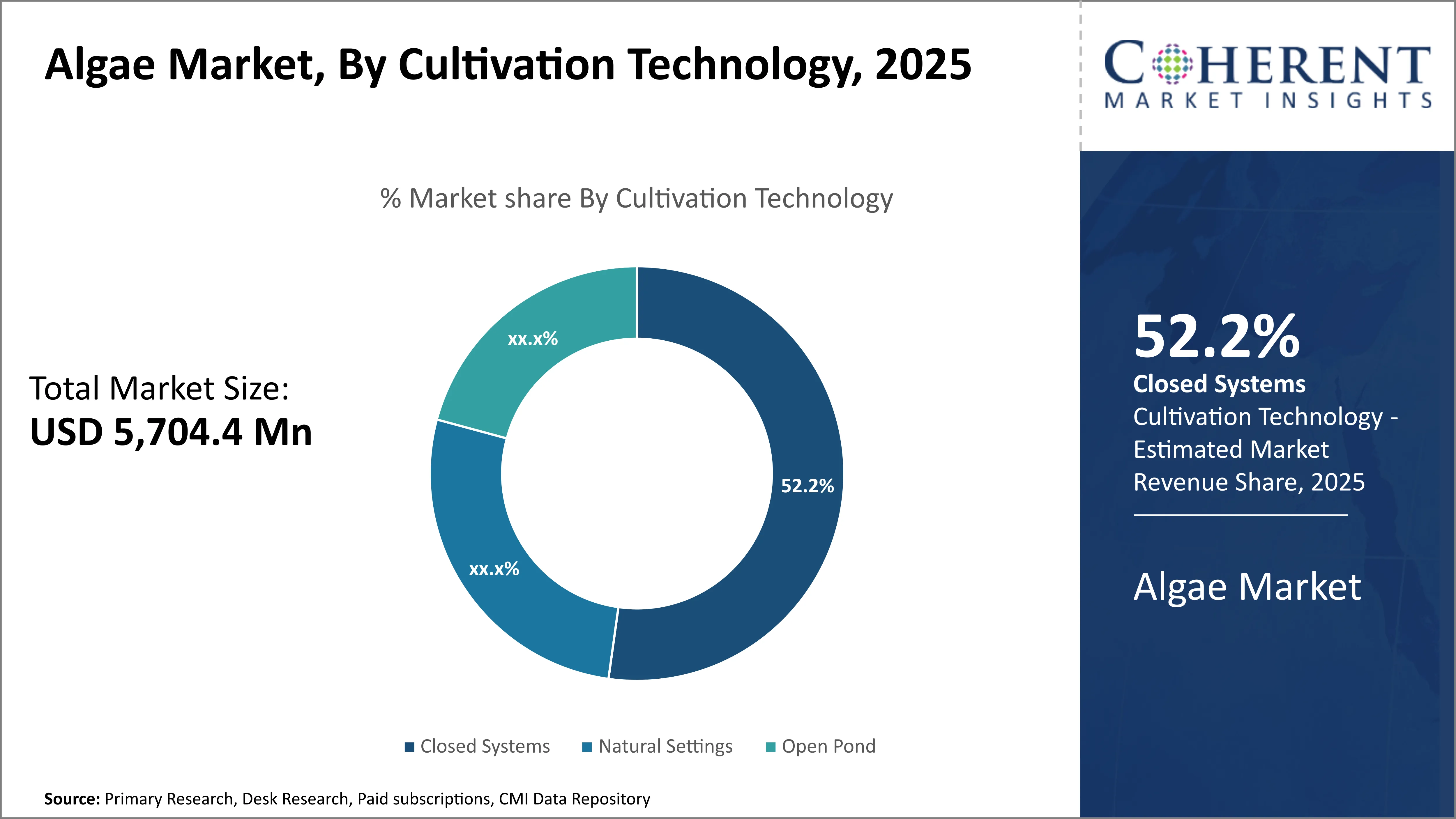
Global Algae Market Insights, by Cultivation Technology
Based on cultivation technology, closed system is projected to hold around 53.2% shares in the global algae market in 2026. This is owing to their ability to provide controlled growing environments that improve algal biomass productivity, purity, and quality while minimizing contamination risks.
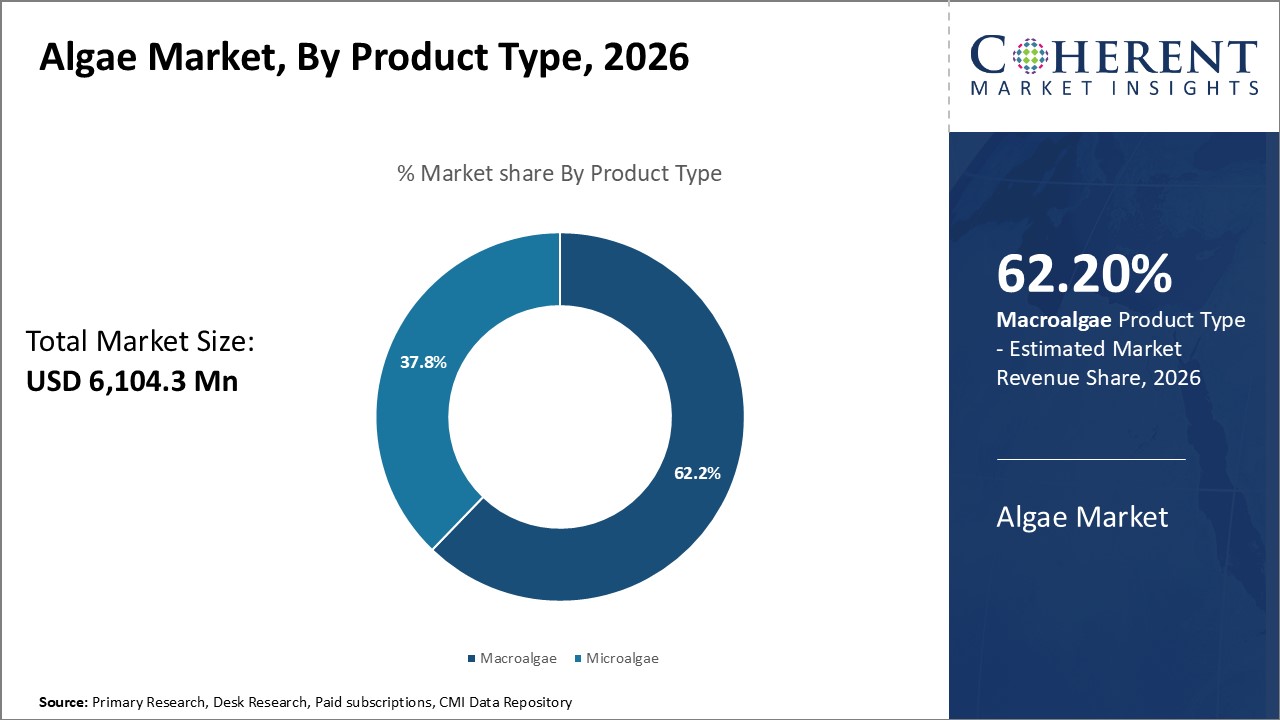
Global Algae Market Insights, by Product Type
Based on product type, macroalgae segment is projected to hold highest shares in the global algae market in 2026. This is owing to its widespread use in food products, hydrocolloids (such as agar, carrageenan, and alginate), animal feed, and cosmetics, combined with its abundant availability and well-established commercial cultivation practices.
Global Algae Market Insights, by Application
Based on application, food & beverages sector is projected to hold largest shares in the global algae market in 2026. This is owing to the increasing consumer demand for natural, plant-based, and nutrient-rich ingredients that enhance health and wellness.
For instance, in October 2026, SIG and Nutrition from Water (NXW) announced a global partnership to develop integrated product concepts that combined algae-based protein beverages with advanced aseptic packaging. The initiative was designed to help close the nutrition gap in rapidly growing economies, delivering protein-rich nutrition to communities where it was needed most.
Regional Insights
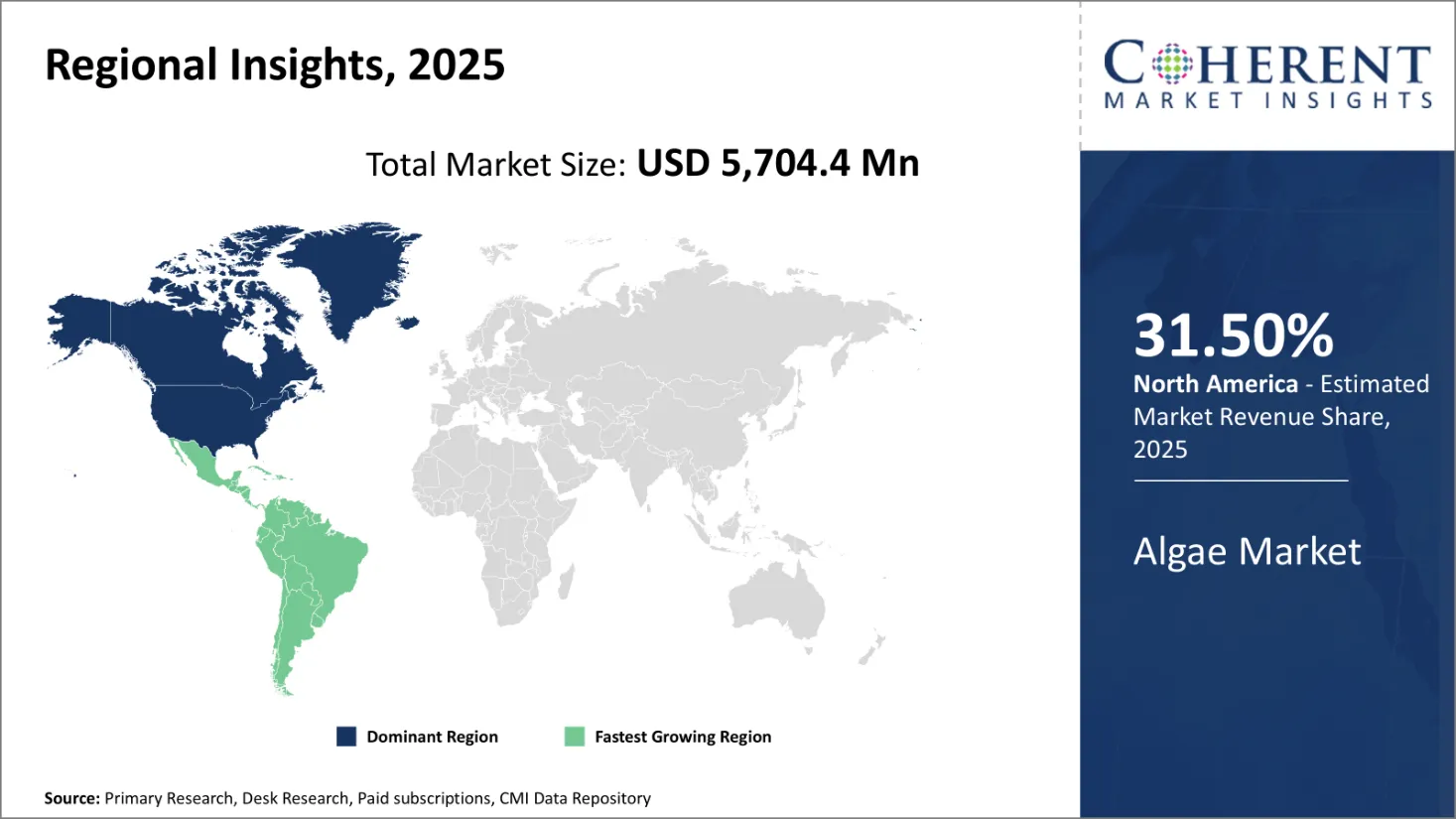
North America Algae Market Analysis and Trends
North America has largest market share 31.50% in global algae market, due to its strong demand for algae-based products in nutraceuticals, food & beverages, cosmetics, and pharmaceuticals. The region benefits from advanced research and development infrastructure, favorable regulatory frameworks, and a high level of consumer awareness regarding health, sustainability, and clean-label products.
For instance, in October 2023, DSM-Firmenich, a leading innovator in health, nutrition, and beauty, announced the North American launch of life’s®OMEGA O3020, the first and only single-source algal omega-3 with the same eicosapentaenoic acid (EPA) to docosahexaenoic acid (DHA) ratio naturally found in standard fish oil, but with twice the potency.
Latin America Algae Market Analysis and Trends
Latin America has the second largest share 18.00% in global algae market, owing to its abundant coastal resources, favorable climatic conditions, and growing aquaculture industry—especially in countries like Chile, Brazil, and Peru. The region has a long history of seaweed harvesting and is expanding into commercial algae cultivation for use in animal feed, agriculture (biofertilizers), and food ingredients.
Global Algae Market – Dominating Countries
The U.S. Algae Market Analysis and Trends
The U.S. is projected to hold dominating position in the global algae market in 2026, owing to its advanced biotechnology infrastructure, strong demand for algae-based products in nutraceuticals, functional foods, cosmetics, and biofuels, and the presence of leading algae research institutions and companies. Supportive regulatory frameworks, increasing consumer preference for plant-based and sustainable products, and rising investments in algae-derived innovations—such as omega-3 supplements, protein alternatives, and bioenergy—are further strengthening the U.S. position as a key player in the global market.
For instance, The U.S. Department of Energy (DOE) Office of Fossil Energy (FE) announced plans to make $8 million in federal funding available for cost-shared research, development, and testing of technologies that could utilize carbon dioxide (CO₂) from power systems or other industrial sources for bio-mediated uptake by algal systems to create valuable products and services.
China Algae Market Analysis and Trends
China is projected to hold dominating position in the global algae market in 2026, owing to its large-scale algae production capacity, particularly in seaweed cultivation, and its long-standing integration of algae in traditional diets, agriculture, and medicine.
For instance, in July 2026, Corbion, an Amsterdam-based sustainable ingredients company, received regulatory approvals from China's General Administration of Customs (GACC) for its algae-derived omega-3 DHA products, opening access to China's expanding animal nutrition market.
Analyst Opinion: Global Algae Market
The global algae market is experiencing robust growth, driven by rising demand for sustainable, plant-based products in food, nutraceuticals, cosmetics, and biofuels. Key trends include increasing consumer preference for natural ingredients, advancements in algae cultivation and processing technologies, and expanding applications across industries.
North America dominates the market due to its strong seaweed production, favorable climate, government support, and large consumer base—especially in countries like U.S. and Canada. With ongoing innovations and growing environmental awareness, the algae market is expected to see steady expansion worldwide.
Speak to the analyst
Want personalized insights?
Take the findings above to one of our principal consultants, or have the report rebuilt around the segments, geographies and competitors you actually track.
Global Algae Market- Recent Developments
- In October 2025, The European Union launched four new projects to expand sustainable algae farming and blue innovation hubs across Europe’s seas, allocating €5.7 million ($6.1 million) in funding under the European Maritime, Fisheries and Aquaculture Fund (EMFAF).
- In April 2025, Pond Technologies Holdings Inc. announced its intention to look to integrate artificial intelligence into its proprietary algae-growing control systems.
- In April 2023, MiAlgae launched algae derived omega-3 product for aqua feed and pet food.
Market Report Scope
Algae Market Report Coverage
| Report Coverage | Details | ||
|---|---|---|---|
| Base Year: | 2025 | Market Size in 2026: | USD 6,104.3 Mn |
| Historical Data for: | 2020 To 2024 | Forecast Period: | 2026 To 2033 |
| Forecast Period 2026 to 2033 CAGR: | 7.0% | 2033 Value Projection: | USD 9,808.6 Mn |
| Geographies covered: |
| ||
| Segments covered: |
| ||
| Companies covered: | Cyanotech Corporation, Dic Corporation, Corbion N.V, Valagro SpA, Far East Microalgae Industries Co. Ltd., Beijing Gingko Group, Heliae Development Llc, Pond Technologies Holdings Inc., Algaetech International Sdn Bhd, Fuqing King Dnarmsa Spirulina Co. Ltd., Sun Chlorella Corporation, and Ecoduna Ag. | ||
| Growth Drivers: |
| ||
| Restraints & Challenges: |
| ||
Global Algae Market- Trends
Increasing Demand for Algae-based Products
Algae-derived products are marketed as healthy food available in different forms like capsules, tablets, and liquids. In country like China and region like Europe, shift in consumer demand for the dietary supplements category is witnessed. Algae ingredients are mixed with candies, gums, snacks, and beverages, due to its high protein and nutritious nature.
Nutraceutical products like nutrient bars, functional beverages, and supplements are prime applications of microalgae. Algae like Arthospira and Chlorella are commonly used in food supplements. Spirulina and Chlorella are most popular algae ty. Algae products are also used in biofuel sector.
Global Algae Market- Drivers
Increasing consumption of protein-rich products
Increasing consumption of protein products is expected to boost the growth of the global algae market during the forecast period, owing to evolving living standards of people, and growing health awareness among consumers. Algae protein prevents weight gain, relieves fatigue and anxiety, and treats Attention Deficit-Hyperactivity Disorder (ADHD), and diabetes, among others. Algae are enriched in nutrient content, has positive effect on t immune system, and has other health-related benefits, all these factors are driving the market growth globally.
Furthermore, rising sustainability concerns such as increased greenhouse gas emissions, and biodiversity loss during meat production, has shifted consumer preference toward plant-based and other alternative sources. Due to health awareness people around the globe are prefering fit lifestyle. Furthermore, people are consuming products such as algae, meat, eggs, and supplements in order to strengthen their muscles, and to improve their physique. As a result, the global demand for protein-rich products is increasing, and this is expected to boost the global market growth.
Increasing demand for algea in the pharmaceutical industry
Rising demand of algae from the pharmaceutical industry is expected to fuel the growth of global algae market during forecast period. Algae are used in the pharmaceutical industry as antimicrobials, therapeutic proteins, antivirals, drugs, and antifungals. Polyphenols, phycobiliproteins, and vitamins are powerful water-soluble antioxidants that are present in algae.
Antioxidants prevent tumor growth by regressing premalignant lesions. Algae and algae-derived materials are allowed to be used in fertilizing products under the European Union Fertilising Products Regulation 2019/1009 (FPR), either in CE (Conformite Europeenne) -marked products or in products that are authorized under national legislation.
Market Segmentation
- Cultivation Technology Insights (Revenue, USD Mn, 2021 - 2033)
- Open Pond
- Natural Settings
- Closed System
- Product Type Insights (Revenue, USD Mn, 2021 - 2033)
- Microalgae
- Macroalgae
- Application Insights (Revenue, USD Mn, 2021 - 2033)
- Food & Beverages
- Nutraceutical
- Pharmaceutical
- Cosmetics
- Animal and Fish Feed
- Biofuel
- Wastewater Treatment
- Fertilizers
- Specialty Chemicals and Polymers
- Regional Insights (Revenue, USD Mn, 2021 - 2033)
- North America
- U.S.
- Canada
- Latin America
- Brazil
- Argentina
- Mexico
- Rest of Latin America
- Europe
- Germany
- U.K.
- Spain
- France
- Italy
- Russia
- Rest of Europe
- Asia Pacific
- China
- India
- Japan
- Australia
- South Korea
- ASEAN
- Rest of Asia Pacific
- Middle East
- GCC Countries
- Israel
- Rest of Middle East
- Africa
- South Africa
- North Africa
- Central Africa
- North America
- Global Algae Market- Competitive Section
- Cyanotech Corporation
- Dic Corporation
- Corbion N.V
- Valagro SpA
- Far East Microalgae Industries Co. Ltd.
- Beijing Gingko Group
- Heliae Development Llc
- Pond Technologies Holdings Inc.
- Algaetech International Sdn Bhd
- Fuqing King Dnarmsa Spirulina Co. Ltd.
- Sun Chlorella Corporation
- Ecoduna Ag.
Sources
Primary Research Interviews
- Algae cultivation facility owners and operators
- Biotech companies specializing in algae-based products
- Food and nutraceutical manufacturers using algae ingredients
- Biofuel production companies utilizing algae feedstock
- Others
Databases
- Global Trade Atlas (GTA)
- Euromonitor International
- IBISWorld Industry Reports
- Others
Magazines
- Algae Industry Magazine
- Biofuels Digest
- Nutraceuticals World
- Food Processing Magazine
- Others
Journals
- Journal of Applied Phycology
- Algal Research
- Bioresource Technology
- Others
Newspapers
- Financial Times
- Wall Street Journal
- Reuters Business News
- Bloomberg News
- Others
Associations
- Algae Biomass Organization (ABO)
- International Society for Applied Phycology (ISAP)
- Biotechnology Innovation Organization (BIO)
- Global Bioenergy Partnership (GBEP)
- Others
Public Domain Sources
- U.S. Department of Energy (DOE) reports
- European Commission research publications
- FAO (Food and Agriculture Organization) databases
- National Renewable Energy Laboratory (NREL) publications
- Others
Proprietary Elements
- CMI Data Analytics Tool
- Proprietary CMI Existing Repository of information for last 8 years
Market Definition
Algae are photosynthetic eukaryotic organisms that grow in aquatic climates, and uses light and carbon dioxide (CO2) to produce biomass. Demand for macroalgae and microalgae food is increasing, owing to health benefits and nutrition. Furthermore, algae offers higher oil yield as compared to biofuel feedstock containing sorghum, corn stover, beet, and corn, and thiscreateimmense opportunities for growth of the global algae market. Increasing research and development activities among manufacturers of algae is expected to fuel the market growth. Increasing demand for reliable, sustainable, and low-cost source of energy in order to ease the petroleum supply chain, and to meet rising demand of algae from the aviation and automotive sector is expected to drive the growth of the global algae market during the forecast period.
Get access to 250+ pages report
Every segment, forecast, competitor profile and data table behind the analysis above — available for instant download.
- ESOMAR Member
- ISO 9001:2015 Certified
- D-U-N-S Registered
- GDPR & CCPA Compliant
Missing comfort of reading report in your local language? Find your preferred language:
Transform your Strategy with Exclusive Trending Reports
Frequently Asked Questions
The algae market is estimated to be valued at USD 6,104.3 Mn in 2026, and is expected to reach USD 9,808.6 Mn by 2033.
Increasing consumption of protein-rich products, increasing demand for algea in the pharmaceutical industry are the major factors that are expected to drive growth of the market
Increasing demand for algae-based products is the trend in the market.
High production cost of algae is one of the major factors that is expected to hamper the growth of the market over the forecast period.
Major players operating in the global algae market include Cyanotech Corporation, Dic Corporation, Corbion N.V, Valagro SpA, Far East Microalgae Industries Co. Ltd., Beijing Gingko Group, Heliae Development Llc, Pond Technologies Holdings Inc., Algaetech International Sdn Bhd, Fuqing King Dnarmsa Spirulina Co. Ltd., Sun Chlorella Corporation, and Ecoduna Ag.
The CAGR of the algae market is projected to be 7.0% from 2026 to 2033.