

Sports Equipment Market Size and Forecast – (2026 - 2033)
The sports equipment market is estimated to be valued at USD 456.60 Bn in 2026 and is expected to reach USD 728.49 Bn by 2033, exhibiting a compound annual growth rate (CAGR) of 6.9% from 2026 to 2033.
Key Takeaways
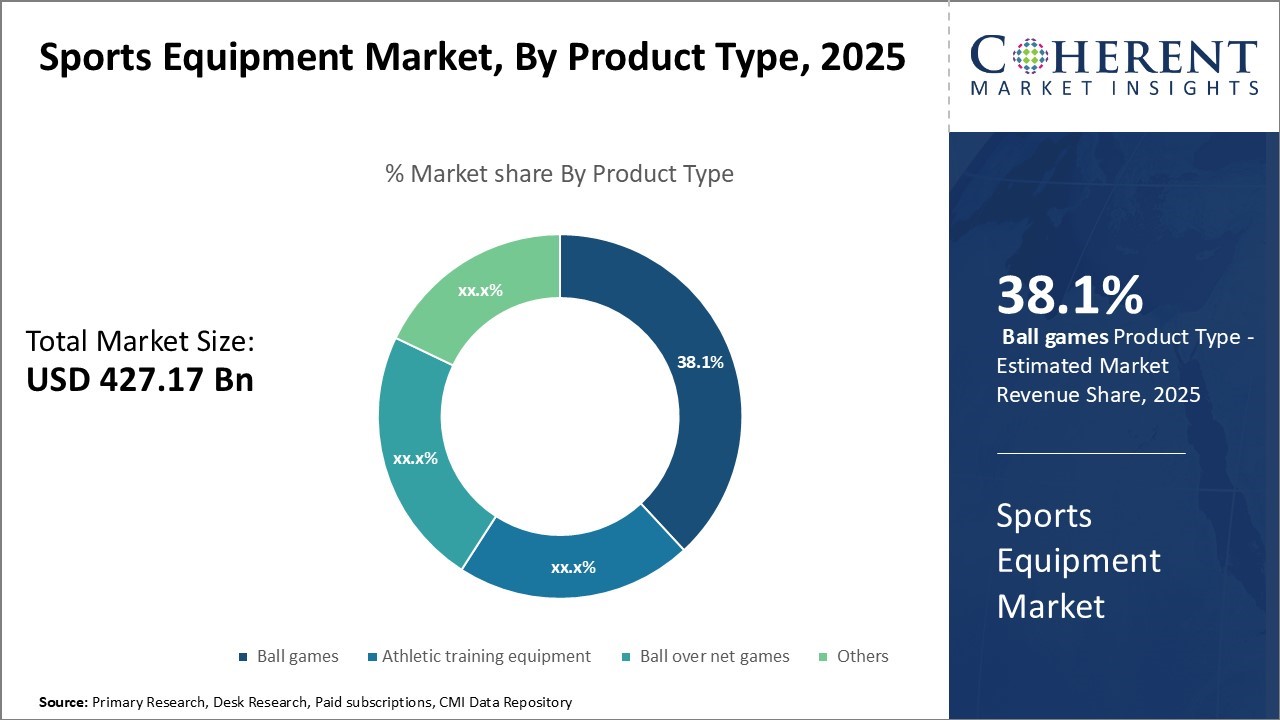
- By Product Type, Ball games hold the largest market share of 39.1% in 2026 owing to the rising global participation in sports.
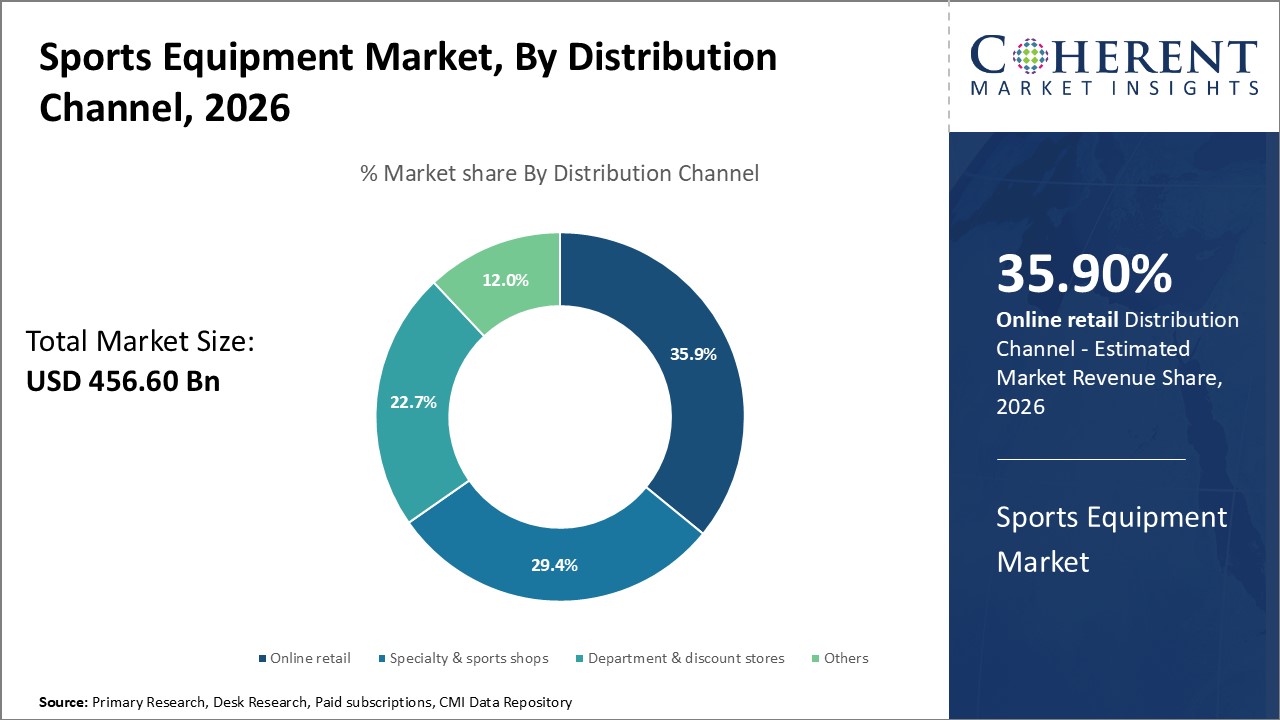
- By Distribution Channel, Online retail expected to hold largest market share of 35.9% in 2026 owing to its convenience & ease of shopping.
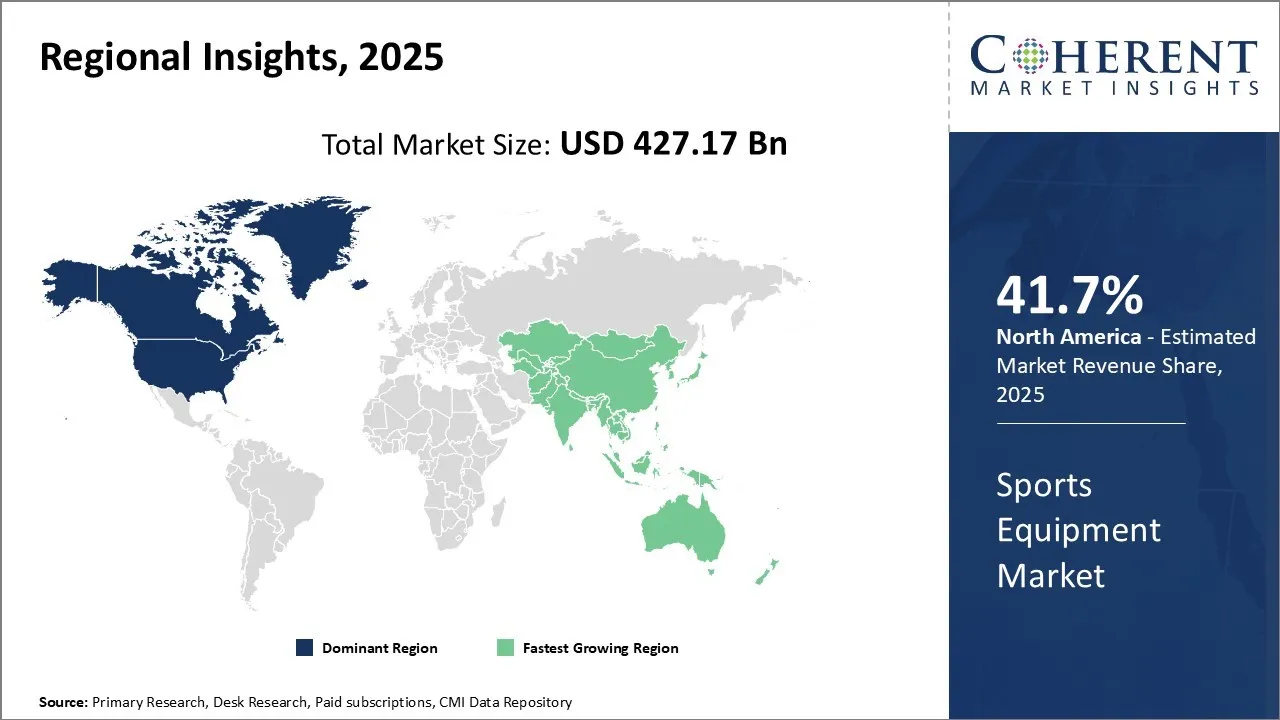
- By Region, North America dominates the overall market with an estimated share of 41.7% in 2026 owing to the strong sports culture & high participation.
Market Overview
The global sports equipment market is growing rapidly as more people prioritize health and actively participate in recreational and professional sports, fitness routines, and outdoor activities. Manufacturers are improving performance and durability through technological advancements in materials and smart equipment, while retailers expand access via e-commerce and other channels. Popular sporting events, youth programs, and professional leagues drive demand, and lifestyle trends, government initiatives, and brand innovations continue to shape a dynamic and competitive market landscape.
Current Events and Its Impact on the Sports Equipment Market
Current Events | Description and its impact |
Geopolitical and Trade Developments |
|
Technological Innovations and Sustainability Trends |
|
Economic Factors and Consumer Behavior |
|
Segmental Insights
- Current Industry Events of 2026
- Market Size Estimation
- Regional Breakdown
- Competitive Landscape
- Customer Intelligence
- Segmental Analysis
- Pricing Analysis
- Key Market Drivers, Challenges & Future Trends
- Customized Insights Section
Sports Equipment Market Insights, By Product Type - Ball Games contribute the highest share of the market owing to its health, fitness & lifestyle trends
Ball games hold the largest market share of 39.1% in 2026. The ball games segment in the sports equipment market is expanding as more people worldwide actively participate in sports like soccer, basketball, volleyball, and cricket. Professional leagues and international tournaments spark interest and motivate amateur players. Manufacturers improve performance and durability through technological innovations in materials and design, attracting consumers. Growing health awareness, the development of sports infrastructure, and convenient access via retail and e-commerce channels drive demand, while marketing campaigns, endorsements, and emerging markets continue to shape this dynamic segment.
For instance, in November 2025, Spalding partnered with Overtime and Overtime Elite, naming the Legacy TF-1000 as the league’s official game ball. The deal covers all OTE games and includes product development and retail distribution rights.
Sports Equipment Market Insights, By Distribution Channel - Online retail contributes the highest share of the market owing to its personalized & tech‑enhanced shopping
Online retail expected to hold largest market share of 35.9% in 2026. Online retail in the sports equipment market is expanding as consumers increasingly seek convenience, browsing, comparing, and purchasing products from any location. Growing internet and smartphone use, along with mobile commerce, improves accessibility. E-commerce platforms attract diverse buyers by offering a wider product selection, competitive pricing, and personalized recommendations. Rising health and fitness awareness, home workout trends, and global market reach further boost online demand, while efficient logistics, secure payment systems, and brand promotions strengthen this rapidly growing digital marketplace.
For instance, in December 2024, BigCommerce, an open SaaS, composable ecommerce platform for B2C and B2B brands, announced that Mizuno USA, a popular sports brand, has launched its new website on the BigCommerce platform.
Regional Insights
North America Sports Equipment Market Trends
North America dominates the overall market with an estimated share of 41.7% in 2026. Consumers’ growing focus on health, fitness, and active lifestyles is driving demand across professional, recreational, and home-based sports, shaping the North America sports equipment market. Manufacturers attract both amateur and professional athletes through innovations in smart and high-performance equipment. Widespread participation in youth programs, collegiate sports, and professional leagues sustains steady sales. E-commerce and omnichannel retail enhance product accessibility, while outdoor recreation and lifestyle activities broaden demand. Brand promotions, sponsorships, and government initiatives encouraging physical activity continue to influence market trends. For instance, in August 2026, the City of Surrey partnered with Jumpstart Charities and Equip Sport to become the first in North America to offer free sports equipment lending. The city launched 30 self-service stations providing items like fitness gear, soccer balls, basketballs, and table tennis sets.
Asia Pacific Sports Equipment Market Trends
Rising disposable incomes, urbanization, and growing health awareness are driving people across Asia Pacific to adopt active lifestyles and participate in sports, expanding the sports equipment market. Increasing interest in team sports, fitness activities, and outdoor recreation boosts demand among all age groups. Governments and organizations invest in sports infrastructure and promote school and community sports programs to support growth. E-commerce platforms and social media marketing improve product accessibility and visibility, while manufacturers attract amateur and professional athletes with durable, high-performance equipment innovations. For instance, in April 2026, Messe Frankfurt Trade Fairs India Pvt Ltd partnered with Concept N Strategies to launch the Sporttech Pavilion at Techtextil India 2026, showcasing sports and activewear textiles and accessories.
United States Sports Equipment Market Trends
Consumers in the United States are increasingly embracing fitness, wellness, and active lifestyles, driving growth in the sports equipment market. Strong interest in professional leagues, collegiate sports, and youth programs fuels demand for both team and individual sports gear. Manufacturers attract buyers by introducing innovative, high-performance, and smart equipment. E-commerce and omnichannel retail channels enhance product accessibility and convenience, while outdoor recreation and lifestyle trends broaden demand. Marketing campaigns, sponsorships, and community programs promoting physical activity continue to influence and shape the market.
India Sports Equipment Market Trends
Rising health awareness and growing participation in fitness and sports activities are driving growth in the India sports equipment market. Consumers actively engage in cricket, football, and traditional sports, while increasing interest in gym workouts and outdoor recreation expands demand for diverse equipment. Governments and organizations invest in sports infrastructure and promote school and community programs to support organized sports. E-commerce platforms and digital marketing improve product accessibility, and manufacturers attract amateur and professional athletes with innovative, durable, and affordable equipment across urban and semi-urban areas. For instance, in August 2026, Decathlon partnered with the University for the Creative Arts (UCA) to develop mass-market cricket gear based on circular economy principles, starting with gloves and leg guards.
End-user Feedback and Unmet Needs in the Sports Equipment Market
- Product Performance and Durability: End-users often seek equipment that delivers consistent performance and withstands intensive use. Feedback highlights concerns over wear-and-tear, substandard materials, and the need for more reliable, long-lasting gear. Manufacturers face opportunities to innovate with high-quality, durable materials that improve user experience and reduce frequent replacement costs.
- Affordability and Value for Money: Many consumers express the need for reasonably priced sports equipment without compromising quality. Feedback indicates that high costs limit accessibility, especially for youth and amateur players. Addressing affordability through cost-effective materials, modular designs, or budget-friendly product lines can expand market reach and satisfy price-sensitive buyers.
- Customization and Fit: Users increasingly desire equipment tailored to their size, skill level, or playing style. Standardized products often fail to meet these preferences, causing discomfort or suboptimal performance. Offering customizable options, adjustable gear, and personalized features can enhance user satisfaction and loyalty
Sports Equipment Market Trend
Growing Health and Fitness Awareness
Consumers are increasingly prioritizing physical health and wellness, driving widespread participation in recreational, professional, and home-based sports. This trend encourages demand for fitness equipment, wearables, and sports accessories. Brands are responding by launching innovative products that cater to workouts, outdoor activities, and lifestyle sports, aligning with evolving consumer habits and promoting a healthier, active lifestyle. The focus on personal well-being continues to expand market potential across all age groups and regions.
Technological Advancements in Equipment
The market is witnessing innovation in materials, design, and smart technology integration. Equipment now features enhanced durability, ergonomic design, and performance tracking capabilities through sensors and apps. These innovations attract both amateur and professional athletes seeking improved outcomes and personalized experiences. Brands are increasingly investing in R&D to offer high-performance gear, blending technology with traditional sports equipment, thereby creating a competitive advantage and responding to consumers’ demand for smarter, more effective products.
Sports Equipment Market Opportunity
Integration of Smart and Connected Equipment
Consumers increasingly demand technologically advanced sports equipment that tracks performance, monitors health, and enhances training. Opportunities exist in developing smart wearables, connected balls, and sensor-equipped fitness gear. Brands can innovate by combining traditional equipment with mobile apps and analytics tools, creating a personalized user experience. By catering to tech-savvy athletes and fitness enthusiasts, manufacturers can differentiate products, increase engagement, and drive premium sales, positioning themselves as leaders in the evolving intersection of sports and technology.
Market Report Scope
Sports Equipment Market Report Coverage
| Report Coverage | Details | ||
|---|---|---|---|
| Base Year: | 2025 | Market Size in 2026: | USD 456.60 Bn |
| Historical Data for: | 2020 To 2024 | Forecast Period: | 2026 To 2033 |
| Forecast Period 2026 to 2033 CAGR: | 6.9% | 2033 Value Projection: | USD 728.49 Bn |
| Geographies covered: |
| ||
| Segments covered: |
| ||
| Companies covered: | Nike Inc., Adidas AG, Amer Sports, New Balance Athletics, Inc., Daei Sportswear & Equipment, Kering S.A., Sports Direct International plc, Black Diamond Equipment, Ltd, ANTA Sports Products Limited, Yonex Co., Ltd, Adidas AG , MIZUNO Corporation, Quiksilver, Inc., Globeride, Inc., Callaway Golf Company, Shenzhen Taishan Sports Technology Co., Ltd, Callaway Golf Co., BPS Direct, LLC, Yonex Co., Ltd, and Under Armour | ||
| Growth Drivers: |
| ||
| Restraints & Challenges: |
| ||
Sports Equipment Market News
- In September 2025, Boldfit partnered with Sania Mirza as an athlete and investor to co-create and promote tennis rackets and pickleball paddles designed for Indian players.
- In November 2025, BSN SPORTS, a division of Varsity Brands, launched Club Direct, a dedicated division serving the youth club sports market.
- In May 2025, Reusch launched the Attrakt Fusion Carbon 3D, the world’s first goalkeeper glove with a 3D-printed punch zone, developed in collaboration with Carbon.
Analyst Opinion (Expert Opinion)
- The sports equipment industry is no longer defined by incremental participation trends alone; it is being reshaped by structural shifts in consumer behavior and technological adoption. Traditional dominance of ball sports gear — which commanded over 70 % share of the equipment segment in 2024 — indicates an enduring cultural preference that underpins stable demand for core categories like soccer, basketball, and tennis gear. However, this figure also highlights market concentration risk should participation trends diversify or high‑visibility sports decline.
- Regional market behavior underscores asymmetric growth profiles. North America remains a structural powerhouse with roughly 38 % of demand, but Asia‑Pacific’s rapid expansion signals a transformative inflection point — propelled by urbanization, rising disposable incomes, and public health initiatives that elevate participation benchmarks. Industry reports consistently show China and India as critical engines of volume growth, with China alone projected to generate the highest equipment revenues globally.
- Brand strategy and competitive positioning are also in flux. The recent launch of a premium pickleball paddle by a non‑traditional entrant like Tesla — selling out in hours despite premium pricing — is emblematic of lifestyle branding reshaping high‑end equipment demand and expanding the market beyond core sports consumers. Such cross‑sector alliances highlight latent willingness among affluent segments to pay for design differentiation and aspirational association.
- Institutional demand remains a critical stabilizer. Over 25 % of equipment consumption is attributed to education, professional leagues, and training centers, insulating manufacturers from purely consumer‑cyclical demand fluctuations and justifying continued investment in high‑precision training and protective gear.
Speak to the analyst
Want personalized insights?
Take the findings above to one of our principal consultants, or have the report rebuilt around the segments, geographies and competitors you actually track.
Market Segmentation
- Product Type Insights (Revenue, USD Bn, 2021 - 2033)
- Athletic training equipment
- Ball games
- Ball over net games
- Others
- Distribution Channel Insights (Revenue, USD Bn, 2021 - 2033)
- Online retail
- Specialty & sports shops
- Department & discount stores
- Others
- Regional Insights (Revenue, USD Bn, 2021 - 2033)
- North America
- U.S.
- Canada
- Latin America
- Brazil
- Argentina
- Mexico
- Rest of Latin America
- Europe
- Germany
- U.K.
- Spain
- France
- Italy
- Russia
- Rest of Europe
- Asia Pacific
- China
- India
- Japan
- Australia
- South Korea
- ASEAN
- Rest of Asia Pacific
- Middle East & Africa
- GCC Countries
- Israel
- Rest of Middle East & Africa
- North America
- Key Players Insights
- Nike Inc.
- Adidas AG
- Amer Sports
- New Balance Athletics, Inc.
- Daei Sportswear & Equipment
- Kering S.A.
- Sports Direct International plc
- Black Diamond Equipment, Ltd
- ANTA Sports Products Limited
- Yonex Co., Ltd
- Adidas AG
- MIZUNO Corporation
- Quiksilver, Inc.
- Globeride, Inc.
- Callaway Golf Company
- Shenzhen Taishan Sports Technology Co., Ltd
- Callaway Golf Co.
- BPS Direct, LLC
- Yonex Co., Ltd
- Under Armour
Sources
Primary Research interviews
- Industry experts
- Retailers and distributors of sports equipment
- Manufacturers and suppliers
- Sports clubs and fitness centers
Databases
- Sports Reference
- Government trade databases
- International Trade Centre (ITC) Trade Map
Magazines
- Sports Illustrated
- Runner’s World
- Golf Digest
- Athletic Business
Journals
- Journal of Sports Sciences
- International Journal of Sports Management
- Sports Technology Journal
- Journal of Physical Activity and Health
Newspapers
- The New York Times (Sports Section)
- The Guardian (Sports Business Section)
- The Wall Street Journal (Sports & Leisure Section)
- Financial Times (Sports & Retail Coverage)
Associations
- International Olympic Committee (IOC)
- National Sporting Goods Association (NSGA)
- World Federation of the Sporting Goods Industry (WFSGI)
- National Collegiate Athletic Association (NCAA)
Public Domain sources
- Government publications on sports and fitness trends
- Census and demographic reports
- Annual reports of publicly listed sports equipment companies
- Open-access research papers on sports market trends
Proprietary Elements
- CMI Data Analytics Tool
- Proprietary CMI Existing Repository of information for last 8 years
Get access to 250+ pages report
Every segment, forecast, competitor profile and data table behind the analysis above — available for instant download.
- ESOMAR Member
- ISO 9001:2015 Certified
- D-U-N-S Registered
- GDPR & CCPA Compliant
Missing comfort of reading report in your local language? Find your preferred language:
Transform your Strategy with Exclusive Trending Reports
Frequently Asked Questions
The Sports Equipment Market is estimated to be valued at USD 456.60 Bn in 2026, and is expected to reach USD 728.49 Bn by 2033.
The CAGR of the Sports Equipment Market is projected to be 6.9% from 2026 to 2033.
Increasing popularity of recreational sports and inclusion and diversity in sports are the major factors driving the growth of the global sports equipment market.
High cost of specialized sports equipment and seasonality in demand are the major factors hampering the growth of the global sports equipment market.
In terms of product type, ball games is estimated to dominate the market revenue share in 2026.
Nike Inc., Adidas AG, Amer Sports, New Balance Athletics, Inc., Daei Sportswear & Equipment, Kering S.A. , Sports Direct International plc, Black Diamond Equipment, Ltd, ANTA Sports Products Limited, Yonex Co., Ltd, Adidas AG , MIZUNO Corporation, Quiksilver, Inc. , Globeride, Inc., Callaway Golf Company, Shenzhen Taishan Sports Technology Co., Ltd, Callaway Golf Co., BPS Direct, LLC, Yonex Co., Ltd, and Under Armour are the major players.
North America is expected to lead the global sports equipment market.