

Global Sprinkles Market Size and Forecast – 2026 To 2033
The Global Sprinkles Market is estimated to be valued at USD 1,923.2 Mn in 2026 and is expected to reach USD 3,128.9 Mn by 2033, exhibiting a compound annual growth rate (CAGR) of 7.2% from 2026 to 2033. Market expansion is supported by consumer preference for decorative and flavorful toppings across the bakery, confectionery, ice cream, and beverage applications.
Seasonal product launches and limited-time menus are also encouraging foodservice operators to use sprinkles for visual differentiation and customer engagement. In March 2025, Tim Hortons reintroduced its CADBURY MINI EGGS Dream Donut in Canada, featuring white fondant, colorful sprinkles, and chocolate egg pieces, demonstrating the commercial relevance of decorative toppings in seasonal bakery portfolios.
Key Takeaways of the Global Sprinkles Market
- Jimmies are expected to lead with 31.8 % of the global sprinkles market in 2026 because their familiar rod shape provides fast, even coverage, controlled portioning, low breakage, and broad compatibility with cakes, doughnuts, cookies, and frozen desserts. In February 2025, OV Group highlighted color-fast sugar strands that retain definition in Funfetti cakes, reinforcing their value for high-throughput, visually consistent decoration.
- The sugar based segment is expected to account for 58.6 % of the market share in 2026 because they offer economical formulation, bright color uptake, scalable extrusion, stable shelf life, and easy customization across shapes and seasonal palettes. In January 2025, the U.S. FDA revoked authorization for FD&C Red No. 3 in food and set a 2027 reformulation deadline, making compliant color systems a central procurement issue for sugar-decoration manufacturers.
- The cakes, cupcakes and pastries segment is expected to hold 31.7 % of the market share in 2026 because sprinkles provide visual differentiation, celebration cues, texture, and low-cost SKU renewal without changing the baked product. In October 2024, Dunkin’ introduced Halloween MUNCHKINS covered in chocolate and orange sprinkles across U.S. restaurants, showing how bakery chains use decorative toppings to refresh seasonal menus and stimulate limited-time purchases.
- North America is expected to account for 36.1 % of the market share in 2026, supported by established industrial bakeries, high seasonal merchandising intensity, broad foodservice penetration, and strong consumer familiarity with decorated doughnuts, cupcakes, cookies, and ice cream. In February 2026, Krispy Kreme launched a U.S. Valentine’s collection including a “Sprinkled with Love” doughnut, illustrating the region’s recurring commercialization of occasion-led decorative formats.
- Asia Pacific is expected to represent 26.3 % of the market share in 2026 and expand the fastest as urban bakery chains, café concepts, quick commerce, premium gifting, and localized celebration products widen the customer base. In February 2025, Oterra opened a color blending and application center in Kerala, India, to serve India and Asia Pacific customers transitioning toward natural colors, strengthening formulation and technical support capacity.
- Natural-Color Reformulation for Clean-Label Products: Color compliance is becoming a product-development capability rather than a label claim. Suppliers that can deliver plant-derived shades with heat, light, moisture, and bleed stability will gain leverage with industrial bakeries and branded dessert manufacturers. This shift will redirect investment toward application testing, dual-sourcing, and formulation support while weakening products that depend on inexpensive but less future-proof synthetic color systems.
- Customization at Industrial Scale for Brand Differentiation: Buyers increasingly want exclusive sprinkle blends aligned with seasonal campaigns, licensing partnerships, local festivals, and brand color codes. Manufacturers will therefore compete on short production runs, rapid sampling, digital color matching, and flexible packaging rather than catalogue breadth alone. The winning operating model will connect B2B co-development with efficient changeovers, enabling customers to launch visually distinctive products without carrying excessive inventory.
Segmental Insights
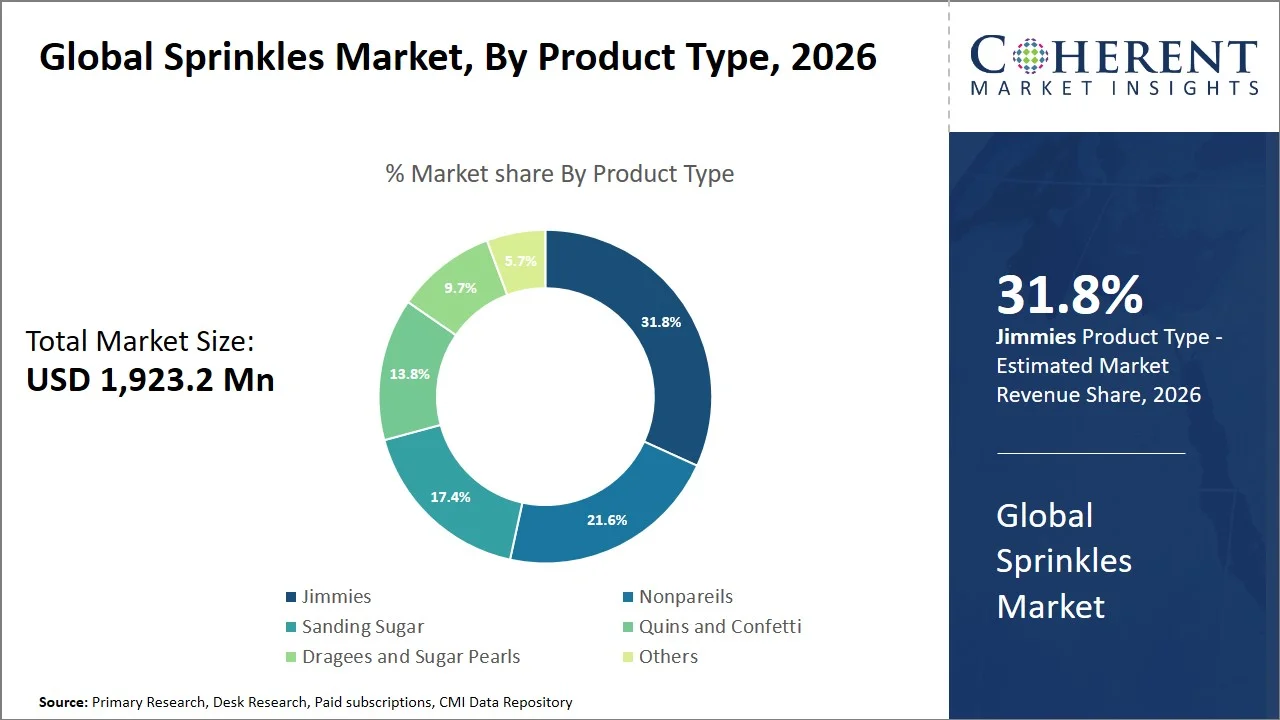
Why Do Jimmies Dominate the Global Sprinkles Market?
The jimmies segment is expected to command 31.8% of the global sprinkles market in 2026 because their elongated shape delivers broad surface coverage with fewer pieces than smaller bead-style decorations. Bakers can apply them through automated dispensers, hand-finishing stations, or inclusion systems without requiring complex placement, which suits high-volume doughnuts, cupcakes, cookies, ice cream, and celebration cakes. Their familiar appearance also allows brands to change colors for seasonal programs while retaining the same production setup. For manufacturers, standardized strand dimensions simplify drying, glazing, packing, and bulk supply, supporting competitive pricing and consistent throughput. In August 2024, Cake Décor detailed its sugar-strand manufacturing offer from a BRC AA-accredited facility, including naturally colored options without artificial flavors or hydrogenated fats and with many shellac-free choices, demonstrating how suppliers are improving compliance flexibility while preserving the format’s industrial practicality.
- Current Industry Events of 2026
- Market Size Estimation
- Regional Breakdown
- Competitive Landscape
- Customer Intelligence
- Segmental Analysis
- Pricing Analysis
- Key Market Drivers, Challenges & Future Trends
- Customized Insights Section
Why Does Sugar Based Represent the Largest Ingredient Base in the Global Sprinkles Market?
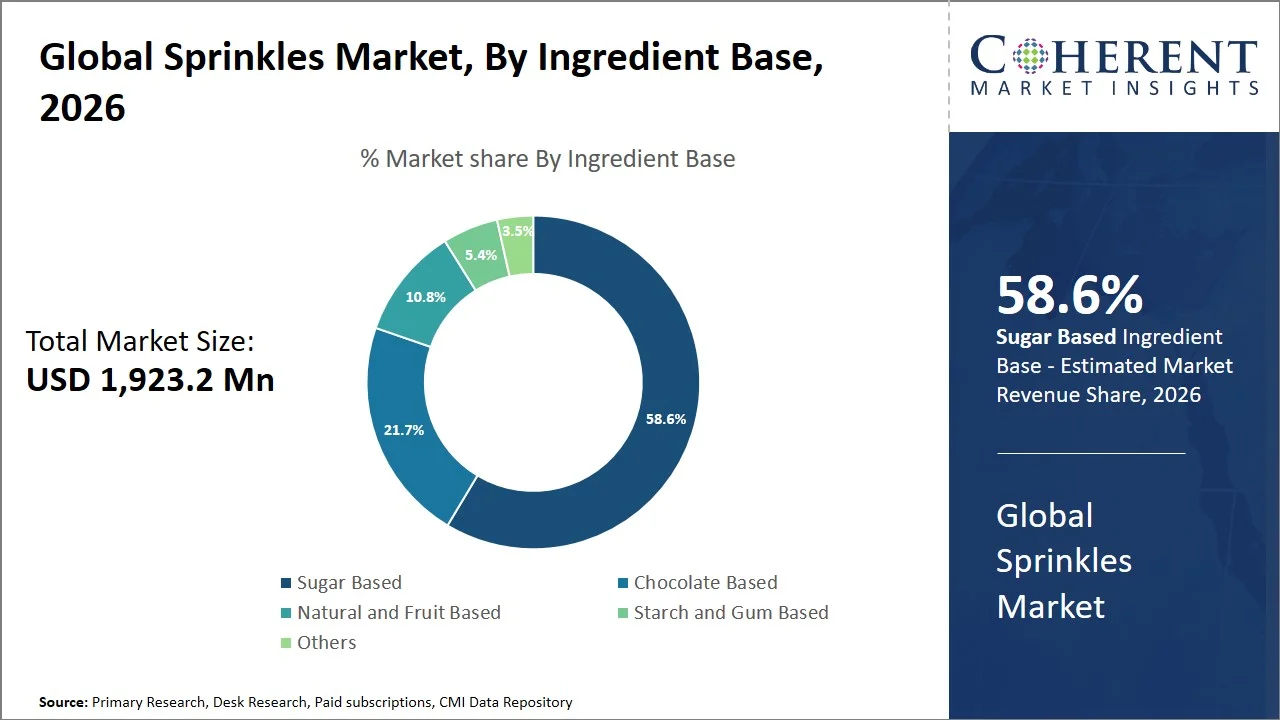
The sugar based segment is expected to represent 58.6% of the global sprinkles market in 2026 because refined sugar provides a widely available, scalable, and technically adaptable foundation for strands, crystals, pearls, confetti, and blended decorations. The base accepts colors and flavors efficiently, supports controlled particle sizing, and offers sufficient rigidity for packaging, transport, and mechanical application. Industrial bakeries and foodservice buyers can therefore purchase economical standard products while requesting customized shades or crystal profiles for private-label and seasonal programs. Suppliers benefit from established sugar-processing infrastructure and can manufacture multiple formats on related production systems, improving asset utilization and procurement efficiency. In March 2024, Nordzucker began its thick-juice campaign across selected European factories, explaining that downstream crystallization enables more targeted fulfillment of customer requests for special products and crystal sizes, an upstream capability relevant to differentiated sugar-decoration production.
Why Do Cakes, Cupcakes and Pastries Dominate the Application Segment of the Global Sprinkles Market?
The cakes, cupcakes and pastries segment is expected to account for 31.7% of the global sprinkles market in 2026 because these products provide the largest decorative surface area and the strongest connection with birthdays, holidays, gifting, and impulse bakery purchases. Sprinkles let producers create visible product differentiation without reformulating the sponge, dough, filling, or frosting, making them cost-efficient for seasonal line extensions and retailer-exclusive designs. They also perform across factory-decorated cakes, in-store bakery items, foodservice pastries, and home-baking kits, giving suppliers access to both bulk and packaged channels. Manufacturers serving this application can capture repeat orders through color matching, portion-controlled sachets, and campaign-based blends. In May 2025, 7-Eleven introduced a limited-time Summer Sprinkle Donut with white frosting and rainbow sprinkles across participating stores, illustrating how convenience retailers use decorated bakery items to refresh seasonal assortments and encourage impulse purchases.
Current Events and their Impact
Current Event | Description and Its Impact |
September 2024 – California Enacts School Food-Dye Restrictions |
|
April 2025 – Great Britain Reforms Regulated-Product Authorisation |
|
February 2025 – EU Packaging and Packaging Waste Regulation Enters into Force |
|
Global Sprinkles Market Dynamics
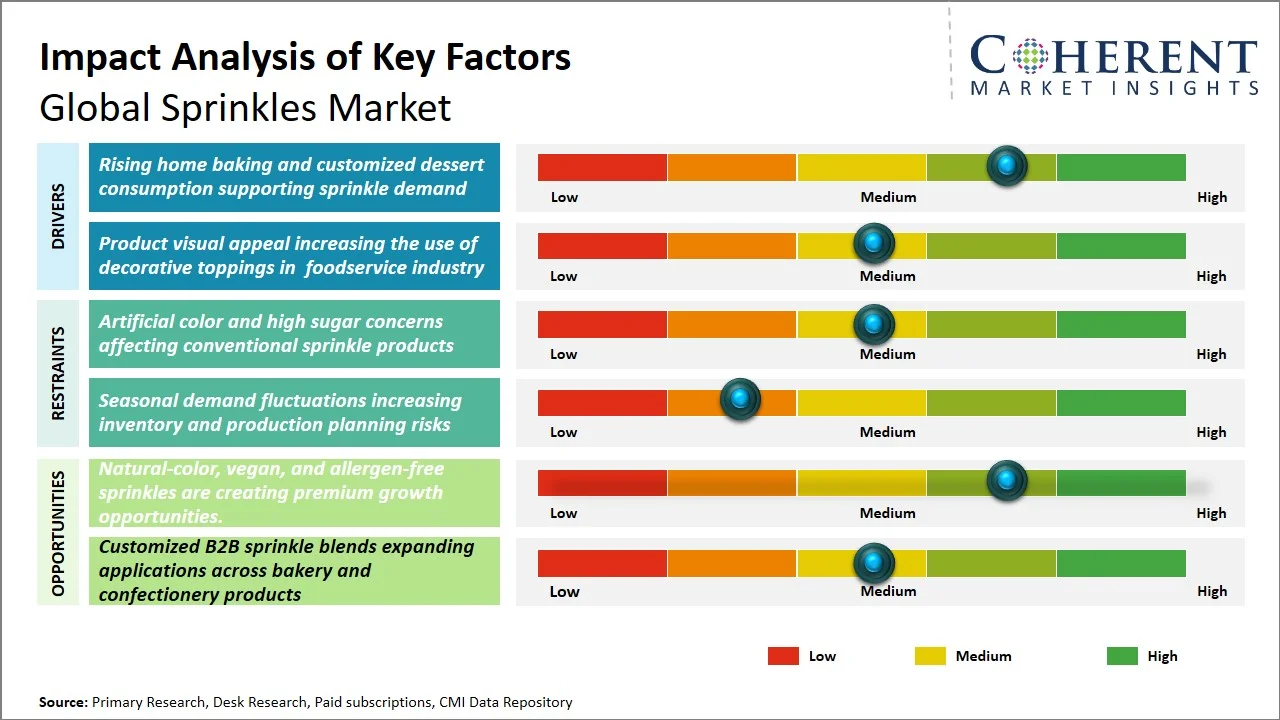
Key Market Drivers
- Home Baking and Simplified Dessert Customization Expand Household Purchases: Home baking is becoming a repeat-purchase channel for sprinkles as consumers move beyond occasional cake decoration toward cookies, brownies, dessert boards, school events, gifting, and social-media-led baking projects. Ready-mixed inclusions and coordinated decoration packs reduce the skill and time required to produce customized desserts, encouraging households to buy multiple colors, shapes, and seasonal assortments. These benefits branded sprinkle suppliers, craft retailers, mass merchants, and manufacturers offering small packs with clear usage guidance. Commercially, the driver broadens demand from single-event purchases to year-round creative consumption and rewards products that perform both inside batter and on finished surfaces. In February 2025, Fancy Sprinkles launched Unicorn and Birthday Baking Confetti blends exclusively at Walmart, combining sprinkles, sugar shapes, white-chocolate morsels, and candy-coated pieces for home-baked cookies.
- Visual Menu Differentiation Strengthens Foodservice Sprinkle Usage: Foodservice operators use sprinkles as a low-cost visual component that can make familiar desserts appear seasonal, premium, or campaign-specific without requiring major equipment changes. Frozen-dessert chains, cafés, doughnut outlets, and in-store bakeries can rotate colors and textures while retaining the same core ice cream, frosting, cake, or beverage platform. This supports frequent menu renewal, improves photographic recognition on delivery applications, and gives procurement teams a flexible ingredient for limited-time offers. Sprinkle producers, foodservice distributors, and contract blenders benefit when operators require repeatable color, controlled particle size, and reliable availability across large outlet networks. In March 2025, Dairy Queen returned its Confetti Cake Blizzard and Cotton Candy Blizzard, both using colorful sprinkles, as part of a limited-time summer menu across participating U.S. locations.
Emerging Market Trends
- Sprinkles are Becoming Process-Tolerant Product Inclusions: Sprinkles are moving beyond surface decoration into engineered inclusions that retain color, texture, and shape during mixing, baking, freezing, and coating. Industrial buyers increasingly seek melt resistance, low color migration, and compatibility with dough, chocolate, dairy, and fat-based systems. This favors suppliers with strong extrusion, glazing, and application-testing capabilities. Bake-stable formats will expand sprinkle use in cookies, cereals, snack bars, frozen desserts, and filled products.
- Channel-Specific Packaging is Replacing Universal Pack Formats: Packaging is becoming more closely aligned with customer needs. Industrial bakeries require bulk packs with traceability and controlled dispensing, foodservice operators need resealable moisture-resistant formats, and home bakers prefer smaller assortments with convenient closures. Suppliers investing in flexible filling, portioning, and late-stage packaging can serve multiple channels while reducing waste and seasonal inventory risk. This capability will improve operational efficiency, customization, and customer retention.
Regional Insights
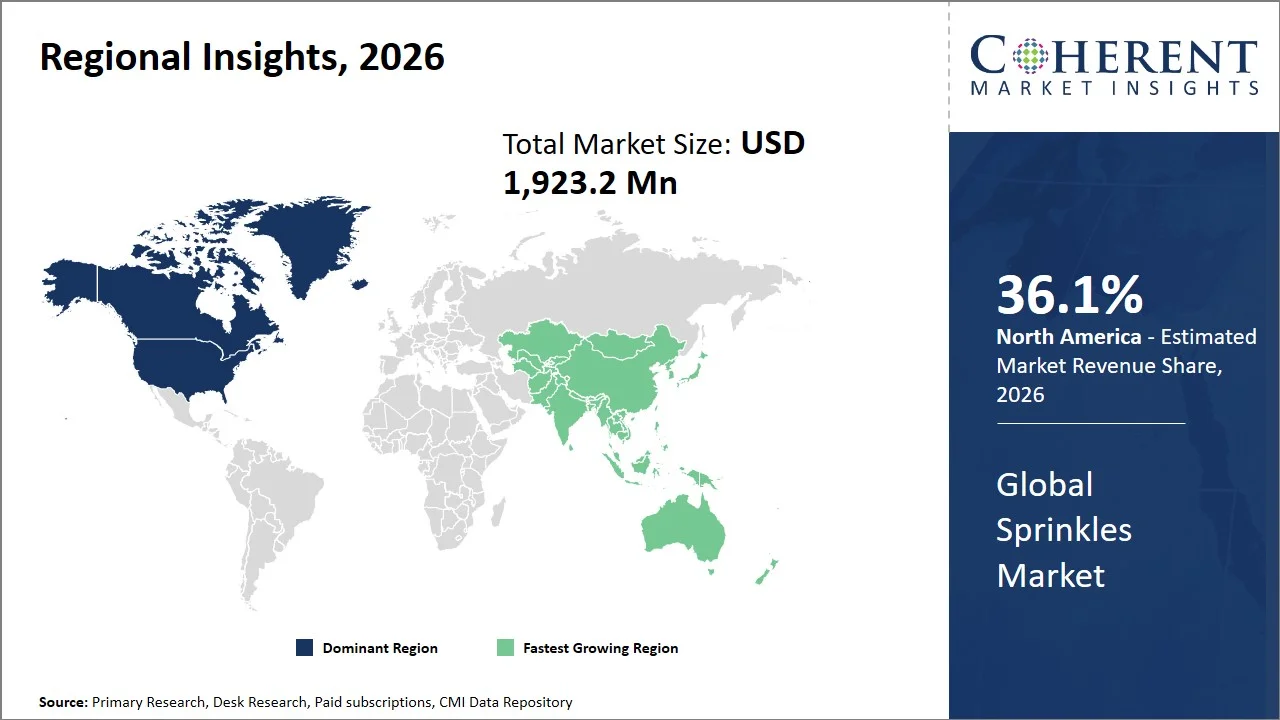
Why Does North America Dominate the Global Sprinkles Market?
North America is expected to dominate the global sprinkles market with a 36.1% share in 2026 because the region combines large industrial bakeries, supermarket in-store bakeries, dessert-focused foodservice chains, and mature ingredient distribution networks. Sprinkles are routinely specified for seasonal cakes, doughnuts, cookies, ice cream, and limited-time products, giving suppliers recurring B2B demand across multiple purchasing cycles. Regional manufacturers also benefit from advanced color matching, application testing, automated depositing, and reliable compliance documentation. The United States and Canada provide substantial customer concentration, while cross-border logistics support efficient replenishment of standardized and customized blends. In August 2025, Puratos opened an Innovation Center in Montreal equipped for bakery, pastry, and chocolate product development, technical training, and regional co-creation, strengthening the infrastructure through which decorative concepts can be tested and commercialized.
Why is Asia Pacific Emerging as the Fastest-Growing Region in the Global Sprinkles Market?
Asia Pacific is expected to be the fastest-growing region in the global sprinkles market, accounting for 26.3% in 2026. Expansion is supported by the spread of premium bakery chains, café-led dessert consumption, organized retail, quick-commerce delivery, and celebration products tailored to local festivals. Suppliers can address a broad spectrum of customers, from industrial cake producers to independent bakers seeking small-batch colors, customized shapes, and heat-stable decorations. Interest in character collaborations and social-media-ready pastries is also widening the role of visual toppings in product differentiation. In April 2026, Starbucks Korea launched a Disney and Pixar Toy Story collaboration featuring character-inspired cakes, macarons, beverages, and decorative toppings. The program demonstrates how international café brands localize themed food collections for Asian consumers, creating recurring demand for colorful, precisely applied finishing ingredients across metropolitan bakery and beverage channels.
Global Sprinkles Market Outlook for Key Countries
Why is the U.S. a Key Market for the Global Sprinkles Market?
The U.S. is a key market for sprinkles because manufacturers can sell through industrial bakery accounts, mass retailers, specialty baking stores, foodservice distributors, and direct-to-consumer channels. Demand extends beyond cakes and cupcakes into cereals, snack mixes, frozen desserts, beverages, and licensed seasonal products, allowing suppliers to diversify application exposure. Strong retail merchandising calendars create frequent opportunities for color-specific blends linked to birthdays, national holidays, sports, entertainment, and school occasions. The country also offers an established ecosystem for rapid concept testing, packaging variation, and nationwide rollout through large retail chains. In February 2025, General Mills launched Lucky Charms Rainbow Sprinkles Cereal, featuring birthday-cake flavor and confetti sprinkle pieces, with nationwide availability scheduled from April 2025. The launch illustrates how sprinkle formats can move from conventional bakery decoration into packaged foods and topping-oriented consumption occasions.
Why is India Important in the Global Sprinkles Market?
India is important in the global sprinkles market because celebration cakes, neighborhood bakeries, premium pâtisserie outlets, ice-cream parlors, and home-based baking businesses are expanding the number of decoration-intensive purchase occasions. Local buyers require economical sugar based products for high-volume use alongside premium chocolate, metallic, natural-color, and customized festival assortments. Domestic production can improve lead times and reduce exposure to imported chocolate and specialty-decoration costs, while digital ordering gives small bakeries access to professional ingredients. The country’s varied regional festivals also support frequent color and theme changes rather than a single standardized portfolio. In July 2025, Barry Callebaut inaugurated its third Indian chocolate factory in Neemrana to support regional demand. The investment strengthens local availability of chocolate and compound solutions that can be used in decorative inclusions, coated toppings, pastries, confectionery, and premium bakery applications.
Why Does China Support Growth in the Global Sprinkles Market?
China supports growth in the global sprinkles market through its extensive food-manufacturing base, dense urban retail networks, expanding lower-tier city consumption, and large-scale restaurant and bakery operations. Industrial customers can absorb standardized decorations in high volumes, while café, tea, and dessert operators create demand for visually distinctive limited editions. Domestic packaging, sugar-processing, and food-color capabilities can also shorten product-development cycles and support competitive pricing. Digital ordering and delivery platforms make appearance especially important because products must remain visually recognizable in online menus and promotional images. In November 2025, Yum China announced its RGM 3.0 strategy, noting that KFC operated more than 12,600 stores in over 2,500 Chinese cities and aimed to exceed 17,000 locations by 2028. Such network expansion increases the addressable outlet base for bakery, dessert, beverage, and decorative-topping suppliers.
Why is Germany a Strategic Country in the Global Sprinkles Market?
Germany is a strategic country in the global sprinkles market because it combines a well-established home-baking culture with technically sophisticated industrial bakery, confectionery, and retail-private-label production. Buyers emphasize consistent particle size, color stability, allergen controls, labeling accuracy, and repeatable performance in automated lines, favoring suppliers with strong quality systems. Germany also provides a valuable launch environment for reduced-sugar, vegan, natural-color, and premium decoration concepts that can later be distributed across European markets. Retail baking brands continually create new preparation methods and seasonal formats, supporting the demand for complementary toppings and decorating kits. In March 2025, Dr. Oetker announced Airfryer Backin, the first baking powder developed specifically for air fryers, for market launch in May 2025. The development demonstrates how German baking companies create new preparation occasions that can broaden household use of convenient decorations, sprinkles, and finishing ingredients.
Why is Japan an Important Growth Market for the Global Sprinkles Market?
Japan is an important growth market for the global sprinkles market because visual precision, seasonal storytelling, giftability, and limited-edition menus strongly influence bakery and dessert purchasing. Japanese customers often value small portions, refined color palettes, contrasting textures, and decorations linked to sakura, matcha, fruit, character licensing, and regional ingredients. This encourages suppliers to develop specialized flakes, sugars, pearls, and chocolate toppings rather than rely only on standard rainbow assortments. Convenience stores, department-store food halls, doughnut chains, and online gifting provide multiple routes to market for decorated products. In February 2025, Mister Donut announced the limited-edition Sakura Mochitto Doughnut range, combining sakura-flavored dough with strawberry-focused seasonal items for a March launch. The release demonstrates how localized visual themes and short selling windows make decorative ingredients central to product identity and repeat customer engagement.
Technology Adoption Landscape in the Global Sprinkles Market
Technology | Adoption Level | Key Application Area | Business Impact |
Continuous extrusion and precision strand cutting | High | Production of jimmies and rod-shaped sprinkles | Improves strand uniformity, throughput, portion consistency, and compatibility with automated bakery dispensing. |
Rotational panning and glazing systems | High | Dragees, sugar pearls, coated inclusions, and polished decorations | Builds controlled layers, creates consistent surface finishes, and supports premium textures and metallic or glossy appearances. |
Fluid-bed drying and coating | Medium | Rapid drying, surface coloring, flavor application, and moisture control | Reduces clumping, shortens processing time, and improves shelf stability and coating uniformity. |
Spectrophotometric color formulation | Medium | Brand-color matching and batch-to-batch shade verification | Reduces subjective color assessment, accelerates customer approvals, and supports repeatable licensed or private-label designs. |
Machine-vision sorting and defect inspection | Medium | Detection of malformed pieces, contamination, discoloration, and size variation | Improves quality assurance, lowers manual inspection requirements, and reduces customer complaints and line rejection. |
Microencapsulation and carrier-plating of natural pigments | Medium | Natural-color protection in heat-, light-, moisture-, or fat-sensitive applications | Limits color migration and degradation, helping natural sprinkles achieve more reliable processing and storage performance. |
How are Savory and Reduced-Sugar Edible Decorations Creating New Growth Opportunities in the Global Sprinkles Market?
Savory and reduced-sugar edible decorations represent an underdeveloped opportunity because the visual language of sprinkles can be transferred beyond conventional cakes and confectionery. Grain-, vegetable-, herb-, seed-, and starch-based particles could be designed for crackers, breads, salads, soups, prepared meals, cheese snacks, children’s lunch products, and foodservice garnishing. This would give ingredient suppliers access to customers that currently use colored seasoning pieces, crumbs, or inclusions but do not purchase products marketed as sprinkles. Commercial capture will require neutral or savory flavor systems, moisture resistance, heat stability, controlled salt delivery, and clear labeling that separates these products from high-sugar decorations. Suppliers should develop application kits for bakeries, snack manufacturers, meal producers, and restaurant chains, supported by pilot trials and dispensing guidance. The opportunity may favor specialist manufacturers and vertically integrated color-and-texture suppliers capable of combining formulation, particle engineering, and regulatory expertise. Established sweet-sprinkle producers can participate, but only if they avoid assuming that existing sugar based processes will transfer directly to savory applications.
Market Players, Key Development, and Competitive Landscape
Key Developments
- In June 2026, Conagra Brands introduced Glutino Frosted Animal Crackers coated in frosting and rainbow sprinkles. This is important for the global sprinkles market because it demonstrates the use of decorative particles in packaged gluten-free snacks, extending commercial demand beyond traditional celebration cakes and foodservice desserts into branded shelf-stable products.
- In September 2025, ColorKitchen partnered with Michaels to distribute its plant-based food colors and natural sprinkles through selected U.S. craft stores. This is important for the global sprinkles market because it places dye-free decorating ingredients within a non-traditional food-crafting channel, improving access among home bakers, cookie decorators, and customers seeking naturally colored products.
- In July 2025, Prodalim launched its VivaPro Coloring Foodstuffs and NaturaPro Natural Colors product lines for applications including bakery and confectionery. This is important for the global sprinkles market because the portfolio expands the range of plant-, fruit-, vegetable-, algae-, and spice-derived pigments available to manufacturers seeking light, pH, and thermal stability in decorative formulations.
Competitive Landscape
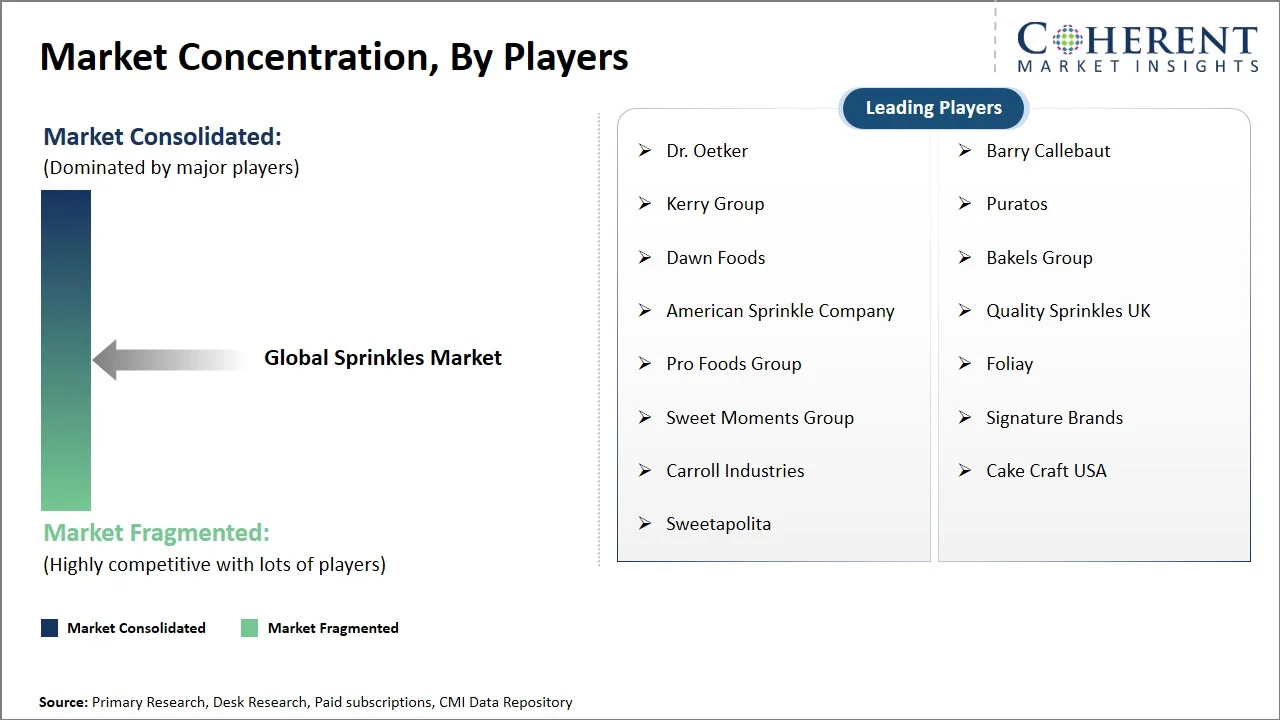
The global sprinkles market is fragmented, with competition spanning multinational bakery-ingredient suppliers, specialist decoration manufacturers, regional confectionery producers, private-label companies, craft-baking brands, and online-first sellers. Large participants benefit from industrial production controls and international distribution, while smaller specialists compete through distinctive shapes, rapid seasonal launches, flexible order quantities, and niche dietary positioning. Competitive advantage increasingly depends on delivering repeatable application performance and dependable supply rather than maintaining the largest catalogue.
Key focus areas include
- Batch consistency: Particle dimensions, shade, gloss, texture, and breakage rates must remain stable across repeat orders.
- Application performance: Suppliers compete on resistance to heat, moisture, freezing, fat contact, and color bleeding.
- Compliance capability: Accurate additive declarations, allergen controls, certification support, and market-specific formulations influence buyer approval.
- Minimum order flexibility: Low-volume custom runs help suppliers serve independent bakeries, regional chains, and seasonal campaigns.
- Supply reliability: Sugar, starch, glazing agents, pigments, packaging, and specialist shapes require disciplined sourcing and inventory management.
- Private-label capability: Retailers value suppliers that can combine product formulation, packaging, documentation, and seasonal portfolio planning.
- Channel reach: Industrial distributors, specialty stores, mass retail, e-commerce, and foodservice wholesalers require different commercial models.
- Technical service: Application trials, shade matching, troubleshooting, and dispensing guidance help suppliers protect B2B relationships and margins.
Market Report Scope
Sprinkles Market Report Coverage
| Report Coverage | Details | ||
|---|---|---|---|
| Base Year: | 2025 | Market Size in 2026: | USD 1,923.2 Mn |
| Historical Data for: | 2020 To 2024 | Forecast Period: | 2026 To 2033 |
| Forecast Period 2026 to 2033 CAGR: | 7.2% | 2033 Value Projection: | USD 3,128.9 Mn |
| Geographies covered: |
| ||
| Segments covered: |
| ||
| Companies covered: | Dr. Oetker, Barry Callebaut, Kerry Group, Puratos, Dawn Foods, Bakels Group, American Sprinkle Company, Quality Sprinkles UK, Pro Foods Group, Foliay, Sweet Moments Group, Signature Brands, Carroll Industries, Cake Craft USA, and Sweetapolita | ||
| Growth Drivers: |
| ||
| Restraints & Challenges: |
| ||
Analyst Opinion (Expert Opinion)
- The global sprinkles market leadership is likely to shift from suppliers selling broad decoration catalogues toward partners that manage application risk for customers. Buyers will place greater value on pre-tested compatibility, rapid troubleshooting, documentation, and regional stock availability. This transition will blur the distinction between ingredient manufacturer and technical-service provider, making customer retention dependent on execution quality rather than novelty alone.
- The proliferation of retailer, restaurant, institutional, and national ingredient restrictions could weaken the economics of one globally standardized sprinkle formulation. Suppliers may need modular recipes that preserve a common visual identity while changing pigments, glazing agents, carriers, or labeling by market. Companies with flexible formulation databases and segregated production will benefit, while inflexible high-volume producers may face costly portfolio fragmentation.
- Manufacturers should prioritize humidity control, allergen segregation, automated inspection, natural-pigment supply redundancy, and packaging that protects low-volume products after opening. Pricing should reflect the true cost of compliance and seasonal changeovers rather than treating customization as a free service. Companies should avoid overinvesting in short-lived novelty shapes unless customer commitments, reusable tooling, or multi-season applications can justify the inventory and capital exposure.
Speak to the analyst
Want personalized insights?
Take the findings above to one of our principal consultants, or have the report rebuilt around the segments, geographies and competitors you actually track.
Market Segmentation
- Product Type Insights (Revenue, USD Mn, 2021 - 2033)
- Jimmies
- Nonpareils
- Sanding Sugar
- Quins and Confetti
- Dragees and Sugar Pearls
- Others
- Ingredient Base Insights (Revenue, USD Mn, 2021 - 2033)
- Sugar Based
- Chocolate Based
- Natural and Fruit Based
- Starch and Gum Based
- Others
- Application Insights (Revenue, USD Mn, 2021 - 2033)
- Cakes, Cupcakes and Pastries
- Cookies and Biscuits
- Ice Cream and Frozen Desserts
- Confectionery and Chocolates
- Beverages and Dairy Desserts
- Others
- Distribution Channel Insights (Revenue, USD Mn, 2021 - 2033)
- Direct B2B Sales
- Supermarkets and Hypermarkets
- Specialty Baking Stores
- Online Retail
- Others
- Regional Insights (Revenue, USD Mn, 2021 - 2033)
- North America
- U.S.
- Canada
- Latin America
- Brazil
- Argentina
- Mexico
- Rest of Latin America
- Europe
- Germany
- U.K.
- Spain
- France
- Italy
- Russia
- Rest of Europe
- Asia Pacific
- China
- India
- Japan
- Australia
- South Korea
- ASEAN
- Rest of Asia Pacific
- Middle East
- GCC Countries
- Israel
- Rest of Middle East
- Africa
- South Africa
- North Africa
- Central Africa
- North America
- Key Players Insights
- Oetker
- Barry Callebaut
- Kerry Group
- Puratos
- Dawn Foods
- Bakels Group
- American Sprinkle Company
- Quality Sprinkles UK
- Pro Foods Group
- Foliay
- Sweet Moments Group
- Signature Brands
- Carroll Industries
- Cake Craft USA
- Sweetapolita
Sources
Primary Research Interviews
- Sprinkles manufacturers, bakery-decoration suppliers, ingredient producers, packaging companies, distributors, retailers, private-label firms, and contract manufacturers
- R&D, procurement, production, quality, regulatory, marketing, and sales executives
Stakeholders
- Industrial bakeries, confectionery producers, ice-cream companies, cafés, foodservice operators, and household-baking brands
- Sugar, chocolate, starch, gum, color, flavor, glazing, packaging, and processing-equipment suppliers
- Importers, exporters, wholesalers, supermarkets, specialty baking stores, and e-commerce platforms
End-use Sectors
- Cakes, cupcakes, pastries, cookies, biscuits, confectionery, chocolates, ice cream, frozen desserts, beverages, and dairy desserts
- Household baking, commercial bakeries, seasonal gifting, foodservice, retail, and online channels
- Regulatory & Government Bodies:
- U.S. FDA, FTC, European Commission, EFSA, UK FSA, Health Canada, CFIA, FSSAI, China SAMR and NHC
- Japan MHLW, Brazil ANVISA, FSANZ, and national customs authorities
Databases
- UN Comtrade, ITC Trade Map, WTO Statistics, Eurostat, USITC DataWeb, FAOSTAT, World Bank, and OECD
- China Customs, India DGCI&S, Brazil Comex Stat, company filings, retail listings, pricing, trade, and consumer-review databases
- Magazines and Journals:
- Food Business News, FoodNavigator, ConfectioneryNews, Baking Business, and BakeryAndSnacks
- Food Chemistry, LWT, Journal of Food Science, and International Journal of Food Science & Technology
Associations
- American Bakers Association
- National Confectioners Association
- Institute of Food Technologists
- International Association of Color Manufacturers
- Federation of Bakers
Public Domain Sources
- Food-safety, additive, labeling, packaging, trade, customs, and consumer-protection authorities
- Company reports, product catalogues, ingredient labels, certifications, pricing records, technical documents, and press releases
- Retail, foodservice, specialty-store, and online marketplace listings
Key Standards and Regulations
- U.S. FD&C Act, FSMA, food-color, additive, allergen, labeling, and GMP requirements
- EU General Food Law, FIC Regulation, food-additive rules, and packaging regulations
- Codex standards for additives, hygiene, allergens, contaminants, and labeling
- India FSSAI, China GB 2760 and GB 7718, Canada, FSANZ, and Brazil ANVISA requirements
Proprietary Elements
- CMI Data Analytics Tool, Proprietary CMI Existing Repository of information for last 10 years.
Get access to 250+ pages report
Every segment, forecast, competitor profile and data table behind the analysis above — available for instant download.
- ESOMAR Member
- ISO 9001:2015 Certified
- D-U-N-S Registered
- GDPR & CCPA Compliant
Missing comfort of reading report in your local language? Find your preferred language:
Transform your Strategy with Exclusive Trending Reports
Frequently Asked Questions
The CAGR of the global sprinkles market is projected to be 7.2% from 2026 to 2033.
The global sprinkles market is estimated to be valued at USD 1,923.2 million in 2026 and is expected to reach USD 3,128.9 million by 2033.
Asia Pacific is expected to emerge as the fastest-growing regional market.
Sugar based sprinkles represent the leading ingredient-base segment.
Cakes, cupcakes and pastries constitute the leading application segment.
Rising home baking and customized dessert consumption supporting sprinkle demand and product visual appeal increasing the use of decorative toppings in foodservice industries are the major factors driving the growth of the global sprinkles market.
Artificial color and high sugar concerns affecting conventional sprinkle products and seasonal demand fluctuations increasing inventory and production planning risks are the major factors hampering the growth of the global sprinkles market.