

Global Sterility Indicators Market Size and Forecast – 2026 To 2033
The global sterility indicators market is expected to grow from USD 972.8 Mn in 2026 to USD 1,721.6 Mn by 2033, registering a compound annual growth rate (CAGR) of 8.5% from 2026 to 2033. The market for sterility indicators is poised for significant expansion, fueled by the increasing emphasis on infection prevention and sterilization validation across healthcare facilities and pharmaceutical manufacturing.
According to the U.S. Centers for Disease Control and Prevention (CDC), approximately 1 in 31 hospitalized patients has at least one healthcare-associated infection (HAI) on any given day, underscoring the critical need for validated sterilization processes and routine sterility monitoring across healthcare settings.
Key Takeaways of the Global Sterility Indicators Market
- Biological indicators are projected to hold 58.6 % of the global sterility indicators market share in 2026, making it the dominant product type segment across North America due to stringent regulatory requirements for sterilization validation in pharmaceutical manufacturing and medical device processing. For instance, the U.S. Food and Drug Administration (FDA) requires manufacturers of sterile drug products to establish validated sterilization processes under 21 CFR Part 211, making biological indicators the gold standard for routine sterilization monitoring. These requirements continue to support the widespread adoption of biological indicators across regulated manufacturing facilities.
- Steam sterilization is projected to hold 34.8 % of the global sterility indicators market share in 2026, making it the dominant technique segment across Europe due to its extensive use for sterilizing reusable medical devices and surgical instruments. For instance, the European Commission's Medical Device Regulation (EU) 2017/745 (MDR) requires manufacturers to validate and routinely monitor sterilization processes for sterile medical devices before market placement. This regulatory framework reinforces the use of steam sterilization supported by validated sterility indicators.
- Pharmaceutical and biotechnology companies are projected to hold 38.7 % of the global sterility indicators market share in 2026, making it the dominant end user segment across Asia Pacific owing to the expanding production of sterile pharmaceutical products, particularly injectables and biologics, along with increasingly stringent Good Manufacturing Practice (GMP) compliance requirements. For instance, the Pharmaceutical Inspection Co-operation Scheme (PIC/S) GMP Guide (Annex 1) requires routine monitoring and validation of sterilization processes during the manufacture of sterile medicinal products. These requirements continue to accelerate the adoption of sterility indicators across pharmaceutical manufacturing facilities.
- North America maintains its dominance with an expected share of 39.2 % in 2026, bolstered by stringent sterilization regulations and mature pharmaceutical and medical device manufacturing industries. For instance, the Association for the Advancement of Medical Instrumentation (AAMI), through the ANSI/AAMI ST79 standard, establishes comprehensive guidelines for steam sterilization and sterility assurance in U.S. healthcare facilities, reinforcing the routine use of biological and chemical indicators for sterilization monitoring.
- Asia Pacific is expected to exhibit the fastest growth with an estimated contribution of 23.4 % share in 2026, driven by expanding pharmaceutical manufacturing capacity and strengthening regulatory oversight for sterile production. For instance, in 2025, China's National Medical Products Administration (NMPA) continued implementing revised Good Manufacturing Practice (GMP) requirements that emphasize validated sterilization processes and environmental monitoring for sterile drug manufacturing, accelerating the adoption of sterility indicators across the region.
- Growing Adoption of Rapid Sterility Testing in Pharmaceutical Manufacturing: The increasing adoption of rapid sterility testing across pharmaceutical, biologics, and advanced therapy manufacturing is driving the demand for high-performance sterility indicators that validate sterilization processes. As manufacturers seek to reduce product release timelines while maintaining regulatory compliance, the need for reliable biological and chemical indicators is growing. This trend is accelerating innovation in sterility assurance technologies and supporting the broader adoption of advanced sterility monitoring solutions.
- Expansion of Cell & Gene Therapy Manufacturing Facilities: The rapid expansion of cell and gene therapy manufacturing is generating new opportunities for sterility indicators, as these facilities require highly controlled aseptic processing environments and stringent sterilization validation. Growing investments in advanced therapy medicinal products (ATMPs) and personalized medicines are increasing the need for high-performance biological and chemical indicators that support regulatory compliance and contamination-free manufacturing.
Segmental Insights
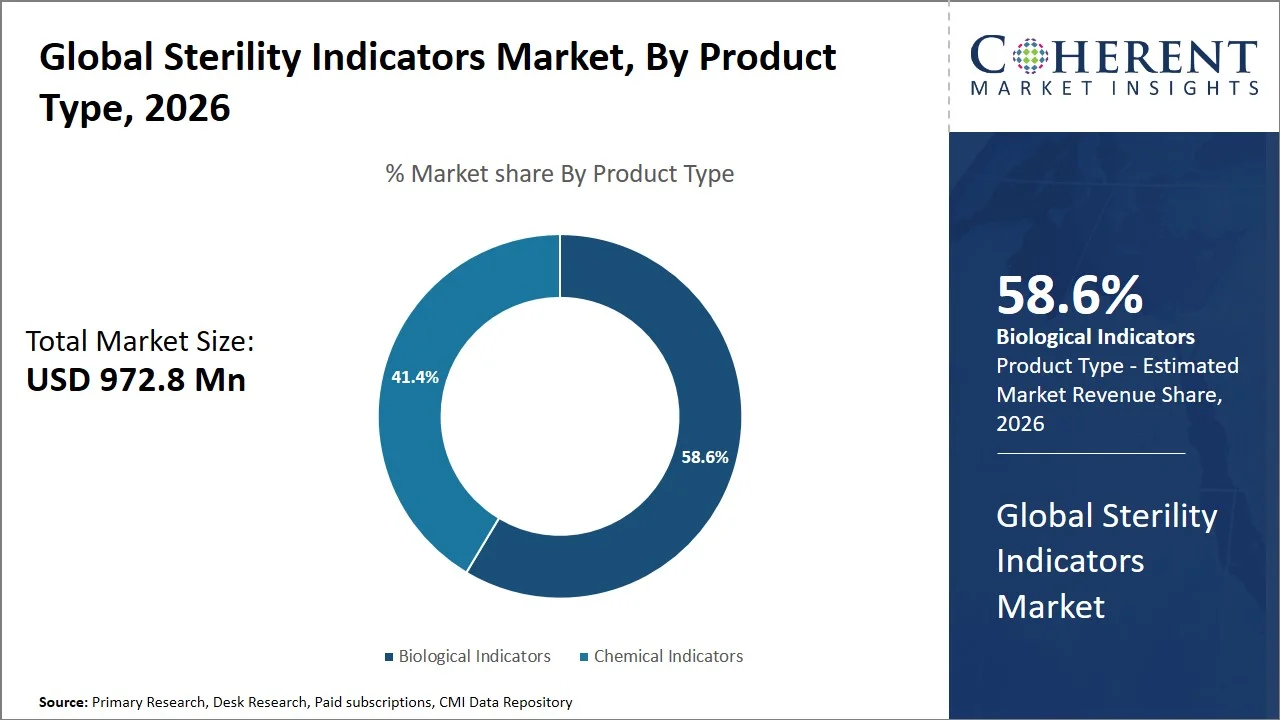
Why Do Biological Indicators Dominate the Global Sterility Indicators Market?
Biological indicators are projected to hold a market share of 58.6% in 2026, as they provide direct verification of microbial inactivation during the sterilization process. This makes them the preferred method for validating sterilization effectiveness in pharmaceutical manufacturing, medical device sterilization, and healthcare facilities. Its compatibility with most sterilization processes and adoption of new fast read-out technology further boosts biological indicator use, where validated sterilization processes remain a high regulatory priority globally. For instance, in June 2025, Solventum introduced the first U.S. FDA-cleared, preassembled Attest Super Rapid Vaporized Hydrogen Peroxide (VHO) Clear Challenge Pack with biological indicator (BI) and chemical indicator (CI) for day-to-day monitoring of low temperature sterilization cycles. This makes validation more efficient, eliminates manual error and facilitates quicker and more accurate assurance of sterility in hospitals and healthcare settings.
- Current Industry Events of 2026
- Market Size Estimation
- Regional Breakdown
- Competitive Landscape
- Customer Intelligence
- Segmental Analysis
- Pricing Analysis
- Key Market Drivers, Challenges & Future Trends
- Customized Insights Section
Why Does Steam Sterilization Represent the Largest Technique Segment in the Sterility Indicators Market?
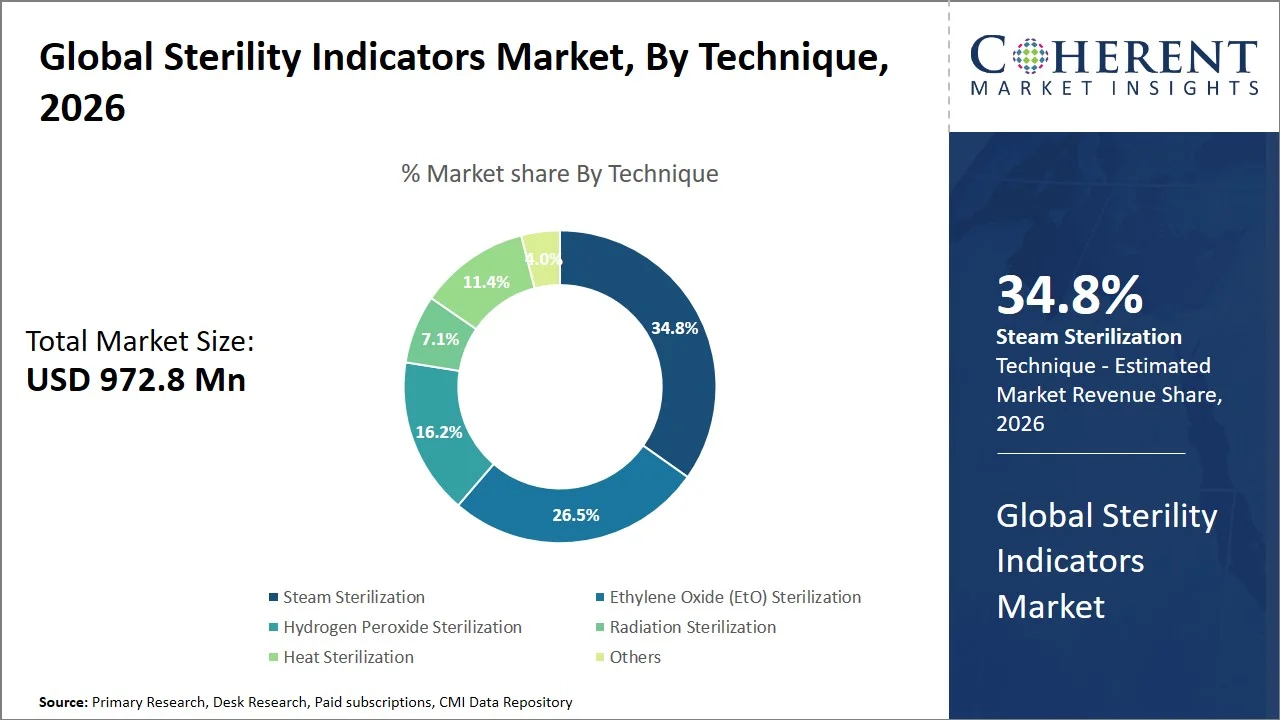
Steam sterilization is projected to hold a market share of 34.8% in 2026, owing to its recognized micro-efficacy and economical costs. It is largely employed in hospitals, pharmaceutical and medical device reprocessing units, which favor the utilization of this technique for various reusable tools, surgical equipment, and laboratory apparatus. Moreover, enhanced compatibility with regulatory requirements and evolving modern standards of sterile processing departments further supports the growth of this segment. For instance, in April 2025, Society for Healthcare Epidemiology of America (SHEA) partners with numerous societies to publish new multi society guideline on sterilization and high-level disinfection. The guideline reaffirms steam sterilization as the best approach for sterilization of heat- and moisture-stable critical medical devices and recommends the regular monitoring of all sterilization cycles with adequate process indicators. The guidelines further strengthen on-going demand for steam sterilization indicators across healthcare facilities.
Pharmaceutical and Biotechnology Companies Segment Dominates the Global Sterility Indicators Market
The pharmaceutical and biotechnology companies segment is projected to hold a market share of 38.7% in 2026, due to the demand for strict adherence to GMP requirements, growing number of sterile injectables, biologics, vaccines, and cell-based product manufacturing, and increasing importance of validating sterilization processes during the entire manufacturing chain. These organizations extensively use chemical and biological indicators for contamination prevention, to provide sterile, high-quality, safe and efficient products according to international guidelines. The growing production of high-value sterile manufacturing continues to reinforce the demand for advanced sterility assurance solutions. For instance, in April 2025, FUJIFILM Biotechnologies, in collaboration with Regeneron Pharmaceuticals, announced an initial 10-year, U.S.-based, manufacturing agreement worth more than USD 3 billion to increase large-scale biologics manufacturing at its site in Holly Springs, North Carolina. The pact underscores the increased focus and investment in the sterile biopharmaceutical space and increased use of and need for valid sterilization processes as well as routine utilization of biological and chemical sterilization indicators.
Currents Events and their Impact
Current Events | Description and its Impact |
U.S. FDA Recognizes Updated ISO Sterility Standards for Biological Indicators (May 2025) |
|
ISO Publishes Revised ISO 11137-1:2025 for Radiation Sterilization of Healthcare Products (April 2025) |
|
Sterility Indicators Market Dynamics
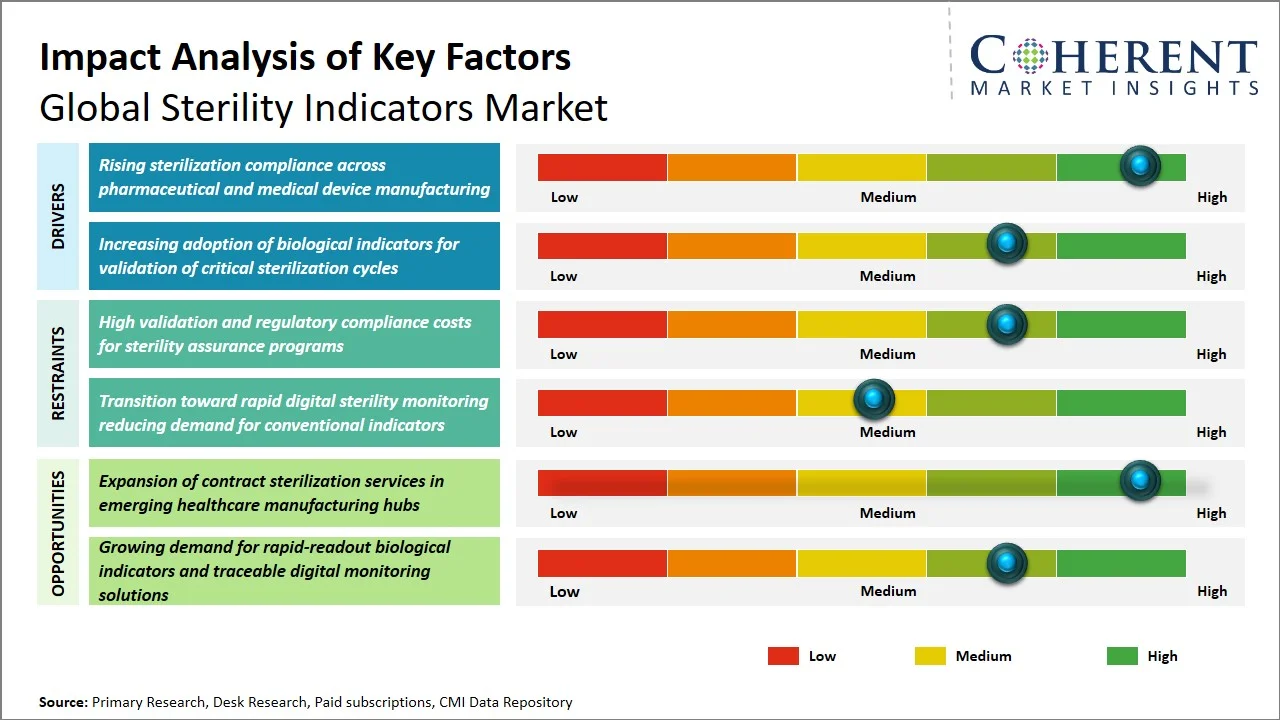
Market Drivers
- Rising sterilization compliance across pharmaceutical and medical device manufacturing: The growing emphasis on sterilization compliance across pharmaceutical and medical device manufacturing is driving the adoption of sterility indicators for validating sterilization cycles and ensuring product quality. Increasingly stringent regulatory expectations and the production of more complex sterile products are making routine sterilization monitoring an essential component of quality assurance and risk management. For instance, in January 2025, the European Commission reinforced contamination control and sterilization validation requirements through the implementation of the revised EU GMP Annex 1 for sterile medicinal products. The updated guidance is expected to accelerate the adoption of validated biological and chemical sterility indicators across pharmaceutical manufacturing facilities.
- Increasing adoption of biological indicators for validation of critical sterilization cycles: The increasing adoption of biological indicators (BIs) for validating critical sterilization cycles is driving growth in the sterility indicators market, as they provide the most reliable verification of microbial inactivation. Their widespread use across pharmaceutical manufacturing, medical devices, and healthcare facilities helps ensure regulatory compliance, product sterility, and patient safety while minimizing the risk of sterilization failures. For instance, in July 2025, the U.S. Pharmacopeia (USP) announced the official adoption of revised USP General Chapter <1229> guidance on sterilization assurance, reinforcing the use of biological indicators for sterilization process validation and routine monitoring in pharmaceutical manufacturing.
Emerging Trends
- Growing Adoption of Digital Sterility Monitoring and Traceability Systems: Healthcare providers and life sciences manufacturers are increasingly integrating digital sterility monitoring platforms with laboratory information management systems (LIMS) and manufacturing execution systems (MES). This trend is improving real-time documentation, audit readiness, and end-to-end traceability of sterilization processes while reducing manual recordkeeping and human error.
- Increasing Demand for Multi-Parameter Sterilization Indicators: Manufacturers are witnessing rising demand for multi-parameter and integrating sterility indicators capable of simultaneously monitoring critical sterilization variables such as time, temperature, pressure, and sterilant concentration. These advanced indicators provide higher process confidence and are increasingly preferred for validating complex sterilization cycles used in pharmaceutical manufacturing and reusable medical devices.
Regional Insights
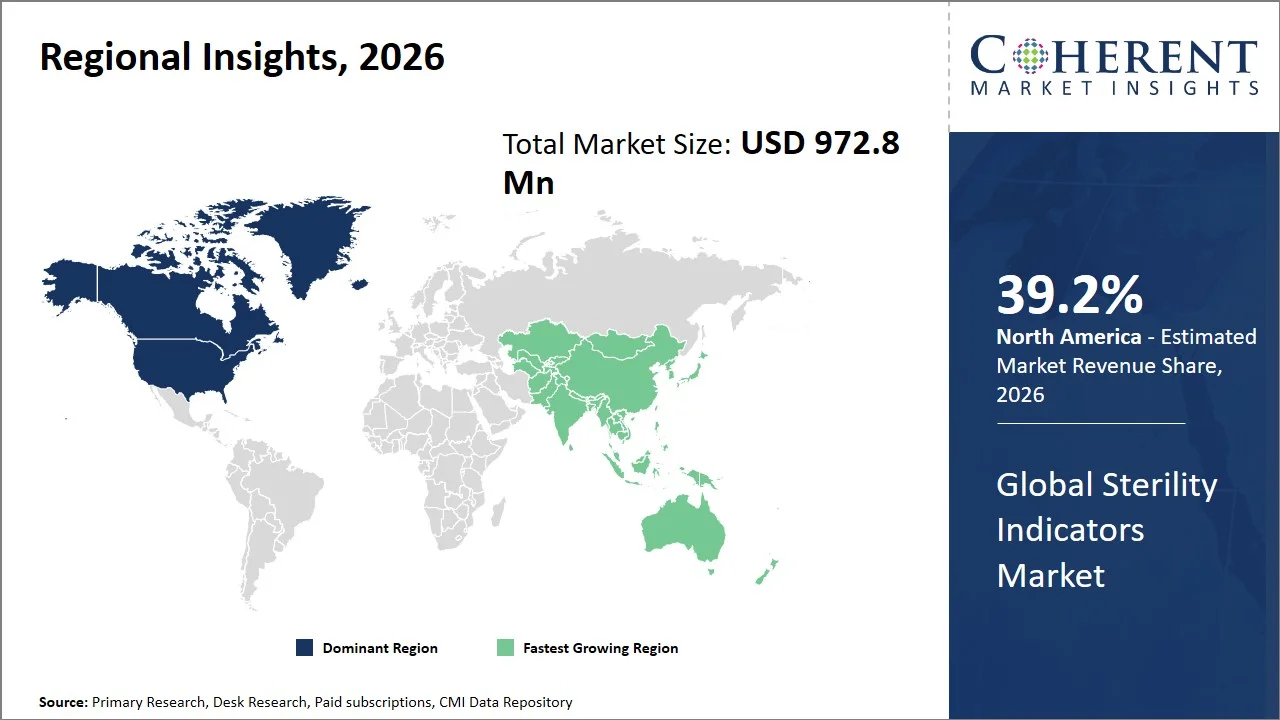
Why is North America a Strong Market for Sterility Indicators?
North America leads the global sterility indicators market, accounting for an estimated 39.2% share in 2026, due to the region’s robust sterile pharmaceutical and medical devices manufacturing infrastructure and adherence to strict regulatory guidelines enforced by agencies including the U.S Food & Drug Administration (FDA) and Health Canada. Such mandates stipulate validated sterilization processes and a continuous supply of biological and chemical indicators to prevent hospital infections in clinical environments and for product manufacturing. For instance, Health Canada's Guide to GMP - Annex 1 (GUI-0119), "Manufacture of sterile drugs," reconfirms the necessary quality control standards for sterile drug products in regard to sterility process validation and environmental monitoring and has been a consistent driver for implementation of sterility indicators throughout GMP facilities.
Why Does the Asia Pacific Sterility Indicators Market Exhibit High Growth?
The Asia Pacific sterility indicators market is expected to exhibit the fastest growth with an estimated contribution of 23.4% share to the global market in 2026, owing to government support to upgrade healthcare and enhance regulations related to sterile practices, rapid expansion of pharma manufacturing and increased penetration in healthcare industry. Growing investment on development of hospitals, medical devices production and exports of sterilized manufacturing facilities is likely to speed up sales of chemical and biological indicators of sterility. Further, increasing awareness regarding the standards for GMP compliance is also likely to enhance demand for sterilized solutions with validation. For instance, in February 2025, the Government of India granted an extension for the implementation of amended Schedule M but simultaneously reiterated the enhanced good manufacturing practices (GMP) conditions for manufacturers and encouraged investments in sterile manufacturing infrastructure and validated sterilization processes for the sector.
Global Sterility Indicators Market Outlook for Key Countries
Why is the U.S. Leading Innovation and Adoption in the Sterility Indicators Market?
The U.S. dominates the sterility indicators market driven by its robust base of sterile drug and biologic manufacturing facilities, developed contract sterilization industry and broad usage of modern sterility validation techniques. Routine use of sterility indicators throughout aseptic operations, medical device manufacturing and sterile processing units in hospitals fuel stable demand. Moreover, quick uptake of new sterility monitoring methods and intense focus on process validation further strengthen the dominance of the country in the global sterility indicators market.
Is Japan a Favorable Market for Sterility Indicators?
Japan is one of the most promising markets for the sterility indicators market driven by its well-developed pharmaceutical manufacturing facilities, high adoption rate of reusable medical devices, and sterile processing standards employed by healthcare facilities in the country. High adoption of aseptic processing, validation of sterilization methods, and automated sterile processing procedures are contributing factors to sustained demand for both biological and chemical sterility indicators in the market.
Is China Emerging as a Key Growth Hub for the Sterility Indicators Market?
China is positioned as a key growth hub in the global sterility indicators market due to the speedy expansion of pharmaceutical and medical device manufacturing, and the growth of contract sterilization. The growth in GMP compliance and modernization of hospitals’ sterilization facilities is spurring demand for biological and chemical sterilization indicators that have been successfully validated. In addition, increased export of sterilized health care goods to international markets contributes to increasing acceptance of sophisticated sterility monitoring technologies in the country.
Why Does Germany Top the European Sterility Indicators Market?
Germany leads the European sterility indicators market driven by its robust pharmaceutical and medical device manufacturing sectors, established sterile processing facility infrastructure, and widespread use of validation sterilization techniques in the healthcare settings. Germany boasts a high number of aseptic manufacturing facilities and sterile service departments (CSSDs), where sterilization validation processes are routinely used to ensure quality control of sterile products. The country’s continued focus on validated processes and sterile production efficiency ensures that the market growth remains sustained with growth driven by the demand for biological and chemical sterility indicators.
Is the Sterility Indicators Market Developing in India?
India is a high-potential market for sterility indicators owing to the rapid growth in the pharmaceutical sector, including development of drugs, production of vaccines, and manufacturing of medical devices and devices. The growing trend in the adoption of GMP-standard sterilized production facilities, growth of contract manufacturing organizations (CMOs/CDMOs) and modernization of the sterilization department in hospital facilities are some of the factors expected to boost the demand for chemical and biological sterility indicators. Further, growing exports of sterilized pharmaceutical products in India are expected to boost investment in sterilization validation and monitoring quality assurance system.
Product Innovation Landscape in the Global Sterility Indicators Market
Innovation Area | Representative Product Type | Key Innovation | End-use Focus | Market Significance |
Rapid Biological Indicators | Biological Indicators | Reduced incubation time | Pharmaceutical Manufacturing | Faster batch release and sterility validation |
Self-contained Biological Indicators | Biological Indicators | Integrated culture media and spore carrier | Hospitals & Medical Devices | Simplifies workflow and minimizes contamination risk |
Integrating Chemical Indicators | Chemical Indicators | Multi-parameter sterilization monitoring | Central Sterile Services Departments (CSSDs) and Healthcare Facilities | Improves sterilization cycle verification |
Digital Sterility Monitoring Solutions | Indicator Monitoring Systems | Barcode/RFID-enabled traceability and electronic documentation | Pharmaceutical & Medical Device Manufacturing | Enhances regulatory compliance and audit readiness |
Process Challenge Devices (PCDs) | Sterility Assurance Accessories | Simulates worst-case sterilization conditions | Healthcare & Contract Sterilization | Improves validation accuracy for complex sterilization loads |
How is the expansion of contract sterilization services in emerging healthcare manufacturing hubs creating new growth opportunities in the sterility indicators market?
Increasing outsourcing of sterilization procedures by pharmaceutical and medical device companies to contracted sterilization service providers for scalability, regulatory compliance and operational benefits will spur the growth of global sterility indicators market. The third-party sterilization infrastructure development has resulted in increase in the utilization of validated biological and chemical indicators to carry out regular process monitoring across diverse sterilization techniques. For instance, in May 2025, Sterigenics plans to add an X-ray sterilization facility to its Haw River, North Carolina campus, next to its current gamma irradiation facility. The expansion will further bolster Sterigenics’ position as a leading contract sterilizer of healthcare products and highlights the importance of valid biological and chemical sterility indicators used to monitor sterilization processes.
Market Players, Key Development, and Competitive Landscape
Key Developments
- In October 2025, Advanced Sterilization Products (ASP) was awarded a national Sterilization Assurance agreement with Premier, Inc., enabling Premier member healthcare organizations to access ASP's sterilization monitoring portfolio under pre-negotiated pricing and contract terms. The agreement is expected to strengthen the adoption of biological and chemical sterility indicators across hospitals and sterile processing departments while improving procurement efficiency and compliance with sterility assurance standards.
- In September 2025, Nelson Laboratories launched the RapidCert Biological Indicator (BI) Sterility Testing solution, designed to significantly reduce the time required to confirm sterilization efficacy while maintaining regulatory compliance. The rapid-read biological indicator enhances sterilization workflow efficiency, supports faster product release, and reflects the industry's growing focus on rapid sterility assurance technologies across pharmaceutical, medical device, and healthcare manufacturing sectors.
Competitive Landscape
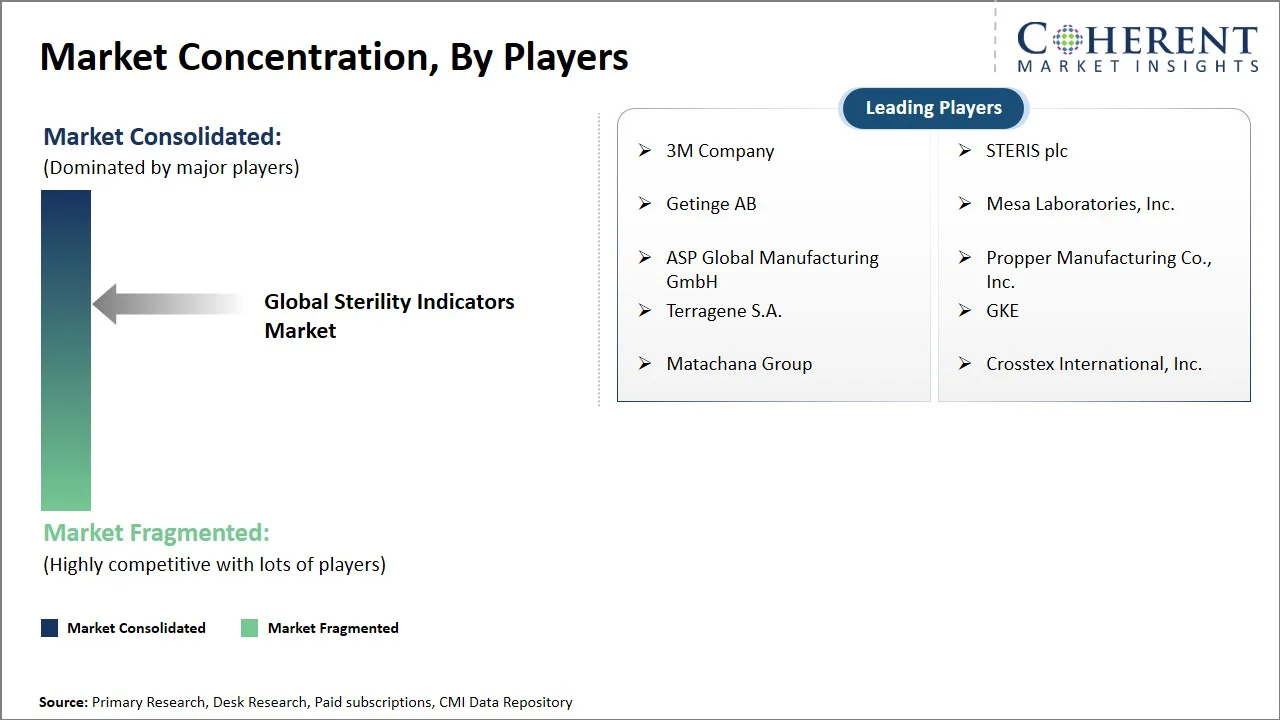
The global sterility indicators market is moderately consolidated, with competition centered on product accuracy, regulatory compliance, rapid sterilization validation, and comprehensive sterility assurance solutions. Market participants are focusing on developing rapid-read biological indicators, advanced chemical indicators, self-contained biological indicators (SCBIs), and digital sterility monitoring systems to improve workflow efficiency and compliance with global sterilization standards. Manufacturers are also strengthening their market position through portfolio expansion, contract sterilization partnerships, regulatory certifications, and investments in automated sterility monitoring technologies. Key focus areas include:
- Development of rapid-read biological indicators to reduce sterilization release time
- Expansion of digital sterility monitoring and traceability solutions
- Enhancement of multi-parameter chemical indicators for advanced sterilization validation
- Strengthening contract sterilization partnerships and global distribution networks
- Capacity expansion and regulatory compliance for sterile healthcare and life sciences products
Market Report Scope
Sterility Indicators Market Report Coverage
| Report Coverage | Details | ||
|---|---|---|---|
| Base Year: | 2025 | Market Size in 2026: | USD 972.8 Mn |
| Historical Data for: | 2020 To 2024 | Forecast Period: | 2026 To 2033 |
| Forecast Period 2026 to 2033 CAGR: | 8.5% | 2033 Value Projection: | USD 1,721.6 Mn |
| Geographies covered: |
| ||
| Segments covered: |
| ||
| Companies covered: | 3M Company, STERIS plc, Getinge AB, Mesa Laboratories, Inc., ASP Global Manufacturing GmbH, Propper Manufacturing Co., Inc., Terragene S.A., GKE, Matachana Group, and Crosstex International, Inc. | ||
| Growth Drivers: |
| ||
| Restraints & Challenges: |
| ||
Analyst Opinion (Expert Opinion)
- The future of the global sterility indicators market will be shaped by increasing regulatory harmonization, automation of sterilization monitoring, and the transition toward rapid, digitally enabled sterility assurance systems. As pharmaceutical manufacturing becomes more complex and sterile healthcare products continue to expand, demand will increasingly shift toward high-performance biological indicators and integrated monitoring solutions.
- The maximum opportunities will probably exist within rapid-read biological indicators for sterile pharmaceutical manufacturing and contract sterilization services, particularly in Asia Pacific (China and India), where pharmaceutical production capacity, biologics manufacturing, and export-oriented sterile manufacturing facilities are expanding rapidly under evolving GMP requirements.
- In order to obtain a competitive advantage, market participants should prioritize the development of rapid-read and self-contained biological indicators, integrate digital traceability and automated sterility monitoring platforms, and align product portfolios with evolving U.S. FDA, EU GMP Annex 1, ISO 11138, and ISO 11140 requirements. Strengthening partnerships with contract sterilization providers and pharmaceutical manufacturers will further enhance long-term market competitiveness.
Speak to the analyst
Want personalized insights?
Take the findings above to one of our principal consultants, or have the report rebuilt around the segments, geographies and competitors you actually track.
Market Segmentation
- Product Type Insights (Revenue, USD Mn, 2021 - 2033)
- Biological Indicators
- Chemical Indicators
- Technique Insights (Revenue, USD Mn, 2021 - 2033)
- Steam Sterilization
- Ethylene Oxide (EtO) Sterilization
- Hydrogen Peroxide Sterilization
- Radiation Sterilization
- Heat Sterilization
- Others
- End User Insights (Revenue, USD Mn, 2021 - 2033)
- Pharmaceutical and Biotechnology Companies
- Hospitals and Healthcare Facilities
- Medical Device Manufacturers
- Contract Sterilization Service Providers
- Research and Academic Institutes
- Others
- Regional Insights (Revenue, USD Mn, 2021 - 2033)
- North America
- U.S.
- Canada
- Latin America
- Brazil
- Argentina
- Mexico
- Rest of Latin America
- Europe
- Germany
- U.K.
- Spain
- France
- Italy
- Russia
- Rest of Europe
- Asia Pacific
- China
- India
- Japan
- Australia
- South Korea
- ASEAN
- Rest of Asia Pacific
- Middle East
- GCC Countries
- Israel
- Rest of Middle East
- Africa
- South Africa
- North Africa
- Central Africa
- North America
- Key Players Insights
- 3M Company
- STERIS plc
- Getinge AB
- Mesa Laboratories, Inc.
- ASP Global Manufacturing GmbH
- Propper Manufacturing Co., Inc.
- Terragene S.A.
- GKE
- Matachana Group
- Crosstex International, Inc.
Sources
Primary Research Interviews
- Sterility Assurance & Validation Managers
- Pharmaceutical Manufacturing Quality Assurance (QA) Managers
- Medical Device Sterilization Specialists
- Hospital Central Sterile Services Department (CSSD) Managers
- Infection Prevention & Control (IPC) Professionals
- Regulatory Affairs Professionals from Pharmaceutical & Medical Device Companies
Stakeholders
- Sterility indicator manufacturers and sterilization equipment manufacturers
- Contract sterilization service providers and pharmaceutical CDMOs
- Healthcare distributors and laboratory consumables suppliers
- End-use Sectors
- Pharmaceutical and biotechnology companies
- Medical device manufacturers
- Hospitals and Central Sterile Services Departments (CSSDs)
- Contract sterilization facilities
- Research and academic institutes
- Diagnostic laboratories
- Regulatory & Health Bodies
- U.S. Food and Drug Administration (FDA)
- European Medicines Agency (EMA)
- European Commission – EudraLex GMP
- International Organization for Standardization (ISO)
- Pharmaceutical Inspection Co-operation Scheme (PIC/S)
- World Health Organization (WHO)
- Pharmaceuticals and Medical Devices Agency (PMDA), Japan
- National Medical Products Administration (NMPA), China
Databases
- U.S. FDA Medical Device Databases
- WHO Global Health Observatory
- U.S. FDA Recognized Consensus Standards Database
- OECD Health Statistics
- World Bank DataBank
- Eurostat Database
Magazines
- Pharmaceutical Manufacturing Magazine
- Infection Control Today
- Medical Device & Diagnostic Industry (MD+DI) Magazine
- Sterile Processing Management Magazine
Journals
- Journal of Hospital Infection
- American Journal of Infection Control
- PDA Journal of Pharmaceutical Science and Technology
Newspapers
- The Wall Street Journal (Healthcare Section)
- Financial Times (Life Sciences Section)
- The Economic Times (Pharma & Healthcare)
Associations
- Association for the Advancement of Medical Instrumentation (AAMI)
- Sterile Processing Department (SPD) Professionals Association
- Parenteral Drug Association (PDA)
- International Association of Healthcare Central Service Materiel Management (IAHCSMM)
Public Domain Sources
- U.S. Food and Drug Administration (FDA) Official Portal
- World Health Organization (WHO) Publications
- Centers for Disease Control and Prevention (CDC) Reports
- European Medicines Agency (EMA) Guidelines
Proprietary Elements
- CMI Data Analytics Tool, Proprietary CMI Existing Repository of information for last 10 years.
Get access to 250+ pages report
Every segment, forecast, competitor profile and data table behind the analysis above — available for instant download.
- ESOMAR Member
- ISO 9001:2015 Certified
- D-U-N-S Registered
- GDPR & CCPA Compliant
Missing comfort of reading report in your local language? Find your preferred language:
Transform your Strategy with Exclusive Trending Reports
Frequently Asked Questions
The global sterility indicators market is estimated to be valued at USD 972.8 Mn in 2026 and is expected to reach USD 1,721.6 Mn by 2033.
Biological indicators dominate due to their ability to provide the most reliable verification of sterilization efficacy by directly confirming microbial inactivation, making them the preferred choice for critical sterilization validation in pharmaceutical, medical device, and healthcare applications.
Sterility indicators are monitoring devices used to verify and validate the effectiveness of sterilization processes by confirming that required sterilization conditions have been achieved.
The CAGR of the global sterility indicators market is projected to be 8.5% from 2026 to 2033.
A Biological Indicator (BI) contains highly resistant bacterial spores used to confirm that a sterilization cycle has effectively destroyed viable microorganisms.
A Chemical Indicator (CI) is a device that changes color or appearance when exposed to specified sterilization parameters, providing visual confirmation that critical process conditions have been met.
The future of the sterility indicators market will be driven by rapid-read biological indicators, digital sterility monitoring, and increasingly stringent global sterilization regulations, supporting faster product release and enhanced compliance across pharmaceutical and medical device manufacturing.