

Sterility Testing Market Size and Forecast – 2026 to 2033
The Sterility Testing Market is anticipated to grow at a CAGR of 10.8% with USD 1.9 Bn in 2026 and is expected to reach USD 4.8 Bn in 2033. Rising pharmaceutical and biologics production, stricter regulatory requirements, growing adoption of single-use manufacturing systems, and increasing demand for injectable drugs are driving the sterility testing market. India’s pharmaceutical industry ranks third globally by volume and 11th by value, comprising over 3,000 companies and 10,500 manufacturing units. The domestic market, currently valued at approximately USD 60 Bn, is expected to reach USD 130 Bn by 2030.
Key Takeaways
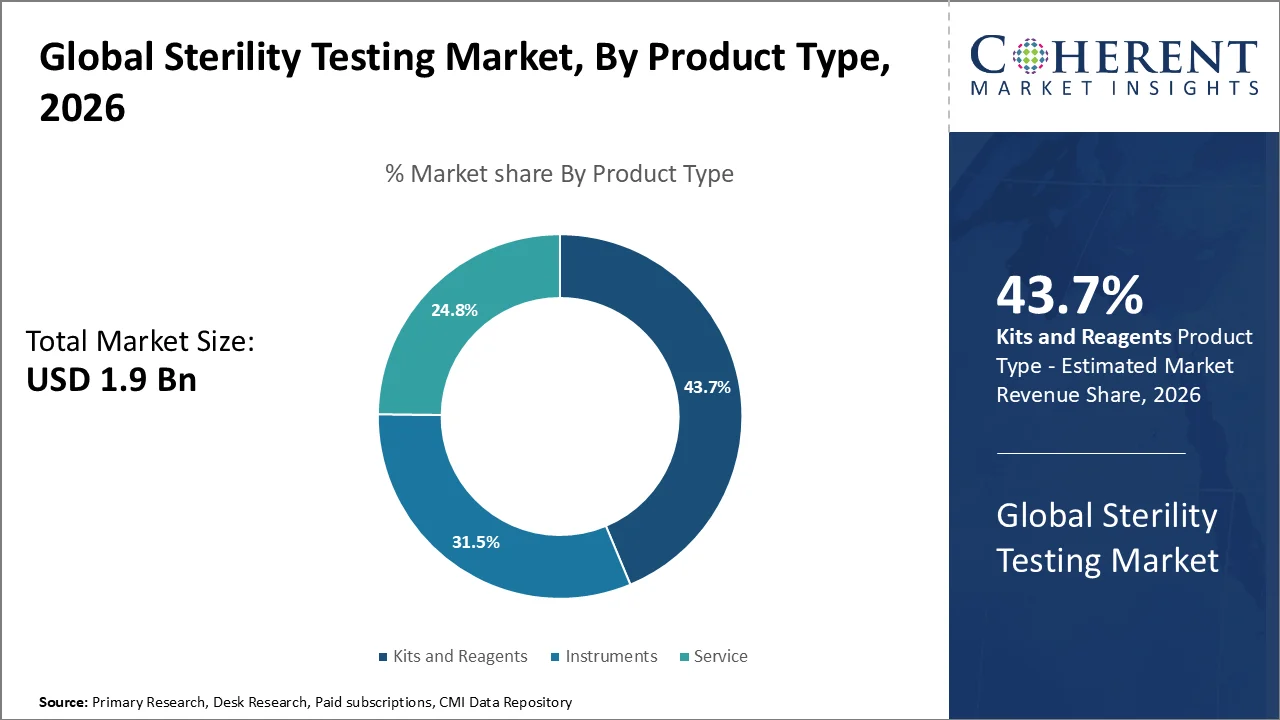
- Kits and Reagents hold the largest market share of 43.7% in 2026 owing to the rising demand for biologics and injectable products. The biologics market is estimated to surpass USD 1,311.8 Mn by 2033.
- Membrane Filtration expected to hold largest market share of 37.9% in 2026 owing to its suitability for filterable products.
- Pharmaceutical and Biological Manufacturing acquired the largest market share of 38.7% in 2026 owing to its increasing adoption of aseptic manufacturing. Sterility testing is a critical GMP requirement used to verify that pharmaceutical products, medical devices, biologics, and cell and gene therapies are free from viable microorganisms before patient administration.
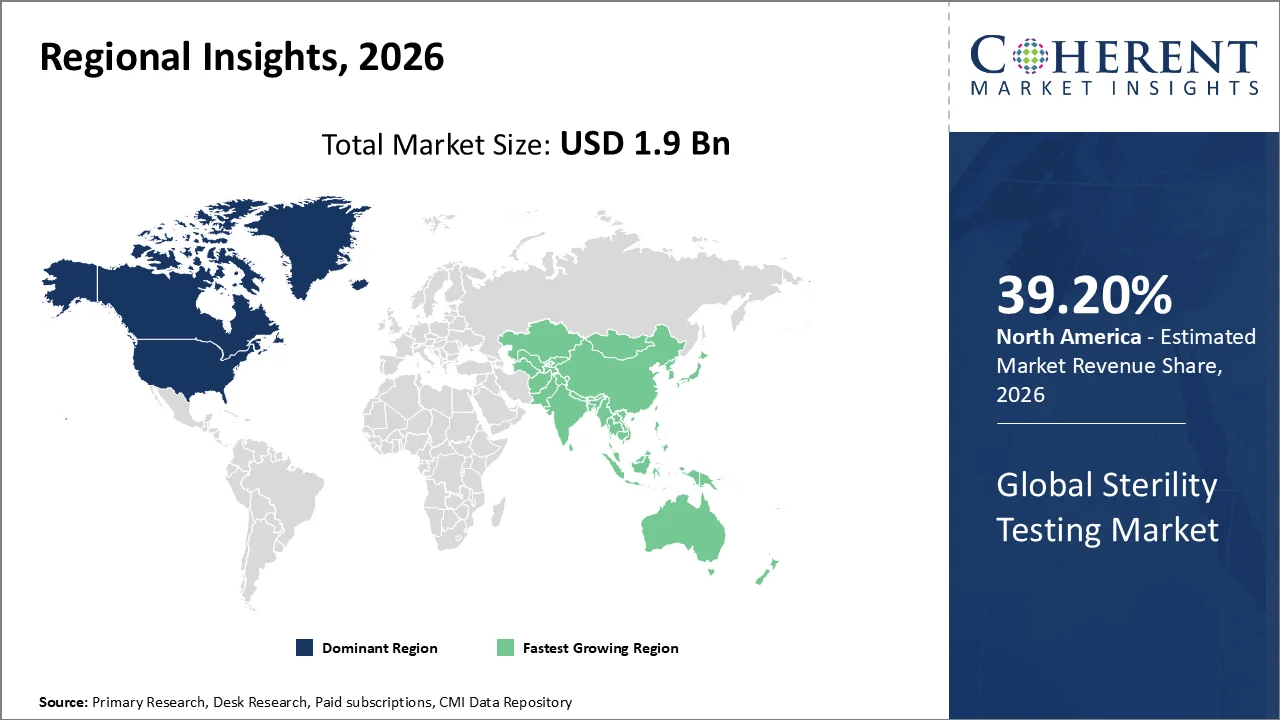
- North America is expected to acquire the dominant share of 39.2% in 2026 owing to the strong pharmaceutical and biotechnology industry. The United States is the world’s largest pharmaceutical market, accounting for more than half of global prescription drug sales by value. Net medicine spending is projected to surpass USD 600 Bn by 2030.
Current Events and Their Impact on the Sterility Testing Market
Current Event | Description and its Impact |
EU GMP Annex 1 Becomes Fully Applicable
|
|
FDA Maintains Strict CGMP Expectations for Sterile Manufacturing
|
|
Segmental Insights
- Current Industry Events of 2026
- Market Size Estimation
- Regional Breakdown
- Competitive Landscape
- Customer Intelligence
- Segmental Analysis
- Pricing Analysis
- Key Market Drivers, Challenges & Future Trends
- Customized Insights Section
Why is Kits and Reagents Acquiring the Largest Market Share?
Kits and Reagents hold the largest market share of 43.7% in 2026. The growing demand for reliable, standardized, and convenient sterility testing drives the kits and reagents segment across pharmaceutical and biotechnology laboratories. Manufacturers routinely use these consumables for sterility, bioburden, and microbial detection tests, generating consistent demand. Ready-to-use kits help laboratories streamline testing, shorten preparation time, and reduce contamination risks, while validated culture media and reagents deliver accurate and consistent results. Rising production of sterile drugs, biologics, vaccines, and advanced therapies, combined with strict quality-control standards and automated testing adoption, further drives market growth. INTEGRA Biosciences developed the WELLJET dispenser family to lower operating costs, improve productivity, and extend walk-away time. Its three sterile models deliver accurate, precise dispensing across volumes ranging from 0.5 μl to 10 ml.
Membrane Filtration expected to hold largest market share
Membrane Filtration expected to hold largest market share of 37.9% in 2026 owing to its ability to test products containing antimicrobial substances. Membrane filtration drives the sterility testing market because pharmaceutical manufacturers widely use it for filterable products, especially liquid formulations, injectables, antibiotics, and preservative-containing drugs. In April 2024, Asahi Kasei began selling a membrane-based system for producing Water for Injection (WFI) as an alternative to conventional distillation. The system uses Microza hollow-fiber membrane technology, reducing steam requirements and thereby lowering CO₂ emissions and WFI production costs. This is further accelerating the market’s growth.
Which Application segment dominates the market?
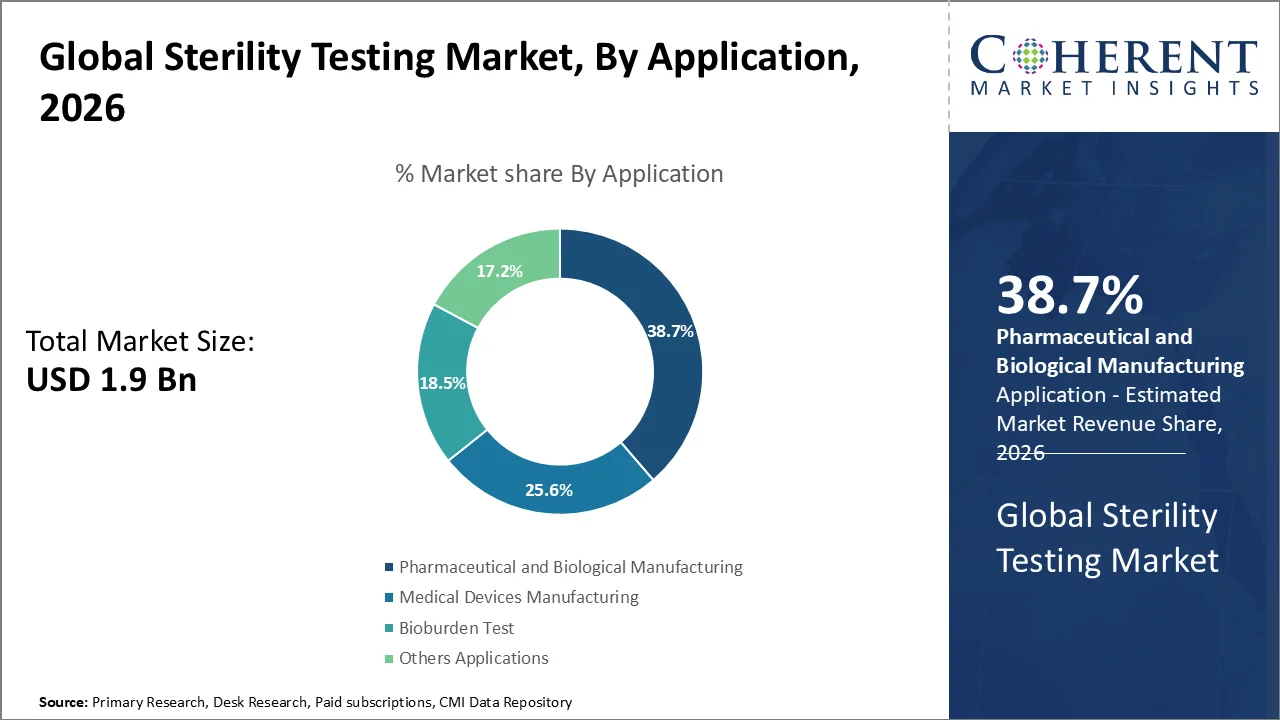
Pharmaceutical and Biological Manufacturing acquired the largest market share of 38.7% in 2026. Expanding pharmaceutical and biological manufacturing drives demand for sterility testing as companies increase production of sterile drugs, biologics, vaccines, injectables, and advanced therapies. Manufacturers perform rigorous sterility tests to identify microbial contamination and comply with strict quality and safety standards. For instance, regulatory agencies require sterile facilities to comply with stringent GMP standards, including ISO 5/Grade A cleanrooms, validated aseptic processes, real-time environmental monitoring, and robust contamination-control strategies, as specified in EU GMP Annex 1 and FDA guidance for sterile drug products. Pharmaceutical R&D, new drug launches, and innovations in biologics and cell and gene therapies further increase testing requirements.
Sterility Testing Market Trends
- Increasing use of automated and closed testing systems: FDA has specifically encouraged the integration of sterility-testing innovations with advanced manufacturing technologies, including robotic isolators, to improve microbial detection and identification. This supports demand for automated and controlled testing environments that reduce manual intervention and contamination risk.
- Rising production of biologics, vaccines, injectables, and advanced therapies: The continued approval of biological products provides a growing base of sterile products requiring microbiological quality controls. For example, FDA recorded new BLA approvals throughout 2025, including gene and cell-based therapies.
- Stricter sterile-manufacturing requirements: The revised EU GMP Annex 1 became applicable on 25 August 2023, with the remaining provision taking effect on 25 August 2024. The updated framework places greater emphasis on contamination-control strategies for sterile medicinal products. This is increasing the importance of validated microbiological testing within broader sterility-assurance programs.
Regional Insights
North America dominates owing to increasing focus on quality and contamination control
North America is expected to acquire the dominant share of 39.20% in 2026. North America’s sterility testing market benefits from strict FDA quality and cGMP requirements, which drive manufacturers to conduct comprehensive microbiological and sterility testing for sterile products. The region’s robust pharmaceutical and biotechnology sectors, along with rising production of biologics, vaccines, injectables, and advanced therapies, further strengthen demand. Manufacturers increasingly prioritize contamination control, validated testing methods, rapid microbiological technologies, and advanced manufacturing systems. Growing regulatory scrutiny and stronger quality-assurance practices also encourage companies to invest in reliable and efficient sterility testing solutions. Abbott has launched Similac 360 Total Care Made With Whole Milk, which it describes as the first and only commercially sterile, ready-to-feed liquid infant formula made with whole milk available in the United States.
Asia Pacific Sterility Testing Market Trends
The Asia Pacific sterility testing market is expanding as pharmaceutical and biopharmaceutical manufacturers increase production across China, India, Japan, and South Korea. Growing demand for vaccines, biologics, biosimilars, injectables, and advanced therapies drives manufacturers to strengthen sterility assurance. Regulatory authorities continue to tighten quality requirements, while rising healthcare spending and clinical research support market growth. Sterility testing is a mandatory quality-control requirement for pharmaceutical manufacturers, compounding pharmacies, and outsourcing facilities. This is further propelling the industry’s growth.
United States Sterility Testing Market Trends
The United States sterility testing market grows as pharmaceutical companies increase their production of sterile injectables, biologics, vaccines, and advanced therapies, including cell and gene treatments. FDA and USP regulations require manufacturers to maintain strict contamination control and product quality, which drives testing demand. Expanding pharmaceutical R&D and drug approvals also increase testing requirements. Pharmaceutical companies increasingly outsource sterility testing to specialized laboratories, while rapid microbiological methods, automation, and advanced detection technologies help them improve testing accuracy, efficiency, and turnaround times. In March 2025, Nelson Labs, a U.S.-based testing and advisory firm specializing in microbiology and analytical chemistry, launched a product sterility testing service using rapid microbiological methods (RMMs) across three laboratory sites in the U.S. and Europe.
Japan Sterility Testing Market Trends
Japan’s sterility testing market continues to grow as pharmaceutical companies strengthen quality and safety measures, expand sterile medicine production, and develop biologics and biotechnology products. Rising demand for injectable drugs, vaccines, and advanced therapies encourages manufacturers to implement robust sterility testing processes. PMDA regulations and GMP requirements further drive adoption across pharmaceutical facilities. Companies are also adopting automated and rapid microbiological testing technologies to enhance accuracy, minimize contamination risks, speed up quality control procedures, and improve overall manufacturing efficiency.
Who are the Major Companies in Sterility Testing Industry
Some of the major key players in Sterility Testing are Merck Millipore, Thermo Fisher Scientific, Inc., bioMérieux SA, SGS S.A., Sartorius AG, WuXi AppTec, and Charles River Laboratories International, Inc.
Key News
- In June 2025, Solventum has launched the Attest Super Rapid VH2O2 Clear Challenge Pack, a ready-to-use sterility test that combines FDA-cleared biological and chemical indicators in a single-use transparent pack to verify microbial neutralization and sterilizer performance.
Market Report Scope
Sterility Testing Market Report Coverage
| Report Coverage | Details | ||
|---|---|---|---|
| Base Year: | 2025 | Market Size in 2026: | USD 1.9 Bn |
| Historical Data for: | 2020 To 2024 | Forecast Period: | 2026 To 2033 |
| Forecast Period 2026 to 2033 CAGR: | 10.8% | 2033 Value Projection: | USD 4.8 Bn |
| Geographies covered: |
| ||
| Segments covered: |
| ||
| Companies covered: | Merck Millipore, Thermo Fisher Scientific, Inc., bioMérieux SA, SGS S.A., Sartorius AG, WuXi AppTec, and Charles River Laboratories International, Inc. | ||
Analyst Opinion
- Sterility testing is no longer a routine quality-control checkpoint; it is becoming a critical risk-management function as manufacturers face increasingly complex sterile drug portfolios. The global burden of injectable and biologic therapies is pushing companies to demand faster and more reliable microbial detection. The strongest demand is coming from pharmaceutical and biopharmaceutical manufacturers that cannot afford batch failures, contamination events, or lengthy release timelines.
- The scale of sterile manufacturing makes testing performance commercially significant. The FDA has repeatedly highlighted microbial contamination as a serious risk in sterile drug production, while regulatory expectations under GMP require manufacturers to demonstrate appropriate sterility assurance. A single contamination event can force manufacturers to quarantine or recall products, making investment in robust sterility testing far more economical than relying on conventional end-stage controls alone.
- Rapid microbiological methods are the biggest technology opportunity within sterility testing. Traditional sterility tests can require up to 14 days of incubation, whereas rapid and automated approaches can provide substantially earlier indications of microbial contamination. This time advantage matters particularly for high-value biologics, cell and gene therapies, and other temperature-sensitive products, where every additional day of batch release can increase inventory and operational costs.
- The expansion of advanced therapies will further strengthen demand for highly sensitive sterility assurance. For example, the FDA has approved hundreds of biological products, while the number of cell and gene therapy applications continues to increase. These products often involve short manufacturing windows and highly controlled processes, making conventional testing workflows increasingly difficult to justify. I expect manufacturers to prioritize automated, rapid, and closed-system testing platforms that reduce analyst intervention while improving contamination control.
- Regulatory pressure will remain a decisive purchasing factor. FDA warning letters and manufacturing observations have repeatedly identified inadequate environmental monitoring, microbial controls, and sterility assurance practices. In my view, this regulatory scrutiny will push pharmaceutical companies toward validated automated systems rather than treating sterility testing as a standalone laboratory exercise. The competitive advantage will increasingly belong to testing technologies that combine faster detection, strong data integrity, automation, and regulatory compliance.
Speak to the analyst
Want personalized insights?
Take the findings above to one of our principal consultants, or have the report rebuilt around the segments, geographies and competitors you actually track.
Market Segmentation
- By Product Type (Revenue, USD Bn, 2021-2033)
- Kits and Reagents
- Instruments
- Service
- By Test Type (Revenue, USD Bn, 2021-2033)
- Membrane Filtration
- Direct Inoculation
- Container closure integrity testing
- Antimicrobial effectiveness testing
- Rapid micro test
- ATP bioluminescence
- Fluorescent labeling
- Electrical resistance
- By Application (Revenue, USD Bn, 2021-2033)
- Pharmaceutical and Biological Manufacturing
- Medical Devices Manufacturing
- Bioburden Test
- Others Applications
- By Region (Revenue, USD Bn, 2021-2033)
- North America
- U.S.
- Canada
- Latin America
- Brazil
- Mexico
- Argentina
- Rest of Latin America
- Europe
- Germany
- U.K.
- France
- Italy
- Spain
- Russia
- Rest of Europe
- Asia Pacific
- China
- India
- Japan
- Australia
- South Korea
- ASEAN
- Rest of Asia Pacific
- Middle East
- GCC
- Israel
- Rest of Middle East
- Africa
- South Africa
- Central Africa
- North Africa
- North America
Sources
Primary Research interviews
- Pharmaceutical manufacturing executives
- Quality assurance and quality control professionals
- Microbiology laboratory managers
- Sterility testing specialists
- Biopharmaceutical manufacturing professionals
- Regulatory affairs experts
- CRO/CDMO industry professionals
- Laboratory automation and microbiology technology specialists
Databases
- U.S. Food and Drug Administration (FDA) databases
- European Medicines Agency (EMA) databases
- U.S. National Library of Medicine (PubMed)
- World Health Organization (WHO) databases
- U.S. Pharmacopeia (USP) resources
- Japan Pharmaceuticals and Medical Devices Agency (PMDA) databases
- ClinicalTrials.gov
- OECD health and pharmaceutical databases
Magazines
- Pharmaceutical Technology
- Pharmaceutical Executive
- BioPharm International
- European Pharmaceutical Review
- Manufacturing Chemist
- Lab Manager
- Drug Development & Delivery
Journals
- Journal of Pharmaceutical Sciences
- PDA Journal of Pharmaceutical Science and Technology
- Journal of Pharmaceutical and Biomedical Analysis
- European Journal of Pharmaceutics and Biopharmaceutics
- Applied and Environmental Microbiology
- Journal of Microbiological Methods
- International Journal of Pharmaceutics
- Pharmaceutical Research
Newspapers
- The Wall Street Journal
- Financial Times
- The New York Times
- Reuters
- The Economic Times
- The Times of India
- Nikkei Asia
Associations
- International Society for Pharmaceutical Engineering (ISPE)
- Parenteral Drug Association (PDA)
- International Federation of Pharmaceutical Manufacturers and Associations (IFPMA)
- Pharmaceutical Research and Manufacturers of America (PhRMA)
- European Federation of Pharmaceutical Industries and Associations (EFPIA)
- Association of Clinical Research Organizations (ACRO)
- International Pharmaceutical Federation (FIP)
Public Domain sources
- U.S. Food and Drug Administration (FDA) — CGMP regulations, guidance documents, inspection and compliance information
- World Health Organization (WHO) — GMP guidelines and sterile pharmaceutical product standards
- U.S. Pharmacopeia (USP) — Sterility Test <71> and related microbiological standards
- European Medicines Agency (EMA) — pharmaceutical quality and GMP guidance
- Japan Pharmaceuticals and Medical Devices Agency (PMDA) — pharmaceutical quality and GMP information
- National Institutes of Health (NIH) and PubMed — scientific and biomedical literature
- ClinicalTrials.gov — clinical trial and advanced-therapy development information
- OECD — pharmaceutical, biotechnology, and healthcare statistics
- World Bank — healthcare and economic indicators
- National statistical agencies and government pharmaceutical databases
- WHO technical reports and pharmaceutical quality-assurance publications
Proprietary Elements
- CMI Data Analytics Tool
- Proprietary CMI Existing Repository of information for last 10 years
Get access to 250+ pages report
Every segment, forecast, competitor profile and data table behind the analysis above — available for instant download.
- ESOMAR Member
- ISO 9001:2015 Certified
- D-U-N-S Registered
- GDPR & CCPA Compliant
Missing comfort of reading report in your local language? Find your preferred language:
Transform your Strategy with Exclusive Trending Reports
Frequently Asked Questions
The Sterility Testing Market is anticipated to grow at a CAGR of 10.8% with USD 1.9 Bn in 2026 and is expected to reach USD 4.8 Bn in 2033.
The Sterility Testing Market is primarily driven by increasing pharmaceutical and biologics production, rising demand for sterile injectables and vaccines, stricter regulatory requirements, and growing adoption of single-use manufacturing systems.
Kits and Reagents represent the leading product type, supported by their extensive use in sterility, bioburden, and microbial detection testing.
Membrane filtration is widely adopted because it works particularly well with filterable pharmaceutical products, including liquid formulations, injectables, antibiotics, and preservative-containing preparations.
Pharmaceutical and Biological Manufacturing represents the leading application segment.
Rapid microbiological methods are shifting sterility testing toward faster and more automated workflows.