

Global Stick Vacuum Cleaner Market Size and Forecast: 2026 to 2033
The Global Stick Vacuum Cleaner Market is estimated to be valued at USD 4.38 Bn in 2026 and is expected to reach USD 6.78 Bn by 2033, reflecting a compound annual growth rate (CAGR) of 6.4% from 2026 to 2033.
Key Takeaways of the Stick Vacuum Cleaner Market
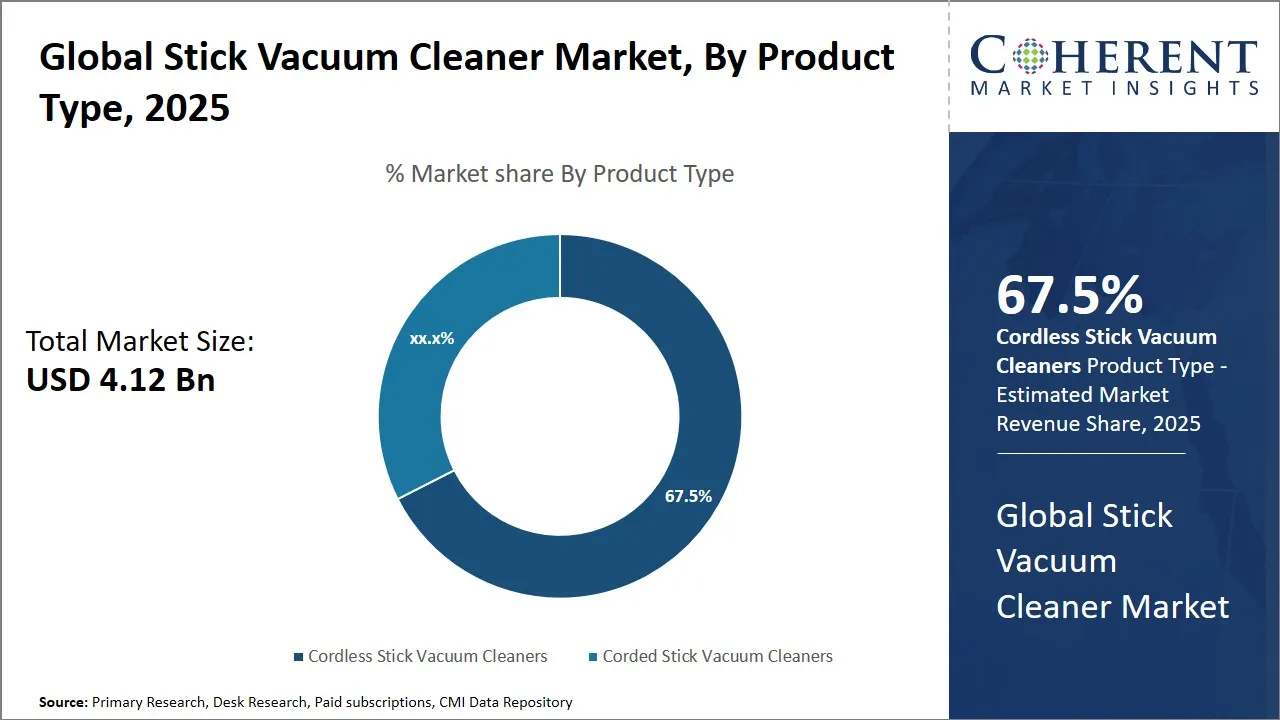
- Cordless stick vacuum cleaners’ segment is projected to capture 68.5% of the stick vacuum cleaner market share in 2026.
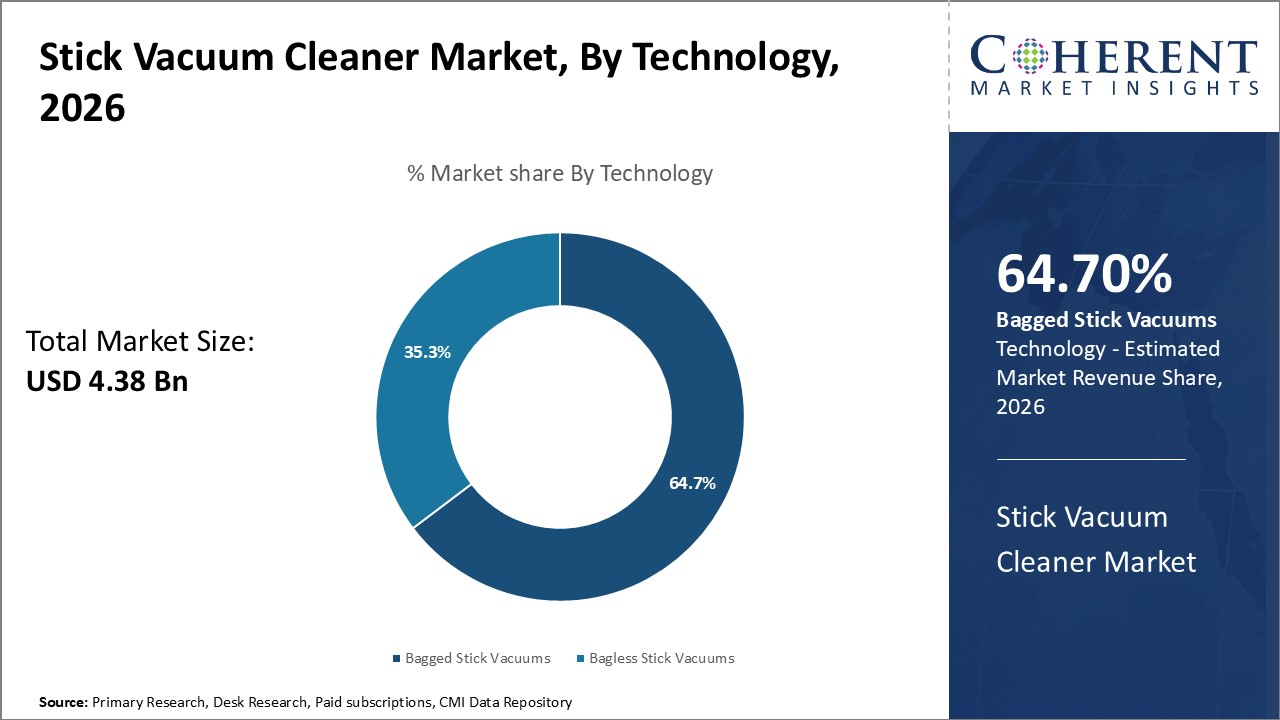
- Bagged stick vacuums segment is projected to account for 64.7% of the market share in 2026.
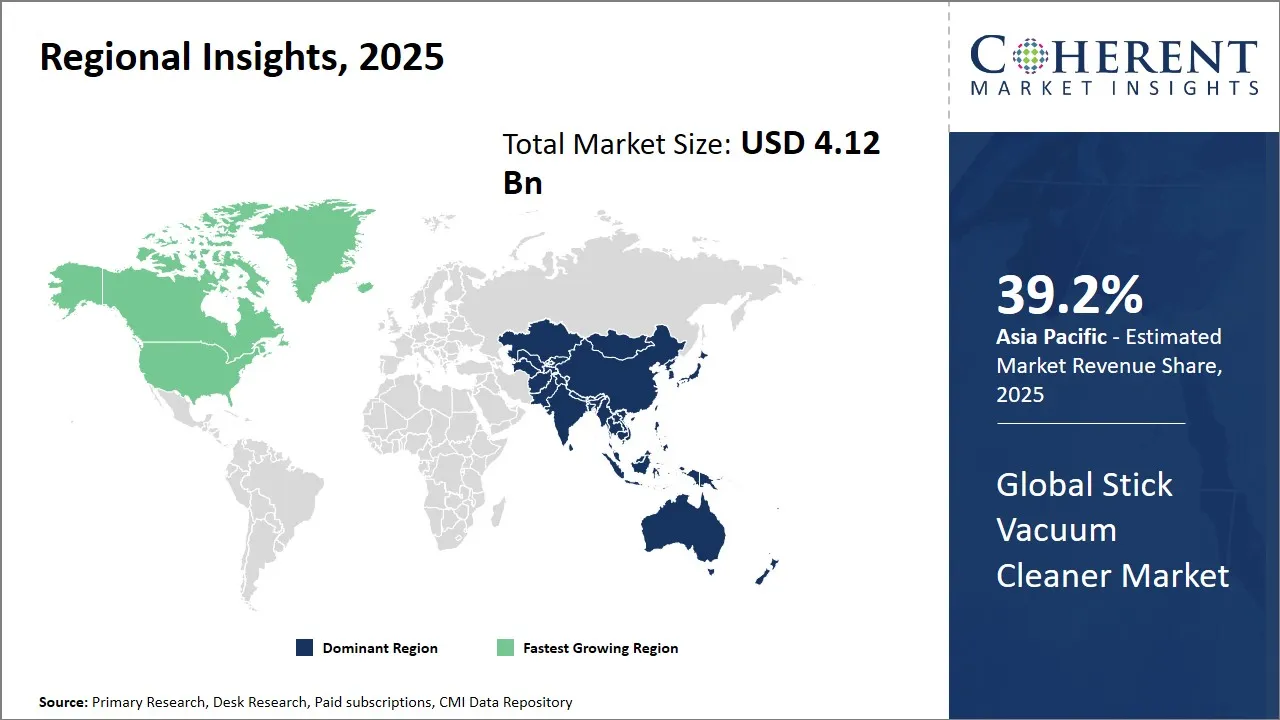
- Asia Pacific will dominate the stick vacuum cleaner market in 2026 with an estimated 39.2% share.
- North America will hold 18.3% share in 2026 and record the fastest growth.
Market Overview
- The market trend involves the application of smart, energy efficient, and multi-functional stick vacuum cleaner with the addition of the IoT features that improve the level of convenience of the user and the effectiveness of cleaning.
- The manufacturers are also paying attention to designing innovation through the use of powerful suction, longer battery life, and ergonomic designs.
- Besides, the change towards sustainable and eco-friendly products is also having an impact on consumer purchase behavior.
- The competitive environment of the stick vacuum cleaner market is being transformed by the online retail channels that are being backed by the intensive marketing and competitive prices.
Currents Events and Its Impact
Current Events | Description and its Impact |
Launch of Dyson PencilVac ultra-slim stick vacuum |
|
EU Ecodesign & ESPR tightening sustainability rules for vacuum cleaners |
|
Segmental Insights
- Current Industry Events of 2026
- Market Size Estimation
- Regional Breakdown
- Competitive Landscape
- Customer Intelligence
- Segmental Analysis
- Pricing Analysis
- Key Market Drivers, Challenges & Future Trends
- Customized Insights Section
Why Does the Cordless Stick Vacuum Cleaners Dominate the Stick Vacuum Cleaner Market in 2026?
Cordless stick vacuum cleaners are expected to command 68.5% of the global stick vacuum cleaner market share in 2026. The most important factor that contributes to this domination is that the consumers are becoming more inclined towards the convenience and mobility in their household cleaning appliances. In contrast to the corded models, the cordless ones are flexible and can be used freely without having to spend time on power points and the disentangled cord, which is a big problem. This is the feature that is especially attractive in the modern houses with the open structure, several floors, and the spaces that can be difficult to access.
In urban apartments with multiple levels, cordless stick vacuums are highly favored as they can easily move between floors and reach difficult-to-clean areas, such as stairs or under furniture, without the hassle of unplugging and re-plugging cords. This convenience makes cordless models particularly popular among busy households that prioritize efficiency and ease of use.
Bagged Stick Vacuums Dominate the Stick Vacuum Cleaner Market
Bagged stick vacuums segment is projected to hold 64.7% of the market share in 2026, driven by heightened consumer awareness regarding cleanliness, hygiene, and air quality. Bagged vacuum systems are successful in keeping dust, allergens and fine particles in a sealed bag that ensures that they do not escape into the environment during and after cleaning. Allergy sufferers and pets are especially appreciative of this containment as it is vital to control airborne irritants in this case.
The perceived quality of bagged vacuum in keeping the indoors clean is a powerful driving force to the buyer of this technology. It is also easy and hygienic to replace vacuum bags and ensure that there is minimal direct interaction with dust and debris. This is unlike others that are bagless and need dustbins emptied, thus releasing dust clouds and allergens during disposal.
Why Does Economy Segment Dominate Market Share Across Price Range Segments?
Economy segment is expected to hold 46.8% share in 2026, attributable to their affordability and accessibility to a wide array of consumers. The rising trend in demand of effective though economizing cleaning systems is a factor that contributed to the popularity of the economy models, particularly to persons making their first purchase, households based on economic factors, and geographically diversified markets where the economic factors significantly determine the choices.
Economy sticks vacuums are vacuum cleaners with necessities but not with any luxury options or fancy materials, which reduces the cost of production and provides more competitive prices in retail. These models have adequate performance with a low cleaning capacity having simple structures to satisfy the minimum cleaning requirements of majority of end users as far as cleaning normal flooring and surfaces that are easy to clean is concerned.
Regional Insights
Asia Pacific Stick Vacuum Cleaner Market Analysis and Trends
The Asia Pacific region is projected to lead the market with a 39.2% share in 2026, due to rapid urbanization, rising disposable incomes, and increasing penetration of modern retail channels like e-commerce. In some countries like China, India, and Southeast Asian countries, governments are commanding clean and healthy living environment, thus encouraging the use of superior cleaning technologies. Furthermore, there is an increasing appreciation of hygiene, as well as a rise in the number of people in the middle-class, which drives the need of household convenience goods.
The high production base of such countries as China and South Korea enables the cost-competitive production, which is attractive to the domestic consumers and export markets. Several other prominent competitors like Xiaomi, LG Electronics, and Panasonic can currently serve the tastes of consumers with highly technological and low-priced products. The markets development path is further supported by trade policies that are supposed to promote manufacturing exports and the enhancement of logistics.
North America Stick Vacuum Cleaner Market Analysis and Trends
The North America region is expected to exhibit the fastest growth in the market contributing 18.3% share in 2026, driven by a well-established market ecosystem characterized by high consumer awareness, advanced retail infrastructure, and widespread adoption of smart home technologies. The area is favorable due to the high conditionalities of the government to support the use of energy saving appliances and the stringent environmental policies that have helped manufacturers to provide greener, cordless, and lightweight vacuum products.
Furthermore, North America has headquarters or large bases of operation of various international giants in household appliances, which promotes innovations and availability. Dyson, SharkNinja and Hoover (a division of Techtronic Industries) hold a strong presence here since they have strong distribution networks and aggressive marketing to sustain market leadership. The free movement of parts and final products across the borders is made easy through trade dynamics, such as free trade agreements, such as the USMCA, which in turn gives supply chain resiliency.
Global Stick Vacuum Cleaner Market Outlook for Key Countries
Why is the U.S. Stick Vacuum Cleaner Market Shifting Decisively Toward Smart Cordless Models?
The American stick vacuum cleaner sector is characterized by the high demand among consumers towards smart, cordless stick vacuums, preconditioned by the active lifestyles and the increased attention to domestic cleanliness and air quality. The dominant brands such as SharkNinja and Dyson have aligned their products lines to suit changing demand of consumers focusing on powerful suction, investing in ergonomics, and the ability to clean more than just the floor. The system of the developed aftermarket services and massive presence in large box stores and the Internet facilitates the stable supply of the product and the brand penetration.
China Stick Vacuum Cleaner Market Trends
The China stick vacuum cleaner market is quickly developing as domestic companies such as Xiaomi and Roborock are innovating hard to win over the tech-savvy segment of the customer base. Those government programmes in support of clean energy and environmental sustainability are indirectly supportive of the demands to the efficient and battery-powered vacuum cleaners. The large e-commerce space in China is important in the distribution of products where manufacturers can expand rapidly and reach tiers two and three of cities with ease.
Germany Stick Vacuum Cleaner Market Trends
Germany continues to lead the European segment with a strong inclination towards premium and energy-efficient household appliances. German consumers gravitate towards brands like Miele and Bosch, both of which emphasize durability, reliability, and sustainable design in their stick vacuum offerings. Stringent EU regulations on appliance energy consumption and waste management further drive demand for high-quality, long-lasting vacuum cleaners. Germany’s position as a manufacturing and innovation hub enhances the availability of cutting-edge technologies in the local market.
Why is India’s Stick Vacuum Cleaner Market Accelerating on the Back of Urban Lifestyles and Hygiene Awareness?
India’s stick vacuum cleaner market is characterized by emerging demand fueled by urbanization, growing middle-class income, and increasing awareness of hygiene. Companies such as Dyson and Philips are expanding their footprint by introducing affordable yet feature-rich models that cater to price-sensitive consumers while maintaining brand prestige. Government initiatives focused on smart city development and cleanliness under programs like Swachh Bharat complement the rising consumer interest in household cleanliness products.
Japan Stick Vacuum Cleaner Market Trends
Japan’s stick vacuum cleaner market is distinguished by consumer preferences for compact, multifunctional, and technologically sophisticated stick vacuum cleaners, reflecting the country’s space-conscious living environments. Brands such as Panasonic and Hitachi tailor their products to integrate advanced filtration systems and quiet operation. The presence of a mature retail sector and a high level of consumer trust in domestic manufacturers ensures consistent market demand despite a relatively saturated environment.
How Battery Degradation Behaves
- New premium cordless sticks cluster around 30–50 minutes of real-world runtime per charge in standard mode, with a few leaders exceeding 50 minutes and some outliers above 100 minutes.
- High-suction “max/boost” modes can cut that runtime to roughly one-third or less (e.g., under 15 minutes for some flagships), which accelerates long-term degradation because cells are repeatedly stressed at high current draw.
Suction Efficiency-to-Power Ratio
- Suction “output” is best measured in air watts (AW) or Pascal (Pa) levels plus actual debris pickup tests, while “input” is electrical power draw in watts, so the key efficiency metric is debris removed (or AW) per watt consumed.
- For cordless sticks, good real-world suction typically sits around 100–150 AW for mass-market designs and 150–210 AW for high-performance models, with better designs achieving strong pickup at the lower end of that power envelope.
- Lab testing shows many high-suction sticks drain batteries faster, clustering in a quadrant of strong sand/dirt pickup but short runtimes, while a few models (e.g., certain Dreame and Shark units) stand out by pairing above-average suction with unusually long runtimes, indicating superior motor and airflow efficiency per watt.
Market Players, Key Development, and Competitive Intelligence
Key Developments
- In September 2025, Dyson Limited launched the Dyson V16 Piston Animal cordless vacuum, an anti-tangle cordless vacuum cleaner in the U.S. market.
- In September 2025, Eufy, a cleaning appliances brand, launched a robotic Marswalker stick vacuum product, which enables users to clean stair surfaces effectively.
- In July 2025, Dreame Technology, a robotic and cordless vacuum cleaner maker, established a partnership with Croma to make its products available to the partnered company’s physical retail stores across over 20 Indian cities.
Top Strategies Followed by Global Stick Vacuum Cleaner Market Players
- The existing market leaders allocate a lot of resources in research and development to create high-performance and technologically advanced products. Such companies focus on the improvement of the features, including suction power, battery life, and ergonomic design to address the changing consumer expectations. They also establish strategic alliances with key industry players and original equipment manufacturers (OEMs) in addition to product innovation in order to consolidate their market share.
- For example, Dyson, LG, Samsung and SharkNinja implement aggressive research and development agendas to stay on top of the technology. Dysons V-series release is a perfect example of never-ending enhancement of suction power, cyclone technology and lightweight motors make the brand in front.
- Mid-level players operating in the market of stick vacuum cleaners have a differentiated and complementary strategy as they focus on cost effective solutions that are a compromise between quality and cost. Their strategic intelligence is mainly focused on price-sensitive customers who want to have a stable performance but not at premium prices. In this regard, the mid-tier firms simplify their manufacturing operations and maximize resulted supply chains to lower expenses, which enable them to have competitive-priced products.
- For example, Tinecos A-series vacuums have shown value engineering strong suction, good battery life, and intelligent capabilities without costing like Dyson. Dreame also optimizes its production pipeline in China to drive down the cost of BOM in order to generate aggressive pricing in Europe and the U.S. Roborock uses common R&D facilities on its robot vacuum product line to drive down the cost of engineering stick vacuums, but offers hybrid devices.
- Small-scale competitors usually serve niche markets in the stick vacuum cleaner industry, and differ by their focus: they specialize on specialized functionality or innovation-based products designed to meet distinctive consumer needs. To remain competitive on par with bigger competitors, these companies often use the latest technologies, i.e., smart sensors, integration with IoT, or environmentally friendly components.
- For example, Eufy uses the experience of its parent company, Ankers battery, to develop light models with high run times, and becomes a smart-value brand. Roidmi is aimed at consumers that are environmentally conscious, as they incorporate recyclable materials and replaceable components.
Market Report Scope
Global Stick Vacuum Cleaner Market Report Coverage
| Report Coverage | Details | ||
|---|---|---|---|
| Base Year: | 2025 | Market Size in 2026: | USD 4.38 Bn |
| Historical Data for: | 2020 To 2024 | Forecast Period: | 2026 To 2033 |
| Forecast Period 2026 to 2033 CAGR: | 6.4% | 2033 Value Projection: | USD 6.78 Bn |
| Geographies covered: |
| ||
| Segments covered: |
| ||
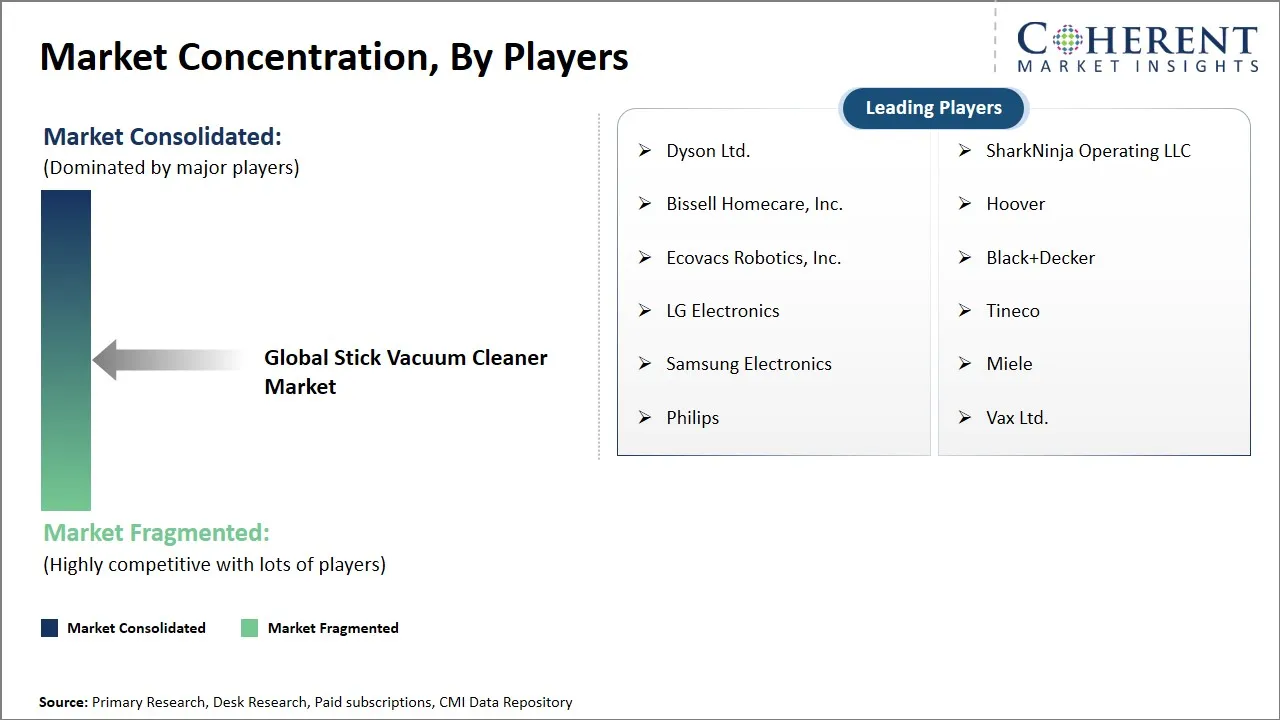
| Companies covered: | Dyson Ltd., SharkNinja Operating LLC, Bissell Homecare, Inc., Hoover, Ecovacs Robotics, Inc., Black+Decker, LG Electronics, Tineco, Samsung Electronics, Miele, Philips, and Vax Ltd. | ||
| Growth Drivers: |
| ||
| Restraints & Challenges: |
| ||
Stick Vacuum Cleaner Market Dynamics
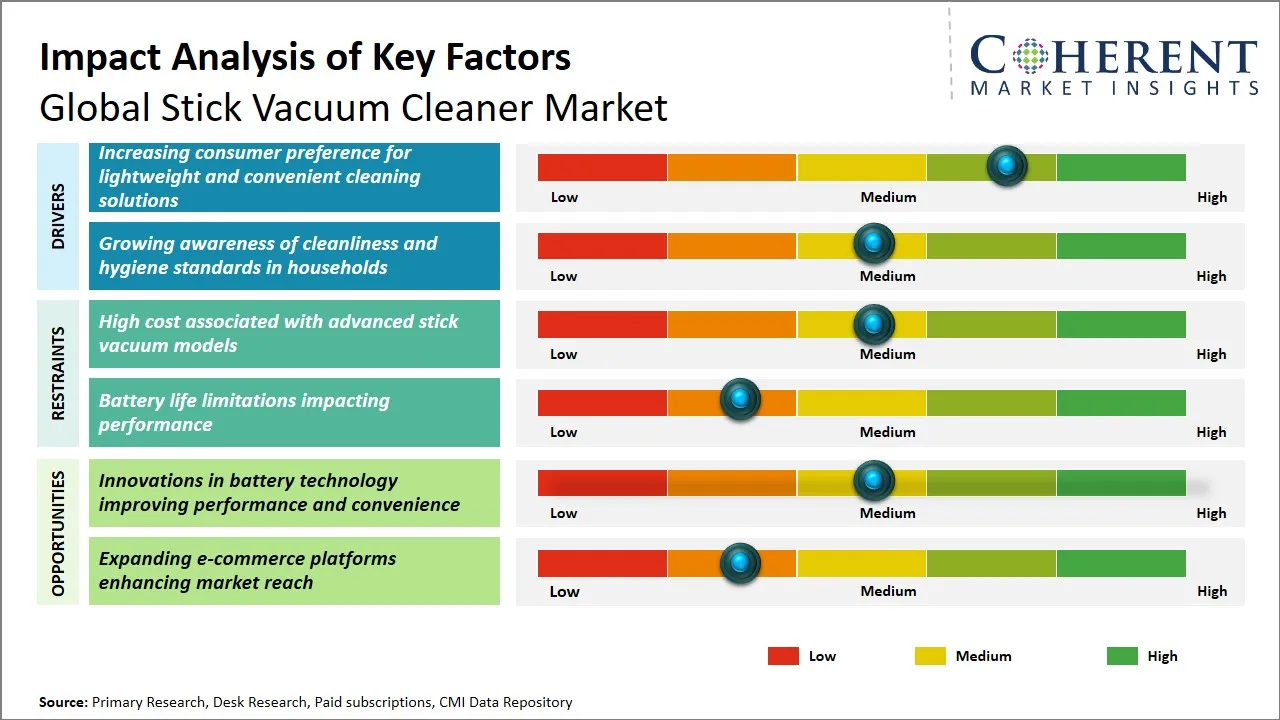
Stick Vacuum Cleaner Market Driver - Increasing Consumer Preference for Lightweight and Convenient Cleaning Solutions
The increased trend towards the use of lightweight and easy to carry cleaning gadgets is largely driving the use of stick vacuum cleaners in the world. The contemporary consumers especially those who are in urban apartments and living in smaller areas are becoming more concerned with products that provide mobility and ease of use without affecting the cleaning efficiency. Stick vacuum cleaners that have a compact design and are powered by a cordless feature are ideally suited to this trend since they are used to clean different surfaces quickly and without any hassles, e.g., hardwood floors, bio-based carpets, and furniture.
As an example, the Dysons V-series stick vacuums of the cordless type have established a new standard of lightweight performance. Such models as Dyson V8 and V12 Slim are much lighter compared to conventional vacuums and provide powerful suction.
Stick Vacuum Cleaner Market Opportunity - Innovations in Battery Technology Enhancing Performance and Convenience
With the constant improvements in battery technology that is radically changing the performance and convenience of the products, the global stick vacuum cleaner market is set to gain a lot. Newer solid-state batteries and improved lithium ion batteries are providing longer run times, shorter charge times, and lighter design, key areas of consumer discomfort like short cleaning time and excessive weight of the device is alleviated. These enhancements allow users to clean more when not interrupted as well as allow the vacuum to be more convenient to move around particularly in multi-story houses or business premises.
As an example, Tinecos Pure One S15 and LGs CordZero series battery have high-end lithium-ion batteries with optional packs, which last well over 60 minutes. This directly addresses consumer disappointment with clean cycles that are not long. Dyson and Panasonic are also working on next generation solid-state battery research that would provide improved density and charge. These developments will enable the stick vacuums to run longer between charging and lessen charging dead time bolstering the attractiveness of the cordless offerings in big households and on the light commercial offerings.
Analyst Opinion (Expert Opinion)
- The worldwide market for stick vacuum cleaner is growing at a very high rate owing to the growing demand of lightweight and efficient cleaning equipment that is capable of meeting the lifestyle demands of the consumers. The trends at the International Home + Housewares Show (2023) and the Global Cleaning Industry Forum (2022) demonstrated some of the main innovations, and such brands as Dyson and Shark dominate technological improvements.
- The recent introduction of a cordless vacuum by Dysons with adaptive suction technology highlights the tendency of more performance and convenience, which also attracts busy people. The conversations at these conferences have demonstrated an increase in the desire of consumers to have multifunctional products that can be changed to various types of floors easily, and the designers of products should pay more attention to their versality.
- The high competition level and price sensitivity were also noted to be some of the challenges that prevent the company to penetrate the market more. Brands focusing more on user-friendly interfaces and intelligent capabilities, like the ability to connect with an app to get maintenance notifications, are probably going to be differentiated. Finally, the market expansion of the stick vacuum cleaner will be determined by its capacity to be innovative and keep up with the demands of the consumer in performance, convenience, and sustainability in home cleaning solutions
Speak to the analyst
Want personalized insights?
Take the findings above to one of our principal consultants, or have the report rebuilt around the segments, geographies and competitors you actually track.
Market Segmentation
- Product Type Insights (Revenue, USD Bn, 2021 - 2033)
- Cordless Stick Vacuum Cleaners
- Corded Stick Vacuum Cleaners
- Technology Insights (Revenue, USD Bn, 2021 - 2033)
- Bagged Stick Vacuums
- Bagless Stick Vacuums
- Price Range Insights (Revenue, USD Bn, 2021 - 2033)
- Economy
- Mid-Range
- Premium
- Application Insights (Revenue, USD Bn, 2021 - 2033)
- Residential
- Commercial
- Regional Insights (Revenue, USD Bn, 2021 - 2033)
- North America
- U.S.
- Canada
- Latin America
- Brazil
- Argentina
- Mexico
- Rest of Latin America
- Europe
- Germany
- U.K.
- Spain
- France
- Italy
- Russia
- Rest of Europe
- Asia Pacific
- China
- India
- Japan
- Australia
- South Korea
- ASEAN
- Rest of Asia Pacific
- Middle East
- GCC Countries
- Israel
- Rest of Middle East
- Africa
- South Africa
- North Africa
- Central Africa
- North America
- Key Players Insights
- Dyson Ltd.
- SharkNinja Operating LLC
- Bissell Homecare, Inc.
- Hoover
- Ecovacs Robotics, Inc.
- Black+Decker
- LG Electronics
- Tineco
- Samsung Electronics
- Miele
- Philips
- Vax Ltd
Sources
Primary Research Interviews
- CEO – Leading Stick Vacuum Manufacturer
- Supply Chain Director – Major Vacuum Cleaner Distributor
- Production Lead – Cordless Stick Vacuum Assembler
- Sustainability Officer – Home Appliance Certification Authority
Stakeholders
- Manufacturers
- End Use Sectors
- Residential Households (Urban Apartments, Pet Owners)
- Commercial Cleaning (Hotels, Offices)
- Healthcare Facilities (Hospitals, Clinics)
- Regulatory & Certification Bodies
- E-commerce Platforms and Retailers (Amazon, Walmart, Best Buy, Alibaba)
- Technology Integration Players: Smart home device makers
Databases
- UN Comtrade Database (HS Code 8508.11 for vacuum cleaners)
- India Import Export (EXIM) Database
- USGS (Household Appliance Trade Data, if applicable)
- Eurostat Trade Statistics for Household Appliances
Magazines
- Consumer Reports – Stick vacuum reviews and trends
- Home Appliance Magazine – Cordless vacuum innovations
- Cleaning & Maintenance Management – Commercial stick vacuums
- Appliance Design – Market dynamics for stick cleaners
Journals
- Journal of Cleaner Production – Sustainability in vacuum manufacturing
- Applied Ergonomics – Design of cordless stick vacuums
- International Journal of Industrial Ergonomics – User experience studies
- Energy Efficiency – Battery tech in appliances
Newspapers
- The Wall Street Journal – Consumer electronics demand for vacuums
- The Guardian – Eco-friendly home appliances
- Business Standard (India) – Vacuum imports and Asia growth
- Reuters – Supply chain in household appliances
Associations
- International Electrotechnical Commission (IEC)
- Association of Home Appliance Manufacturers (AHAM)
- Consumer Technology Association (CTA)
- European Committee of Domestic Equipment Manufacturers (CECED)
- Green Electronics Council
Public Domain Sources
- EPA – Energy Star guidelines for vacuums
- European Commission – Ecodesign regulations for appliances
- World Health Organization – Indoor air quality standards
- U.S. Department of Energy – Appliance efficiency reports
Proprietary Elements
- CMI Data Analytics Tool
- Proprietary CMI Existing Repository of information for last 8 years.
Get access to 250+ pages report
Every segment, forecast, competitor profile and data table behind the analysis above — available for instant download.
- ESOMAR Member
- ISO 9001:2015 Certified
- D-U-N-S Registered
- GDPR & CCPA Compliant
Missing comfort of reading report in your local language? Find your preferred language:
Transform your Strategy with Exclusive Trending Reports
Frequently Asked Questions
The global stick vacuum cleaner market is estimated to be valued at USD 4.38 Bn in 2026 and is expected to reach USD 6.78 Bn by 2033.
The CAGR of global stick vacuum cleaner market is projected to be 6.4% from 2026 to 2033.
Increasing consumer preference for lightweight and convenient cleaning solutions and growing awareness of cleanliness and hygiene standards in households are the major factors driving the growth of the global stick vacuum cleaner market.
High cost associated with advanced stick vacuum models and battery life limitations impacting performance. are the major factors hampering the growth of and global stick vacuum cleaner market.
In terms of product type, and cordless stick vacuum cleaners are estimated to dominate the market revenue share in 2026.
Dyson Ltd., SharkNinja Operating LLC, Bissell Homecare, Inc., Hoover, Ecovacs Robotics, Inc., Black+Decker, LG Electronics, Tineco, Samsung Electronics, Miele, Philips, and Vax Ltd. are the major players.
Asia Pacific is expected to lead the global stick vacuum cleaner market in 2026.