

Global Street Sweeper Market Size and Forecast – 2026 to 2033
The global street sweeper market is estimated to be valued at USD 2.27 Bn in 2026 and is expected to reach USD 3.06 Bn by 2033, exhibiting a compound annual growth rate (CAGR) of 4.4% from 2026 to 2033.
Key Takeaways of the Street Sweeper Market
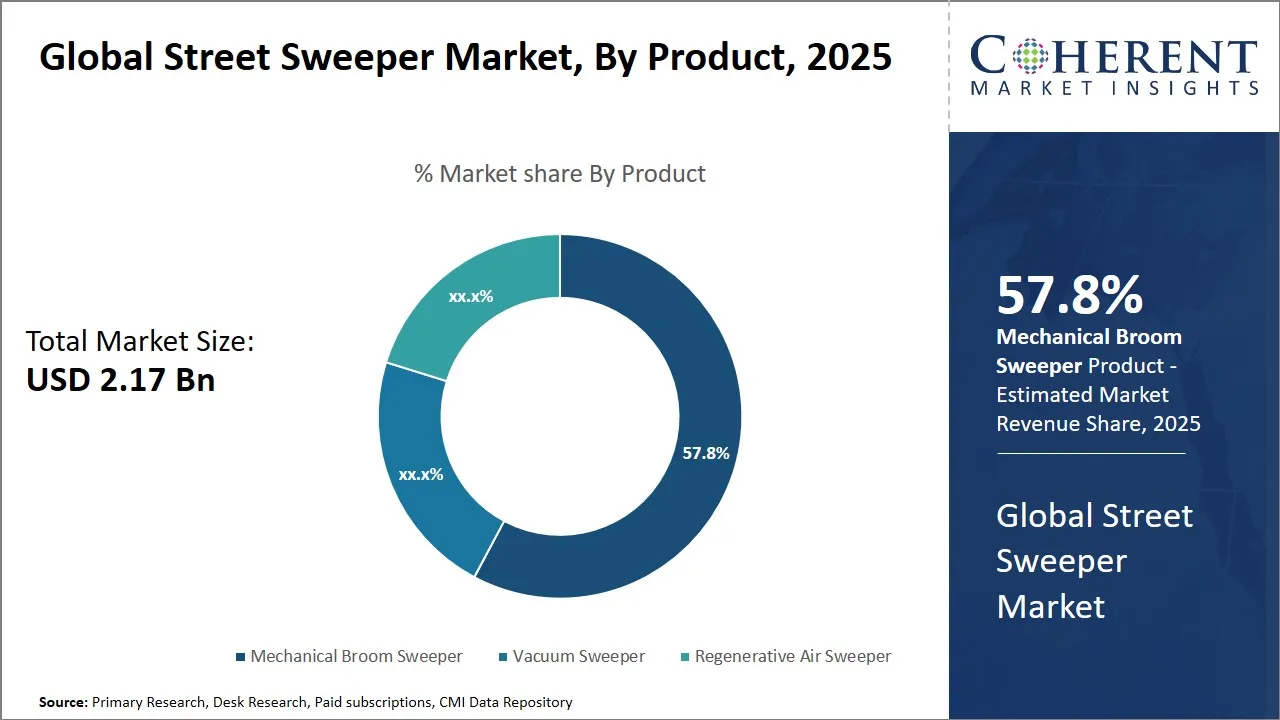
- The mechanical broom sweeper segment is projected to hold 58.8% of the global street sweeper market share in 2026.
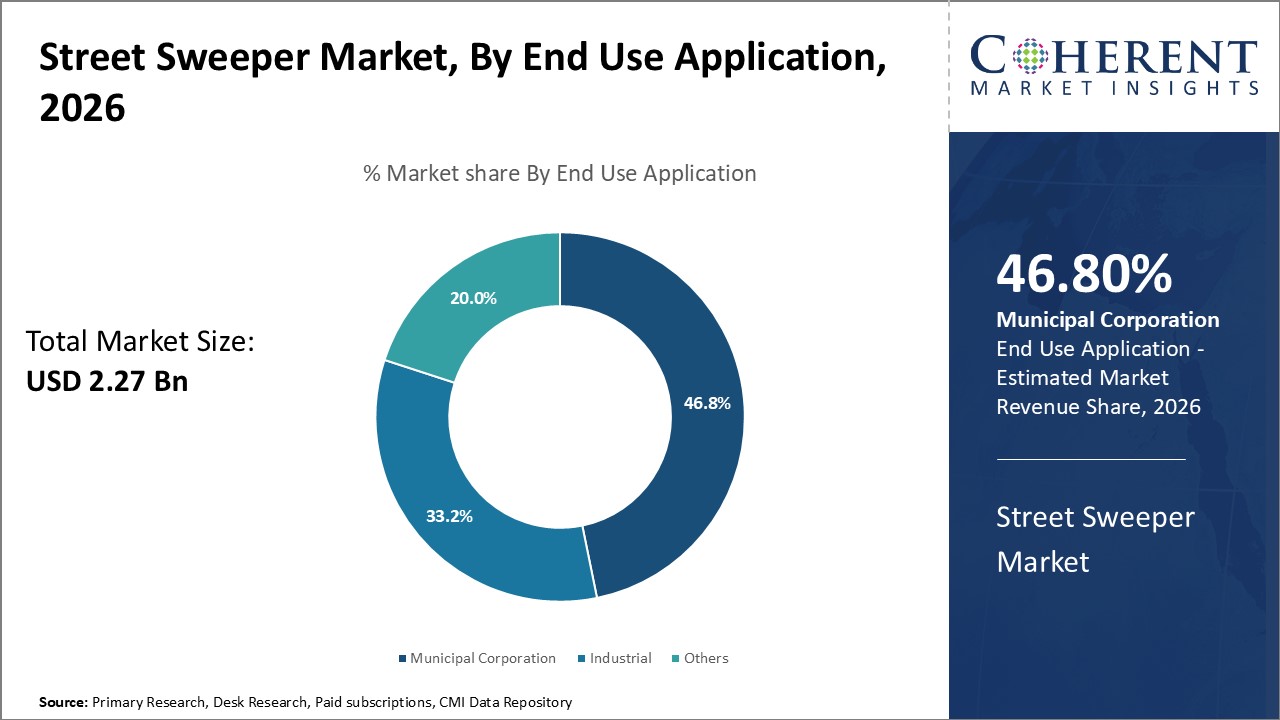
- The municipal corporation segment is expected to capture 46.8% of the market share in 2026.
- The diesel segment is projected to account for 54.8% of the street sweeper market share in 2026.
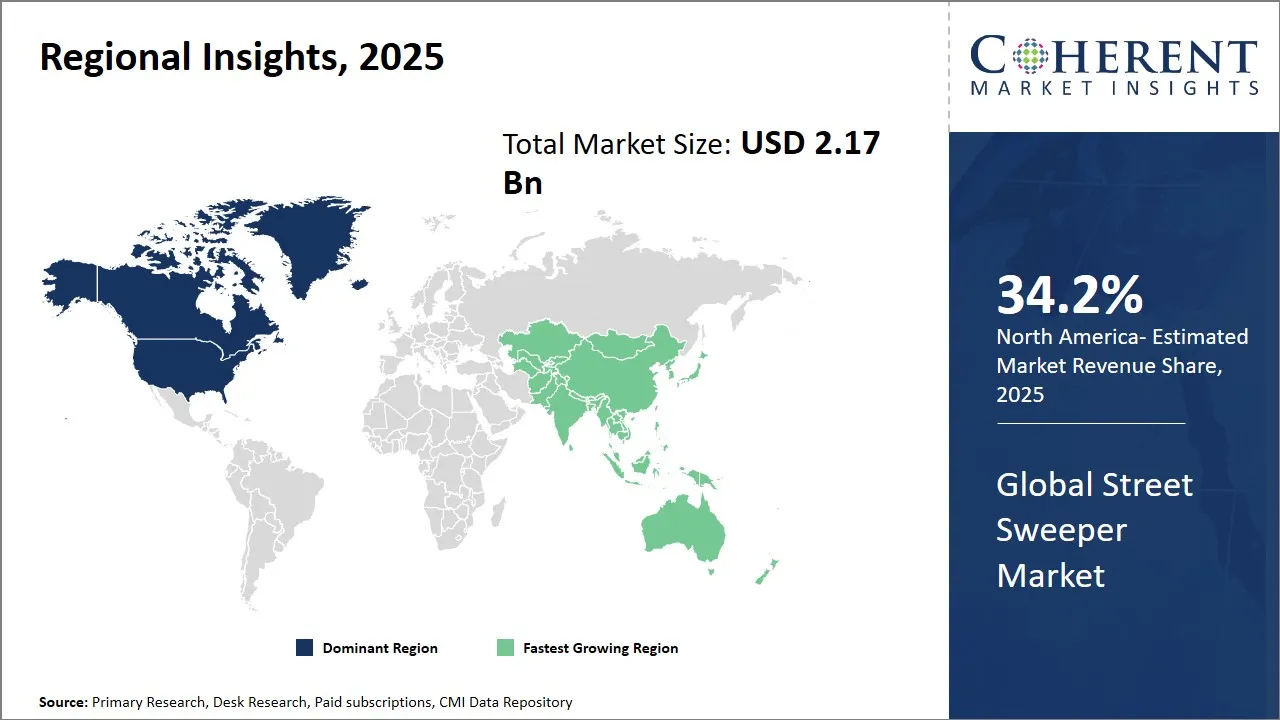
- North America is projected to lead the global street sweeper market in 2026 with a 34.2% share. Asia Pacific, with an estimated share of 19.5% in 2026, and it is projected to be the fastest-growing region.
Market Overview
Market trends show a significant movement towards the use of electric and eco-friendly street sweepers to lessen carbon footprints and meet strict environmental regulations. Automation, real-time monitoring, and IoT platforms integration are some of the latest technologies that are improving the street sweeping operations in terms of both efficiency and effectiveness. Moreover, the warmer acceptance of smart city projects worldwide is another factor supporting the demand for advanced and sustainable street cleaning solutions.
Currents Events and Its Impact
Current Events | Description and its Impact |
Regulatory Push Via the Clean Vehicles Directive in Europe |
|
Rapid Urbanization and Infrastructure Expansion in Asia Pacific |
|
Segmental Insights
- Current Industry Events of 2026
- Market Size Estimation
- Regional Breakdown
- Competitive Landscape
- Customer Intelligence
- Segmental Analysis
- Pricing Analysis
- Key Market Drivers, Challenges & Future Trends
- Customized Insights Section
Street Sweeper Market Insights, By Product - Mechanical Broom Sweeper Segment Dominates the Market Leads by Offering Cost-Effective and Versatile Cleaning Solutions
The mechanical broom sweeper segment is projected to contribute 58.8% of the street sweeper market share in 2026, by the mechanical broom sweeper segment which is known for its being cost-effective, easy to operate and its ability to function in different environments. The mechanical broom sweeper functions by rotating brushes that sweep the dirt into a collection hopper. This even though old and simple to make design has shown to be very reliable for urban maintenance and that is the very reason why its usage is still so widespread.
The city employs mechanical broom sweepers for their large volume debris handling capabilities, especially in autumn when leaves are scattered in public areas. The sweeping machines have been selected for their low operation cost and high efficiency, so the streets' cleanliness is guaranteed using little labor and producing a lot.
Street Sweeper Market Insights, By End Use Application - Municipal Corporations Segment Dominates the Market Driving Demand Through Urban Sanitation Initiatives
The municipal corporation segment will take up 46.8% of the global street sweeper market share in 2026, an escalation attribute to the global trend of increasing urbanization and the allocation of resources to sanitation and cleanliness in cities as the universal basic needs. The further investment in street cleaning machines made by city governments is a result of the fact that cleaning and removing rubbish from streets is becoming an important issue in the areas of public health, environment, and aesthetics cities, especially as more people move in and the urban infrastructures are stretched out.
Urban centers are always having to go the extra mile in their cleanliness efforts as a way of keeping the government and the public happy by complying with the government's tough regulations which are meant to reduce pollution, flooding due to blocked drains, and a healthy living environment, among other things. The frameworks have made it easier for them to buy and use new street cleaning machines that are capable of carrying out cleaning tasks efficiently at all times including when faced with challenges such as heavy leaf fall and storm debris.
Street Sweeper Market Insights, By Propulsion - Diesel Segment Maintains Dominance Due to Power and Endurance Advantages
The diesel segment will account for 54.8% of the market share in 2026, supported by the diesel engine's power, reliability, and broad fuel availability. Diesel propulsion dramatically increases the performance of the machine since powerful and reliable engines are the only ones that can tolerate the tough conditions street sweepers are subjected to such as long routes, heavy debris, and uneven ground.
The greater torque generated by the diesel engine results in greater sweeping efficiency and even the option to pull extra equipment along which constitutes the reason why these machines are preferred in both urban and industrial areas. Such dependability and might are especially important in the case of operators that need uninterrupted performance without frequent stopping for fueling or maintenance.
Regional Insights
North America Street Sweeper Market Analysis and Trends
The North America region is expected to be the market leader with a share of 34.2% in the year 2026, which has been supported by a well-established market as a result of extensive urban infrastructure and strict environmental regulations. Both the U.S. and Canada encourage the adoption of new and advanced street cleaning solutions through their government policies related to sustainable urban planning and pollution control. The presence of prominent companies such as Tennant Company, Elgin Sweeper Company, and Johnston Sweepers has made the market stronger through their innovative product offerings, including electric and hybrid sweepers.
Besides, the region is supported by a strong trade network and advanced manufacturing facilities, which enable quick deployment of new technologies and parts. The demand for eco-friendly and efficient street sweepers from both the government and private sectors further strengthens North America’s leading position.
Asia Pacific Street Sweeper Market Analysis and Trends
The Asia Pacific region is expected to be the quickest growing area in the market supplying 19.5% of the worldwide share in 2026, as a result of the rapid urbanization, the enlargement of the industrial zones, and the rising public consciousness of cleanliness and health. Countries like China and India have already started implementing policies, among others, that aim at urban sanitation and waste management improvements and have also been offering subsidies or incentives to the municipalities for upgrading the fleets. The market ecosystem is undergoing a transformation characterized by an increase in local manufacturing capacity and a surge in investment associated with smart city projects.
Key companies including Zoomlion (China) and JCB India play crucial roles in local production and market penetration. Furthermore, international manufacturers are strategically entering the Asia Pacific street sweeper market through joint ventures and partnerships to leverage the growing demand and regional trade facilitation, which drives the swift expansion.
Global Street Sweeper Market Outlook for Key Countries
U.S. Street Sweeper Market Trends
The U.S. street sweeper market is a modernized and technical one due to the air pollution control and the waste management rule that the government imposes. Key players like the Tennant Company and Elgin Sweepers have developed electric and hybrid truck models to meet the tough emission limit. The issue of municipal contracts and a changeover that prefers sustainability have been factors in the constant modernity of the new sweepers. Bringing about the competition are new inventions in robotization, fuel efficiency, and less polluting technology.
Germany Street Sweeper Market Trends
Germany remains the first in Europe’s street sweeper market, strengthened by its dedication to environmental sustainability and reforms in waste management. German manufacturers such as Schmidt Fahrzeugfabrik and Kärcher provide a wide range of products from mechanical to high-tech vacuum sweepers which are suitable for the various urban environments. Stringent government regulations regarding cleanliness in public places together with an industrial base that is highly developed support Germany’s supremacy in the region as far as technology development and deployment are concerned.
China Street Sweeper Market Trends
The rapid urban growth and large government programs aimed at urban cleanliness and environmental improvement are the main drivers of the China street sweeper market. Domestic manufacturers like Zoomlion and Sany have increased their production of inexpensive but reliable street sweeper trucks to satisfy the demand from the public sector. The market is also witnessing substantial involvement of international players who are teaming up with local companies to improve the services offered. Investment in infrastructure and the smart city concept are still the primary forces behind the changing market dynamics.
India Street Sweeper Market Trends
India's street cleanliness market is a new and yet uncharted territory and this is highly associated with the urban population growth. Government initiatives that focus on cleanliness like the Smart Cities Mission are also an integral part. Indian makers such as JCB and Greaves Cotton are able to make new technologies more suitable for the local markets and this can be done by making them cheaper and longer-lasting to get through the municipal market. Burning waste management rules along with the acceptance of environmental issues among urban planners are the major factors that are pushing the market to grow and flourish.
Brazil Street Sweeper Market Trends
Brazilian street sweeper market is affected by the reasons of growth of urban population and the cleaning conditions created by the government through its finance and international aid programs, which have increased the sanitation sector. The local companies, due to the hot climate, work along with the technologies of Johnston Sweepers and Hako to provide hybrid solutions that are suitable. The trade flow is such that the imports of high-tech machines have the upper hand, while the local assembly is supported as a way to bring down the costs. The trend of hiring the private sector for the maintenance of municipal cleanliness has diversified the demand in the market and led to its further expansion.
Power Source & Technology Transition (Diesel, CNG, Electric Sweepers)
- Diesel-powered sweepers currently dominate the market due to their high-power output and operator familiarity; however, diesel vehicles face growing restrictions from emissions regulations and urban air quality directives pushing cities to reduce diesel use.
- CNG and natural gas sweepers offer a cleaner alternative to diesel, significantly reducing energy consumption (by over 50%) and lowering CO2 emissions by up to 60% compared to diesel during typical operational cycles.
- Electric sweepers are gaining rapid momentum, especially in regions with strong environmental policies like Europe and North America. They deliver zero tailpipe emissions, quiet operation, and lower maintenance costs. Battery tech improvements and faster charging have boosted feasibility.
- Hybrid sweepers serve as a transitional technology, combining diesel or CNG engines with electric motors to improve fuel efficiency, reduce emissions, and provide emission-free operation when stationary or indoors. Hybrids allow fleets to bridge from diesel to full electric.
Market Players, Key Development, and Competitive Intelligence
Key Developments
- In March 2025, Nilfisk introduced the CS7500 Combination Sweeper-Scrubber, an advanced industrial cleaning solution that redefines efficiency, user accessibility, and sustainability. The CS7500 is designed for maximum performance in various environments, featuring an intuitive touchscreen, multilingual support, and an ergonomic design that makes it easy to use.
- In January 2025, Boschung announced the launch of the Urban-Sweeper S2.0 MAX, marking the company's latest advancement in fully electric urban maintenance vehicles. This is the third electric machine in Boschung's portfolio, demonstrating the company's commitment to sustainable and innovative urban maintenance solutions.
Top Strategies Followed by Global Street Sweeper Market Players
- Established market leaders tend to prioritize heavy investment in research and development (R&D) to continually innovate high-performance and environmentally friendly products. These companies focus on integrating advanced technologies such as electric and hybrid drivetrains, enhanced dust filtration systems, and automated sweeping solutions to meet stringent environmental regulations and evolving customer demands.
- For instance, Elgin Sweeper, which is a top-notch manufacturer in the street sweeping segment of the global market, is investing a lot in the research and development of electric and hybrid street sweeper technologies. Compliance with the strict environmental laws is one of the benefits, in addition to the existence of low operating costs and reduced noise that the Elgin Crosswind Electric series brings.
- Mid-tier street sweeper manufactures don't follow the same path as the high-end ones, but they have their own less expensive and yet similar effective strategy which usually revolves around the production of cost-effective but good-quality products. They do not only focus on that customer base that is sensitive to the price but also on the municipal agencies and small private contractors which are their main target; hence, they mix up the affordability factor with the reliable performance feature.
- For example, companies like Fayat Group also follow a similar approach, producing versatile and cost-effective street sweepers that meet performance needs without the premium price tag of top-tier models.
- The small-scale players in the street sweeper market tend to focus on niche segments by developing specialized or innovative products that address unique customer requirements. These smaller companies often adopt cutting-edge technologies such as autonomous navigation systems, IoT-enabled fleet management, or eco-friendly materials to differentiate themselves from larger competitors.
- For example, Green Machines, a U.K.-based company, offers compact, highly maneuverable electric street sweepers ideal for urban areas with limited space. These companies often integrate innovative features such as autonomous navigation systems, IoT-enabled fleet management, and the use of eco-friendly materials, differentiating themselves in a competitive landscape.
Market Report Scope
Street Sweeper Market Report Coverage
| Report Coverage | Details | ||
|---|---|---|---|
| Base Year: | 2025 | Market Size in 2026: | USD 2.27 Bn |
| Historical Data for: | 2020 To 2024 | Forecast Period: | 2026 To 2033 |
| Forecast Period 2026 to 2033 CAGR: | 4.4% | 2033 Value Projection: | USD 3.06 Bn |
| Geographies covered: |
| ||
| Segments covered: |
| ||
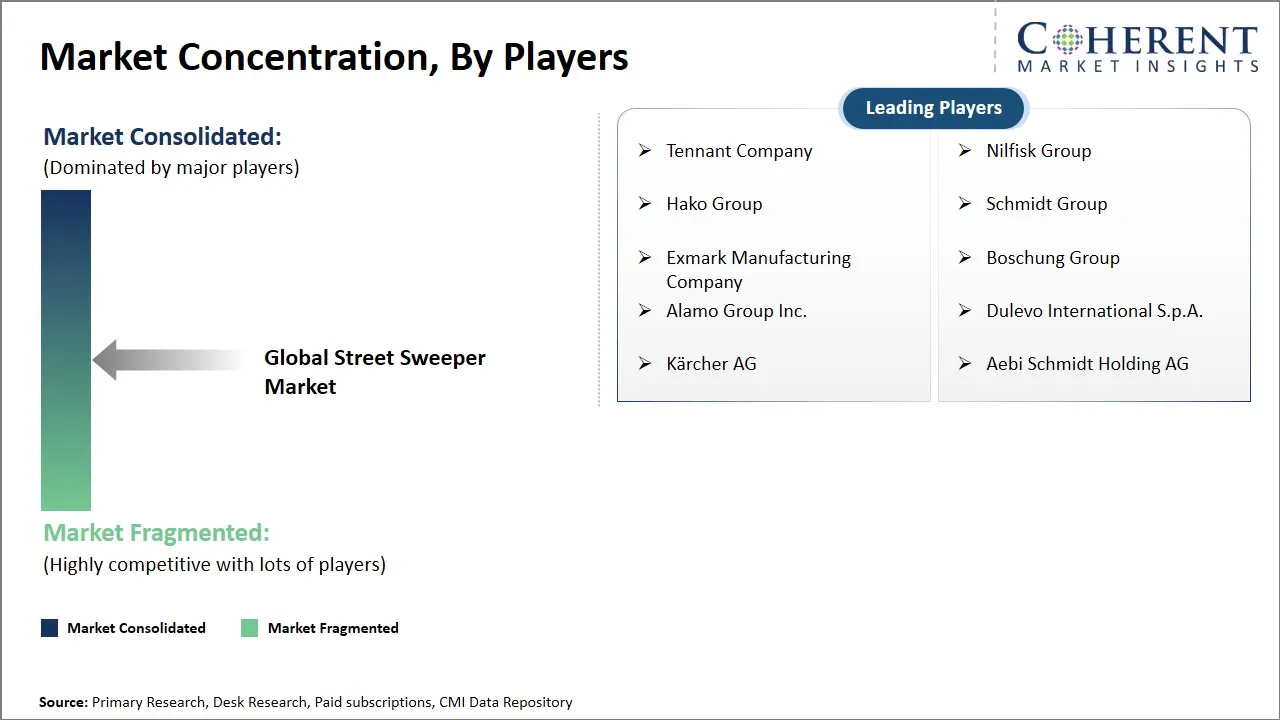
| Companies covered: | Tennant Company, Nilfisk Group, Hako Group, Schmidt Group, Exmark Manufacturing Company, Boschung Group, Alamo Group Inc., Dulevo International S.p.A., Kärcher AG, and Aebi Schmidt Holding AG | ||
| Growth Drivers: |
| ||
| Restraints & Challenges: |
| ||
Street Sweeper Market Dynamics
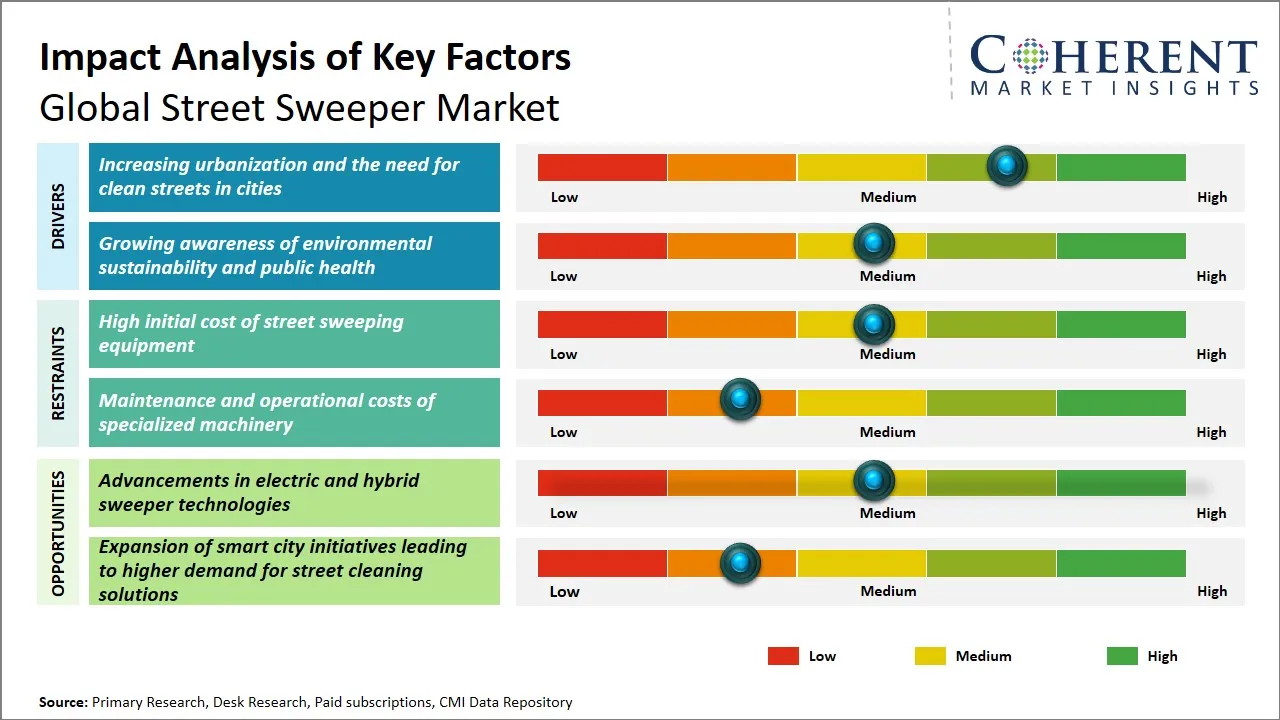
Street Sweeper Market Driver - Increasing Urbanization and the Need for Clean Streets in Cities
Urbanization happening at a fast pace all over the globe has made it so that a big number of people live in cities, which in turn is making the waste management and urban cleaning issues harder to solve. When cities grow and the areas where people live, work, and the industry are very crowded, the concern about the dirt and gutter on streets becoming a more serious problem that the local government needs to take care of. On the other hand, the need for cleanliness to be enforced is pushing the acquisition of street sweeping machines that are extremely efficient in managing the different kinds of urban waste at the same time and at a much faster rate than covering the bigger areas of the city.
For example, cities like Beijing and Mumbai are growing fast, and so are the waste and debris on the streets. The local governments in such cities are pouring money into the latest street cleaning machines that are capable of making streets cleaner quicker, and thus the health of the public will also be improved along with the cleanliness of the streets. One of the examples here is the Dulevo 5000 which is being used in different cities across Europe and it has a very high cleaning capability in the urban environment and thus is able to meet the street sanitation need that is becoming more effective with the passage of time.
Street Sweeper Market Opportunity - Advancements in Electric and Hybrid Sweeper Technologies
The global street sweeper market is going to be one of the major winners of the fast-changing electric and hybrid sweeper technologies, therefore, it is a very attractive focus for the manufacturers and service providers. On the one hand, preventive environmental measures and on the other hand, the educated public have created the demand for the sanitation sector to turn its attention to the modern, clean, high-tech and silent sweepers that will be none other than electric and hybrid ones. The shift to these cleaner sources of energy brings with it the additional advantage of reduction in cost, besides the already realized benefits of reduced carbon emissions. The use of cleaner electric and compact road sweepers, hybrid sweepers, and the like are now widely recognized as the future of urban sanitation.
Los Angeles has always been one step ahead when it comes to the use of electric street sweepers, as the city already operates Elgin Crosswind Electric Sweepers, which not only lead to a significant reduction in operational costs but also a notable decrease in noise pollution and carbon dioxide emissions. Moreover, the city of Stockholm has also taken a step forward by introducing hybrid sweeper machines in its sanitation operations, obtaining the double advantage of elevated efficiency and eco-friendliness, thus, propagating the global trend of urban habitat development through sustainability.
Analyst Opinion (Expert Opinion)
- The street sweeper industry is undergoing a powerful change, where the increasing urbanization and the demand for cleaner cities are the major factors. The Information presented by the International Road Congress (2023) and Cleaning Equipment Show (2022) pointed out very well the major developments in this field, and the firms such as Tennant Company and Schwarze Industries were first in the row regarding the eco-friendly street cleaning technologies. The recent unveiling of an electric street sweeper by Tennant not only shows the sustainability trend in the market but also confirms the stricter controls of emissions.
- The conversations during these gatherings indicated the great advantage of including smart technologies, like GPS and IoT, for the improvement of productivity and providing real-time information for the management of the city. However, among the mentioned challenges were high initial costs and specialized maintenance, which were usually regarded as obstacles to the wide adoption of this technology.
- Market players who concentrate on providing flexible payment plans alongside the training of operators will probably take a larger portion of the market. The future of the street sweeper market is thus linked to the industry's ability not only to come up with sustainable innovations but also to meet the changing needs of the urban infrastructure for environmental protection through rapid growth in cities.
Speak to the analyst
Want personalized insights?
Take the findings above to one of our principal consultants, or have the report rebuilt around the segments, geographies and competitors you actually track.
Market Segmentation
- Product Insights (Revenue, USD Bn, 2021 - 2033)
- Mechanical Broom Sweeper
- Vacuum Sweeper
- Regenerative Air Sweeper
- End Use Application Insights (Revenue, USD Bn, 2021 - 2033)
- Municipal Corporation
- Industrial
- Others
- Propulsion Insights (Revenue, USD Bn, 2021 - 2033)
- Diesel
- Electric
- CNG/Gasoline
- Regional Insights (Revenue, USD Bn, 2021 - 2033)
- North America
- U.S.
- Canada
- Latin America
- Brazil
- Argentina
- Mexico
- Rest of Latin America
- Europe
- Germany
- U.K.
- Spain
- France
- Italy
- Russia
- Rest of Europe
- Asia Pacific
- China
- India
- Japan
- Australia
- South Korea
- ASEAN
- Rest of Asia Pacific
- Middle East
- GCC Countries
- Israel
- Rest of Middle East
- Africa
- South Africa
- North Africa
- Central Africa
- North America
- Key Players Insights
- Tennant Company
- Nilfisk Group
- Hako Group
- Schmidt Group
- Exmark Manufacturing Company
- Boschung Group
- Alamo Group Inc.
- Dulevo International S.p.A.
- Karcher AG
- Aebi Schmidt Holding AG
Sources
Primary Research Interviews
- R&D Director – Leading Street Sweeper Manufacturer
- Procurement Manager – Major Municipal Equipment Retailer
- Product Development Head – Well-Known Street Sweeper Brand
- Sustainability Manager – Urban Cleaning & Environment Certification Body
Stakeholders
- Manufacturers
- End-use Sectors
- Municipal and City Cleaning Departments
- Industrial and Commercial Facility Management
- Construction and Road Maintenance Services
- Regulatory & Certification Bodies
- E-commerce Platforms and Retailers providing cleaning equipment
- Technology Integration Players: AI and IoT solution providers for smart street sweepers
Databases
- UN Comtrade Database
- Global Trade Data for Industrial Equipment Database
- National Import Export (EXIM) Databases specialized in urban machinery
Magazines
- Urban Cleaning Magazine – Trends in city cleaning technology
- Municipal Equipment Review – Innovations in street sweeping
- Smart City Insights – Technological integration in urban maintenance equipment
- Industrial Cleaning World – Market updates on street cleaning machinery
- Sustainable Cities Journal – Environmental impacts and solutions in street cleaning
Journals
- Journal of Environmental Management – Efficiency of street sweeping technologies
- Journal of Urban Technology – Innovations in cleaning machinery
- Waste Management Journal – Impact of street sweepers on urban waste control
- Journal of Sustainable Development – Environmental benefits of advanced sweepers
- Transportation Research Part D – Road maintenance and cleaning equipment research
Newspapers
- The Financial Times – Market growth of municipal cleaning equipment
- The Guardian – Consumer and city trends in urban cleaning
- Asia Urban Review – Growth opportunities in street sweeping machinery in Asia-Pacific
- European Clean Tech News – Regulation and innovation in street cleaning equipment
- The New York Times – Trends in smart and sustainable street cleaning solutions
Associations
- International Municipal Street Sweeper Association
- American Public Works Association (APWA)
- European Federation of Municipal Equipment Manufacturers
- Clean Cities Coalition
- ISO Committee on Urban Cleaning Equipment Standards
- Green Tech Alliance for Urban Environments
Public Domain Sources
- Environmental Protection Agency (EPA) – Standards for urban cleaning machinery
- European Commission – Regulation on municipal equipment emissions and safety
- World Health Organization – Urban health and sanitation reports
- OECD – Environmental and efficiency standards for street cleaning technologies
Proprietary Elements
- CMI Data Analytics Tool
- Proprietary CMI Existing Repository of information for last 8 years.
Get access to 250+ pages report
Every segment, forecast, competitor profile and data table behind the analysis above — available for instant download.
- ESOMAR Member
- ISO 9001:2015 Certified
- D-U-N-S Registered
- GDPR & CCPA Compliant
Missing comfort of reading report in your local language? Find your preferred language:
Transform your Strategy with Exclusive Trending Reports
Frequently Asked Questions
The global street sweeper market is estimated to be valued at USD 2.27 Bn in 2026 and is expected to reach USD 3.06 Bn by 2033.
The CAGR of the global street sweeper market is projected to be 4.4% from 2026 to 2033.
Increasing urbanization and the need for clean streets in cities and growing awareness of environmental sustainability and public health are the major factors driving the growth of the global street sweeper market.
High initial cost of street sweeping equipment and maintenance and operational costs of specialized machinery are the major factors hampering the growth of the global street sweeper market.
In terms of product, the mechanical broom sweeper segment is estimated to dominate the market revenue share in 2026.
Tennant Company, Nilfisk Group, Hako Group, Schmidt Group, Exmark Manufacturing Company, Boschung Group, Alamo Group Inc., Dulevo International S.p.A., Kärcher AG, and Aebi Schmidt Holding AG are the major players.
North America is expected to lead the global street sweeper market in 2026.