

Global Telehandler Market Size and Forecast – 2026 To 2033
The global telehandler market is expected to grow from USD 6.50 Bn in 2026 to USD 10.45 Bn by 2033, registering a compound annual growth rate (CAGR) of 6.4% from 2026 to 2033. The global telehandler market is driven by the growing expansion of warehouse & logistics automation. On March 16, 2026, DHL Supply Chain, one of the world’s leading contract logistics providers, announced the deployment of SVT Robotics’ SOFTBOT platform across its global warehouse network. (Source: DHL)
Key Takeaways of the Global Telehandler Market
- The compact telehandlers segment is expected to account for 44.0 % of the global telehandler market share in 2026. Rising demand for rental construction equipment is driving the growth of compact telehandlers. On January 26, 2026, EquipmentShare raised about USD 747 million in its 2026 IPO, driven by rapid growth in its equipment rental and jobsite technology platform. (Source: EquipmentShare)
- The construction segment is estimated to capture 35.0 % of the market share in 2026. The increasing integration of IoT and telematics in smart construction is aiding the growth of the segment. On January 7, 2026, Caterpillar Inc. unveiled a set of AI-powered and autonomous innovations that mark a major step forward for heavy industry, transforming machines into intelligent, connected systems that help customers build and power the world’s critical infrastructure. (Source: Caterpillar)
- Asia Pacific is expected to dominate the telehandler market in 2026 with a market share of 36.0 %. Increasing replacement of aging equipment fleets across Asia Pacific countries is a major driver for the regional market. In April 2025, Komatsu Ltd. introduced upgraded excavator models featuring improved fuel efficiency, electro-hydraulic systems, and digital monitoring upgrades for infrastructure projects. (Source: Komatsu)
- North America is expected to account for 31.0 % share in 2026 and is projected to record the fastest growth over the forecast period. Need for multi-functional lifting machinery in the region to facilitate the increasing number of construction projects is driving the telehandler market in North America. On March 3, 2026, SANY America introduced the STH634A and STH5519A telehandlers targeted at rental companies, featuring multiple steering modes (two-wheel, four-wheel, crab steering) and both compact and high-capacity configurations. (Source: SANY)
- Shift toward electrification and hybrid power systems: A key developing trend is the increasing use of electric and hybrid telehandlers as businesses strive towards low or zero emission and sustainable operations. Stricter environmental rules and carbon reduction targets are putting pressure on manufacturers to build battery-powered versions that consume less gasoline and have lower operating expenses. These machines are becoming popular, especially in urban building projects and inside applications where noise and emissions must be kept to a minimum.
- Rising demand from agriculture and multi-sector applications: Telehandlers are being used more and more in agriculture, warehousing and industrial logistics, in addition to construction. Logistics businesses use them for flexible lifting operations, farmers use them to handle feed, load harvests and handle large objects. The variety of end-use sectors is growing the market base and prompting manufacturers to build more adaptable and attachment-friendly machines.
Segmental Insights
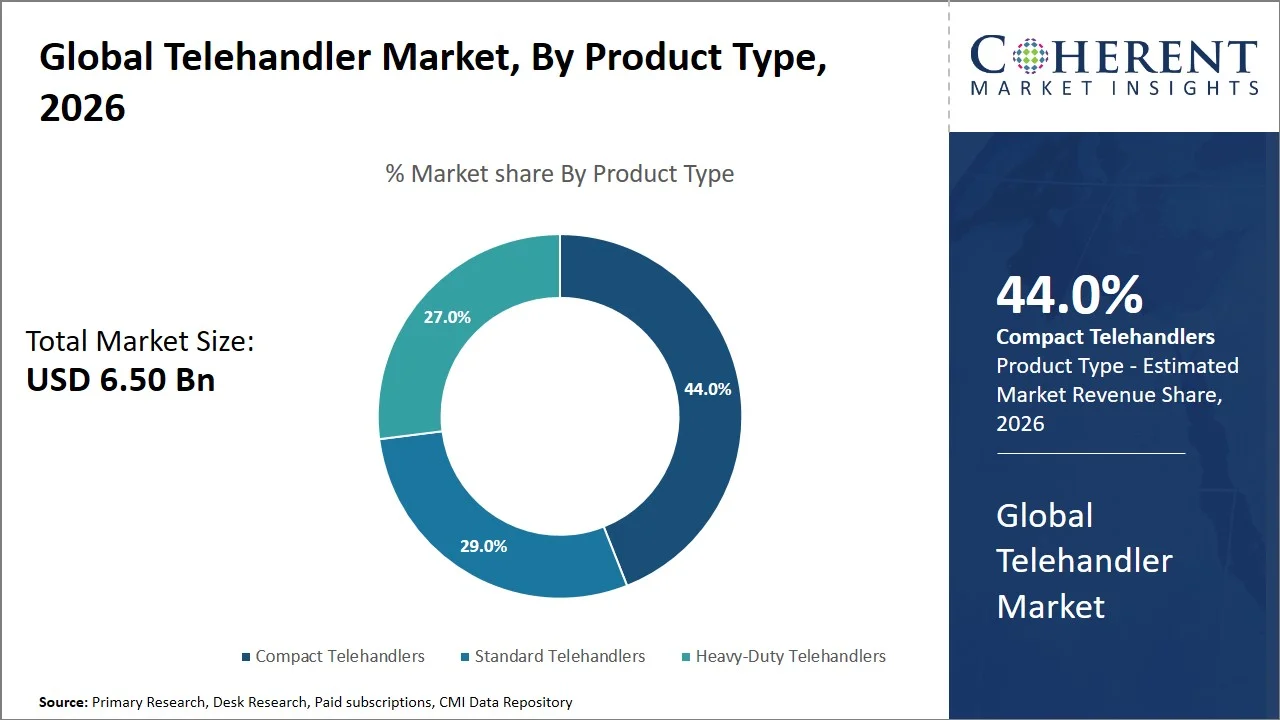
Why Do Compact Telehandlers Dominate the Global Telehandler Market?
The compact telehandlers segment is expected to account for 44.0% of the global telehandler market share in 2026. Compact telehandlers lead the worldwide telehandler market as they are most ideal for working in tight and crowded areas. In urban building sites, warehouses and repair sites, there is little space for movement and huge equipment is not suitable.
Compact telehandlers are easy to maneuver with a tighter turning radius and can efficiently handle material in tight spaces without sacrificing lift capacity. Their adaptability makes them a go-to for contractors operating in densely constructed cities and in indoor applications. On June 4, 2025, JCB expanded its compact telehandler lineup with upgraded 505-20E, designed specifically for narrow construction sites and urban infrastructure projects. The machine is built for confined spaces such as residential redevelopment zones and indoor material handling, where emissions-free and tight-radius operations are essential. (Source: JCB)
- Current Industry Events of 2026
- Market Size Estimation
- Regional Breakdown
- Competitive Landscape
- Customer Intelligence
- Segmental Analysis
- Pricing Analysis
- Key Market Drivers, Challenges & Future Trends
- Customized Insights Section
Why is Construction the Most Widespread Application?
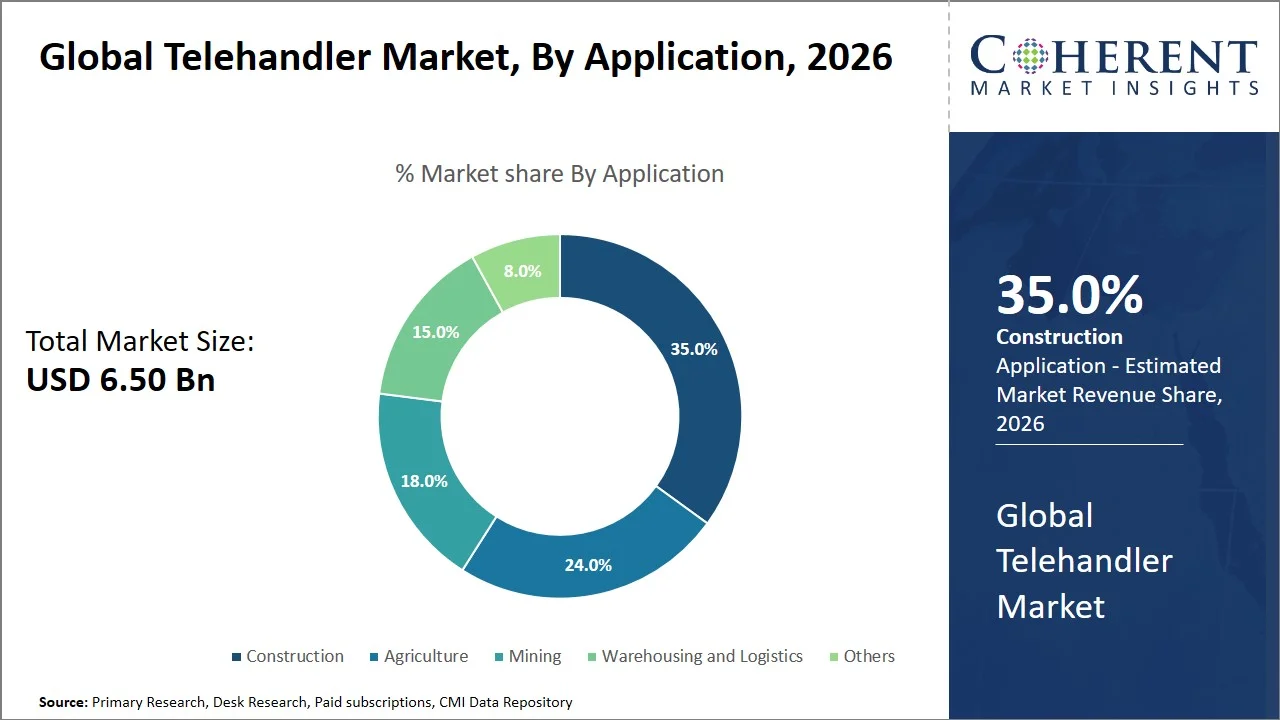
The construction segment is expected to account for 35.0% of the global telehandler market share in 2026. The construction industry is always a strong driver for big scale demand for material handling equipment and this is where telehandlers are most commonly used. For the continuous construction of infrastructure like residential buildings, business complexes, roads, bridges, and smart cities, effective lifting and placement of heavy material at various heights and terrains is needed. Telehandlers are a very versatile piece of equipment in the construction industry. They can do numerous duties with one machine, such as lifting, loading and positioning goods. They are a vital piece of equipment on practically every construction site. On February 4, 2025, Manitou introduced two new construction telehandler models, the MTA 1242 MAX and MTA 1242 MAX E74, to offer increased power, stability, and efficiency. These models aim to meet the specific requirements of rental businesses and construction fleet managers, providing enhanced lifting capacity and ease of maintenance. (Source: Manitou)
Currents Events and their Impact
Current Events | Description and its Impact |
EU Machinery Regulation (EU 2023/1230) |
|
EU Stage V Emission Standards (Non-Road Mobile Machinery) |
|
(Source: European Union, International Council on Clean Transportation)
Telehandler Market Dynamics
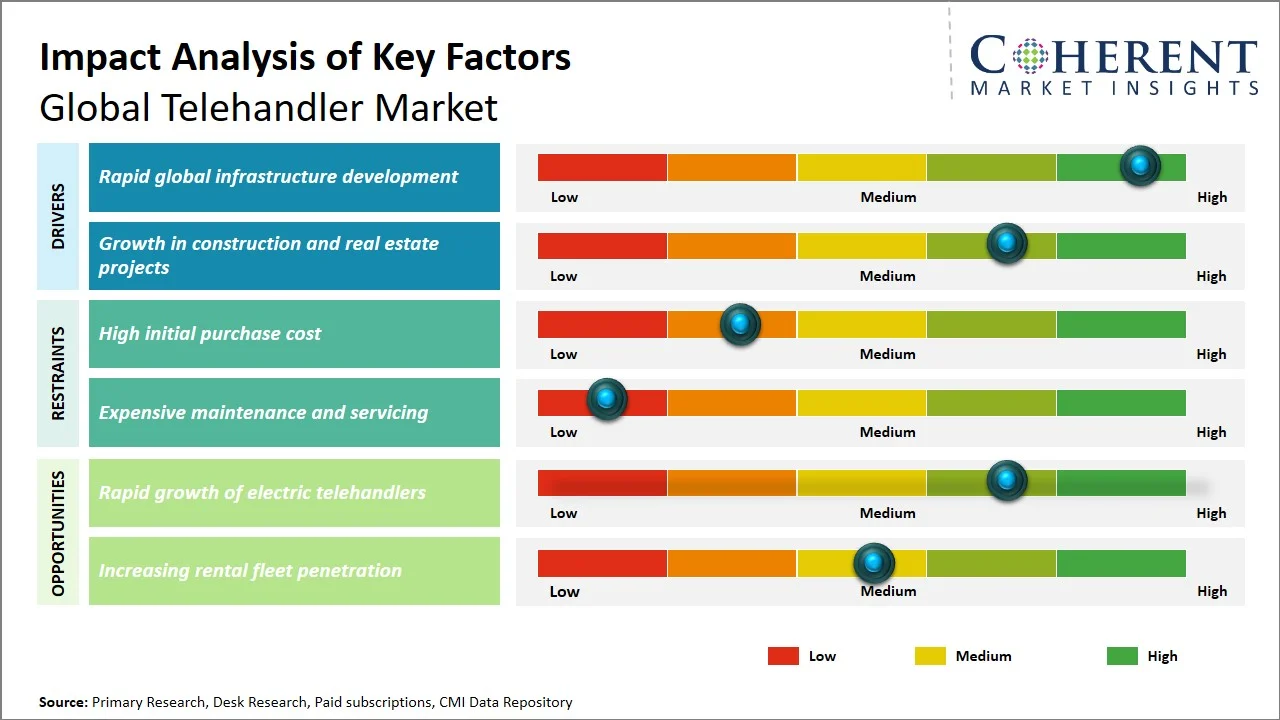
Market Drivers
- Rapid global infrastructure development: The fast global infrastructure development is a major driver of demand for telehandlers. Countries are ramping up investments in building of highways, bridges, airports, residential complexes, and smart city projects. The growing urban populations and industrialization, especially in developing nations, is driving the demand for efficient material handling and lifting equipment at building sites. Due to their versatility, the ability to work on uneven ground and lift big objects at different heights, telehandlers are often employed on these projects for boosting production and efficiency of the operation. On May 28, 2026, The National Highways Authority of India (NHAI) announced 17 highway assets totaling 1,692 km for monetization through TOT and InvIT models to fund new infrastructure expansion. (Source: Press Information Bureau)
- Growth in construction and real estate projects: The need for telehandlers is witnessing a substantial increase due to the growth in construction and real estate projects as developers are carrying out more and more residential, commercial, and industrial projects globally. Accelerated urbanization, increased housing needs and growth of commercial infrastructure are fueling ongoing construction activity in developed and emerging nations. These sites often have telehandlers on hand to help lift and move heavy goods efficiently. Telehandlers are a necessary tool in modern construction operations, and help make the entire project flow faster and more productively. On October 11, 2024, Mirvac revealed a collection of unparalleled residences and penthouses, offering exclusive dress circle views of the city and an unmatched living experience in Sydney’s iconic Harbourside precinct, set to reimagine the Darling Harbour waterfront. (Source: Mirvac)
Emerging Trends
- Integration of advanced telematics and smart technologies: Telehandlers are increasingly equipped with IoT-enabled telematics systems that provide real-time monitoring of machine performance, location tracking, and predictive maintenance. The use of digital technologies allows fleet operators to increase productivity, minimize downtime and optimize fuel consumption. Automated diagnostics, remote access to machine data are among the features becoming standard, facilitating better decision-making and operational control.
- Growth of rental and equipment-as-a-service models: The growing tendency toward rental and leasing services is transforming the telehandler market scenario. The high cost of buying and maintaining equipment is leading contractors and small enterprises to prefer short-term access to equipment rather than ownership. The trend is also fueling the growth of equipment-as-a-service (EaaS) business models where customers pay based on consumption, thus making modern telehandlers more accessible and increasing market penetration.
Regional Insights
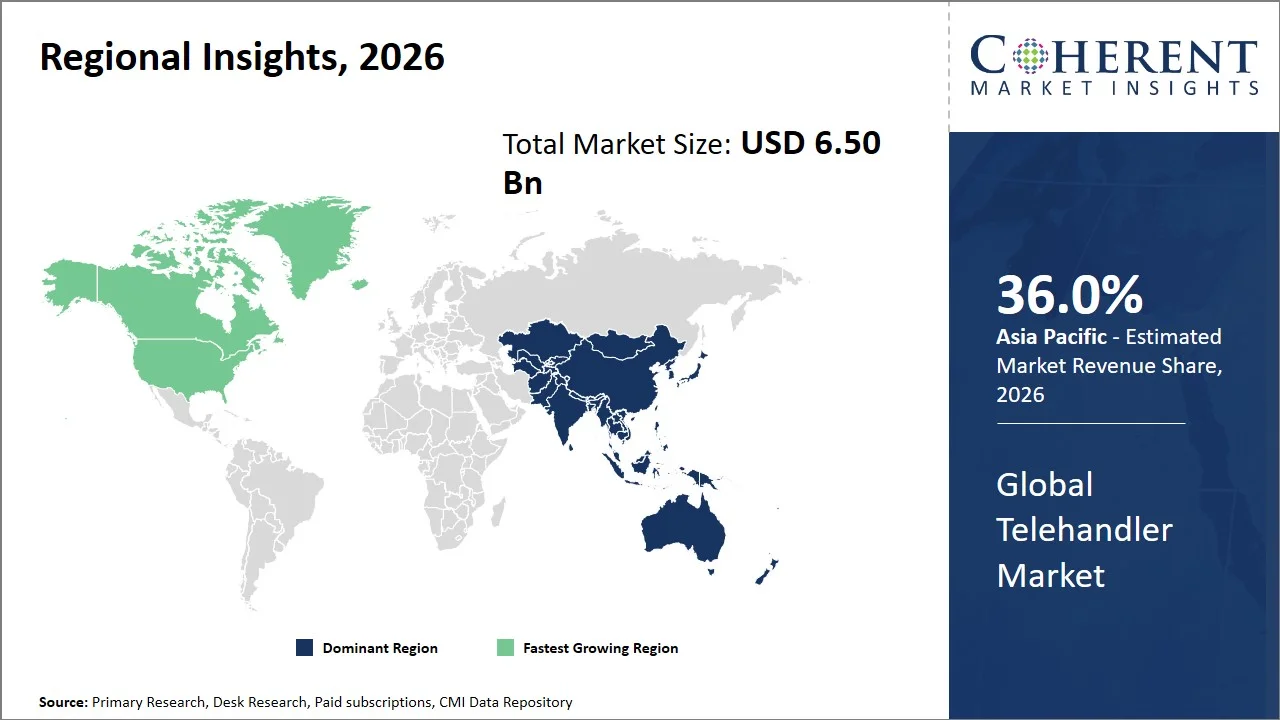
Why is Asia Pacific a Strong Market for Telehandlers?
Asia Pacific is expected to account for a market share of 36.0% in 2026. The Asia Pacific region has a robust telehandler market with big infrastructure and resource driven projects. In India, equipment is commonly employed in big projects like the Delhi - Mumbai Expressway and metro rail expansions by companies like Larsen & Toubro, where telehandlers are used to hoist precast segments and large site materials. The mining and port logistics activities in Australia rely largely on telehandlers for bulk cargo handling in locations such as the iron ore mining centers in Western Australia.
Moreover, the development of better products to replace aging fleets is also driving the growth of the telehandler market in Asia Pacific. On December 10, 2025, Caterpillar launched the next generation design for the Cat 321, 322 and 324 models, built to deliver high performance, long-lasting durability and increased fuel efficiency. These excavators are specifically designed for and manufactured in India, incorporating insights from customers throughout the country. (Source: Caterpillar)
Why Does the North America Telehandler Market Exhibit High Growth?
North America is projected to account for 31.0% of the global telehandler market and is expected to register the fastest growth. Large rental fleets and commercial building megaprojects are major drivers of the North America telehandler market. Companies like United Rentals and Sunbelt Rentals employ telehandlers extensively on U.S. highway expansion, warehouse building, and oil & gas operations in Texas and Alberta. Demand from big industrial projects results in high utilization and considerable rental penetration, making it one of the most equipment-intensive locations of the world. On February 5, 2025, JLG introduced the new 519 compact telehandler as part of its updated North American lineup, targeting construction, rental, and industrial users needing high maneuverability in confined jobsite conditions. (Source: JLG)
Global Telehandler Market Outlook for Key Countries
Why is China Emerging as a Major Hub in the Telehandler Market?
Telehandlers are frequently utilized in state-backed infrastructure projects in China, including the extension of high-speed rail and the creation of industrial parks as part of the Belt and Road Initiative. Domestic company, XCMG supplies high-capacity telehandlers for use in logistics hubs, smart city projects and large-scale construction sites in places such as Shenzhen and Chengdu. Foundation and structural lifting equipment deployment is still strong, driven by government urban expansion.
Is the U.S. the Next Growth Engine for the Telehandler Market?
Commercial warehouse building and energy infrastructure projects have a significant impact on the U.S. telehandler market. Amazon makes extensive use of telehandlers from firms such as JLG Industries for Amazon fulfillment center expansions, and big scale solar farm projects in places like California and Nevada. Oilfield operations in Texas and offshore support facilities also rely on high-reach telehandlers to move materials in tough conditions.
Italy Telehandler Market Analysis and Trends
Italy remains a world leader in telehandler production, with manufacturers such as Merlo S.p.A. leading the way in the development of compact and rotating telehandlers. These machines are widely employed in Italian agricultural vineyards and restoration projects in historic towns such as Florence and Rome where the need for small lifting solutions for tight urban situations exists. Strong export demand across Europe also boosts domestic production.
U.K. Telehandler Market Analysis and Trends
The U.K. telehandler market is mostly driven by agriculture and housing building projects with extensive use of devices such as JCB telehandlers. They are common on U.K. agricultural estates for transporting bales and feed and in residential construction projects in cities such as London and Manchester. The strong rental penetration in the country also bolsters the sustained use for short-term infrastructure and renovation projects.
Global Telehandler Market - Telehandler Rental Penetration
Country | Estimated Telehandler Rental Penetration |
U.S. | 65–75% |
Canada | 60–70% |
France | 55–65% |
Germany | 50–60% |
Italy | 45–55% |
U.K. | 75–85% |
Japan | 20–30% |
China | 15–25% |
India | 10–20% |
Global Telehandler Market - Smart Fleet Management Software Adoption
Region | Estimated Smart Fleet Management Software Adoption |
North America | 70–80% |
Europe | 60–70% |
Asia Pacific | 40–55% |
Middle East | 35–50% |
Latin America | 25–40% |
Africa | 15–30% |
How is the Rapid Growth of Electric Telehandlers Creating New Growth Opportunities in the Telehandler Market?
The rapid expansion of electric telehandlers is opening up new possibilities in the telehandler market, as the need for low-emission and energy-efficient construction equipment continues to increase. Diesel powered equipment is rapidly being employed because to limits on its use in urban infrastructure projects, indoor construction sites and environmentally regulated zones. European construction organizations and rental businesses are starting to adopt electric models in warehouse development and city center redevelopment projects to reduce noise and carbon emissions. This transition is prompting manufacturers to invest in battery technology, charging infrastructure and hybrid systems, creating new revenues and widening the entire market reach. For example, JCB expanded its electric telehandler strategy, including compact zero-emission models such as the 525-60E, targeted at city construction, warehouses, and rental fleets. (Source: JCB)
Market Players, Key Development, and Competitive Intelligence
Key Developments
- On March 5, 2026, Manitou launched the MRT 4070 rotating telehandler, capable of reaching up to 131 ft lift height for infrastructure and industrial construction. The model is designed for complex projects like steel framing, masonry, and high-rise construction.
- On October 20, 2025, JCB announced that it is investing USD 500 million in a new 1-million sq. ft. plant in Texas, U.S., focused heavily on producing telehandlers and construction lifting equipment. The facility is expected to become the company’s largest in North America and will significantly increase telehandler supply for the U.S. construction and rental markets.
Competitive Landscape
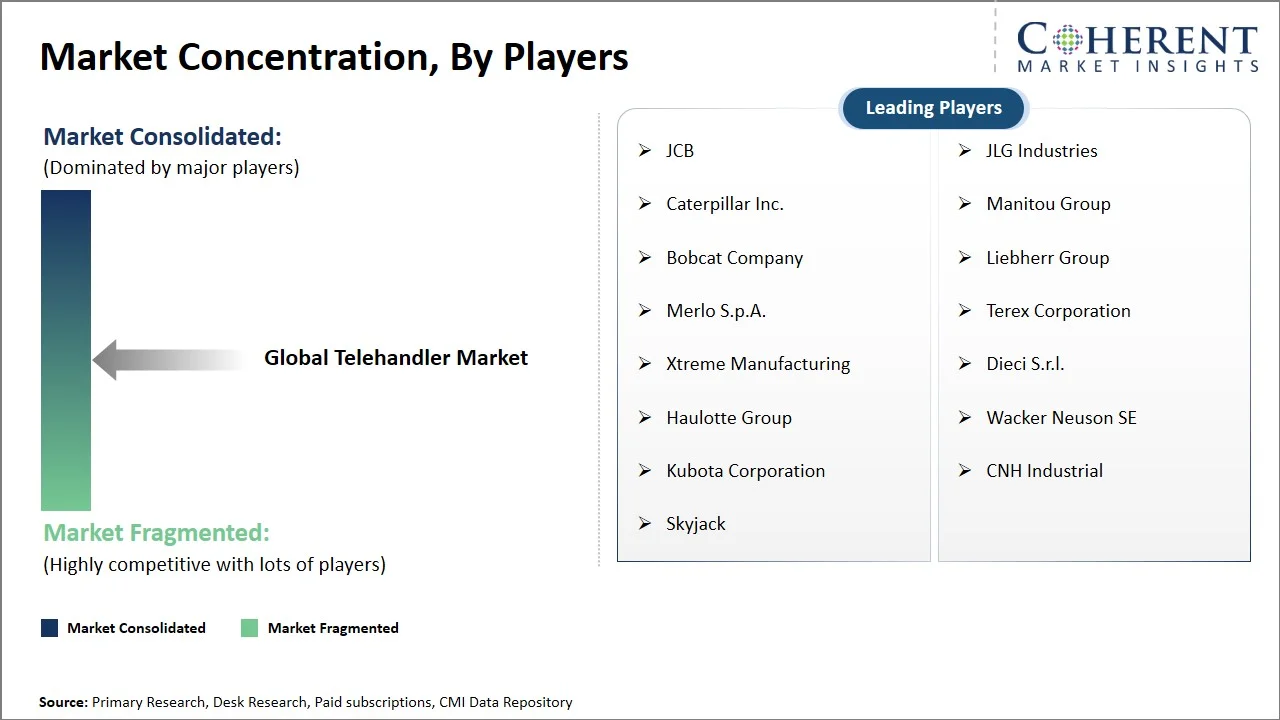
The global telehandler market sees the existence of several established players and intense competition in terms of product innovation, rental alliances, and geographical expansion. Presence of firms like as JCB, Manitou Group, Merlo S.p.A., Caterpillar Inc., and JLG Industries that focus on the development of sophisticated telehandlers with enhanced lifting capacity, safety systems, and fuel efficiency is dominating the market. Companies are intensifying competition in both developed and emerging markets by expanding their rental networks and offering electric and hybrid vehicles to boost their position in the market.
Market Report Scope
Telehandler Market Report Coverage
| Report Coverage | Details | ||
|---|---|---|---|
| Base Year: | 2025 | Market Size in 2026: | USD 6.50 Bn |
| Historical Data for: | 2020 To 2024 | Forecast Period: | 2026 To 2033 |
| Forecast Period 2026 to 2033 CAGR: | 6.4% | 2033 Value Projection: | USD 10.45 Bn |
| Geographies covered: |
| ||
| Segments covered: |
| ||
| Companies covered: | JCB, JLG Industries, Caterpillar Inc., Manitou Group, Bobcat Company, Liebherr Group, Merlo S.p.A., Terex Corporation, Xtreme Manufacturing, Dieci S.r.l., Haulotte Group, Wacker Neuson SE, Kubota Corporation, and CNH Industrial and Skyjack | ||
| Growth Drivers: |
| ||
| Restraints & Challenges: |
| ||
Analyst Opinion (Expert Opinion)
- Steady increase in infrastructure development and rental equipment penetration is projected to be mirrored in the rising demand for telehandlers throughout worldwide markets. We notice that the Company is adopting technology improvements such as electrification, telematics integration and automation to improve operational efficiency and compliance with environmental requirements. Moreover, top producers are looking to consolidate their markets and forge strategic partnerships to bolster distribution networks and increase their regional footprint.
- Over the next few years, the telehandler industry is predicted to see strong growth, fueled by increasing infrastructure investments, urbanization and industrial expansion worldwide. Electric and hybrid telehandlers are expected to gain traction as sustainability requirements become increasingly stringent and construction practices transition toward low-emission alternatives. Increased availability of rental and equipment-as-a-service models will likely improve accessibility, while smart technologies and automation improvements are predicted to improve productivity and change the way equipment will be used in future.
Speak to the analyst
Want personalized insights?
Take the findings above to one of our principal consultants, or have the report rebuilt around the segments, geographies and competitors you actually track.
Market Segmentation
- Product Type Insights (Revenue, USD Billion, 2021 - 2033)
- Compact Telehandlers
- Standard Telehandlers
- Heavy-Duty Telehandlers
- Application Insights (Revenue USD Billion, 2021 - 2033)
- Construction
- Agriculture
- Mining
- Warehousing and Logistics
- Others
- Regional Insights (Revenue, USD Billion, 2021 - 2033)
- North America
- U.S.
- Canada
- Latin America
- Brazil
- Argentina
- Mexico
- Rest of Latin America
- Europe
- Germany
- U.K.
- Spain
- France
- Italy
- Russia
- Rest of Europe
- Asia Pacific
- China
- India
- Japan
- Australia
- South Korea
- ASEAN
- Rest of Asia Pacific
- Middle East
- GCC Countries
- Israel
- Rest of Middle East
- Africa
- South Africa
- North Africa
- Central Africa
- North America
- Key Players Insights
- JCB
- JLG Industries
- Caterpillar Inc.
- Manitou Group
- Bobcat Company
- Liebherr Group
- Merlo S.p.A.
- Terex Corporation
- Xtreme Manufacturing
- Dieci S.r.l.
- Haulotte Group
- Wacker Neuson SE
- Kubota Corporation
- CNH Industrial
- Skyjack
Sources
Primary Research Interviews
- Senior executives from telehandler OEMs
- Construction contractors
- Agricultural equipment users
- Regional Business Heads
Magazines
- Construction Equipment
- International Construction
- KHL International Construction
- Equipment World
Journals
- Automation in Construction
- Journal of Construction Engineering and Management
- International Journal of Industrial Ergonomics
Associations
- Association of Equipment Manufacturers
- Indian Construction Equipment Manufacturers' Association
- Committee for European Construction Equipment
Public Domain Sources
- World Bank
- International Monetary Fund
- World Trade Organization (WTO) trade statistics
- Organisation for Economic Co-operation and Development
Proprietary Elements
- CMI Data Analytics Tool
- Proprietary CMI Existing Repository of information for last 10 years
Get access to 250+ pages report
Every segment, forecast, competitor profile and data table behind the analysis above — available for instant download.
- ESOMAR Member
- ISO 9001:2015 Certified
- D-U-N-S Registered
- GDPR & CCPA Compliant
Missing comfort of reading report in your local language? Find your preferred language:
Transform your Strategy with Exclusive Trending Reports
Frequently Asked Questions
The global telehandler market is expected to stand at USD 6.50 Bn in 2026 and is expected to reach USD 10.45 Bn by 2033.
The CAGR of the global telehandler market is projected to be 6.4% from 2026 to 2033.
Rapid global infrastructure development and growth in construction and real estate projects are the major factors driving the growth of the global telehandler market.
High initial purchase cost and expensive maintenance and servicing are the major factors hampering the growth of the global telehandler market.
In terms of product type, the compact telehandlers segment is estimated to dominate the market revenue share in 2026.
Telehandlers are preferred because they offer greater reach, higher lifting capacity, and better performance on rough terrain than forklifts.
Telehandlers improve efficiency by performing multiple lifting and material handling tasks with a single versatile machine.