

Global Textile Machinery Market and Forecast – 2026 to 2033
The global textile machinery market is estimated to be valued at USD 32.58 Bn in 2026 and is expected to reach USD 46.15 Bn by 2033, reflecting a compound annual growth rate (CAGR) of 5.1% from 2026 to 2033.
Key Takeaways of the Textile Machinery Market
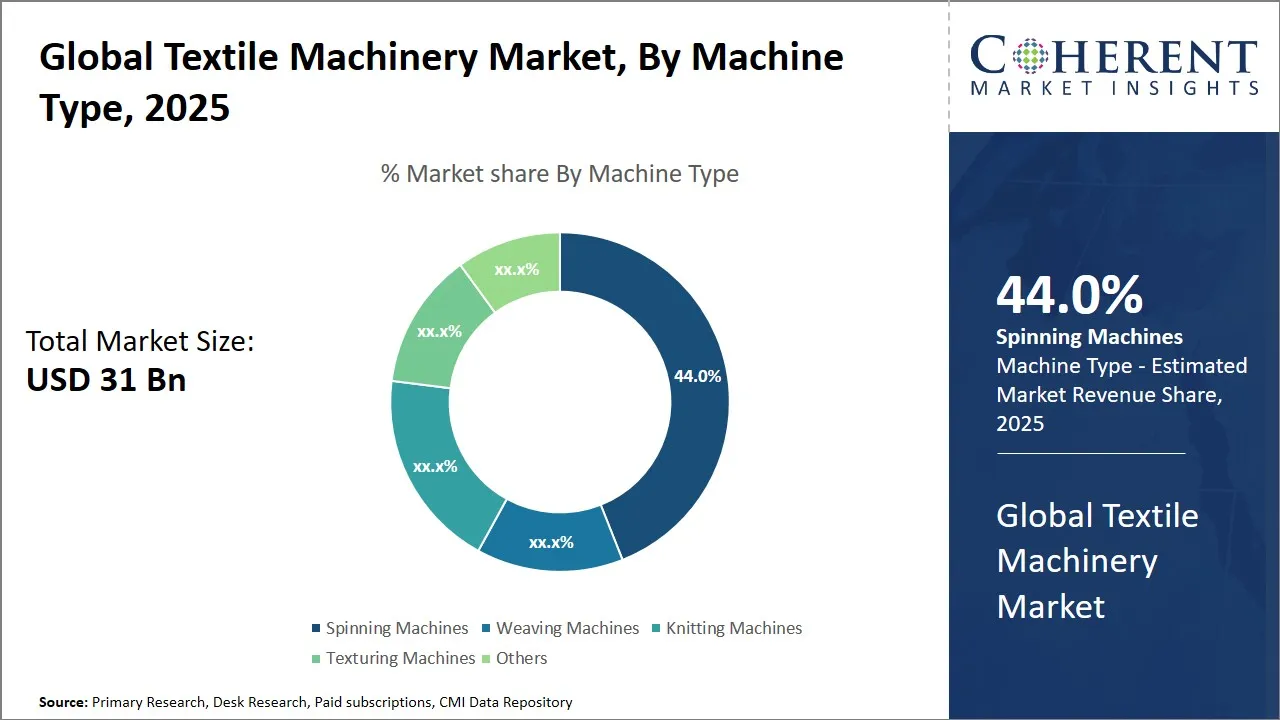
- The spinning machines segment is expected to account for 45% of the textile machinery market share in 2026.
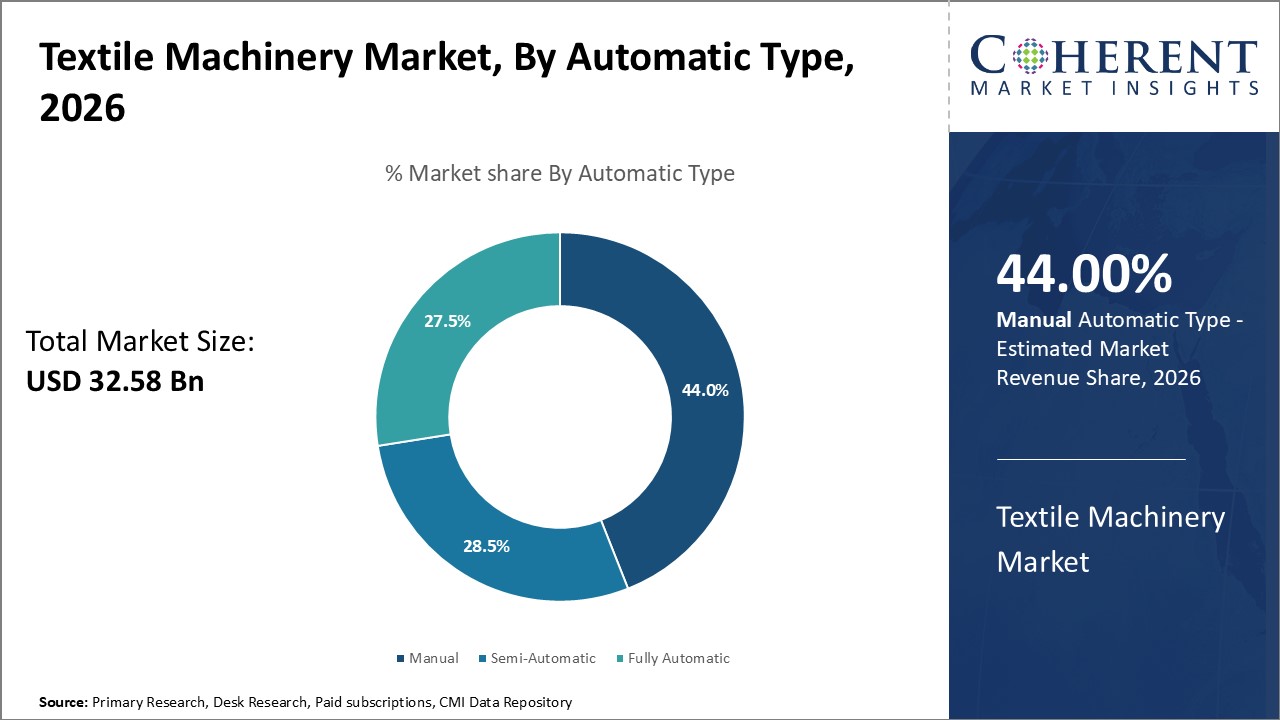
- The manual segment is projected to capture 44% of the market share in 2026.
- The garments & apparels segment is expected to command 62% of the market share in 2026.
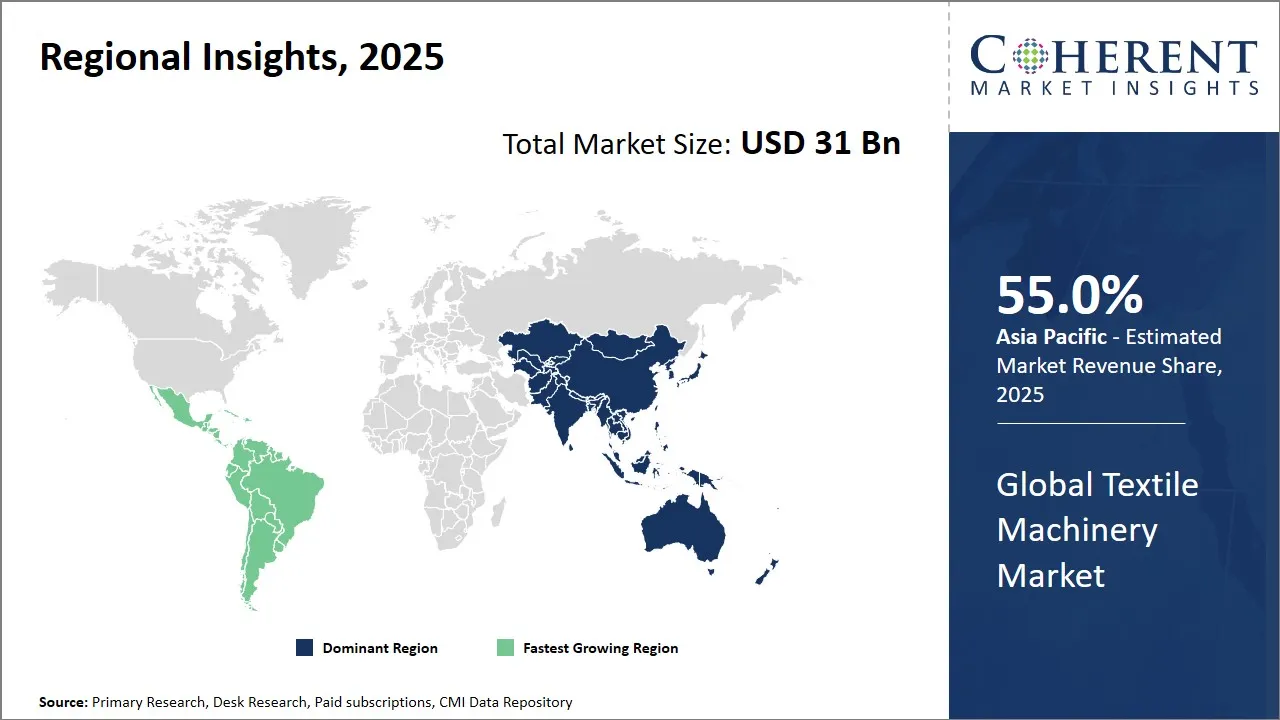
- Asia Pacific will dominate the textile machinery market in 2026 with an estimated 55%
- Latin America will hold 17% share in 2026 and record the fastest growth.
Currents Events and Its Impact
Current Events | Description and its Impact |
Promotion of PM Mitra Parks |
|
Segmental Insights
- Current Industry Events of 2026
- Market Size Estimation
- Regional Breakdown
- Competitive Landscape
- Customer Intelligence
- Segmental Analysis
- Pricing Analysis
- Key Market Drivers, Challenges & Future Trends
- Customized Insights Section
Why Do Spinning Machines Dominate the Textile Machinery Market in 2026?
The spinning machines segment is expected to hold 45% of the global textile machinery market share in 2026. Spinning machines lead the global textile machinery market - their role is crucial right from the beginning of cloth production: converting raw fibers into yarn. Rather than simply handling materials, these units change cotton, wool, or synthetic strands into workable threads. From there, such yarns serve as core elements in next-stage processes, like weaving or knitting. Since most textile goods depend on yarn, need remains high; hence, spinning equipment continues to see broad adoption.
The return of natural fibers, together with better yarn production methods, has boosted the role of spinning technology. New types of machines like ring, open-end, or rotor spinners allow makers to improve durability, uniformity, and flexibility in yarns. As a result, factories can supply diverse items effectively, ranging from delicate clothing materials to heavy-duty industrial fabrics.
For instance, on October 27, 2025, Rieter introduced its newest pre-combing system, the J 70. This air-jet spinner works efficiently with uncombed fibers, achieving this through an innovative twisting mechanism that boosts output rates while improving material use. As a result, manufacturers gain higher productivity without sacrificing quality.
Manual Segment Dominates the Textile Machinery Market
The manual segment is expected to hold 44% of the textile machinery market share in 2026. Manual textile machines still lead worldwide markets because they suit custom needs, cut costs, among smaller factories. Even as automation spreads globally, many producers, in emerging economies especially , depend on these tools so they can adapt output while lowering running expenses.
Manual machines enable makers take direct control when crafting fabrics, especially useful for complex patterns, handmade goods, or small batches needing high accuracy and flexibility. Their importance comes from regions with plenty of trained workers, turning craftsmanship into a market edge. Skilled textile artists use hand-driven methods like spinning, weaving, or knitting - producing unique pieces automation can't match - preserving heritage techniques along the way.
Why do Garments & Apparels lead the Application Segment of the Global Textile Machinery Market?
The garments & apparels segment is expected to hold 62% of the market share in 2026. The apparel sector dominates global demand for textile machinery, fueled mainly through rising trends in fashion across countries. Although consumer tastes evolve quickly, manufacturers need advanced systems capable of handling uniform fabrics without delay. As designs shift often, businesses depend on adaptable solutions to maintain their edge. Despite constant changes, investing in responsive tools helps firms meet new requirements efficiently. As demand evolves, so does the need for efficient manufacturing tools.
The expanding population alongside higher personal incomes has lifted interest in clothing, especially styles combining look and ease. This change increases need for high-performance tools that handle diverse fabrics. Because they serve these sectors, makers focus on machines working with various yarns and textures. So their goal covers everything from casual clothing to performance athletic wear.
Capex Spending by Textile Manufacturers & Government Production-Linked Incentives
Policy | Approx. Target Investment/Capex |
PLI Scheme for Textiles (India) | USD 3.23 Billion |
Regional & Cluster-level Textile Modernization (China) | USD 13.8 Billion |
ATUFS (Amended Technology Upgradation Fund Scheme) (India) | USD 2.0 Billion |
Regional Insights
Asia Pacific Textile Machinery Market Analysis and Trends
The Asia Pacific region is expected to register a market share of 55% in 2026. In Asia Pacific, leadership in the global textile machinery sector comes from a broad manufacturing network, active state backing, while relying on an ample pool of trained workers. Nations including China, India, Japan, or South Korea host major textile makers, creating steady need for sophisticated equipment that boosts output speed with better consistency.
Policies aimed at expanding fabric exports alongside upgrades in factory setups encourage more spending on machines. Firms such as Toyota Industries Corp (Japan), Rieter via its Chinese activities, and Lakshmi Machine Works (India) play key roles through innovations like self-operating looms together with smart spinning units. Well-linked supply routes combined with nearby access to materials strengthen this regional advantage.
Latin America Textile Machinery Market Analysis and Trends
Latin America is expected to register the fastest growth rate with a market share of 17% in 2026. Latin America shows the quickest rise in the global textile machinery sector, boosted by rising funding for factory upgrades and a larger customer pool. In nations such as Brazil and Mexico, outdated systems are being replaced with advanced setups to strengthen worldwide competitiveness, this shift raises needs for high-performance equipment.
Rather than relying on imports, local rules now cut machine taxes while rewarding technology integration, helping firms grow faster. At the same time, renewed focus on home-based fabric making, encouraged by nearby outsourcing patterns, pulls interest from key suppliers including Stäubli (based in Switzerland, operating in Brazil) and Picanol (from Belgium, well-established in Mexico). On top of that, growing factories focused on exports - and better transport networks - are speeding up regional development.
Global Textile Machinery Market Outlook for Key Countries
China Textile Machinery Market Analysis and Trends
The market in China is key to the global textile machine market because its large-scale fabric production needs ongoing tech updates to stay competitive. Many firms in China are also working on the production of performance fabrics. Owing to initiatives such as 'Made in China 2026', the country backs digital production units and automatic setups in textile manufacturing. Companies like Zhangjiagang Shuangjun, working alongside collaborators including Rieter, deliver up-to-date spinning and weaving technologies. High-volume production combined with innovation drives demand for machinery used in everyday textiles as well as advanced materials.
Why is India Emerging as a Competitive Producer of Textile Machinery?
India's textile machinery sector benefits from plentiful local resources, trained workers, also strong export goals backed by initiatives such as TUFS. Firms including Lakshmi Machine Works and Vardhman Textile Machinery serve home demand along with overseas clients, aiming at eco-friendly, resource-saving equipment. A fast-expanding fabric production base - paired with rising focus on specialized textiles - opens wide potential for growth.
U.S. Textile Machinery Market Analysis and Trends
The U.S. represents a major market where advanced textile equipment thrives due to growing needs for specialized fabrics, eco-friendly processes, or digital control systems. Its industrial framework gains strength from solid research capacities; firms such as Rieter and Itema run key facilities here, developing machines suited for technical textiles or intelligent materials. Innovation-focused regulations, combined with environmental priorities, help push forward machine development. Integration of smart factory solutions marks this sector, while precision-driven tools serve specific industry niches.
Brazil Textile Machinery Market Analysis and Trends
Brazil leads in Latin America due to rising activity in textile equipment, driven by programs focused on upgrading and strengthening ties within worldwide fabric markets. Alongside global firms like Stäubli or Picanol, domestic producers offer high-performance machines suited for clothing as well as household textiles. Export-friendly regulations together with lower import duties on machinery have made the country more appealing to buyers. In addition, spending on transport networks and distribution systems supports growing manufacturing zones, increasing the need for new tools.
Is Germany the Next Growth Engine for the Textile Machinery Market?
Germany stays ahead in Europe’s textile machinery market, owing to strong industry roots alongside advanced engineering skills. Firms like Karl Mayer or Trützschler shape the field, offering technology that includes smart automation paired with lower energy use. Backed by EU rules focused on green growth, new machines are quickly integrated into fabric manufacturing. The country also serves as a key exporter, influencing how factories automate throughout Europe and further.
Sustainable & Energy-Efficient Textile Machinery Adoption
Parameter | Low-Water Dyeing | Recycled-Fiber Processing | Energy Efficient Machinery |
Approx. Adoption % | 3–5% | 10–12% | 20–25% |
Approx. Water Reduction (%) | 80–95% | 30–50% | 35–60% |
Approx. Energy Reduction (%) | 30–50% | 20–30% | 10–30% |
Approx. Carbon Reduction (%) | 30–40% | 30% | 10–25% |
Market Players, Key Development, and Competitive Intelligence
Key Development
- On August 22, 2025, Saurer introduced the "Zinser 51" ring-spun device. While available in both standard and compact versions, this model improves efficiency across spinning operations. It delivers better sustainability while enhancing cost performance. User experience benefits from intuitive layout changes - automation features now adapt more easily to different production needs.
Top Strategies Followed by Global Textile Machinery Market Players
- The worldwide textile machinery sector sees strong rivalry between companies of different sizes, with many using unique approaches to build and keep their position in a fast-changing environment. Major firms usually spend a lot on R&D - this pushes new ideas and leads to advanced machines that match shifting client needs. By focusing on tech progress, they launch modern tools offering better performance, higher automation levels, or lower environmental impact.
- Middle-tier firms in textile equipment aim at low-cost options, yet maintain decent quality. Because many buyers watch their spending closely, these makers build machines that work well enough without high prices. Their approach targets smaller factories, especially where funding is tight - offering practical tools for everyday needs instead of premium features. By keeping costs down, they reach more customers across emerging markets.
- At the opposite extreme, smaller firms in the textile machinery sector stand out by focusing on narrow markets with tailored solutions. Instead of broad offerings, they prioritize distinctive or custom-built equipment meant for particular local needs or technical challenges ignored by bigger rivals. By adopting advanced tools like IoT connectivity, automation powered by artificial intelligence, or eco-friendly inputs, these compact businesses manage to stay relevant even with fewer assets.
Market Report Scope
Global Textile Machinery Market Report Coverage
| Report Coverage | Details | ||
|---|---|---|---|
| Base Year: | 2025 | Market Size in 2026: | USD 32.58 Bn |
| Historical Data for: | 2020 To 2024 | Forecast Period: | 2026 To 2033 |
| Forecast Period 2026 to 2033 CAGR: | 5.1% | 2033 Value Projection: | USD 46.15 Bn |
| Geographies covered: |
| ||
| Segments covered: |
| ||
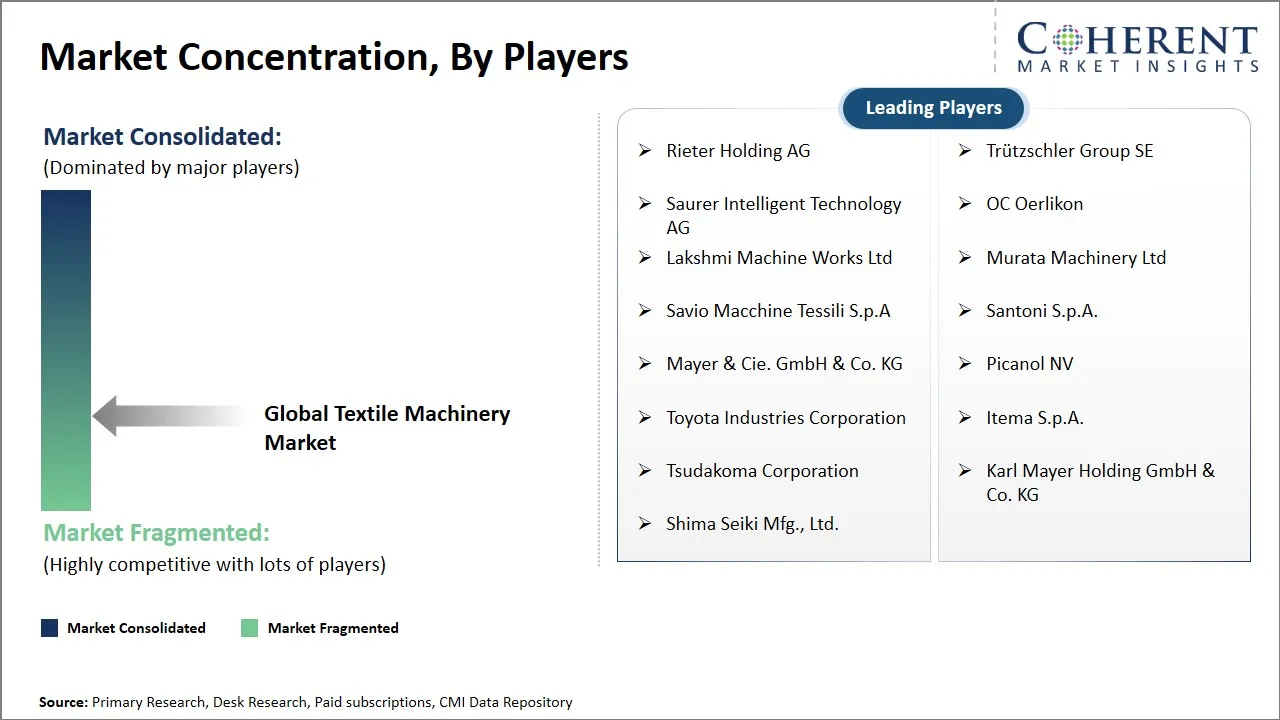
| Companies covered: | Rieter Holding AG, Trützschler Group SE, Saurer Intelligent Technology AG, OC Oerlikon, Lakshmi Machine Works Ltd, Murata Machinery Ltd, Savio Macchine Tessili S.p.A, Santoni S.p.A., Mayer & Cie. GmbH & Co. KG, Picanol NV, Toyota Industries Corporation, Itema S.p.A., Tsudakoma Corporation, Karl Mayer Holding GmbH & Co. KG, and Shima Seiki Mfg., Ltd. | ||
| Growth Drivers: |
| ||
| Restraints & Challenges: |
| ||
Global Textile Machinery Market Dynamics
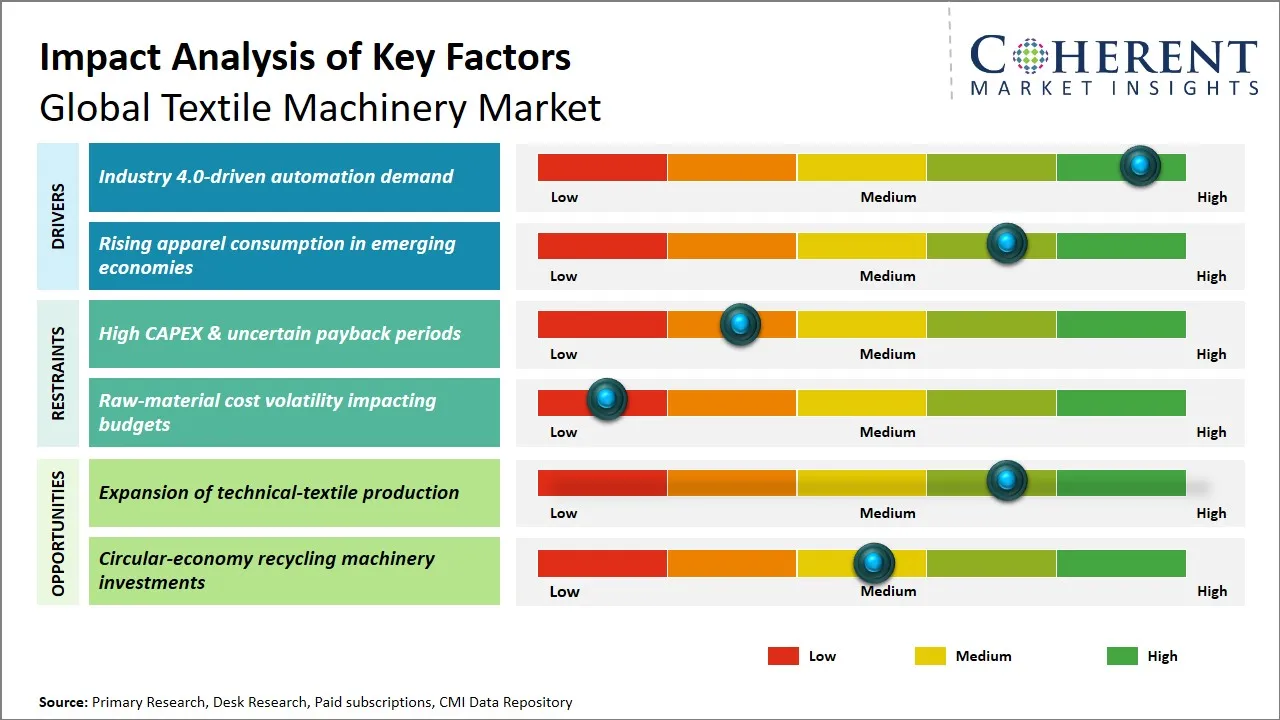
Global Textile Machinery Market Driver - Industry 4.0-Driven Automation Demand
The fast adoption of Industry 4.0 tools in textile production is boosting global need for modern machines. Because smart plants use internet-connected sensors, along with AI and data analysis, they allow constant live tracking - this helps foresee repairs while cutting delays. As a result, automation improves classic workflows like spinning or weaving through sharper accuracy and steady output.
Instead of relying only on manual work, firms now turn to robotic systems so they can fulfill stricter quality demands, lower staff needs, and manage gaps in trained personnel. Moreover, Industry 4.0 boosts adaptability in manufacturing, so firms can adjust faster to shifts in customer demand or fashion patterns. As a result, many are funding updated machines that use real-time data while cutting environmental impact; this pushes global producers to upgrade tools and stay ahead within a tech-focused industry setting.
Global Textile Machinery Market Opportunity - Expansion of Technical-Textile Production
The global textile machinery market is moving toward strong growth, supported by rising needs for technical fabrics in fields like cars, health care, buildings, and military use. These materials focus on function instead of looks, gaining popularity because they last longer, resist damage, and weigh less. As this area expands, makers of textile machines can develop new tools designed specifically for modern methods such as producing nonwovens, applying coatings, bonding layers, or building composites. Growing interest in smart clothing and wearables also increases demand for accurate machines that place electronics into textiles during making.
Furthermore, public policies combined with rising funding for eco-friendly and advanced textiles are pushing growth in technical fabric output. In parallel, developing nations - especially across Asia Pacific - are boosting spending to modernize textile facilities, meeting local needs along with global demand. As a result, companies offering innovative, adaptable, low-energy equipment can benefit from this expanding specialty area, serving sectors focused on premium-grade materials while helping evolve machine performance. That shift opens opportunities for businesses to broaden offerings as well as strengthen presence within a fast-rising market segment.
Analyst Opinion (Expert Opinion)
- The global textile machinery market is shifting into a key upgrade period, fueled by smart systems, eco rules, plus bringing factory work back home. Across Asia Pacific, in nations like India, China, Bangladesh, or Vietnam - fabric plants are boosting spending on fast looms, self-running spinners, together with computerized knit machines to lower expenses, boost output uniformity, while handling quicker delivery demands. Moving toward advanced factories - with AI spotting flaws, forecasting repairs, also live tracking of output - is now common as makers aim for better performance due to growing wages and power prices.
- Sustainability demands from the EU Green Deal, alongside carbon-border measures or corporate ESG goals, push faster uptake of water-saving dye methods, energy-smart finishing equipment, yet recycling-based fiber systems. Rising demand ties more closely to preparedness for rules, not merely boosting output. While top machine makers emphasize intelligent, green, adaptable tech, the sector may shift from chasing scale toward valuing performance, favoring producers combining digitization with environmental progress.
Speak to the analyst
Want personalized insights?
Take the findings above to one of our principal consultants, or have the report rebuilt around the segments, geographies and competitors you actually track.
Market Segmentation
- Machine Type Insights (Revenue, USD Bn, 2021 - 2033)
- Spinning Machines
- Weaving Machines
- Knitting Machines
- Texturing Machines
- Others
- Automation Type Insights (Revenue, USD Bn, 2021 - 2033)
- Manual
- Semi-Automatic
- Fully Automatic
- Application Insights (Revenue, USD Bn, 2021 - 2033)
- Garments & Apparels
- Household and Home Textiles
- Technical Textiles
- Regional Insights (Revenue, USD Bn, 2021 - 2033)
- North America
- U.S.
- Canada
- Latin America
- Brazil
- Argentina
- Mexico
- Rest of Latin America
- Europe
- Germany
- U.K.
- Spain
- France
- Italy
- Russia
- Rest of Europe
- Asia Pacific
- China
- India
- Japan
- Australia
- South Korea
- ASEAN
- Rest of Asia Pacific
- Middle East
- GCC Countries
- Israel
- Rest of Middle East
- Africa
- South Africa
- North Africa
- Central Africa
- North America
- Key Players Insights
- Rieter Holding AG
- Trützschler Group SE
- Saurer Intelligent Technology AG
- OC Oerlikon
- Lakshmi Machine Works Ltd
- Murata Machinery Ltd
- Savio Macchine Tessili S.p.A
- Santoni S.p.A.
- Mayer & Cie. GmbH & Co. KG
- Picanol NV
- Toyota Industries Corporation
- Itema S.p.A.
- Tsudakoma Corporation
- Karl Mayer Holding GmbH & Co. KG
- Shima Seiki Mfg., Ltd.
Sources
Primary Research Interviews
- Textile machinery manufacturers and suppliers
- Equipment distributors and dealers
- Textile mill owners and production managers
- Industry consultants and technology experts
Databases
- International Trade Centre (ITC) Trade Statistics Database
- UN Comtrade Database
- Euromonitor International
Magazines
- Textile World Magazine
- International Textile Magazine
- Knitting Industry Magazine
- Asian Textile Journal
Journals
- Journal of Textile Engineering
- Textile Research Journal
- International Journal of Textile Science
Newspapers
- Financial Times
- The Wall Street Journal
- Economic Times
- Business Standard
Associations
- International Textile Manufacturers Federation (ITMF)
- Textile Machinery Association of India (TMAI)
- European Committee of Textile Machinery Manufacturers (CEMATEX)
- China Textile Machinery Association (CTMA)
Public Domain Sources
- World Trade Organization (WTO) reports
- Government statistical offices and trade departments
- Industry white papers and research publications
- Company annual reports and investor presentations
Proprietary Elements
- CMI Data Analytics Tool
- Proprietary CMI Existing Repository of information for last 8 years
Get access to 250+ pages report
Every segment, forecast, competitor profile and data table behind the analysis above — available for instant download.
- ESOMAR Member
- ISO 9001:2015 Certified
- D-U-N-S Registered
- GDPR & CCPA Compliant
Missing comfort of reading report in your local language? Find your preferred language:
Transform your Strategy with Exclusive Trending Reports
Frequently Asked Questions
The global textile machinery market is estimated to be valued at USD 32.58 Bn in 2026 and is expected to reach USD 46.15 Bn by 2033.
The CAGR of the global textile machinery market is projected to be 5.1% from 2026 to 2033.
Industry 4.0-driven automation demand and rising apparel consumption in emerging economies are the major factors driving the growth of the global textile machinery market.
High CAPEX & uncertain payback periods and raw-material cost volatility impacting budgets are the major factors hampering the growth of the global textile machinery market.
In terms of machine type, the spinning machines segment is estimated to dominate the market revenue share in 2026.
Digital systems improve efficiency, reduce defects, and optimize energy and resource use.
The market is expected to grow steadily as sustainability, automation, and capacity expansion reshape global manufacturing.