

Global Thermal Energy Harvesting Market Size and Forecast – 2026 to 2033
According to Coherent Market Insights, the global thermal energy harvesting market is estimated to be valued at USD 825.3 Mn in 2026 and is expected to reach USD 1,479.8 Mn by 2033, exhibiting a compound annual growth rate (CAGR) of 8.7% from 2026 to 2033.
Key Takeaways of the Thermal Energy Harvesting Market
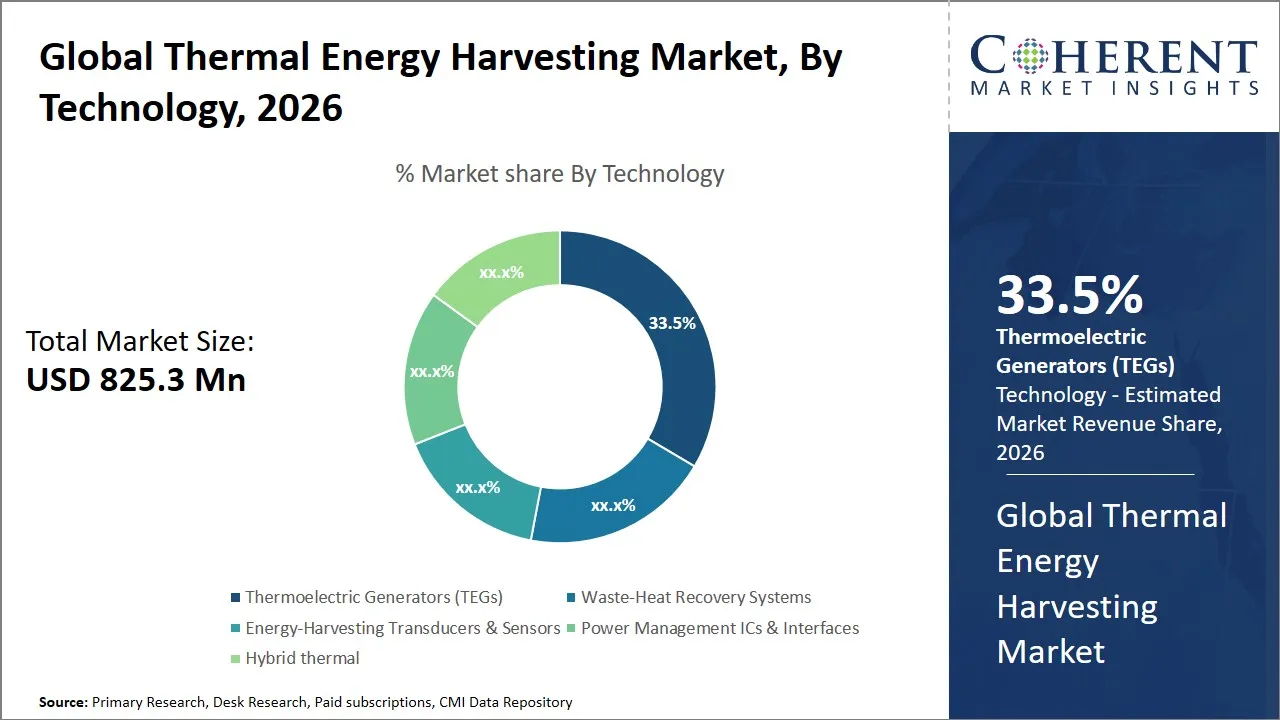
- Thermoelectric Generators (TEGs) segment is expected to lead the global thermal energy harvesting market, holding a 33.5 % share in 2026.
- The Standalone on-device harvesters segment is estimated to account for 44.7 % of the market share in 2026.
- Manufacturing & process industries segment is projected to hold a 29.9 % of the global thermal energy harvesting market share in 2026.
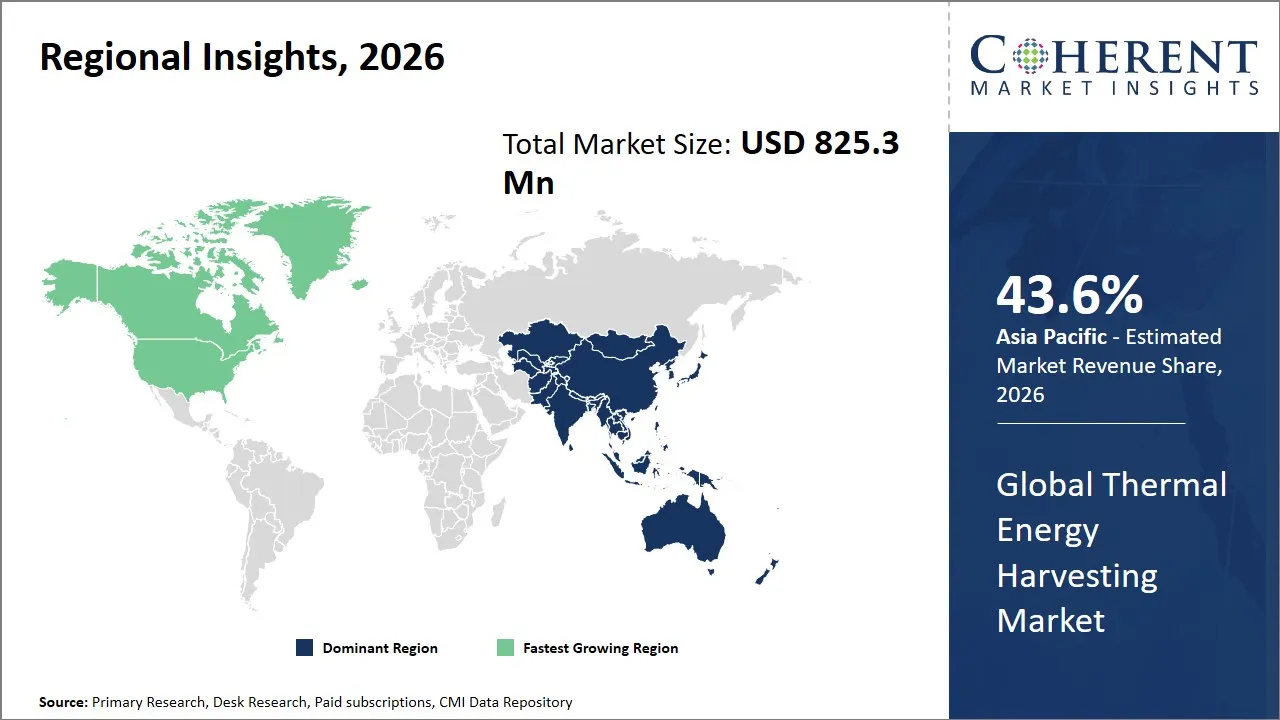
- The Asia Pacific will dominate the thermal energy harvesting market in 2025 with an estimated 43.6 % share in 2026.
- North America will hold 15.3 % share in 2026 and record the fastest growth.
Market Overview
- A key market trend is the rising adoption of thermal energy harvesting systems in industrial and consumer applications due to their potential for green energy generation and enhanced energy efficiency.
- Innovations in thermoelectric materials and integration with IoT devices are driving demand, enabling more effective conversion of waste heat into usable energy.
- Additionally, stringent environmental regulations and growing awareness of carbon footprint reduction are bolstering the adoption of these technologies globally.
Current Events and Its Impact
Current Events | Description and its Impact |
Rising Energy Prices & Supply Chain Disruptions |
|
St Stricter Carbon Emission Regulations |
|
Segmental Insights
- Current Industry Events of 2026
- Market Size Estimation
- Regional Breakdown
- Competitive Landscape
- Customer Intelligence
- Segmental Analysis
- Pricing Analysis
- Key Market Drivers, Challenges & Future Trends
- Customized Insights Section
Why Does Thermoelectric Generators (TEGs) Dominate the Thermal Energy Harvesting Market in 2026?
Thermoelectric Generators (TEGs) are expected to dominate the global thermal energy harvesting market in 2026 with 33.5% share, due to the fact that they do not require moving components to generate electric power, thus making them very reliable and maintenance free. This technology is based on the Seebeck effect in which temperature variation across the materials used in thermoelectric generate voltage, which is suitable in harnessing the energy of different sources of waste heat in industrial, automotive and consumer systems. TEGs are attractive because they are miniature, scalable and can be used in extreme environments where the mechanical recovery of energy traditionally is challenging and expensive.
In the automotive sector, TEGs are increasingly used to recover waste heat from engine exhausts. For instance, BMW has implemented TEGs in some of their vehicles to capture heat from the engine and convert it into electrical power, which can be used to charge the vehicle’s battery.
Why are Standalone On-Device Harvesters Leading the Thermal Energy Harvesting Market?
The standalone on-device harvesters segment is projected to hold 44.7% of the market share in 2026, addressing the growing need for autonomy in portable and remote devices. These harvesters use localized thermal gradients to generate electricity directly on the device, which allows them to be very flexible to a wide range of small and medium-scale applications in such things as industrial sensors, medical equipment and consumer electronics.
Among the major trends influencing the demand of standalone harvesters is the growing the market of wireless sensor networks (WSNs) and Internet of Things (IoT) systems, particularly in situations where regular battery change is not feasible or expensive. Independent harvesters provide a good solution to powering independent sensor nodes, used to check temperature, pressure, or health of machinery, allowing it to operate over extended periods of time without any human intervention. The autonomy is critical in industries like manufacturing where real time monitoring enhances efficiency in operations as well as predictive maintenance.
Manufacturing & Process Industries dominate the Thermal Energy Harvesting Market
Manufacturing & process industries are projected to represent 29.9% of the global thermal energy harvesting market share in 2026, among end users is in manufacturing and process industries since they have large sources of untapped waste heat and mounting pressure to manage energy consumption. These industries have huge equipment and are run with continuous operations that produce an amount of thermal energy which otherwise goes to waste, and can be used to generate energy which is a profitable venture in its implementation.
The key driver behind the uptake in this industry is the high focus on minimizing the operational cost and increasing the sustainability indicators. The thermal energy harvesting systems will enable factories to recover heat in exhaust gases, furnaces, and other process equipment and use it to produce additional electricity which can reduce the total energy requirement of the grid. This will save on fuel consumption and limit emission of greenhouse gases which will be in tandem with corporate environmental responsibility and regulatory compliance.
Regional Insights
Asia Pacific Thermal Energy Harvesting Market Analysis and Trends
The Asia Pacific region is projected to lead the market with a 43.6% share in 2026, and there is an anticipated rise in energy consumption among the major economies of the world including China, India, Japan and South Korea. In these countries, government policies are placed more and more on energy conservation and the development of renewable technologies giving subsidies and making high environmental goals.
Also, the growth of the market is being fueled by better infrastructure and increased awareness on sustainable energy sources. Other companies that have a significant role to play in this area include TDK Corporation, Mitsubishi Electric, and Samsung Electronics who incorporate thermal energy harvesting solutions in consumer electronics, auto parts, and industrial products. The presence of the large manufacturing base of the region also serves as an impulse to implement these technologies on mass.
North America Thermal Energy Harvesting Market Analysis and Trends
The North America region is expected to exhibit the fastest growth in the market contributing 15.3% share in 2026, driven by a highly developed technological ecosystem, robust government funding to encourage renewable and sustainable energy solution, and a well-established industrial environment with high level of R&D funds. Specifically, the U.S. enjoys properly developed infrastructure and a proactive regulation system that promotes energy efficiency and the use of green technologies.
Other prominent firms like Alphabet Inc. (through its subsidiary Calico that specializes in heat recovery systems), Texas Instruments and Honeywell are essential in the design of superior thermoelectric materials and devices that are specifically used in automotive, industrial and consumer electronics. The existence of the major research centers and cooperation with the business corporations also boost the innovation in the sphere of the thermal energy harvesting technologies, which ensures the dominant role of North Americas.
Global Thermal Energy Harvesting Market Outlook for Key Countries
Why are the U.S. Thermal Energy Harvesting Market Driving Innovation and Adoption?
The U.S thermal energy harvesting market can be described as the market which is strong in terms of innovation ecosystem due to the government programs such as the departments of Energy’s efficiency initiatives. Key competitors, such as Honeywell and Texas Instruments, are on the forefront to develop high-efficiency thermoelectric generators to be used in automotive exhaust systems, or IoT. The focus on minimizing carbon footprint and strict environmental policies is driving the adoption, and high levels of cooperation between the private and the public are encouraging the continuous development of the technologies.
China Thermal Energy Harvesting Market Trends
China’s market is a sign of active industrial development and a powerful government drive towards clean energy solutions which is manifested in policies such as the 14th Five-Year Plan that emphasizes energy conservation. Chinese manufacturers including BYD and Huawei are putting heavy investments in thermal energy harvesting technologies to be used in electric vehicles and intelligent production. The inclusion of thermal energy capturing into the national wide renewable energy system helps in quick scaling and commercialization of the products.
Why is Japan Leading the Thermal Energy Harvesting Market in Innovation and Commercialization?
Japan remains on the forefront of research and commercialization of thermal energy collecting gadgets, supported by the already developed electronics and automobile industries. Firms such as TDK Corporation and Mitsubishi Electric are taking the lead in thermoelectric modules that are applied in consumer electronics and auto industries so as to improve energy efficiency. The intent of Japan to become carbon-neutral is the reason why the government enacts legislation in support of R&D and contributes to the long-term development of the market.
Germany Thermal Energy Harvesting Market Trends
Germany’s market is an effective industrial base and being the leader in energy efficient production processes. Companies like Siemens and Infineon Technologies are the major players with the concentration being the heat recovery in industrial processes and the incorporation of thermal energy harvesting into factory automation. The policy of Energiewende (Energy Transition) through the use of government incentives are favoring the use of renewable energy and efficient energy technologies that allow the diversification of market uses in the heavy industries and smart grids.
India Thermal Energy Harvesting Market Trends
India’s market is fast changing because of its increasing demand of energy and sustainable solutions, as part of the national programs like the National Electric Mobility Mission. Indian companies, along with international companies like Honeywell and Bosch are also concentrating on the thermal energy harvesting in the automotive and rural electrification endeavors. The favorable policies of the governments and increased concern in energy efficiency are enabling pilot projects and incremental adoption of thermal solutions of energy in industrial and consumer sectors.
Integration Cost with Sensors & Edge Devices
Integration Factor | Description | Impact on Cost | Key Components |
Sensor Type | Different sensors (temperature, pressure, humidity, etc.) integrated with TEGs. | Cost of sensors contributes to total integration cost. | Sensors for temperature, pressure, flow, and energy conversion efficiency. |
Data Processing & Communication | Cost of data transmission, processing, and analytics at the edge level. | High data transmission cost can increase total integration. | Data storage, processing power, communication infrastructure (Wi-Fi, Bluetooth, IoT systems). |
Power Management | Power management systems ensuring optimal energy use for sensors and devices. | Essential for low-power edge devices, increasing costs. | Energy-efficient components like DC-DC converters, low-power processors, energy storage. |
Market Players, Key Development, and Competitive Intelligence
Key Developments
- In September 2025, E-Peas demonstrated its energy harvesting PMICs at Electronica India 2025. The Company has showcased ways of energy harvested from ambient sources to power everyday electronics.
- In November 2024, a CES innovation award was given to SMK Electronics' self-contained power supply (SCPS) coin battery module for creating the industry's first energy harvesting modules. This module replaces standard CR2032 coin cell batteries and can help phase out billions of coin-cell batteries used in sensors, trackers, and tags.
Top Strategies Followed by Global Thermal Energy Harvesting Market Players
Player Type | Strategic Focus | Example |
Established Market Leaders | Heavy investment in R&D and innovation | Alphabets X Lab has been on the frontline in the development of new thermoelectric materials and devices that can transform heat generated in the industrial processes to a usable electricity and lead to a high degree of energy recovery. |
Mid-Level Players | Cost-effective solutions with balanced quality | ThermoElectric power systems is a mid-level company that has gone ahead to provide efficient yet affordable thermoelectric generators (TEGs) that can be utilized in residential heating systems and portable power solutions. |
Small-Scale Players | Niche specialization & innovative variants | Everbright Thermal Solutions is another small-scale player that has invented micro-scale thermoelectric generators (MTEGs) to capture body heat and use it to power wearable technology. These companies target a niche market such as wearables, sensors and medical devices, where size and energy efficiency are the most important factors because they concentrate on ultra-efficient thermoelectric materials and compact system designs. |
Market Report Scope
Thermal Energy Harvesting Market Report Coverage
| Report Coverage | Details | ||
|---|---|---|---|
| Base Year: | 2025 | Market Size in 2026: | USD 825.3 Mn |
| Historical Data for: | 2020 To 2024 | Forecast Period: | 2026 To 2033 |
| Forecast Period 2026 to 2033 CAGR: | 8.7% | 2033 Value Projection: | USD 1,479.8 Mn |
| Geographies covered: |
| ||
| Segments covered: |
| ||
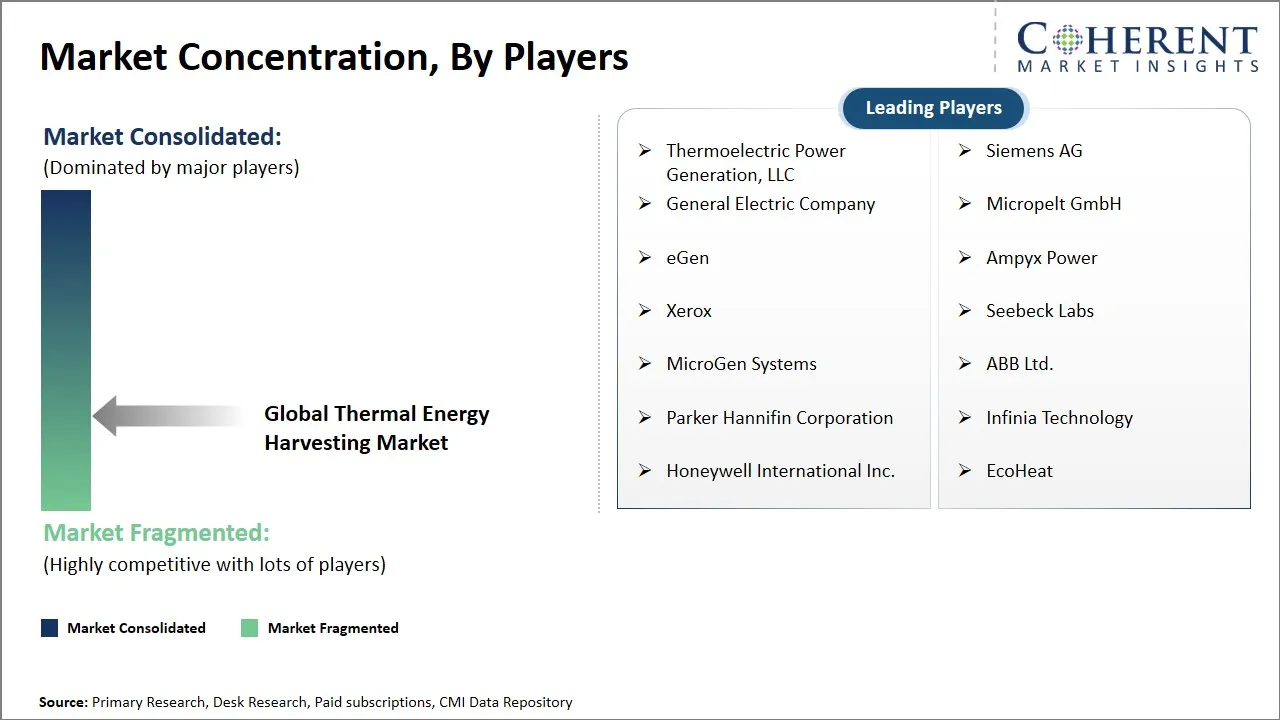
| Companies covered: | Thermoelectric Power Generation, LLC, Siemens AG, General Electric Company, Micropelt GmbH, eGen, Ampyx Power, Xerox, Seebeck Labs, MicroGen Systems, ABB Ltd., Parker Hannifin Corporation, Infinia Technology, Honeywell International Inc., and EcoHeat | ||
| Growth Drivers: |
| ||
| Restraints & Challenges: |
| ||
Thermal Energy Harvesting Market Dynamics
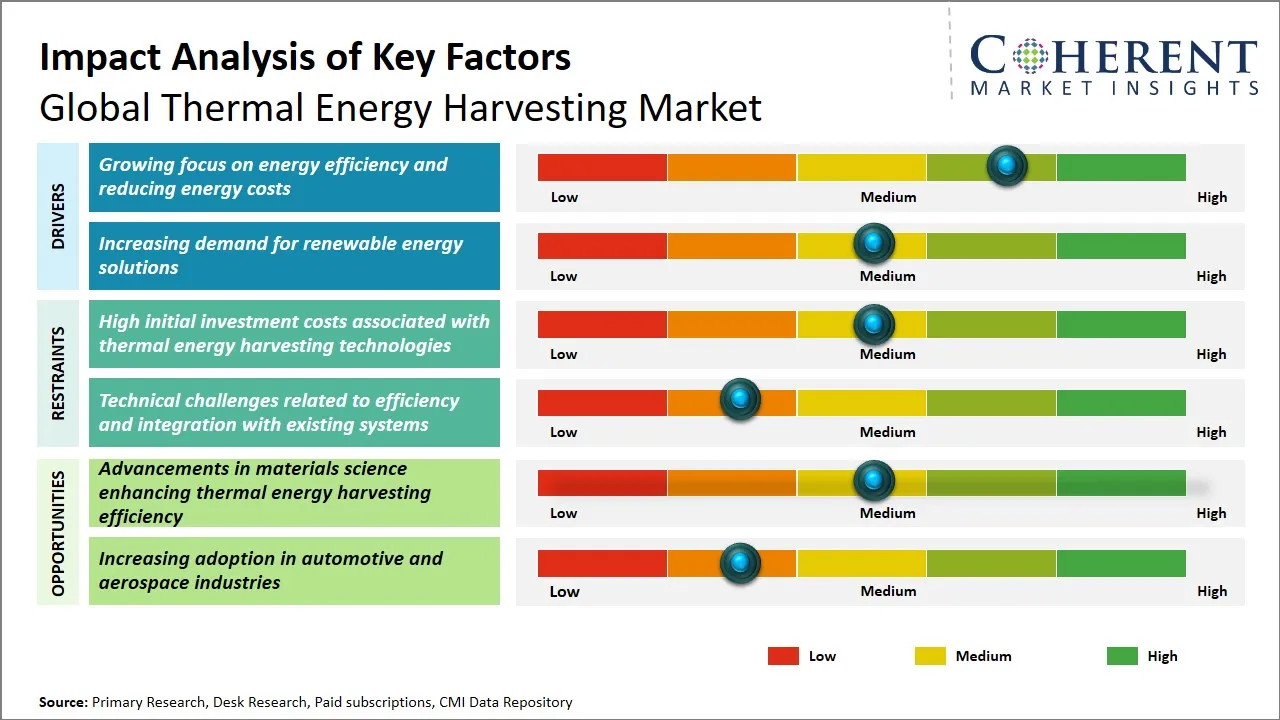
Thermal Energy Harvesting Market Driver - Growing Focus on Energy Efficiency and Reducing Energy Costs
The escalating demand for sustainable and cost-effective energy solutions is a significant factor propelling the adoption of thermal energy harvesting technologies globally. Thermal energy harvesting is a novel solution as industries and consumers seek to maximize their energy use and reduce operational costs as pressure mounts upon them to utilize more efficiently the energy they use. Not only does this increase the efficiency of power consumption as a whole, but also it is used to reduce dependence on traditional power sources thereby reducing the cost of energy significantly.
For example, General Motors has introduced the use of thermal energy harvesting system in its vehicles to transform the waste heat in the engines exhaust, to generate electricity in vehicles which enhances fuel efficiency and reduces the cost of running their vehicles. One of the industries that have highly embraced this type of technology is the automotive industry, which applies waste heat recovery systems to drive the auxiliary systems thereby avoiding the use of the main power sources to drive the cars and enhancing the overall consumption of energy.
Thermal Energy Harvesting Market Opportunity - Advancements in Materials Science Enhancing Thermal Energy Harvesting Efficiency
The fast development of materials science offers a number of opportunities to the global thermal energy harvesting market, as it is enabling significant enhancement of the energy conversion efficiency. The development of highly efficient thermal energy harvesting devices that can be efficient over a wider temperature range and in a wide range of environments is possible due to innovations in nanomaterials, phase change materials and thermoelectric materials. In particular, the development of new semiconductor materials and nanostructured materials has enabled higher thermoelectric figure-of-merit (ZT), which is one of the key parameters determining the capacity to use heat gradients in producing useful electrical energy.
As an example, BMW has collaborated with material science firms in order to integrate the use of complex thermoelectric materials to their concept cars. This allows them to convert the unnecessary amount of heat into electrical power that could be used in the vehicles electrical system, which has an environmental and cost saving advantage.
Analyst Opinion (Expert Opinion)
- The thermal energy harvesting market is under a strong momentum, which is mainly attributed to the rising need to use sustainable energy solutions and the development of material sciences. The International Conference on Thermoelectricity (2023) and the Global Energy Harvesting Forum (2022) have introduced some insights into the key innovations, and such companies as GreenTEG and Mide Technology have pioneered the technologies that turn waste heat into valuable energy.
- The recent invention of an advanced thermoelectric generator by GreenTEGs that increases the performance of the thermoelectric generator indicates the industries dedication towards solving the energy losses in the industrial works. Documents at these conferences acknowledged the significance of the harvesting of thermal energy in improving energy efficiency in many industries, particularly where industries are trying to reduce their carbon footprints.
- The problems like high start-up price and the necessity to integrate with already existing systems were often mentioned as the obstacles to larger implementation. To create a competitive advantage, the companies that choose to focus on the R&D to make the technologies more affordable and efficient and that strategize on corporate partnerships are likely to achieve a competitive advantage. Finally, the expansion of the thermal energy harvesting market will be driven by its ability to be innovative at all times and adhere to the global sustainability agenda in response to the seriousness of the awareness of efficient use of energy in an energy-aware world.
Speak to the analyst
Want personalized insights?
Take the findings above to one of our principal consultants, or have the report rebuilt around the segments, geographies and competitors you actually track.
Market Segmentation
- Technology Insights (Revenue, USD Mn, 2021 - 2033)
- Thermoelectric Generators (TEGs)
- Waste-Heat Recovery Systems
- Energy-Harvesting Transducers & Sensors
- Power Management ICs & Interfaces
- Hybrid thermal
- Deployment Insights (Revenue, USD Mn, 2021 - 2033)
- Standalone on-device harvesters
- Embedded or integrated harvesters
- System or plant-level waste heat recovery units
- Cloud-managed energy-harvesting sensor networks
- End User Insights (Revenue, USD Mn, 2021 - 2033)
- Manufacturing & Process Industries
- Automotive & Transportation
- Consumer Electronics & Wearable
- Oil & Gas & Energy Utilities
- Aerospace & Defense
- Others
- Regional Insights (Revenue, USD Mn, 2021 - 2033)
- North America
- U.S.
- Canada
- Latin America
- Brazil
- Argentina
- Mexico
- Rest of Latin America
- Europe
- Germany
- U.K.
- Spain
- France
- Italy
- Russia
- Rest of Europe
- Asia Pacific
- China
- India
- Japan
- Australia
- South Korea
- ASEAN
- Rest of Asia Pacific
- Middle East
- GCC Countries
- Israel
- Rest of Middle East
- Africa
- South Africa
- North Africa
- Central Africa
- North America
- Key Players Insights
- Thermoelectric Power Generation, LLC
- Siemens AG
- General Electric Company
- Micropelt GmbH
- eGen
- Ampyx Power
- Xerox
- Seebeck Labs
- MicroGen Systems
- ABB Ltd.
- Parker Hannifin Corporation
- Infinia Technology
- Honeywell International Inc.
- EcoHeat
Sources
Primary Research Interviews
- CEO – Leading Thermal Energy Harvesting Company (e.g., Laird Thermal Systems or Honeywell International equivalent)
- Supply Chain Director – Major Energy Harvesting Components Distributor
- Production Lead – Thermoelectric Generator (TEG) Manufacturer
- Sustainability Officer – Renewable Energy Certification Authority
Stakeholders
- Manufacturers
- End-use Sectors
- Industrial IoT and Wireless Sensor Networks
- Automotive and Aerospace Applications
- Building Automation and Smart Cities
- Consumer Electronics and Wearables
- Regulatory & Certification Bodies (e.g., EPA for energy devices, EU REACH compliance for materials, IEA for energy efficiency)
- E-commerce Platforms and Retailers (Alibaba, Industrial Suppliers, Digi-Key, Mouser Electronics)
- Technology Integration Players: IoT device makers and TEG integrators (e.g., Texas Instruments, STMicroelectronics)
Databases
- UN Comtrade Database (HS Code for thermoelectric devices)
- India Import Export (EXIM) Database
- USGS Mineral Commodity Summaries (related materials)
- Eurostat Trade Statistics for Electronics and Energy Tech
- IEA Energy Efficiency Reports
Magazines
- Energy Harvesting Journal – Trends in thermal harvesting tech
- Electronics Weekly – TEG innovations for IoT
- Renewable Energy World – Waste heat recovery applications
- Industrial Automation Magazine – Market dynamics for energy harvesters
Journals
- Journal of Power Sources – Thermoelectric energy harvesting efficiency
- Applied Energy – Thermal energy systems review
- Energy Conversion and Management – TEG advancements
- Sensors and Actuators – IoT energy harvesting
- Frontiers in Thermal Engineering – Innovations in thermal systems
Newspapers
- The Wall Street Journal – Global demand for energy harvesting tech
- Reuters – Supply chain in renewable energy components
- Business Standard (India) – Thermal harvesting market growth in Asia
- Chemical Week – Materials for thermoelectric devices
Associations
- International Energy Agency (IEA) 4E Programme
- Energy Harvesting Network
- IEEE Power Electronics Society
- International Electrotechnical Commission (IEC)
- Green Electronics Council
Public Domain Sources
- EPA – Guidelines for energy-efficient devices
- European Commission – Energy efficiency directives
- World Health Organization – Safety standards for electronics
- IEA – Reports on energy harvesting for IoT
- OECD – Sustainability reports for clean energy tech
Proprietary Elements
- CMI Data Analytics Tool, Proprietary CMI Existing Repository of information for last 8 years.
Get access to 250+ pages report
Every segment, forecast, competitor profile and data table behind the analysis above — available for instant download.
- ESOMAR Member
- ISO 9001:2015 Certified
- D-U-N-S Registered
- GDPR & CCPA Compliant
Missing comfort of reading report in your local language? Find your preferred language:
Transform your Strategy with Exclusive Trending Reports
Frequently Asked Questions
The global thermal energy harvesting market is estimated to be valued at USD 825.3 Mn in 2026 and is expected to reach USD 1,479.8 Mn by 2033.
The CAGR of global thermal energy harvesting market is projected to be 8.7% from 2026 to 2033.
Energy efficiency and decarbonization are corporate and regulatory priorities. Waste heat is ubiquitous (industry, automotive, consumer electronics). Harvesting that heat reduces energy waste, lowers operating costs, and supports IoT/edge sensor deployments without batteries.
Growing focus on energy efficiency and reducing energy costs and increasing demand for renewable energy solutions are the major factors driving the growth of the global thermal energy harvesting market.
High initial investment costs associated with thermal energy harvesting technologies and technical challenges related to efficiency and integration with existing systems are the major factors hampering the growth of the global thermal energy harvesting market.
It is applied in industrial waste heat recovery, automotive exhaust, consumer electronics, IoT networks, and remote sensors, particularly where traditional power sources are impractical.
In terms of technology, Thermoelectric Generators (TEGs) are estimated to dominate the market revenue share in 2026.