

Global Thin Brick Market Size and Forecast – 2026-2033
The global thin brick market is estimated to be valued at USD 1.88 Bn in 2026 and is expected to reach USD 2.75 Bn by 2033, exhibiting a compound annual growth rate (CAGR) of 5.6% from 2026 to 2033.
Key Takeaways of the Thin Brick Market
- The natural stone thin brick segment is estimated to account for 38.6 % of the global thin brick market share in 2026.
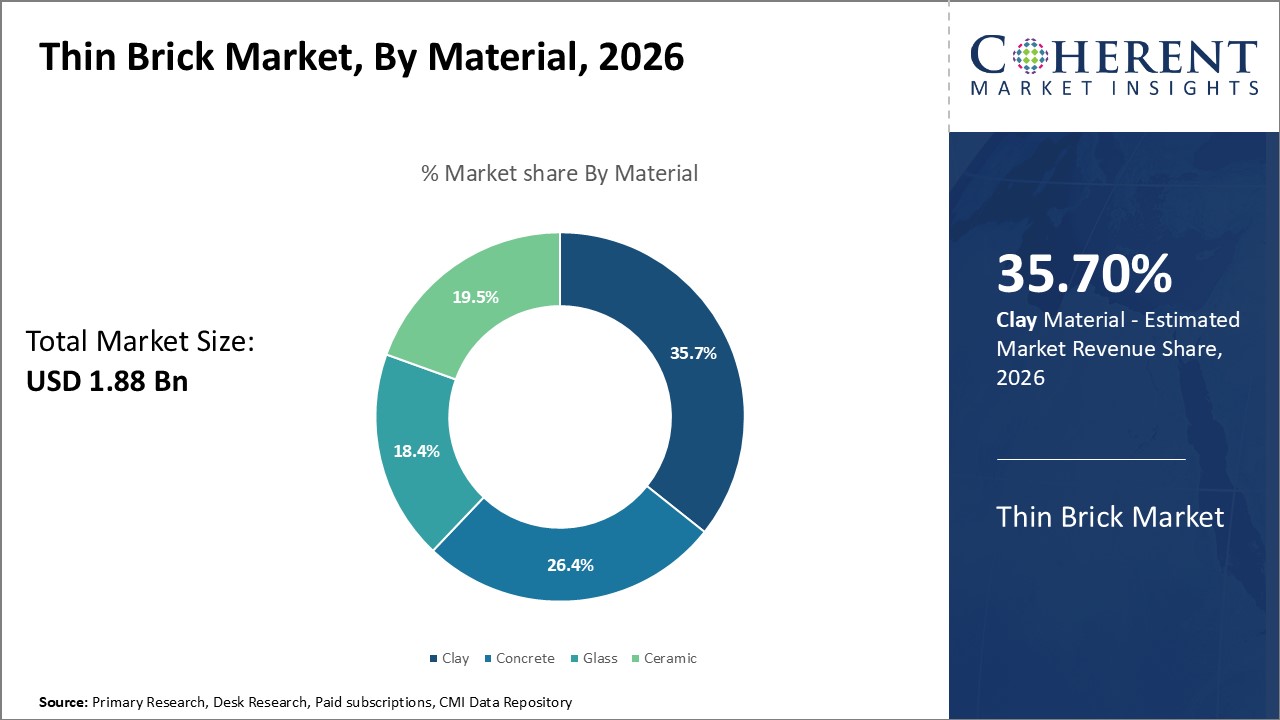
- The clay segment is projected to hold 35.7 % of the market share in 2026.
- The residential segment is expected to capture 36.8 % of the global thin brick market share in 2026.
- Asia Pacific is expected to lead the global thin brick market in 2026 with a 38.2 % share. North America, with an estimated share of 17.5% in 2026, and it is projected to be the fastest-growing region.
Market Overview
The trend in the market represents an increasing interest in sustainable and green construction opportunities, where thin bricks provide higher energy efficiency, simplify installation and provide more opportunities to design. Besides, the increasing urbanization and infrastructural changes in the emerging economies are increasing the use of thin bricks. The manufacturers are also targeting on sustainable production processes as well as new product finishes to satisfy new consumer demands pushing the market to a high level of innovation and environmental friendliness.
Current Events and Its Impact
Current Events | Description and its Impact |
Construction cyclicality: U.S. residential recovery vs. EU slowdown |
|
Consolidation among manufacturers and distributors |
|
Segmental Insights
- Current Industry Events of 2026
- Market Size Estimation
- Regional Breakdown
- Competitive Landscape
- Customer Intelligence
- Segmental Analysis
- Pricing Analysis
- Key Market Drivers, Challenges & Future Trends
- Customized Insights Section
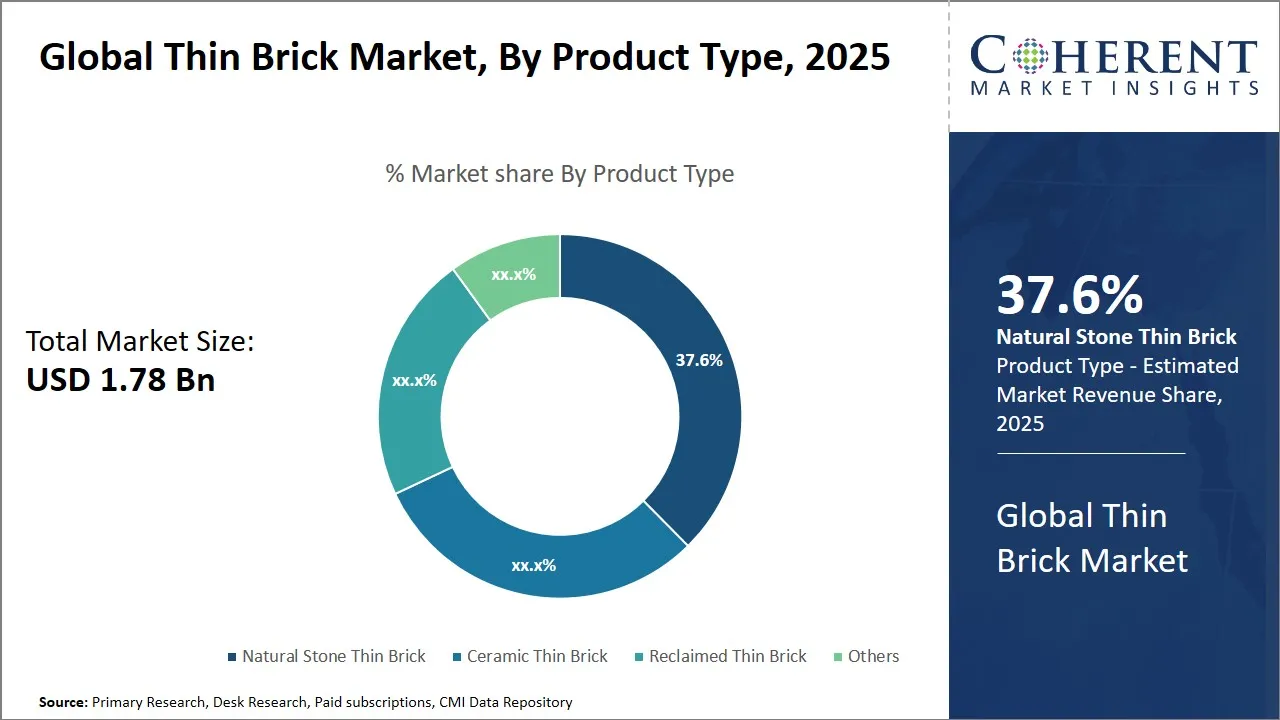
Thin Brick Market Insights, By Product Type - Natural Stone Thin Brick Segment Dominates the Market due to Driven by Aesthetic Appeal and Durability
Natural stone thin brick segment contributes the 38.6% of the global thin brick market share in 2026, owing to its unmatched aesthetic appeal and superior durability. The rising need to have high-quality and authentic architectural finishes in both residential and commercial developments contributes largely to the growth of this segment. The thin bricks made of natural stones provide a unique texture and natural beauty which synthetic ones can hardly imitate, and thus, this type of construction is favorable to the architects and designers who want to combine the old with the new. Their capacity to give a distinct visual warmth and personality to facades, inside and outside landscaping endeavors makes them more desirable.
For example, the renovation of the iconic Washington National Cathedral in Washington, D.C., incorporated natural stone thin bricks for its facade to maintain the original aesthetic while updating its durability and structural integrity. This use of natural stone thin bricks was essential to preserve the cathedral's historical look, while also ensuring it meets modern durability standards. This real-world application exemplifies how natural stone thin bricks are used in high-profile projects where authenticity and longevity are paramount.
Thin Brick Market Insights, By Material – Clay Segment Dominates the Market Due to Tradition and Versatility
Clay segment commands the 35.7% of the market share in 2026, due to its time-tested reliability, versatility and natural shape. The use of clay bricks in construction process dates back centuries and the heritage is one of the reasons that make them continue being popular in the use of thin bricks in the modern world. Clay is an ideal material used in the envelopes of energy-efficient buildings because it has natural thermal insulations that will help in controlling the temperatures inside and minimizes the need to heat or cool the premises. This property coincides with the growing sustainability targets in the construction industry, and as such, the clay thin bricks are being used in popular developments with regard to their eco-friendly characteristics.
Additionally, clay offers exceptional adaptability to various manufacturing processes, allowing thin bricks made from this material to achieve uniform size, color consistency, and precise surface finishes that cater to both traditional and innovative design aesthetics. Clay’s mineral richness provides a range of color options without the need for artificial dyes or coatings, enhancing the appeal to architects seeking authentic and customizable façade solutions. Its high compressive strength and resistance to fire and abrasion position clay thin bricks as a durable and safe choice for multiple applications.
Thin Brick Market Insights, By Application - Residential Sector Growth Fueled by Customization and Lifestyle Trends
The residential segment holds the 36.8% of the global thin brick market share in 2026, and this is significantly due to the growing consumer preference in personalization of their homes and aesthetic enhancements. Home owners are spending more on improving the appearance outside and inside using materials that give warmth, texture and features of character that thin bricks can provide perfectly. The reason why thin bricks have taken over the traditional bulky bricks in residential homes is because they are lightweight, easy to set up and can fit easily on the existing structures without the need of a major structural change.
Regional Insights

Asia Pacific Thin Brick Market Analysis and Trends
The Asia Pacific region is projected to lead the market with a 38.2% share in 2026, due to the fast urbanization and the growing construction industry that is concentrated on modernization and aesthetic designs. The government programs of smart city development and environmentally-friendly infrastructure have become a big demand.
The development of new housing construction in nations such as China, India and the Southeast Asian countries due to emerging middle-class populations are providing new markets where the utilization of thin bricks can be used. This is enhanced by the availability of a local manufacturer such as CSI Building Materials in China and Terreal in India and the entry of international players into the market using the joint venture approach. Another contributor to market expansion is improved trade agreements and investments in logistics infrastructure.
North America Thin Brick Market Analysis and Trends
The North America region is expected to exhibit the fastest growth in the market contributing 17.5% share in 2026, due to the well-established construction ecosystem with high demand of residential and commercial renovation. The area has a well-developed manufacturing infrastructure and a strong distribution system. Sustainable and energy efficient building materials are also encouraged by the government and this encourages the use of thin brick, and the strict building codes favor the use of fire resistant and durable building materials.
The main players in the industry including Glen-Gery, Acme Brick Company and Meridian Brick have established themselves with constant innovation and formation of alliances. The developed logistics and trade structure makes it easy to trade between the U.S., Canada and Mexico and this improves market penetration in the region.
Global Thin Brick Market Outlook for Key Countries
U.S. Thin Brick Market Analysis and Trends
The thin brick market in the U.S. still is stable because of the steady demand in the construction and renewal of buildings focusing on energy consumption and beauty. The major players in the industry like Glen-Gery and Acme Brick have a wide range of products depending on the architecture designs, both contemporaneous and traditional. Also, the impact of the green building certifications promotes the adoption of thin bricks as green building materials. The extensive availability and market stability is guaranteed by strategic supply chain management and a large number of distributors.
China Thin Brick Market Analysis and Trends
Urbanization rate and the government projects on constructions drive the rapid growth of the thin brick market of China. Domestic companies such as CSI Building Materials specialize in the creation of affordable but good quality thin bricks and this is used in the large scale infrastructural developments. The focus of the government in intelligent city planning and environment-friendly substances fits the advantages of the thin brick market. Multinational companies are quickly joining China firms in alliances where local expertise is integrated with high technology to seize this emerging market.
Germany Thin Brick Market Analysis and Trends
Germany still spearheads the European market in thin bricks due to extremely high requirements in the durability of the structure, fire resistance, and environmental sustainability. German manufacturers like Nelissen and Vandersanden have focused on production of quality thin brick products which are of high quality and of proper building requirements of the European Union. The stable construction sector and the active government policies that are encouraging retrofitting projects that are energy efficient help in ensuring that demand remains in the country. The export-oriented trade policies as well make Germany a strategic point to supply thin bricks to most parts of Europe.
India Thin Brick Market Analysis and Trends
The market of thin brick in India is at its growth stage and it is affected by the high rate of urbanization and the growth of government expenditure on the cheap housing. The firms such as Terreal India are critical in bringing about the advanced methods of making thin bricks. The industry is going towards the development of the more advanced thin brick industry, which is facilitated by the governments with their focus on green buildings and infrastructure modernization. The retail growth via the online arena and the strengthening logistics networks are expanding the market accessibility, in the tier-2 and tier-3 cities, and increasing the consumer base.
Brazil Thin Brick Market Analysis and Trends
Brazil is an upcoming market with thin bricks owing to the urban redevelopment initiative and the increased investment in commercial and residential infrastructure. The local manufacturers are adjusting to the need of building materials, which are attractive and at the same time affordable. The openness of the trade of the country and the bilateral agreements promote foreign direct investment that allows foreign firms to become active. Economic initiatives targeted at infrastructure improvement further stimulate the consumption of innovative thin brick products across metropolitan areas.
Macro and Micro Economic Factors Impacting on Thin Brick Market Growth
Macroeconomic Factors
- Urbanization and Infrastructure Development: Rapid urbanization, particularly in Asia Pacific and the Middle East, is a major driver as thin bricks are ideal for high-density residential and commercial projects due to their lightweight and ease of installation.
- Economic Growth and Real Estate Investment: Expanding economies in Europe and North America are supporting construction investments. A rise in disposable income and commercial real estate projects strengthens the market potential for thin brick facades and interiors.
- Technological Advancements and Industry Digitization: Integration of digital manufacturing technologies and automation in construction has improved production efficiency, reduced energy usage, and lowered costs in the thin brick segment.
Microeconomic Factors
- Consumer Preferences and Aesthetic Demand: Rising interest in aesthetic building finishes and energy-efficient homes drives the demand for thin bricks as a sustainable and visually appealing product. Their versatility in interior and exterior applications enhances consumer appeal.
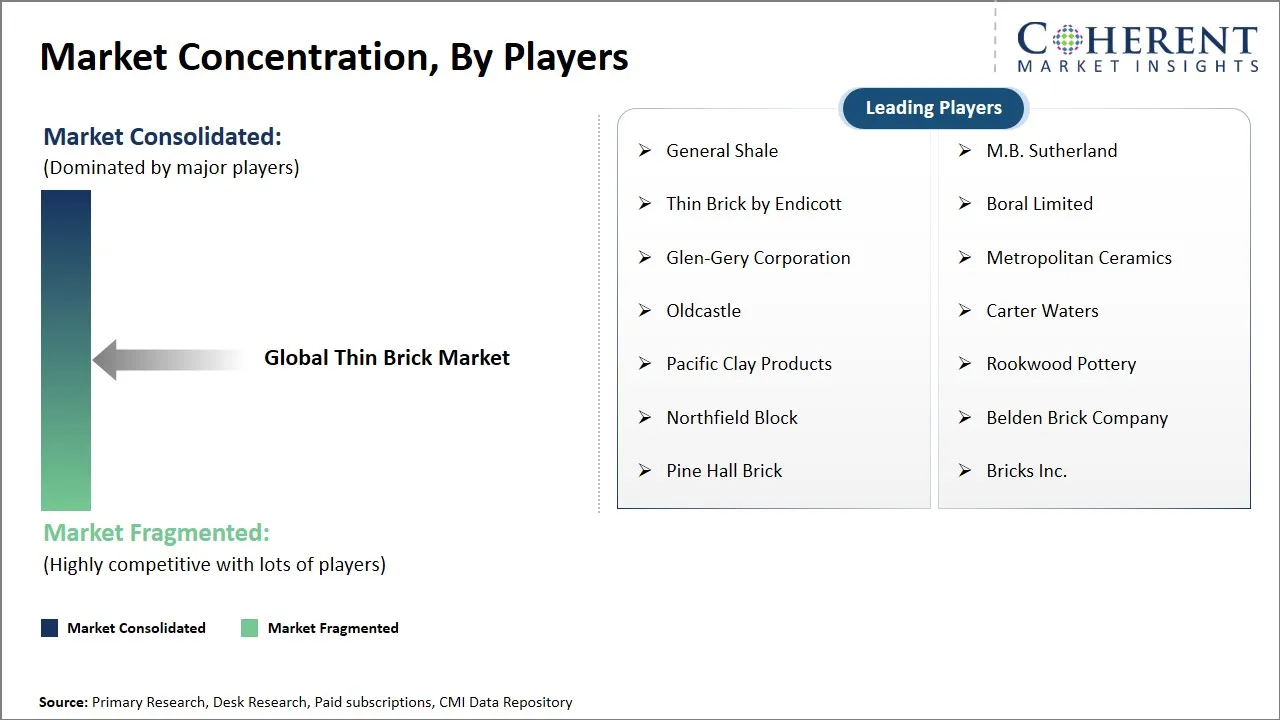
- Competition and Product Differentiation: The market is fragmented with players like SUZUKA Group, Z BRICK, and Eldorado Stone emphasizing innovative designs, color variations, and adherence veneer types to gain competitive advantages.
- Cost Efficiency and Pricing Strategies: Though initial costs are higher compared to traditional bricks, the lower installation time and reduced labor costs enhance total cost efficiency for developers, enabling premium pricing strategies.
- Technological Innovation at Firm Level: Companies are investing in new production technologies such as low-temperature firing and recyclable materials to reduce carbon footprints, meeting the dual goals of cost reduction and sustainability.
Market Players, Key Development, and Competitive Intelligence
Key Development
- In February 2025, MAPEI offers the most complete systems of installation products for a large variety of manufactured stone veneer (MSV), natural stone veneer or thin-brick siding projects in order to simplify compliance with new building codes.
Top Strategies Followed by Global Thin Brick Market Players
- Established players in the industry is dominated by established players who use the large resources they have to invest heavily in research and development. This innovation commitment enables them to bring up performance, high durable and aesthetically versatile thin brick products that address the changing customer demands.
- For example, Wienerberger offered Porotherm Eco-bricks with lightweight clay composites to enhance energy efficiency on facades.
- Mid-level competitors: The competitors that are in the mid-level of the thin brick market have a slightly different strategy and are trying to balance quality and affordability in order to attract price-sensitive consumers. These players are concerned with providing efficient products at low cost without affecting performance parameters that significantly affect the performance thereby serving a wide range of clientele such as small contractors, developers and renovation works. Mid-level players usually enter into strategic alliances and joint ventures in order to increase their market presence and improve their potentials.
- As an example, Hebron Brick uses regional distributors and architects as its partners in increasing market share in the cost-sensitive renovation segments in the U.S. Midwest. Their business plan focuses on their cost-efficient production where semi-automated production and joint venture would help in reaching more people without the burden of large cost of capital.
- Small-scale players in the global thin brick market carve out niche segments by focusing on specialized features or innovative products that cater to specific architectural or environmental needs. These smaller companies are typically more agile and adaptive, rapidly adopting cutting-edge technologies such as digital printing, eco-friendly materials, or custom design capabilities to differentiate themselves from larger competitors.
- For example, to illustrate, Ziegel Tech employs the digital inkjet printing to provide customized architectural designs on commercial buildings on a boutique basis in Europe.
Market Report Scope
Thin Brick Market Report Coverage
| Report Coverage | Details | ||
|---|---|---|---|
| Base Year: | 2025 | Market Size in 2026: | USD 1.88 Bn |
| Historical Data for: | 2020 To 2024 | Forecast Period: | 2026 To 2033 |
| Forecast Period 2026 to 2033 CAGR: | 5.6% | 2033 Value Projection: | USD 2.75 Bn |
| Geographies covered: |
| ||
| Segments covered: |
| ||
| Companies covered: | General Shale, M.B. Sutherland, Thin Brick by Endicott, Boral Limited, Glen-Gery Corporation, Metropolitan Ceramics, Oldcastle, Carter Waters, Pacific Clay Products, Rookwood Pottery, Northfield Block, Belden Brick Company, Pine Hall Brick, and Bricks Inc. | ||
| Growth Drivers: |
| ||
| Restraints & Challenges: |
| ||
Thin Brick Market Dynamics
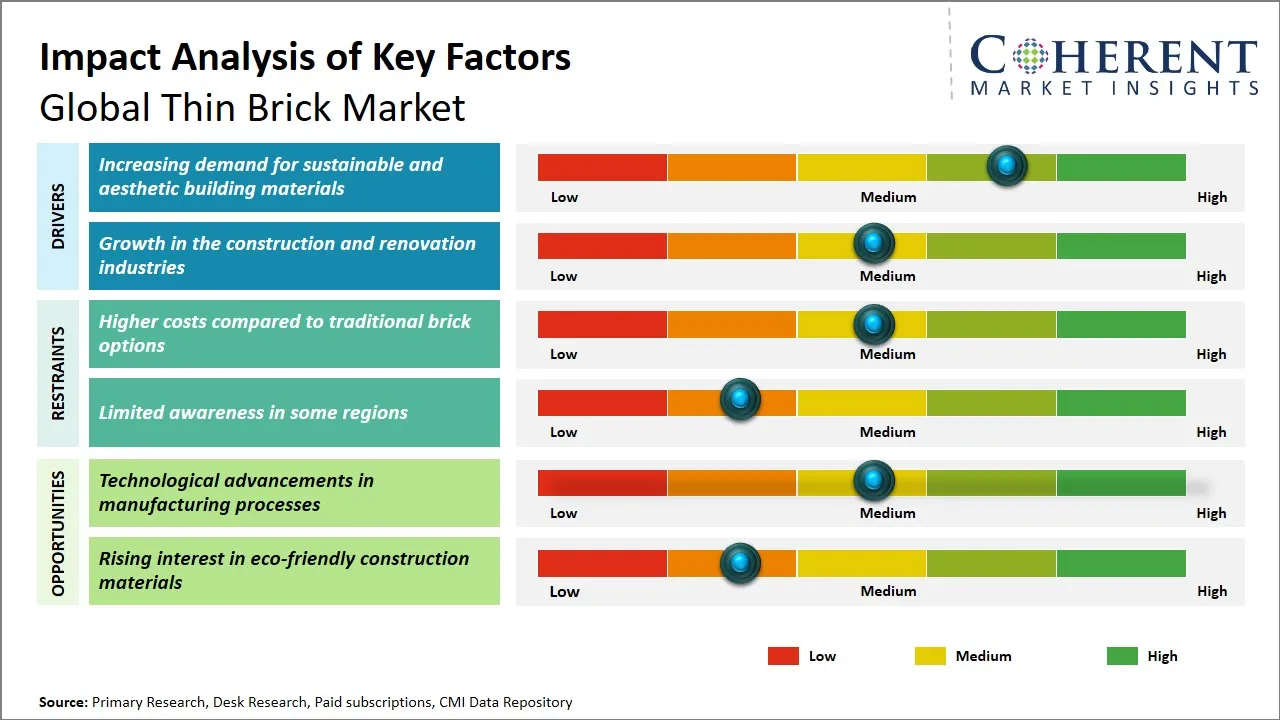
Thin Brick Market Driver - Increasing Demand for Sustainable and Aesthetic Building Materials
The rising need of sustainability and environmental responsibility in the construction sector is also playing an important role in increasing the demand of thin bricks. With architectural services and constructors looking to find eco-friendly design solutions that decrease resource use and carbon footprints, thin bricks have become one of their preferred materials because of their lightweight characteristics and low amounts of raw materials used to create them in comparison with traditional masonry. More so, these bricks have greater aestheticability and this enables designers to attain a variety of architectural styles between the traditional and the modern without losing structural integrity and architectural aesthetic.
As an example, General Shale released the Thin Brick Sustainable Collection that is expected to work with up to 80% recycled materials, and emit less carbon in the form of embodied energy than an average brick made of clay, by almost half as much. The era of design enables easy transportation and reduced cost of installation, which complies with LEED and green building requirements.
Thin Brick Market Opportunity - Technological Advancements in Manufacturing Processes
Continuing technology improvement in the manufacturing process is bound to leave the global thin brick market with a lot to gain in the form of revolution in the efficiency in production, quality of products as well as its ability to customize products. The automation, robotic handling, and advanced kiln technologies have also innovated to make manufacturing processes smoother and thus the cycles of production are completed faster and the cost of operations reduced. The advancements have made manufacturers be able to manufacture thinner, lightweight and stronger bricks that do not lose their aesthetic appearance and structural integrity, and thus broaden their range of use in residential and commercial buildings.
As an example, Wienerberger AG installed high-tech machinery in the tunnel kiln that led to the minimization of energy usage and carbon dioxide emissions by 30 percent enabling mass customization of any surface signage and coloration. These developments indicate the growth of automation and digital manufacturing to use thin bricks in energy-efficient, design-led architecture.
Analyst Opinion (Expert Opinion)
- There is a significant growth in the thin brick business and this is due to the increasing architectural tendencies towards lightweight construction and sustainable construction. The information about the International Builders’ Show (2023) and the Brick Industry Association Conference (2022) provided relevant information about the new innovations with such companies as Glen-Gery and Belden Brick setting the pace of development in terms of design and producing methods.
- The most recent example of the market reaction to the growing demand of the construction solutions that are sustainable is the introduction of a new series of thin bricks by Glen-Gerys that are fabricated with the help of recycled materials. Debates at these conferences focused on the flexibility of the use of thin bricks, whether used in the residential or commercial setting, as it was seen to attract architects and designers seeking aesthetic beauty, but light in weight as compared to conventional bricks.
- The threats like substitutes of the material and ineffective price of the raw materials were often mentioned among possible obstacles to expanding the market. Those companies, which invest into the marketing strategies, which promote the advantages of thin brick, i.e., they are easy to install, and save energy, are likely to gain a bigger part of a market. Finally, the future success of the thin brick market will also be determined by its innovation capability and response to sustainability and design-based preferences in the changing construction environment.
Speak to the analyst
Want personalized insights?
Take the findings above to one of our principal consultants, or have the report rebuilt around the segments, geographies and competitors you actually track.
Market Segmentation
- Product Type Insights (Revenue, USD Bn, 2021 - 2033)
- Natural Stone Thin Brick
- Ceramic Thin Brick
- Reclaimed Thin Brick
- Others
- Material Type Insights (Revenue, USD Bn, 2021 - 2033)
- Clay
- Concrete
- Glass
- Ceramic
- Application Insights (Revenue, USD Bn, 2021 - 2033)
- Residential
- Commercial
- Industrial
- Others
- Regional Insights (Revenue, USD Bn, 2021 - 2033)
- North America
- U.S.
- Canada
- Latin America
- Brazil
- Argentina
- Mexico
- Rest of Latin America
- Europe
- Germany
- U.K.
- Spain
- France
- Italy
- Russia
- Rest of Europe
- Asia Pacific
- China
- India
- Japan
- Australia
- South Korea
- ASEAN
- Rest of Asia Pacific
- Middle East
- GCC Countries
- Israel
- Rest of Middle East
- Africa
- South Africa
- North Africa
- Central Africa
- North America
- Key Players Insights
- General Shale
- B. Sutherland
- Thin Brick by Endicott
- Boral Limited
- Glen-Gery Corporation
- Metropolitan Ceramics
- Oldcastle
- Carter Waters
- Pacific Clay Products
- Rookwood Pottery
- Northfield Block
- Belden Brick Company
- Pine Hall Brick
- Bricks Inc.
Sources
Primary Research Interviews
- R&D Director – Leading Thin Brick Manufacturing Firm
- Procurement Manager – Major Construction Material Distributor
- Product Development Head – Prominent Building Materials Brand
- Sustainability Manager – Green Construction or LEED Certification Body
Stakeholders
- Manufacturers
- Residential and Commercial Construction
- Architectural Facade and Cladding
- Interior Design and Renovation Companies
- Industrial and Institutional Infrastructure Development
- Regulatory & Certification Bodies
- Distributors and Retail Builders
- E-commerce and Wholesale Building Supply Platforms
- Smart Construction and Sustainability Technology Players (AI & Digital Fabrication Tools)
Databases
- UN Comtrade Database
- India Import Export (EXIM) Database
- World Integrated Trade Solution (WITS)
- USITC DataWeb (for import-export trends of clay-based and masonry products)
Magazines
- Construction Week – Trends in Building Materials and Facade Systems
- Architectural Record – Innovations in Facade Design and Thin Brick Applications
- Building Design + Construction (BD+C) – Smart and Sustainable Masonry Solutions
- Masonry Magazine – Advancements in Clay Masonry and Thin Brick Products
Journals
- Journal of Building Engineering – Structural and Thermal Performance Studies of Thin Brick
- Construction and Building Materials – Research on Brick Composition and Performance
- Journal of Architecture and Urbanism – Thin Brick Applications in Modern Design
- International Journal of Sustainable Built Environment – Lower Carbon Construction Materials
Newspapers
- The Financial Times – Reportage on global building material investments
- The Guardian – European changes in eco-friendly building products
- The Economic Times – Construction material market growth trends in India
- The New York Times – U.S. housing and infrastructure project updates
Associations
- Brick Industry Association (BIA)
- European Ceramic Industry Association (Cerame-Unie)
- National Brick Research Center (NBRC, Clemson University)
- Mason Contractors Association of America (MCAA)
- U.S. Green Building Council (USGBC)
Public Domain Sources
- ASTM International – Standards for Thin Brick Veneers (ASTM C1088, C1784)
- U.S. EPA – Sustainability and lifecycle analysis for building materials
- European Commission – Construction Products Regulation (CPR)
- World Trade Organization (WTO) – Ceramic and construction material trade standards
- World Bank – Reports on urbanization and infrastructure materials
Proprietary Elements
- CMI Data Analytics Tool, Proprietary CMI Existing Repository of information for last 8 years.
Get access to 250+ pages report
Every segment, forecast, competitor profile and data table behind the analysis above — available for instant download.
- ESOMAR Member
- ISO 9001:2015 Certified
- D-U-N-S Registered
- GDPR & CCPA Compliant
Missing comfort of reading report in your local language? Find your preferred language:
Transform your Strategy with Exclusive Trending Reports
Frequently Asked Questions
The global thin brick market is estimated to be valued at USD 1.88 Bn in 2026 and is expected to reach USD 2.75 Bn by 2033.
The CAGR of the global thin brick market is projected to be 5.6% from 2026 to 2033.
Increasing demand for sustainable and aesthetic building materials and growth in the construction and renovation industries are the major factors driving the growth of the global thin brick market.
Higher costs compared to traditional brick options and limited awareness in some regions are the major factors hampering the growth of the global thin brick market.
In terms of product type, the natural stone thin brick is estimated to dominate the market revenue share in 2026.
General Shale, M.B. Sutherland, Thin Brick by Endicott, Boral Limited, Glen-Gery Corporation, Metropolitan Ceramics, Oldcastle, Carter Waters, Pacific Clay Products, Rookwood Pottery, Northfield Block, Belden Brick Company, Pine Hall Brick, and Bricks Inc. are the major players.
Asia Pacific is expected to lead the global thin brick market in 2026.