

Global Train Battery Market and Forecast: 2026 to 2033
The global train battery market is estimated to be valued at USD 308.3 Mn in 2026 and is expected to reach USD 419.5 Mn by 2033, exhibiting compound annual growth rate (CAGR) of 4.5% from 2026 to 2033.
Key Takeaways of the Global Train Battery Market
- The lead acid battery segment is expected to lead the market holding a share of 42.3% in 2026.
- The conventional lead acid battery segment is projected to hold a prominent market share of 34.8% in 2026.
- The metros segment is projected to hold a market share of 38.5% in 2026.
- Asia Pacific, expected to hold a share of 41.4% in 2026, dominates the market.
- Europe is expected to be the fastest growing regional market with a share of 27.6% in 2026.
Market Overview
The continuous rise in the global train battery market reflects growing need for reliable, eco-friendly power storage across rail networks, fueled by innovation and a global move toward electric trains.
The current market shows growing interest in powerful, durable batteries like lithium-ion and solid-state types to boost train efficiency while cutting emissions. Besides this, public policies supporting eco-friendly transit, along with tight pollution rules, drive funding toward greener power solutions. Also, smarter battery controls combined with renewables highlight shifts in rail energy use, shaped by worldwide efforts to build sustainable transport.
Current Events and Its Impact
Current Events | Description and its Impact |
Siemens Infrastructure Expansion |
|
Electronic Travel Authorization |
|
Segmental Insights
- Current Industry Events of 2026
- Market Size Estimation
- Regional Breakdown
- Competitive Landscape
- Customer Intelligence
- Segmental Analysis
- Pricing Analysis
- Key Market Drivers, Challenges & Future Trends
- Customized Insights Section
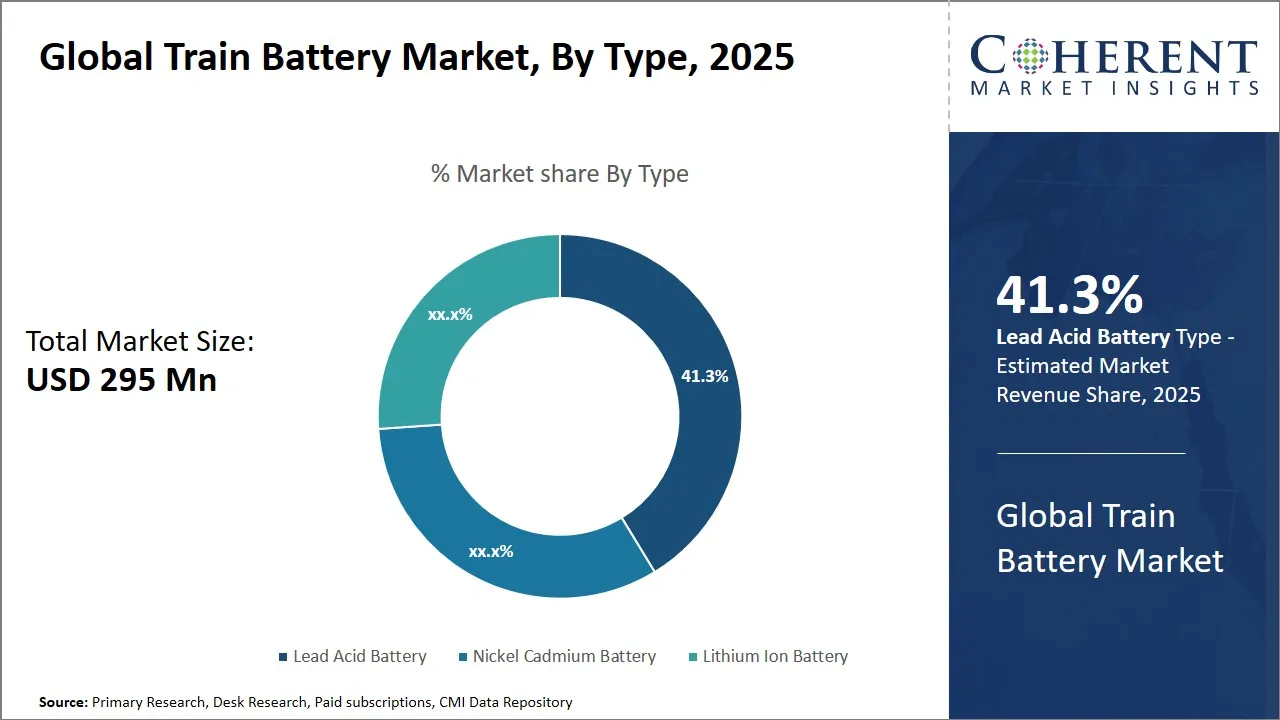
Global Train Battery Market Insights, By Type – Lead Acid Battery Maintains Dominance Driven by Cost-Effectiveness and Established Reliability
In terms of type, lead acid battery segment is expected to contribute the highest share of 42.3% of the global train battery market because they are known to work well, save money, and are commonly used in trains. Lead acid batteries have played a key role in industry and transit for many years, owing to dependable output and long-used production methods. They provide enough stored power at low cost, which appeals to railway companies trying to reduce spending while keeping solid results.
The strength of lead acid batteries makes them still popular for use in trains. Because they handle tough situations like changes in temperature or constant shaking, they work well where reliability matters most. Where heavy-duty performance is needed, these batteries stay dependable over time. Also, since upkeep is simple and recycling methods are clear, operators find them practical. This fits with how railways now aim to manage equipment life more responsibly.
For instance, on July 23, 2025, GS Yuasa announced the launch of its updated SWL+ line. Following the strong performance of the established SWL models, this upgrade delivers enhanced reliability for VRLA batteries used in rapid discharge setups. While maintaining durability, it improves efficiency in backup power scenarios. With optimized design features, the series supports demanding energy needs. As a result, users gain longer service life under heavy loads. Because of advanced engineering, charging cycles are more consistent. Therefore, operational downtime is reduced significantly.
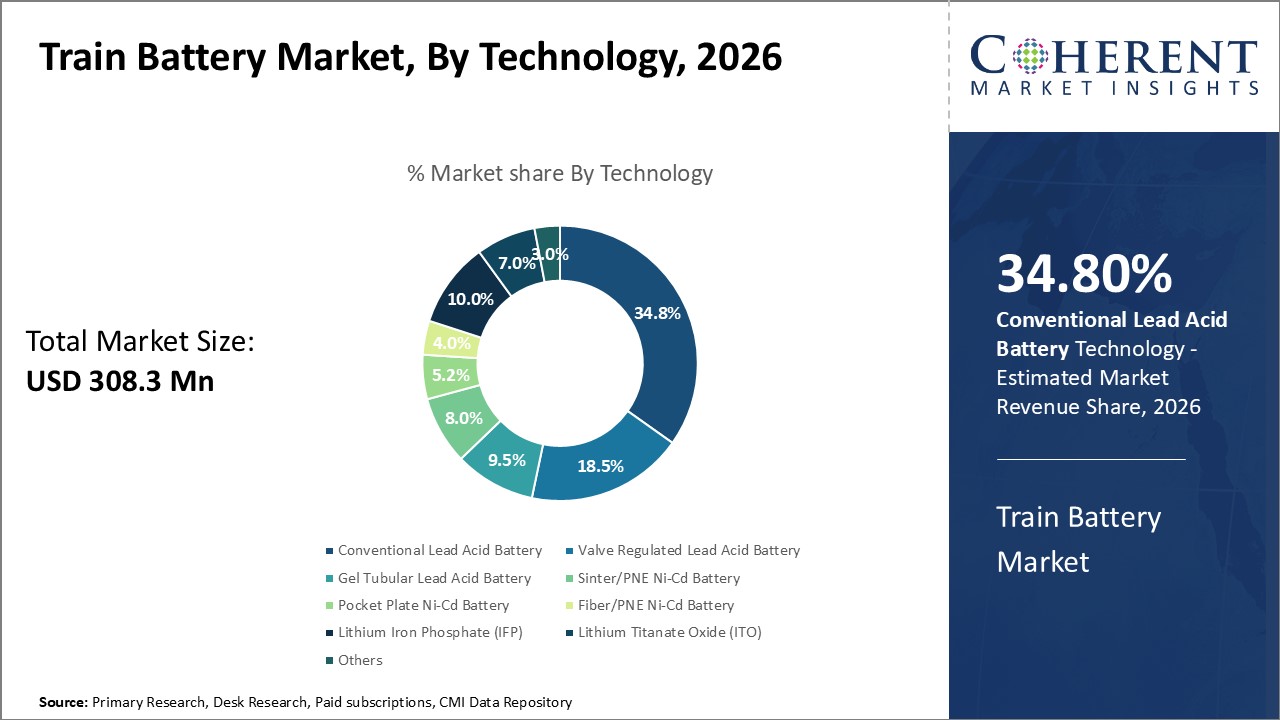
Global Train Battery Market Insights, By Technology – Conventional Lead Acid Battery Leads Market Due to Proven Technology and Wide Compatibility
The conventional lead acid battery segment is projected to command the highest market share of 34.8% in 2026, due to its well-known, proven structure. Because this system fits smoothly into current railway operations, it works reliably across established networks. Its uncomplicated nature means upkeep stays manageable; no advanced training or special tools are needed on site. As a result, service teams can maintain consistent results using familiar methods.
Lead acid batteries work well because they deliver strong initial power, needed for starting trains and running onboard systems steadily. Since these batteries fit many train types, rail companies often pick them instead of niche alternatives. Also, current rules match up easily with this tech, so operators choose it to stay compliant without disruptions.
Global Train battery market Insights, By Application – Metros Dominate Due to Intense Urbanization and Continuous Operation Needs
The metros segment is expected to dominate the market with a share of 38.5% in 2026. The rise in this sector comes from fast city development along with a growing need for reliable mass transit that handles large passenger volumes. Because urban areas aim to cut down on road jams, lower greenhouse gases, or improve travel ease, subway systems are spreading worldwide. As these networks grow steadily, they require stable power storage options - ones flexible enough to keep up with constant daily use typical in subways.
The energy needs of metro systems like powering movement, emergency setups, or lights and signals call for dependable batteries suited to constant use and quick charging shifts. Because metros stop and start often while sticking to tight timetables, consistent battery function is essential. These operating conditions lead to ongoing demand for durable, low-maintenance batteries that keep public transport running smoothly.
For instance, on October 21, 2024, Paris metro’s operator, Régie autonome des transports (RATP), Contracted Stadler to build twelve tailored locomotives. For Stadler, this marks their initial deal with RATP - ranked globally as the third-biggest city transit provider - which moves around 11 million riders every day.
Battery Lifecycle Economics & Replacement Cycle
Battery Type | Approx. Lifespan | Approx. Lifecycle |
Lead ‑ Acid | 3–5 years | 300–500 cycles |
Lithium ‑ Ion | 8–10 years | 2,000 – 5,000 cycles |
Rail Decarbonization Policies & Subsidy Mapping
Region/Country | Key Policy / Regulation | Support / Incentives |
India |
| Approx. Allocation USD 72.62 Million for further electrification projects |
European Union |
| Member states (e.g. Germany) allowed to subsidize rail operators under EU State Aid rules, enabling support schemes such as the German USD 1.28 billion traction‑support scheme. |
U.S. Department of Transportation |
| In November 2024, FRA awarded USD 96.5 million for three hydrogen‑rail projects (California, Colorado, Pennsylvania) for deployment of zero‑emission rail. |
Regional Insights
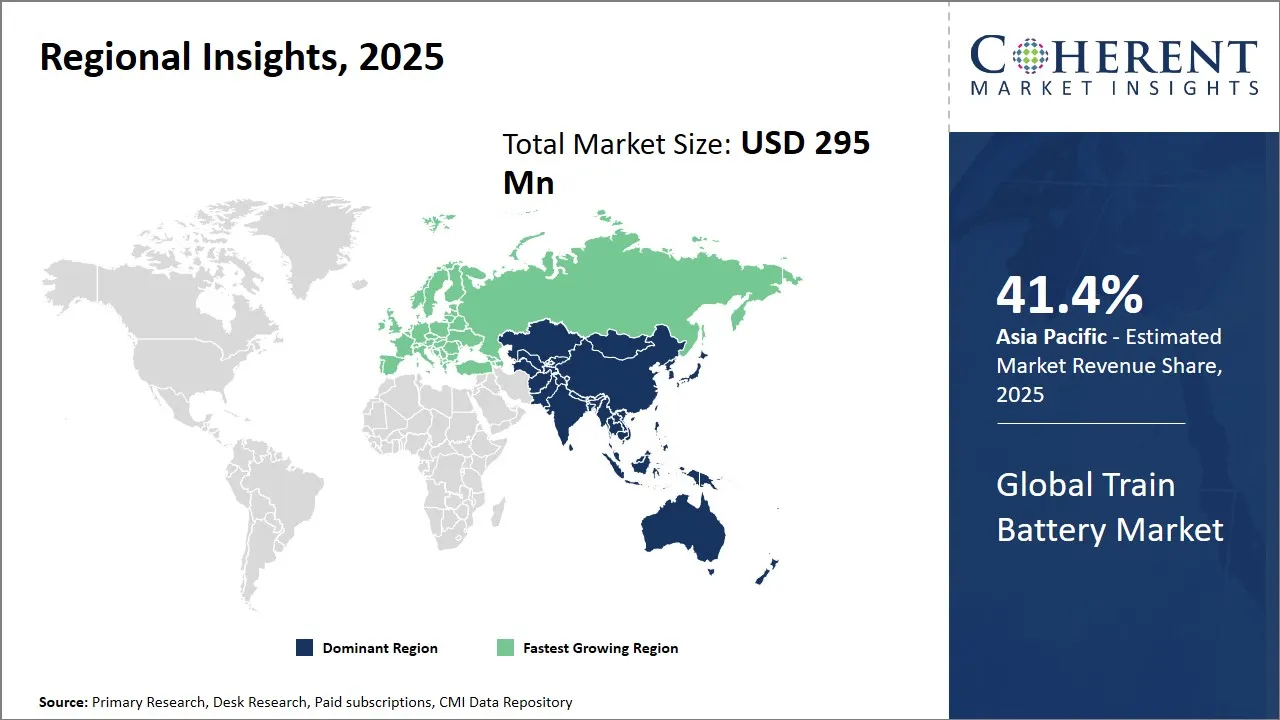
Asia Pacific Train Battery Market Analysis and Trends
Asia Pacific is the leader in the global train battery market with an estimated share of 41.4% in 2026. The growth is driven by fast city growth, wider rail lines and also a push for electric upgrades in nations such as India and China. Rising need for clean, effective mass transport has drawn strong funding into train-specific battery tech. Some countries here are improving old railways to use battery-run or mixed-power trains instead.
Across Asia Pacific, the sector is shifting quickly - as major firms like BYD, CATL, Toshiba, and Hitach build more output while making targeted alliances. Favorable government actions boost transportation rail transport while rising local production speeds up market spread. Rules supporting cross-border trade in batteries help expand the sector.
Europe Train Battery Market Analysis and Trends
Europe train battery market is expected to exhibit the fastest growth and hold a market share of 27.6% in 2026, because of modern rail systems, tough environmental rules, together with a focus on green transit. Governments there actively push policies promoting low-energy use and emission-free trains which boosts need for high-performance an large capacity batteries. A well-developed industrial setup backs this up, along with steady R&D spending by key firms like Siemens, Alstom, or Varta AG. Cross-border train links combined with EU-wide clean energy plans strengthen the region’s edge. On top of that, trade flows smoothly owing to unrestricted transport of parts between member nations, enabling efficient supply chains.
Global Train Battery Market Outlook for Key Countries
Germany Train Battery Market Analysis and Trends
Germany's market relies heavily on industry, while companies such as Siemens focus on building battery tech for electric trains. Because of its goal to cut CO₂, along with funding upgrades in rail networks, there’s growing need for advanced battery options. Being centrally located in the EU helps streamline logistics; furthermore, joint research efforts between nations boost innovation - this keeps Germany ahead in the sector.
China Train Battery Market Analysis and Trends
China stays ahead in the Asia Pacific region by expanding electric railways and boosting local battery production. Firms such as CATL and BYD play major roles, introducing new lithium-ion and solid-state batteries for trains. Government rules that limit pollution, while also supporting local production through rewards, push quick growth in market scale and tech skills.
India Train Battery Market Analysis and Trends
India’s market is expanding quickly, driven by efforts to electrify rail transport while introducing modern trains such as the Vande Bharat Express. As demand rises for battery-powered and hybrid models, foreign battery producers are teaming up with local firms instead of working alone. Support from state funding, upgrades in infrastructure, while shifting away from diesel engines, plays a major role in steering this growth.
France Train Battery Market Analysis and Trends
France still plays a key role in the train battery sector, thanks to big companies such as Alstom developing new power systems for future trains. Its push for greener rail transport relies on solid rules and government support aimed at saving energy. Working together in pan-European initiatives has strengthened France’s efforts in researching and launching battery tech for railways.
Japan Train Battery Market Analysis and Trends
Japan's market stands out due to advanced tech in batteries and railways. Firms like Toshiba or Hitachi lead in developing quick-charge, long-lasting battery solutions for trains. High-speed rail development along with city transport upgrades, driven by strict eco rules, shapes an active industry setting. Supportive state measures that boost new ideas but also global sales ability help solidify Japan’s role in railway energy storage
Market Players, Key Development, and Competitive Intelligence
Key Developments
- On July 2, 2025, Turntide Technologies, a global leader in electrification solutions, was awarded a contract by Hitachi Rail to supply Gen 2 lithium iron phosphate (LFP) battery system for its Grand Central intercity battery train contract.
- On September 24, 2024, Forsee Power, the French expert in battery systems for sustainable electromobility, announced the launch of ZEN LFP RAIL 1500 V, its new high-energy battery system designed to meet the power requirements of railway powertrains.
Top Strategies Followed by Train Battery Market Players
- The global train battery sector sees firms at different levels using unique tactics to boost their position. While major names spend significantly on R&D, they aim to create advanced batteries suited for today’s demanding railways. Instead of relying on old methods, these organizations focus on progress - boosting power storage, extending life cycles, or adding intelligent control features - to stand out from rivals.
- On February 13, 2025, Siemens Mobility secured its initial order for a battery-equipped Vectron locomotive. The Swiss freight company JeMyn AG, linked to Widmer Rail Service, placed the request - two units were purchased.
- Mid-tier companies in the train battery sector mainly offer affordable, steady power systems that blend decent performance with lower costs. Because they aim at budget-focused transit agencies and regional rail efforts, reliability matters more than top-tier specs. Instead of chasing breakthroughs, they team up with tech developers or producers to boost output and refine processes gradually. These alliances help them grow steadily while keeping investment needs under control.
- In September 2025, Concord Control Systems Limited introduced a battery-driven locomotive built from a 700 HP diesel-electric base. Using Lithium Iron Phosphate (LFP) cells, this version runs on a DC chopper setup instead of traditional drives. The unit supplies as much as 800A at peak to the motors while cutting idle waste found in standard diesel models.
- Small companies enter the global train battery market through specialization or tailored offerings. Instead of broad appeal, they use advanced technology such as solid-state cells or lighter components - to stand out from bigger competitors. Rather than working alone, numerous startups collaborate with local manufacturers to pool expertise while sharing costs. Because of such alliances, they’re able to focus on specific customer segments or join regionally based transit projects.
Market Report Scope
Global Train Battery Market Report Coverage
| Report Coverage | Details | ||
|---|---|---|---|
| Base Year: | 2025 | Market Size in 2026: | USD 308.3 Mn |
| Historical Data for: | 2020 To 2024 | Forecast Period: | 2026 To 2033 |
| Forecast Period 2026 to 2033 CAGR: | 4.5% | 2033 Value Projection: | USD 419.5 Mn |
| Geographies covered: |
| ||
| Segments covered: |
| ||
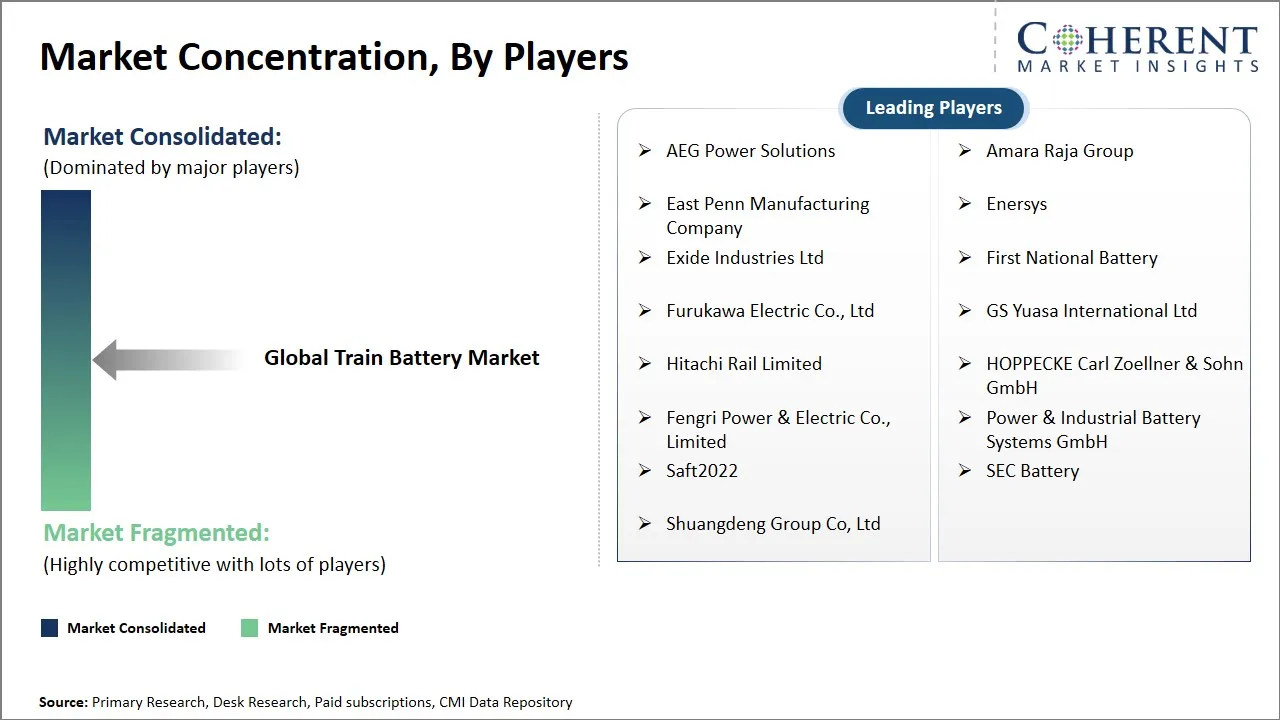
| Companies covered: | AEG Power Solutions, Amara Raja Group, East Penn Manufacturing Company, Enersys, Exide Industries Ltd, First National Battery, Furukawa Electric Co., Ltd, GS Yuasa International Ltd, Hitachi Rail Limited, HOPPECKE Carl Zoellner & Sohn GmbH, Fengri Power & Electric Co., Limited, Power & Industrial Battery Systems GmbH, Saft2022, SEC Battery, and Shuangdeng Group Co, Ltd | ||
| Growth Drivers: |
| ||
| Restraints & Challenges: |
| ||
Market Dynamics
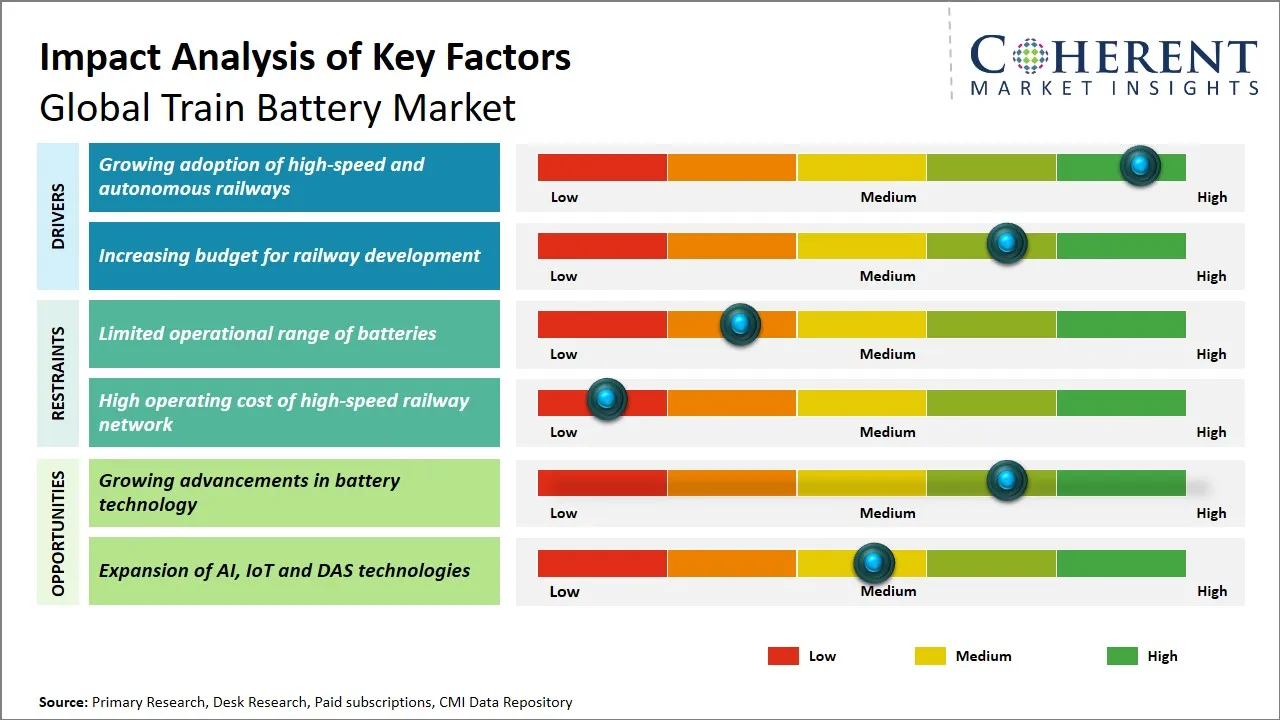
Global Train Battery Market Driver - Growing Adoption of High-Speed and Autonomous Railways
The rapid shift toward fast and self-operating trains is pushing growth in the train battery sector. Because high-speed models need steady, powerful energy sources, strong batteries are essential - particularly when speeding up, slowing down, or running internal electronics. Instead of wasting energy during stops, modern setups use regeneration methods; this helps save power while cutting expenses over time.
At the same time, driverless rail innovations depend on advanced battery units that remain dependable under constant demand from digital controls, communication networks, and emergency functions. This move toward automated systems requires power sources that store more energy and last longer, reducing how often they need servicing while boosting dependability. Because railway companies and builders are putting more into electric and self-operating solutions - driven by eco rules and traveler demand for smooth journeys - the reliance on modern train batteries grows rapidly, encouraging new developments and wider use throughout international rail infrastructure.
For instance, on July 17, 2025, CRRC Changchun introduced a high-speed maglev model capable of reaching 600 km/h. At a rail technology showcase in Beijing’s National Railway Test Centre, the front section of this experimental EDS maglev was presented. This new train uses superconducting tech for levitation. It marks another step forward in CRRC's expanding line-up of magnetic transit systems.
Global Train Battery Market Opportunity – Growing Advancements in Battery Technology
The global train battery market is seeing strong momentum due to faster progress in battery tech, opening clear growth potential. Because of breakthroughs like solid-state units, better lithium-ion models, or higher energy density, train batteries now perform more efficiently, last longer, and operate safer. As a result, trains can run farther on one charge while needing less time to recharge - key factors boosting use of electric and hybrid systems across city and long-distance routes.
On top of that, growing emphasis on eco-friendly power storage supports worldwide efforts to cut transport-related carbon output. Better battery control and heat handling improve performance across different weather and usage situations, maintaining steady operation. Smart tech in batteries allows early fault detection through continuous tracking, which cuts delays and lowers expenses for rail services. As nations push electric trains and support eco-friendly transport with funding, advanced battery demand should rise sharply. New developments help shift from diesel engines to greener options while upgrading older vehicles, opening more opportunities for battery makers and related firms in the international train power network.
For instance, on January 8, 2025, ProLogium Technology launched its fourth-generation lithium-ceramic battery (LCB) system at the CES 2025. With five transformative breakthroughs, ProLogium directly addressed key concerns including total cost of ownership, range anxiety, and safety.
Analyst Opinion (Expert Opinion)
- The train battery market is expanding steadily, supported by efforts to electrify railways, reduce emissions, and extend urban and regional lines. Because full overhead wires can be expensive or impractical, hybrid and auxiliary battery-powered trains gain favor on certain corridors. Developments in lithium-ion types - particularly LFP and LTO - are playing a key role; alongside better control electronics, they help lower running expenses. As these technologies mature, their use should grow significantly within the coming ten years.
- The market grows slowly due to steep initial costs, reliance on complex supply chains for battery components, or low energy capacity in existing technology, limiting the practicality of all-electric long-haul trains soon. Experts note better potential in city transport, short-range routes, yet also backup power roles; lasting progress will hinge on charging networks, longer product life cycles, alongside improved recycling systems and greener practices.
Speak to the analyst
Want personalized insights?
Take the findings above to one of our principal consultants, or have the report rebuilt around the segments, geographies and competitors you actually track.
Market Segmentation
- Type Insights (Revenue, USD Mn, 2021 - 2033)
- Lead Acid Battery
- Nickel Cadmium Battery
- Lithium-Ion Battery
- Technology Insights (Revenue, USD Mn, 2021 - 2033)
- Conventional Lead Acid Battery
- Valve Regulated Lead Acid Battery
- Gel Tubular Lead Acid Battery
- Sinter/PNE Ni-Cd Battery
- Pocket Plate Ni-Cd Battery
- Fiber/PNE Ni-Cd Battery
- Lithium Iron Phosphate (IFP)
- Lithium Titanate Oxide (ITO)
- Others
- Application Insights (Revenue, USD Mn, 2021 - 2033)
- Metros
- High-speed Trains
- Light Rails/Trams/Monorails
- Passenger Coaches
- Regional Insights (Revenue, USD Mn, 2021 - 2033)
- North America
- U.S.
- Canada
- Latin America
- Brazil
- Argentina
- Mexico
- Rest of Latin America
- Europe
- Germany
- U.K.
- Spain
- France
- Italy
- Russia
- Rest of Europe
- Asia Pacific
- China
- India
- Japan
- Australia
- South Korea
- ASEAN
- Rest of Asia Pacific
- Middle East
- GCC Countries
- Israel
- Rest of Middle East
- Africa
- South Africa
- North Africa
- Central Africa
- North America
- Key Players Insights
- AEG Power Solutions
- Amara Raja Group
- East Penn Manufacturing Company
- Enersys
- Exide Industries Ltd
- First National Battery
- Furukawa Electric Co., Ltd
- GS Yuasa International Ltd
- Hitachi Rail Limited
- HOPPECKE Carl Zoellner & Sohn GmbH
- Fengri Power & Electric Co., Limited
- Power & Industrial Battery Systems GmbH
- Saft2022
- SEC Battery
- Shuangdeng Group Co, Ltd
Sources
Primary Research Interviews
- Train Manufacturers and OEMs
- Battery Technology Suppliers
- Railway Operations Directors
- Rail Infrastructure Companies
Databases
- Railway Industry Association Database
- International Energy Agency (IEA) Transport Database
- Global Railway Statistics Database
- Bloomberg New Energy Finance Database
Magazines
- Railway Technology Magazine
- International Railway Journal
- Electric & Hybrid Rail Technology
- Rail Business Magazine
- Battery Industry Magazine
Journals
- Journal of Rail Transport Planning & Management
- Transportation Research Part C: Emerging Technologies
- IEEE Transactions on Transportation Electrification
Newspapers
- Financial Times
- The Wall Street Journal
- Railway Gazette International
- Transport Topics
- Energy Storage News
Associations
- International Association of Railway Companies (UIC)
- American Railway Engineering and Maintenance-of-Way Association (AREMA)
- European Rail Industry Association (UNIFE)
- Battery Council International (BCI)
- International Railway Safety Council (IRSC)
Public Domain Sources
- Government Railway Department Publications
- International Transport Forum Reports
- European Railway Agency Publications
- U.S. Department of Transportation Data
- World Bank Transport Sector Reports
Proprietary Elements
- CMI Data Analytics Tool
- Proprietary CMI Existing Repository of information for last 8 years
Get access to 250+ pages report
Every segment, forecast, competitor profile and data table behind the analysis above — available for instant download.
- ESOMAR Member
- ISO 9001:2015 Certified
- D-U-N-S Registered
- GDPR & CCPA Compliant
Missing comfort of reading report in your local language? Find your preferred language:
Transform your Strategy with Exclusive Trending Reports
Frequently Asked Questions
The global train battery market is estimated to be valued at USD 308.3 Mn in 2026 and is expected to reach USD 419.5 Mn by 2033.
The CAGR of the global train battery market is projected to be 4.5% from 2026 to 2033.
Growing adoption of high-speed and autonomous railways and increasing budget for railway development are the major factors driving the growth of the global train battery market.
Limited operational range of batteries and high operating cost of high-speed railway network are the major factors hampering the growth of the global train battery market.
In terms of type, the lead acid battery is estimated to dominate the market revenue share in 2026.
AEG Power Solutions, Amara Raja Group, East Penn Manufacturing Company, Enersys, Exide Industries Ltd, First National Battery, Furukawa Electric Co., Ltd, GS Yuasa International Ltd, Hitachi Rail Limited, HOPPECKE Carl Zoellner & Sohn GmbH, Fengri Power & Electric Co., Limited, Power & Industrial Battery Systems GmbH, Saft2022, SEC Battery, and Shuangdeng Group Co, Ltd are the major players.
Asia Pacific is expected to lead the global train battery market in 2026.