

Global Travel Bag Market Size and Forecast – 2026 To 2033
The global travel bag market is estimated to be valued at USD 21.45 Bn in 2026 and is expected to reach USD 37.96 Bn by 2033, exhibiting a compound annual growth rate (CAGR) of 8.5% from 2026 to 2033. The market growth is driven by rising international and domestic travel demand, increasing online retail penetration, and higher consumer spending on lifestyle accessories.
For instance, according to the latest data from World Tourism Barometer by the UN World Tourism Organization (UNWTO), global international tourist arrivals reached an estimated 1.3 billion in 2023, up approximately 34% from 2022 and recovering close to pre‑pandemic levels. (Source: UN Tourism)
Key Takeaways of the Global Travel Bag Market
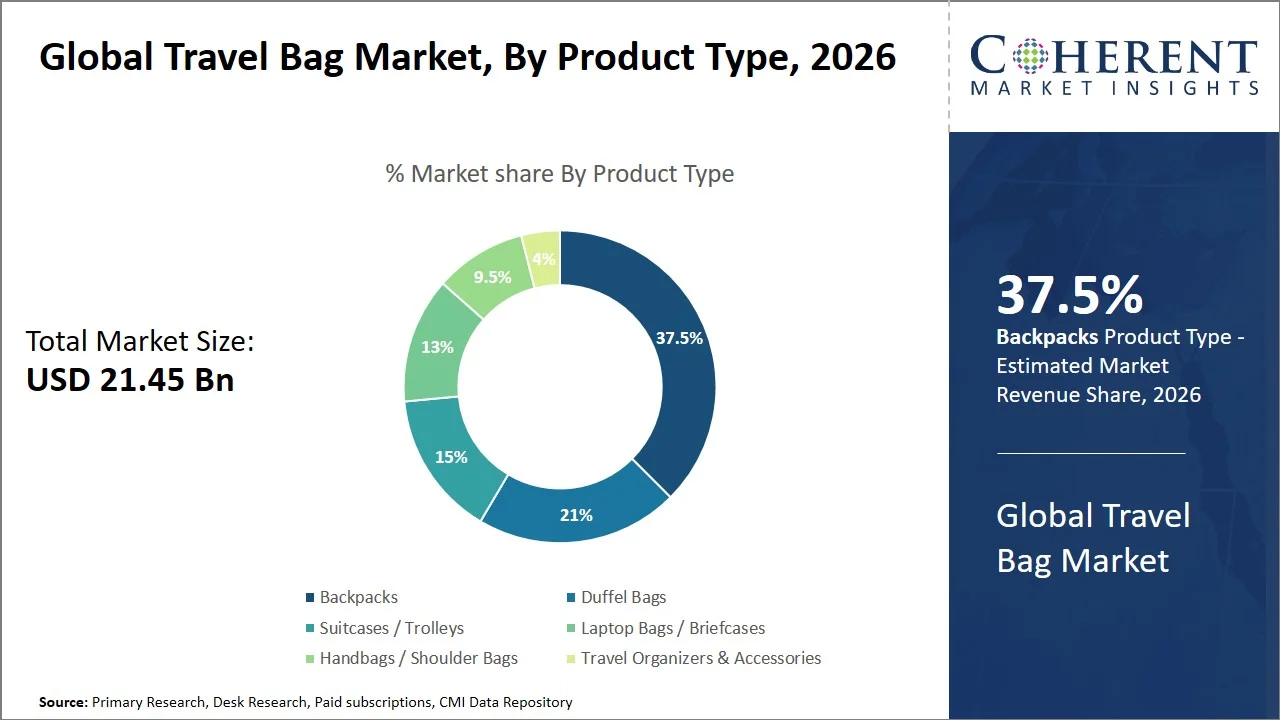
- The backpacks segment is expected to hold 37.5 % of the global travel bag market share in 2026, making it the dominant product type. Backpacks are chosen because they are comfortable to wear, allow for hands-free movement, and are suitable for leisure and business use. According to the Outdoor Industry Association in the U.S., in May 2026, more than 52 million people were engaged in outdoor recreation, creating a strong demand for versatile backpacks that can be used for travel and adventure activities.
- The leather segment is expected to hold 26.5 % of the global travel bag market share in 2026, owing to the preference of consumers for durability and premiumization trend for leather. Leather luggage remains the preferred choice for premium travelers in North America and Europe, valued for its durability, sophisticated appearance, and status appeal during extended journeys. An example of this is Tumi's leather luggage collection released in March 2026, which had high sales in the U.S. and EU stores where leather is popular among consumers. (Source: Tumi Inc.)
- The men segment is expected to hold 51.6 % share of the global travel bag market in 2026, led by growing business travel and urban commuting trends. According to the U.S. Travel Association, inbound travel spending dropped 2.4% to USD 175 billion in 2025 but will rise by 1.6% to USD 178 billion in 2026. This is still 18 percent lower (inflation adjusted) than 2019. The growth is expected to be steady and will increase in 2027 and future periods.(Source: U.S. Travel Association)
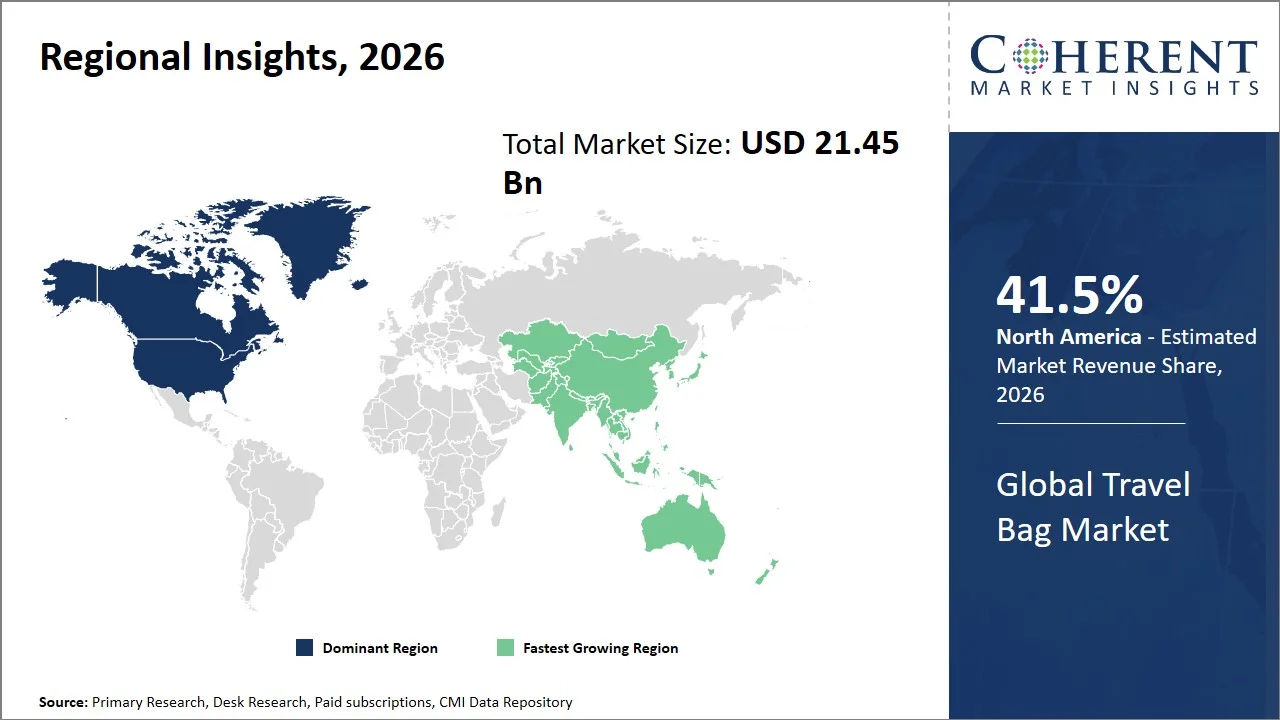
- North America dominates the global travel bag market with an estimated share of 41.5 % during 2026. High domestic travel volume, business travel, and regular short breaks are the key drivers for the region’s dominance, aided by a well-established tourist market. Examples of real-world scenarios involve an increase in airport traffic on major centers such as JFK, LAX, or Chicago O'Hare; and airline passenger volumes rising by 6% in Q1 of 2026 versus 2025. (Source: Centre for Aviation)
- Asia Pacific is projected to show the highest growth, accounting for an estimated 21.9% share of the global market in 2026, which can be attributed to the growth in tourism infrastructure, the rise in middle-class’ disposable income, and rapid urbanization. The UN projects that 55% of the Asia Pacific population will live in urban areas by 2030, and Asian Development Bank (2025) estimates that the region needs USD 1.7 trillion in infrastructure investment each year to continue the growth. (Source: PIB)
- Smart Travel & Mobility Alignment: Lightweight, durable, and tech-enabled travel bags are increasingly addressing traveler needs for convenience, security, and organized mobility across business, leisure, and weekend trips.
- Market Expansion Catalysts: Growth in domestic and international travel and tourism, rising e-commerce availability, demand for affordable fashion-oriented luggage and travel goods, and innovation in water-resistant, anti-theft, expandable, and USB-enabled bags are propelling the market expansion.
Segmental Insights
Why Do Backpacks Dominate the Travel Bag Market?
The backpacks segment is expected to hold 37.5% of the global travel bag market in 2026, primarily because of their versatility, ergonomic design, and hands-free mobility. Backpacks are versatile enough to be used by casual tourists, students, adventure travelers, and business commuters. They distribute the weight evenly, making them easy to navigate on airport ground, public transportation, and outdoors. The United Nations World Tourism Organization (UNWTO) reports that in 2025, 1.52 billion international tourists were received, among whom an increasing proportion were young people (the millennial and Gen Z generations) who like backpacked travel methods for convenience and mobility. (UN Tourism)
- Current Industry Events of 2026
- Market Size Estimation
- Regional Breakdown
- Competitive Landscape
- Customer Intelligence
- Segmental Analysis
- Pricing Analysis
- Key Market Drivers, Challenges & Future Trends
- Customized Insights Section
Why is Leather the Most Preferred Material Type for Travel Bags?
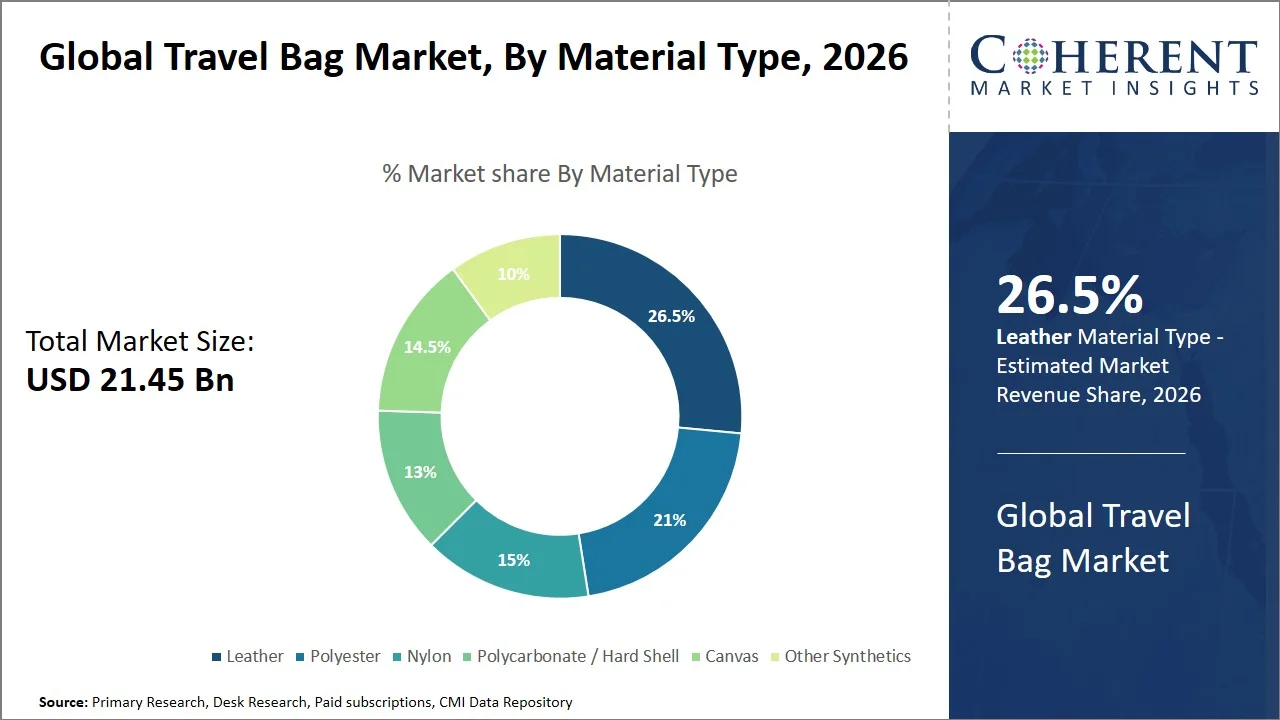
The leather segment is expected to hold 26.5% of the global travel bag market in 2026, driven by its premium appeal, durability, and timeless aesthetic. Business professionals travelers tend to opt for leather travel bags, which exude elegance, durability, and luxury. UNWTO data shows a strong recovery in business travel and luxury travel, with high-value travelers representing more than 22% of arrivals from abroad in 2025, mostly preferring leather suitcases.
Men Segment Dominates the Travel Bag Market
The men segment is expected to hold 51.6% share of the global travel bag market in 2026, mainly due to higher participation in business travel, corporate mobility, and frequent short-duration domestic and international trips. Men's travel bags have a number of design features that make them ideal for business travelers, consultants, salespeople, executives, and entrepreneurs, yet are also practical and stylish for any occasion. They are generally practical, elegant, have pockets for a lap top or papers, last, and are comfortable in the cabin.
High male workforce participation is also a growth driving factor. In October 2024, the International Labour Organization (ILO) published its Employment Conditions and Outlook Report, which indicated that the proportion of the labor force, who are men, was 73.0% of the population in 2023, while the proportion of women in the labor force was 48.7% of the population in 2023. This indicates that there were more male than female workers in total mobility for work purposes.
(Source: International Labour Organization)
Currents Events and their Impact
Current Events | Description and its Impact |
E-Commerce Expansion |
|
Government Tourism Initiatives |
|
(Source: Ministry of Tourism Government of India)
Travel Bag Market Dynamics
Market Drivers
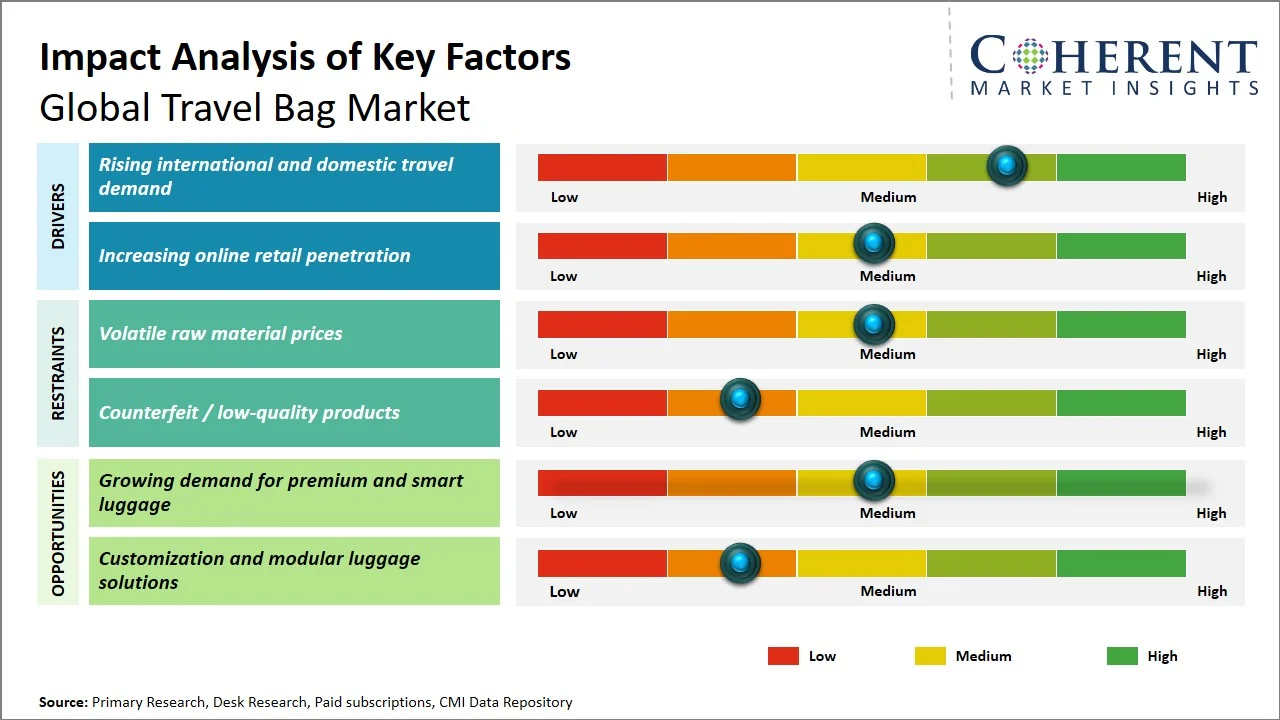
- Rising International and Domestic Travel Demand: The growth of both international and domestic travel is a huge driver for the travel bag market growth. As people are becoming more adventurous and interested in vacations and business trips, they are demanding more reliable, durable, and stylish suitcases to suit their needs. Frequent travel is facilitated by the increasing number of middle-class people and increasing accessibility of air transportation. For example, in the U.S., in 2024, 2.1 billion carry-on bags and 494 million checked bags were screened at airports, while 904 million passengers were screened, showing that there are a lot of bags being screened and transported through air travel. The number of passengers in airports in India for FY25 was 412 million and is projected to reach 665 million by FY21 which will stimulate the demand for affordable trolley bags, luggage sets, backpacks, and family travel bags. (Source: Press Information Bureau)
- Increasing online retail penetration: The penetration of online retail platforms is a major contributor to the travel bag market growth, allowing shoppers to explore an array of travel bags, negotiate prices, and make informed decisions from the comfort of their homes. Some of these features – like door-to-door delivery, easy returns, user feedback, and online discounts – have been made possible by eCommerce and have helped tourists make better and useful choices about their travel bags. UNCTAD reported that business e-commerce sales across 43 economies were approaching USD 25 trillion in 2021 and were estimated to rise 10% to almost USD 27 trillion in 2022. (Source: UNTAD)
Emerging Trends
- Premiumization and Experiential Offering: Travel bags are moving beyond the pure functional design and are being developed to deliver high quality materials, innovative compartments, and style that are premium and experiential. The combination of short production cycles and seasonal styling is making it easier for people to engage with the brand, be loyal to the brand, and have more price power, particularly among the frequent fliers and luxury minded.
- Smart Travel Bags Gain Momentum: The travel bag market is being reshaped by the shift toward smart and tech-enabled bags, with the adoption of features like GPS tracking, built-in USB charging ports, and anti-theft devices. A great deal of consumers is wanting bags that include technology to provide greater convenience, security, and connectivity while traveling.
Regional Insights
Why is North America a Strong Market for Travel Bags?
North America leads the global travel bag market, accounting for an estimated 41.5% share in 2026, due to high disposable income, high air travel volume, developed retail fabric, and high preference for travel bags among the population. The NTTO forecasts the total volume of international visitors to the U.S. will increase to 77.1 million in 2025, up 4.7 million, or 6.5%, from 72.4 million visitors in 2024, and driving a robust tour and travel sector in the region (Source: International Trade Administration ). Domestic travel is also booming, with Screened 904 million passengers, a more than 5% increase from 2023 and increase of 17% from 2022. Screened 494 million checked bags and over 2 billion carry-on items, according to the Transportation Security Administration (TSA), a figure which suggests that many folks travel frequently by plane and thus need to have a suitcase that's tough and adaptable.
Why Does the Asia Pacific Travel Bag Market Exhibit the Fastest Growth?
The Asia Pacific travel bag market is expected to exhibit the fastest growth with a contribution of 21.9% share to the global market in 2026, attributed to high disposable income, rapid urbanization, and increasing outbound tourism. In 2025, Chinese residents made about 167.92 million outbound trips (travel abroad) according to China’s official tourism statistics, representing a rise in international tourism for leisure and business trips.
Global Travel Bag Market Outlook for Key Countries
Why is the U.S. Leading Innovation and Adoption in the Travel Bag Market?
The U.S. travel bag market is substantial, driven by a diverse range of travelers, including business professionals, leisure tourists, and international visitors. Companies such as Samsonite, Tumi, and Delsey are well represented and specialize in high quality products that are long-lasting and innovative. The U.S. Travel Association's May 2026 forecast projects that total U.S. travel spending in 2026 will be USD 1.37 trillion, with USD 909 billion of that spent on domestic leisure travel. (Source: US Travel Association)
Is China a Favorable Market for Travel Bags?
The China travel bag market growth is propelled by the world’s largest population of outbound tourists and a burgeoning domestic travel segment. Brands such as VIP Industries, though Indian in origin, along with international giants like Samsonite and American Tourister, are prominent. Domestic tourism is also becoming faster due to government infrastructural projects. The government has various infrastructural projects aimed at supporting domestic tourism, which is also rapidly increasing. According to China’s Ministry of Culture and Tourism, domestic residents made 6.522 billion domestic trips in 2025, while domestic travel spending reached USD 882 billion (RMB 6.30 trillion). This indicates strong domestic tourism activity in China, supporting higher demand for travel bags and travel bag accessories.
Is India Emerging as a Key Growth Hub for the Travel Bag Market?
India remains at the forefront of being a major growth center for the travel bag industry because of its dynamic growth trends in the industry. India’s travel bag demand is supported by rapid domestic tourism growth and expanding air connectivity. In September 2025, India's PIB released a report, where it said the domestic tourist visits in the country stood at USD 36.58 million till August 2025 and that 110 projects were developed under Swadesh Darshan and Swadesh Darshan 2.0. According to another PIB note, the domestic air passenger traffic in 2024 was USD 2.75 million, and the international traffic had touched 64.5 million in the first 11 months of 2024. Examples of this are the Bodh Gaya tourism project, Bangaram, Hampi, Attari, and Sohra tourism project, which cater to pilgrimage, leisure, adventure, and family tourism, among others. (Source: Pib.gov)
Why Does Germany Top the Europe Travel Bag Market?
Travel bag demand in Germany is boosted by short breaks, domestic travel, and robust aviation recovery. The facts report from German Travel Association for 2026 reveals 72% of short breaks were taken domestically, 91.2 million short breaks were taken in 2025, and 80.5% of travel intensity was observed by DRV. It also forecasts 497.5 million overnight stays in Germany and 219.3 million air passengers at German airports in 2025, reflecting a 3.6% increase compared to 2024. This boosts the demand for travel accessories such as cabin-size bags, soft duffels, weekend bags, and organized travel accessories. The actual travel flows feature a high level of domestic short-break traffic and intense airport traffic in Frankfurt, Munich, Berlin, Düsseldorf, and Hamburg. (Source: German Travel Association)
How is the increasing demand for durable, stylish, and tech-enabled travel bags driving new growth opportunities in the travel bag market?
Increased travel requirements and consumption power are increasing the demand for smart and premium bags for travelling all around the world. Customers who value luxury are interested in high-quality materials such as polycarbonate, aluminum, and top-quality leather, with luxury products being made by luxury brand luggage. Features such as GPS tracking, biometric locks, USB charging ports, and Bluetooth connectivity cater to the needs of tech-savvy travelers, offering a more advanced means of controlling and protecting their luggage.
For example, travelers are more and more affluent, and they are seeking a higher quality luggage solution, as the World Tourism Organization (UNWTO) reported 1.52 billion international tourist arrivals in 2025 – a 4% increase from 2024. (Source: UN Tourism)
Macro-Economic and Micro Economic Factors Impacting the Travel Bag Market
Type | Factor | Indicator | Impact on Travel Bag Market |
Macro-economic Factor | Trade Policy and Tariff Uncertainty | WTO reported that tariff effects and uncertainty shaped world trade growth in 2025, including import frontloading and pricing uncertainty. | Many travel bags are globally sourced, tariff changes can affect import prices, supplier selection, inventory planning, and final consumer pricing. |
Micro-economic Factor | Increasing Baggage Fees | U.S. scheduled passenger airlines earned US$ 7.4 billion from baggage fees in 2025. | Travelers are shifting toward compact carry-on bags, expandable cabin luggage, lightweight backpacks, and under-seat bags to reduce checked baggage costs. |
Market Players, Key Development, and Competitive Intelligence
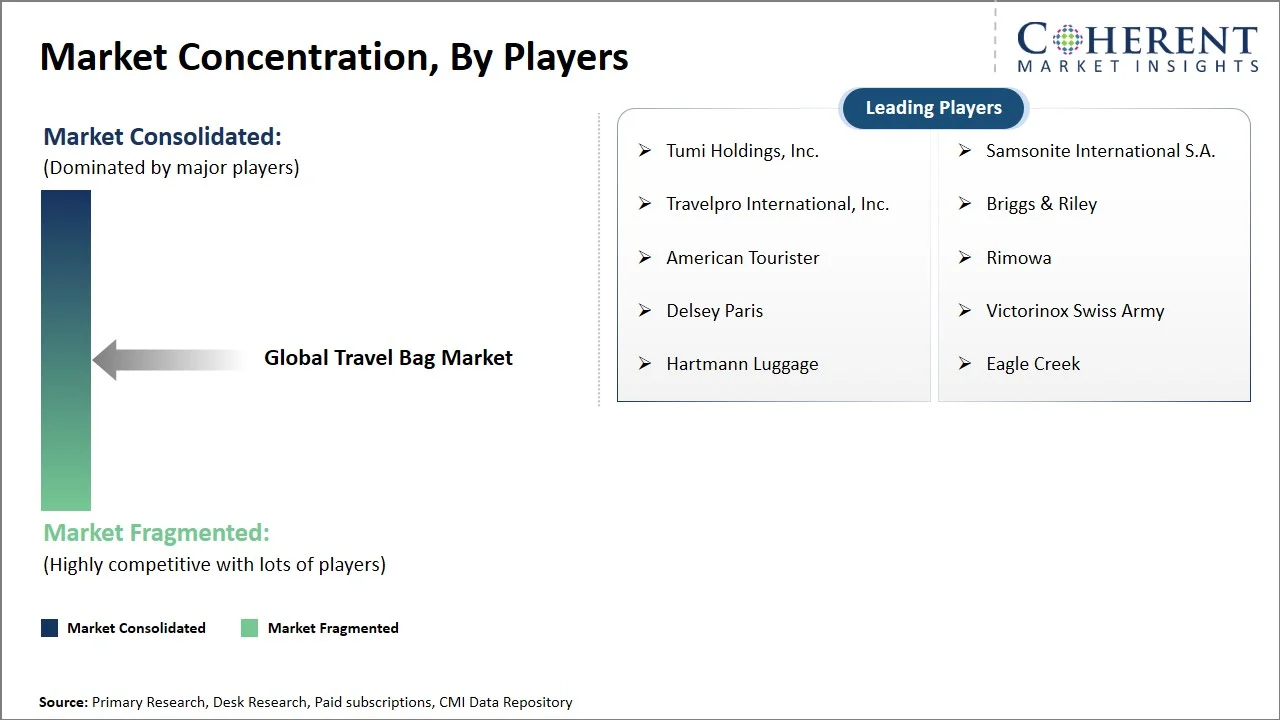
Key Developments
- In January 2026, Delsey Paris appointed VML Agency to lead its communications strategy and manage campaign production in France. This collaboration aimed to enhance brand visibility, streamline marketing efforts, and create cohesive messaging across digital and traditional channels. As a result, Delsey Paris launched several high-impact campaigns highlighting its innovative luggage designs and travel-focused features, which strengthened consumer engagement, increased social media interactions, and contributed to a noticeable uplift in brand recognition within the market.
- In November 2025, VF Corporation, a global leader in branded lifestyle apparel, footwear and accessories, announced that it had successfully closed the previously announced transaction to sell the Dickies brand to Bluestar Alliance LLC, a leading global brand management firm.
- In October 2024, EssilorLuxottica, a global leader in the optical industry, announced that it had successfully closed the transaction to acquire the Supreme brand from VF Corporation.
Competitive Landscape
The travel bag industry is highly competitive and is being fueled by the rise in traveling around the globe and growing demand for stylish and practical travel bags. Scale, brand equity, and the level of distribution are the advantages for established brands, while the smaller brands fight for market share on design differentiation, innovation, and pricing agility. Key focus areas are:
- Durable and lightweight designs
- Product diversification and smart features
- Business partners and integrating multiple channels into your strategy
- Collaborations and multichannel integration
Market Report Scope
Travel Bag Market Report Coverage
| Report Coverage | Details | ||
|---|---|---|---|
| Base Year: | 2025 | Market Size in 2026: | USD 21.45 Bn |
| Historical Data for: | 2020 To 2024 | Forecast Period: | 2026 To 2033 |
| Forecast Period 2026 to 2033 CAGR: | 8.5% | 2033 Value Projection: | USD 37.96 Bn |
| Geographies covered: |
| ||
| Segments covered: |
| ||
| Companies covered: | Tumi Holdings, Inc., Samsonite International S.A., Travelpro International, Inc., Briggs & Riley, American Tourister, Rimowa, Delsey Paris, Victorinox Swiss Army, Hartmann Luggage, and Eagle Creek | ||
| Growth Drivers: |
| ||
| Restraints & Challenges: |
| ||
Analyst Opinion (Expert Opinion)
- The travel bag market is projected to shift from being a simple replacement for luggage to a lifestyle-oriented mobility. Customers are picking bags for travel frequency, storage, lightweight, durability, security, and versatility. Compact cabin luggage, backpacks, waterproof and anti-theft fabrics, expandable designs, and sustainable materials are set to influence the future of the industry. Premiumization will expand in the urban markets, and value-for-money will continue to be significant in mass travel markets.
- India’s youthful workforce, the growth of inbound and weekend tourism, widespread availability of e-commerce, and a strong appetite for low-cost and fashionable travel products are driving the expansion of the country’s domestic and international tourism. Rather than hard suitcases, backpacks are better for short trips, students, business travelers, adventure trips, and budget travelers. This is making India one of the most appealing markets for brands that sell durable, light-weight, multi-compartment, and affordable backpacks for travel.
Speak to the analyst
Want personalized insights?
Take the findings above to one of our principal consultants, or have the report rebuilt around the segments, geographies and competitors you actually track.
Market Segmentation
- Product Type Insights (Revenue, USD Bn, 2021 - 2033)
- Backpacks
- Duffel Bags
- Suitcases / Trolleys
- Laptop Bags / Briefcases
- Handbags / Shoulder Bags
- Travel Organizers & Accessories
- Material Type Insights (Revenue, USD Bn, 2021 - 2033)
- Leather
- Polyester
- Nylon
- Polycarbonate / Hard Shell
- Canvas
- Other Synthetics
- End User Insights (Revenue, USD Bn, 2021 - 2033)
- Men
- Women
- Kids
- Distribution Channel Insights (Revenue, USD Bn, 2021 - 2033)
- Online
- Offline
- Regional Insights (Revenue, USD Bn, 2021 - 2033)
- North America
- U.S.
- Canada
- Latin America
- Brazil
- Argentina
- Mexico
- Rest of Latin America
- Europe
- Germany
- U.K.
- Spain
- France
- Italy
- Russia
- Rest of Europe
- Asia Pacific
- China
- India
- Japan
- Australia
- South Korea
- ASEAN
- Rest of Asia Pacific
- Middle East
- GCC Countries
- Israel
- Rest of Middle East
- Africa
- South Africa
- North Africa
- Central Africa
- North America
- Key Players Insights
- Tumi Holdings, Inc.
- Samsonite International S.A.
- Travelpro International, Inc.
- Briggs & Riley
- American Tourister
- Rimowa
- Delsey Paris
- Victorinox Swiss Army
- Hartmann Luggage
- Eagle Creek
Sources
Primary Research Interviews
- Travel bag manufacturer
- Product development head of a luggage, backpack, or duffel bag brand
- Supply chain director of a travel accessories producer or distributor
- Sustainability or materials officer at a bag manufacturer
- Retail buyer or category manager for luggage and travel accessories
Stakeholders
- Manufacturers of travel bags and luggage (e.g., Samsonite, VIP Industries, American Tourister, Delsey, Tumi, Titan, Safari)
- End-use sectors
- Frequent leisure travelers
- Business travelers
- Students and commuters
- Tour operators and travel agencies
- Corporate gifting and institutional buyers
- Retailers and distributors
- E-commerce platforms
- Department stores
- Specialty luggage shops
- Travel accessories retailers
- Technology and materials players
- Lightweight material innovators
- Anti-theft and smart luggage solution providers
- Recycled fabric and sustainable polymer suppliers
Databases
- UN Comtrade Database for HS codes covering travel bags, suitcases, backpacks, and similar containers
- India Import Export (EXIM) Database for luggage and travel bag trade flows
- USITC DataWeb for U.S. imports and exports of travel bags
- Eurostat trade statistics for luggage and travel goods
- Customs and shipment databases for brand-level import tracking
Magazines
- The Travel Goods Show / Travel Goods Association publications
- Luggage & Bags
- FashionUnited
- Retail TouchPoints
- SGB Media
- Apparel Resources
Journals
- Journal of Fashion Marketing and Management
- Journal of Cleaner Production
- Materials Today: Proceedings
- Textile Research Journal
- Fibers and Polymers
Newspapers
- The Wall Street Journal
- Financial Times
- Business Standard
- The Economic Times
Associations
- Travel Goods Association (TGA)
- American Luggage Dealers Association
- Consumer Brands Association
- Retailers Association of India
- National Retail Federation (NRF)
Public Domain Sources
- USITC and customs tariff schedules for luggage and travel accessories
- UN Comtrade trade summaries
- OECD consumer goods and sustainability reports
- Government consumer spending and retail sales data
Proprietary Elements
- CMI Data Analytics Tool, Proprietary CMI Existing Repository of information for last 10 years.
Get access to 250+ pages report
Every segment, forecast, competitor profile and data table behind the analysis above — available for instant download.
- ESOMAR Member
- ISO 9001:2015 Certified
- D-U-N-S Registered
- GDPR & CCPA Compliant
Missing comfort of reading report in your local language? Find your preferred language:
Transform your Strategy with Exclusive Trending Reports
Frequently Asked Questions
The global travel bag market is estimated to be valued at USD 21.45 Bn in 2026 and is expected to reach USD 37.96 Bn by 2033.
Key trends include smart luggage with GPS tracking, USB charging, RFID protection, sustainable and eco-friendly materials, and customizable travel bags.
E-commerce is the fastest-growing channel due to convenience, wider product selection, and integration of online-exclusive smart luggage features.
The CAGR of global travel bag market is projected to be 8.5% from 2026 to 2033.
Rising international and domestic travel demand and increasing online retail penetration are the major factors driving the growth of the global travel bag market.
Volatile raw material prices and counterfeit / low-quality products are the major factors hampering the growth of the global travel bag market.
In terms of product type, backpacks are estimated to dominate the market revenue share in 2026.