

Global Travel Retail Market Size and Forecast – 2026-2033
The Global Travel Retail Market is estimated to be valued at USD 76.63 Bn in 2026 and is expected to reach USD 112.22 Bn by 2033, reflecting a compound annual growth rate (CAGR) of 5.6% from 2026 to 2033.
Key Takeaways of the Travel Retail Market
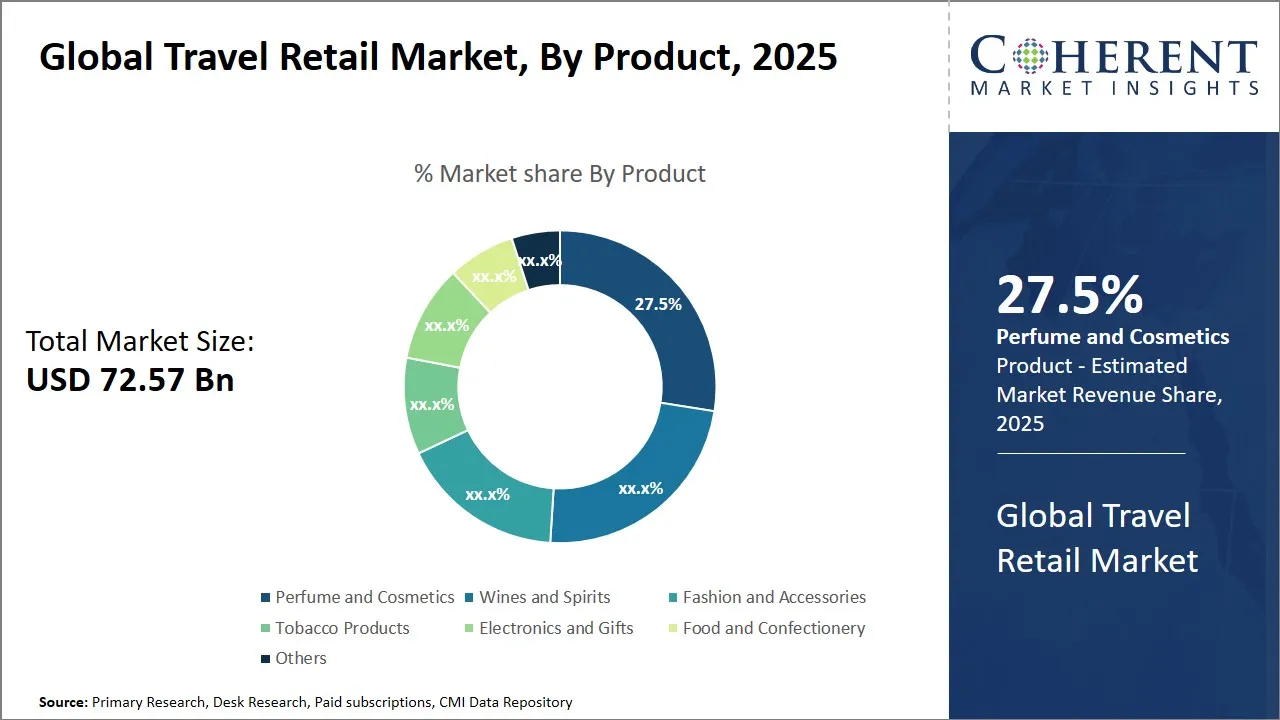
- The perfume and cosmetics segment is expected to hold 28.5 % of the global travel retail market share in 2026.
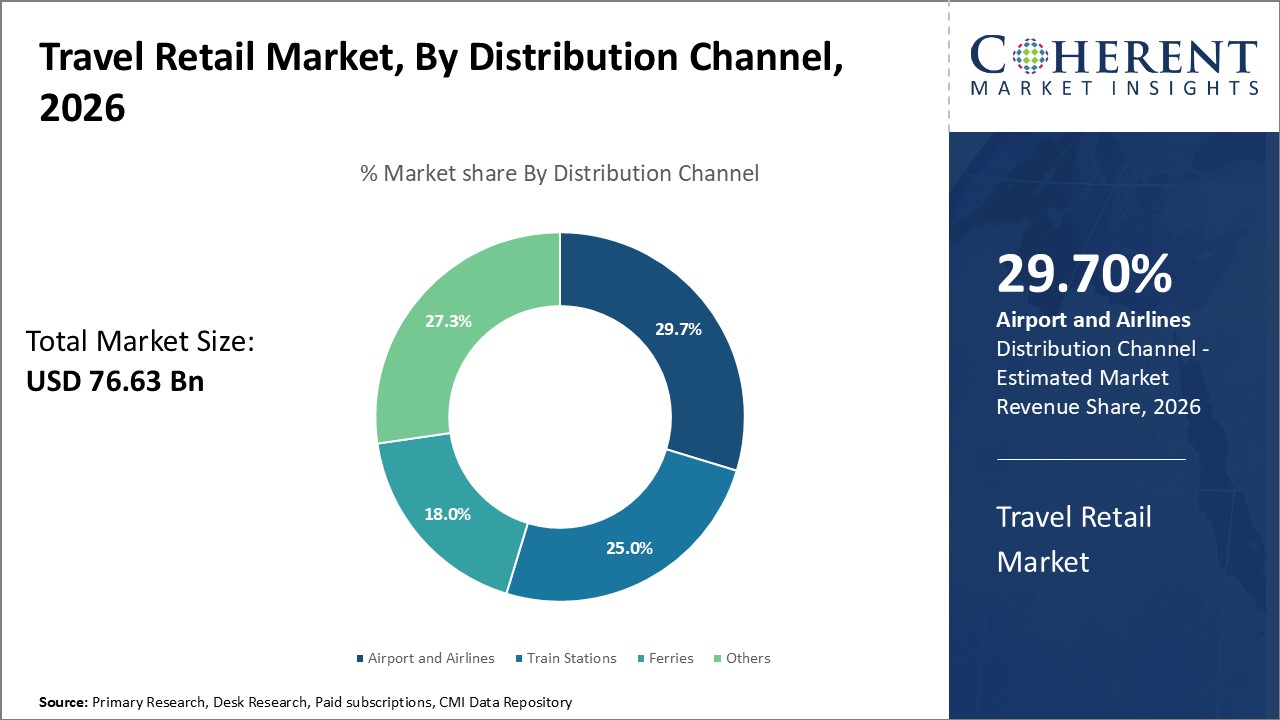
- The airport and airlines segment is estimated to hold 29.7 % of the market share in 2026.
- The leisure travelers segment is projected to hold 59.5 % of the travel retail market share in 2026.
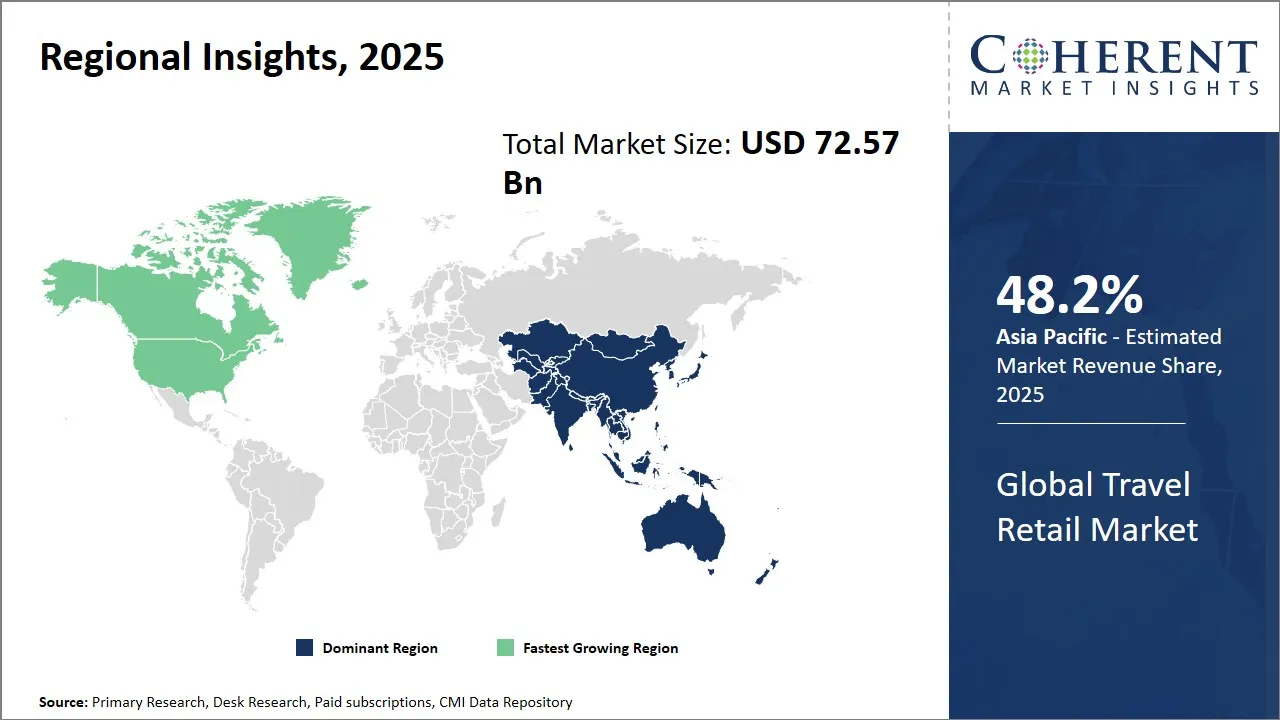
- Asia Pacific will dominate the global travel retail market in 2026 with an estimated 48.2 % share.
- North America will hold 23.3 % share in 2026 and record the fastest growth.
Market Overview
- The existing trends in the market suggest a high degree of digitization and customized customer experience in travel retail.
- Retailers are using superior technologies like AI, augmented reality, and data analytics to increase in-store experiences, improve inventory control, and offer personalized products and services.
- Sustainability is becoming a central theme, and several brands are turning to more environmentally friendly packaging and sourcing solutions to attract the audience of environmentally conscious travel and tourism. The trends are causing innovation and changing the competitive market of the global travel retail market.
Current Events and Its Impact
Current Events | Description and its impact |
Travel Retail Market Growth & Passenger Recovery |
|
Shift in Consumer Spend Patterns and Market Dynamics |
|
Segmental Insights
- Current Industry Events of 2026
- Market Size Estimation
- Regional Breakdown
- Competitive Landscape
- Customer Intelligence
- Segmental Analysis
- Pricing Analysis
- Key Market Drivers, Challenges & Future Trends
- Customized Insights Section
Why Does the Perfume and Cosmetics Dominate the Travel Retail Market in 2026?
The perfume and cosmetics segment is expected to hold 28.5% of the global travel retail market share in 2026, because of the distinct consumer behavior during the travel, in respect of luxury and personal indulgence. Luxury Travelers tend to view their travelling as a chance to buy luxury beauty products that are not readily available in their respective markets or more costly. This is supported by the fact that the travel retails have the capability of providing a wide variety of limited-edition perfumes, foreign cosmetic brands and exclusive beauty kits that directly address the requirements of the on-the-go traveler.
Besides, the increase in international travel and the disposable incomes of the emerging markets have resulted to a greater demand in premium beauty products by the middle-income travelers. The fact that it is possible to buy goods in duty-free zones, and the sales staff knows how to provide customers with individual experiences contribute to the satisfaction and the desire to spend more money in this segment. The perfume and cosmetics products also attract a wide range of consumers such as those who buy gifts and those who travel who focus on ensuring that they look good in their journey.
For example, The Estée Lauder Companies Inc. scaled men’s grooming and premium skincare activations in duty-free zones, using trained beauty advisors and quick skin diagnostics to convert time-constrained travelers. This directly validates how personalization, exclusivity, and gifting relevance sustain the segment’s dominance.
Why are Airport and Airlines Leading the Global Travel Retail Market?
The airport and airlines segment is projected to account for 29.7% of the travel retail market share in 2026, due to the fact that airports are the main hubs of international and local travelling customers with a long stay duration to promote consumption. Airports provide a good level of foot traffic and a captive audience, which makes the sales of travel retail opportunities. The contemporary airport has ceased being an exchange point and it has become a lifestyle destination with elaborate retail areas which are modelled to promote window shopping and buying. Customers usually have to wait in line and airport check-in, and this aspect gives them more reasons to engage in duty-free shopping more when the products are well displayed.
Another relevant contribution is made by airlines who incorporate retail services onboard by offering in-flight catalogs and online shopping, which are those services that aim at attracting passengers, who would then be interested to make purchases without the need of carrying their goods across the trip. There has been increased collaboration between airlines and travel retail providers, with offers and exclusives offered based on the duration of the flight, destination, and profile of the passengers. High levels of international passengers who require various product offerings and tax concessions that are not available in other sector strengthen the specific strength of this channel in travel retailing.
Leisure Travelers dominates the Travel Retail Market
Leisure travelers segment is expected to hold 59.5% of the market share in 2026, as the travel experiences of these travelers are often linked with things such as exploration, rest, and decadence. In contrast to business travelers, leisure travelers can usually afford more disposable income to shop on their own behalf and to give gifts, thus creating a lucrative ground on which travel retail can be developed. The desire to find unusual and natural goods that reflect the essence of the places they visit frequently pushes them to pay more on their travel exclusive products such as luxury cosmetics, fine food, and presents with the spirit of the places they visit such as gifts with cultural meanings.
Psychological dimension of leisure traveling is very vital in influencing expenditure behavior. Holidays and vacations are perceived as the time to indulge oneself and buy trinkets that serve as a reminder of the experience and therefore, leisure travelers are more open to buying on impulse and high-quality products. This opportunity is exploited by the retailers who offer immersive shopping experiences and display the local products that delight the emotional aspect of travel. Promotional activities like exclusive offers, product-testing and pre-made gift collections are also more likely to receive leisure travelers, which further stimulates their purchasing behavior.
Regional Insights
Asia Pacific Travel Retail Market Analysis and Trends
The Asia Pacific region is projected to lead the market with a 48.2% share in 2026. This leadership is driven by the ever-growing travel infrastructure, the growing international tourism and the growing middle classes whose disposable incomes are increasing. Retail space at the main hubs such as China, Japan, South Korea, and Singapore have also been intensively developed in the form of state-of-the-art facilities that make the shopping experience more fulfilling.
The market ecosystem is further triggered by government programs that encourage tourism, lax custom and tax policies at major tourist destinations. Some of the major retailers that have capitalized on this situation include Lotte Duty Free (South Korea), Shilla Duty Free (South Korea), and China Duty Free Group, which have developed huge retail chains that sell luxury items, cosmetics, as well as electronic to foreign travelers. Further, collaborating with international brands can help such companies to stay competitive attracting high-end travelers in the regional and international market.
North America Travel Retail Market Analysis and Trends
The North America region is expected to exhibit the fastest growth in the market contributing 23.3% share in 2026, as a result of enormous passenger traffic in leading airports, including John F. Kennedy International, Los Angeles International, and Toronto Pearson International. The area enjoys a mature retail sector and a varied consumer market that consists of wealthy travelers in search of high-end and luxury goods. The shopping experience is still getting more enhanced through the continuous investment in the shopping space in the airports particularly with the growth of the terminals and modernization activities.
The attractiveness of favorable taxation systems and effective customs control, especially in American airports, can also contribute to an increase in the popularity of both the international and domestic brands. Firms such as Hudson Group and Dufry are major players in the region, and they are leading in terms of innovations in the digital retail and omnichannel to meet the changing demands of the travelers. Additionally, the high tourism and outbound travel trends in North Americas will lead to a high demand in the duty-free products, which will make the regions a leader in the global travel retail market.
Global Travel Retail Market Outlook for Key Countries
Is China Redefining the Global Growth Trajectory of the Travel Retail Market?
The travel retail market in China is flourishing on its huge outbound tourism market and the growing domestic transit hubs. Due to increased connectivity due to government support of tourism infrastructure and other projects like the Belt and Road Initiative, airports such as Beijing Capital and Shanghai Pudong are now retail hotspots.
The major stakeholders like the China Duty Free Group take advantage of close brand affiliations in the country and the global luxury brand associations to provide services to the affluent Chinese shoppers. Digital payment innovations and customized shopping experiences also provide added impetus to the dynamism of the markets, which makes China a key growth driver in the Asia Pacific.
South Korea Travel Retail Market Trends
South Korea remains a leader in the Asia Pacific travel retail market, and the airport retail infrastructure is well developed, and the consumers of these products are highly inclined towards luxury and cosmetics products in the travel industry. Seoul Incheon International Airport is an important retail arena such that the presence of players such as Lotte Duty Free and Shilla Duty Free dominates the market by offering a wide array of products and marketing them aggressively to the Chinese and regional travelers. The policies by the government in favor of tourism and innovation in retailing and increasing consumer attractiveness is contributed by the fact that the country is known to be beautiful and fashionable.
U.A.E. Travel Retail Market Trends
U.A.E., especially Dubai is a key player in the Middle East travel retail market. The markets dynamics are greatly influenced by the high level of customer engagement through the wide retail network of Dubai Duty Frees as well as exclusive products launch and loyalty programs. High international flow of passengers is experienced due to government investment in the world-class airport infrastructure and tourism events. Tax-free shopping atmosphere and emphasis on experience-based retail formats makes U.A.E. a leader in the travel retail industry of the regions.
U.K. Travel Retail Market Trends
U.K. is still a major player in the European travel retail sector and the two major retail centers are London Heathrow and Gatwick International airports. The U.K. market enjoys good brand placement, high level on consumer tastes and established retailing environment which incorporates companies like Dufry and World Duty Free Group. The U.K. has a competitive travel retailing environment despite the increasing regulatory complexity since the Brexit vote through sustained investments in retail innovation, sustainability efforts, and partnerships with high-end and luxury brands.
Is Brazil the Next Growth Engine for the Travel Retail Market?
Brazil is a hot spot in the development of travel retail in Latin America due to the growing tourism and modernization of retailing facilities at airports in the cities, such as Sao Paulo and Rio de Janeiro. The emphasis of the governments on the development of traveling infrastructure and softening import restrictions promotes market growth.
The most important actors are the Grupo Fernao de Magalhaes and Dufry that have increased the retail presence in the region through the provision of a diverse range of products targeting both the local and international traveler. The changing environment is a result of an increasing interest in luxury goods and growth in middle-class travel.
AI Store Automation Adoption
Checkout-free tech using AI, computer vision, and RFID sees North America at 38% global share in airports, targeting duty-free for impulse buys. Adoption rises for frictionless experiences, cutting wait times and costs amid disruptions. Rates grow via predictive analytics and smart shelves, enhancing personalization in high-traffic zones.
Flight Disruption Impact
Delays and cancellations, like November 2025's 43,987 global flights (up 40% from October), drive economic losses including reduced retail spending from stranded passengers. Costs hit USD 75 Bn-USD 88 Bn annually across regions, with passenger time losses (e.g., 650M hours) and spillover to hospitality/retail at 16-37% of totals. No standardized "Real-time Flight Disruption Impact Index" exists publicly, but it would quantify delays/cancellations against sales drops, using metrics like USD 285-580M daily U.S. impacts from reductions.
What is the role of CTG Duty Free Group in the travel retail market?
- Product Offering & Customer Base: CTG Duty Free Group operates in a market segment that caters to travelers, offering tax-free shopping advantages. They provide a variety of high-demand products, often leveraging partnerships with well-known brands to attract both leisure and business travelers. This segment benefits from a constant influx of international consumers.
- Market Penetration: With a wide geographical footprint in airports and travel hubs across the globe, CTG Duty Free Group expands its reach to a diverse range of travelers, particularly those in the international travel segment. This increases their market share in the global travel retail industry.
- Competitive Advantage: By offering products that are duty-free, they provide an economic incentive for consumers, especially in regions with high taxes on luxury goods. This is a major driver for the growth of the travel retail market, contributing significantly to the global demand for duty-free shopping.
Market Players, Key Development, and Competitive Intelligence
Key Developments
- In March 2024, Lagardère Travel Retail unveiled an exclusive partnership with RaiseLab, a trailblazing firm focused on promoting open innovation. This strategic alliance underscores Lagardère Travel Retail's commitment to becoming a leader in innovation within the travel retail sector, aiming to expedite the deployment of cutting-edge solutions.
- In July 2023, Micro Mobility Systems AG, the global leader in premium mobility solutions, partnered with Dufry, a prominent player in the global travel industry. This partnership aimed to redefine the travel retail experience by integrating Micro's innovative product and solution offerings with Dufry's wide global outreach and expertise.
Top Strategies Followed by Global Travel Retail Market Players
Player Type | Strategic Focus | Example |
Established Market Leaders | Heavy investment in R&D and innovation | As a market leader, Estee Lauder invests constantly in R&D, to provide the high-end cosmetics and skincare products as offered in the travel retail market. Their appropriateness in the market such as portable skincare packages and their exclusive duty-free deals have continued to ensure they remain at the top of the premium market. |
Mid-Level Players | Cost-effective solutions with balanced quality | Shiseido travel retail approaches with value-based products, a high-quality of skincare and make up at lower prices than other premium players. The travel-size skincare sets and everyday cosmetic essentials are the products in their product lines that attract travelers who would like to have dependable products at an affordable price. |
Small-Scale Players | Niche specialization & innovative variants | Triton Innovations specializes in the travel-friendly and innovative, smart packaging solutions, including luggage that can track your location with the help of GPS and built-in chargers. Their dynamism in embracing new technology fast makes them to be visible in the middle of a competitive market. |
Market Report Scope
Travel Retail Market Report Coverage
| Report Coverage | Details | ||
|---|---|---|---|
| Base Year: | 2025 | Market Size in 2026: | USD 76.63 Bn |
| Historical Data for: | 2020 To 2024 | Forecast Period: | 2026 To 2033 |
| Forecast Period 2026 to 2033 CAGR: | 5.6% | 2033 Value Projection: | USD 112.22 Bn |
| Geographies covered: |
| ||
| Segments covered: |
| ||
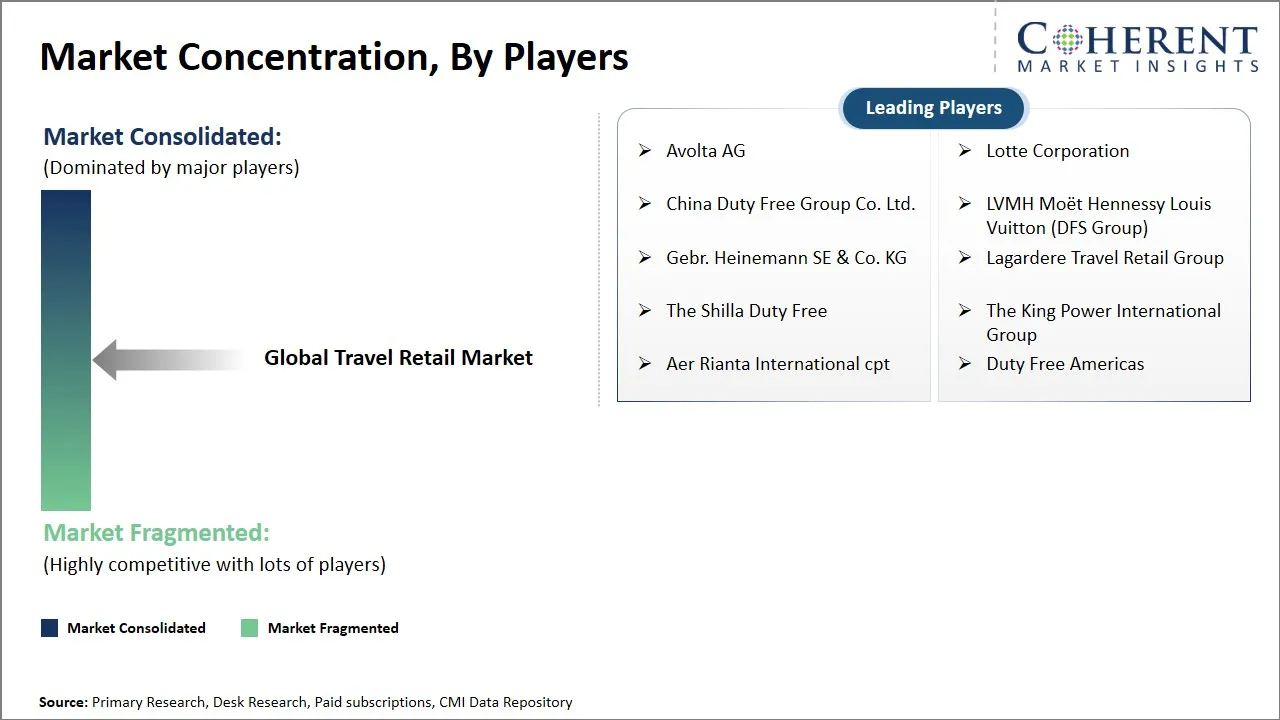
| Companies covered: | Avolta AG, Lotte Corporation, China Duty Free Group Co. Ltd., LVMH Moët Hennessy Louis Vuitton (DFS Group), Gebr. Heinemann SE & Co. KG, Lagardere Travel Retail Group, The Shilla Duty Free, The King Power International Group, Aer Rianta International cpt, and Duty Free Americas | ||
| Growth Drivers: |
| ||
| Restraints & Challenges: |
| ||
Travel Retail Market Dynamics
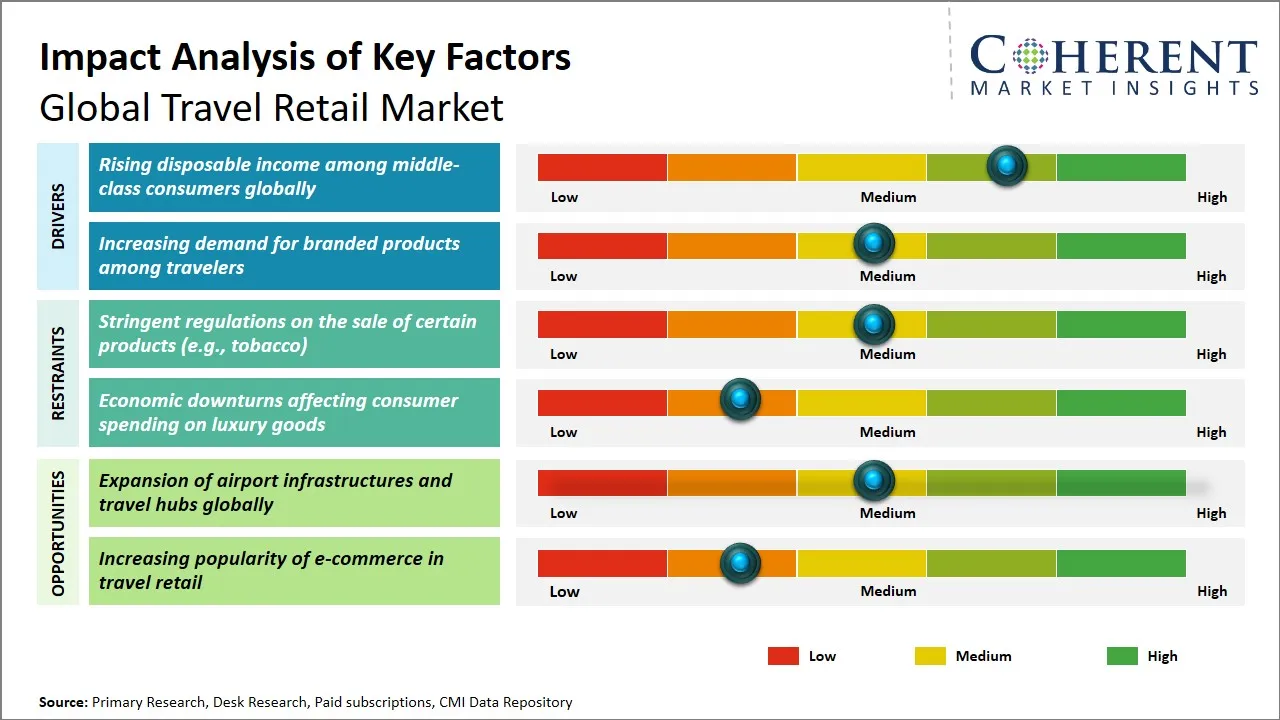
Travel Retail Market Driver - Rising Disposable Income Among Middle-Class Consumers Globally
The growing disposable income of the growing number of the middle-class population in both emerging and developed economies contributes greatly to the world travel retail market. With the increasing number of people with high purchasing power, their capacity to spend on premium and luxury products in the process of traveling increases significantly.
This increased financial ability stimulates the consumer to purchase non-essential items, such as cosmetics, fashion tech accessories, electronics and gourmet food items promoted within airports, duty- free stores and other travel retail stores. Moreover, the middle-class consumers are getting aspirational, demanding distinctive shopping experiences and exclusive products, which are not always available in the travel retail setting.
For example, Major international airports such as Dubai International, Singapore Changi, and Istanbul Airport have significantly expanded luxury retail zones after observing higher per-passenger spend from middle-income travelers upgrading to premium cosmetics, fragrances, and electronics during international trips. The growth is not tourist-elite led; it is volume-driven by salaried professionals and frequent flyers.
Travel Retail Market Opportunity - Expansion of Airport Infrastructures and Travel Hubs Globally
The travel retail market is about to see tremendous growth due to the current expansion and modernization of infrastructures and travel hubs across the world. As the number of passenger vehicles traveling to and from destinations and the level of international tourism grows, the airports are turning into full lifestyle destinations.
This change provides a tremendous potential to the travel retail business to tap into bigger and more varied consumer groups in terminals. New investments into modern terminals, increased connectivity and building new airports in emerging markets are providing more retail areas and an increase in footfall which is allowing brands to access more and more high-income, time-sensitive travelers.
An example here is that, such infrastructure development is especially essential in new markets, including the Middle East, Southeast Asia, and Latin America, whereby airports are becoming a significant travel retail destination. Consequently, brands will be able to access more and more travelers that will be looking to purchase a broader assortment of higher-quality and luxury products.
Analyst Opinion (Expert Opinion)
- The travel retail market is evolving from traditional duty-free models to a data-driven, experience-focused sector. Events like the TFWA World Exhibition & Conference in Cannes and TFWA Asia Pacific in Singapore play a pivotal role in shaping strategies, with a focus on Gen Z and millennial travelers.
- Conferences such as MEADFA in Dubai highlight the Middle East’s role in omni-channel growth and duty-free expansion. Moving forward, success will depend on leveraging real-time analytics, predictive personalization, and integrating pre-order and app-based fulfilment, as traditional retail risks being overtaken by digital-native platforms.
- Regional forums such as MEADFA in Dubai reinforce Middle East hub dynamics where duty‑free expansions and omni‑channel integration are aggressively pursued.
- The market’s future will not be defined by sheer passenger volumes alone but by how operators leverage real‑time analytics to predict purchase intent, integrate pre‑order and app‑based fulfilment, and curate limited‑edition travel exclusives.
Speak to the analyst
Want personalized insights?
Take the findings above to one of our principal consultants, or have the report rebuilt around the segments, geographies and competitors you actually track.
Market Segmentation
- Product Insights (Revenue, USD Bn, 2021 - 2033)
- Perfume and Cosmetics
- Wines and Spirits
- Fashion and Accessories
- Tobacco Products
- Electronics and Gifts
- Food and Confectionery
- Others
- Distribution Channel Insights (Revenue, USD Bn, 2021 - 2033)
- Airport and Airlines
- Train Stations
- Ferries
- Others
- Consumer Demographics Insights (Revenue, USD Bn, 2021 - 2033)
- Leisure Travelers
- Business Travelers
- Regional Insights (Revenue, USD Bn, 2021 - 2033)
- North America
- U.S.
- Canada
- Latin America
- Brazil
- Argentina
- Mexico
- Rest of Latin America
- Europe
- Germany
- U.K.
- Spain
- France
- Italy
- Russia
- Rest of Europe
- Asia Pacific
- China
- India
- Japan
- Australia
- South Korea
- ASEAN
- Rest of Asia Pacific
- Middle East
- GCC Countries
- Israel
- Rest of Middle East
- Africa
- South Africa
- North Africa
- Central Africa
- North America
- Key Players Insights
- Avolta AG
- Lotte Corporation
- China Duty Free Group Co. Ltd.
- LVMH Moët Hennessy Louis Vuitton (DFS Group)
- Heinemann SE & Co. KG
- Lagardere Travel Retail Group
- The Shilla Duty Free
- The King Power International Group
- Aer Rianta International cpt
- Duty Free Americas
Sources
Primary Research Interviews
- CEO – Leading Travel Retail Operator (e.g., Dufry or Lagardère Travel Retail equivalent)
- Supply Chain Director – Major Duty-Free Distributor
- Retail Operations Lead – Airport Retail Concessionaire
- Sustainability Officer – Travel Retail Industry Certification Body
Stakeholders
- Operators
- End-use Sectors
- Perfumes & Cosmetics Retailers
- Fashion & Luxury Goods Providers
- Alcoholic Beverages & Tobacco Distributors
- Food & Confectionery Vendors
- Regulatory & Certification Bodies (e.g., IATA for aviation retail, EU customs for duty-free)
- E-commerce Platforms and Retailers (DFS Group, Alibaba Duty-Free, Amazon Travel Exclusives)
- Technology Integration Players: Digital retail and experiential store innovators in airports
Databases
- UN Comtrade Database
- India Import Export (EXIM) Database
- Eurostat Trade Statistics (Comext for services and goods)
- USITC DataWeb (Travel Retail Imports/Exports)
- IATA Economic Reports (Passenger Traffic and Retail Spend)
Magazines
- Global Travel Retail Magazine – Trends in duty-free innovations
- TRBusiness Magazine – Airport retail and operator strategies
- Travel Markets Insider – Americas duty-free market dynamics
- Moodie Aviation Group Publications – Global travel retail analysis
Journals
- Journal of Travel Research – Consumer behavior in travel retail
- Tourism Management – Duty-free shopping trends
- International Journal of Retail & Distribution Management – Airport retail models
Newspapers
- The Wall Street Journal – Global luxury travel retail demand
- Financial Times – Airport retail recovery post-pandemic
- Business Standard (India) – Asia Pacific travel retail growth
- Reuters – Duty-free market volatility and expansions
Associations
- Duty Free World Council (DFWC)
- Asia Pacific Travel Retail Association (APTRA)
- European Travel Retail Confederation (ETRC)
- Tax Free World Association (TFWA)
- International Association of Airport Duty Free Stores (IAADFS)
- Middle East & Africa Duty Free Association (MEADFA)
Public Domain Sources
- IATA – Airport retail guidelines and passenger data
- European Commission – EU duty-free and VAT regulations
- World Tourism Organization (UNWTO) – Travel retail expenditure stats
- OECD – Tourism services trade reports
- ICAO – Aviation retail standards
Proprietary Elements
- CMI Data Analytics Tool, Proprietary CMI Existing Repository of information for last 8 years.
Get access to 250+ pages report
Every segment, forecast, competitor profile and data table behind the analysis above — available for instant download.
- ESOMAR Member
- ISO 9001:2015 Certified
- D-U-N-S Registered
- GDPR & CCPA Compliant
Missing comfort of reading report in your local language? Find your preferred language:
Transform your Strategy with Exclusive Trending Reports
Frequently Asked Questions
The global travel retail market is estimated to be valued at USD 76.63 Bn in 2026 and is expected to reach USD 112.22 Bn by 2033.
The CAGR of global travel retail market is projected to be 5.6% from 2026 to 2033.
Travel shoppers are impulse‑driven, time‑constrained, and value premium/luxury deals, exclusivity, and convenience.
Yes, due to premium pricing, high footfall, and luxury demand, but margin pressure exists from rent and competitive concessions.
Rising disposable income among middle-class consumers globally and increasing demand for branded products among travelers are the major factors driving the growth of the global travel retail market.
Stringent regulations on the sale of certain products (e.g., tobacco) and economic downturns affecting consumer spending on luxury goods are the major factors hampering the growth of the global travel retail market.
In terms of product, the perfume and cosmetics segment is estimated to dominate the market revenue share in 2026.