

Wallpaper Market Size and Trends
Global wallpaper market is estimated to be valued at USD 48.88 Bn in 2026 and is expected to reach USD 68.33 Bn by 2033, exhibiting a compound annual growth rate (CAGR) of 4.9% from 2026 to 2033.
Key Takeaways
- Based on Product Type, the Vinyl Wallpaper is expected to lead the market holing an estimated share of 40.1% in 2026, owing to its convenience and durability
- Based on Application, Residential segment is projected to lead the market with a share of 60.2% in 2026, allowing homeowners to have unique decorative design.
- Based on Distribution Channel, DIY stores segment is expected to lead the market with a 46.2% share in the market in 2026, owing to its convenience of one-stop shopping.
- Based on Region, North America is expected to lead the market, holding a share of 31. 2% in 2026, due to larges construction industry. While, Asia Pacific is anticipated to be the fastest-growing region during the forecast period due to presence of key manufacturers.
Market Overview
The global wallpaper market is proven to have significant growth, driven by the rising demand for aesthetically pleasing interior solutions across residential, commercial and hospital environment. The market has witnessed steady growth over the past few years, due to growing real estate and construction industries. there is a constant shift in urbanization and lifestyle changes which contribute in evolving consumer preference for personalization and sustainable living spaces.
Current Events and their Impact on the Wallpaper Market
Current Events | Description and its Impact |
Changing consumer preferences and interior design trends |
|
Government regulations and environmental policies |
|
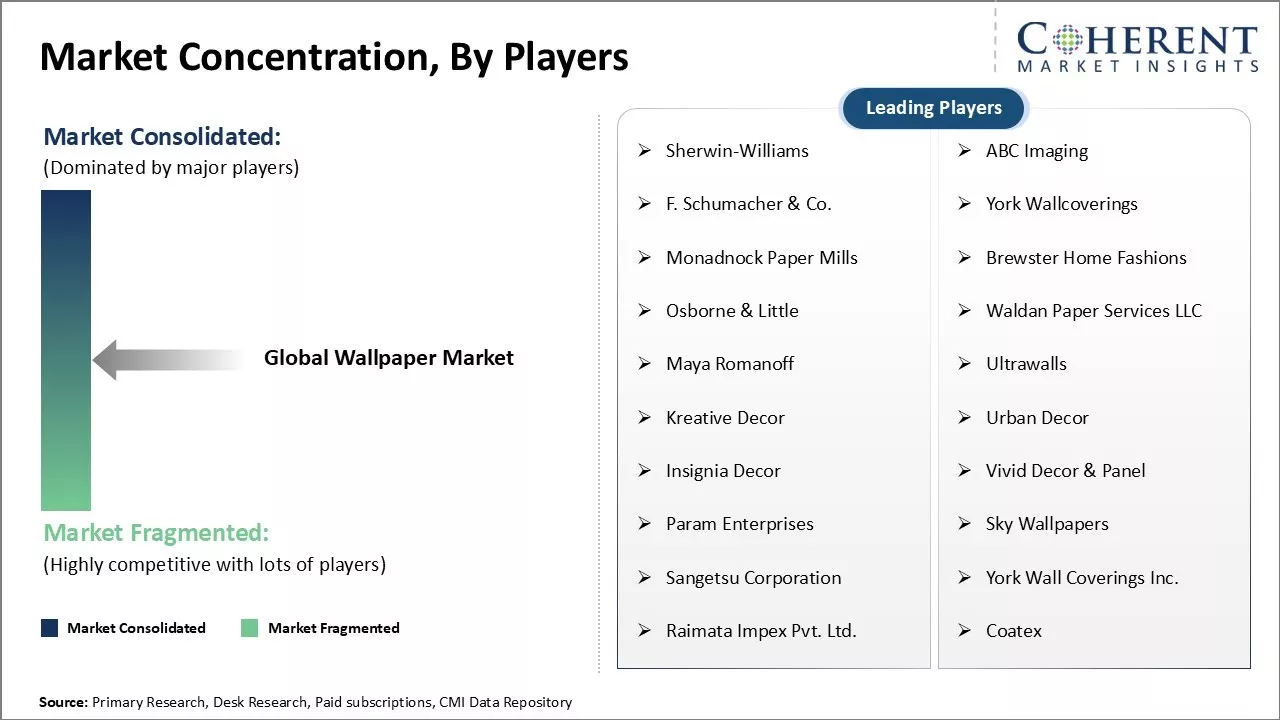
Wallpaper Market Concentration and Competitive Landscape
- Current Industry Events of 2026
- Market Size Estimation
- Regional Breakdown
- Competitive Landscape
- Customer Intelligence
- Segmental Analysis
- Pricing Analysis
- Key Market Drivers, Challenges & Future Trends
- Customized Insights Section
Segmental Analysis
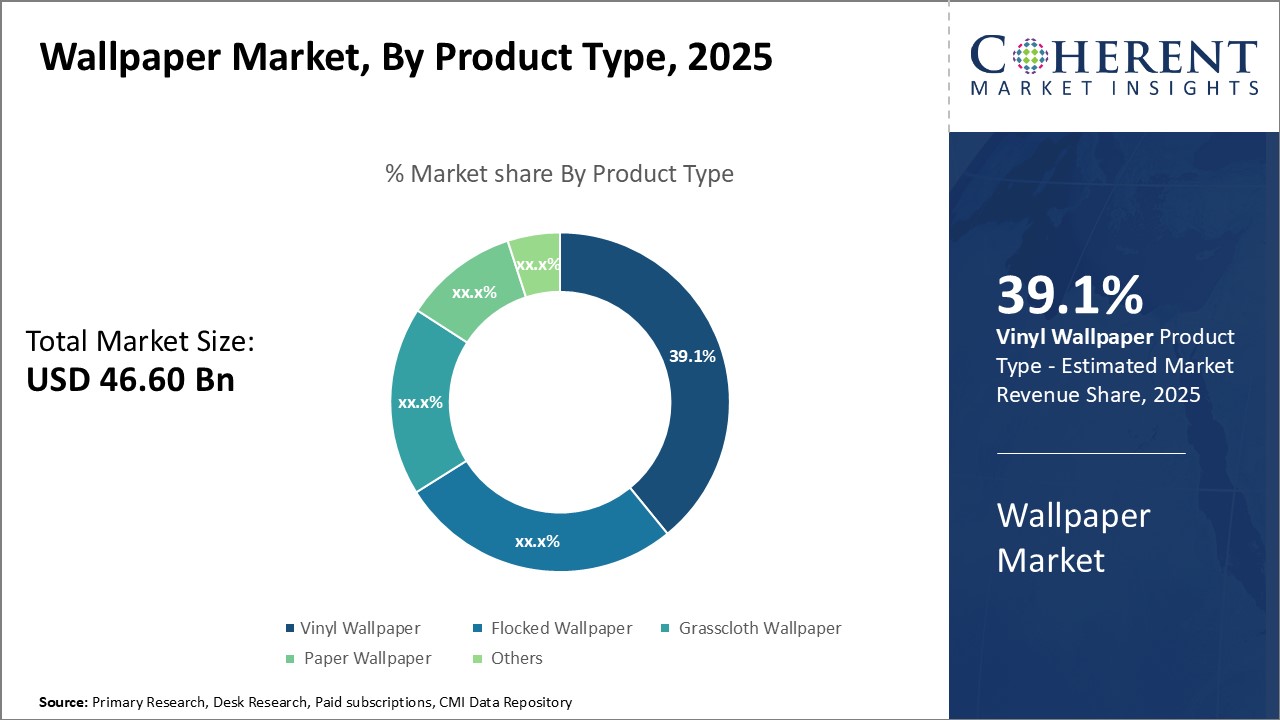
Wallpaper Market Insights, By Product Type: Vinyl Wallpaper Acquires the Largest Share Owing to its Convenience and Durability
In terms of product type, vinyl wallpaper segment is estimated to contribute the highest market share of 40.1% in 2026, owing to its convenient application and durable nature. Vinyl wallpaper is much easier to hang on walls in comparison to other traditional paper and fabric-based wallpapers, as it does not require paste and can be easily put up using a steam roller. Its watertight plastic coating also makes it highly resistant to moisture damage like wrinkling or peeling even in bathrooms. This ensures vinyl wallpaper retains its quality for many years with minimal maintenance requirements. The faux finishes and textures in vinyl wallpaper open up creative design possibilities for consumers looking for low-cost transformations. Its cost-effectiveness and ease of replacement has helped vinyl wallpaper gain widespread popularity among both household and commercial users.
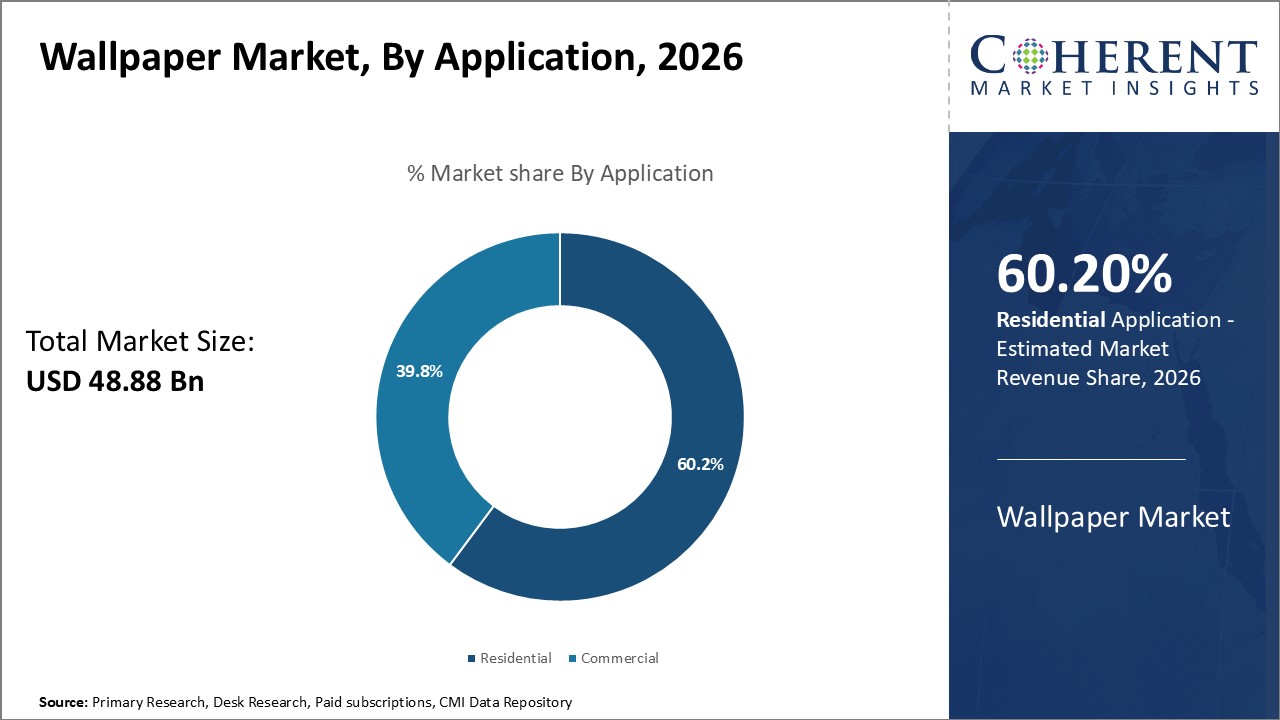
Wallpaper Market Insights, By Application: Residential Segment Dominates the Overall Market
In terms of application, residential segment is estimated to contribute the highest market share of 60.2% in 2026, as wallpaper allows homeowners to uniquely decorate their private living spaces. Wallpaper plays a significant role in establishing the aesthetic style and personality of a house. Homeowners associate wallpaper with creativity and self-expression, using innovative designs and motifs to reflect their individual tastes. The variety of patterns and textures in current wallpaper collections further inspires residential users to experiment with bold statements on walls. In contrast, commercial applications have rigid norms of professional decoration. Thus, residential segment dominates as wallpaper satisfies people's desire to customize their private dwellings.
Wallpaper Market Insights, By Distribution Channel: DIY stores Acquires the largest share owing to its Convenience
In terms of distribution channel, DIY stores segment is estimated to contribute the highest market share of 46.2% in 2026, owing to convenience of one-stop shopping. DIY stores stock an extensive assortment of wallpaper options from different brands under one roof. Customers can find inspirations by viewing samples on display and receive expert advice from well-informed staff. For instance, homeowners spent an average of 37 hours on DIY home improvement projects during the fourth quarter of 2024. These also offer value-added services like custom cutting and pre-pasting of wallpaper. This saves residential and commercial buyers time by eliminating the need to visit individual retailers or rely on online purchases. DIY stores have emerged as a preferred shopping experience for both novice and professional installers. Their accessibility on the high street along with discounted offers and loyalty programs further attracts a regular customer base, driving the highest sales through this distribution medium.
Regional Insights
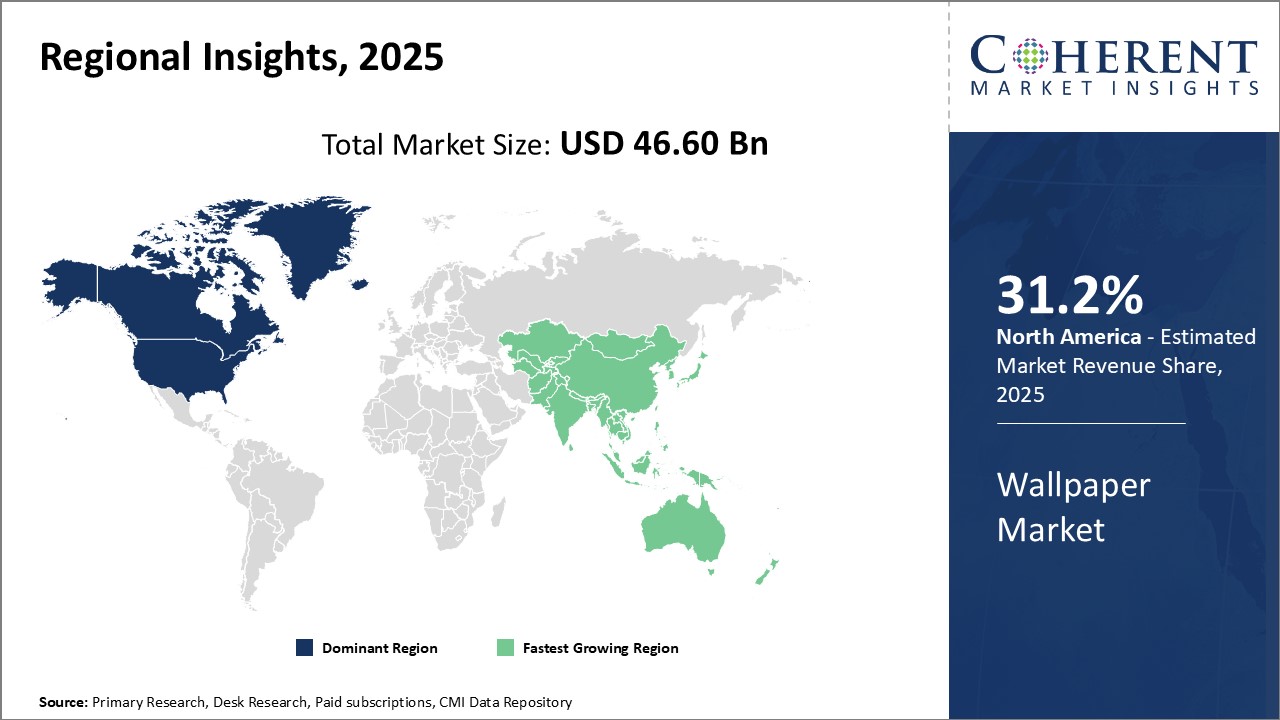
North America Wallpaper Market Analysis and Trends
North America has established itself as the dominant region in the global wallpaper market with an estimated market share of 31.2% in 2026. The large size and robustness of the construction industry in countries such as the U.S. has led to consistently high demand for interior decor elements like wallpaper. With its focus on the latest interior design trends, consumers in North America frequently refurbish and renovate spaces within their homes, fueling sales of wallpaper. Furthermore, the presence of top wallpaper manufacturers has made North America a hub for innovation and new product development. These companies continuously invest in R&D to launch novel wallpaper varieties featuring innovative textures, fabrics and patterns. This ensures that American consumers have access to a wide variety of high-quality and aesthetically appealing wallpapers.
Asia Pacific Wallpaper Market Analysis and Trends
Asia Pacific is the fastest growing region in the market; it is expected to gain exponential growth during he forecast period. Several Asia Pacific countries, especially emerging economies such as India and China, have been witnessing rapid urbanization and rising disposable incomes over the past decade. The burgeoning middle-class population in cities across the region has been allocating greater spend towards home décor and interior design. This has boosted sales of wallpapers through both residential and commercial applications like offices, hotels and malls. Asia Pacific presents lucrative export opportunities due to the presence of key wallpaper manufacturing hubs and comparatively lower trade barriers.
Wallpaper Market Outlook Country-wise
The United States Wallpaper Market Trends
The wallpaper market is demanding in united states due to the rising demand for customization and sustainable wallpapers with digital printing technologies enhancing design options. The consumers of U.S. seeking for home renovation trends, increasing imports and focus on eco-friendly material.
India Wallpaper Market Analysis and Trends
India is experiencing a growing wallpaper market due to popularity in home remodeling and technological advancements in wallpaper printing methods and many more. Additionally, India is expanding its market with a surge in disposable income, a shift in consumer requirement and DIY projects.
Wallpaper Market Driver
Growing construction industry
The construction industry has witnessed steady expansion worldwide, and this has boosted demand for wallpaper across the globe. Developing countries in Asia Pacific and Latin America, which are rapidly urbanizing, have become major centers of construction activity. As the middle-class population swells in emerging economies, there has been increase in investment in residential and commercial construction to meet the rising housing needs.
Several nations in Asia Pacific such as India, Indonesia and the Philippines have registered strong GDP growth rates in recent times, which has translated to higher disposable incomes. This has boosted demand for new residential units from emerging affluent populations in urban areas. Real estate developers are launching large townships and housing projects, catering to different income segments. To enhance the aesthetic appeal and ambience of new residential constructions, wallpaper is gaining traction as an affordable interior design solution. The durable and easy to install characteristics of modern wallpaper using non-woven substrates have made them a practical choice for numerous real estate ventures.
Countries in the Middle East and Africa are also undertaking massive infrastructure projects to develop transport and urban infrastructure. Mega cities are coming up across the Gulf region, supported by billions of dollars of investments. This has spurred the activity levels in building construction industry locally. Various types of commercial spaces such as shopping malls, hospitals, hotels and office buildings are increasingly adopting wallpaper for interior decoration purposes. The thriving construction sector can boost wallpaper usage for new projects initiated in public as well as private sector.
In Western nations, policies for green buildings and sustainable construction can stimulate residential repair and renovation activities. As older houses undergo refurbishment, homeowners and builders show greater inclination towards eco-friendly wallpaper that qualifies for green building certifications. Rising inclination towards green products in the construction sphere bodes well for future sales of sustainable wallpaper materials made from recycled paper or plant-based substrates.
Increasing disposal income
Rising disposable incomes have been a key growth driver boosting demand in the global wallpaper market. As economic conditions improve around the world, consumers have more purchasing power available after mandatory expenses to spend on lifestyle upgrades and home decor. This has translated directly into higher sales of wallpaper products. Consumers in developing nations have seen some of the most significant income gains in recent years. For example, average disposable incomes have risen sharply in countries such as India, Indonesia, and Brazil over the past decade according to World Bank data from 2020. As individual wealth accumulates in emerging middle classes within these populations, more households are able to consider redecorating rooms in their homes or apartments beyond basic necessities. The additional funds give consumers options to experiment with aesthetic wall finishes including premium and designer wallpaper options.
Wallpaper Market Restraint
Availability of substitutes
Global wallpaper market growth can be hampered due to availability of substitutes in the form of other decor materials like paints, wall claddings, wall tiles, and others. These substitutes have gained popularity as these provide greater convenience of application and require less maintenance over time. Paints have emerged as a popular alternative as these can be easily applied on walls with minimum hassle. Moreover, with technological advancements, paint manufacturers are able to provide a wide variety of designs and patterns resembling wallpaper. Wall claddings and tiles are also preferred by many consumers as these provide higher durability and can withstand moisture easily. The shifting consumer preferences towards low maintenance solutions can hamper the growth of wallpaper market. Manufacturers need to address convenience aspects and promote benefits of wallpaper to mitigate the challenge of alternatives crowding the market.
Wallpaper Market Opportunity
Developments of new designs and patterns
Developments of new designs and patterns can offer growth opportunities for global wallpaper market. As the tastes and preferences of consumers are continuously evolving, there has been huge demand for innovative and unique wallpaper designs. Manufacturers can capitalize on this opportunity by investing in R&D to develop differentiated designs. Introduction of advanced printing technologies allows for limitless possibilities of creativity in wallpaper patterns. Developing wallpapers imitating natural materials like wood, stone, and others as well as contemporary abstract designs would appeal to new target segments. Periodical launch of fresh designs can boost demand drastically and help revive sales volumes. Along with designs, new textures and finishes in wallpapers relating to various interior themes can also attract consumers. Tapping into this opportunity of creative product development holds the key for wallpaper companies to drive growth in the competitive market.
Market Report Scope
Wallpaper Market Report Coverage
| Report Coverage | Details | ||
|---|---|---|---|
| Base Year: | 2025 | Market Size in 2026: | USD 48.88 Bn |
| Historical Data for: | 2020 To 2024 | Forecast Period: | 2026 To 2033 |
| Forecast Period 2026 to 2033 CAGR: | 4.9% | 2033 Value Projection: | USD 68.33 Bn |
| Geographies covered: |
| ||
| Segments covered: |
| ||
| Companies covered: | Sherwin-Williams, ABC Imaging, F. Schumacher & Co., York Wallcoverings, Monadnock Paper Mills, Brewster Home Fashions, Osborne & Little, Waldan Paper Services LLC, Maya Romanoff, Ultrawalls, Kreative Decor, Urban Decor, Insignia Decor, Vivid Decor & Panel, Param Enterprises, Sky Wallpapers, Sangetsu Corporation, York Wall Coverings Inc., Raimata Impex Pvt. Ltd., Coatex | ||
| Growth Drivers: |
| ||
| Restraints & Challenges: |
| ||
Wallpaper Industry News
- In April 2025, Ahlstrom, a global leader in fiber-based specialty material, launched WallStar Digital, a 100% PVC-free nonwoven portfolio for wallcovering. It delivers exceptional diital print quality and limitless creative potential.
- In February 2025, Mark & Graham a portfolio brand of Williams-Sonoma, Inc., the world’s largest digital-first, design-led and sustainable home retailer, launched collaboration with sanderson, a new collection available for personalization includes more than 100 new products featuring prints and patterns from iconic fabric and wallpaper house.
- In January 2025, tesa and Rasch launched their self-adhesive wallpaper collection. Both the partners, the cooperation is a strategic step to expand the existing portfolio with an innovative new product. Through the partnership with Rasch, we can further advance our brand in the decorative DIY project sector. Our innovative adhesive technology enables us to offer aesthetically pleasing and high-quality products that quickly and efficiently transform our customers' living environment.
- In November 2024, Decoyard, a leading name in wallcoverings and interior design solutions, launched LEMURAl, an innovative online platform dedicated to high-quality, customizable wall murals. The aim behind this launch is to transform the way customers discover and purchase wall murals, catering to both residential and commercial spaces.
- In February 2024, Life n Colors, a leading luxury wallpaper brand, launched its latest collection called Suneherii. This exclusive line showcases intricate detailing that sets a new benchmark for ultra-luxury wallpaper designs. By blending exceptional craftsmanship with innovative techniques, Life n Colors has created a collection that seamlessly elevates the ambiance of any space.
- In February 2024, Asian Paints, a prominent Indian multinational in the paint industry, launched its Paris-Calcutta Collection in collaboration with the esteemed designer Mr. Sabyasachi. Inspired by Kolkata, often referred to as the 'Paris of the East,' this collection offers a diverse array of over 30 unique wallpapers and more than 120 exquisite fabrics, organized into four distinct volumes.
Analyst Opinion (Expert Opinion)
- Global wallpaper market growth is driven by rising residential and commercial construction activities around the world. Renovation and remodeling of existing properties also boosts demand for wallpapers. However, high raw material prices can pose challenge for the market growth due to supply constraints. Availability of cheaper substitutes like paints can also hamper the market expansion.
- North America region, especially China and India, dominates the global wallpaper market, owing to rapid urbanization and growth in non-residential construction in these countries. Asia Pacific is another major region and demand will be driven by infrastructure revamp programs. Developing eco-friendly and premium wallpaper products catering to the rising income groups can offer growth opportunities. Digital and mural wallpapers are gaining traction among millennials looking for unique home decor ideas.
- In terms of segments, non-residential or commercial wallpaper is likely to exhibit higher growth rate due to expansion of the hospitality sector globally. Vinyl-based wallpapers also dominate the market, owing to their inexpensive nature and easy maintenance. Innovations in surface textures and designs like 3D, DIY, and customizable options can open up new avenues. Rising consumer preference for interior aesthetics due to social media is a key trend in the market.
Speak to the analyst
Want personalized insights?
Take the findings above to one of our principal consultants, or have the report rebuilt around the segments, geographies and competitors you actually track.
Market Segmentation
- Product Type Insights (Revenue, USD Bn, 2021 - 2033)
- Vinyl Wallpaper
- Flocked Wallpaper
- Grasscloth Wallpaper
- Paper Wallpaper
- Others
- Application Insights (Revenue, USD Bn, 2021 - 2033)
- Residential
- Commercial
- Distribution Channel Insights (Revenue, USD Bn, 2021 - 2033)
- DIY Stores
- Specialty Stores
- Online Retailers
- Others
- Regional Insights (Revenue, USD Bn, 2021 - 2033)
- North America
- U.S.
- Canada
- Latin America
- Brazil
- Argentina
- Mexico
- Rest of Latin America
- Europe
- Germany
- U.K.
- Spain
- France
- Italy
- Russia
- Rest of Europe
- Asia Pacific
- China
- India
- Japan
- Australia
- South Korea
- ASEAN
- Rest of Asia Pacific
- Middle East
- GCC Countries
- Israel
- Rest of Middle East
- Africa
- South Africa
- North Africa
- Central Africa
- Key Players Insights
- Sherwin-Williams
- ABC Imaging
- Schumacher & Co.
- York Wallcoverings
- Monadnock Paper Mills
- Brewster Home Fashions
- Osborne & Little
- Waldan Paper Services LLC
- Maya Romanoff
- Ultrawalls
- Kreative Decor
- Urban Decor
- Insignia Decor
- Vivid Decor & Panel
- Param Enterprises
- Sky Wallpapers
- Sangetsu Corporation
- York Wall Coverings Inc.
- Raimata Impex Pvt. Ltd.
- Coatex
Sources
Primary Research Interviews from the following stakeholders:
Stakeholders:
- Interviews with wallpaper manufacturers, interior designers, home improvement retailers, construction contractors, facility managers, and procurement heads across major global markets.
Specific stakeholders:
- Heads of merchandising and product development at home décor retail chains (e.g., IKEA, Home Depot, B&Q, Pepperfry)
- Procurement and project managers at real estate developers (e.g., DLF, Emaar, Lendlease)
- Design consultants and architects specializing in residential and commercial interiors
- Facility and operations managers in the hospitality sector (e.g., Hyatt, ITC Hotels, Hilton)
- Procurement teams at corporate real estate and office fit-out firms
- Production managers at wallpaper and wallcovering manufacturers (e.g., vinyl, non-woven, paper-based, textile)
- Wholesalers and distributors of decorative materials across North America, Europe, Asia, and the Middle East
Databases:
- World Trade Organization (WTO) Trade Statistics
- UN Comtrade Database
- Eurostat – Manufacturing and Retail Trade Statistics
- U.S. Census Bureau – Economic Indicators Division
- China National Bureau of Statistics – Textile and Paper Goods Sectors
- India Ministry of Commerce & Industry – Export-Import Data
- Korea Statistical Information Service (KOSIS)
- Japan External Trade Organization (JETRO)
- Directorate General of Commercial Intelligence and Statistics (DGCIS), India
Magazines:
- Interior Design Magazine
- Architectural Digest (Global Editions)
- House Beautiful
- Elle Décor
- Wallpaper
- Better Homes & Gardens – Home Improvement Section
- Design Middle East
- India Design World
Journals:
- Journal of Interior Design
- Color Research & Application
- Materials Today: Proceedings – Decorative Materials Section
- International Journal of Architecture, Engineering and Design
- Textile Research Journal
- Surface Coatings International
- Journal of Building Engineering
Newspapers:
- The Economic Times – Real Estate & Lifestyle
- The Hindu Business Line – Retail and Consumer Goods
- Financial Times – Housing and Interiors Reports
- South China Morning Post – Property & Manufacturing
- The Guardian – Lifestyle & Home Sections
- Nikkei Asia – Manufacturing and Home Furnishing Industry Updates
Associations:
- Wallcoverings Association (WA) – U.S.
- British Coatings Federation – Wallcoverings Group
- Confederation of Indian Industry (CII) – Real Estate and Design Forums
- European Wallpaper Manufacturers Group
- American Society of Interior Designers (ASID)
- Indian Institute of Interior Designers (IIID)
- International Furnishings and Design Association (IFDA)
Public Domain Sources:
- Ministry of Housing and Urban Affairs (Government of India)
- U.S. Department of Commerce – Home Improvement and Furnishings Data
- Ministry of Economy, Trade and Industry (METI), Japan
- Eurostat – Construction and Design Inputs
- Reserve Bank of India (RBI) – Household Consumption Reports
- NITI Aayog – Urban Housing and Lifestyle Studies
- India Brand Equity Foundation (IBEF) – Furniture and Furnishings Sector
- National Institute of Fashion Technology (NIFT) – Materials and Textile Use in Interiors
Proprietary Elements:
CMI Data Analytics Tool, and Proprietary CMI Existing Repository of information for last 8 years
*Definition: Global wallpaper market involves the manufacturing, distribution and sales of wallpapering materials globally. Wallpaper provides an aesthetic overlay on interior walls and is a cost-effective way to decorate and protect wall surfaces in homes and commercial buildings. The market includes businesses that produce innovative wallpaper designs showcasing diverse patterns, textures and colors to suit different architectural styles and customer tastes worldwide.
Get access to 250+ pages report
Every segment, forecast, competitor profile and data table behind the analysis above — available for instant download.
- ESOMAR Member
- ISO 9001:2015 Certified
- D-U-N-S Registered
- GDPR & CCPA Compliant
Missing comfort of reading report in your local language? Find your preferred language:
Transform your Strategy with Exclusive Trending Reports
Frequently Asked Questions
The Wallpaper Market is estimated to be valued at USD 48.88 Bn in 2026, and is expected to reach USD 68.33 Bn by 2033.
The CAGR of the Wallpaper Market is projected to be 4.9% from 2026 to 2033.
Growing construction industry and increasing disposable income are the major factors driving the growth of global wallpaper market.
Availability of substitutes and high costs associated with wallpaper are the major factors hampering the growth of global wallpaper market.
In terms of product type, vinyl wallpaper segment is estimated to dominate the market in 2026.
Sherwin-Williams, ABC Imaging, F. Schumacher & Co., York Wallcoverings, Monadnock Paper Mills, Brewster Home Fashions, Osborne & Little, Waldan Paper Services LLC, Maya Romanoff, Ultrawalls, Kreative Decor, Urban Decor, Insignia Decor, Vivid Decor & Panel, Param Enterprises, Sky Wallpapers, Sangetsu Corporation, York Wall Coverings Inc., Raimata Impex Pvt. Ltd., Coatex are the major players.
North America is expected to lead the global wallpaper market in 2026.