

U.S. Digital Signage Market Size and Forecast – 2026 To 2033
The U.S. digital signage market is expected to grow from USD 9,812.8 Mn in 2026 to USD 16,811.4 Mn by 2033, registering a compound annual growth rate (CAGR) of 8% from 2026 to 2033. The U.S. digital signage market growth is primarily driven by a steady growth in development of smart cities and public infrastructure.
For instance, on May 13, 2026, Celestica Inc., a global leader in data center infrastructure and advanced technology solutions, provided an update on its plans to establish operations in AllianceTexas in Fort Worth, Texas, U.S. Once fully completed, the new campus will include over one million square feet of advanced manufacturing and engineering space.
(Source: Celestica)
Key Takeaways of the U.S. Digital Signage Market
- The hardware segment is expected to account for 60. 5% of the U.S. digital signage market share in 2026. The increasing use of vending kiosk signs and outdoor boards is a major factor driving the segment growth. On September 9, 2024, Praevar, announced a partnership with BrightSign, the provider of the most advanced, capable, and trusted digital media players and operating system. The collaboration will put BrightSign’s powerful technology inside outdoor and semi-outdoor digital signage and digital out-of-home (OOH) displays. (Source: Praevar)
- The LCD segment is estimated to capture 54. 3% of the market share in 2026. LCDs are the best option in terms of economy for large scale deployments like corporate displays and retail signages. On February 10, 2026, the Pennsylvania Convention Center (PCC) completed the Phase I of a large-scale digital display modernization program as part of its ongoing investment in facility-wide technology upgrades. The upgrade establishes a convention center-wide network of LED and LCD displays to support event messaging, wayfinding, and on-site communications. (Source: AV Network)
- The 32 to 52 Inches segment is estimated to capture 48.5 % of the market share in 2026. The 32 to 52 inches size is preferred as it provides the best balance of visibility, versatility and space efficiency.
- Shift toward AI-powered smart displays: Digital signage and LCD systems are increasingly integrating artificial intelligence to enable features like audience analytics, real-time content optimization, and automated scheduling.
- Growth of energy-efficient and sustainable display technologies: There is a strong push toward low-power electronic displays, improved backlighting systems, and eco-friendly manufacturing practices.
Segmental Insights
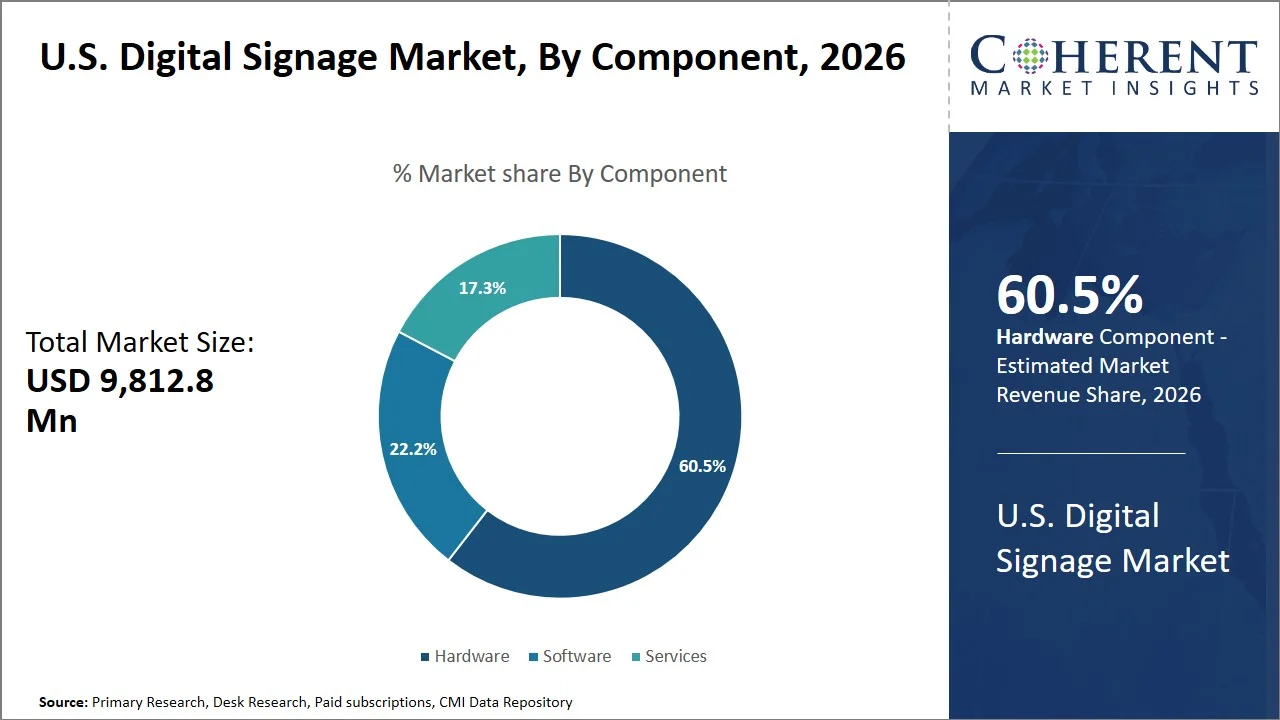
Why Does Hardware Segment Dominate the U.S. Digital Signage Market ?
The hardware segment is expected to account for 60.5% of the U.S. digital signage market share in 2026. The development of advanced signage players with modern processors are driving the demand for the hardware segment. For instance, on October 7, 2024, Advantech (2395, TW), a leading provider of AIoT platforms and services, announced the launch of DS-086, an ultra-slim digital signage player powered by the Intel Core Ultra (Meteor Lake) 125H SoC. This state-of-the-art player, equipped with the latest Intel Arc graphics, is engineered to deliver outstanding multimedia playback on 4K and 8K screens. (Source: Advantech)
- Current Industry Events of 2026
- Market Size Estimation
- Regional Breakdown
- Competitive Landscape
- Customer Intelligence
- Segmental Analysis
- Pricing Analysis
- Key Market Drivers, Challenges & Future Trends
- Customized Insights Section
Why is LCD the Most Preferred Display Technology?
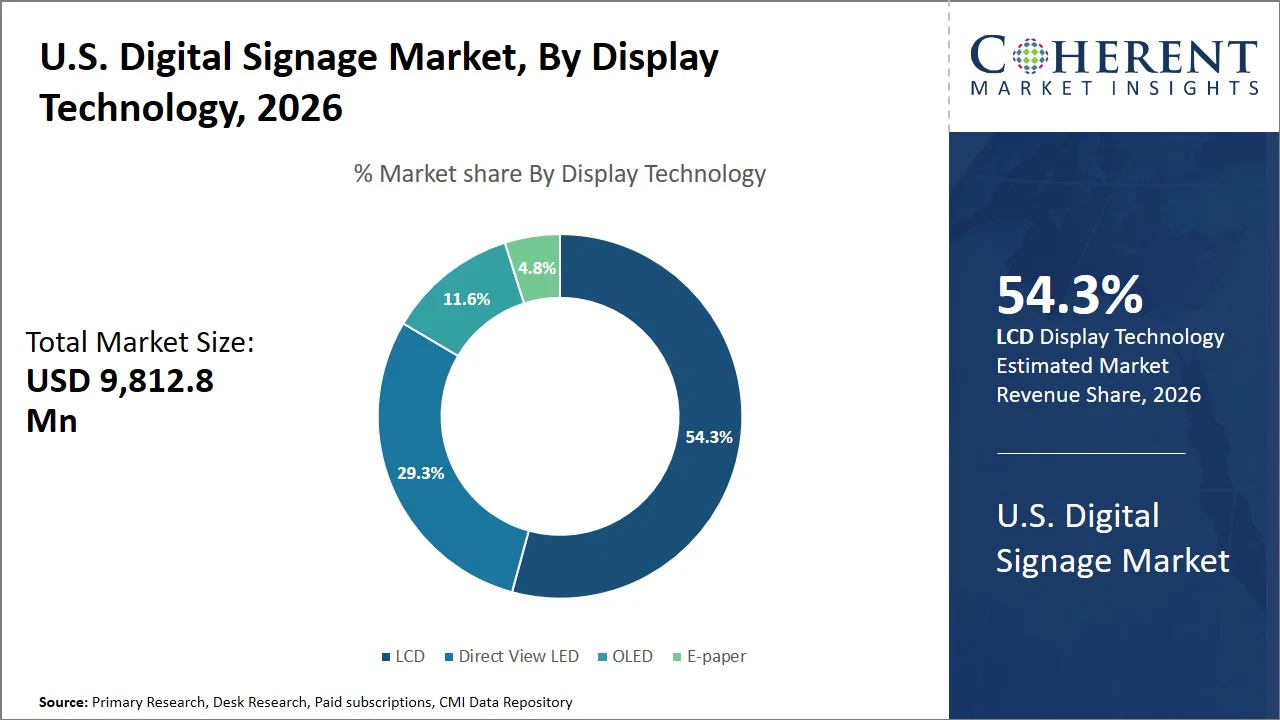
The LCD segment is expected to account for 54.3% of the U.S. digital signage market share in 2026. The consistency offered by LCDs in terms of brightness and sharp image output is a major factor driving the demand. On October 16, 2025, Samsung launched its 115-inch 4K Smart Signage display (QHFX 115”), filling a critical gap between the Videowall and LED product categories. The new super-sized model builds on the success of the 105-inch QPDX 5K display by delivering versatile screens that use 50% less power and are designed to captivate audiences through eye-catching visuals and crisp audio quality. (Source: Samsung)
32 to 52 Inches Segment Dominates the U.S. Digital Signage Market
The 32 to 52 Inches segment is expected to account for 62.5% of the U.S. digital signage market share in 2026. Increasing product innovations to support energy efficiency and high-quality visibility is driving the segment growth. On June 5, 2025, Samsung Electronics announced the launch of its 32-inch Color E-Paper (EM32DX model), expanding its portfolio of energy-efficient digital signage solutions. Featuring advanced digital ink technology, this latest model delivers ultra-low power consumption, high visibility and a lightweight design. As such, it is a more sustainable and flexible display alternative for businesses. (Source: Samsung)
Currents Events and their Impact
Current Events | Description and its Impact |
ADA Title II Digital Accessibility Rule |
|
(Source: ADA)
U.S. Digital Signage Market Dynamics
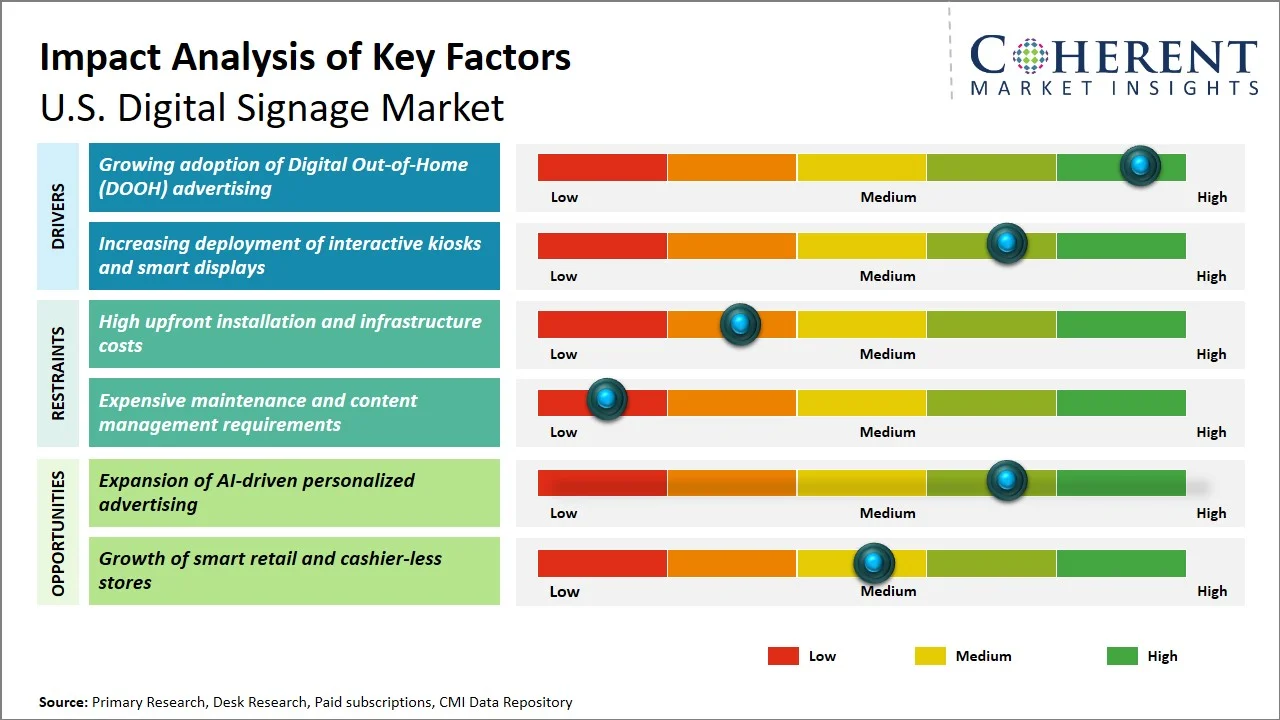
Market Drivers
- Growing adoption of Digital Out-of-Home (DOOH) advertising: Digital Out-of-Home ads gain ground in the U.S., fueled less by tradition than by demand for live performance tracking through automated systems. Instead of fixed displays, moving visuals now occupy spaces like shopping centers, stations, air terminals, city walls - where attention flows fast. Messages adjust based on who passes by; timing shifts without manual input thanks to networked screens. Updates happen instantly, guided not by schedules but by behavior patterns captured via sensors and smart software. Behind scenes, cloud platforms distribute media, reducing delays that once slowed response times. On January 13, 2025, T-Mobile announced that it had entered into a definitive agreement to acquire Vistar Media, the leading provider of technology solutions for digital-out-of-home (DOOH) advertisements reaching millions of consumers.
- Increasing deployment of interactive kiosks and smart displays: Across the U.S., more interactive kiosks appear where people shop, travel, receive care, or stay temporarily - this shift follows a growing preference for handling tasks without staff assistance. Speed matters now; responses must come quickly, so organizations turn toward automated tools that keep pace. Instead of long waits, users interact directly via screens designed for ease. Behind such setups lies a purpose to lower expenses tied to labor while maintaining consistent support. Performance improves when machines manage routine steps, freeing humans for complex duties. On April 21, 2026, LG Electronics demonstrated and expanded its commercial smart display ecosystem (LG Business Cloud) aimed at U.S. retail environments, integrating interactive kiosks, digital signage, and analytics platforms, at the ISE 2026. (Source: LG)
Emerging Trends
- Cloud-based remote management of display networks: Organizations are rapidly adopting cloud content management system platforms that allow centralized control of thousands of screens across multiple locations. This reduces operational complexity, enables instant content updates, and improves consistency across retail chains, transport hubs, and corporate campuses.
- Expansion of interactive and experiential display formats: Displays are evolving from static communication tools into interactive systems using touch, sensors, and IoT integration. This is driving immersive experiences in retail, museums, airports, and education, where engagement and real-time interaction significantly enhance user experience.
How is the Expansion of AI-Driven Personalized Advertising Creating New Growth Opportunities in the U.S. Digital Signage Market?
With artificial intelligence shaping ad delivery, U.S. digital signage sees fresh paths for growth through tailored messages updated instantly according to who is watching, where they are, how they act, and what surrounds them. Driven by insights from visual recognition tech, connected devices, and analysis tools, displays now modify content on the fly - aligning with individual traits seen in viewers, which leads to stronger attention and better returns on media spending. Progress unfolds rapidly within stores, transit areas, and fast-food locations; at the same time, interest grows in automated outdoor platforms managed remotely using centralized software built for large-scale, responsive campaigns fueled by live information flows.
U.S. Digital Signage Market - Import Dependency for Display Panels/Components
Component | Estimated Import Share | Estimated Import Share |
LCD TV Panels | ~85–95% | China, South Korea, Taiwan, Vietnam |
LCD Monitor Panels | ~80–90% | China, Taiwan, Vietnam |
OLED Panels | ~90–98% | South Korea, China |
Quantum Dot (QD) Enhanced Displays | ~70–80% | South Korea, China, Taiwan |
Touch Panels (ITO / capacitive layers) | ~75–90% | China, Taiwan |
Complete Flat Panel Displays | ~85–95% | China, South Korea, Taiwan |
Finished Digital Signage Displays | ~70–85% | South Korea, China, Vietnam |
Market Players, Key Development, and Competitive Intelligence
Key Development
- On March 5, 2024, Samsung Electronics America announced it is partnering with Quest Technology Management to introduce a groundbreaking managed service, offering innovative digital signage solutions for small and midsize businesses (SMBs) exclusively through Telarus technology advisors.
Competitive Landscape
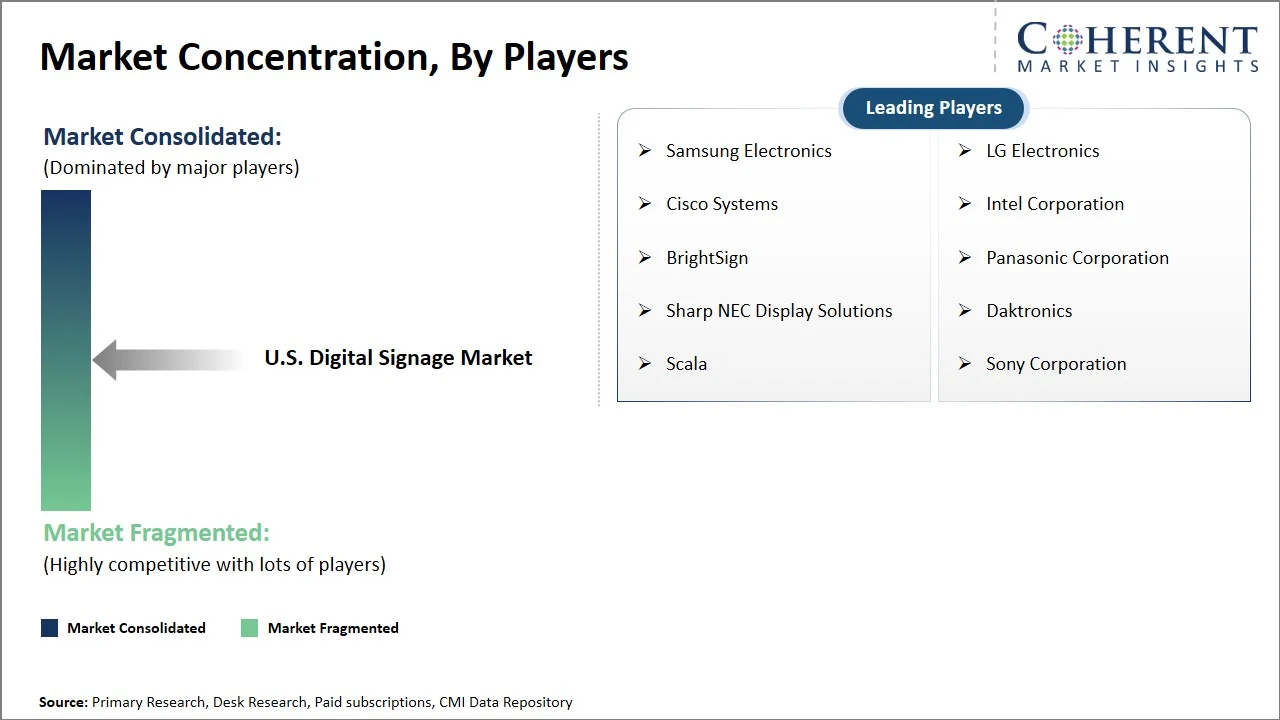
The U.S. digital signage market is highly consolidated at the top, with global technology leaders such as Samsung Electronics, LG Electronics, Sharp NEC Display Solutions, Cisco Systems, and Intel competing alongside specialized signage software and CMS providers like Scala, BrightSign, Daktronics, and Omnivex. Hardware manufacturers dominate display and kiosk supply, while software and platform companies increasingly control value through cloud-based content management, programmatic DOOH integration, and AI-driven analytics.
Market Report Scope
U.S. Digital Signage Market Report Coverage
| Report Coverage | Details | ||
|---|---|---|---|
| Base Year: | 2025 | Market Size in 2026: | USD 9,812.8 Mn |
| Historical Data for: | 2020 To 2024 | Forecast Period: | 2026 To 2033 |
| Forecast Period 2026 to 2033 CAGR: | 8% | 2033 Value Projection: | USD 16,811.4 Mn |
| Segments covered: |
| ||
| Companies covered: | Samsung Electronics, LG Electronics, Cisco Systems, Intel Corporation, BrightSign, Panasonic Corporation, Sharp NEC Display Solutions, Daktronics, Scala, and Sony Corporation | ||
| Growth Drivers: |
| ||
| Restraints & Challenges: |
| ||
Analyst Opinion (Expert Opinion)
- The U.S. digital signage market is transitioning from a traditional display business into a data-driven communication and advertising infrastructure layer. Growth is strongly supported by rising adoption of AI, IoT, cloud CMS platforms, and programmatic DOOH advertising, which are enabling real-time personalization and centralized multi-location control at scale. At the same time, analysts highlight that value is shifting away from screens themselves toward software ecosystems, audience analytics, and integration capabilities, meaning companies that can combine display hardware with intelligence layers are expected to outperform pure-play manufacturers.
- What lies ahead for the U.S. digital signage sector centers on artificial intelligence shaping tailored messaging, automated ad placement gaining ground, alongside deeper links to urban technology - displays shifting from fixed visuals to responsive information points embedded with sensors. In areas like store-based media grids, transit locations, fast food venues, medical facilities, and civic installations, demand grows where timely message changes and focused viewer reach produce clear outcomes. Systems are increasingly operated through cloud frameworks supported by application interfaces, allowing signs to interact fluidly with commerce, transport, and promotion tools, adjusting messages using current inputs.
Speak to the analyst
Want personalized insights?
Take the findings above to one of our principal consultants, or have the report rebuilt around the segments, geographies and competitors you actually track.
Market Segmentation
- Component Insights (Revenue, USD Million, 2021 - 2033)
- Hardware
- Commercial Displays
- Video Walls
- Interactive Kiosks
- Media Players
- Software
- Content Management Systems (CMS)
- Analytics & Audience Measurement Tools
- Scheduling & Remote Management Platforms
- Services
- Installation & Integration
- Maintenance & Support
- Hardware
- Display Technology Insights (Revenue, USD Million, 2021 - 2033)
- LCD
- Direct View LED
- OLED
- E Paper
- Screen Size Insights (Revenue, USD Million, 2021 - 2033)
- Up to 32 Inches
- 32 to 52 Inches
- Above 52 Inches
- Installation Type Insights (Revenue, USD Million, 2021 - 2033)
- Indoor
- Outdoor
- Industry Vertical Insights (Revenue, USD Million, 2021 - 2033)
- Retail
- Corporate
- Education
- Healthcare
- Transportation
- Hospitality and QSR
- Others
- Sales Channel Insights (Revenue, USD Million, 2021 - 2033)
- Direct Sales
- Distributors
- Key Players Insights
- Samsung Electronics
- LG Electronics
- Cisco Systems
- Intel Corporation
- BrightSign
- Panasonic Corporation
- Sharp NEC Display Solutions
- Daktronics
- Scala
- Sony Corporation
Sources
Primary Research Interviews
- Digital Signage Solution Providers and Manufacturers
- Technology Integrators and System Installers
- End-use Industries (Retail, Healthcare, Transportation)
- Digital Marketing Agencies and Content Creators
Magazines
- Digital Signage Today
- AV Technology Magazine
- Display Daily
- Commercial Integrator Magazine
Journals
- Journal of Digital Media & Advertising
- International Journal of Human-Computer Studies
- IEEE Transactions on Consumer Electronics
Associations
- Digital Signage Federation (DSF)
- Audiovisual and Integrated Experience Association (AVIXA)
- National Retail Federation (NRF)
- Consumer Technology Association (CTA)
Public Domain Sources
- U.S. Census Bureau Economic Data
- Federal Communications Commission (FCC) Reports
- Small Business Administration (SBA) Market Data
- Bureau of Labor Statistics Industry Reports
Proprietary Elements
- CMI Data Analytics Tool
- Proprietary CMI Existing Repository of information for last 10 years
Get access to 250+ pages report
Every segment, forecast, competitor profile and data table behind the analysis above — available for instant download.
- ESOMAR Member
- ISO 9001:2015 Certified
- D-U-N-S Registered
- GDPR & CCPA Compliant
Missing comfort of reading report in your local language? Find your preferred language:
Transform your Strategy with Exclusive Trending Reports
Frequently Asked Questions
The U.S. digital signage market is expected to stand at USD 9,812.8 Mn in 2026 and is expected to reach USD 16,811.4 Mn by 2033.
The CAGR of the U.S. digital signage market is projected to be 8% from 2026 to 2033.
Growing adoption of Digital Out-of-Home (DOOH) advertising and increasing deployment of interactive kiosks and smart displays are the major factors driving the growth of the U.S. digital signage market.
High upfront installation and infrastructure costs and expensive maintenance and content management requirements are the major factors hampering the growth of the U.S. digital signage market.
In terms of component, hardware segment is estimated to dominate the market revenue share in 2026.
Digital signage is a broader term, while DOOH (Digital Out-of-Home) specifically refers to outdoor or public advertising screens.
AI enables personalized content, audience analytics, and automated real-time content updates.