

U.S. Opium and Cannabis API Market Size and Forecast – 2026 To 2033
The U.S. opium and cannabis API market is expected to grow from USD 6,832.0 Mn in 2026 to USD 17,863.8 Mn by 2033, registering a compound annual growth rate (CAGR) of 14.7% from 2026 to 2033. The U.S. opium and cannabis API market is poised for significant expansion fueled by the increasing prevalence of neurological disorders and chronic pain, which is surging the demand for pharmaceutical-grade opium- and cannabis-derived APIs
According to the U.S. Centers for Disease Control and Prevention (CDC), in 2023, 24.3% of adults had chronic pain, and 8.5% of adults had chronic pain that frequently limited life or work activities, highlighting the rising need for effective pain management therapies and supporting the demand for high-quality APIs used in cannabinoid-based and analgesic medicines.
Key Takeaways of the U.S. Opium and Cannabis API Market
- Opium is projected to hold 62.4 % of the U.S. opium and cannabis API market share in 2026, making it the dominant API type segment owing to its continued use in the production of prescription analgesics for acute, chronic, and palliative pain management. The segment remains supported by stringent federal oversight that ensures a stable supply of opioid APIs for legitimate medical use. For instance, in September 2024, the U.S. Drug Enforcement Administration (DEA) finalized the 2025 Aggregate Production Quotas (APQs) for Schedule I and II controlled substances, including morphine, codeine, oxycodone, hydrocodone, and thebaine, to ensure adequate availability for medical, scientific, and industrial purposes while preventing diversion.
- Biopharmaceutical companies are projected to hold 81.2 % of the U.S. opium and cannabis API market share in 2026, making it the dominant end user segment, driven by increasing investments in cannabinoid-based drug discovery and controlled-substance therapeutics. For instance, the U.S. Food and Drug Administration (FDA) continues to support the development of cannabis-derived medicines through its final Guidance for Industry, Cannabis and Cannabis-Derived Compounds: Quality Considerations for Clinical Research, which provides regulatory recommendations on sourcing, quality, manufacturing, and chemistry requirements for cannabis-derived drug products, thereby facilitating pharmaceutical companies' clinical development and API manufacturing activities.
- Growing Demand for Cannabis Testing and Quality Assurance: The expansion of cannabis testing services and stricter quality assurance requirements are creating opportunities for high-purity cannabis API manufacturers. Comprehensive testing for cannabinoid potency, residual solvents, heavy metals, pesticides, and microbial contamination is becoming essential for FDA-regulated clinical research and pharmaceutical manufacturing, driving investments in standardized API production.
- Expanding Medical Cannabis Drug Development: The expanding pipeline of medical cannabis-based pharmaceuticals is creating sustained demand for pharmaceutical-grade cannabis APIs. Increasing clinical research on cannabinoid therapies for epilepsy, chronic pain, multiple sclerosis, oncology supportive care, and neurological disorders is encouraging manufacturers to scale up GMP-compliant production of high-purity CBD- and THC-based APIs. As more cannabis-derived medicines progress through clinical development, API suppliers are expected to benefit from long-term commercial opportunities.
Segmental Insights
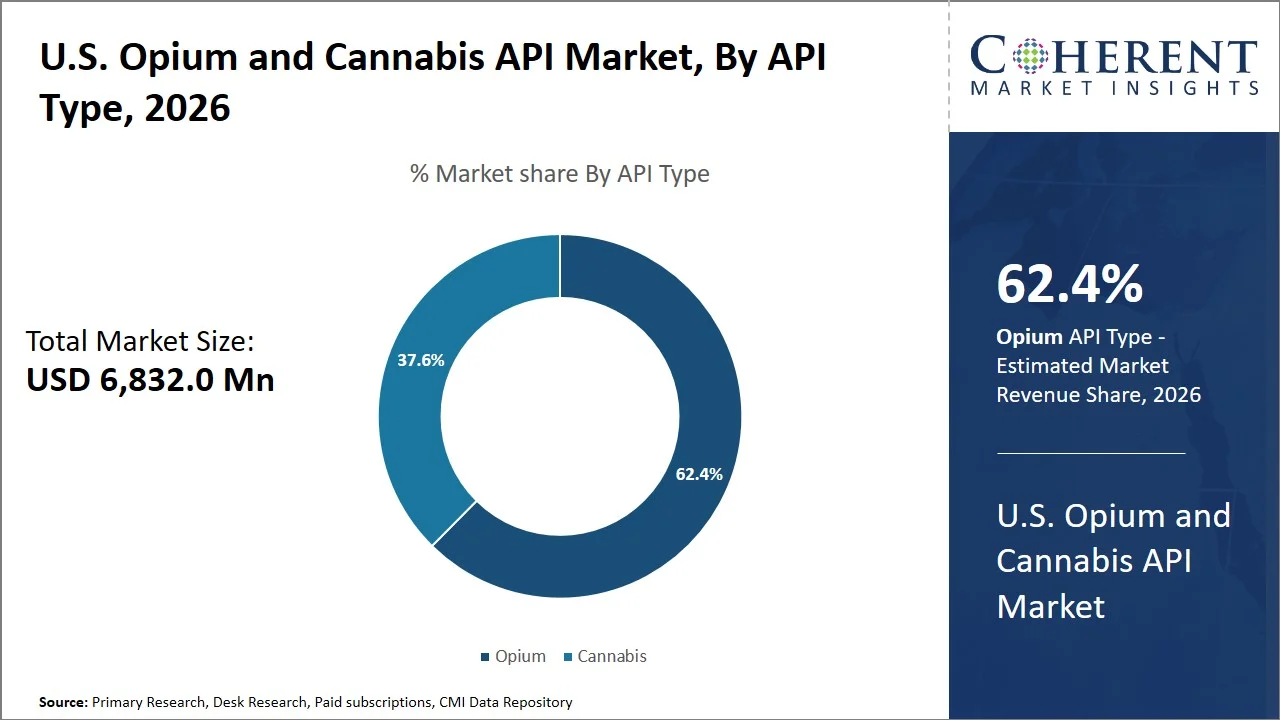
Why Does Opium Dominate the U.S. Opium and Cannabis API Market?
Opium is projected to hold a market share of 62.4% in 2026, as they are extensively utilized to synthesize prescription pain relievers for managing pain across multiple stages of life (acute, chronic and palliating). Strong pharmaceutical supply chains, well-developed manufacturing processes, and continuous demand from patients requiring pain managing solutions with opioid-based medicines help bolster the demand for this segment. For instance, in October 2024, the U.S. Food and Drug Administration (FDA) modified the Opioid Analgesic Risk Evaluation and Mitigation Strategy (OA REMS) to boost patient education and secure drug disposal at no cost starting by March 2025. The modified REMS highlights continued reliance on regulated, premium quality opioid API in the pharmaceutical industry supply chain.
- Current Industry Events of 2026
- Market Size Estimation
- Regional Breakdown
- Competitive Landscape
- Customer Intelligence
- Segmental Analysis
- Pricing Analysis
- Key Market Drivers, Challenges & Future Trends
- Customized Insights Section
Why Do Biopharmaceutical Companies Represent the Largest End User Segment in the U.S. Opium and Cannabis API Market?
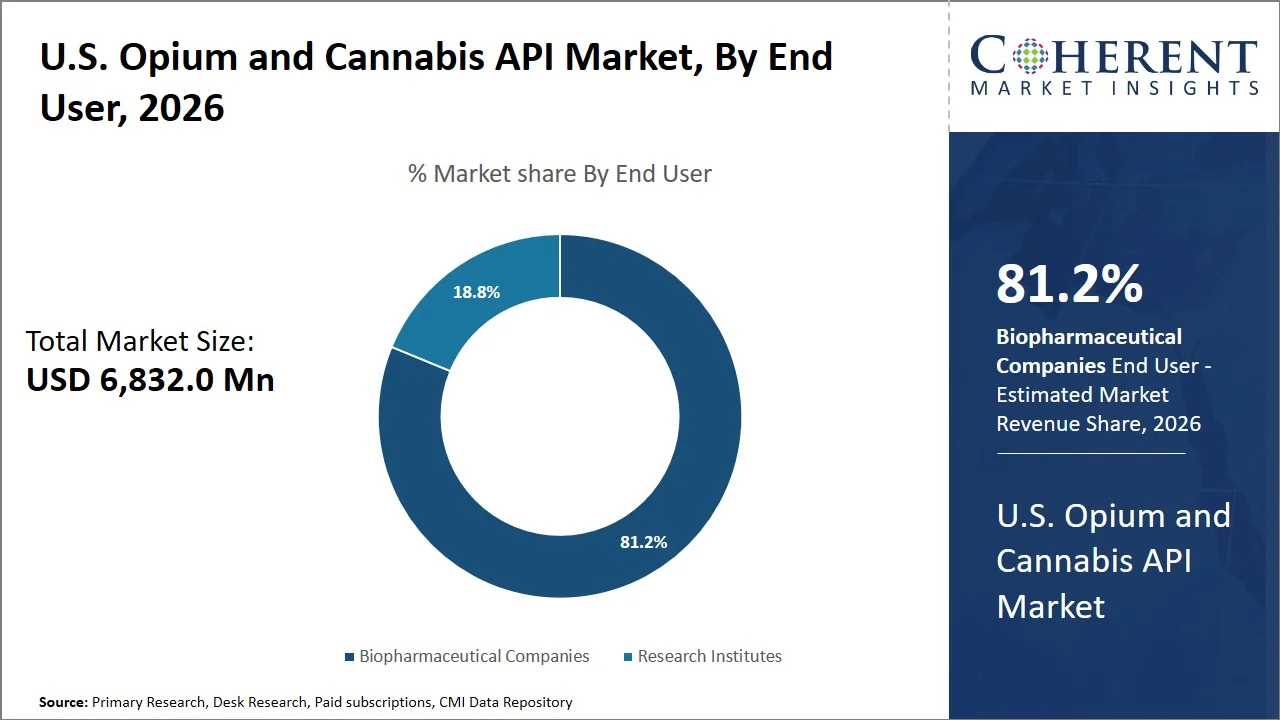
Biopharmaceutical companies are projected to hold 81.2% of the market share in 2026, due to sustained investments in the development and commercialization of opioid and cannabinoid-derived drugs. The companies are continuously broadening clinical pipelines in indications such as neurological disorders, chronic pain, oncology and orphan indications, thus fueling the growth of high-quality pharmaceutical APIs. For instance, the U.S. Food and Drug Administration (FDA) supports clinical research and the commercialization of cannabis derived products through its Cannabis: Research and Drug Approval Process that describes the investigational new drug (IND) process and expectations for sponsors. The framework aids pharmaceutical drug manufacturers in pursuing pharmaceutical-grade cannabis API development.
Currents Events and their Impact
Current Events | Description and its Impact |
U.S. Executive Order to Accelerate Medical Marijuana and Cannabidiol (CBD) Research (December 2025) |
|
Drug Enforcement Administration (DEA) Announces 2026 Marijuana Rescheduling Hearing (June 2026) |
|
U.S. Opium and Cannabis API Market Dynamics
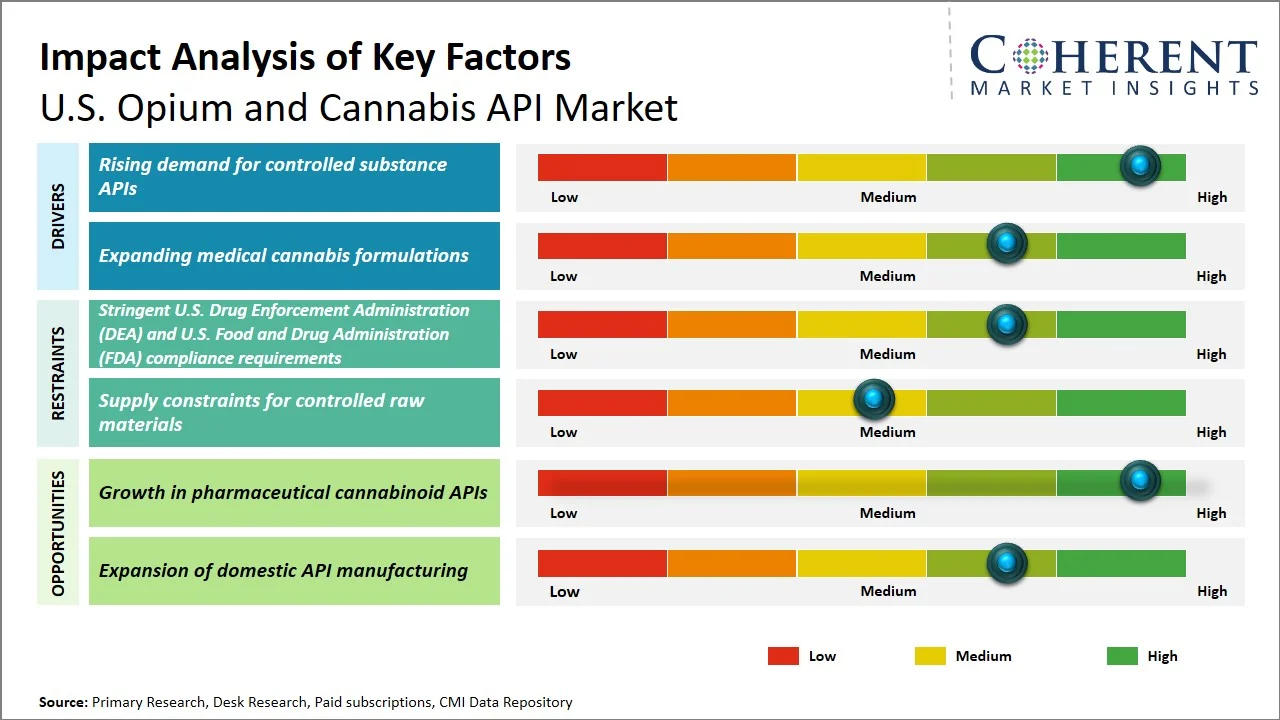
Market Drivers
- Rising demand for controlled substance APIs: The increasing pharmaceutical R&D and application of cannabinoid- and opioid- based drugs for the treatment of pain, neurology, oncology, and palliation has been surging the demand for controlled substance APIs. This increased push for uniform, quality API and the introduction of alternative regulatory avenues are forcing the suppliers to bolster their onshoring capacity. For instance, in July 2025, the U.S. Food and Drug Administration (FDA) mandated class-wide labeling changes for all opioid pain medicines, reinforcing the importance of sourcing premium, U.S. FDA-regulated APIs for pharmaceutical ingredient supply.
- Expanding medical cannabis formulations: A proliferation of medical cannabis formulations is consequently fueling the demand for pharmaceutical-grade cannabis APIs as drug developers expand treatment indications from epilepsy into areas of chronic pain, multiple sclerosis, supportive cancer treatment, and neurological diseases. Robust ongoing research activities and emerging standard dosage form options also position well for manufacturers to invest in high-purity cannabidiol (CBD) and tetrahydrocannabinol (THC) APIs. For instance, in December 2025, the U.S Food and Drug Administration (FDA) issued executive order authorizing research to facilitate medical cannabis and cannabidiol (CBD) study for the development of cannabis-based medicines, and strengthening opportunities for pharmaceutical cannabinoid API suppliers.
Emerging Trends
- Increasing Adoption of Synthetic Cannabinoid APIs: As manufacturers consider the future use of synthetic cannabinoid APIs, they are now focusing on how synthetic cannabinoids offer them an opportunity to overcome inherent plant-based material fluctuations and supply problems. Their use allows for standardization, large-scale production and easier and greater control for regulatory compliance.
- Rising Focus on Pharmaceutical Supply Chain Localization: Companies are ramping up domestic production of APIs and localization of their supply chains to decrease their reliance on imported controlled substances and enhance security of supply. The shift towards more resilient pharmaceutical supply chains, an increased level of transparency and traceability, and a constant supply of regulated drug APIs based on opium and cannabis continues to gain ground.
Key Regulatory Factors Influencing the U.S. Opium and Cannabis API Market
Regulatory Authority | Key Regulation / Requirement | Implication for API Manufacturers |
U.S. Drug Enforcement Administration (DEA) | Annual Aggregate Production Quotas (APQs) for controlled substances | Determines production volumes of opium-derived APIs and ensures controlled supply. |
U.S. Food and Drug Administration (FDA) | Current Good Manufacturing Practice (cGMP) regulations | Requires pharmaceutical-grade manufacturing, quality control, and documentation for APIs. |
Controlled Substances Act (CSA) | Classification and handling of Schedule I & II substances | Governs licensing, storage, transport, and recordkeeping for opium and cannabis APIs. |
U.S. FDA Investigational New Drug (IND) Framework | Clinical development requirements for cannabinoid drugs | Facilitates development of cannabis-derived APIs for regulated pharmaceuticals. |
DEA Registration Requirements | Registration for manufacturing and handling controlled substances | Creates high entry barriers while ensuring supply chain security. |
How is the growth in pharmaceutical cannabinoid APIs creating new growth opportunities in the U.S. opium and cannabis API market?
Pharmaceutical cannabinoid-based therapeutic pipeline, particularly in rare diseases, neurological disorders, oncology supportive care, and chronic pain segments are presenting growth avenues in the U.S. opium and cannabis API industry. Increasing focus on the production of high-purity cannabidiol (CBD), tetrahydrocannabinol (THC) and minor cannabinoid APIs, has increased the adoption of GMP compliance for API manufacturing and its standardization. For instance, in November 2024, the U.S. Food and Drug Administration (FDA) issued orphan drug designation to a cannabidiolic acid (CBDA)-dominant cannabis sativa extract for the treatment of Rett syndrome, emphasizing regulatory approval of emerging cannabinoid-drug solutions and establishing new opportunities for pharmaceutical-grade cannabis API manufacturers.
Market Players, Key Development, and Competitive Landscape
Key Developments
- In August 2025, MediPharm Labs Corp. announced that the potential rescheduling of cannabis in the U.S. could create significant opportunities for pharmaceutical-grade cannabinoid active pharmaceutical ingredient (API) manufacturers. The company emphasized that evolving federal regulations could accelerate pharmaceutical research, expand prescription cannabinoid products, and increase demand for GMP-compliant cannabis APIs, strengthening growth prospects within the U.S. opium and cannabis API market.
- In March 2024, Bright Green Corporation submitted an application to the U.S. Drug Enforcement Administration (DEA) for registration to produce Schedule I and Schedule II controlled substances, including plant-based active pharmaceutical ingredients (APIs). The initiative supports domestic manufacturing of pharmaceutical-grade controlled substances for medical research and therapeutic applications, reinforcing the U.S. supply chain for regulated APIs.
Competitive Landscape
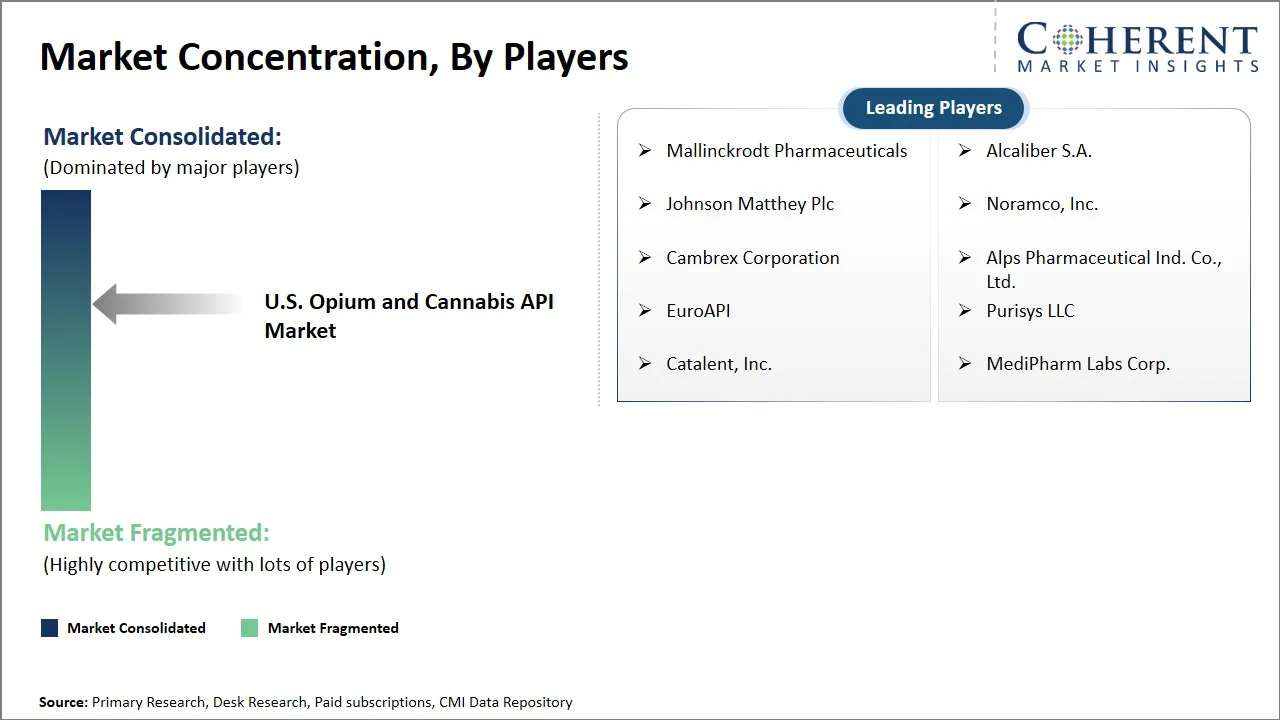
The U.S. opium and cannabis API market is moderately competitive, with manufacturers focusing on expanding their portfolios of pharmaceutical-grade opium alkaloids and cannabis-derived APIs while ensuring compliance with stringent U.S. Drug Enforcement Administration and U.S. Food and Drug Administration regulations. Companies are investing in advanced extraction, purification, and GMP-compliant manufacturing technologies to enhance API purity, consistency, and scalability. Strategic collaborations with pharmaceutical companies, contract development and manufacturing organizations (CDMOs), and research organizations are also accelerating cannabinoid drug development and strengthening supply chain capabilities. Key focus areas include:
- Expansion of pharmaceutical-grade opioid alkaloid and cannabinoid API portfolios
- Investment in advanced extraction, purification, and continuous API manufacturing technologies
- Strengthening GMP-compliant manufacturing facilities and regulatory compliance capabilities
- Strategic collaborations with pharmaceutical companies, CDMOs, and clinical research organizations
- Enhancing API quality, traceability, and supply chain resilience through digital manufacturing and quality management systems
Market Report Scope
U.S. Opium and Cannabis API Market Report Coverage
| Report Coverage | Details | ||
|---|---|---|---|
| Base Year: | 2025 | Market Size in 2026: | USD 6,832.0 Mn |
| Historical Data for: | 2020 To 2024 | Forecast Period: | 2026 To 2033 |
| Forecast Period 2026 to 2033 CAGR: | 14.7% | 2033 Value Projection: | USD 17,863.8 Mn |
| Segments covered: |
| ||
| Companies covered: | Mallinckrodt Pharmaceuticals, Alcaliber S.A., Johnson Matthey Plc, Noramco, Inc., Cambrex Corporation, Alps Pharmaceutical Ind. Co., Ltd., EuroAPI, Purisys LLC, Catalent, Inc., and MediPharm Labs Corp. | ||
| Growth Drivers: |
| ||
| Restraints & Challenges: |
| ||
Analyst Opinion (Expert Opinion)
- In the coming years, the U.S. opium and cannabis API market is expected to transition from a conventional controlled-substance supply market to a more innovation-driven pharmaceutical API industry. While opium-derived APIs will continue to dominate owing to their established role in pain management, the strongest long-term growth is expected from pharmaceutical-grade cannabis APIs, supported by increasing clinical research, evolving regulatory frameworks, and growing investment in cannabinoid-based therapeutics. Future market expansion will be driven by the demand for high-purity, GMP-compliant APIs for regulated drug development rather than recreational cannabis applications.
- The maximum growth opportunity lies within medical cannabis API segment, particularly CBD- and THC-based APIs for neurological disorders, epilepsy, chronic pain, and oncology supportive care in the United States. As more cannabinoid-based therapies progress through clinical trials, demand for standardized APIs produced under stringent quality standards is expected to accelerate. Additionally, contract development and manufacturing organizations (CDMOs) specializing in controlled substances are likely to benefit from increasing outsourcing by pharmaceutical and biotechnology companies.
- In order to create an advantage for themselves, the competitors should invest in advanced extraction and purification technologies, expand GMP-compliant manufacturing capacity, and strengthen regulatory expertise to meet U.S. Drug Enforcement Administration (DEA) and U.S. Food and Drug Administration (FDA) requirements. Strategic collaborations with pharmaceutical companies, clinical research organizations, and contract development and manufacturing organizations (CDMOs), coupled with investments in quality-by-design manufacturing, digital traceability, and next-generation cannabinoid API development will position companies to capitalize on the market's long-term growth potential.
Speak to the analyst
Want personalized insights?
Take the findings above to one of our principal consultants, or have the report rebuilt around the segments, geographies and competitors you actually track.
Market Segmentation
- API Type Insights (Revenue, USD Mn, 2021 - 2033)
- Opium
- Cannabis
- End User Insights (Revenue, USD Mn, 2021 - 2033)
- Biopharmaceutical Companies
- Research Institutes
- Key Players Insights
- Mallinckrodt Pharmaceuticals
- Alcaliber S.A.
- Johnson Matthey Plc
- Noramco, Inc.
- Cambrex Corporation
- Alps Pharmaceutical Ind. Co., Ltd.
- EuroAPI
- Purisys LLC
- Catalent, Inc.
- MediPharm Labs Corp.
Sources
Primary Research Interviews
- API Manufacturing Heads – opium alkaloid extraction, cannabinoid API production, and GMP manufacturing practices
- Pharmaceutical R&D Scientists – opioid and cannabinoid drug development and formulation trends
- Regulatory Affairs Experts – DEA licensing, FDA compliance, and controlled substance regulations
- CDMO Executives – contract API manufacturing, scale-up, and commercialization strategies
- Cannabis Cultivation & Extraction Specialists – pharmaceutical-grade cannabis cultivation and extraction technologies
Stakeholders
- Opium and Cannabis API Manufacturers (e.g., Mallinckrodt Pharmaceuticals, Noramco, Purisys LLC, Johnson Matthey, Cambrex Corporation)
- End-use Sectors
- Biopharmaceutical Companies
- Generic Pharmaceutical Manufacturers
- Contract Development & Manufacturing Organizations (CDMOs)
- Research Institutes & Clinical Trial Organizations
- Specialty Pharmaceutical Companies
- Regulatory & Health Bodies
- U.S. Drug Enforcement Administration (DEA)
- U.S. Food and Drug Administration (FDA)
- National Institutes of Health (NIH)
- National Institute on Drug Abuse (NIDA)
- U.S. Department of Health and Human Services (HHS)
Databases
- DEA Controlled Substances Quotas Database – aggregate production quotas for opioid APIs
- FDA Drugs@FDA Database – approved opioid and cannabinoid drug products
- ClinicalTrials.gov – ongoing cannabinoid- and opioid-based clinical studies
- NIH RePORTER – federally funded cannabinoid and opioid research
- PubChem – API chemical properties and compound information
Magazines
- Pharmaceutical Technology – API manufacturing and pharmaceutical production trends
- Pharmaceutical Commerce – pharmaceutical supply chain and API commercialization
- Contract Pharma – CDMO activities and outsourcing trends
- BioProcess International – biologics and API manufacturing innovations
- Genetic Engineering & Biotechnology News (GEN) – biotechnology and cannabinoid drug development
Journals
- Journal of Pharmaceutical Sciences – API formulation and manufacturing research
- International Journal of Pharmaceutics – drug delivery and pharmaceutical formulation studies
- Drug Development and Industrial Pharmacy – API development and scale-up technologies
- Cannabis and Cannabinoid Research – cannabinoid pharmacology and pharmaceutical applications
- Pain Medicine – opioid therapeutics and pain management research
Newspapers
- The Wall Street Journal (Health & Pharma) – U.S. pharmaceutical industry, API manufacturing, and drug commercialization developments
- Financial Times (Healthcare & Pharmaceuticals) – global pharmaceutical supply chains, API production, and regulatory developments
- USA Today (Health) – healthcare policy, prescription drug trends, and public health developments
- The New York Times (Health) – coverage of opioid policy, medical cannabis, pharmaceutical innovation, and healthcare regulations
Associations
- American Association of Pharmaceutical Scientists (AAPS)
- Biotechnology Innovation Organization (BIO)
- Drug Information Association (DIA)
- International Society for Pharmaceutical Engineering (ISPE)
- Controlled Substances and Cannabis Branch (industry engagement forums)
Public Domain Sources
- U.S. Drug Enforcement Administration (DEA) – controlled substance quotas, licensing, and regulations
- U.S. Food and Drug Administration (FDA) – drug approvals, guidance documents, and GMP regulations
- National Institutes of Health (NIH) – cannabinoid and opioid research publications
- National Institute on Drug Abuse (NIDA) – opioid and cannabis research data
- U.S. Department of Health and Human Services (HHS) – public health policies and controlled substance initiatives
Proprietary Elements
- CMI Data Analytics Tool, Proprietary CMI Existing Repository of information for last 10 years.
Get access to 250+ pages report
Every segment, forecast, competitor profile and data table behind the analysis above — available for instant download.
- ESOMAR Member
- ISO 9001:2015 Certified
- D-U-N-S Registered
- GDPR & CCPA Compliant
Missing comfort of reading report in your local language? Find your preferred language:
Transform your Strategy with Exclusive Trending Reports
Frequently Asked Questions
The U.S. opium and cannabis API market is estimated to be valued at USD 6,832.0 Mn in 2026 and is expected to reach USD 17,863.8 by 2033.
Opium dominates due to its widespread use in prescription analgesics for acute, chronic, and palliative pain management, supported by established pharmaceutical manufacturing and regulated medical demand.
It comprises pharmaceutical-grade active ingredients derived from opium (e.g., morphine, codeine) and cannabis (e.g., CBD, THC) used to manufacture regulated prescription medicines.
The CAGR of the U.S. opium and cannabis API market is projected to be 14.7% from 2026 to 2033.
Rising demand for controlled substance APIs, and expanding medical cannabis formulations are the major factors driving the growth of the U.S. opium and cannabis API market.
Opium and cannabis APIs must be manufactured under Good Manufacturing Practice (GMP) standards and comply with U.S. Food and Drug Administration (FDA) quality requirements and U.S. Drug Enforcement Administration (DEA) controlled-substance regulations for identity, purity, potency, and traceability.
Major opium-derived APIs include morphine, codeine, oxycodone, hydrocodone, and thebaine, primarily used in pain management and cough-suppression therapies.