

U.S. Neuropathic Pain Treatment Market Size and Share Analysis: 2026 - 2033
The U.S. neuropathic pain treatment market size is expected to reach approximately USD 2,492.0 Mn in 2026 and USD 3,447.0 Mn by 2033, growing at a CAGR of 4.9% throughout the forecast period (2026-2033).
Key Takeaways from the U.S. Neuropathic Pain Treatment Market Report
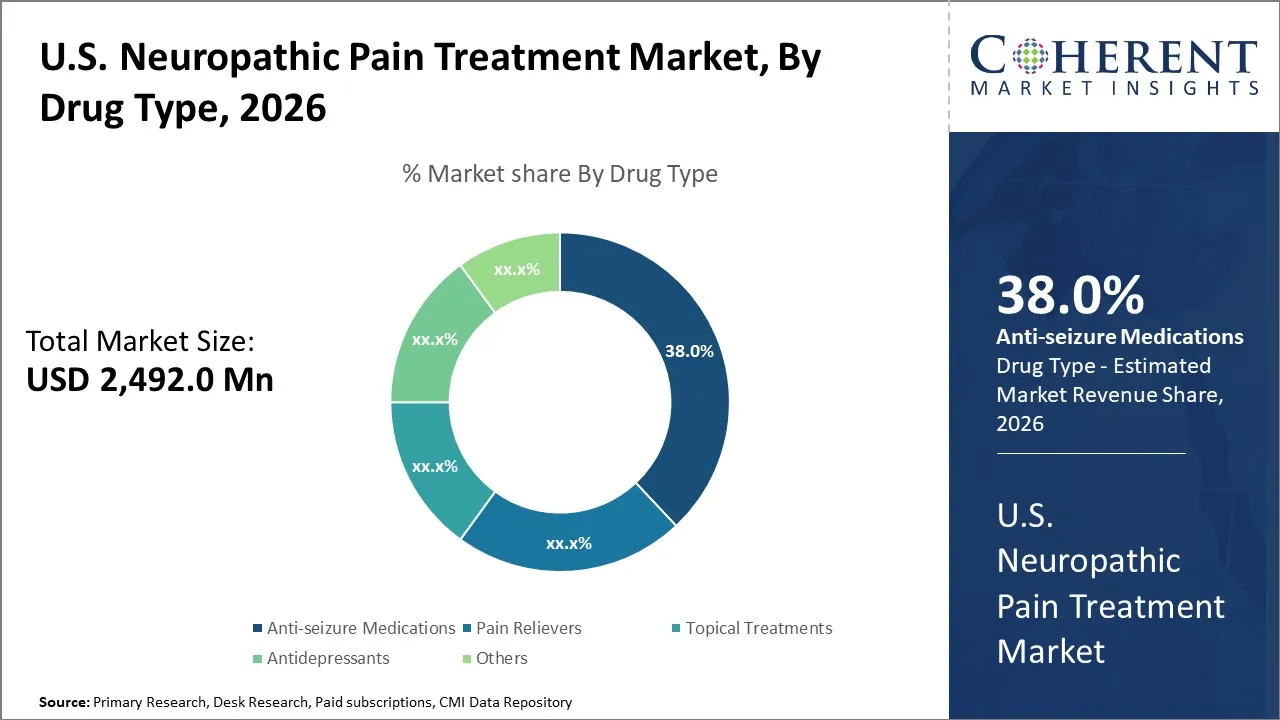
- Anti-seizure medications main a highly sought-after type, accounting for about 38% of the market share in 2026 as it is first-line treatment for neuropathic pain and strong clinical adoption in the U.S.
- Diabetic peripheral neuropathy is expected to remain leading indication segment accounting for 40% in the whole slide imaging market revenue in 2026, driven by rising prevalence of diabetes in the U.S. and requires long-term pain management.
- The retail pharmacies segment registered its dominance over the U.S. neuropathic pain treatment market with share of 56.7 % in 2026 because most neuropathic pain medications are long-term prescriptions and strong presence of major pharmacy chains across the U.S.
U.S. Neuropathic Pain Treatment Market Overview
Neuropathic pain, a chronic condition characterized by shooting, burning, or stabbing sensations, arises from damage or disease affecting the somatosensory nervous system. This condition frequently coexists with numbness or heightened sensitivity, known as allodynia. The market is gaining strategic importance due to increasing incidence of conditions like diabetes and the adverse effects of cancer treatments, both of which are becoming more prevalent due to poor lifestyle choices, contribute to continuous market expansion. A robust clinical pipeline, including ion channel-targeting medications, diabetic neuropathy treatments, and chemotherapy-induced peripheral neuropathy (CIPN) therapies, promises future commercial breakthroughs to address high unmet medical needs. Neuropathic pain drug development is currently a hotbed of investment, drawing interest from both major pharmaceutical corporations and specialized biotech companies. This influx of funding has fostered a competitive landscape, with multiple treatment classes on the verge of regulatory approval.
Current Events and Their Impact on the U.S. Neuropathic Pain Treatment Market
Current Event | Description and its Impact |
Increasing Investment in Clinical Trial Studies for New Drug Innovation |
|
Growing Demand for Neuropathy Treatment |
|
Segmental Insights
- Current Industry Events of 2026
- Market Size Estimation
- Regional Breakdown
- Competitive Landscape
- Customer Intelligence
- Segmental Analysis
- Pricing Analysis
- Key Market Drivers, Challenges & Future Trends
- Customized Insights Section
U.S. Neuropathic Pain Treatment Market Insights, By Drug Type - Anti-seizure Medications Holds Dominant Drug Type in the Market
Based on drug type, anti-seizure medications are expected to lead the market, accounting for a revenue share of 38% in 2026. The anti-seizure medications are widely recommended as first-line therapy in clinical guidelines for neuropathic pain which ensures high prescription volume across the U.S. As the anti-seizure medications are highly effective in treating diabetic peripheral neuropathy and postherpetic neuralgia it works by stabilizing nerve activity and reducing abnormal pain signals. The anti-seizure medications have lower risk of addiction and dependence compared to opioid pain killers which aligns with the U.S. shift toward non-opioid therapies. Hence, the above all factors make anti-seizure medications lead to strong clinical preference among physicians.
U.S. Neuropathic Pain Treatment Market Insights, By Indication - Diabetic Peripheral Neuropathy to Remain Leading Indication of Neuropathic Pain
By indication, the diabetic peripheral neuropathy segment is estimated to account for a prominent market share of 40% in 2026. Diabetes is routinely monitored, increasing the likelihood of early detection of neuropathy which results in higher treatment rates compared to other indications. The U.S. has a large diabetic population, and a significant proportion develops neuropathy over time which creates the largest patient pool among all neuropathic conditions.
U.S. Neuropathic Pain Treatment Market Insights, By Distribution Channel
Based on distribution channel, retail pharmacies segment led the U.S. neuropathic pain treatment market with share of 56.7% in 2026. The conditions like diabetic neuropathy require long-term, continuous medication and patients need regular monthly refills. Retail pharmacies are best suited for ongoing prescription fulfilment. Patient prefer retail pharmacies for quick and convenient access. Most neuropathic pain access are treated in outpatients, not hospitals which drives higher volume through retail channels.
U.S. Neuropathic Pain Treatment Market News
- In January 2026, Lexicon Pharmaceuticals, Inc., biopharmaceutical company based in U.S., unveiled that that the FDA's End-of-Phase 2 (EOP2) Meeting for pilavapadin in diabetic peripheral neuropathic pain (DPNP) was completed successfully. The FDA did not object during the meeting to pilavapadin's advancement into Phase 3 development, which would involve two 12-week, two-arm, placebo-controlled registrational studies that would compare the daily dose of 10 mg to a placebo. The average daily pain score (ADPS) from baseline to Week 12 will be the main outcome of the Phase 3 trials. Source: Neurolive.
- In January 2026, Vertex Pharmaceuticals Incorporated, biotech company, disclosed program and business updates in advance of the January investor meetings, including the company's planned webcast from the 44th annual J.P. The Morgan Healthcare Conference. Vertex is actively broadening the use of JOURNAVX (suzetrigine), which was approved by the FDA for acute pain in January 2025. Vertex is still conducting Phase 3 trials of suzetrigine for peripheral neuropathic pain (including DPN) as of January 2026; enrollment is anticipated to be finished by the end of 2026.
Market Report Scope
U.S. Neuropathic Pain Treatment Market Report Coverage
| Report Coverage | Details | ||
|---|---|---|---|
| Base Year: | 2025 | Market Size in 2026: | USD 2,492.0 Mn |
| Historical Data for: | 2020 To 2024 | Forecast Period: | 2026 To 2033 |
| Forecast Period 2026 to 2033 CAGR: | 4.9% | 2033 Value Projection: | USD 3,447.0 Mn |
| Geographies covered: |
| ||
| Segments covered: |
| ||
| Companies covered: | Teva Pharmaceutical Industries Ltd., Eli Lilly and Company, Johnson & Johnson, Dr. Reddy’s Laboratories Ltd., Pfizer, Inc., Cipla Inc., Lupin Limited, Averitas Pharma, Inc., NeuroBo Pharmaceuticals, Inc., LEXICON PHARMACEUTICALS, INC., Asahi Kasei Corporation, Vertex Pharmaceuticals Incorporated, and Biogen | ||
| Growth Drivers: |
| ||
| Restraints & Challenges: |
| ||
U.S. Neuropathic Pain Treatment Market Drivers
Increasing Prevalence of Neuropathic and Diabetes Disorders
Rising epidemiology of diabetes in the U.S. is leading to a higher incidence of diabetic peripheral neuropathy (DPN). For instance, in 2026, according to the data published by Elsevier B.V., estimated that as of the beginning of 2026, up to 50% of people with diabetes will experience diabetic neuropathy diseases at some point throughout their lives. An Elsevier B.V. report published in January 2026 projected a global pooled prevalence of diabetic peripheral neuropathy (DPN) at 36%. Millions of patients suffer from nerve-related conditions such as postherpetic neuralgia and chemotherapy-induced neuropathy.
U.S. Neuropathic Pain Treatment Market Trends
Expansion in Usage of Personalised Medicine
Growth of personalized medicine is significant driver of the market. Treatments are becoming more patient-specific, based on pain type & severity and genetic profile. Use of advanced technologies like biomarkers and AI to predict drug response has helped in innovation of personalized medicine therapy. The evolution of genetic and biomarker testing is enabling doctors to pinpoint certain neuropathic pain conditions, like post-herpetic neuralgia and diabetic neuropathy, with improved precision. Hence, personalized medicine developed using AI and biomarkers enhances treatment outcomes and patient satisfaction.
Switch To Non-Opioid Therapies
Due to ongoing opioid crisis, there is strong movement away from opioids due to addiction risks and strict regulations. Development of new non-opioids drugs targeting nerve pathways (e.g., sodium channel blockers) has reduced risks associated with opioids. This trend is transforming treatment approaches toward safer, long-term solutions.
Analyst Opinion (Expert Opinion)
- The U.S. neuropathic pain treatment market is being driven by the rising prevalence of chronic diseases such as cancer, diabetes, and neurological disorders and growing aging population. Increasing clinical trial studies into the causes of neuropathic pain and a greater emphasis on individualized treatment strategies that improve patient outcomes and quality of life further contribute to the market's expansion.
- Launch of latest diagnostic testing, advancements in technology within drug development, coupled with a more comprehensive understanding of neuropathic pain mechanisms, are increasing the implementation of targeted therapies and patient-specific treatment strategies, thereby enhancing patient outcomes.
- The market is projected to experience substantial expansion as novel pharmacologic therapies, non-opioid analgesics, and combination treatment regimens gain acceptance in clinical practice. Analgesics, including antidepressants, anticonvulsants, and other targeted medications, continue to be widely utilized, while progress in neuromodulation technologies and device-based therapies is generating new opportunities for pain relief.
- Consequently, sustained growth within the U.S. neuropathic pain treatment market is being propelled by the escalating disease burden, the proliferation of therapeutic options beyond conventional drug classes, and ongoing technological advancements in pain management. The transition toward personalized medicine, non-opioid treatment strategies, and innovative device therapies continues to be a primary driving force
Speak to the analyst
Want personalized insights?
Take the findings above to one of our principal consultants, or have the report rebuilt around the segments, geographies and competitors you actually track.
U.S. Neuropathic Pain Treatment Market Segmentation
- By Drug Type ( Revenue, USD Mn, 2020 - 2033)
- Pain Relievers
- NSAIDS
- Opioids
- Tramadol
- Oxycodone
- Others
- Anti-seizure Medications
- Gabapentin
- Pregabalin
- Others
- Topical Treatments
- Antidepressants
- Duloxetine
- Amitriptyline
- Escitalopram
- Others
- Others
- Pain Relievers
- By Indication Insights (Revenue, USD Mn, 2020 - 2033)
- Diabetic Peripheral Neuropathy
- Chemotherapy-induced Peripheral Neuropathy
- Idiopathic Peripheral Neuropathy
- Others
- By Distribution Channel Insights ( Revenue, USD Mn, 2020 - 2033)
- Hospitals Pharmacies
- Retail Pharmacies
- Online Pharmacies
- By Region Insights (Revenue, USD Mn, 2020 - 2033)
- North America
- U.S.
- Canada
- Latin America
- Brazil
- Argentina
- Mexico
- Rest of Latin America
- Europe
- Germany
- U.K.
- Spain
- France
- Italy
- Russia
- Rest of Europe
- Asia Pacific
- China
- India
- Japan
- Australia
- South Korea
- ASEAN
- Rest of Asia Pacific
- Middle East & Africa
- GCC Countries
- Israel
- Rest of Middle East & Africa
- North America
- Key Players
- Teva Pharmaceutical Industries Ltd.
- Eli Lilly and Company
- Johnson & Johnson
- Reddy’s Laboratories Ltd.
- Pfizer, Inc.
- Cipla Inc.
- Lupin Limited
- Averitas Pharma, Inc.
- NeuroBo Pharmaceuticals, Inc.
- LEXICON PHARMACEUTICALS, INC.
- Asahi Kasei Corporation
- Vertex Pharmaceuticals Incorporated
- Biogen
Sources
Primary Research Interviews
- Interviews with pain management specialists, neurologists, and anesthesiologists to understand current treatment protocols, challenges in treating neuropathic pain, and preferences for pharmacological vs. non-pharmacological therapies.
- Insights from pharmaceutical product managers, company executives, and R&D professionals on new drug developments, clinical trial trends, and the pipeline of novel neuropathic pain treatments.
- Discussions with healthcare providers, hospital administrators, and procurement managers to assess the impact of cost, insurance coverage, and reimbursement policies on the adoption of advanced treatment options.
- Conversations with patients, caregivers, and patient advocacy groups to gauge the real-world effectiveness of current therapies, unmet needs, and preferences for personalized or alternative treatment approaches.
Databases
- Scopus — Literature on the effectiveness of neuropathic pain treatments, including both drug-based and non-drug therapies, and the integration of advanced pain management technologies.
- PubMed — Biomedical and clinical studies on neuropathic pain, pain management therapies, and pharmacological advancements in neuropathic pain treatment.
- Web of Science — Multidisciplinary scientific research on pain management mechanisms, novel therapeutic approaches, and clinical trial outcomes for neuropathic pain.
- ClinicalTrials.gov — Clinical trial registry for studies evaluating new drugs, medical devices, and treatment methods for neuropathic pain.
Magazines
- Neurology Today
- Neuropathic Pain Journal
- Pain Medicine News
- Pharmaceutical Technology Magazine
- The Pain Report
Journals
- The Journal of Pain
- Pain Medicine
- Clinical Journal of Pain
- Journal of Neurology, Neurosurgery & Psychiatry
- Neurology
Newspapers
- The New York Times — Health and Medicine Section
- Reuters — Healthcare and Medical Technology
- The Washington Post — Health Section
- The Guardian — Health Section
- The Wall Street Journal — Healthcare and Drug Development
Associations
- American Academy of Neurology (AAN)
- American Pain Society (APS)
- Neuropathic Pain Special Interest Group (NeuPSIG)
- International Association for the Study of Pain (IASP)
- American Society of Anesthesiologists (ASA)
Public Domain Sources
- U.S. Food and Drug Administration (FDA) — Approvals, regulatory guidance, and safety information on neuropathic pain treatments and medical devices.
- ClinicalTrials.gov — Clinical trial information related to neuropathic pain treatments and new therapeutic interventions.
- National Institute of Neurological Disorders and Stroke (NINDS) — Neurological research and treatment developments for neuropathic pain.
- National Institutes of Health (NIH) / PubMed Central — Research on neuropathic pain, pain management guidelines, and clinical trials.
Proprietary Elements
- CMI Data Analytics Tool
- Proprietary CMI Existing Repository of Information for the Last 8 Years
Get access to 250+ pages report
Every segment, forecast, competitor profile and data table behind the analysis above — available for instant download.
- ESOMAR Member
- ISO 9001:2015 Certified
- D-U-N-S Registered
- GDPR & CCPA Compliant
Missing comfort of reading report in your local language? Find your preferred language:
Transform your Strategy with Exclusive Trending Reports
Frequently Asked Questions
The U.S market is estimated to be valued at USD 2,492.0 Mn in 2026.
The U.S. Neuropathic Pain Treatment Market value is expected to reach USD 3,447.0 Mn by 2033.
The U.S. neuropathic pain treatment market is poised to exhibit a CAGR of 4.9% from 2026 to 2033.
Major growth factors include increasing prevalence of neuropathic and diabetes disorders.
Side effects associated with the treatment of neuropathic pain
Anti-seizure medications segment, with about 38% share in 2026, dominates the market.
Some major companies in the Teva Pharmaceutical Industries Ltd., Eli Lilly and Company, Johnson & Johnson, Dr. Reddy’s Laboratories Ltd., Pfizer, Inc., Cipla Inc., Lupin Limited, Averitas Pharma, Inc., NeuroBo Pharmaceuticals, Inc., LEXICON PHARMACEUTICALS, INC., Asahi Kasei Corporation, Vertex Pharmaceuticals Incorporated, and Biogen