

U.S. OTC Eye Drops Market Size and Forecast – 2026 To 2033
The U.S. OTC eye drops market is expected to grow from USD 1,552.77 Mn in 2026 to USD 2,704.95 Mn by 2033, registering a compound annual growth rate (CAGR) of 9.6% from 2026 to 2033. The U.S. OTC eye drops market is poised for significant expansion, fueled by the mounting prevalence of dry eye disease and rising screen exposure among the population.
According to National Eye Institute, nearly 16.4 million Americans have dry eye disease, highlighting the substantial burden of ocular discomfort and the surging need for readily accessible eye care solutions. This growth in the patient base is expected to drive the sustained demand for OTC eye drops such as artificial tears and lubricants.
(Source: National Eye Institute)
Key Takeaways of the U.S. OTC Eye Drops Market
- Systane is projected to hold 29.0 % of the U.S. OTC eye drops market share in 2026, making it the dominant product segment, owing to its extensive product portfolio, strong retail presence, and focus on addressing a broad spectrum of dry eye symptoms. The segment continues to benefit from growing clinical attention toward ocular surface disorders and eye lubrication therapies. For instances, the National Eye Institute identifies dry eye as one of the most common ocular conditions affecting adults and continues to support research initiatives focused on improving diagnosis and treatment options for ocular surface diseases. (Source: National Eye Institute)
- Multi-dose bottle is projected to hold 69.5 % of the U.S. OTC eye drops market share in 2026, making it the dominant packaging type segment, due to its convenience, ease of storage, and suitability for repeated daily use. The segment is further supported by regulatory oversight that ensures the quality and sterility of ophthalmic products. For instance, the U.S. Food and Drug Administration (FDA) enforce Current Good Manufacturing Practice (CGMP) requirements for ophthalmic drug products to maintain product integrity and patient safety. (Source: Food and Drug Administration)
- Contains preservative are projected to hold 58.8 % of the U.S. OTC eye drops market share in 2026, making it the dominant preservative status segment, owing to their extended shelf life, affordability, and widespread retail availability. These formulations remain commonly used for occasional and moderate eye discomfort. For instance, the American Academy of Ophthalmology (AAO) recognizes that preserved eye drops remain appropriate for many patients’ requiring intermittent lubrication, while emphasizing proper product selection based on frequency of use and symptom severity. (Source: American Academy of Ophthalmology)
- Rising Demand for Preservative-Free Eye Drops: The awareness about ocular surface and the potential harmful effects associated with regular use of preservatives are leading to the growing demand for preservative-free OTC eye drops. Patients with chronic dry eye conditions and contact lens wearers are gradually demanding milder and less irritating formulations which may also provide longer term relief. This is compelling manufacturers to increase their preservative-free product portfolios and invest in more advanced delivery techniques.
- Expansion of OTC Eye Care Through Digital Health and Teleoptometry: The rise of telehealth and digital eye care solutions offers new possibilities for OTC eye drop manufacturers. More consumers are now turning to online appointments and virtual diagnosis of typical eye conditions including dryness, redness and allergies, contributing to higher consumer education levels, increased availability of OTC eye drops and an expanded reach for the direct-to-consumer eye care category in the U.S.
Segmental Insights
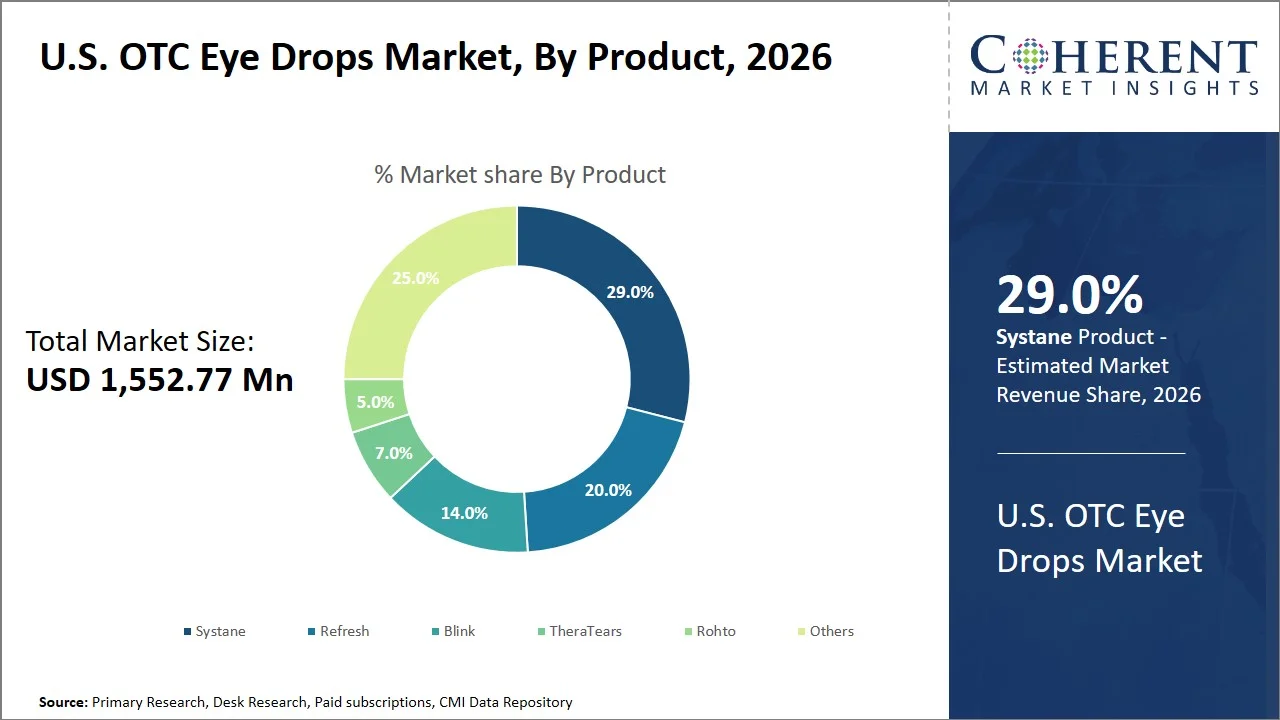
Why Do Systane Dominate the U.S. OTC Eye Drops Market?
Systane is projected to hold a market share of 29.0% in 2026, due to its portfolio diversity of dry eye relief products, customer confidence and its success in catering to the various degree of eye discomfort patients experience. The brand employs novel lubricant technologies to render extended relief through hydration and barrier creation, rendering it a popular option for eye irritation suffering patients. For instance, MyAlcon offers a dedicated range of Systane products namely Systane Complete PF, Systane Hydration PF, and Systane Ultra PF. This enables the company to treat various dry eye subtypes and severities with targeted treatment options. (Source: MyAlcon) The wide range of products confirms Systane's leadership in the U.S OTC eye drops market.
- Current Industry Events of 2026
- Market Size Estimation
- Regional Breakdown
- Competitive Landscape
- Customer Intelligence
- Segmental Analysis
- Pricing Analysis
- Key Market Drivers, Challenges & Future Trends
- Customized Insights Section
Why Does Multi-Dose Bottle Represent the Largest Packaging Type Segment in the U.S. OTC Eye Drops Market?
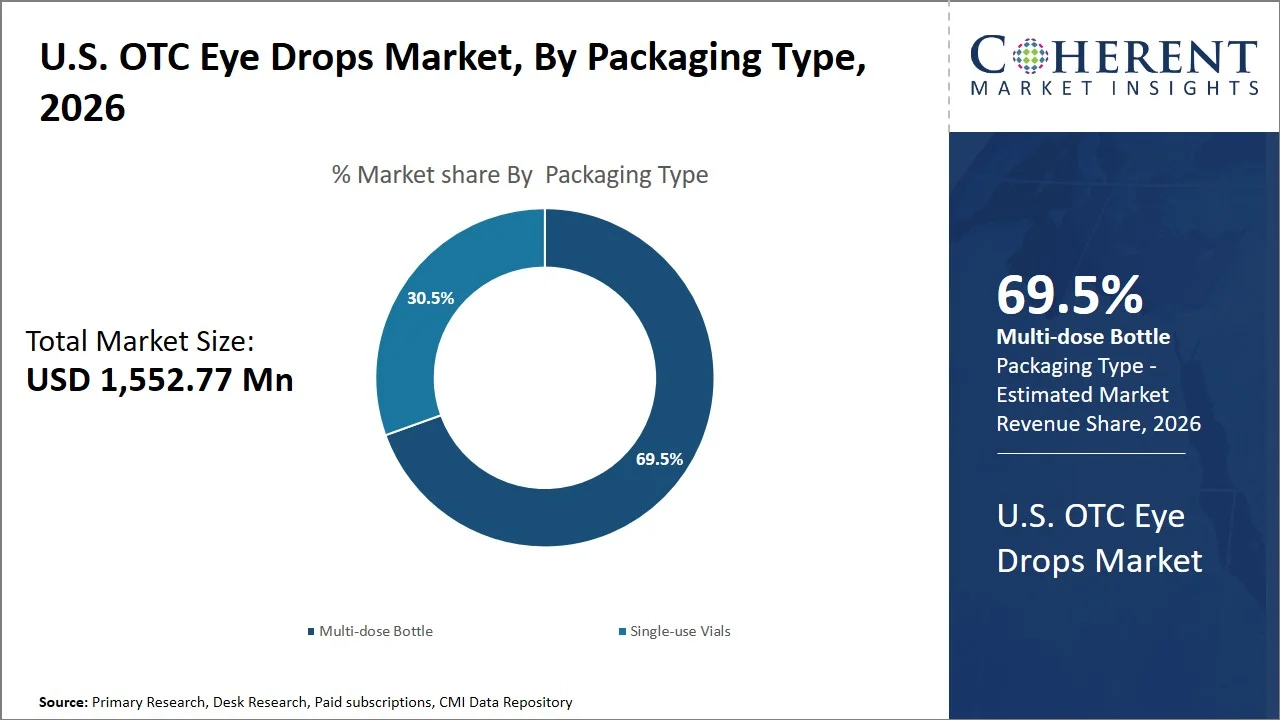
Multi-dose Bottle is projected to hold 69.5% of the market share in 2026, driven by its cost-effectiveness and suitability for long-term or regular use. Multi-dose bottles are most preferred by consumers as they contain a larger quantity of the product compared to single-use vials. In addition, producers are also modifying such packages with superior technology that supports dispensing and maintains sterility while providing the ease of application. For instance, Alcon’s Systane Hydration Multi-Dose Preservative-Free (MDPF) features company’s patented PureFlow bottle technology which allows preservative free delivery in a multi dose format. (Source: Alcon) Such innovations continue to foster the preference for multi-dose packaging across the U.S. OTC eye drops market.
Contains Preservative Segment Dominates the U.S. OTC Eye Drops Market
The contains preservative segment is expected to hold 58.8% of the U.S. OTC Eye Drops market share in 2026, due to its longer shelf life, lower manufacturing costs, and extensive distribution network via retail and pharmacies. These formulations are preferred by consumers seeking for occasional dry eye, redness and mild irritation relief. Manufacturers continue to develop and use preservative technologies that ensure product sterility and stability over multiple application. For instance, Refresh Tears is among the leading OTC lubricant eye drops in the U.S. and includes preservatives with PURITE technology that converts into natural tear components after insertion. These features contribute to the high acceptance of preservative-added eye drops in the U.S OTC eye drops market.
Currents Events and their Impact
Current Events | Description and its Impact |
U.S. FDA Emphasis on Ophthalmic Product Manufacturing and Sterility Controls (June 2026) |
|
U.S. FDA Revision to Guidance on Quality Considerations for Ophthalmic Drug Products (February 2024) |
|
U.S. OTC Eye Drops Market Dynamics
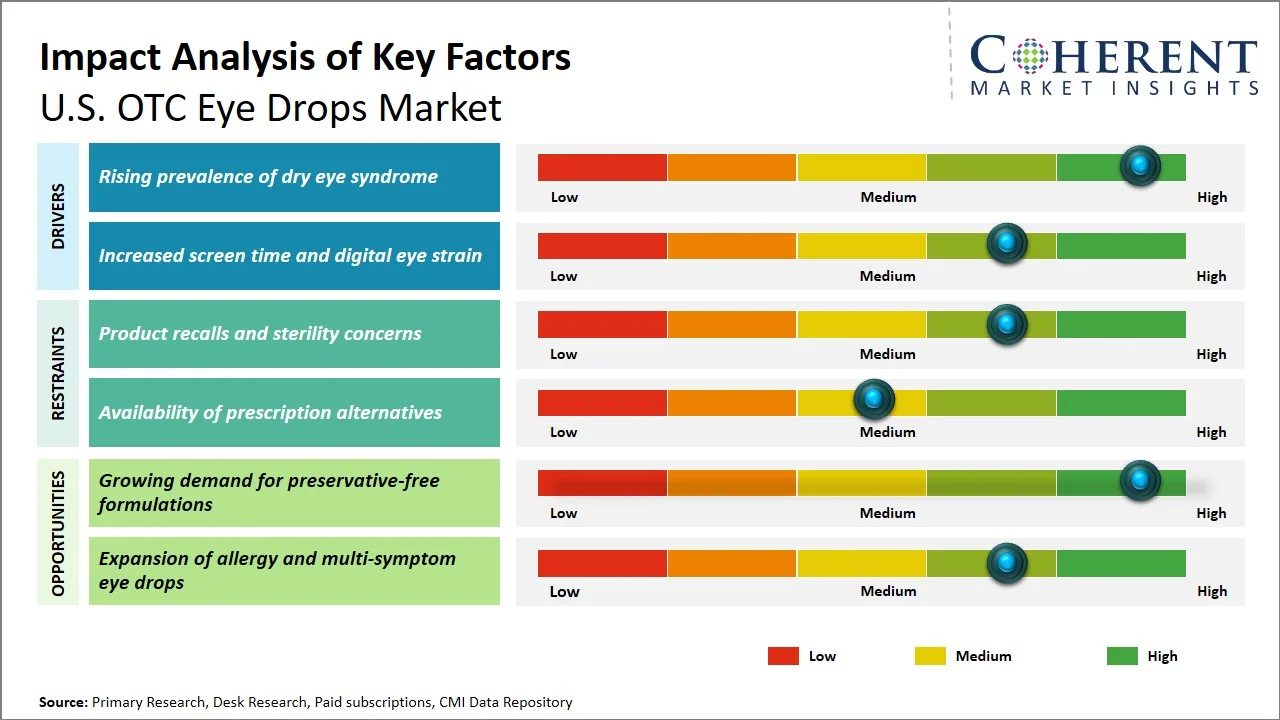
Market Drivers
- Rising prevalence of dry eye syndrome: The mounting impact of dry eye syndrome caused by increased screen time, a growing number of elderly individuals and exposure to environmental factors is propelling the use of OTC eye drops throughout the U.S. Consumer demand for self-care remedies for dryness, irritation, and eye fatigue are reducing demand for prescription remedies for less severe cases, while new moisturizing and preservative-free formulas enhance their popularity. For instance, in October 2025, a study published by National Library of Medicine indicated that the prevalence of dry eye disease ranged from 6.3% to 22.9% in those using screens for more than 2 hours, with an overall prevalence of 67.4% among digital screen users. (Source: National Library of Medicine) With the continued digital screen exposure and the rise in age-related eye diseases, there will be sustained demand for easy-to-use, effective OTC eye drops across the U.S. market.
- Increased screen time and digital eye strain: In the U.S., the widespread use of smart phones, computers, and other digital devices has created increasing demand for OTC eye drops and led to an increase in digital eye strain. Use of digital devices decreases the rate of blinking and speed up the tear film evaporation. These effects bring about symptoms like dryness, irritation, and visual discomfort. Hence, the eye lubricants are expected to maintain eye comfort when consumers frequently use the digital devices. For instance, according to American Optometric Association, about 58% of the U.S. adults have experienced digital eye strain or vision problems, emphasizing the rising need for accessible OTC eye care products. (Source: American Optometric Association)
Emerging Trends
- Growth of Contact Lens-Compatible Eye Drops: The growth of contact lens usage, particularly among working professionals and the younger demographic, is increasing the need for special OTC eye drops, specifically formulated to moisturize the eye without affecting the lens performance. These will be lens-friendly solutions that provide longer lasting hydration and improved comfort.
- Premiumization of OTC Eye Care Products: The consumers are willing to pay for innovative formulations with sustained lubrication, advanced hydrating technology, and clinically validated ingredients. This is driving manufacturers to expand premium product segments and develop unique offerings through better functionality and usability.
Key Regulatory Requirements Influencing the U.S. OTC Eye Drops Market
Regulatory Area | Requirement | Impact on Manufacturers | Impact on Consumers |
OTC Monograph Compliance | Products must comply with U.S. FDA OTC monograph requirements for active ingredients and claims | Reduces regulatory uncertainty and supports faster product launches | Ensures product safety and efficacy |
Sterility & Quality Standards | Ophthalmic products must meet stringent manufacturing and sterility requirements | Increases investment in quality control and production facilities | Minimizes contamination risks |
Labeling & Drug Facts Requirements | Mandatory disclosure of ingredients, directions, and warnings | Requires continuous label updates and compliance monitoring | Improves product transparency and informed usage |
Adverse Event Reporting | Manufacturers must monitor and report safety-related incidents | Strengthens post-market surveillance obligations | Enhances patient safety and product reliability |
Product Recall Framework | U.S. FDA can mandate or oversee recalls for non-compliant products | Increases quality assurance and supply chain oversight | Protects consumers from defective products |
HSA/FSA Eligibility | Certain OTC eye care products qualify for tax-advantaged healthcare spending accounts | Expands addressable consumer base | Improves affordability and accessibility |
How is the growing demand for preservative-free formulations creating new growth opportunities in the U.S. OTC eye drops market?
The rising consumer concern over ocular sensitivity and overall eye health is fueling the demand for preservative-free OTC eye drops in the U.S. Consumers with chronic dry eye, frequent eye drop usage and contact lens wear are increasingly choosing formulas with an emphasis on reducing ocular irritation while still offering effective lubrication. The marketers are responding by developing the next-generation preservative-free multi-dose delivery systems that are easy to use and maintain a long shelf-life. For instance, the American Academy of Ophthalmology suggests preservative-free artificial tears should be used by patients who are frequent daily users due to repeated exposure to preservatives potentially inducing irritation and inflammation of the ocular surface. (Source: American Academy of Ophthalmology)
Market Players, Key Development, and Competitive Intelligence
Key Developments
- On June 1, 2026, Bausch + Lomb introduced Blink Triple Care Preservative Free Lubricant Eye Drops to the U.S. Market to increase its line of dry eye relief products. The unique formula provides clinically proven 3-in-1 relief that lasts up to 10 hours and comes in a preservative-free multi-dose bottle. The release marks consumer demand for preservative-free OTC eye drops and Bausch + Lomb's interest in innovation within the dry eye market.
- In June 2025, Glenmark Therapeutics Inc., USA released its OTC Olopatadine Hydrochloride Ophthalmic Solution USP 0.2%, adding a choice for allergy relief sufferers in the U.S. Glenmark's olopatadine hydrochloride is therapeutically equivalent to Pataday Once Daily Relief's active ingredient and it is intended to provide once daily relief for the symptoms of allergic conjunctivitis. Glenmark's entry adds to the growing competition and availability in the OTC eye drops market, particularly in the allergy relief category.
Competitive Landscape
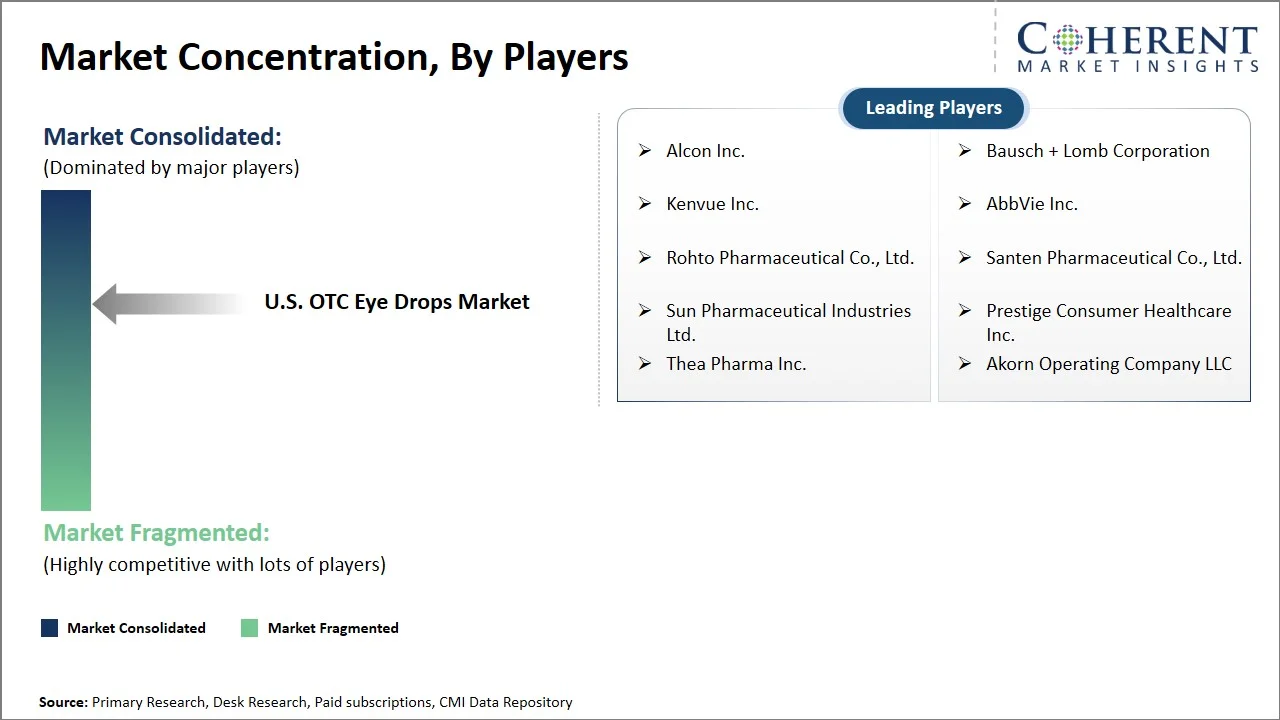
The U.S. OTC eye drops market is highly competitive, where major players aim at innovation in products, brand distinction, and expanding their portfolio in relation to growing customer eye care needs. The manufacturers are investing in preservative-free formulations, latest lubricating technologies, and multi-symptom relieved products which help in reducing dryness, irritation and allergy caused to eye. Key companies are also aiming at increasing their reach through increasing e-commerce and developing ties with eye care professionals and consumers. Key focus areas include:
- Development of preservative-free and contact lens-compatible eye drops
- Introduction of advanced hydration technologies and long-lasting lubricant formulations
- Expansion of digital and e-commerce distribution channels for OTC eye care products
- Strengthening collaborations with optometrists and ophthalmologists to enhance product adoption
- Investment in premium, multi-symptom, and clinically differentiated eye care solutions
Market Report Scope
U.S. OTC Eye Drops Market Report Coverage
| Report Coverage | Details | ||
|---|---|---|---|
| Base Year: | 2025 | Market Size in 2026: | USD 1,552.77 Mn |
| Historical Data for: | 2020 To 2024 | Forecast Period: | 2026 To 2033 |
| Forecast Period 2026 to 2033 CAGR: | 9.6% | 2033 Value Projection: | USD 2,704.95 Mn |
| Segments covered: |
| ||
| Companies covered: | Alcon Inc., Bausch + Lomb Corporation, Kenvue Inc., AbbVie Inc., Rohto Pharmaceutical Co., Ltd., Santen Pharmaceutical Co., Ltd., Sun Pharmaceutical Industries Ltd., Prestige Consumer Healthcare Inc., Thea Pharma Inc., Akorn Operating Company LLC | ||
| Growth Drivers: |
| ||
| Restraints & Challenges: |
| ||
Analyst Opinion (Expert Opinion)
- In the coming years, U.S. OTC eye drops market will be driven by an increase in dry eye syndrome, excessive exposure of digital screens and consumer demand for self-care treatment of eye health. Innovation in the formulation of products including preservative-free and latest lubricants will maintain the competitive landscape and premiumization in the market.
- The maximum growth opportunity lies within dry eye relief, such as preservative-free artificial tears and sustained lubricant eye drops focused on target customers in the U.S. including elderly population, contact lens wearers, and the ones who work with computers and suffers from computer vision syndrome. Growing awareness of ocular surface conditions will fuel the demand for high-quality and clinically differentiate products.
- In order to create an advantage for themselves, the competitors should focus on developing advanced preservative-free formulations, increasing both pharmacy and e-commerce channel presence and building relationships with eye-care professionals. Investments in educating the consumer, innovative delivery mechanism, and scientifically supported product claims will be crucial in developing strong brand loyalty and share in the market.
Speak to the analyst
Want personalized insights?
Take the findings above to one of our principal consultants, or have the report rebuilt around the segments, geographies and competitors you actually track.
Market Segmentation
- Product Insights (Revenue, USD Mn, 2021 - 2033)
- Systane
- Refresh
- Blink
- TheraTears
- Rohto
- Others
- Packaging Type Insights (Revenue, USD Mn, 2021 - 2033)
- Multi-dose Bottle
- Single-use Vials
- Preservative Status Insights (Revenue, USD Mn, 2021 - 2033)
- Contains Preservative
- Preservative-Free
- Cool Type Status Insights (Revenue, USD Mn, 2021 - 2033)
- Cool
- Non-Cool
- Distribution Channel Insights (Revenue, USD Mn, 2021 - 2033)
- Retail Pharmacies and Drugstores
- E-Commerce and Online Pharmacies
- Supermarkets and Hypermarkets
- Eye-Care Clinics
- Others
- Key Players Insights
- Alcon Inc.
- Bausch + Lomb Corporation
- Kenvue Inc.
- AbbVie Inc.
- Rohto Pharmaceutical Co., Ltd.
- Santen Pharmaceutical Co., Ltd.
- Sun Pharmaceutical Industries Ltd.
- Prestige Consumer Healthcare Inc.
- Thea Pharma Inc.
- Akorn Operating Company LLC
Sources
Primary Research Interviews
- Ophthalmologists and Cornea Specialists – dry eye disease management, OTC eye drop recommendations, and treatment trends
- Optometrists and Eye Care Practitioners – consumer purchasing behavior and eye health awareness trends
- Retail Pharmacy Managers – OTC eye drops sales patterns, product preferences, and distribution insights
- Contact Lens Specialists – demand for lubricating and contact lens-compatible eye drops
- Ocular Surface Disease Researchers – preservative-free formulations, tear film stability, and product innovation
Stakeholders
- OTC Eye Care Manufacturers (e.g., Alcon Inc., Bausch + Lomb Corporation, AbbVie Inc., Kenvue Inc., Rohto Pharmaceutical Co., Ltd.)
- End-use Sectors
- Retail Pharmacies and Drug Stores
- Hospital and Clinic Pharmacies
- Optical Stores and Vision Centers
- E-commerce and Online Healthcare Platforms
- Consumers Managing Dry Eye, Allergy, and Red Eye Conditions
- Regulatory & Health Bodies
- U.S. Food and Drug Administration (FDA)
- American Academy of Ophthalmology (AAO)
- American Optometric Association (AOA)
- Centers for Disease Control and Prevention (CDC)
Databases
- U.S.FDA OTC Monograph Database – OTC ophthalmic drug regulations and compliance requirements
- U.S. FDA Drug Recalls and Safety Alerts – ophthalmic product safety monitoring and recalls
- CDC Vision Health Initiative – eye disease prevalence and vision health statistics
- National Eye Institute (NEI) – dry eye disease, ocular disorders, and eye care research
- ClinicalTrials.gov – ongoing studies involving dry eye treatments and ophthalmic products
Magazines
- Review of Optometry – dry eye management, OTC eye care trends, and clinical updates
- Ophthalmology Times – ophthalmic product launches and industry developments
- EyeWorld – ocular surface disease management and eye care innovations
- Optometric Management – eye care practice trends and patient management strategies
- Drug Store News – retail pharmacy trends and consumer healthcare products
Journals
- Ophthalmology – clinical research on eye diseases and therapeutic interventions
- American Journal of Ophthalmology – dry eye disease, ocular surface health, and treatment outcomes
- Cornea – tear film disorders, ocular lubrication, and corneal health studies
- Clinical Ophthalmology – ophthalmic drug efficacy and patient outcomes
- Investigative Ophthalmology & Visual Science (IOVS) – vision science and ocular research
Newspapers
- USA Today (Health Section) – consumer healthcare and eye health awareness coverage
- The Wall Street Journal (Health & Pharma) – pharmaceutical and consumer health industry developments
- The New York Times (Health Section) – vision care trends and healthcare innovations
Associations
- American Academy of Ophthalmology (AAO)
- American Optometric Association (AOA)
- Prevent Blindness
- Association for Research in Vision and Ophthalmology (ARVO)
- Tear Film & Ocular Surface Society (TFOS)
Public Domain Sources
- U.S. Food and Drug Administration (FDA) – OTC ophthalmic regulations, recalls, and safety updates
- Centers for Disease Control and Prevention (CDC) – vision health and disease burden statistics
- National Eye Institute (NEI) – eye disease prevalence and treatment research
- National Institutes of Health (NIH) – ophthalmology and ocular surface disease studies
- ClinicalTrials.gov – clinical trial data related to eye care and dry eye therapies
Proprietary Elements
- CMI Data Analytics Tool, Proprietary CMI Existing Repository of information for last 10 years.
Get access to 250+ pages report
Every segment, forecast, competitor profile and data table behind the analysis above — available for instant download.
- ESOMAR Member
- ISO 9001:2015 Certified
- D-U-N-S Registered
- GDPR & CCPA Compliant
Missing comfort of reading report in your local language? Find your preferred language:
Transform your Strategy with Exclusive Trending Reports
Frequently Asked Questions
The U.S. OTC eye drops market is estimated to be valued at USD 1,552.77 Mn in 2026 and is expected to reach USD 2,704.95 by 2033.
Systane dominates due to its strong brand recognition, broad portfolio of dry eye relief products, extensive retail availability, and continuous innovation in preservative-free and long-lasting lubricant formulations.
OTC eye drops are non-prescription ophthalmic solutions used to relieve symptoms such as dry eyes, redness, irritation, allergies, and minor eye discomfort.
The CAGR of U.S. OTC eye drops market is projected to be 9.6% from 2026 to 2033.
Preservative-free eye drops reduce the risk of ocular surface irritation and are preferred for frequent use, particularly among dry eye patients and contact lens wearers.
Common ingredients include polyethylene glycol, propylene glycol, glycerin, carboxymethylcellulose sodium, and hyaluronic acid, which help restore tear film stability and provide ocular lubrication.
Rising prevalence of dry eye syndrome, and increased screen time and digital eye strain are the major factors driving the growth of the U.S. OTC eye drops market.