

Vehicle Security Market Analysis & Forecast
Vehicle Security Market is estimated to be valued at USD 11.50 Bn in 2026 and is expected to reach USD 17.79 Bn in 2033, exhibiting a compound annual growth rate (CAGR) of 6.4% from 2026 to 2033.
Key Takeaways
- According to Type, The Immobilizers Category is anticipated to account for the largest share of 32.6% for the Vehicle Security market in 2026.
- According to Application, The Passenger Vehicles Segment is anticipated to hold major share of 68.4% the Vehicle Security market in 2026.
- According to region, North America holds the largest market share of 35.30% for Vehicle Security market growth by 2026.
Market Overview
The Vehicle Security Market Size is expanding rapidly which is propelled by legislative requirements for improved automotive safety, growing rates of auto theft, and technology developments. Growing concerns over vehicle theft coupled with the increasing integration of smart security technologies in automobiles are expected to drive the demand for vehicle security systems globally. Advanced solutions, such as biometric authentication, remote immobilization, and AI-powered surveillance systems, are gaining traction as manufacturers and consumers prioritize safety.
Current Events and Its Impact on the Vehicle Security Market
Event | Description and Impact |
Surge in Connected Car Adoption |
|
Adoption of AI and Machine Learning in Automation |
|
Pricing Analysis
Price points in the market are influenced by the integration of advanced technologies such as biometric authentication, AI-powered surveillance, and remote immobilization, which tend to command higher premiums.
Additionally, regulatory mandates and insurance incentives for installing security devices are pushing both OEMs and consumers toward more sophisticated and often more expensive solutions. While basic immobilizers and alarm systems remain relatively affordable, the adoption of multi-layered, tech-driven security systems is driving up the average selling price in both OEM and aftermarket channels.
- Current Industry Events of 2026
- Market Size Estimation
- Regional Breakdown
- Competitive Landscape
- Customer Intelligence
- Segmental Analysis
- Pricing Analysis
- Key Market Drivers, Challenges & Future Trends
- Customized Insights Section
Integration of New Technologies
- The vehicle security sector is rapidly evolving through the integration of cutting-edge technologies.
- AI-powered security algorithms, biometric access controls, IoT-enabled tracking, and blockchain-based data protection are transforming how vehicles are protected against theft and cyber threats.
- Major automakers and technology suppliers are investing heavily in connected mobility platforms, over-the-air (OTA) software updates, and smart telematics, all of which enhance both physical and digital security.
- The proliferation of software-defined vehicles and the rise of autonomous driving technologies are further accelerating the adoption of advanced cybersecurity measures, including proactive threat intelligence and real-time vulnerability management.
- These innovations not only improve security effectiveness but also enable new business models, such as remote vehicle monitoring and subscription-based security services.
Consumer Feedback and Unmet Demand
- Consumer feedback highlights a growing demand for user-friendly, reliable, and seamlessly integrated vehicle security solutions.
- While advanced features such as biometric authentication and real-time tracking are well-received, many consumers express concerns about the complexity of use, high costs, and potential privacy risks associated with connected security systems.
- There is also unmet demand for standardized security features across all vehicle segments, not just premium models, as well as for better protection against both traditional theft and emerging cyber threats.
- Consumers are increasingly seeking solutions that offer a balance between robust security, ease of use, and affordability.
- The market is responding with innovations, but gaps remain in areas such as interoperability between aftermarket and OEM systems, transparent data handling, and affordable security options for entry-level vehicles.
Segmental Insights
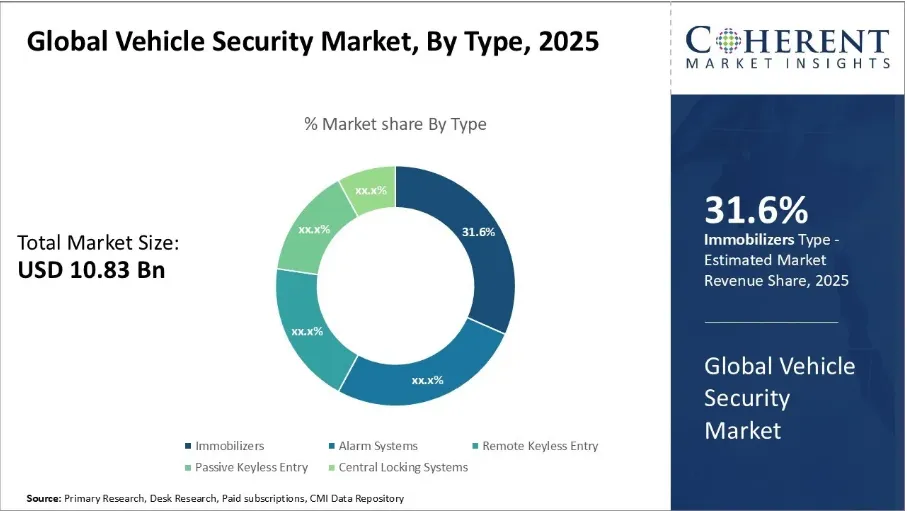
Vehicle Security Market, Insights By Type
In terms of type, the immobilizers segment is expected to contribute the highest share of 32.6% in the market in 2026 owing to increased vehicle theft concerns. Immobilizers have seen rising adoption rates in recent years due to growing security concerns among vehicle owners.
These devices use transponder technology to communicate between a transistor fitted in the ignition key and the vehicle's computer system. When the correct key is present, it allows the engine to start; otherwise, it prevents the engine from firing up, thereby immobilizing the vehicle.
Traditional mechanical locks and alarm systems alone cannot offer protection against sophisticated criminal techniques like relay attacks and hardwiring. Criminals have found ways to bypass these older security features. In contrast, modern immobilizers make unauthorized vehicle starting nearly impossible when paired with advanced transponder keys. Original equipment manufacturers now pre-install immobilizers in most new vehicles due to stricter regulatory mandates on vehicle anti-theft mechanisms.
Moreover, immobilizers provide peace of mind to owners without significant maintenance or hassle. Once installed during production, they require no effort from the user's end and enable silent protection indefinitely. On the other hand, alarm systems need periodical testing, battery replacement, and may trigger false alarms unintentionally. The set-it-and-forget-it nature of immobilizers has increased their popularity relative to alarm options.
With rising incidents of vehicle crimes documented by law enforcement agencies, consumers pay more attention to foolproof security solutions. Immobilizers meet this need admirably through covert protection that deters criminals without inconvenience to law-abiding drivers. Their effectiveness in thwarting vehicle theft attempts reinforces the safety perceptions around this segment.
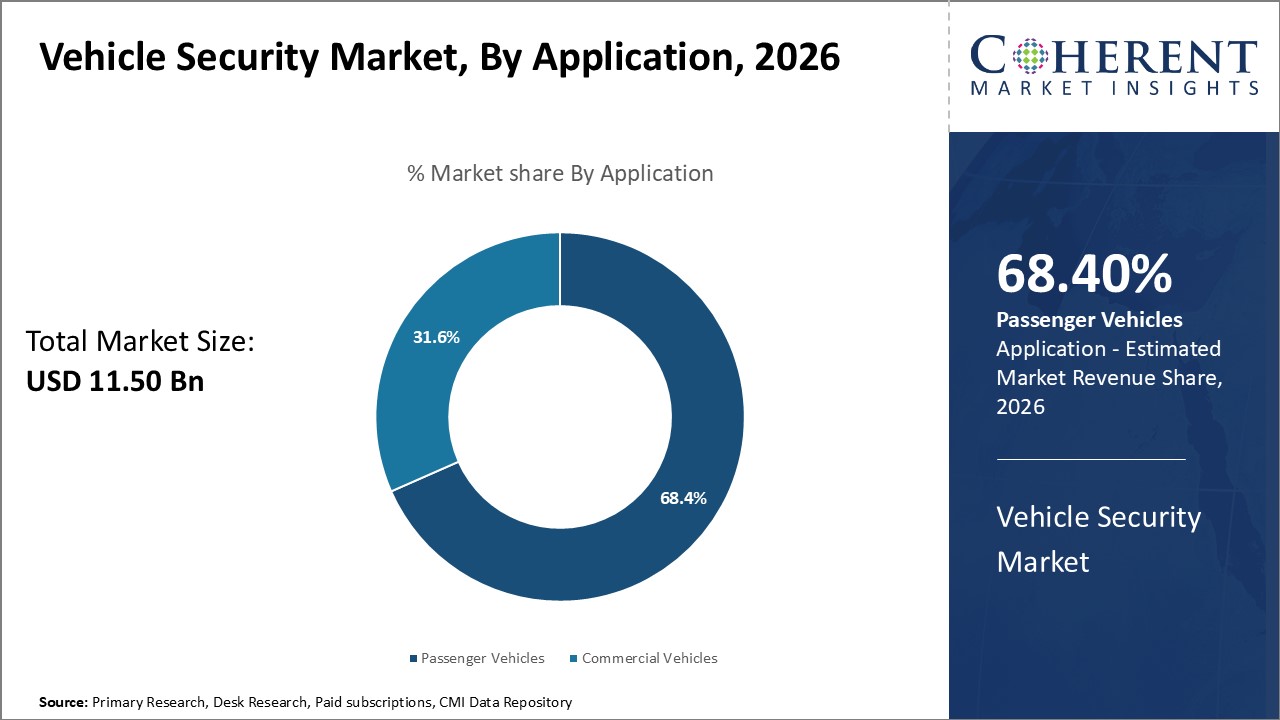
Vehicle Security Market Insights, By Application
The passenger vehicles segment is expected to hold the major share of 68.4% in the vehicle security market in 2026. Private car owners recognize the value of immobilizing and tracking systems to safeguard their expensive personal assets. Moreover, families with children especially opt for advanced security to block unauthorized access or vehicle movement.
Passenger cars see cross-generational usage within households unlike commercial fleets. Younger customers now desire connected security features like remote protocols and smartphone commands. Meanwhile, older users also embrace automation for safety and convenience. This widespread inter-demographic appeal raises installation rates.
Furthermore, the sheer volume of passenger vehicles globally surpasses other segments like commercial trucks or buses. Even a small attach rate for aftermarket security systems translates into massive revenues due to the immense size of the private vehicle population on roads. Manufacturers prioritize this segment while designing customizable security portfolios.
Rising per capita incomes also contribute to passenger vehicle affordability in developing markets. As more households acquire cars and become victims of theft, their security concerns grow exponentially. This expands the total available market for vehicle security solutions.
Regional Insights
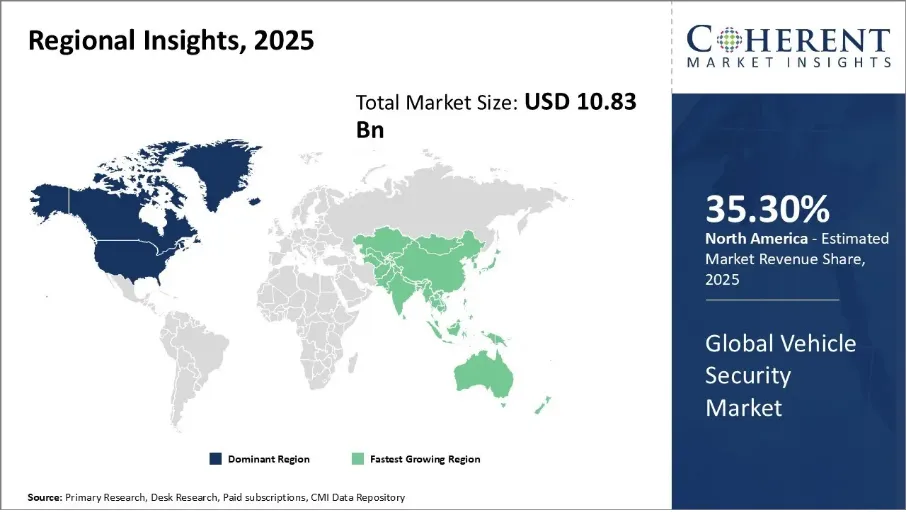
North America Vehicle Security Market
North America is expected to dominate the vehicle security market, holding a share of 35.30% in 2026. The region’s market dominance can be attributed to factors such as strong automotive industry presence, stringent vehicle safety regulations, and high consumer awareness. Major players like ONSTAR and LoJack have established themselves well in this region.
Asia Pacific Vehicle Security Market
The Asia Pacific region, holding a share of 26.8% in 2026, is expected to exhibit the fastest growth in the vehicle security landscape. This can be attributed to increasing vehicle ownership, growing middle-class population, and improving road infrastructure in emerging countries like China and India. Local giants, such as HPB and Fortune, are helping expand demand.
Vehicle Security Market In Europe
The vehicle security market in Europe is experiencing robust growth, driven by rising vehicle theft rates, increasing consumer awareness, and the integration of advanced security technologies such as immobilizers, biometric authentication, and AI-powered surveillance. Regulatory mandates across the region require automakers to incorporate robust security features, further propelling market expansion.
The market is also influenced by the rapid adoption of connected and software-defined vehicles, which has heightened the need for sophisticated cybersecurity solutions to protect against evolving digital threats.
Vehicle Security Market Dominating Countries
U.S Vehicle Security Market
The U.S. vehicle security market continues to witness strong demand for both basic and advanced security solutions, driven by rising vehicle theft rates and increasing consumer awareness. Leading companies, such as Viper and Directed, have introduced sophisticated alarm systems, remote start solutions, and GPS-based tracking devices to cater to high-value vehicle owners.
The presence of major automakers and aftermarket security providers has fostered an ecosystem where innovation in connected security solutions, including biometric authentication and AI-driven monitoring, is gaining traction. Additionally, local players such as LoJack and OnStar contribute to the market by offering advanced theft recovery and emergency response services, further enhancing vehicle security across the country.
India Vehicle Security Market
The market is also benefiting from the integration of advanced technologies such as AI and IoT, which are enabling more robust and intelligent security solutions. Luxury and premium vehicle manufacturers are leading the way in adopting biometric-based systems, which is influencing broader adoption across mid-range and budget vehicle segments.
Vehicle Security Market In China
China vehicle security market is expanding rapidly, fueled by rising personal incomes, increasing car ownership, and the growing demand for smart security solutions. International brands, such as Bosch, Valeo, and Continental, are actively investing in the country to capitalize on its massive automotive industry, while domestic manufacturers like Hikvision and Huawei are introducing AI-powered surveillance and cybersecurity solutions tailored to local needs.
The Chinese government has also implemented stricter regulations to enhance vehicle security, driving the demand for advanced anti-theft systems, GPS trackers, and biometric-based entry systems. Additionally, the integration of vehicle security solutions into the country's broader smart city initiatives is further boosting market growth.
Vehicle Security Market In Japan
Japan remains at the forefront of technological innovations in the vehicle security market, with a strong emphasis on high-quality, integrated security solutions. Established brands, such as Mitsubishi Electric, Pioneer, and Alpine, continue to develop advanced security systems that cater specifically to the country's unique automotive landscape, including keyless entry systems, advanced immobilizers, and in-car monitoring solutions.
Domestic players also leverage cutting-edge AI and IoT technologies to enhance security features, making Japan a leader in the development of next-generation vehicle protection. The nation's stringent safety regulations and consumer preference for high-tech solutions further accelerate the adoption of smart security features in both passenger and commercial vehicles.
Germany Vehicle Security Market Trends
Germany vehicle security market is supported by stringent regulations and a customer base that prioritizes high-quality safety and security features. The country is home to automotive powerhouses, such as Bosch, Continental, and Hella, which supply state-of-the-art security solutions, including electronic immobilizers, anti-theft alarms, and radar-based surveillance systems, to major global automakers.
The demand for premium and luxury vehicles in Germany has also driven innovation in high-end security systems, with local players developing advanced biometric access controls and AI-powered theft prevention technologies.
Additionally, German manufacturers are at the forefront of cybersecurity advancements for connected and autonomous vehicles, ensuring robust protection against digital threats and hacking attempts.
Market Report Scope
Vehicle Security Market Report Coverage
| Report Coverage | Details | ||
|---|---|---|---|
| Base Year: | 2025 | Market Size in 2026: | USD 11.50 Bn |
| Historical Data for: | 2020 To 2024 | Forecast Period: | 2026 To 2033 |
| Forecast Period 2026 to 2033 CAGR: | 6.4% | 2033 Value Projection: | USD 17.79 Bn |
| Geographies covered: |
| ||
| Segments covered: |
| ||
| Companies covered: | Continental AG, Delphi Automotive, Denso Corporation, Hella Kgaa Hueck & Co., Lear Corporation, Mitsubishi Electric Corporation, Robert Bosch GmbH, Tokai Rika Co., Ltd., Valeo SA, ZF TRW Automotive Holdings Corporation, Gentex Corporation, Visteon Corporation, Johnson Electric Holdings Limited, Aptiv PLC, and NXP Semiconductors | ||
| Growth Drivers: |
| ||
| Restraints & Challenges: |
| ||
Vehicle Security Market: Growth Drivers
- Increasing vehicle theft rates
With rising income levels and ownership of expensive luxury and high-end vehicles, vehicle theft has unfortunately become a serious problem. Criminals are increasingly targeting expensive cars knowing they can be dismantled and parts sold illegally. According to reports from law enforcement agencies worldwide, the theft of motor vehicles has been steadily increasing in the past decade. There are a few main factors driving this disturbing trend.
Firstly, sophisticated methods employed by organized crime networks have made it easier to bypass basic security measures in most cars. Secondly, developments in technology have given rise to a lucrative black market worldwide for spare car parts. This has motivated gangs to steal for profit. Lastly, inadequate penalties and lax law enforcement in some regions have meant vehicle theft does not carry much risk.
Vehicle owners, particularly those with high-value brands, now live with a constant fear of becoming a victim. Apart from the financial loss, getting one's car stolen can disrupt daily lives and transportation needs. The emotional trauma of such a violation should not be overlooked. With numbers expected to continue rising, strong security solutions have become paramount.
Customers are willing to pay more for advanced security controls as a way to deter potential thieves. This has opened up a huge business opportunity for automakers and third-party security system providers to develop sophisticated technologies that not only lock the car, but also track it in case of theft. Governments too have a role to play in curbing the demand side of this criminal industry through stricter laws and penalties.
Vehicle Security Market: Restraints
- High costs of advanced security systems
One of the major challenges currently being faced by the global vehicle security market is the high costs associated with advanced security systems. As automotive security technologies continue to advance with new cutting-edge features like biometric recognition, 360-degree surveillance cameras, and GPS fleet tracking; the costs of manufacture and installation of such systems is rising considerably.
While most consumers understand the importance of vehicle security and safety, many are unwilling or unable to pay premium prices for state-of-the-art security devices. Vehicle manufacturers and aftermarket security solution providers must strive to drive down costs through economies of scale, use of more affordable components, and competitive pricing strategies to make advanced security accessible for the average consumer. If costs remain prohibitively high, it could limit market growth and adoption rates of new vehicle security technologies.
Vehicle Security Market: Trends
The vehicle security market is characterized by several prominent trends shaping its rapid expansion. Growing concerns over vehicle theft and the rising demand for advanced safety features are major drivers, prompting widespread adoption of technologies such as biometric access systems, GPS tracking, and remote immobilization.
The increasing integration of advanced driver-assistance systems (ADAS) and connected car technologies is further fueling demand, as these innovations offer heightened protection against unauthorized access and theft. Regulatory mandates across key regions, including Europe and North America, are compelling automakers to incorporate robust security features, while insurance incentives are also encouraging adoption of immobilizers, alarms, and tracking systems.
Vehicle Security Market: Opportunities
- Integration of cybersecurity solutions in connected vehicles
One of the biggest opportunities for the global vehicle security market is in the integration of cybersecurity solutions within the rapidly growing segment of connected vehicles. As vehicles become increasingly automated and integrated with wireless networks, internet connectivity, and cloud-based services; the risks of cyber-attacks on critical systems are also rising.
Hackers can potentially access sensitive vehicle components and data like engine controls, braking mechanisms, location tracking, infotainment systems, and others through software vulnerabilities. This presents a massive market potential for automotive cybersecurity providers to develop and deploy endpoint protection, intrusion detection, identity and access management tools specially tailored for automotive networks and gateways.
By prioritizing vehicle cybersecurity early in the design stage of connected cars, manufacturers and technology vendors can capitalize on increasing consumer concerns about data privacy and system integrity.
Vehicle Security Market: Key Developments
- March 2025, Physical AI is unlocking new possibilities at the intersection of autonomy and robotics accelerating, in particular, the development of autonomous vehicles (AVs). The right technology and frameworks are crucial to ensuring the safety of drivers, passengers and pedestrians.
- May 2025, The rapid expansion of commercial space launch providers and innovations presents new opportunities to meet national security needs with greater speed, agility and resilience. This evolving launch landscape creates unprecedented potential for industry to play an integral role in delivering mission success, but it also raises the stakes for reliability and integration. The National Space Security Launch (NSSL) program is designed to meet these challenges by sustaining access to space through a broadened and reliable launch base.
- April 2025, Blue Origin won a contract to serve as a National Security Space Launch (NSSL) Phase 3 Lane 2 heavy-lift provider for the nation’s most critical missions. We’re proud to support the Department of Defense and the National Reconnaissance Office in this effort. The award marks an important step to expand the choice of launch providers and sustained competition for assured access to space.
Analyst Opinion
- The global vehicle security market is poised for steady growth, driven by increasing concerns over vehicle theft and the rising integration of connected vehicle technologies. As automotive manufacturers focus on smart security solutions, the demand for advanced anti-theft systems, biometric authentication, and cybersecurity measures is expected to rise.
- A major challenge for the market is the high cost associated with advanced vehicle security systems, which may limit adoption, particularly in price-sensitive markets. Additionally, technical failures or vulnerabilities in connected security solutions pose risks that could impact consumer trust.
- North America is anticipated to maintain its dominance in the vehicle security market, supported by high vehicle ownership rates, strong regulatory frameworks, and the presence of key market players. However, the Asia Pacific region is expected to witness the fastest growth, driven by increasing vehicle sales, urbanization, and growing consumer awareness of automotive security solutions.
Speak to the analyst
Want personalized insights?
Take the findings above to one of our principal consultants, or have the report rebuilt around the segments, geographies and competitors you actually track.
Market Segmentation
- Type Insights (Revenue, USD Bn, 2021 - 2033)
- Immobilizers
- Alarm Systems
- Remote Keyless Entry
- Passive Keyless Entry
- Central Locking Systems
- Application Insights (Revenue, USD Bn, 2021 - 2033)
- Passenger Vehicles
- Commercial Vehicles
- Regional Insights (Revenue, USD Bn, 2021 - 2033)
- North America
- U.S.
- Canada
- Latin America
- Brazil
- Argentina
- Mexico
- Rest of Latin America
- Europe
- Germany
- U.K.
- Spain
- France
- Italy
- Russia
- Rest of Europe
- Asia Pacific
- China
- India
- Japan
- Australia
- South Korea
- ASEAN
- Rest of Asia Pacific
- Middle East
- GCC Countries
- Israel
- Rest of Middle East
- Africa
- South Africa
- North Africa
- Central Africa
- North America
- Key Players Insights
- Continental AG
- Delphi Automotive
- Denso Corporation
- Hella Kgaa Hueck & Co.
- Lear Corporation
- Mitsubishi Electric Corporation
- Robert Bosch GmbH
- Tokai Rika Co., Ltd.
- Valeo SA
- ZF TRW Automotive Holdings Corporation
- Gentex Corporation
- Visteon Corporation
- Johnson Electric Holdings Limited
- Aptiv PLC
- NXP Semiconductors
Sources
Primary Research interviews
- OEM Security System Engineers
- Aftermarket Security Product Manufacturers
- Automotive Cybersecurity Experts
- Fleet Operators & Logistics Managers
- Automotive Insurance Analysts
- Car Dealership Owners
- Vehicle Telematics Providers
Databases
- IEEE Xplore
- Automotive World Data Centre
- IHS AutoTechInsight
- Global Trade Atlas
- UN Comtrade
- National Crime Records Bureau (India)
Magazines
- Automotive News
- Car and Driver
- Auto Express
- Autocar
- Motor Trend
- Top Gear Magazine
- Road & Track
Journals
- Journal of Transportation Technologies
- International Journal of Vehicle Safety
- Journal of Automotive Safety and Energy
- Journal of Transportation Security
- International Journal of Automotive Technology
- Sensors (MDPI)
Newspapers
- The Economic Times (Auto Section)
- The Hindu Business Line
- The Times of India (Auto)
- Business Standard (Auto)
- The Guardian (Mobility & Tech)
- Financial Times (Transport Section)
Associations
- International Association of Auto Theft Investigators (IAATI)
- European Automobile Manufacturers Association (ACEA)
- Automotive Component Manufacturers Association of India (ACMA)
- Japan Automobile Manufacturers Association (JAMA)
- Society of Indian Automobile Manufacturers (SIAM)
- National Highway Traffic Safety Administration (NHTSA)
- International Organization of Motor Vehicle Manufacturers (OICA)
Proprietary Elements
- CMI Data Analytics Tool, Proprietary CMI Existing Repository of information for last 8 years
*Definition: Vehicle Security refers to the comprehensive set of technologies, systems, and measures designed to protect vehicles from theft, unauthorized access, vandalism, and cyber threats. It encompasses physical security features such as immobilizers, alarms, locks, and surveillance systems, as well as digital protections like encryption, biometric authentication, GPS tracking, and cybersecurity protocols.
Get access to 250+ pages report
Every segment, forecast, competitor profile and data table behind the analysis above — available for instant download.
- ESOMAR Member
- ISO 9001:2015 Certified
- D-U-N-S Registered
- GDPR & CCPA Compliant
Missing comfort of reading report in your local language? Find your preferred language:
Transform your Strategy with Exclusive Trending Reports
Frequently Asked Questions
The global vehicle security market size is estimated to be valued at USD 10.83 Bn in 2025 and is expected to reach USD 16.50 Bn by 2032.
The CAGR of the global market is projected to be 6.2% from 2025 to 2032.
Increasing vehicle theft rates and advancements in automotive electronics are the major factors driving the growth of the global market.
High costs of advanced security systems and potential technical failures leading to vehicle lockouts are the major factors hampering the growth of the global market.
In terms of type, the immobilizers segment is estimated to dominate the market revenue share in 2025.
Continental AG, Delphi Automotive, Denso Corporation, Hella Kgaa Hueck & Co., Lear Corporation, Mitsubishi Electric Corporation, Robert Bosch GmbH, Tokai Rika Co., Ltd., Valeo SA, ZF TRW Automotive Holdings Corporation, Gentex Corporation, Visteon Corporation, Johnson Electric Holdings Limited, Aptiv PLC, and NXP Semiconductors are the major players.
North America is expected to lead the global market in 2025, holding a share of 35.3%.