

Intraoral Cameras Market Size and Forecast: 2026-2033
The Intraoral Cameras Market is estimated to be valued at USD 3.2 Bn in 2026 and is expected to reach USD 5.7 Bn by 2033, exhibiting a compound annual growth rate (CAGR) of 14.2% from 2026 to 2033.
Key Takeaways
- By Type, Fiber Optic Camera hold the largest market share of 41.3% in 2026 owing to the superior image quality & diagnostic precision.
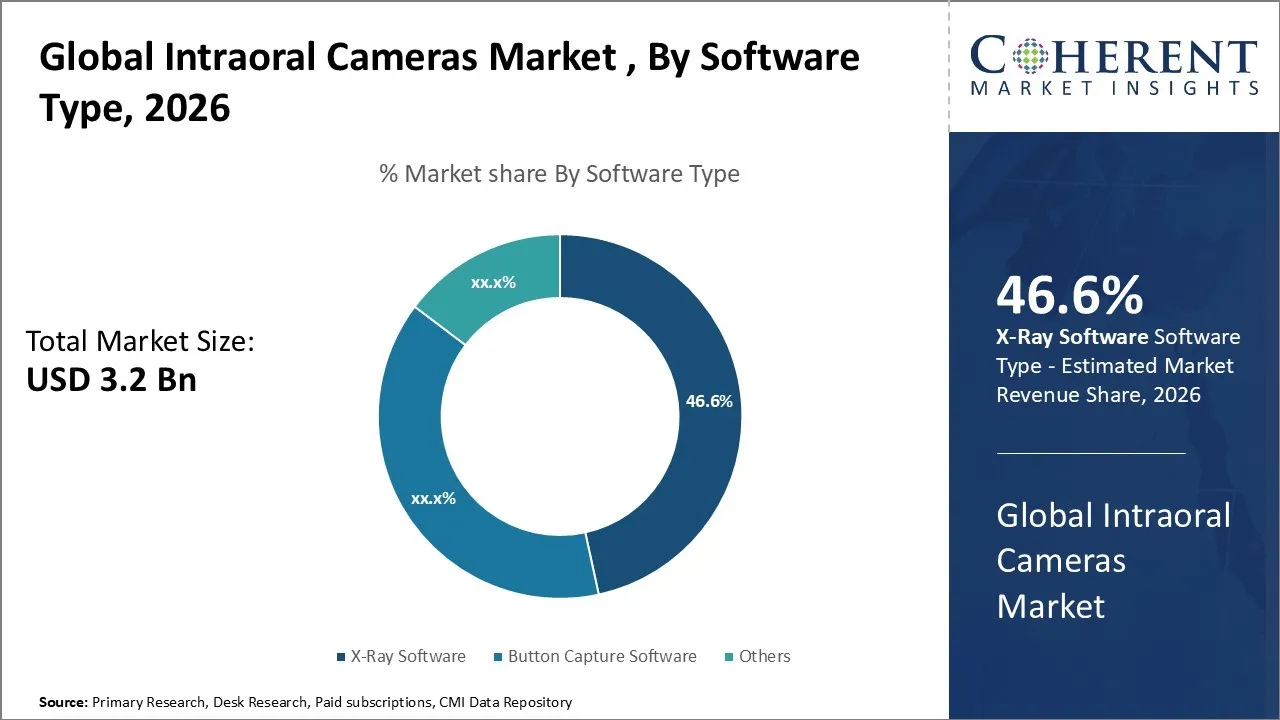
- By Software Type, X-Ray Software expected to hold largest market share of 46.6% in 2026 owing to its digital transformation of dental diagnostics.
- By Application, Implantology acquired the prominent market share of 39.4% in 2026 owing to the enhanced visualization for implant planning.
- By End User, Dental Hospitals and Clinics capture the largest market share of 33.3% in 2026 owing to the rising adoption of digital dentistry and advanced diagnostics.
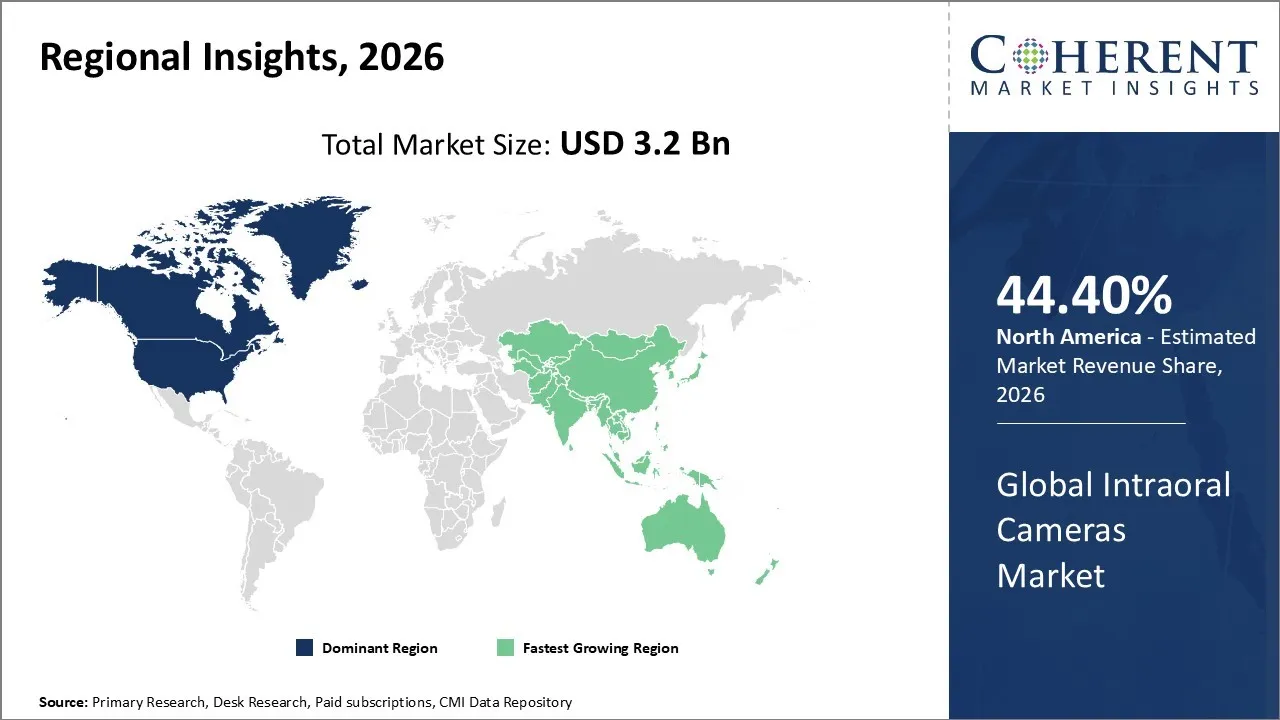
- By Region, North America dominates the overall market with an estimated share of 44.4% in 2026 owing to the well-established healthcare & dental infrastructure.
Market Overview
The intraoral cameras market continues to grow steadily as dental professionals increasingly adopt digital dentistry and seek advanced diagnostic tools. Dentists use intraoral cameras to capture real-time images, improve diagnostic accuracy, and clearly explain oral conditions to patients. Rising awareness of preventive dental care and the expansion of dental clinics further drive demand. Clinics also integrate these devices with imaging software and electronic records to streamline workflows. Ongoing innovations, including wireless technology and high-resolution imaging, further accelerate global adoption.
Current Events and their Impact on the Intraoral Cameras Market
Current Events | Description and its impact |
Geopolitical and Regulatory Developments |
|
Economic Trends and Healthcare Funding |
|
Industry Dynamics and Competitive Landscape |
|
Segmental Insights
- Current Industry Events of 2026
- Market Size Estimation
- Regional Breakdown
- Competitive Landscape
- Customer Intelligence
- Segmental Analysis
- Pricing Analysis
- Key Market Drivers, Challenges & Future Trends
- Customized Insights Section
Intraoral Cameras Market Insights, By Software Type - X-Ray Software contribute the highest share of the market owing to its workflow efficiency and practice productivity
X-Ray Software expected to hold largest market share of 46.6% in 2026. X-ray software fuels growth in the intraoral cameras market by enabling dentists to analyze, store, and retrieve images efficiently within digital workflows. Dentists use features like image enhancement, measurement tools, and comparison functions to boost diagnostic accuracy and plan treatments effectively. Integrating the software with practice management systems and electronic records streamlines clinical operations and improves data access. Increased attention to precise documentation, radiation safety, and clear patient communication further drives the adoption of advanced X-ray imaging solutions. For instance, in November 2024, Overjet launched IRIS, the first AI-powered dental imaging software that uses the cloud to simplify X-ray analysis, enhance diagnostic accuracy, and provide patients clearer insights into their oral health.
Intraoral Cameras Market Insights, By Type - Fiber Optic Camera contribute the highest share of the market owing to its increasing dental procedures & clinic expansion
Fiber Optic Camera hold the largest market share of 41.3% in 2026. The fiber optic camera segment drives growth in the intraoral cameras market by offering superior illumination and consistent image clarity during oral examinations. Dentists choose fiber optic technology because it delivers bright, focused lighting in hard-to-reach areas, enabling accurate detection of cavities, fractures, and soft tissue issues. Growing demand for precise diagnostics, minimally invasive treatments, and detailed patient documentation boosts adoption. Moreover, clinics upgrading to modern dental environments actively invest in dependable, high-performance imaging solutions. For instance, in February 2024, Philips unveiled a groundbreaking innovation in healthcare imaging. LumiGuide, utilizing Fiber Optic RealShape (FORS) technology, allows doctors to navigate blood vessels with light rather than relying on X-rays.
Intraoral Cameras Market Insights, By Application - Implantology contribute the highest share of the market owing to its monitoring implant healing & progress
Implantology acquired the prominent market share of 39.4% in 2026. Implantology boosts demand in the intraoral cameras market by giving dentists clear, detailed visuals for planning, placing, and following up on dental implants. Dentists use high-resolution imaging to evaluate bone structure, soft tissue, and implant alignment, ensuring precise and successful procedures. Intraoral cameras help clinicians document surgical results and track healing, enhancing patient care. They also improve communication by showing patients treatment progress, while modern digital implant workflows prompt clinics to adopt these imaging solutions for greater accuracy and efficiency.
Neoss Group, a pioneer in dental implant solutions, has released the NeoScan 2000, a fast, user-friendly wireless intraoral scanner, building on the success of last year’s NeoScan 1000.
Intraoral Cameras Market Insights, By End User - Dental Hospitals and Clinics contribute the highest share of the market owing to its enhanced patient communication and education
Dental Hospitals and Clinics capture the largest market share of 33.3% in 2026. Dental hospitals and clinics fuel growth in the intraoral cameras market by adopting advanced imaging tools to enhance patient care and optimize workflows. Dentists in these facilities capture clear oral images, improve diagnostic precision, and visually demonstrate conditions and treatments, increasing patient engagement and acceptance. The expansion of clinic networks, emphasis on accurate documentation, and integration with digital records drive further demand. Hospitals and multi-specialty clinics also invest in high-quality imaging systems to efficiently support a variety of dental procedures.
Regional Insights
North America Intraoral Cameras Market Trends
North America dominates the overall market with an estimated share of 44.40% in 2026. In North America, dental practices drive the intraoral cameras market by widely adopting digital dentistry and advanced imaging technologies. Clinicians use intraoral cameras to improve diagnostics, treatment planning, and patient communication. Growing emphasis on preventive care and cosmetic dentistry boosts demand for these devices. Practices integrate cameras with software and electronic records to streamline workflows and enhance efficiency. Ongoing innovations in high-resolution and wireless imaging prompt dental professionals to upgrade equipment and invest in the latest diagnostic solutions. For instance, in April 2025, ProDENT expanded into Vancouver, Canada, by introducing its advanced intraoral camera technology to enhance dentists’ diagnostic precision and oral health assessments.
Asia Pacific Intraoral Cameras Market Trends
Dental clinics across the Asia Pacific drive growth in the intraoral cameras market by expanding dental infrastructure and promoting oral health awareness, particularly in countries like China, India, Japan, and Southeast Asian nations. Clinics increasingly install imaging devices to address rising patient demand for preventive and cosmetic treatments. Affordable USB and portable wireless cameras gain popularity, while growing middle-class incomes and dental tourism further boost adoption. Additionally, integrating cameras with digital workflows and government efforts to improve access to modern dental technology support market expansion.
United States Intraoral Cameras Market Trends
Dental practices in the United States drive the intraoral cameras market by adopting high‑definition, advanced imaging devices to enhance diagnosis, treatment planning, and patient communication. Clinicians integrate these cameras with digital workflows and practice management systems to streamline operations and improve recordkeeping. Rising awareness of oral health and the need to manage prevalent dental conditions increase demand for detailed imaging. Manufacturers continuously release innovative features, prompting dentists to upgrade equipment and modernize their clinics across the country. For instance, in June 2024, Aseptico unveiled the GO Ultra Portable Dental System, featuring an integrated piezoelectric ultrasonic scaler, to enhance dental hygiene in mobile settings such as nursing homes and in-home care.
China Intraoral Cameras Market Trends
Dental clinics and hospitals in China drive the intraoral cameras market by adopting imaging devices as they expand modern dental infrastructure and promote oral health awareness. Facilities increasingly install high-resolution and portable systems to support preventive care, diagnostics, and cosmetic treatments. Growing middle-class incomes and wider access to advanced dental technology encourage practices to invest in digital tools. Additionally, integrating cameras with practice management software and government initiatives to improve access to modern diagnostic equipment further strengthens market growth across the country.
End-user Feedback and Unmet Needs in the Intraoral Cameras Market
- Image Quality and Clarity: Dental professionals often praise intraoral cameras for convenience but report that some models provide insufficient resolution or uneven illumination. High-detail imaging is critical for detecting subtle caries, cracks, or soft tissue abnormalities. Users seek cameras with consistent brightness, sharper focus, and real-time clarity for better diagnostics and patient education.
- Ergonomics and Handling: Clinicians highlight challenges with bulky or poorly balanced devices, especially during long procedures or in posterior oral areas. End-users desire lightweight, ergonomically designed cameras with flexible heads or smaller tips, enabling comfortable handling, precise positioning, and reduced hand fatigue during extended use in diverse dental treatments.
- Software Integration and Compatibility: Users report difficulties in integrating intraoral cameras with existing practice management systems or electronic health records. Seamless compatibility, intuitive interfaces, and efficient image transfer are unmet needs. Dental practices seek cameras that easily sync with multiple platforms, support cloud storage, and offer AI-assisted analysis to enhance workflow efficiency and documentation.
Intraoral Cameras Market Trend
Shift Toward Digital Dentistry
Dental practices increasingly adopt intraoral cameras as part of a broader move to digital dentistry. These devices integrate with imaging software, electronic health records, and treatment planning tools, enabling faster, more accurate diagnostics. Clinicians rely on digital imaging to enhance patient communication, streamline workflow, and document treatments. This shift encourages investment in high-resolution and wireless cameras, transforming traditional procedures into more efficient, patient-friendly, and technology-driven dental care models across clinics and hospitals.
Rising Demand for Preventive and Cosmetic Dentistry
Preventive care and cosmetic procedures are gaining popularity, driving intraoral camera adoption. Dentists use cameras to detect early-stage caries, assess soft tissue, and plan cosmetic treatments like veneers or whitening. Clear visualizations improve patient understanding and treatment acceptance. Clinics increasingly leverage intraoral cameras to document procedures, track results over time, and enhance patient satisfaction. This trend highlights the role of imaging technology in proactive oral health management and aesthetic dental solutions.
Intraoral Cameras Market Opportunity
Adoption of Wireless and Portable Devices
The growing preference for compact, wireless intraoral cameras presents significant market opportunities. Dental clinics and mobile practices seek devices that are easy to maneuver, reduce clutter, and allow imaging in hard-to-reach areas. Portable cameras enable off-site diagnostics, dental camps, and home visits, expanding service capabilities. Manufacturers can capitalize on this demand by offering lightweight, high-resolution, battery-efficient models with intuitive controls that enhance clinician mobility and patient convenience while maintaining image quality.
Market Report Scope
Intraoral Cameras Market Report Coverage
| Report Coverage | Details | ||
|---|---|---|---|
| Base Year: | 2025 | Market Size in 2026: | USD 3.2 Bn |
| Historical Data for: | 2020 To 2024 | Forecast Period: | 2026 To 2033 |
| Forecast Period 2026 to 2033 CAGR: | 14.2% | 2033 Value Projection: | USD 5.7 Bn |
| Geographies covered: |
| ||
| Segments covered: |
| ||
| Companies covered: | Danaher Corporation, Sirona Dental System, Carestream Health, Gendex, Owandy Radiology, TPC Advanced Technology Inc., Digital Doc LLC, Shofu Dental Corporation, Polaroid, Flight Dental Systems, Imagin Systems Corporation, Rolence Enterprise Inc., Acteon, Dentsply Sirona, Royal Dental, TPC Advanced Technology, Durr Dental, and PhotoMed. | ||
| Growth Drivers: |
| ||
| Restraints & Challenges: |
| ||
Intraoral Cameras Market News
- In June 2024, OMNIVISION launched the OCH2B30 camera module for 3D intraoral scanners, featuring a compact 2.6 mm × 2.6 mm CameraCubeChip design, high image quality, and MIPI interface for benchtop, standalone, and portable dental scanners.
- In April 2025, ACTEON launched the C20 full HD intraoral camera with AIS 5.5 software, combining advanced imaging and intuitive design to help dentists deliver superior patient care and modernize their practices.
Analyst Opinion (Expert Opinion)
- Intraoral imaging has clearly shifted from a niche accessory to a core diagnostic tool embedded in everyday dental workflows, with over 80 % of U.S. clinics now equipped with digital imaging systems that routinely include intraoral cameras, reflecting a fundamental change in how oral health is assessed and communicated to patients. Unlike older reliance on mirrors and basic visual inspection, many practices now report intraoral cameras being used in approximately 70 % of patient consultations, underscoring their integration into both routine and complex care.
- Clinics’ increasing emphasis on patient engagement and documentation is driving adoption beyond general dentistry into specialties such as orthodontics and implantology, where imaging plays a practical role in treatment planning and longitudinal tracking. In Asia‑Pacific markets, deployment of these systems surged nearly 28 % between 2021 and 2023, illustrating that broader awareness and investment in dental infrastructure are leaving mid‑tier clinics no choice but to modernize or risk competitive disadvantage.
- However, this expansion is uneven. Smaller clinics, especially in price sensitive regions, still cite cost barriers and training gaps that restrict uptake of higher‑end models and software integrations, limiting the full potential of intraoral imaging in global dental workflows.
Speak to the analyst
Want personalized insights?
Take the findings above to one of our principal consultants, or have the report rebuilt around the segments, geographies and competitors you actually track.
Market Segmentation
- By Type
- USB Camera
- Fiber Optic Camera
- Wireless Camera
- Others
- By Software Type
- X-Ray Software
- Button Capture Software
- Others
- By Application
- Implantology
- Endodontic
- Oral and Maxillofacial Surgery
- Orthodontics
- Others
- By End User
- Dental Hospitals and Clinics
- Dental Diagnostic Centers
- Dental Academic and Research Institutes
- Others
- By Regional Insights
- North America
- U.S.
- Canada
- Latin America
- Brazil
- Argentina
- Mexico
- Rest of Latin America
- Europe
- Germany
- U.K.
- Spain
- France
- Italy
- Russia
- Rest of Europe
- Asia Pacific
- China
- India
- Japan
- Australia
- South Korea
- ASEAN
- Rest of Asia Pacific
- Middle East
- GCC Countries
- Israel
- Rest of Middle East
- Africa
- South Africa
- North Africa
- Central Africa
- North America
- Key Players Insights
- Danaher Corporation
- Sirona Dental System
- Carestream Health
- Gendex
- Owandy Radiology
- TPC Advanced Technology Inc.
- Digital Doc LLC
- Shofu Dental Corporation
- Polaroid
- Flight Dental System
- Imagin Systems Corporation
- Rolence Enterprise Inc.
- Acteon
- Dentsply Sirona
- Royal Dental
- TPC Advanced Technology
- Durr Dental
- PhotoMed
Sources
Primary Research interviews
- Interviews with practicing dentists and dental hygienists regarding imaging preferences and intraoral camera usage (e.g., clinical evaluation of restorations and plaque using intraoral camera)
- Discussions with dental clinic administrators on integration with practice management systems and digital workflows
Databases
- PubMed (biomedical literature including studies on intraoral camera diagnostic accuracy)
- Ovid (Journal of Evidence-Based Dental Practice diagnostics research)
- National Library of Medicine and MEDLINE indexed articles on dental imaging technology
Magazines
- British Dental Journal articles on intra‑oral camera applications and future directions
- Specialty dental practice magazines featuring clinical case studies of intraoral imaging in diagnostics and patient engagement
Journals
- IIUM Journal of Orofacial and Health Sciences comparative imaging quality research
- Journal of Dental Sciences pilot studies on image quality in dental photography
- Journal of Evidence-Based Dental Practice diagnostic accuracy studies involving intraoral cameras
Newspapers
- National and regional healthcare coverage on advancements in dental technologies and digital imaging adoption trends (e.g., integrated imaging in oral health reporting)
- Press reports on tele‑dentistry studies involving intraoral imaging
Associations
- American Dental Association clinical guidelines on dental imaging standards and documentation practices
- Dental associations’ white papers on best practices for intraoral imaging and patient communication
Public Domain sources
- Wikipedia entry on intraoral cameras describing imaging features and clinical applications
- Open access book chapters on the application of intra‑oral cameras in dentistry
Proprietary Elements
- CMI Data Analytics Tool
- Proprietary CMI Existing Repository of information for last 8 years
Get access to 250+ pages report
Every segment, forecast, competitor profile and data table behind the analysis above — available for instant download.
- ESOMAR Member
- ISO 9001:2015 Certified
- D-U-N-S Registered
- GDPR & CCPA Compliant
Missing comfort of reading report in your local language? Find your preferred language:
Transform your Strategy with Exclusive Trending Reports
Frequently Asked Questions
The Intraoral Cameras Market is estimated to be valued at USD 3.2 Bn in 2026 and is expected to reach USD 5.7 Bn by 2033.
Factors such as a rise in the prevalence of dental diseases and increasing technological advancements in intraoral cameras are expected to drive the market growth over the forecast period.
The Fiber Optic Camera segment is expected to hold a major market share during the forecast period.
The major factors hampering the growth of the market include the shortage of dental radiologists to meet the increasing demand for imaging services.
Major players operating in the market are Danaher Corporation, Sirona Dental System, Carestream Health, Gendex, Owandy Radiology, TPC Advanced Technology Inc., Digital Doc LLC, Shofu Dental Corporation, Polaroid, Flight Dental Systems, Imagin Systems Corporation, Rolence Enterprise Inc., Acteon, Dentsply Sirona, Royal Dental, TPC Advanced Technology, Durr Dental, and PhotoMed