

Global Vehicle to Load Market Size and Forecast – 2026-2033
The Global Vehicle to Load Market is estimated to be valued at USD 3.12 Bn in 2026 and is expected to reach USD 18.56 Bn by 2033, exhibiting a compound annual growth rate (CAGR) of 29.0% from 2026 to 2033.
Key Takeaways of the Global Vehicle to Load Market
- The low-power (≤ 3 kW) segment leads the market holding an estimated share of 48.4% in 2026.
- The residential segment is projected to dominate with a share of 47.7 % in 2026.
- The OEM segment leads the market holding an estimated share of 68.9 % in 2026.
- North America, holding a share of 39.4 % in 2026, is anticipated to dominate the market.
- Europe, holding a share of 22.6 % in 2026, is projected to show the fastest growth in the market.
Market Overview
Market trends indicate a significant shift towards integrated vehicle-to-load systems that enable electric vehicles to supply power externally to various devices and infrastructures. Growing investments in renewable energy integration and smart grid technologies are pushing innovation in this market. Also, the growing electric vehicle fleet worldwide is driving the demand for reliable and versatile V2L solutions. These are being added to improve vehicle utility, contributing to sustainable urban energy ecosystems.
Current Events and Its Impact
Current Events | Description and its Impact |
Geopolitical and Trade Developments |
|
Economic and Industrial Trends |
|
Segmental Insights
- Current Industry Events of 2026
- Market Size Estimation
- Regional Breakdown
- Competitive Landscape
- Customer Intelligence
- Segmental Analysis
- Pricing Analysis
- Key Market Drivers, Challenges & Future Trends
- Customized Insights Section
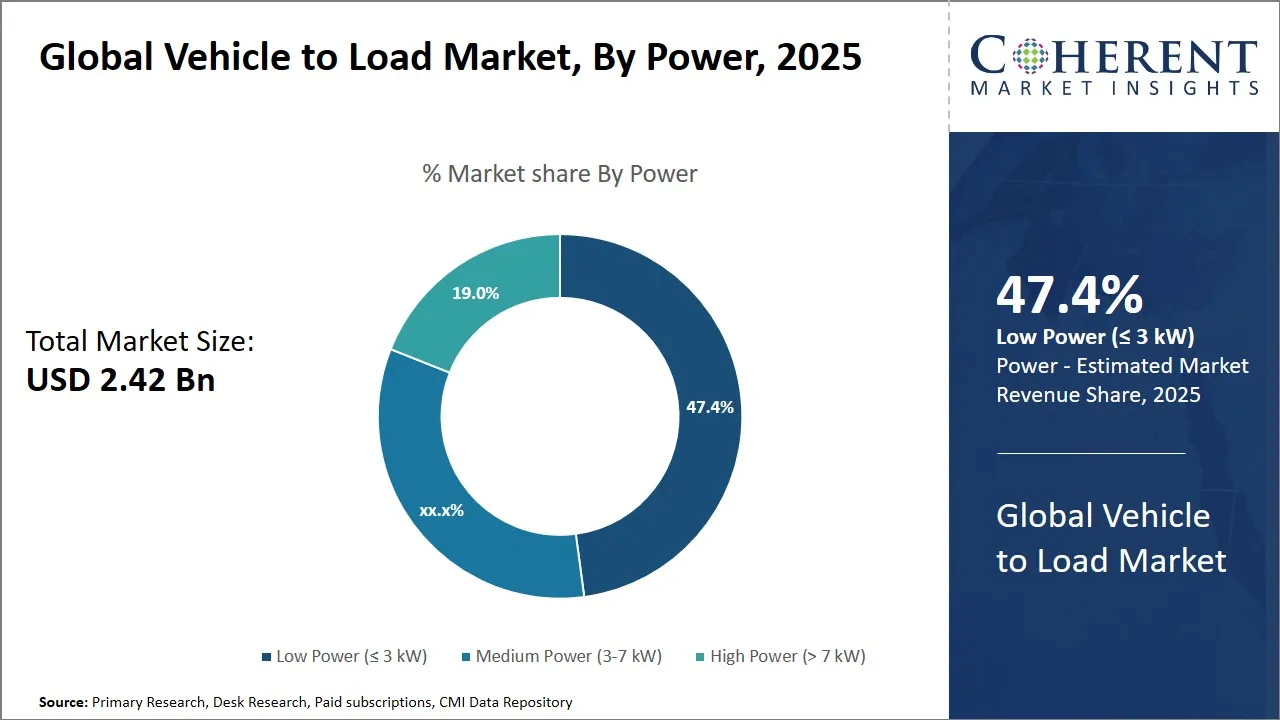
Global Vehicle to Load Market Insights, By Power – Low Power (≤ 3 kW) Dominates Because of its Versatility and Accessibility
The low power (≤ 3 kW) segment is expected to account for 48.4% of the global vehicle to load market in 2026 because of its adaptability in compact and mid-size EVs. These systems suit everyday needs like charging small appliances, laptops, or camping gear, making them ideal for urban and off-grid users. Their affordability and ease of integration help automakers add Vehicle to Load (V2L) without any big redesigns or battery strain. Hyundai’s Ioniq 5 offers 3.6 kW V2L output, allowing users to power outdoor equipment and household devices.
Global Vehicle to Load Market Insights, By Application – Residential Application Leads Because of Increasing Home Energy Management Needs
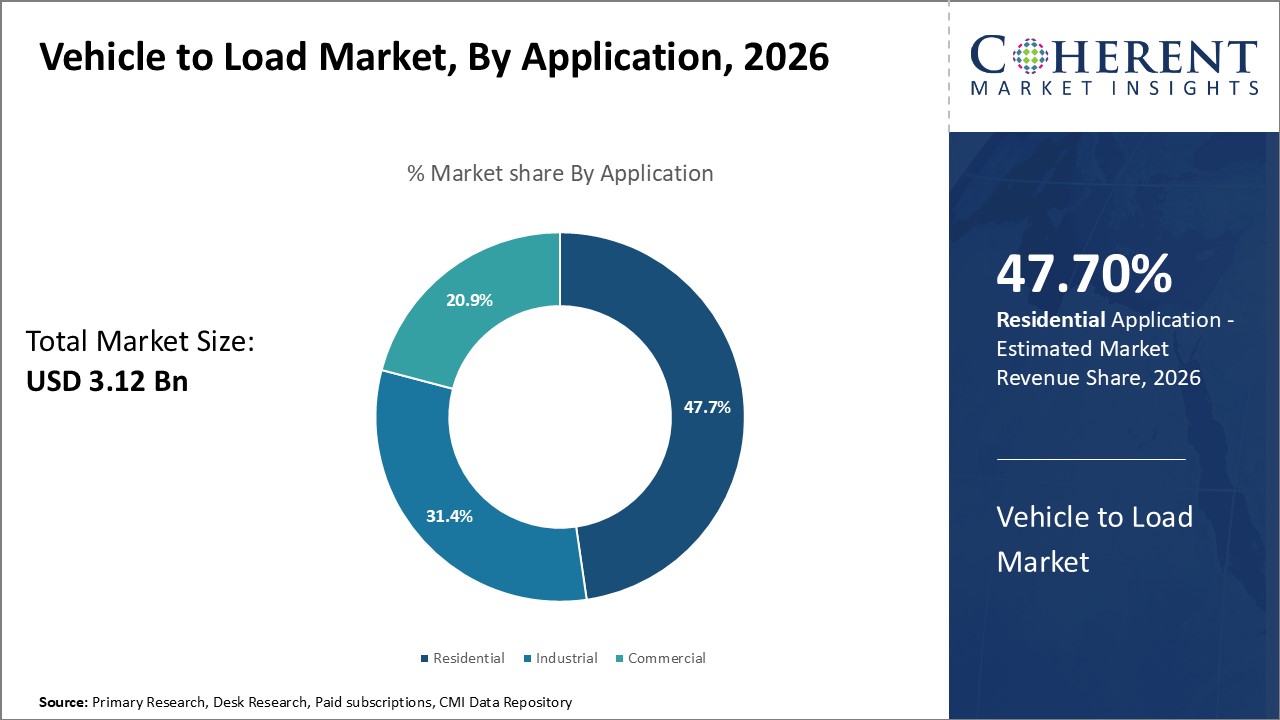
The residential segment is projected to lead with a 47.7% share in 2026 because of the rise of home energy management and renewable adoption. V2L allows EVs to serve as mobile energy storage systems, giving backup during grid instability or peak pricing. Integration with smart home systems improves control and energy optimization. In Japan, Nissan’s Leaf V2L system is used in homes to supply backup power during blackouts, showing strong residential adoption supported by government energy resilience programs.
Global Vehicle to Load Market Insights, By End User – OEM Segment Drives Growth Because of its Integrated Solutions and Innovation Focus
The OEM segment is expected to dominate with a 68.9% share in 2026 because of manufacturers adding V2L features directly to EV design for reliability and seamless user experience. OEMs use R&D and partnerships to give bidirectional power innovations for smart grid integration. Ford’s F-150 Lightning uses factory-installed V2L technology (“Intelligent Backup Power”) that can power an entire home for several days.
Impact of AI on the Global Vehicle to Load Market
Artificial Intelligence (AI) is improving the efficiency, reliability, and adaptability of V2L systems. By using AI algorithms, electric vehicles (EVs) can manage energy distribution, optimizing when and how power is supplied to external devices. This ensures that the vehicle’s battery is used efficiently while maintaining sufficient reserve for driving, reducing energy waste.
Also, AI-driven predictive analytics can predict power demands based on usage patterns and environmental conditions, making possible smarter load management in real time. Such automation improves user experience, making V2L systems more practical for both emergency power supply and daily consumer electronics charging.
Hyundai’s Ioniq 5 uses AI-based energy management to optimize V2L functionality. The system automatically adjusts power output based on connected devices, ambient temperature, and remaining battery capacity. This allows the vehicle to safely power external appliances, tools, or even home devices.
Regional Insights
North America Vehicle to Load Market Analysis and Trends
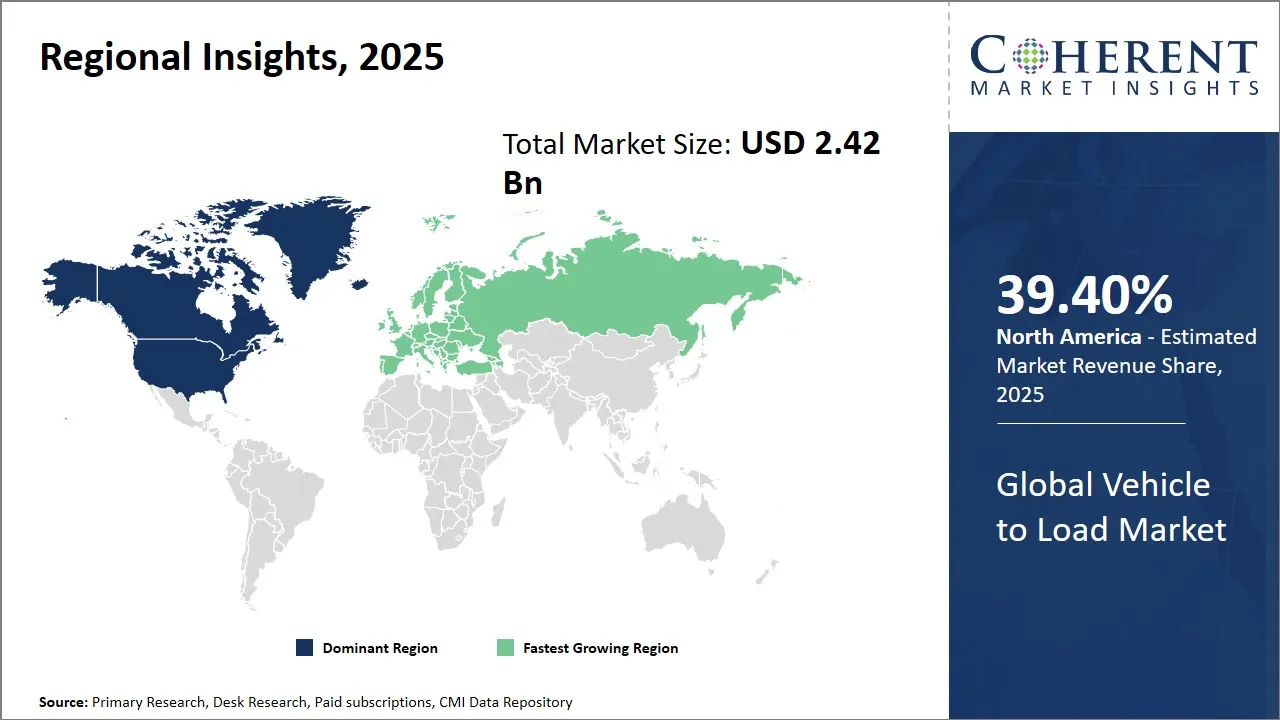
North America, holding a share of 39.4% in 2026, is expected to dominate the vehicle to load market because of a mature automotive ecosystem seeing a lot of adoption of electric vehicles (EVs), advanced infrastructure, and strong consumer awareness about energy efficiency and sustainability. The region sees strong government policies supporting EV adoption, including incentives for electric vehicle purchases, infrastructure grants for public charging stations, and mandates for cleaner transportation solutions.
These policies push automakers and technology providers to innovate in V2L technologies, supporting vehicle-to-grid (V2G) and vehicle-to-load functionalities. A strong presence of leading automotive and technology companies, like Tesla, General Motors, and Ford, add to market development. For instance, Ford’s F-150 Lightning shows real-world V2L applications, allowing users to power homes or tools during outages.
These players invest a lot in advanced battery management systems and V2L-enabled EV models that appeal to both residential and commercial users. The developed trade dynamics and the presence of advanced supply chains support swift R&D cycles and deployment, fostering North America’s position as the market leader.
Europe Vehicle to Load Market Analysis and Trends
Europe, holding a share of 22.6%, is projected to show the fastest growth in the vehicle to load market, driven by strong policy alignment with sustainability goals and the rapid expansion of EV infrastructure. The European Union’s Fit for 55 and Green Deal initiatives have put in place ambitious decarbonization targets, encouraging automakers to integrate bidirectional charging and V2L capabilities into their electric vehicle portfolios. Countries such as Germany, the Netherlands, Norway, and the UK are leading adoption through pilot programs that link V2L-enabled EVs with residential energy systems and national grids.
A strong regulatory ecosystem and high consumer environmental awareness has pushed investment in smart charging networks and energy management platforms. European automakers like Volkswagen, Renault, Stellantis, and BMW are collaborating with grid operators and tech firms to deploy V2L-ready models and chargers. Also, the region’s focus on energy independence and renewable integration—especially following recent energy security challenges—has positioned V2L as a practical solution for grid stability and household resilience.
Vehicle to Load Market Outlook for Key Countries
U.S. Vehicle to Load Market Analysis and Trends
The U.S. vehicle to load market sees a lot of government focus on energy independence and renewable integration. Federal and state incentives make consumer demand for electric vehicles equipped with V2L features. Tesla, Rivian, and Ford push V2L capabilities, with Tesla’s Powerwall integrations and Ford’s recent F-150 Lightning model offering bi-directional charging functions.
China Vehicle to Load Market Analysis and Trends
China vehicle to load market sees growth because of decisive government policies that mandate cleaner transportation and enhance grid stability through V2L and V2G tech integration. Leading local manufacturers like BYD, NIO, and XPeng are advancing V2L applications in their EV portfolios, leveraging China’s extensive EV infrastructure.
Germany Vehicle to Load Market Analysis and Trends
Germany continues to lead Europe in vehicle electrification and advanced automotive technologies. With high support from the European Union’s Green Deal and national initiatives, German automakers like Volkswagen, BMW, and Mercedes-Benz invest a lot in V2L functionalities to complement their expanding EV fleets. The presence of a mature automotive supply chain and a strong innovation ecosystem focused on energy storage solutions adds to the use of V2L systems. Germany’s role in shaping EU policies also makes possible supportive trade and regulatory conditions for V2L products.
Japan Vehicle to Load Market Analysis and Trends
Japan sees strong expertise in hybrid and electric vehicle technology, with companies like Toyota and Honda offering advanced battery management systems for V2L applications. The government’s focus on energy resilience and smart city initiatives adds to the adoption of V2L-enabled vehicles. Also, collaboration between automotive and electronics sectors adds to continuous innovation. Japan’s unique grid infrastructure and historical interest in efficient energy systems make a supportive environment for V2L market growth.
South Korea Vehicle to Load Market Analysis and Trends
South Korea sees a lot of R&D investments from leading automotive giants such as Hyundai and Kia, who are integrating V2L features as part of their strategic EV product lines. The government’s push for green mobility and smart grid technologies makes a lot of demand for V2L capabilities. South Korea’s advanced semiconductor and battery manufacturing industries complement automotive innovations, enabling seamless integration of V2L solutions. Also, partnerships with technology startups and energy companies add to market expansion.
Market Players, Key Development, and Competitive Intelligence
Key Developments
- In November 2024, BYD, the world’s leading manufacturer of new-energy vehicles, introduced the BYD SEALION 7 to European customers. Combining sporty performance, a stylish SUV design, cutting-edge EV technology, a beautifully finished, spacious cabin, a smarter in-car interface and the long-distance security of charging speeds of up to 230 kW, the new model extends the reach of BYD in the European car market.
- In February 2025, in the U.S., Kia introduced a vehicle-to-home (V2H) service – in seven states to be precise (California, Washington, New York, Florida, Texas, New Jersey and Illinois). With this service, the Kia EV9 can act as an energy storage device in a smart home ecosystem or as an emergency power source in the event of power outages.
- In October 2024, Nissan announced it will launch affordable bi-directional charging on selected electric vehicles in 2026.
- In May 2024, Motor Co announced that its customers can use Tesla's TSLA.O electric-vehicle charging network, opening more than 12,000 Tesla Superchargers to drivers of Ford vehicles in North America.
Top Strategies Followed by the Vehicle to Load Market Players
- Established players dominate the sector because of huge investments in research and development to create high-performance, reliable, and innovative V2L products that meet evolving consumer demands.
- Ford Motor Company has invested in advanced V2L-enabled electric vehicles like the Ford F-150 Lightning, which integrates a 9.6 kW V2L system capable of powering home appliances, tools, and outdoor equipment.
- Mid-level players in the V2L market use different approaches for balancing cost and quality to target more price-sensitive segments.
- MG Motor offers electric vehicles like the MG ZS EV with V2L functionality at a relatively lower price point compared to premium EVs.
- Small-scale players make their niches by targeting specialized segments or offering innovative and technologically advanced products that larger companies may miss.
- Zero EV (Australia) focuses on compact electric utility vehicles equipped with V2L capabilities tailored for off-grid and recreational use, such as camping and remote work applications.
Market Report Scope
Vehicle to Load Market Report Coverage
| Report Coverage | Details | ||
|---|---|---|---|
| Base Year: | 2025 | Market Size in 2026: | USD 3.12 Bn |
| Historical Data for: | 2020 To 2024 | Forecast Period: | 2026 To 2033 |
| Forecast Period 2026 to 2033 CAGR: | 29.0% | 2033 Value Projection: | USD 18.56 Bn |
| Geographies covered: |
| ||
| Segments covered: |
| ||
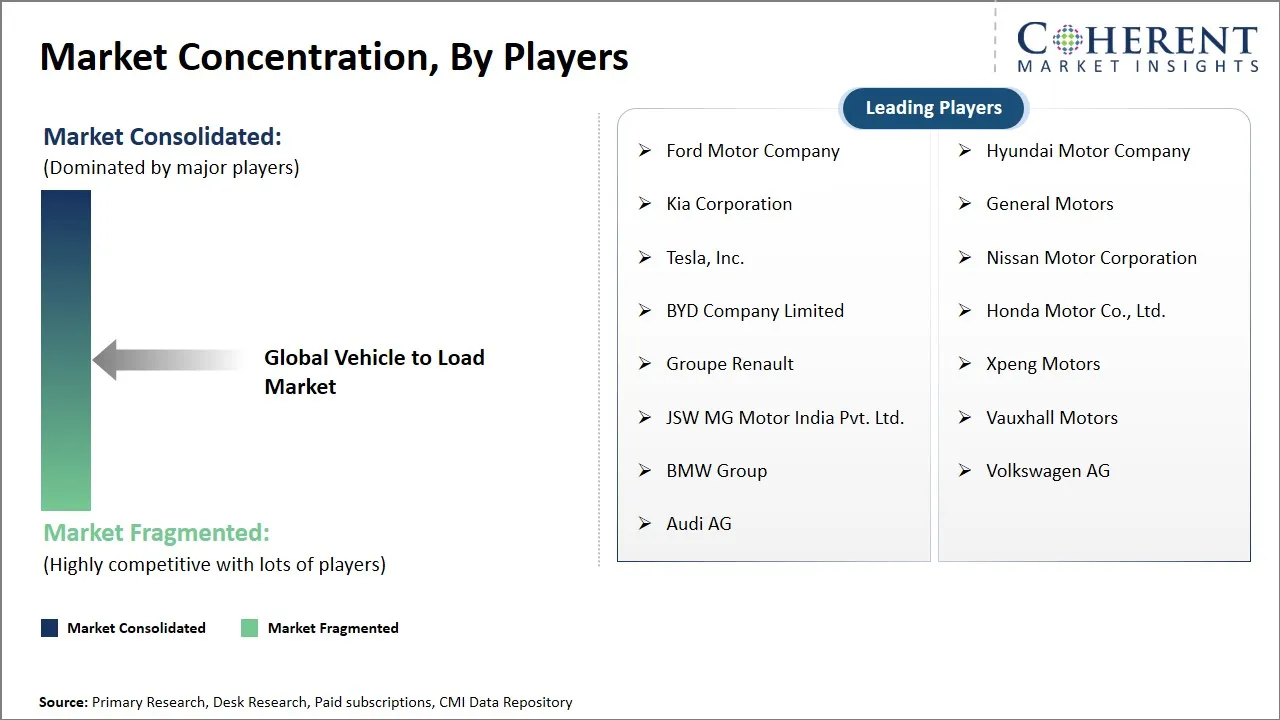
| Companies covered: | Ford Motor Company, Hyundai Motor Company, Kia Corporation, General Motors, Tesla, Inc., Nissan Motor Corporation, BYD Company Limited, Honda Motor Co., Ltd., Groupe Renault, Xpeng Motors, JSW MG Motor India Pvt. Ltd., Vauxhall Motors, BMW Group, Volkswagen AG, and Audi AG | ||
| Growth Drivers: |
| ||
| Restraints & Challenges: |
| ||
Market Dynamics
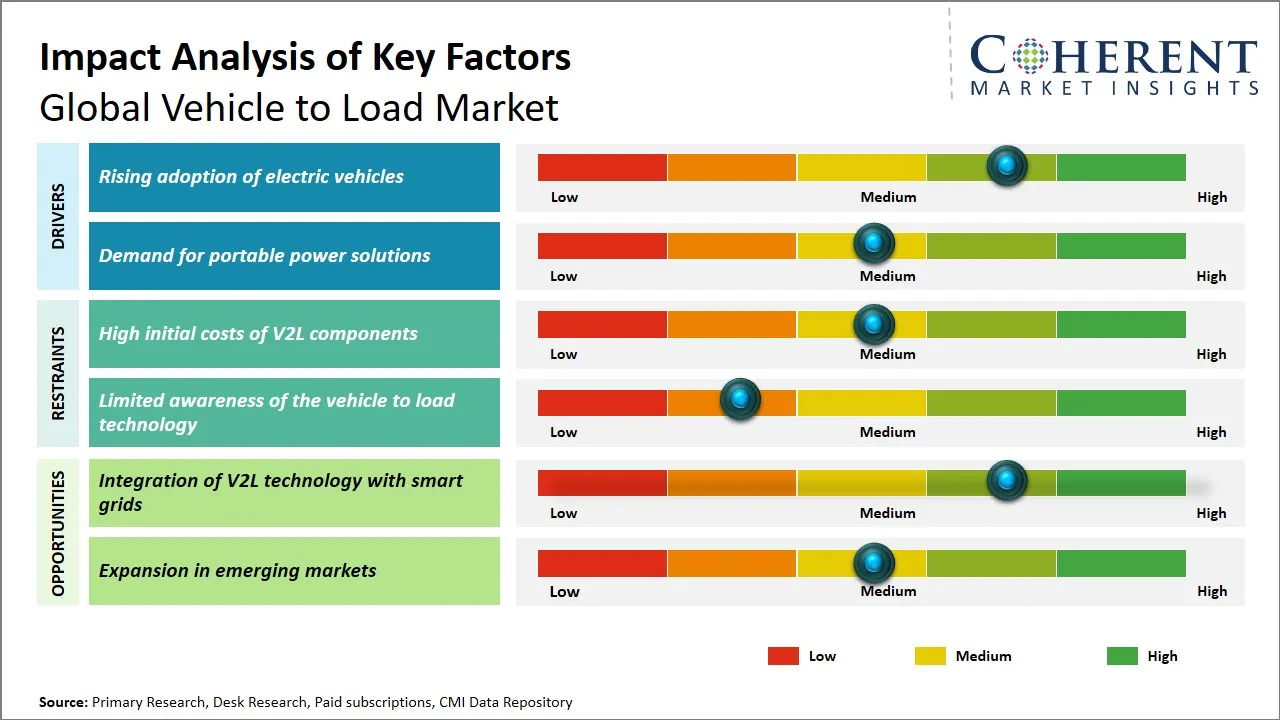
Global Vehicle to Load Market Driver – Rising Adoption of Electric Vehicles
The increasing adoption of electric vehicles (EVs) is making a lot of demand for vehicle-to-load (V2L) technology, as consumers and industries seek versatile energy solutions that extend beyond traditional transportation. As EVs become more common, the ability to use these vehicles as mobile power sources is gaining a lot of traction. This dual functionality improves the practical utility of EVs, making them not just a mode of transport, but also a reliable energy reservoir.
Hyundai’s IONIQ 5 comes with factory-integrated V2L capability, allowing users to power appliances, camping equipment, or even another EV. Also, the move towards renewable energy and sustainable practices push the use of V2L systems, as they enable users to optimize energy use and promote energy independence. Automakers and technology developers are increasingly incorporating V2L features to meet evolving consumer preferences for multi-functional electric vehicles, thereby bolstering the adoption of EVs and accelerating innovation in complementary power transfer technologies.
Global Vehicle to Load Market Opportunity – Integration of V2L technology with smart grids
The integration of Vehicle-to-Load (V2L) technology with smart grids represents a big growth opportunity in the global V2L market. As smart grid infrastructure advances worldwide, the capability for electric vehicles (EVs) to act as decentralized energy storage assets and supply power back to the grid becomes increasingly feasible and attractive. V2L-enabled EVs can discharge stored energy to support grid stability during peak demand periods or outages, functioning as mobile energy reservoirs. This symbiotic relationship improves grid resilience, promotes renewable energy utilization, and optimizes energy distribution efficiency.
Japan’s TEPCO has been piloting programs that connect Nissan LEAFs to the power grid using bi-directional charging systems to stabilize energy flow during high-demand periods. Also, utility companies are pushing the adoption of V2L-enabled vehicles with demand response programs and financial compensation models.
Technological advancements in bi-directional charging systems and communication protocols are facilitating seamless real-time energy exchange between vehicles and smart grids, enhancing system interoperability and user experience. Furthermore, government policies promoting sustainable energy solutions and smart city initiatives are expected to accelerate investments toward V2L-smart grid integrations, creating a lucrative environment for manufacturers and service providers in the V2L ecosystem.
Analyst Opinion (Expert Opinion)
- Everyday consumers are increasingly valuing the ability to power home appliances, laptops, and personal electronics directly from their EVs. This use case will continue to dominate V2L adoption, as convenience and off-grid capabilities become non-negotiable features for EV buyers, particularly in regions with intermittent electricity supply.
- V2L’s potential to serve as a backup energy source during blackouts or natural disasters cannot be overstated. From my perspective, this segment is underappreciated by the broader market; as awareness grows, emergency power applications will become a critical factor driving EV purchase decisions in both developed and emerging markets.
- While consumer adoption is important, the real untapped opportunity lies in industrial and commercial deployments—powering tools, equipment, and temporary site operations. Analysts like myself believe this use case could rapidly accelerate V2L integration, particularly in construction, outdoor events, and mobile businesses, where traditional generators are cumbersome or cost-prohibitive.
Speak to the analyst
Want personalized insights?
Take the findings above to one of our principal consultants, or have the report rebuilt around the segments, geographies and competitors you actually track.
Market Segmentation
- Power Insights (Revenue, USD Bn, 2021 - 2033)
- Low Power (≤ 3 kW)
- Medium Power (3–7 kW)
- High Power (> 7 kW)
- Application Insights (Revenue, USD Bn, 2021 - 2033)
- Residential
- Industrial
- Commercial
- End User Insights (Revenue, USD Bn, 2021 - 2033)
- OEM
- Aftermarket
- Regional Insights (Revenue, USD Bn, 2021 - 2033)
- North America
- U.S.
- Canada
- Latin America
- Brazil
- Argentina
- Mexico
- Rest of Latin America
- Europe
- Germany
- U.K.
- Spain
- France
- Italy
- Russia
- Rest of Europe
- Asia Pacific
- China
- India
- Japan
- Australia
- South Korea
- ASEAN
- Rest of Asia Pacific
- Middle East
- GCC Countries
- Israel
- Rest of Middle East
- Africa
- South Africa
- North Africa
- Central Africa
- North America
- Key Players Insights
- Ford Motor Company
- Hyundai Motor Company
- Kia Corporation
- General Motors
- Tesla, Inc.
- Nissan Motor Corporation
- BYD Company Limited
- Honda Motor Co., Ltd.
- Groupe Renault
- Xpeng Motors
- JSW MG Motor India Pvt. Ltd.
- Vauxhall Motors
- BMW Group
- Volkswagen AG
- Audi AG
Sources
Primary Research Interviews
Stakeholders
- Electric Vehicle Manufacturers
- EV Charging Infrastructure Providers
- Automotive Technology R&D Teams
- Fleet Operators and Logistics Companies adopting V2L-enabled EVs
- Renewable Energy and Smart Grid Consultants
- Consumer Focus Groups testing V2L functionalities in EVs
Databases
- International Energy Agency (IEA) EV Database
- U.S. Department of Energy Vehicle Technologies Office Data
- Global EV Outlook Database
- OECD Automotive Sector Statistics
Magazines
- EV Tech Review
- Electric Vehicle News
- Green Mobility Magazine
- Automotive Innovations Journal
Journals
- Journal of Electric Vehicles and Sustainable Mobility
- IEEE Transactions on Vehicular Technology
- Energy Storage and Mobility Systems Journal
- International Journal of Automotive Technology and Management
Newspapers
- Automotive News (US)
- The Verge – Electric Mobility Section
- Financial Times – Automotive & Energy Focus
- The Economic Times – Green Transport Insights
Associations
- International Electric Vehicle Association (IEVA)
- Electric Power Research Institute (EPRI)
- Society of Automotive Engineers (SAE International)
- European Association for Electromobility (AVERE)
- American Council for an Energy-Efficient Economy (ACEEE)
Public Domain Sources
- U.S. Department of Transportation – EV Reports
- EUROSTAT – Transport and Energy Data
- United Nations Environment Programme (UNEP) – Sustainable Mobility
- World Bank – Global Energy & Transport Data
- ResearchGate – EV Technology Papers
Proprietary Elements
- CMI Data Analytics Tool, Proprietary CMI Existing Repository of information for last 8 years
Get access to 250+ pages report
Every segment, forecast, competitor profile and data table behind the analysis above — available for instant download.
- ESOMAR Member
- ISO 9001:2015 Certified
- D-U-N-S Registered
- GDPR & CCPA Compliant
Missing comfort of reading report in your local language? Find your preferred language:
Transform your Strategy with Exclusive Trending Reports
Frequently Asked Questions
The global vehicle to load market is estimated to be valued at USD 3.12 billion in 2026 and is expected to reach USD 18.56 billion by 2033.
The CAGR of global vehicle to load market is projected to be 29.0% from 2026 to 2033.
Rising adoption of electric vehicles and demand for portable power solutions are the major factors driving the growth of the global vehicle to load market.
High initial costs of V2L components and limited awareness of the vehicle to load technology are the major factors hampering the growth of the global vehicle to load market.
V2L allows electric vehicles (EVs) to supply power to external devices or appliances directly from the vehicle’s battery.
Consumer electronics charging, emergency power supply, and industrial/commercial equipment powering are some of the applications of V2L.
In terms of power, low power (≤ 3 kW) is estimated to dominate the market revenue share in 2026.