

Global Vendor Management Systems Market Size and Forecast: 2026-2033
The Global Vendor Management Systems Market is estimated to be valued at USD 11.51 Bn in 2026 and is expected to reach USD 23.16 Bn by 2033, exhibiting a compound annual growth rate (CAGR) of 10.5% from 2026 to 2033.
Key Takeaways of the Vendor Management Systems Market
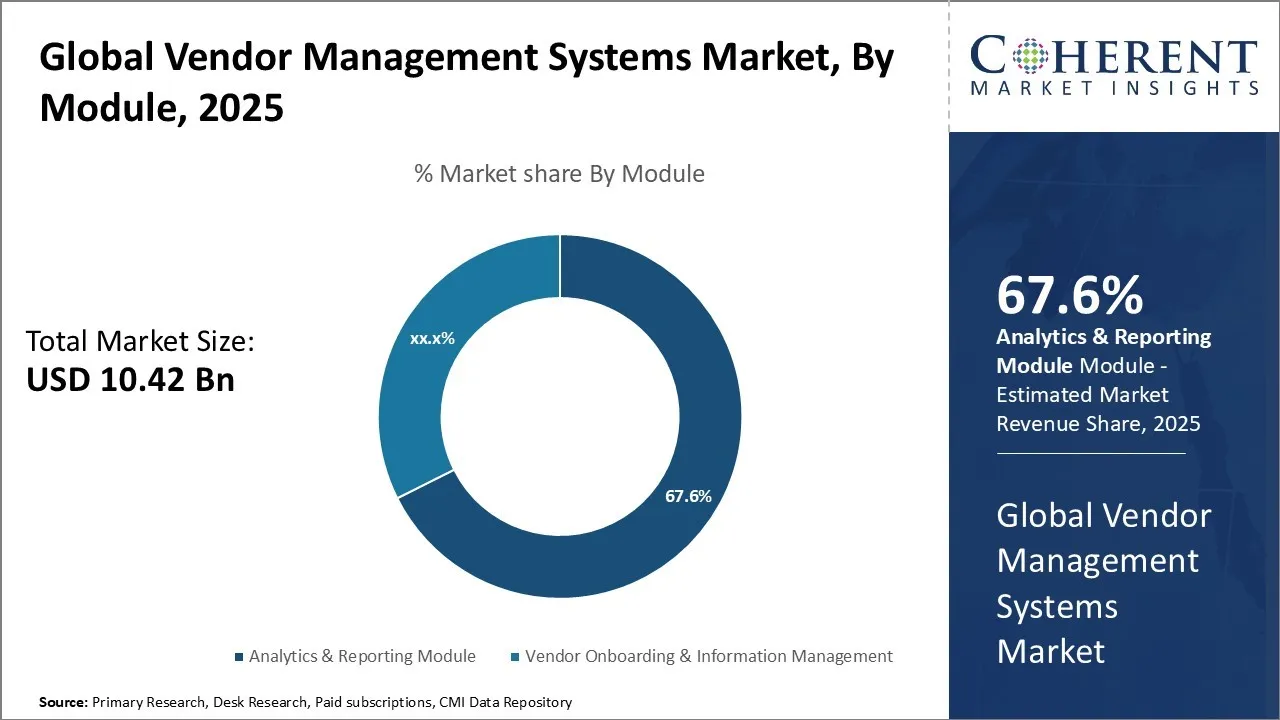
- The analytics & reporting module segment leads the market holding an estimated share of 68.6% in 2026.
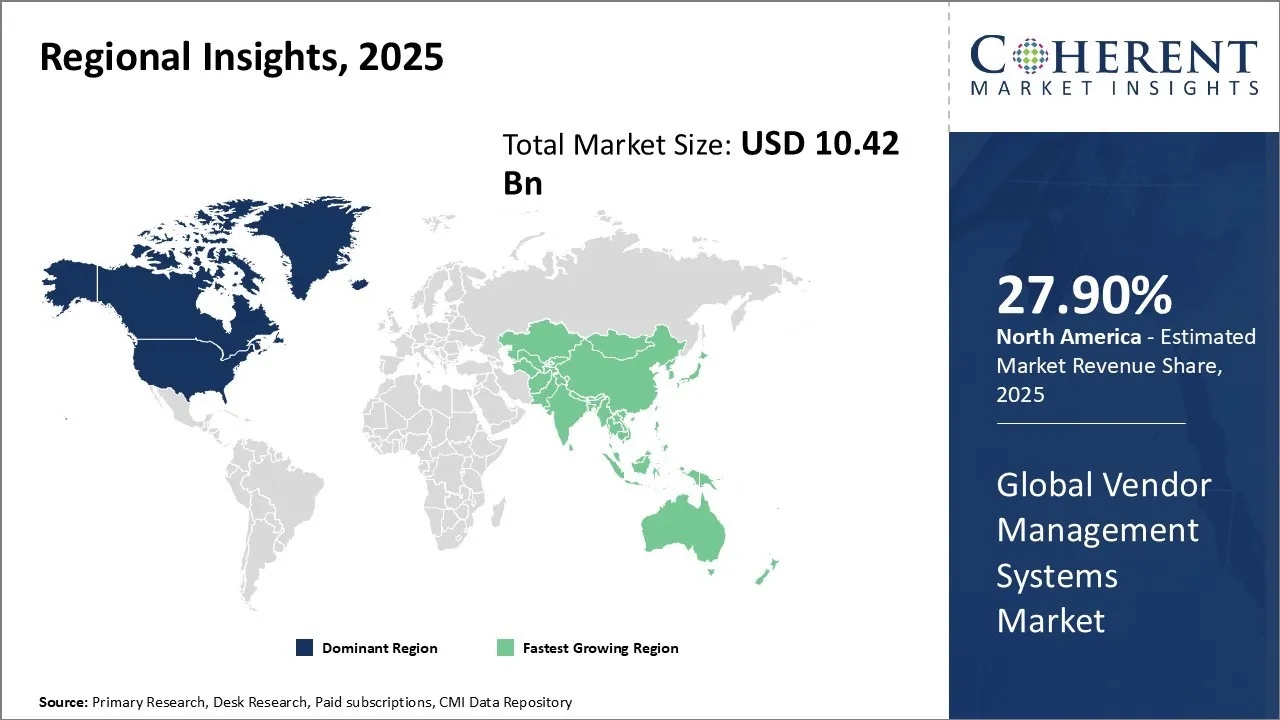
- North America is estimated to lead the market with a share of 27. 9% in 2026.
- Asia Pacific, holding a share of 22. 4% in 2026, is projected to be the fastest growing region.
Market Overview
A key trend shaping the vendor management systems market is the integration of advanced technologies such as artificial intelligence (AI) and machine learning (ML), which enable predictive analytics and automated vendor performance evaluation. Additionally, the rising focus on risk management, data security, and regulatory compliance is propelling organizations to invest in robust vendor management platforms. The growing demand for cloud-based solutions further accelerates market expansion by offering scalable, flexible, and cost-effective deployment options suited to dynamic business environments.
Current Events and their Impact
Current Events | Description and its impact |
Geopolitical and Trade Developments |
|
Technology & Solution Launches |
|
Segmental Insights
- Current Industry Events of 2026
- Market Size Estimation
- Regional Breakdown
- Competitive Landscape
- Customer Intelligence
- Segmental Analysis
- Pricing Analysis
- Key Market Drivers, Challenges & Future Trends
- Customized Insights Section
Global Vendor Management Systems Market Insights, By Module – Analytics & Reporting Module Leads Owing to Advanced Data-Driven Decision-Making Capabilities
Analytics & reporting module is expected to contribute the highest share of 68.6% in the market in 2026. As businesses increasingly seek to optimize their supply chains and enhance vendor relationships, the demand for sophisticated analytics tools within vendor management systems has surged significantly. Organizations rely on the analytics & reporting module to continuously monitor vendor compliance, delivery timelines, and quality of service. This enables early identification of potential disruptions, leading to proactive risk management and uninterrupted business continuity.
Moreover, regulatory compliance requirements across various industries have made it imperative for companies to maintain comprehensive records and generate accurate reports on vendor activities. The analytics & reporting module simplifies this process by automating data aggregation and report generation, thereby reducing manual effort and ensuring adherence to industry standards.
The growing complexity of vendor ecosystems, especially in large enterprises managing multiple suppliers worldwide, further propels the adoption of robust analytics solutions. Advanced modules offer customizable dashboards and real-time reporting features, allowing procurement teams to assess vendor performance trends, negotiate better contracts, and identify cost-saving opportunities effectively.
Impact of Artificial Intelligence (AI) on the Vendor Management Systems Market
Artificial Intelligence (AI) is fundamentally transforming vendor management systems by automating traditionally manual tasks such as vendor onboarding, performance monitoring, risk assessment, and compliance tracking. Through AI-driven algorithms, VMS platforms can now process large volumes of vendor data in real-time to identify risks, detect anomalies, and even suggest optimal vendor selections. Natural language processing (NLP) further enhances communication management by extracting key information from contracts and emails, streamlining the vetting process, and ensuring regulatory alignment. This leads to faster decision-making, reduced human error, and greater operational efficiency across procurement and vendor operations.
A real-world example of AI integration in VMS is Coupa Software’s acquisition of LLamasoft, a supply chain AI firm, which was leveraged to enhance its VMS platform with predictive analytics and scenario modeling.
Regional Insights
North America Vendor Management Systems Market Analysis and Trends
North America, holding a share of 27.90% in 2026, is expected to dominate the global vendor management systems market, driven by a highly mature technological ecosystem and widespread adoption of digital procurement processes among enterprises. The region benefits from a strong presence of established software vendors such as SAP Ariba, Oracle, and IBM, who provide comprehensive VMS solutions integrated with broader enterprise resource planning and supply chain products.
Government initiatives aimed at promoting transparency and efficiency in vendor relations, particularly in sectors like healthcare, finance, and government contracting, have further solidified North America’s leadership. The sophisticated vendor ecosystem, combined with a robust regulatory framework and high technology penetration, supports steady demand for advanced VMS solutions catering to complex supplier networks.
Asia Pacific Vendor Management Systems Market Analysis and Trends
The Asia Pacific region, holding a share of 22.4% in 2026, is expected to exhibit the fastest growth in the vendor management systems market, propelled by rapid digital transformation initiatives across emerging economies such as India, China, and Southeast Asian nations. Increasing industrialization and expanding manufacturing sectors have fueled the need for streamlined vendor management to improve operational efficiencies and cost control.
Government policies focusing on “Digital India” and China’s push for Industry 4.0 adoption include incentives for enterprises implementing cloud-based and AI-powered vendor management solutions. Additionally, growing foreign direct investment and expanding multinational corporations in the region accelerate demand. Local and regional players like Zoho Corporation and Freshworks, alongside global incumbents, contribute to market expansion by tailoring solutions for specific regional requirements and cost considerations.
Vendor Management Systems Market Outlook for Key Countries
U.S. Vendor Management Systems Market Analysis and Trends
The U.S. remains the most influential market within North America due to widespread corporate adoption of sophisticated vendor management systems. Major industry leaders such as IBM, Oracle, and SAP dominate the landscape by continuously innovating their cloud-based and AI-driven offerings. The government’s stringent compliance frameworks, particularly in sectors such as defense, healthcare, and financial services, compel organizations to deploy advanced VMS platforms to ensure supplier auditability and risk mitigation. Additionally, the large number of enterprises in retail, technology, and manufacturing sectors fosters a competitive market environment encouraging innovation and adoption.
Germany Vendor Management Systems Market Analysis and Trends
Germany holds a strong position in Europe owing to its highly industrialized economy and well-established manufacturing base. Companies like Siemens and SAP play integral roles by offering vendor management solutions embedded within larger industrial automation and supply chain management suites. The country’s focus on Industry 4.0 and digitization strategies promotes the integration of VMS with IoT and analytics to enhance procurement efficiency. Moreover, robust data protection laws and regulatory standards in Europe demand vendor transparency and compliance, driving enterprises to invest in reliable vendor management frameworks.
China Vendor Management Systems Market Analysis and Trends
China's rapidly expanding manufacturing sector and government-led push for smart manufacturing have significantly propelled the adoption of vendor management systems. Domestic technology providers like Huawei and Alibaba Cloud are investing heavily in VMS platforms that leverage AI and big data analytics to streamline supplier compliance and performance monitoring. Government policies focusing on supply chain resilience, particularly in post-pandemic scenarios, prioritize vendor risk management, thus accelerating VMS deployment. Foreign players also form strategic partnerships, adapting their systems to the local market’s scale and complexity, further expanding the ecosystem.
India Vendor Management Systems Market Analysis and Trends
India is benefitting from extensive digital infrastructure development and government-led initiatives such as “Digital India” and Corporate Social Responsibility (CSR) regulations that encourage transparent supply chains. Vendors like Zoho and Freshworks have gained traction by offering cost-effective, scalable solutions adapted to small and medium enterprises that form the backbone of the economy. Additionally, large multinational corporations establishing regional hubs ensure demand for integrated vendor management platforms. India’s rapidly evolving regulatory environment around data security and procurement is also increasingly driving enterprises toward adopting compliant vendor management systems.
U.K. Vendor Management Systems Market Analysis and Trends
The U.K. maintains a robust VMS ecosystem supported by a diverse base of financial services, retail, and manufacturing companies requiring streamlined vendor relationships and compliance management. Prominent players such as Capgemini and Advanced Software Group provide tailored solutions combining procurement automation and risk management. The post-Brexit landscape has intensified the focus on supply chain resilience and regulatory compliance, which drives investments in vendor management infrastructure. Furthermore, government mandates on transparency and anti-corruption measures reinforce the need for comprehensive VMS solutions that provide audit trails and risk assessment capabilities.
Market Players, Key Development, and Competitive Intelligence
Key Developments
- In August 2025, Flexo Label Advantage Group announced the launch of 23 brand-new Vendor Partner Programs, made possible through a partnership with Corcentric. These programs open the door to new categories and preferred pricing options never before available to FLAG members.
- In June 2025, Certificial, the leading all-in-one Certificate of Insurance (COI) platform and creator of the Smart COI Network, announced the official launch of its Vendor Management Partner Program, bringing together a rapidly growing network of compliance, procurement and risk management platforms committed to transforming the way insurance data is shared and verified.
- In January 2025, B2Gnow, a provider of business diversity, labor compliance, and grant management solutions, announced the launch of the B2Gnow Partner Network. This strategic initiative connects public-sector organizations (federal, state, county/city, education, transits, airports, housing, etc.) with a network of trusted, B2Gnow partner program credentialed consultants.
- In July 2024, Aya Healthcare, a U.S. healthcare staffing firm, announced the next generation of its VMS called LotusOne. The product uses AI to forecast future staffing needs and define optimal schedules.
Top Strategies Followed by Vendor Management Systems Market Players
- Established market leaders focus heavily on research and development (R&D) to innovate and deliver high-performance, scalable products that cater to diverse industry needs.
- Through extensive R&D, SAP Ariba integrated Generative AI and predictive analytics into its VMS platform in 2025, enabling smarter vendor selection and compliance automation.
- Mid-level players in the market adopt a more targeted approach centered around delivering cost-effective solutions that strike a balance between quality and affordability.
- Zoho Corporation enhanced its vendor management tools in Zoho One with AI capabilities, offering enterprise-grade features at SME-friendly pricing.
- Small-scale players in the global vendor management systems market differentiate themselves by focusing on niche segments, specialized features, and innovation-driven products.
- 360factors Inc. offers a compliance-centric VMS tailored for the financial services sector, addressing specific regulatory and risk scoring requirements.
Market Report Scope
Vendor Management Systems Market Report Coverage
| Report Coverage | Details | ||
|---|---|---|---|
| Base Year: | 2025 | Market Size in 2026: | USD 11.51 Bn |
| Historical Data for: | 2020 To 2024 | Forecast Period: | 2026 To 2033 |
| Forecast Period 2026 to 2033 CAGR: | 10.5% | 2033 Value Projection: | USD 23.16 Bn |
| Geographies covered: |
| ||
| Segments covered: |
| ||
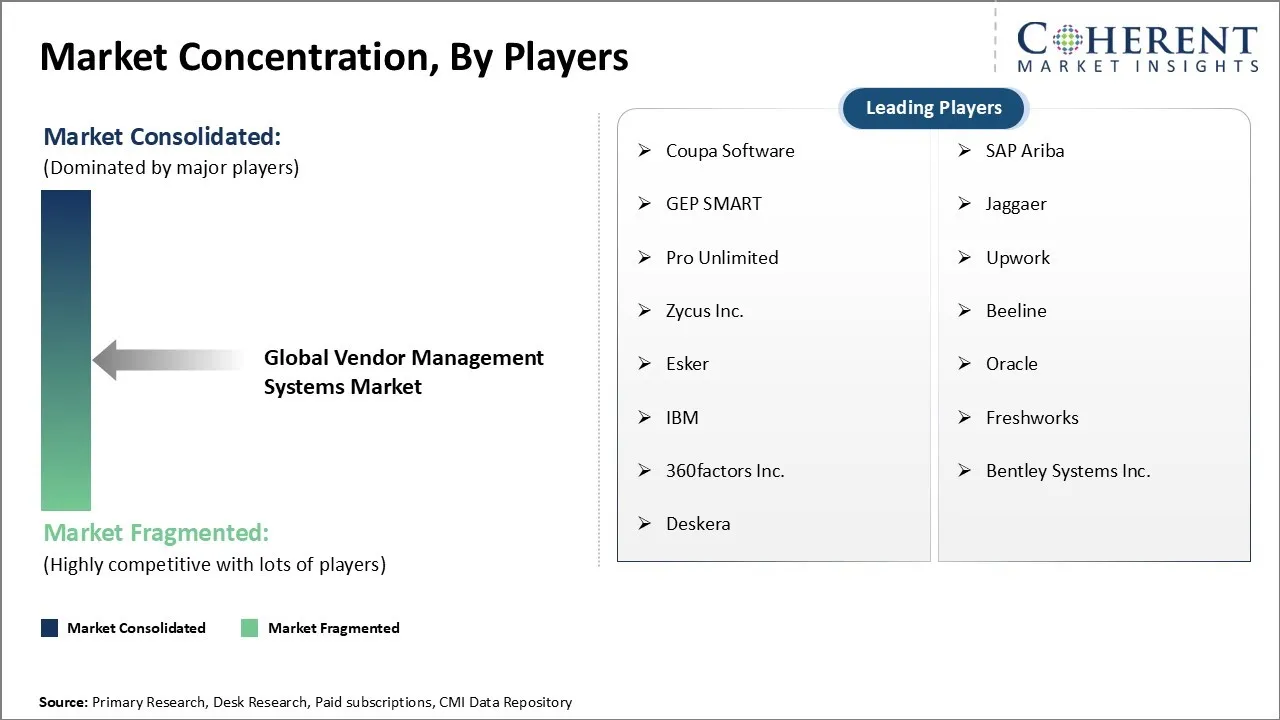
| Companies covered: | Coupa Software, SAP Ariba, GEP SMART, Jaggaer, Pro Unlimited, Upwork, Zycus Inc., Beeline, Esker, Oracle, IBM, Freshworks, 360factors Inc., Bentley Systems Inc., and Deskera | ||
| Growth Drivers: |
| ||
| Restraints & Challenges: |
| ||
Market Dynamics
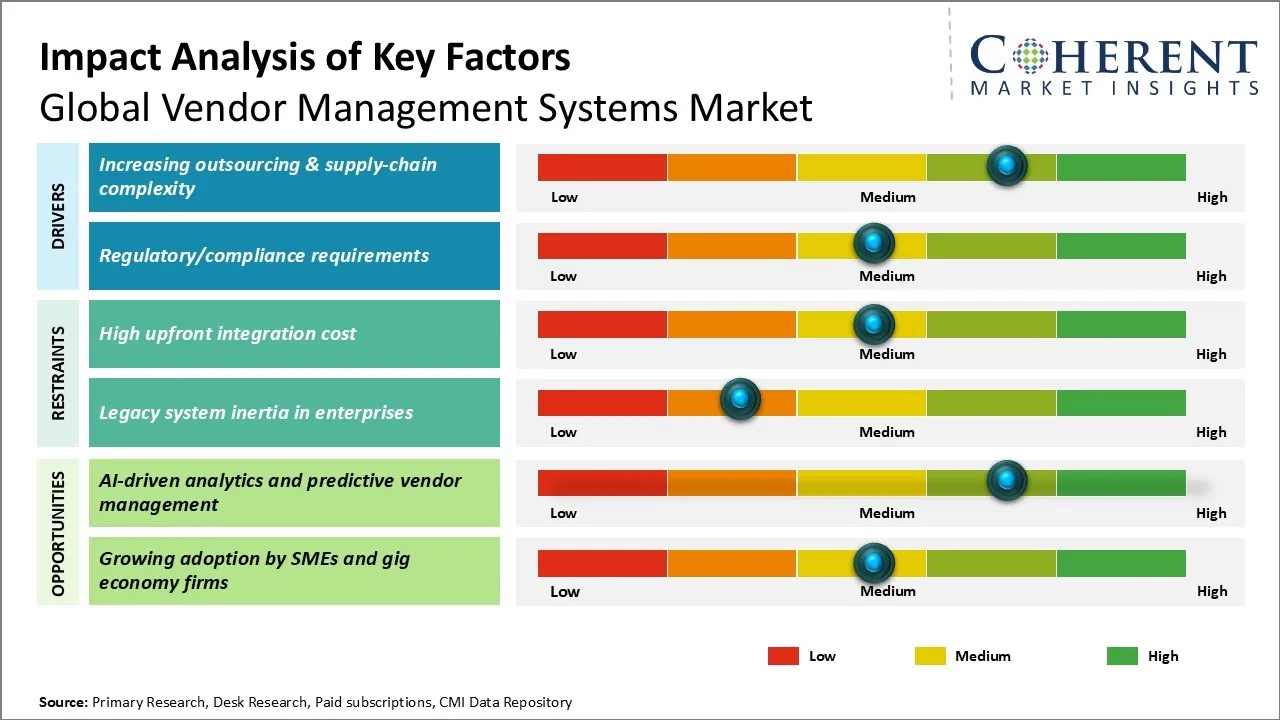
Global Vendor Management Systems Market Driver – Increasing Outsourcing & Supply ‑ Chain Complexity
The rising trend of outsourcing across various industries has significantly intensified the complexity of global supply chains, prompting organizations to adopt sophisticated vendor management systems (VMS) to streamline operations. As companies increasingly rely on multiple third-party vendors for diverse functions such as manufacturing, logistics, IT services, and procurement, managing these relationships manually becomes challenging and prone to inefficiencies. Vendor management systems offer centralized platforms that enable better visibility, compliance tracking, and performance evaluation, allowing businesses to mitigate risks associated with fragmented supplier networks. In 2024, Apple Inc. expanded its global vendor ecosystem by increasing reliance on third-party logistics providers and contract manufacturers in India and Southeast Asia to diversify away from China.
Moreover, the expansion of geographically dispersed supply chains introduces challenges related to regulatory adherence, contract management, and communication delays. VMS solutions help organizations maintain consistent standards, ensure timely deliveries, and facilitate seamless collaboration across stakeholders.
Global Vendor Management Systems Market Opportunity – AI-Driven Analytics and Predictive Vendor Management in the Global Vendor Management Systems Market
As organizations increasingly seek to optimize their supply chains and vendor relationships, the adoption of advanced AI tools enables more efficient data processing, real-time insights, and proactive decision-making. AI-powered analytics can sift through vast amounts of vendor performance data, contract details, and market trends to identify patterns and anomalies that might be missed by traditional methods. In 2025, Coupa Software launched an AI-powered predictive risk module within its VMS suite that uses machine learning to assess vendor financial stability, delivery reliability, and compliance history. This allows businesses to predict potential risks such as supplier delays, compliance issues, or financial instability, enabling timely interventions that reduce operational disruptions.
Moreover, predictive vendor management helps enterprises forecast demand, negotiate better terms, and allocate resources more effectively, ultimately reducing costs and enhancing supplier collaboration. The growing complexity of global supply chains and the increasing volume of data generated create an environment where AI’s machine learning algorithms can drive continuous improvement in vendor selection, performance evaluation, and risk mitigation.
Analyst Opinion (Expert Opinion)
- As global and regional regulations such as EU’s DORA (Digital Operational Resilience Act) and U.S. Executive Orders on supply chain transparency gain traction, enterprises are prioritizing VMS platforms with built-in compliance tracking, audit trails, and risk scoring. These mandates are transforming VMS from a procurement tool into a strategic compliance enabler.
- VMS platforms are increasingly incorporating AI and predictive analytics not only for vendor selection but also for real-time risk detection, ESG monitoring, and cybersecurity alerts. These expanded use-cases are making VMS solutions critical in broader areas like third-party risk management, sustainability assurance, and digital trust.
- With frameworks like India’s DPDP Act, China’s CSL, and GDPR, organizations must ensure vendor data handling practices meet evolving data sovereignty requirements. This is driving demand for VMS platforms that provide data residency controls, consent tracking, and automated legal documentation workflows during vendor onboarding and beyond.
Speak to the analyst
Want personalized insights?
Take the findings above to one of our principal consultants, or have the report rebuilt around the segments, geographies and competitors you actually track.
Market Segmentation
- Module Insights (Revenue, USD Bn, 2021 - 2033)
- Analytics & Reporting Module
- Vendor Onboarding & Information Management
- Regional Insights (Revenue, USD Bn, 2021 - 2033)
- North America
- U.S.
- Canada
- Latin America
- Brazil
- Argentina
- Mexico
- Rest of Latin America
- Europe
- Germany
- U.K.
- Spain
- France
- Italy
- Russia
- Rest of Europe
- Asia Pacific
- China
- India
- Japan
- Australia
- South Korea
- ASEAN
- Rest of Asia Pacific
- Middle East
- GCC Countries
- Israel
- Rest of Middle East
- Africa
- South Africa
- North Africa
- Central Africa
- North America
- Key Players Insights
- Coupa Software
- SAP Ariba
- GEP SMART
- Jaggaer
- Pro Unlimited
- Upwork
- Zycus Inc.
- Beeline
- Esker
- Oracle
- IBM
- Freshworks
- 360factors Inc.
- Bentley Systems Inc.
- Deskera
Sources
Primary Research Interviews
Stakeholders
- Procurement Managers and Strategic Sourcing Heads from multinational corporations
- IT Heads and CIOs from large enterprises implementing enterprise resource planning (ERP) and VMS solutions
- Compliance Officers and Risk Analysts involved in third-party risk assessment
- Operations Managers from logistics and manufacturing sectors using vendor platforms
- VMS Software Developers and Product Managers
- Independent Vendor Risk Management Consultants
Databases
- TechGlobal Procurement Database
- North American Digital Vendor Index (NADVI)
- Asia-Pacific Procurement Innovation Archive (APPIA)
- OECD Digital Infrastructure Reports
- United Nations Global Sourcing Database
Magazines
- Procurement Today
- Enterprise Technology & Compliance Weekly
- Cloud ERP Digest
- NextGen Supply Chain Magazine
- Intelligent Procurement Monthly
Journals
- Journal of Supply Chain & Vendor Risk Management
- Enterprise Systems and Software Management Review
- Journal of Cloud-Based Business Applications
- Global Journal of Strategic Procurement
- Journal of Applied AI in Procurement
Newspapers
- The Business Procurement Times
- Tech & Vendor Daily (North America)
- Supply Chain Insider (Asia Pacific Edition)
- The Economic Intelligence (Global Markets)
- The Vendor Report Online
Associations
- Global Vendor Management Professionals Association (G-VMPA)
- International Association of Procurement Officers (IAPO)
- North American Cloud Procurement Forum (NACPF)
- Asia-Pacific Sourcing & Risk Alliance (APSRA)
- Institute for Ethical Vendor Practices (IEVP)
Public Domain Sources
- U.S. Census Bureau
- EUROSTAT
- United Nations Economic Commission for Europe (UNECE)
- World Bank
- ResearchGate
Proprietary Elements
- CMI Data Analytics Tool, Proprietary CMI Existing Repository of information for last 8 years
Get access to 250+ pages report
Every segment, forecast, competitor profile and data table behind the analysis above — available for instant download.
- ESOMAR Member
- ISO 9001:2015 Certified
- D-U-N-S Registered
- GDPR & CCPA Compliant
Missing comfort of reading report in your local language? Find your preferred language:
Transform your Strategy with Exclusive Trending Reports
Frequently Asked Questions
The global vendor management systems market is estimated to be valued at USD 11.51 Bn in 2026 and is expected to reach USD 23.16 Bn by 2033.
The CAGR of global vendor management systems market is projected to be 10.5% from 2026 to 2033.
Increasing outsourcing & supply‑chain complexity and regulatory/compliance requirements are the major factors driving the growth of the global vendor management systems market.
High upfront integration cost and legacy system inertia in enterprises are the major factors hampering the growth of the global vendor management systems market.
In terms of module, analytics & reporting module is estimated to dominate the market revenue share in 2026.
Coupa Software, SAP Ariba, GEP SMART, Jaggaer, Pro Unlimited, Upwork, Zycus Inc., Beeline, Esker, Oracle, IBM, Freshworks, 360factors Inc., Bentley Systems Inc., and Deskera are the major players.
North America is expected to lead the global vendor management systems market in 2026.