

Global Veterinary Diagnostic Kits Market Size and Forecast – 2026 To 2033
The global veterinary diagnostic kits market is expected to grow from USD 1,510.5 Mn in 2026 to USD 3,071.0 Mn by 2033, registering a compound annual growth rate (CAGR) of 10.7% from 2026 to 2033. The market for veterinary diagnostic kits is poised for significant expansion, fueled by the increasing prevalence of zoonotic and transboundary animal diseases, which has intensified the need for rapid and accurate veterinary diagnostics.
According to the World Organisation for Animal Health (WOAH)'s State of the World's Animal Health 2025 report, 47% of emerging animal diseases reported globally have zoonotic potential, while outbreaks of avian influenza in mammals more than doubled in 2024 compared with 2023, reinforcing the importance of early disease detection and surveillance.
Key Takeaways of the Global Veterinary Diagnostic Kits Market
- Immunodiagnostic/Rapid POC is projected to hold 45.9 % of the global veterinary diagnostic kits market share in 2026, making it the dominant product type segment, across North America due to the increasing adoption of rapid in-clinic diagnostics. For instance, the American Animal Hospital Association (AAHA) guidelines for veterinary point-of-care diagnostic testing recommend the use of in-house diagnostic testing to support timely clinical decision-making and improve patient outcomes in veterinary practice.
- Companion animal is projected to hold 54.1 % of the global veterinary diagnostic kits market share in 2026, making it the dominant animal type segment, across Europe owing to increasing preventive veterinary care and routine health screening. For instance, the Federation of Veterinarians of Europe (FVE) promotes preventive healthcare, routine diagnostics, and early disease detection as essential components of companion animal welfare through its European veterinary practice guidance.
- Infectious disease is projected to hold 32.9 % of the global veterinary diagnostic kits market share in 2026, making it the dominant application segment, across Asia Pacific due to the high burden of transboundary animal diseases and the increasing focus on early disease detection. For instance, in April 2025, the Food and Agriculture Organization (FAO) launched the Regional Strategy for the Prevention and Control of High Pathogenicity Avian Influenza (2024–2033) for Asia and the Pacific, emphasizing strengthened animal disease surveillance, laboratory diagnostic capacity, and rapid detection systems to improve outbreak preparedness.
- North America maintains dominance with an expected share of 42.2 % in 2026, bolstered by its advanced veterinary diagnostic infrastructure, high companion animal healthcare expenditure, and strong disease surveillance capabilities. For instance, in May 2025, the Canadian Food Inspection Agency (CFIA) launched its renewed Animal Health Surveillance System, strengthening national disease monitoring, laboratory coordination, and early detection of reportable animal diseases across Canada.
- Asia Pacific is expected to exhibit the fastest growth with an estimated contribution of 18.8 % share in 2026, propelled by expanding veterinary healthcare services, increasing livestock productivity initiatives, and greater investment in animal disease monitoring. For instance, in July 2025, Australia's Department of Agriculture, Fisheries and Forestry announced additional funding under the National Biosecurity System to strengthen animal disease surveillance, diagnostic capability, and laboratory preparedness for emergency animal diseases.
Segmental Insights
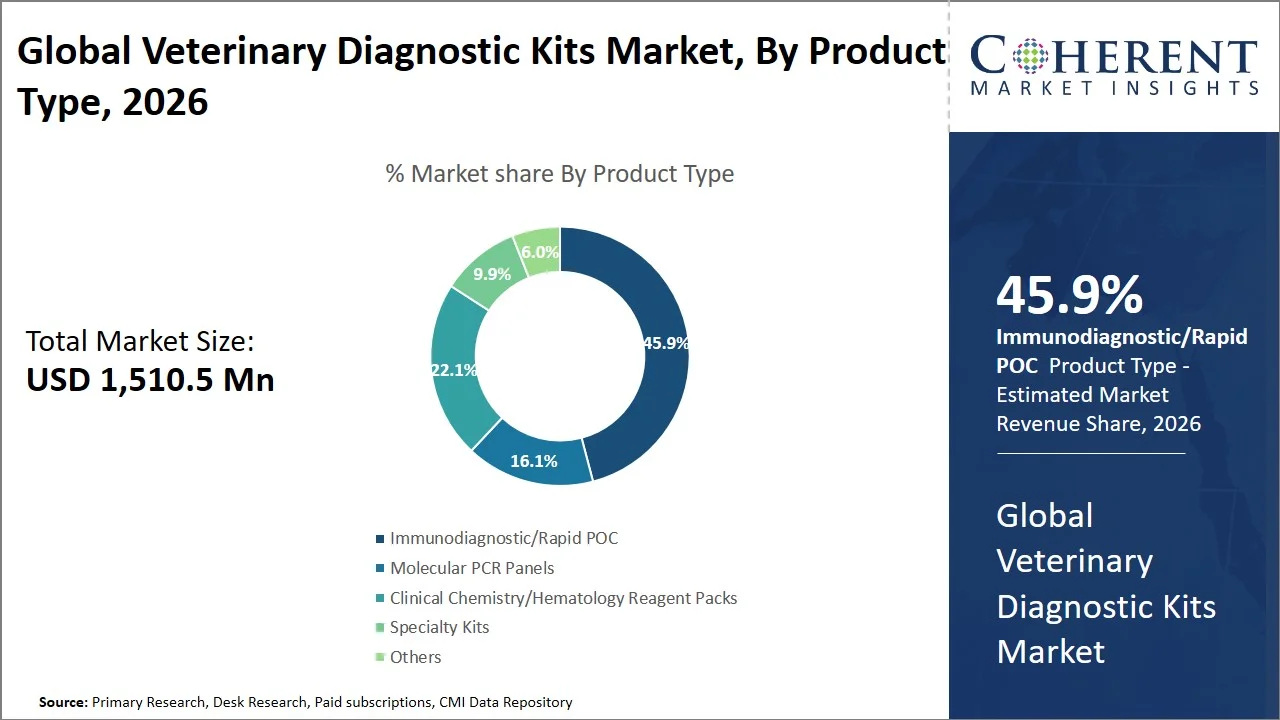
Why Does Immunodiagnostic/Rapid POC Dominate the Global Veterinary Diagnostic Kits Market?
Immunodiagnostic/Rapid POC is projected to hold a market share of 45.9% in 2026, as they provide fast and accurate results at the site of treatment and/or within the vicinity of animal care and thus facilitate prompt decisions towards the patient and appropriate management. Simplicity of use, portability, and negligible lab setup support the preference for these kits at both routine check-ups and in the diagnosis of infectious diseases in companion and livestock animals. For instance, in November 2023, IDEXX Laboratories updated its SNAP platform with the introduction of the SNAP Leish 4 Dx Test, a rapid in-clinic immunodiagnostic test for concurrent detection of canine leishmaniosis and other vector-borne diseases.
- Current Industry Events of 2026
- Market Size Estimation
- Regional Breakdown
- Competitive Landscape
- Customer Intelligence
- Segmental Analysis
- Pricing Analysis
- Key Market Drivers, Challenges & Future Trends
- Customized Insights Section
Why Does the Companion Animal Segment Represent the Largest Animal Type Segment in the Global Veterinary Diagnostic Kits Market?
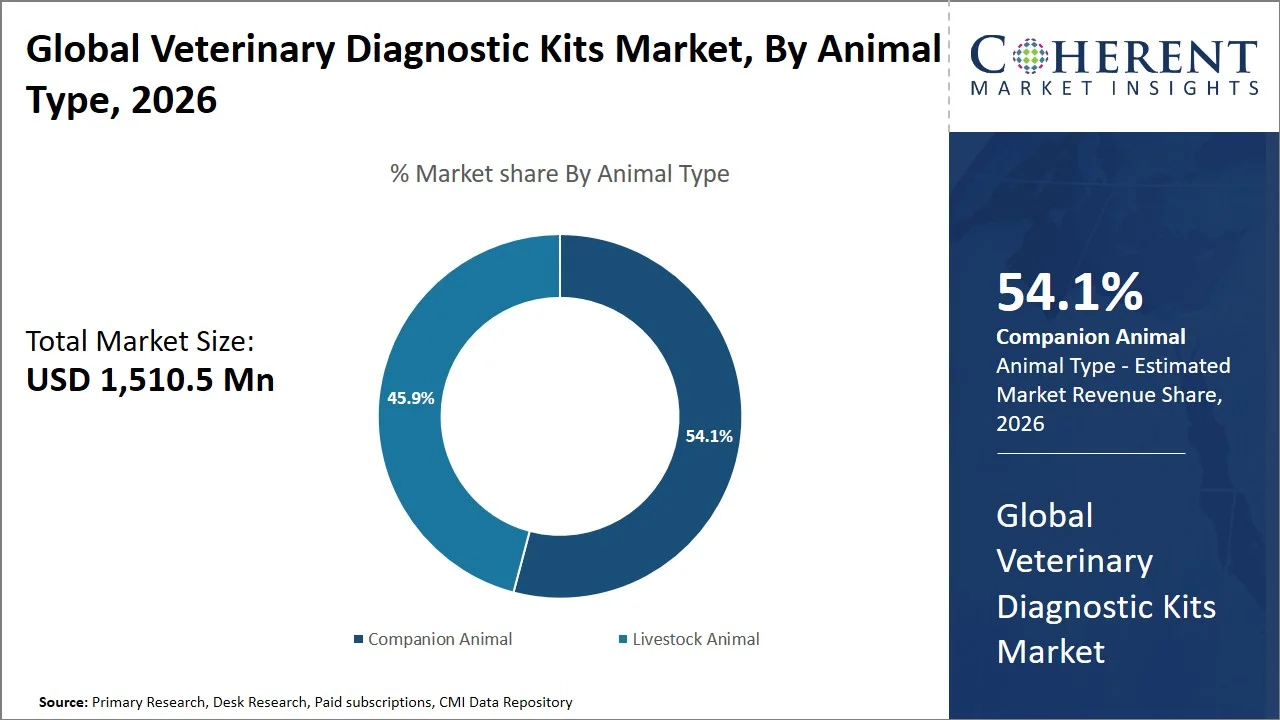
Companion animal is projected to hold a market share of 54.1% in 2026, owing to rising companion animal humanization, increase in preventive veterinary healthcare expenses and high demand for early disease diagnostics. Frequent routine wellness check-ups and ongoing screenings for infectious, age-related and metabolic diseases, are continuously driving the diagnostics in companion animal practice. For instance, in August 2025, the American Animal Hospital Association (AAHA) unveiled the one health guidelines that encourages improved focus on the integration of companion animal health into preventive medicine and a broadened and improved approach for diagnosis, which is predicted to encourage greater adoption of veterinary diagnostic kits for companion animal healthcare.
Infectious Disease Segment Dominates the Global Veterinary Diagnostic Kits Market
The infectious disease segment is projected to hold a market share of 32.9% in 2026, due to the surging demand for rapid detection and prevention of contagious diseases affecting livestock as well as companion animals. Routine screening of animal population, disaster management of diseases, and enhanced biosecurity have raised demand for quick immunodiagnostic tests and molecular diagnostic techniques among veterinaries. For instance, in December 2025, the European Food Safety Authority (EFSA), in conjunction with European Centre for Disease Prevention and Control (ECDC) has published the Avian Influenza Overview (September - November 2025), reinforcing the prevalent HPAI detections in 29 European countries, emphasizing the need of persistent surveillance and laboratory diagnoses to quickly identify and control any outbreak to potentially support a consistent requirement for infectious disease diagnostic kits.
Current Events and their Impact
Current Events | Description and its Impact |
U.S. Department of Agriculture's Animal and Plant Health Inspection Service (APHIS) Updates Veterinary Diagnostic Service User Fees (January 2025) |
|
EMA Highlights Record Recommendations for Veterinary Medicines in 2025 (June 2026) |
|
Global Veterinary Diagnostic Kits Market Dynamics
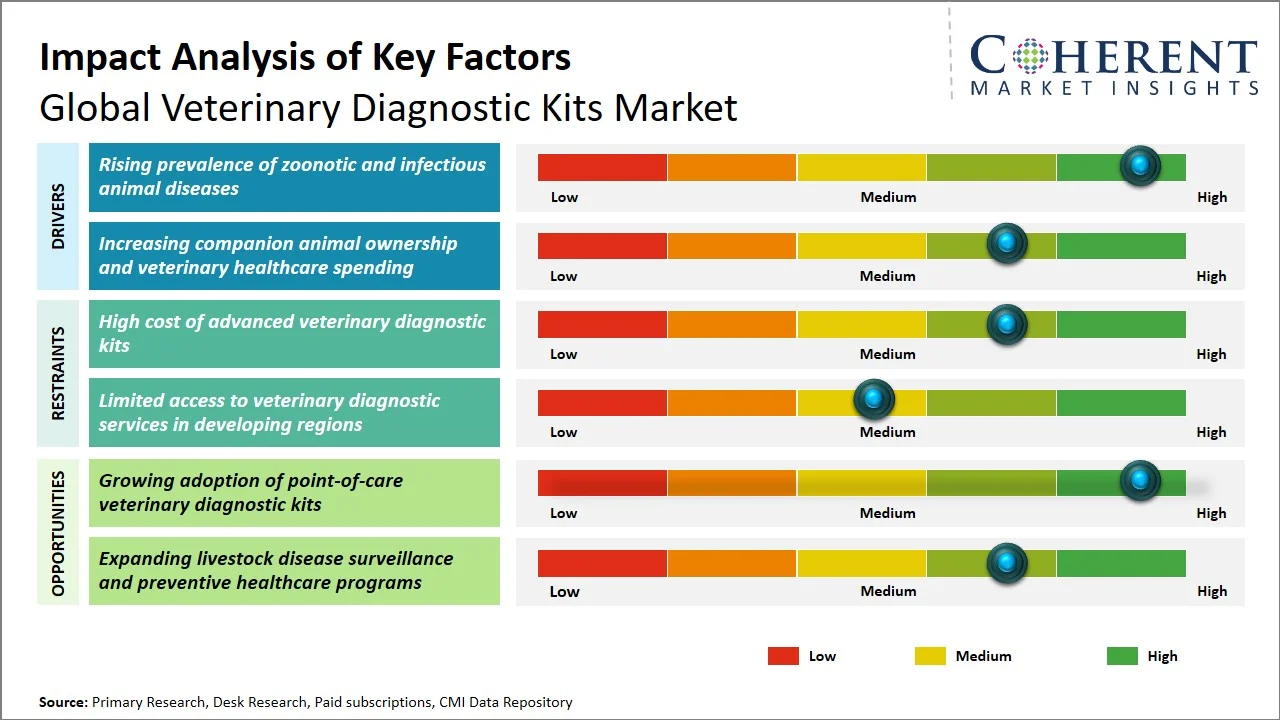
Market Drivers
- Rising prevalence of zoonotic and infectious animal diseases: The global veterinary diagnostic kits market is driven by the increasing incidence of zoonotic and infectious animal diseases, which has heightened the need for rapid and accurate disease detection to support outbreak prevention and animal health management. Growing livestock intensification and expanding companion animal populations have further reinforced the importance of routine diagnostic testing for early intervention. For instance, in February 2025, the European Commission adopted the annual EU Animal Health Law surveillance and monitoring programs, strengthening coordinated surveillance and laboratory testing for priority animal diseases across Member States. This initiative is expected to accelerate the adoption of veterinary diagnostic kits for disease monitoring and control.
- Increasing companion animal ownership and veterinary healthcare spending: The increasing ownership of companion animals and rising expenditure on veterinary healthcare are significantly driving the demand for veterinary diagnostic kits. Pet owners are increasingly seeking preventive health screening, routine wellness examinations, and early disease detection, encouraging greater adoption of rapid and laboratory-based diagnostic testing in veterinary practice. For instance, in November 2025, the American Veterinary Medical Association (AVMA) and the American Animal Hospital Association (AAHA) released the updated Canine Life Stage Guidelines, recommending routine preventive diagnostic screening throughout a dog's life to facilitate early disease detection and improve long-term health outcomes. These recommendations are expected to support the growing utilization of veterinary diagnostic kits in companion animal care.
- Expansion of Livestock Disease Surveillance Programs: Expanding livestock disease surveillance programs are driving the adoption of veterinary diagnostic kits by increasing routine testing for transboundary and economically significant animal diseases. Governments are strengthening surveillance frameworks to enable early disease detection, safeguard livestock productivity, and facilitate safe domestic and international trade in animals and animal products. For instance, in May 2025, the European Commission adopted Implementing Regulation (EU) 2025/925, updating Union surveillance programs for diseases such as avian influenza, African swine fever, and bluetongue under the Animal Health Law, reinforcing the need for standardized veterinary diagnostic testing across Member States.
Emerging Trends
- Expansion of Multiplex Veterinary Diagnostic Panels: Veterinary diagnostic manufacturers are increasingly developing multiplex assays capable of detecting multiple pathogens from a single sample. These panels reduce testing time, improve diagnostic efficiency, and support differential diagnosis, particularly for respiratory, enteric, and vector-borne diseases in companion animals and livestock.
- Integration of Cloud-Connected Veterinary Diagnostics: Modern veterinary diagnostic kits are increasingly being integrated with cloud-based software platforms that enable real-time data sharing, remote result interpretation, and centralized disease monitoring. This trend is improving clinical workflow efficiency while supporting population-level animal health surveillance.
- Growing Adoption of Portable Molecular Diagnostics: The market is witnessing increasing adoption of compact molecular diagnostic platforms that enable PCR-quality testing outside centralized laboratories. These portable systems are enhancing disease detection at veterinary clinics, farms, and field locations by delivering rapid, high-accuracy results closer to the point of care.
Regional Insights
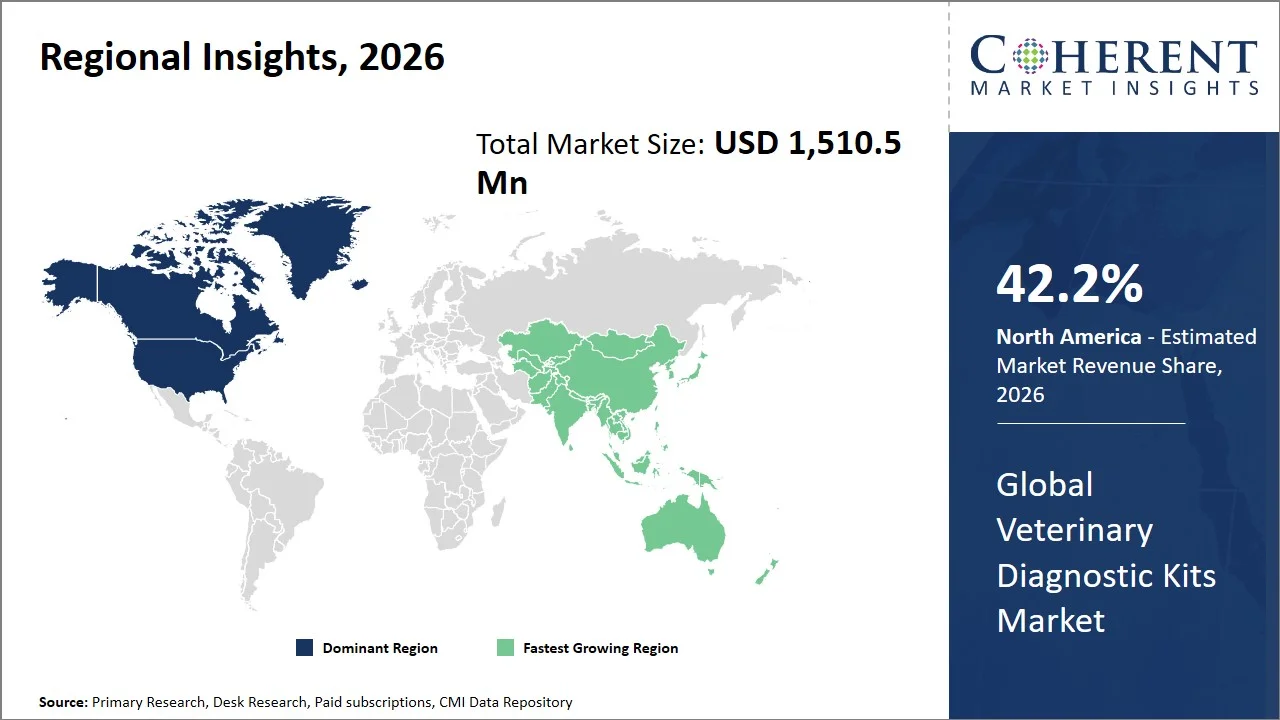
Why is North America a Strong Market for Veterinary Diagnostic Kits?
North America leads the global veterinary diagnostic kits market, accounting for an estimated 42.2% share in 2026, owing to its well-developed veterinary healthcare infrastructure, high adoption of advanced diagnostic technology and high emphasis on companion animal and livestock health management. The government policies for animal health, surveillance and outbreak prevention drive the routine diagnostic testing services in the region. For instance, in April 2026, the U.S. Department of Agriculture (USDA) reaffirmed opportunities to fund the National Animal Health Laboratory Network (NAHLN) to improve the ability of veterinary diagnostic laboratories to detect significant animal diseases early, to quickly respond to outbreaks and to recover from diseases. Additionally, the continuous R&D investments and quick commercialization of latest diagnostic solutions strengthen region’s leadership in the market.
Why Does the Asia Pacific Veterinary Diagnostic Kits Market Exhibit High Growth?
The Asia Pacific veterinary diagnostic kits market is expected to exhibit the fastest growth with an estimated contribution of 18.8% share to the global market in 2026, owing to rising livestock production, the increasing number of companion animals, and enhanced investment in veterinary care infrastructure. The rising government initiatives aimed at boosting livestock productivity and controlling zoonotic diseases are positively contributing to improve the disease surveillance and diagnostic capacities in the region. For instance, in March 2025, the Indian Department of Animal Husbandry & Dairying (DAHD) expanded the scope of the National Animal Disease Control Programme (NADCP) to strengthen disease surveillance, diagnosis and monitoring, alongside vaccination and surveillance of foot-and-mouth disease (FMD) and brucellosis to increase uptake of diagnostic services for animal disease testing across India. Furthermore, increasing demand for rapid and molecular diagnostic technologies and growing veterinary care accessibility across new markets will enhance further market development.
Global Veterinary Diagnostic Kits Market Outlook for Key Countries
Why is the U.S. Leading Innovation and Adoption in the Veterinary Diagnostic Kits Market?
The U.S. holds the largest market share for innovation and adoption in the veterinary diagnostic kits market owing to higher use of innovative molecular diagnostics, immunodiagnostics, and point-of-care testing in the companion animal health sector. Favorable market trends, such as early availability of innovative veterinary diagnostic tests, high demand for preventive pet health screening and smooth integration of in-clinic diagnostic systems in the day-to-day veterinary work create positive environment for continuous innovation and technology adoption.
Is the U.K. a Favorable Market for Veterinary Diagnostic Kits Market?
The U.K. is a promising market for veterinary diagnostic kits due to its strong emphasis on preventive care in companion animals, a trend for frequent use of diagnostic testing in practice and early adoption of sophisticated point-of-care and molecular diagnostics. The service-oriented nature of veterinary practices and growing need for quick and evidence-based decisions help to maintain healthy market growth for veterinary diagnostics in the country.
Is China Emerging as a Key Growth Hub for the Veterinary Diagnostic Kits Market?
China is becoming an important growth area in the veterinary diagnostic kits market owing to the rapid growth of its livestock and companion animal industries, increasing public and private sector investment in animal disease monitoring and prevention programs, and the increase in domestic veterinary diagnostic manufacturing facilities. China's emphasis on enhancing the biosecurity levels, improving animal health management, and incorporating with modern molecular and point-of-care diagnostic applications is boosting demand for innovative veterinary diagnostics.
Why Does Germany Top the European Veterinary Diagnostic Kits Market?
Germany leads the European veterinary diagnostic kits market due to the superior nature of Germany’s veterinary healthcare, the large animal health R&D infrastructure, and high utilization rates for both molecular and in-clinic diagnostics. The country also has a well-developed animal health market (companion and livestock), which results in ongoing demand for fast, accurate, quality veterinary diagnostic tests in both the clinical and agricultural markets.
Is the Veterinary Diagnostic Kits Market Developing in Japan?
The veterinary diagnostic kits market in Japan is gradually expanding due to the rising demand for companion animals’ health care solutions, widespread acceptance of state-of-the-art molecular and point-of-care diagnosis tests, and rapid advancements in veterinary technologies. The heightened consumer focus in Japan toward the preventative aspect of animal welfare standards, enhanced veterinary skills and growing acceptance in-clinic diagnostic tools are promoting veterinary diagnostic kits among veterinarians.
Evolution of Veterinary Diagnostic Technologies
Technology | Conventional Approach | Current Advancement | Future Direction |
Immunodiagnostics | ELISA-based laboratory tests | Rapid lateral flow POC kits | Digital immunoassays with AI interpretation |
Molecular Diagnostics | Conventional PCR | Real-time multiplex PCR panels | CRISPR-based molecular diagnostics |
Clinical Chemistry | Standalone analyzers | Compact in-clinic analyzers | Fully automated integrated diagnostic platforms |
Disease Surveillance | Laboratory-based reporting | Cloud-enabled data sharing | AI-driven predictive disease surveillance |
Veterinary Workflow | Centralized laboratory testing | Point-of-care diagnostics | Connected digital veterinary ecosystems |
How is the growing adoption of point-of-care veterinary diagnostic kits creating new growth opportunities in the veterinary diagnostic kits market?
The increased adoption of point-of-care (POC) veterinary diagnostic kits represents a significant growth trend for the global veterinary diagnostic kits market as this allows for quicker detection of diseases at the point of care and reduces the dependence on centralized laboratories. The ability to achieve accurate test results within minutes assists in rapid decision-making in the clinics and livestock production facilities and this positively impacts the treatment outcomes. For instance, in December 2024, Zoetis Inc. launched Vetscan OptiCell, an artificial-intelligence (AI) enabled point-of-care hematology analyzer that provides complete blood count (CBC) results in minutes, bolstering the industry's continued trajectory toward sophisticated in-clinic diagnostic options.
Market Players, Key Development, and Competitive Landscape
Key Developments
- In January 2026, Antech Diagnostics, Inc. introduced its next-generation veterinary diagnostic innovations at VMX 2026, expanding its portfolio with advanced testing solutions designed to improve diagnostic accuracy and clinical decision-making. The launch integrates rapid diagnostics and data-driven insights to support earlier disease detection and more personalized veterinary care. The development reinforces the industry's shift toward advanced and integrated veterinary diagnostic technologies.
- In September 2025, FUJIFILM Healthcare Europe announced the European launch of the FUJI DRI-CHEM AU20V, an enhanced in-house veterinary diagnostics measurement device for veterinary use. The system delivers laboratory-quality diagnostic results with an intuitive workflow and rapid turnaround, including hormone testing results in approximately 10 minutes. The launch expands FUJIFILM's FVET veterinary diagnostics portfolio, supporting faster in-clinic diagnostics and improved veterinary decision-making.
- In June 2025, bioMérieux launched VETFIRE, a molecular diagnostic test designed for the rapid detection of equine infectious respiratory diseases. The syndromic PCR-based panel enables veterinarians to identify multiple respiratory pathogens from a single sample, supporting faster clinical decision-making and targeted disease management. The launch strengthens the company's veterinary diagnostics portfolio while advancing point-of-care molecular testing in animal health.
Competitive Landscape
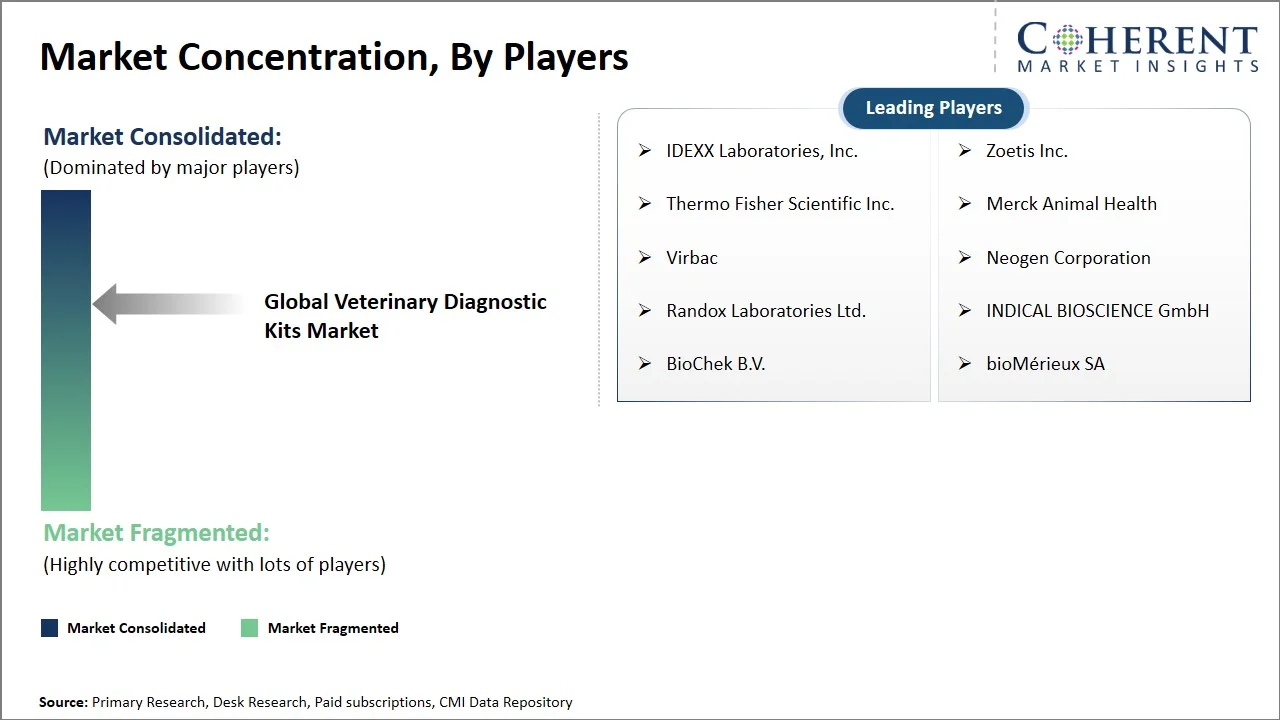
The global veterinary diagnostic kits market is moderately consolidated, with competition centered on technological innovation, expansion of point-of-care and molecular diagnostic portfolios, and strategic collaborations to strengthen animal health offerings. Market participants are focusing on enhancing diagnostic accuracy, reducing turnaround times, expanding geographic reach, and integrating digital technologies to improve veterinary clinical decision-making. Key focus areas include:
- Expansion of Rapid Point-of-Care and Molecular Diagnostic Kit Portfolios
- Development of Multiplex and Syndromic Veterinary Diagnostic Solutions
- Strategic Partnerships, Acquisitions, and Animal Health Collaborations
- Integration of AI-Enabled Analytics and Digital Veterinary Diagnostic Platforms
- Geographic Expansion and Strengthening of Veterinary Distribution Networks
Market Report Scope
Veterinary Diagnostic Kits Market Report Coverage
| Report Coverage | Details | ||
|---|---|---|---|
| Base Year: | 2025 | Market Size in 2026: | USD 1,510.5 Mn |
| Historical Data for: | 2020 To 2024 | Forecast Period: | 2026 To 2033 |
| Forecast Period 2026 to 2033 CAGR: | 10.7% | 2033 Value Projection: | USD 3,071.0 Mn |
| Geographies covered: |
| ||
| Segments covered: |
| ||
| Companies covered: | IDEXX Laboratories, Inc., Zoetis Inc., Thermo Fisher Scientific Inc., Merck Animal Health, Virbac, Neogen Corporation, Randox Laboratories Ltd., INDICAL BIOSCIENCE GmbH, BioChek B.V., and bioMérieux SA | ||
| Growth Drivers: |
| ||
| Restraints & Challenges: |
| ||
Analyst Opinion (Expert Opinion)
- In the coming years, the global veterinary diagnostic kits market will be driven by the increasing adoption of rapid molecular and point-of-care diagnostics, supported by the growing emphasis on preventive animal healthcare, disease surveillance, and precision veterinary medicine. Advancements in multiplex testing, digital connectivity, and AI-assisted diagnostic platforms are expected to further improve diagnostic efficiency and clinical outcomes across companion animal and livestock healthcare.
- The maximum opportunities are foreseen within molecular PCR panels for infectious disease diagnostics in companion animals, particularly in the U.S., where high pet healthcare expenditure, increasing demand for advanced diagnostics, and widespread adoption of in-clinic testing continue to accelerate market growth. Emerging opportunities are also expected in Asia Pacific, driven by expanding livestock disease surveillance and veterinary healthcare infrastructure.
- In order to gain a competitive advantage market players should prioritize the development of rapid multiplex and point-of-care diagnostic kits, strengthen digital integration with veterinary practice management systems, expand their presence in high-growth emerging markets through strategic partnerships, and invest in affordable, easy-to-use diagnostic solutions that support both companion animal care and large-scale livestock disease surveillance.
Speak to the analyst
Want personalized insights?
Take the findings above to one of our principal consultants, or have the report rebuilt around the segments, geographies and competitors you actually track.
Market Segmentation
- Product Type Insights (Revenue, USD Mn, 2021 - 2033)
- Immunodiagnostic/Rapid POC
- Molecular PCR Panels
- Clinical Chemistry/Hematology Reagent Packs
- Specialty Kits
- Others
- Animal Type Insights (Revenue, USD Mn, 2021 - 2033)
- Companion Animal
- Livestock Animal
- Application Insights (Revenue, USD Mn, 2021 - 2033)
- Infectious Disease
- Reproductive and Fertility Testing
- Endocrinology and Metabolic Disorders
- Oncology
- General Health and Clinical Pathology
- Others
- End User Insights (Revenue, USD Mn, 2021 - 2033)
- Veterinary Clinics and Hospitals
- Veterinary Diagnostic/Reference Laboratories
- Livestock Farms and Point-of-Care (Field Testing)
- Academic and Research Institutes
- Others
- Regional Insights (Revenue, USD Mn, 2021 - 2033)
- North America
- U.S.
- Canada
- Latin America
- Brazil
- Argentina
- Mexico
- Rest of Latin America
- Europe
- Germany
- U.K.
- Spain
- France
- Italy
- Russia
- Rest of Europe
- Asia Pacific
- China
- India
- Japan
- Australia
- South Korea
- ASEAN
- Rest of Asia Pacific
- Middle East
- GCC Countries
- Israel
- Rest of Middle East
- Africa
- South Africa
- North Africa
- Central Africa
- North America
- Key Players Insights
- IDEXX Laboratories, Inc.
- Zoetis Inc.
- Thermo Fisher Scientific Inc.
- Merck Animal Health
- Virbac
- Neogen Corporation
- Randox Laboratories Ltd.
- INDICAL BIOSCIENCE GmbH
- BioChek B.V.
- bioMérieux SA
Sources
Primary Research Interviews
- Veterinary diagnosticians and clinical pathologists from veterinary hospitals and reference laboratories
- Veterinarians specializing in companion animal and livestock healthcare
- Executives from veterinary diagnostic kit manufacturers and animal health companies
- Laboratory directors and molecular diagnostics specialists in veterinary medicine
- Experts in veterinary point-of-care (POC) diagnostics and animal disease surveillance
Stakeholders
- Veterinary diagnostic kit manufacturers
- Veterinary hospitals and clinics
- Veterinary reference laboratories
- Livestock producers and integrated poultry companies
- Animal health distributors and veterinary product suppliers
- Government veterinary services and animal disease surveillance agencies
- End-use Sectors
- Veterinary hospitals & clinics
- Veterinary diagnostic laboratories
- Livestock farms
- Poultry farms
- Research & academic institutions
- Regulatory & Health Bodies
- World Organisation for Animal Health (WOAH)
- Food and Agriculture Organization (FAO)
- U.S. Department of Agriculture (USDA) – APHIS
- U.S. Food and Drug Administration (FDA) – Center for Veterinary Medicine (CVM)
- European Medicines Agency (EMA) – Veterinary Medicines Division
- European Commission – Directorate-General for Health and Food Safety (DG SANTE)
- Canadian Food Inspection Agency (CFIA)
- Department of Agriculture, Fisheries and Forestry (DAFF), Australia
Databases
- WOAH WAHIS (World Animal Health Information System)
- USDA APHIS Animal Disease Information Database
- FDA Animal Drugs @ FDA Database
- EMA Veterinary Medicines Database
Magazines
- Today's Veterinary Business
- Veterinary Practice News
- Animal Health International
- Veterinary Times
- VetAdvantage Magazine
Journals
- Journal of Veterinary Diagnostic Investigation
- Veterinary Microbiology
- Preventive Veterinary Medicine
- BMC Veterinary Research
- Frontiers in Veterinary Science
Newspapers
- The Wall Street Journal (Health Section)
- Financial Times (Pharma & Healthcare)
- The New York Times (Health Section)
Associations
- American Veterinary Medical Association (AVMA)
- World Small Animal Veterinary Association (WSAVA)
- Federation of Veterinarians of Europe (FVE)
- American Association of Veterinary Laboratory Diagnosticians (AAVLD)
- Animal Health Institute (AHI)
Public Domain Sources
- World Organisation for Animal Health (WOAH)
- Food and Agriculture Organization (FAO)
- U.S. Department of Agriculture (USDA)
- U.S. Food and Drug Administration (FDA)
- European Medicines Agency (EMA)
- European Commission (DG SANTE)
- Canadian Food Inspection Agency (CFIA)
Proprietary Elements
- CMI Data Analytics Tool, Proprietary CMI Existing Repository of information for last 10 years.
Get access to 250+ pages report
Every segment, forecast, competitor profile and data table behind the analysis above — available for instant download.
- ESOMAR Member
- ISO 9001:2015 Certified
- D-U-N-S Registered
- GDPR & CCPA Compliant
Missing comfort of reading report in your local language? Find your preferred language:
Transform your Strategy with Exclusive Trending Reports
Frequently Asked Questions
The global veterinary diagnostic kits market is estimated to be valued at USD 1,510.5 Mn in 2026 and is expected to reach USD 3,071.0 Mn by 2033.
Immunodiagnostic/Rapid POC dominate due to their rapid turnaround time, ease of use, cost-effectiveness, and ability to support on-site clinical decision-making.
Veterinary diagnostic kits are diagnostic tools used to detect diseases, infections, biomarkers, and physiological conditions in companion animals and livestock for timely diagnosis and treatment.
The CAGR of the global veterinary diagnostic kits market is projected to be 10.7 % from 2026 to 2033.
Multiplex veterinary diagnostic testing enables the simultaneous detection of multiple pathogens or biomarkers from a single animal sample, improving diagnostic efficiency and accuracy.
PCR is widely used because it provides highly sensitive and specific detection of infectious pathogens, enabling early diagnosis and effective disease surveillance in animals.
Rising prevalence of zoonotic and infectious animal diseases, and increasing companion animal ownership and veterinary healthcare spending are the major factors driving the growth of the global veterinary diagnostic kits market.