

Hemostasis Diagnostics Market Size and Forecast – 2026 to 2033
The Hemostasis Diagnostics Market is anticipated to grow at a CAGR of 5.1% with USD 2.1 Bn in 2026 and is expected to reach USD 3.5 Bn in 2033. The hemostasis diagnostics market is expanding as bleeding and thrombotic disorders increase, and healthcare providers increasingly use anticoagulant therapies that require regular coagulation monitoring. Up to 900,000 people in the United States are affected by venous thromboembolism (VTE) each year.
Key Takeaways
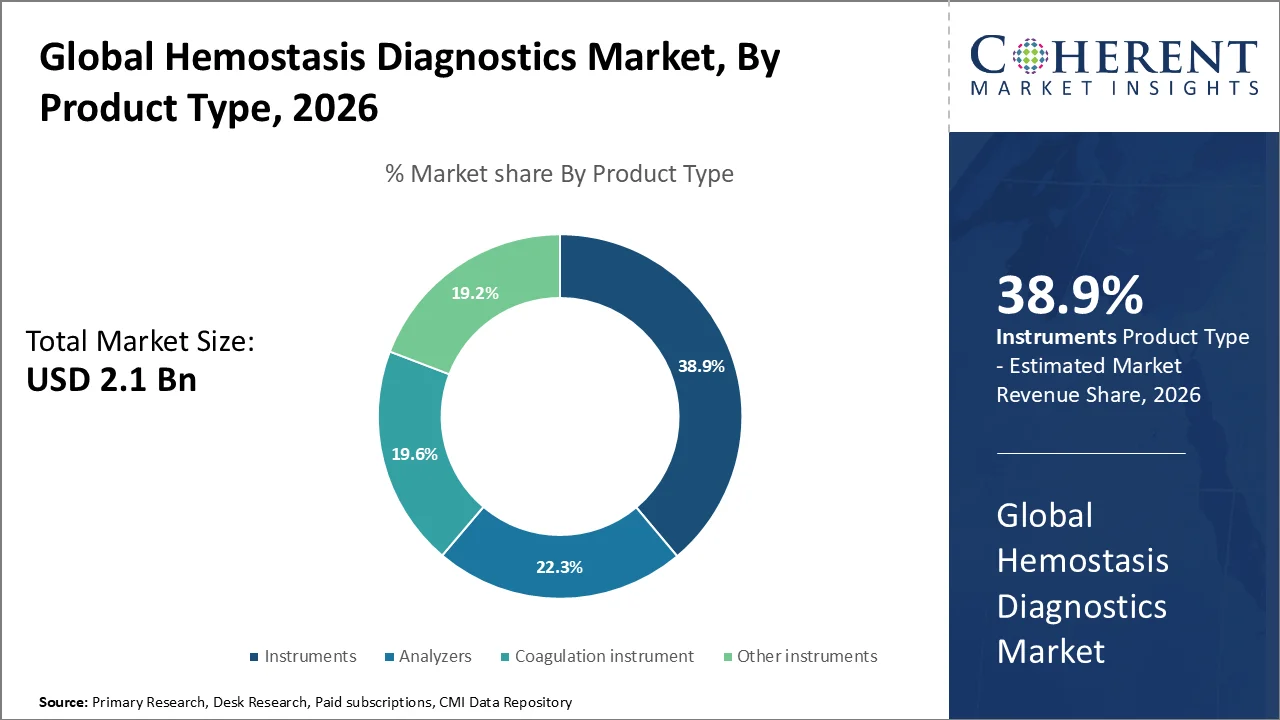
- Instruments hold the largest market share of 38.9% in 2026 owing to its rising prevalence of bleeding and thrombotic disorders.
- Automated expected to hold largest market share of 41.1% in 2026 owing to the growing demand for high-throughput testing.
- Prothrombin Test Time (PT) acquired the prominent market share of 37.8% in 2026 owing to its growing use of anticoagulant therapy. Anticoagulants are medications that reduce blood clotting by helping the body break down existing clots and preventing new ones from forming.
- Hospital/Clinics captures the largest market share of 42.7% in 2026 owing to the high patient and testing volumes. Approximately 98% of hospitalized patients undergo at least one laboratory test during their hospital stay.
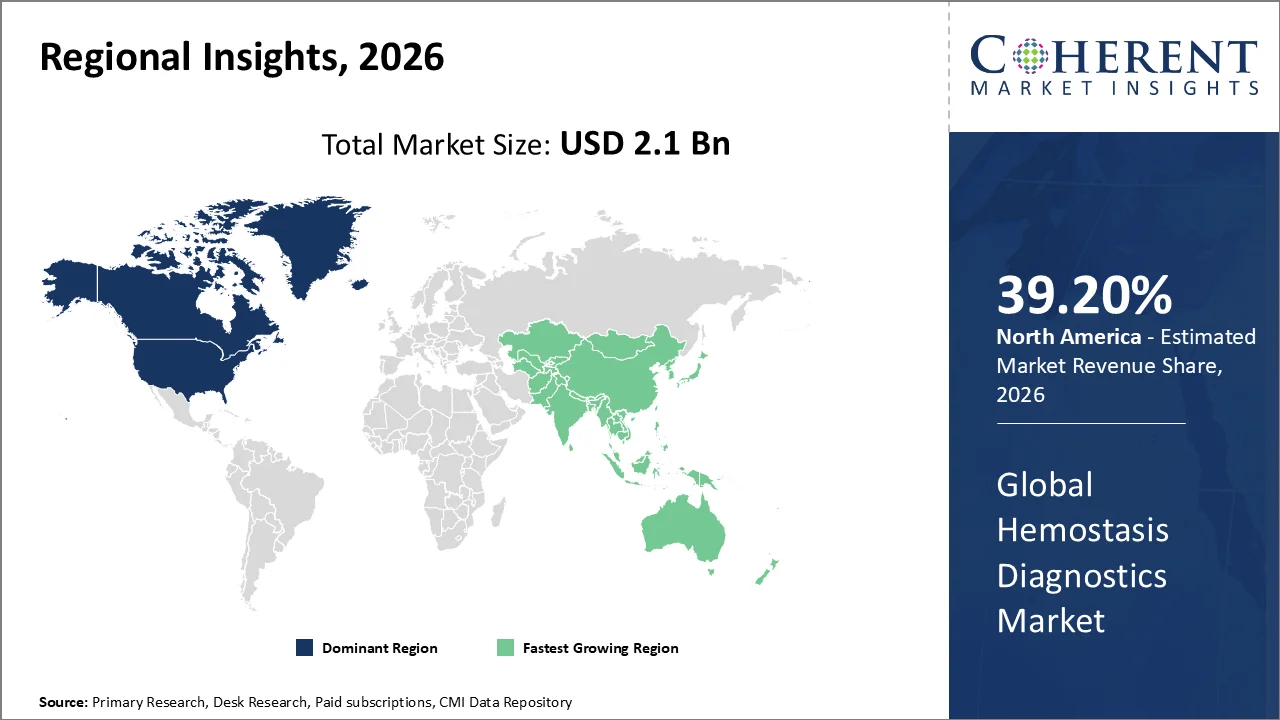
- North America is expected to acquire the dominant share of 39.2% in 2026 owing to its high prevalence of cardiovascular diseases. Cardiovascular disease affects approximately 9.9% of U.S. adults aged 20 years and older and remains the nation’s leading cause of death.
Current Events and Their Impact on the Hemostasis Diagnostics Market
Current Event | Description and its Impact |
FDA’s 2025 reversal of the Laboratory Developed Test (LDT) rule |
|
CMS Medicare coverage revision for hereditary thrombophilia testing effective January 2026 |
|
Segmental Insights
- Current Industry Events of 2026
- Market Size Estimation
- Regional Breakdown
- Competitive Landscape
- Customer Intelligence
- Segmental Analysis
- Pricing Analysis
- Key Market Drivers, Challenges & Future Trends
- Customized Insights Section
Why is Instruments Acquiring the Largest Market Share?
Instruments hold the largest market share of 38.9% in 2026. The instruments segment in the Hemostasis Diagnostics Market grows as healthcare providers demand faster and more accurate coagulation testing and manage increasing cases of bleeding and thrombotic disorders, surgeries, and critical-care procedures. Laboratories increasingly adopt automated and high-throughput analyzers to minimize manual errors, address staffing shortages, streamline workflows, and shorten turnaround times. Advances in optical, mechanical, electrochemical, microfluidic, and AI-enabled technologies, combined with LIS connectivity and point-of-care capabilities, further encourage hospitals and diagnostic laboratories to invest in advanced hemostasis instruments.
Automated expected to hold largest market share
Automated expected to hold largest market share of 41.1% in 2026 owing to the increasing surgical and critical-care volumes. The automated segment in the Hemostasis Diagnostics Market is growing as hospitals and laboratories demand rapid, accurate, and high-throughput coagulation testing. Healthcare providers increasingly use automated analyzers to minimize manual errors, overcome staffing shortages, streamline laboratory workflows, and shorten turnaround times. These systems standardize testing, automate quality control, and support a wider range of assays. Integration with laboratory information systems, digital connectivity, artificial intelligence, and point-of-care technologies further drives adoption by enhancing data management and enabling faster, more informed clinical decisions. For instance, Sysmex America launched the CN-9000 Automated Hemostasis Solution, expanding its CN-Series with a system designed to streamline workflows and manage rising testing volumes, particularly in high-throughput clinical laboratories.
Prothrombin Test Time (PT) acquired the prominent market share
Prothrombin Test Time (PT) acquired the prominent market share of 37.8% in 2026 owing to its expansion of point-of-care PT/INR testing. The Prothrombin Time (PT) segment in the Hemostasis Diagnostics Market grows as healthcare providers increasingly use PT/INR testing to monitor warfarin therapy and evaluate coagulation abnormalities. Rising cardiovascular and thromboembolic disorders, bleeding conditions, liver disease, and vitamin K deficiency further increase testing demand. Hospitals also perform PT testing before surgeries and during emergency care to assess clotting status. Growing adoption of automated and point-of-care testing enables healthcare providers to obtain faster results, improve workflow efficiency, and make timely clinical decisions. Roche launched a Bluetooth-enabled home PT/INR self-testing device that sends results directly to physicians. The system supports better anticoagulant management by improving treatment adherence and helping patients maintain their INR within the therapeutic range.
Which End User segment dominates the market?
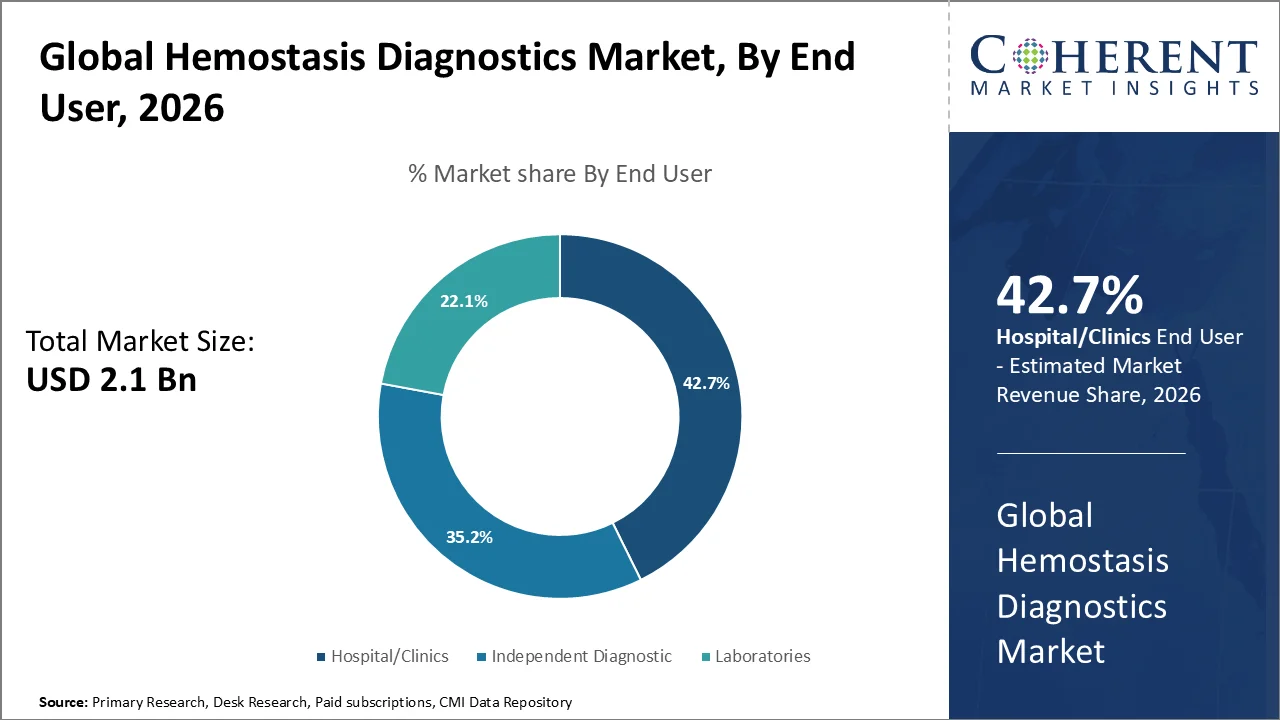
Hospital/Clinics captures the largest market share of 42.7% in 2026. The Hospitals/Clinics segment in the Hemostasis Diagnostics Market is driven by high patient volumes and increasing demand for coagulation testing across surgical, emergency, intensive-care, and chronic disease settings. Hospitals increasingly perform tests to manage cardiovascular, thrombotic, and bleeding disorders while monitoring anticoagulant therapy. Healthcare providers are also adopting automated analyzers and point-of-care systems to improve testing speed, accuracy, and workflow efficiency. Investments in advanced laboratory infrastructure, digital connectivity, and specialized diagnostic services further strengthen hospital and clinic adoption of hemostasis diagnostics.
Hemostasis Diagnostics Market Trends
- Rising adoption of automated hemostasis analyzers: Automation is increasingly important for improving testing consistency, reducing manual intervention, and shortening turnaround times for routine and specialized coagulation assays. This is particularly relevant as laboratories manage increasing testing volumes and seek greater workflow efficiency. FDA classifies coagulation instruments as Class II medical devices and recognizes CLSI POCT14, “Point-of-Care Coagulation Testing and Anticoagulation Monitoring,” as a consensus standard relevant to point-of-care coagulation systems
- Increasing need for anticoagulation monitoring: The large burden of thromboembolic disease supports continued demand for coagulation assessment among patients receiving anticoagulant therapy. The CDC estimates that up to 900,000 people in the United States are affected by venous thromboembolism (VTE) each year, with 60,000–100,000 deaths annually. The CDC also identifies hospitalization and surgery as particularly high-risk periods for VTE.
- Growing surgical, trauma, transplantation, and critical-care activity supports rapid coagulation assessment: Hemostasis testing is particularly important during and after major surgery, trauma, transplantation, and critical illness because clinicians must rapidly identify bleeding or impaired coagulation and guide appropriate treatment. The CDC reports that approximately one-half of blood clots occur during or soon after a hospital stay or surgery, highlighting the importance of coagulation and thrombotic-risk assessment in acute-care settings.
- Expansion of diagnostic capacity in developing regions creates longer-term opportunities for hemostasis testing: WHO reports that more than three-quarters of cardiovascular disease deaths occur in low- and middle-income countries, while the number of people aged 60 years and older is increasing particularly rapidly in developing regions. These demographic and disease-burden trends create a growing need for accessible diagnostic infrastructure, including coagulation testing, although adoption of advanced automated systems remains dependent on healthcare investment, laboratory capacity, and affordability.
Regional Insights
North America dominates owing to established reimbursement environment
North America is expected to acquire the dominant share of 39.20% in 2026. North America’s Hemostasis Diagnostics Market benefits from the region’s high burden of cardiovascular and thromboembolic diseases, aging population, and widespread anticoagulant use. The median age in the U.S. has increased to 39.4 years, while adults aged 65 and older account for approximately 19.2% of the population. Healthcare providers invest in advanced coagulation analyzers and point-of-care systems because the region maintains strong healthcare infrastructure and diagnostic capabilities. Hospitals also increase hemostasis testing as surgical and critical-care procedures expand. Furthermore, laboratories adopt automation, digital connectivity, and specialized diagnostic technologies to streamline workflows, enhance accuracy, accelerate turnaround times, and strengthen clinical decision-making. Baxter launched PERCLOT Absorbable Hemostatic Powder in the U.S., offering a ready-to-use, absorbable solution for controlling mild bleeding in patients with intact coagulation.
Asia Pacific Hemostasis Diagnostics Market Trends
The Asia Pacific Hemostasis Diagnostics Market is growing as cardiovascular, thrombotic, and bleeding disorders become more prevalent and aging populations increase healthcare demand. Governments and healthcare providers are expanding hospitals, diagnostic laboratories, and access to advanced testing technologies. Healthcare facilities are adopting automated coagulation analyzers and point-of-care systems to improve testing efficiency and shorten turnaround times. Rising healthcare spending, growing awareness of coagulation disorders, increasing surgical procedures, and continued laboratory modernization further drive the adoption of hemostasis diagnostics across the region. Sysmex Corporation launched the compact CS-1600 automated blood coagulation analyzer, expanding its hemostasis testing portfolio beyond traditional hemorrhagic-disorder diagnostics such as hemophilia.
United States Hemostasis Diagnostics Market Trends
The U.S. hemostasis diagnostics market is gaining momentum as clinicians increasingly prioritize rapid and reliable assessment of coagulation disorders. Rising cases of thrombosis, cardiovascular complications, and bleeding conditions are expanding testing requirements, while the growing use of anticoagulants strengthens demand for routine coagulation monitoring. Well-established diagnostic laboratories and hospital systems support widespread adoption. At the same time, next-generation analyzers, decentralized testing, and digital laboratory technologies are improving workflow efficiency, diagnostic precision, and treatment decisions. Biotronik launched the Acticor device family in the U.S., including Acticor DX and CRT-DX, enabling electrophysiologists to use its new ICD and CRT-D systems for patient treatment.
Japan Hemostasis Diagnostics Market Trends
Japan’s aging population is increasing demand for hemostasis diagnostics as healthcare providers manage more cardiovascular and thrombotic conditions. In Japan, more than 10% of the population is aged 80 years or older, while approximately 36.23 million people, nearly one-third of the population—are aged 65 and above. Physicians increasingly use PT/INR, aPTT, D-dimer, and specialized coagulation tests to monitor patients receiving anticoagulant and antithrombotic treatments. Hospitals also rely on hemostasis testing before and after surgeries and interventional procedures to reduce bleeding and clotting risks. Furthermore, Japan’s well-developed healthcare system, expanding laboratory automation, precision medicine, and growing use of point-of-care testing are driving healthcare facilities to adopt advanced diagnostic solutions.
Who are the Major Companies in Hemostasis Diagnostics Industry
Some of the major key players in Hemostasis Diagnostics are HORIBA, Ltd., Abbott Laboratories, Siemens AG, and Bio-Rad Laboratories, Inc., Becton, Dickinson & Company, Grifols S.A, Alere, Inc., F. Hoffmann-La Roche AG, Beckman Coulter Inc. Sekisui, Helena Labor, Chrono-Log, and Axis-Shield.
Key News
- In June 2024, Siemens Healthineers launched Sysmex’s CN-3000 and CN-6000 Hemostasis Systems for mid- and high-volume laboratories, enabling routine and specialized coagulation testing through a compact, comprehensive solution.
Market Report Scope
Hemostasis Diagnostics Market Report Coverage
| Report Coverage | Details | ||
|---|---|---|---|
| Base Year: | 2025 | Market Size in 2026: | USD 2.1 Bn |
| Historical Data for: | 2020 To 2024 | Forecast Period: | 2026 To 2033 |
| Forecast Period 2026 to 2033 CAGR: | 5.1% | 2033 Value Projection: | USD 3.5 Bn |
| Geographies covered: |
| ||
| Segments covered: |
| ||
| Companies covered: | HORIBA, Ltd., Abbott Laboratories, Siemens AG, Bio-Rad Laboratories, Inc., Becton, Dickinson & Company, Grifols S.A, Alere, Inc., F. Hoffmann-La Roche AG, Beckman Coulter Inc. Sekisui, Helena Labor, Chrono-Log, and Axis-Shield. | ||
Analyst Opinion
- The strongest demand driver in hemostasis diagnostics is the growing clinical burden of thrombosis and bleeding, not technology novelty. Venous thromboembolism alone affects an estimated 10 million people globally each year, while atrial fibrillation affects more than 50 million people worldwide and frequently requires anticoagulation monitoring and coagulation assessment. This persistent clinical workload gives hemostasis testing a fundamentally defensive demand profile: hospitals cannot simply postpone coagulation diagnostics when physicians must continuously balance bleeding risks against thrombotic complications.
- Anticoagulant therapy is structurally expanding the testing opportunity, particularly for high-risk and elderly patients. More than 100 million people worldwide are estimated to take oral anticoagulants, with warfarin remaining an important therapy in several patient populations despite the availability of direct oral anticoagulants. PT/INR testing therefore remains clinically relevant for dose management and bleeding-risk assessment. The continued coexistence of traditional vitamin K antagonists, newer anticoagulants, and complex patient profiles will sustain demand for both routine and specialized hemostasis assays rather than allowing the market to consolidate around a single testing platform.
- The real competitive advantage is shifting toward automation, speed, and integrated testing rather than standalone analyzer performance. Modern hemostasis laboratories increasingly process high volumes of PT, aPTT, fibrinogen, D-dimer, and factor assays while operating under pressure to shorten turnaround times. For example, major automated platforms can integrate multiple coagulation methodologies, automated sample handling, and quality-control functions within a single workflow. Laboratories will increasingly favor systems that reduce manual intervention and operator variability, making workflow efficiency a more decisive purchasing criterion than incremental improvements in individual assay specifications.
- D-dimer testing is becoming particularly important because clinicians increasingly use laboratory results to support rapid exclusion of venous thromboembolism. Clinical guidelines recognize high-sensitivity D-dimer testing as an important component of diagnostic pathways for appropriately selected patients with suspected pulmonary embolism or deep-vein thrombosis. The key opportunity is not simply higher testing volumes but faster clinical decision-making: hospitals that can deliver reliable results quickly can reduce unnecessary imaging and accelerate treatment decisions. This makes D-dimer one of the most strategically valuable assays within the broader hemostasis diagnostics portfolio.
- Japan represents an especially compelling market because demographic aging directly increases the complexity of coagulation management. Japan has one of the world’s oldest populations, with people aged 65 and over accounting for roughly three in ten residents. This demographic profile creates sustained demand for anticoagulation management, perioperative coagulation assessment, and thrombosis-related diagnostics. Japan’s opportunity lies less in rapid volume expansion and more in the replacement of labor-intensive laboratory processes with highly automated, reliable systems capable of supporting an aging patient population and increasingly sophisticated hospital workflows.
Speak to the analyst
Want personalized insights?
Take the findings above to one of our principal consultants, or have the report rebuilt around the segments, geographies and competitors you actually track.
Market Segmentation
- By Product Type (Revenue, USD Bn, 2021-2033)
- Instruments
- Analyzers
- Coagulation instrument
- Other instruments
- By Technology (Revenue, USD Bn, 2021-2033)
- Automated
- Semi-Automated
- Manual
- Reagents & Kits
- By Test Type (Revenue, USD Bn, 2021-2033)
- Prothrombin Test Time (PT)
- Activated Partial Thromboplastin Time (APTT)
- Fibrinogen Degradation Products (FDP)
- Activated Clotting Time, Platelet Aggregation Test
- D Dimer
- By End User (Revenue, USD Bn, 2021-2033)
- Hospital/Clinics
- Independent Diagnostic
- Laboratories
- By Region
- North America
- U.S.
- Canada
- Latin America
- Brazil
- Mexico
- Argentina
- Rest of Latin America
- Europe
- Germany
- U.K.
- France
- Italy
- Spain
- Russia
- Rest of Europe
- Asia Pacific
- China
- India
- Japan
- Australia
- South Korea
- ASEAN
- Rest of Asia Pacific
- Middle East
- GCC
- Israel
- Rest of Middle East
- Africa
- South Africa
- Central Africa
- North Africa
- North America
Sources
Primary Research interviews
- Hematologists and coagulation specialists
- Clinical pathologists and laboratory directors
- Hospital laboratory managers
- Diagnostic laboratory procurement professionals
- Clinical researchers specializing in thrombosis and bleeding disorders
- Medical device and in-vitro diagnostics experts
- Hospital procurement and healthcare technology decision-makers
Databases
- PubMed / MEDLINE
- ClinicalTrials.gov
- WHO Global Health Observatory
- CDC Data & Statistics
- OECD Health Statistics
- World Bank Health Data
- National health and laboratory databases
- National regulatory databases and device approval records
Magazines
- CAP Today
- Medical Laboratory Observer
- LabPulse
- Diagnostic Testing & Emerging Technologies publications
- Hematology-focused professional publications
Journals
- Journal of Thrombosis and Haemostasis
- Research and Practice in Thrombosis and Haemostasis
- Blood
- Blood Advances
- Haematologica
- Thrombosis Research
- Clinical Chemistry
- International Journal of Laboratory Hematology
- Journal of Clinical Pathology
Newspapers
- The New York Times
- The Guardian
- The Wall Street Journal
- Financial Times
- Reuters
- The Japan Times
- Nikkei Asia
Associations
- International Society on Thrombosis and Haemostasis (ISTH)
- American Society of Hematology (ASH)
- World Federation of Hemophilia (WFH)
- International Federation of Clinical Chemistry and Laboratory Medicine (IFCC)
- College of American Pathologists (CAP)
- European Hematology Association (EHA)
- International Federation of Biomedical Laboratory Science (IFBLS)
Public Domain sources
- World Health Organization (WHO)
- U.S. Food and Drug Administration (FDA)
- Centers for Disease Control and Prevention (CDC)
- National Institutes of Health (NIH)
- National Center for Biotechnology Information (NCBI)
- European Medicines Agency (EMA)
- U.S. National Library of Medicine
- U.S. Centers for Medicare & Medicaid Services (CMS)
- Japan Ministry of Health, Labour and Welfare (MHLW)
- Japan National Institute of Public Health
- OECD
- World Bank
- National statistical offices and government health agencies
Proprietary Elements
- CMI Data Analytics Tool
- Proprietary CMI Existing Repository of information for last 10 years
Get access to 250+ pages report
Every segment, forecast, competitor profile and data table behind the analysis above — available for instant download.
- ESOMAR Member
- ISO 9001:2015 Certified
- D-U-N-S Registered
- GDPR & CCPA Compliant
Missing comfort of reading report in your local language? Find your preferred language:
Transform your Strategy with Exclusive Trending Reports
Frequently Asked Questions
The Hemostasis Diagnostics Market is anticipated to grow at a CAGR of 5.1% with USD 2.1 Bn in 2026 and is expected to reach USD 3.5 Bn in 2033.
The market primarily includes PT/INR, aPTT, D-dimer, fibrinogen, thrombin time, coagulation-factor assays, platelet function tests, and viscoelastic tests such as TEG and ROTEM.
The strongest driver is the need to manage thrombotic and bleeding risks across anticoagulation, surgery, cardiovascular care, trauma, and critical care.
PT/INR remains deeply embedded in routine clinical workflows, particularly for warfarin monitoring and preoperative assessment.
Automation, point-of-care testing, microfluidics, and viscoelastic testing are the technologies with the greatest potential to change laboratory workflows.
POC systems can provide coagulation results close to the site of care, which is particularly valuable in emergency departments, operating rooms, trauma units, and critical-care settings.