

North Africa Non-Invasive Prenatal Testing Market Analysis & Forecast: 2026-2033
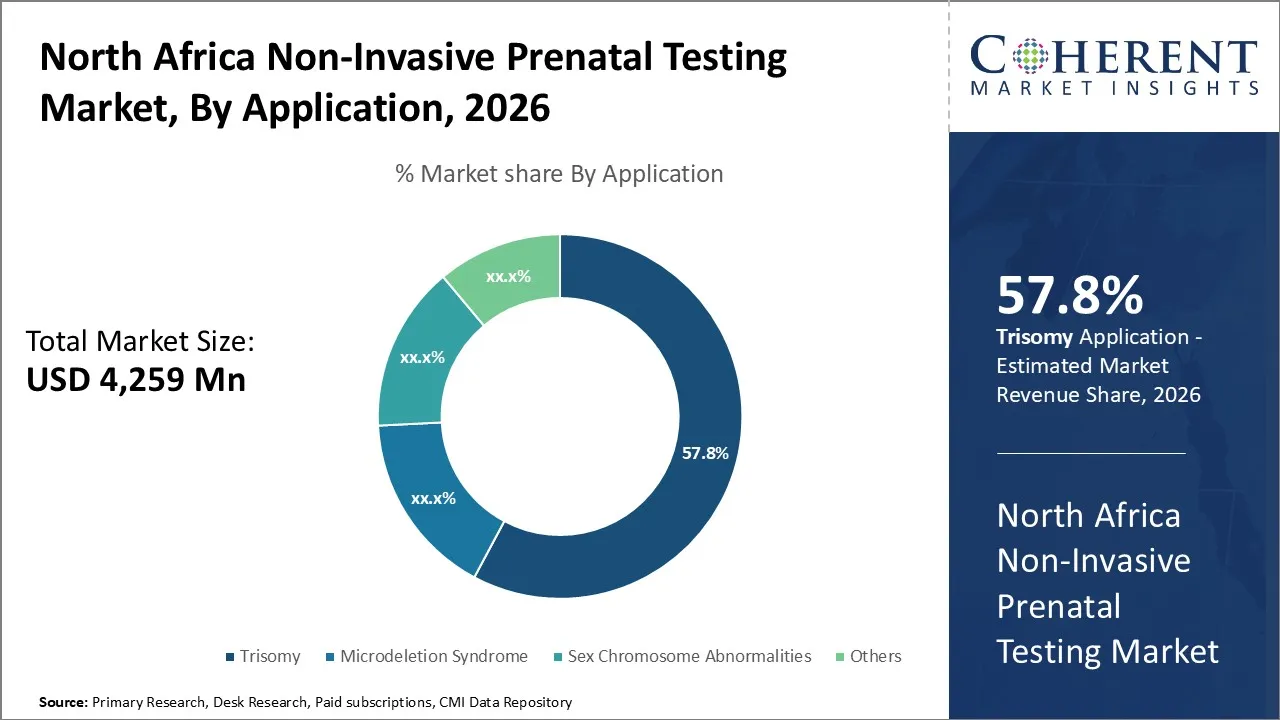
The North Africa non-invasive prenatal testing market is estimated to be valued at USD 4,259 Mn in 2026 and expected to reach USD 7,636 Mn by 2033, witnessing a CAGR of 8.7% over the forecast period (2026-2033).
Key Takeaways
- Based on Application, the trisomy segment is expected to hold 57.8% share of the market in 2026.
- Based on End User, the hospitals segment is expected to lead the market with 47.2% share in 2026.
Market Overview
Noninvasive prenatal testing (NIPT) is an evolving screening procedure for pregnant women. It examines cell free Deoxyribonucleic Acid (DNA) of both fetus and the mother. It provides an analysis of genetic screening using only one tube blood. NIPT provides predictions about the absence or presence of genetic abnormality in the fetus. It involves a simple method of blood withdrawal but presents high quality effectiveness for the detection of trisomy by minimizing the number of performing further invasive testing procedures. NIPT is performed to detect certain genetic abnormalities such as missing or extra copies of X and Y chromosomes, trisomy 18, trisomy 13, and Down syndrome. With technological advancements in the near future, NIPT will be able to detect other genetic abnormalities.
Current Events and their Impacts on the North Africa Non-invasive Prenatal Testing Market
Current Event | Description and its Impact |
Regional Healthcare Infrastructure Development |
|
Regulatory and Policy Developments |
|
Segmental Insights
- Current Industry Events of 2026
- Market Size Estimation
- Regional Breakdown
- Competitive Landscape
- Customer Intelligence
- Segmental Analysis
- Pricing Analysis
- Key Market Drivers, Challenges & Future Trends
- Customized Insights Section
North Africa Non-invasive Prenatal Testing Market Insights, By Application - Trisomy testing dominates due to clinical relevance and awareness
In terms of application, the trisomy segment is expected to hold 57.8% share of the market in 2026. Trisomy testing is the most popular type of NIPT in North Africa because it addresses the most common chromosomal problems, like Down Syndrome. Physicians prioritize it because it is clinically important, there is a strong demand from expecting parents, and there are established guidelines. Since it is reliable and well-known, it will be the main method of prenatal genetic screening in 2026.
North Africa Non-invasive Prenatal Testing Market Insights, By End User - Hospitals lead is driven by accessibility and integrated prenatal care
In terms of end user, the hospitals segment is expected to lead the market with 47.2% share in 2026, because they are still the main places for prenatal care, offering integrated diagnostic services and reliable medical supervision. Expecting mothers prefer testing performed in hospitals because it is safer and comprehensive. Even though independent labs are becoming more popular, hospitals still have the upper hand as they are accessible, have a lot of infrastructure, and get referrals from doctors.
Market Report Scope
North Africa Non-invasive Prenatal Testing Market Report Coverage
| Report Coverage | Details | ||
|---|---|---|---|
| Base Year: | 2025 | Market Size in 2026: | USD 4,259 Mn |
| Historical Data for: | 2020 To 2024 | Forecast Period: | 2026 To 2033 |
| Forecast Period 2026 to 2033 CAGR: | 8.7% | 2033 Value Projection: | USD 7,636 Mn |
| Geographies covered: |
| ||
| Segments covered: |
| ||
| Companies covered: | Illumina, Inc., Eurofins Scientific, PerkinElmer, Inc., F. Hoffmann-La Roche AG, Natera, Inc., Yourgene Health Plc., Laboratory Corporation of America Holdings (LabCorp), BGI Group, and Quest Diagnostics Incorporated | ||
| Growth Drivers: |
| ||
| Restraints & Challenges: |
| ||
North Africa Non-invasive Prenatal Testing Market Driver
Rising Maternal Age
In North Africa, the women are choosing to have children later in life. Older mothers are much more likely to have chromosomal problems like Down syndrome. This makes it essential to find safer and more accurate ways to screen for these problems before birth. Non-invasive prenatal testing (NIPT) solves these problems by giving accurate results without the risks that come with invasive tests. As healthcare providers adjust to changing patient needs, this demographic shift is a major reason for the North Africa Non-invasive Prenatal Testing Market growth.
Growing Awareness of Genetic Disorders
Families in North Africa are becoming more aware of genetic disorders like trisomy 21, microdeletion syndromes, and sex chromosome abnormalities due to public health campaigns and better access to medical information. Increasingly more individuals are becoming aware of this, which is making pregnant women want to get early and accurate tests to make sure their pregnancies go better. As more people learn about them, the need for advanced screening technologies like NIPT is growing quickly. This increased knowledge is driving up the North Africa Non-invasive Prenatal Testing Market demand, making NIPT the preferred option for prenatal care.
North Africa Non-invasive Prenatal Testing Market Opportunity
Expansion of Medical Tourism
Countries in North Africa, like Egypt, Morocco, and Tunisia, are increasingly marketing themselves as affordable healthcare destinations, drawing in patients from nearby areas and beyond. An influx of international patients is coming to get advanced diagnostic services, which is a great chance for non-invasive prenatal testing (NIPT) providers to add more services and meet demand from other countries. Healthcare facilities can enhance accessibility and accelerate adoption of cutting-edge prenatal screening technologies by using medical tourism. This trend is likely to have a big effect on the North Africa Non-invasive Prenatal Testing Market forecast, which means that it will have a lot of room to grow in the future.
Analyst Opinion (Expert Opinion)
- In North Africa, clinical adoption of NIPT is concentrated in Egypt, Morocco, and Algeria, where hospitals and diagnostic centers are increasingly offering cfDNA-based screening for trisomies and microdeletion syndromes. According to regional reports, trisomy detection is still the most common use of NIPT, making up more than 60% of all NIPT use. Microdeletion and sex chromosome abnormality testing are smaller but growing areas of use.
- Diagnostic laboratories and independent centers are making NIPT services more available, and they now make up a large part of the service delivery in cities. But there are still differences: people in rural areas have less access, and people are still less aware than the global average. Reports show that Egypt has the most tests available, while Morocco and Algeria are slowly building up their infrastructure. This shows that genomic testing capacity is not evenly distributed across the region.
Speak to the analyst
Want personalized insights?
Take the findings above to one of our principal consultants, or have the report rebuilt around the segments, geographies and competitors you actually track.
Market Segmentation
- By Application
- Trisomy
- Microdeletion Syndrome
- Sex Chromosome Abnormalities
- Others
- By End User
- Hospitals
- Diagnostic Centers & Independent Laboratories
- By Countries
- Egypt
- Algeria
- Morocco
- Rest of North Africa
- Key Players
- Illumina, Inc.
- Eurofins Scientific
- PerkinElmer, Inc.
- Hoffmann-La Roche AG
- Natera, Inc.
- Yourgene Health Plc.
- Laboratory Corporation of America Holdings (LabCorp)
- BGI Group
- Quest Diagnostics Incorporated.
Sources
Primary Research Interviews
- Non-invasive Prenatal Testing (NIPT) Kit & Reagent Manufacturers
- Genetic Testing Laboratories (Public & Private) and Reference Lab Networks
- Hospital & Diagnostic Chain Laboratory Heads (OB-GYN / Maternal-Fetal Medicine affiliated)
- Obstetricians, Maternal-Fetal Medicine (MFM) Specialists, and Fetal Medicine Centers
- Genetic Counselors & Clinical Geneticists
- Distributors / Importers of Molecular Diagnostics & Genomics Consumables (North Africa)
- Payers & Reimbursement Stakeholders (Public insurers / private TPAs where applicable)
- Regulatory & Tender/Procurement Stakeholders (health authorities, hospital procurement teams)
- Others
Databases
- IQVIA (Market/Prescription & Healthcare Data)
- Fitch Solutions / BMI Research
- UN Comtrade (Trade Data)
- World Bank Data
- WHO Global Health Observatory
- International Trade Centre (ITC) Trade Map
- Others
Magazines
- GenomeWeb
- Genetic Engineering & Biotechnology News (GEN)
- Diagnostics World
- Medical Device Network
- Clinical Lab Products
- Others
Journals
- Prenatal Diagnosis
- Ultrasound in Obstetrics & Gynecology
- American Journal of Obstetrics & Gynecology (AJOG)
- Genetics in Medicine
- Clinical Chemistry
- Journal of Medical Genetics
- Others
Newspapers
- Reuters
- Bloomberg News
- Financial Times
- The Wall Street Journal
- Local & Regional Business/Healthcare News Portals (North Africa)
- Others
Associations
- International Society for Prenatal Diagnosis (ISPD)
- European Society of Human Genetics (ESHG)
- American College of Obstetricians and Gynecologists (ACOG) – Guidelines/Practice Updates
- African Society of Human Genetics (AfSHG)
- International Federation of Gynecology and Obstetrics (FIGO)
- Others
Public Domain Sources
- Ministries of Health / National Health Authorities (Egypt, Morocco, Algeria, Tunisia, Libya, etc.)
- WHO (maternal health, screening and health system indicators)
- World Bank Open Data (health expenditure, population, income indicators)
- UN Comtrade / ITC Trade Map (imports of diagnostics instruments/consumables proxies)
- OECD/UNICEF/UNFPA (where relevant for maternal and child health indicators)
- Others
Proprietary Elements
- CMI Data Analytics Tool
- Proprietary CMI Existing Repository of Information for the Last 8 Years
Get access to 250+ pages report
Every segment, forecast, competitor profile and data table behind the analysis above — available for instant download.
- ESOMAR Member
- ISO 9001:2015 Certified
- D-U-N-S Registered
- GDPR & CCPA Compliant
Missing comfort of reading report in your local language? Find your preferred language:
Transform your Strategy with Exclusive Trending Reports
Frequently Asked Questions
The global North Africa Non-Invasive Prenatal Testing Market size was valued at USD 4,259 Mn in 2026 and is expected to reach USD 7,636 Mn in 2033
Rising maternal age and growing awareness of genetic disorders are expected to drive the market growth over the forecast period.
Trisomy segment is expected to hold a major market in 2026.
Egypt holds the largest share in the market.
Major factors hampering the growth of the market include the presence of alternative methods for prenatal diagnosis and risk of claiming false test results.
Major players operating in the market include Illumina, Inc., Eurofins Scientific, PerkinElmer, Inc., F. Hoffmann-La Roche AG, Natera, Inc., Yourgene Health Plc., Laboratory Corporation of America Holdings (LabCorp), BGI Group, and Quest Diagnostics Incorporated.