

Anticoagulant Market Size and Share Analysis- 2026 To 2033
The Anticoagulant Market size is anticipated to grow at a CAGR of 8.9% with USD 46.1 Bn in 2026 and is expected to reach USD 83.5 Bn in 2033. The primary drivers are largely defined by rising prevalence of atrial fibrillation, growing venous thromboembolism burden, increasing use of direct oral anticoagulants, expanding geriatric population, and higher adoption of preventive thrombosis therapy in hospitals. According to This is strengthening demand for oral and injectable anticoagulants across hospitals, specialty clinics, retail pharmacies, and long-term cardiovascular care settings.
Key Takeaways
- The Novel Oral Anticoagulants (NOACs) is likely to dominate the market with 58.2% in 2026. The segment’s growth is owing to its fixed-dose convenience, lower requirement for routine coagulation monitoring, rapid onset of action, and stronger clinical preference over traditional vitamin K antagonists in eligible patients. The 2024 ESC atrial fibrillation guidance states that DOACs such as apixaban, dabigatran, edoxaban, and rivaroxaban are preferred over vitamin K antagonists, except in patients with mechanical heart valves and mitral stenosis. This is strengthening NOAC adoption across stroke prevention, VTE treatment, as well as long-term cardiovascular risk management.
- The atrial fibrillation/myocardial infarction (heart attack) segment is set to lead with 46.8% in 2026. The segment’s growth is owing to the rising burden of irregular heart rhythm, stroke risk, coronary artery disease, and acute coronary syndrome requiring anticoagulant intervention. CDC data indicates that around 805,000 people in the U.S. have a heart attack every year, including both first-time and recurrent events. This is increasing the use of anticoagulants in hospital care, secondary prevention, and long-term cardiovascular treatment pathways.
- North America is expected to acquire the prominent share of 50.5% in 2026. The region’s growth is owing to the high prevalence of cardiovascular diseases (such as atrial fibrillation), a large geriatric population, and rising rates of obesity. In the U.S., someone experiences a stroke every 40 seconds, thereby highlighting the continued need for effective anticoagulant therapies for stroke prevention and long-term cardiovascular care.
Segmental Insights
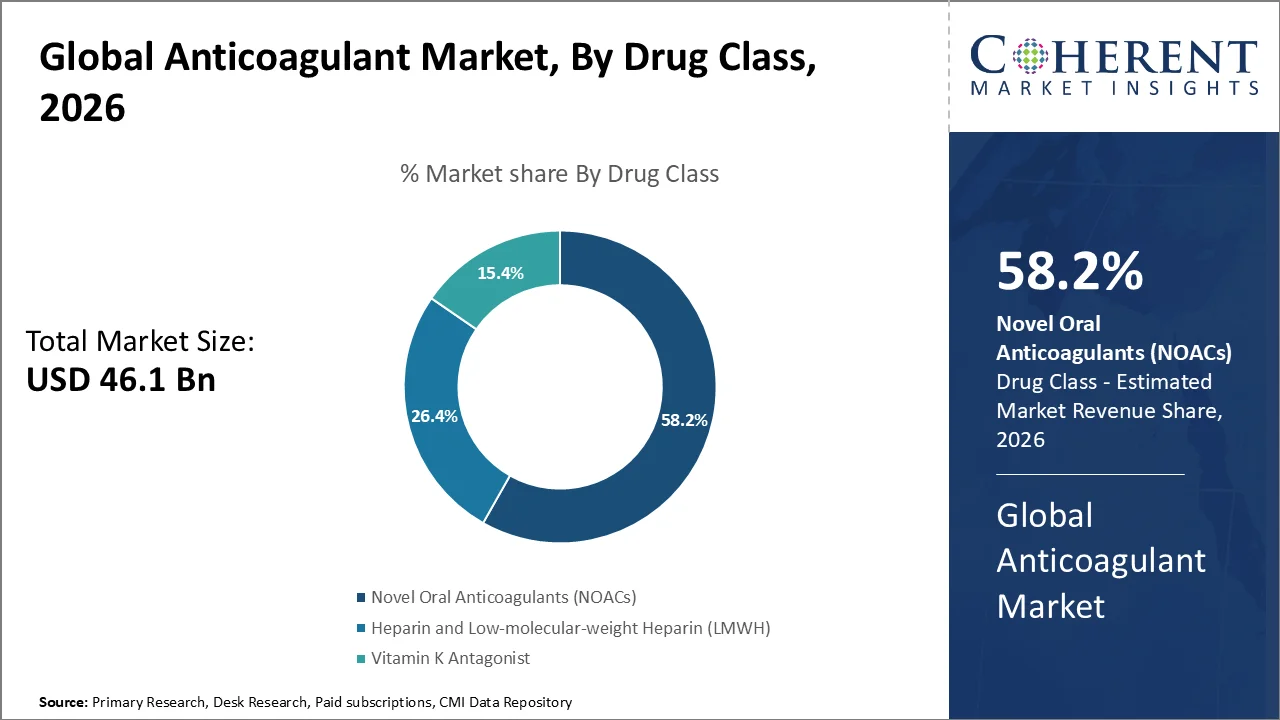
Why is Novel Oral Anticoagulants (NOACs) Acquiring the Largest Share?
On the basis of drug class, the Novel Oral Anticoagulants (NOACs) segment is projected to account for the largest Anticoagulant Market share of 58.2% in 2026. The segment’s growth is owing to their ease of administration, predictable pharmacological profile, fewer dietary restrictions, reduced monitoring burden, and growing use in atrial fibrillation, deep vein thrombosis, pulmonary embolism, and post-surgical thromboprophylaxis.
The segment is further supported by the large patient base using branded NOACs. Bristol Myers Squibb and Pfizer reported that more than 19 million Americans had been prescribed Eliquis since launch, highlighting the scale of NOAC adoption in the U.S. market.
In April 2026, Bristol Myers Squibb and Pfizer also announced that Eliquis would be available through Mark Cuban Cost Plus Drug Company at USD 345 for a 30-day supply, improving direct access for cash-paying patients. This development is expected to support therapy continuation, improve affordability, and strengthen NOAC penetration among patients requiring long-term anticoagulation.
- Current Industry Events of 2026
- Market Size Estimation
- Regional Breakdown
- Competitive Landscape
- Customer Intelligence
- Segmental Analysis
- Pricing Analysis
- Key Market Drivers, Challenges & Future Trends
- Customized Insights Section
Atrial Fibrillation / Myocardial Infarction (Heart Attack) hold the Largest Market Share
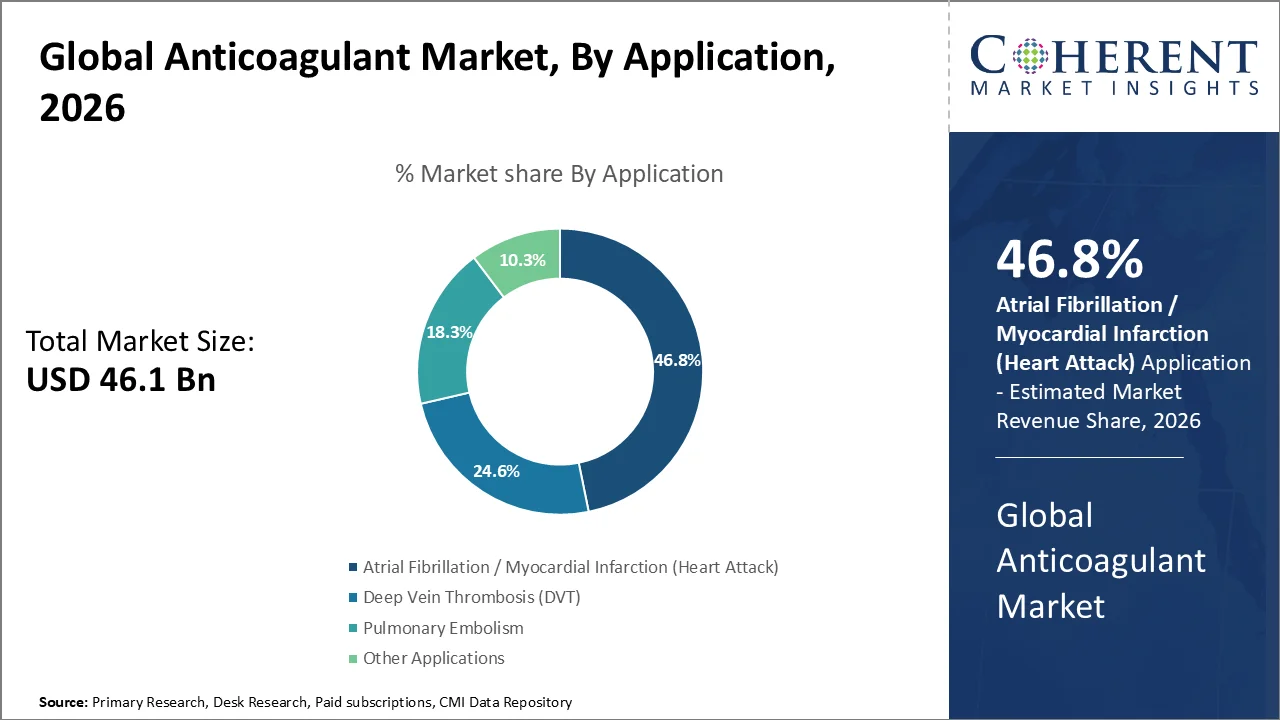
On the basis of application, the atrial fibrillation/myocardial infarction (heart attack) segment lead with a major 46.8% share in 2026. The segment’s growth is owing to the high prevalence of atrial fibrillation, increasing heart attack incidence, rising stroke-prevention needs, and continued use of anticoagulants in acute coronary and long-term cardiovascular care pathways.
CDC estimates that 12.1 million people in the U.S. will have atrial fibrillation by 2050, while AFib was mentioned on 232,030 death certificates in 2021. This creates a strong long-term treatment pool for NOACs and other anticoagulants.
In March 2025, the U.S. FDA approved the first generics of Xarelto (rivaroxaban) 2.5 mg tablets for reducing the risk of major cardiovascular events in adults with coronary artery disease and major thrombotic vascular events in adults with peripheral artery disease.
Market Drivers
Rising Innovations in Anticoagulant Access and Adherence is Transforming the Anticoagulant Market in the US
Rising innovations in drug affordability, prescription-payment flexibility, and patient access programs are transforming the anticoagulant market in the U.S. The long-term anticoagulation requires uninterrupted therapy for stroke prevention, venous thromboembolism management, and cardiovascular risk reduction.
In 2025, the Medicare Part D benefit redesign introduced a USD 2,000 annual out-of-pocket cap for covered prescription drugs, while These affordability improvements are expected to support stronger adherence among patients using high-value anticoagulants for atrial fibrillation, coronary artery disease, peripheral artery disease, as well as recurrent clot prevention.
In December 2025, Bristol Myers Squibb also announced an agreement with the U.S. government to make Eliquis available to Medicaid programs for free and to donate more than seven tons of Eliquis active pharmaceutical ingredient to the U.S. Strategic Active Ingredient Reserve. This development is expected to strengthen anticoagulant access for vulnerable patients, improve therapy continuity, and support long-term market growth in the U.S.
Factor XI inhibition: A Major Breakthrough in the Anticoagulant Market
Factor XI/Factor XIa inhibition is emerging as one of the most important technology breakthroughs in the anticoagulant market. Factor XI inhibitors are being developed to separate antithrombotic benefit from excess bleeding risk by targeting the intrinsic coagulation pathway while preserving essential hemostasis.
Abelacimab, asundexian, and milvexian are among the leading investigational assets in this class. In the AZALEA–TIMI 71 study, abelacimab showed markedly fewer bleeding events compared with rivaroxaban in patients with atrial fibrillation. Anthos Therapeutics reported in March 2025 that abelacimab reduced major or clinically relevant non-major bleeding compared with rivaroxaban across bleeding-risk categories, with rates ranging from 2.5% to 7.1% in the pooled abelacimab arm compared with 5.6% to 21.2% in the rivaroxaban arm across risk groups.
In February 2025, Novartis announced the acquisition of Anthos Therapeutics for USD 925 million, adding abelacimab, a Phase 3 Factor XI inhibitor. The acquisition is aimed at preventing stroke in atrial fibrillation and addressing cancer-associated thrombosis.
Current Events and Their Impact on the Anticoagulant Market
Current Event | Description and its Impact |
U.S. Medicare Drug Price Negotiation for Eliquis and Xarelto Takes Effect (2026) |
|
FDA Priority Review for Bayer’s Asundexian in Secondary Stroke Prevention (May 2026) |
|
Anticoagulant Market Trends
- Rising adoption of direct oral anticoagulants (DOACs) such as apixaban, rivaroxaban, dabigatran, and edoxaban is reducing dependence on warfarin monitoring, fixed diet restrictions, and frequent dose adjustments.
- Growing atrial fibrillation burden is strengthening long-term stroke-prevention demand, especially as clinical guidelines increasingly prefer DOACs over vitamin K antagonists in eligible patients, excluding mechanical valve and mitral stenosis cases.
- Factor XI/FXIa inhibitors are emerging as next-generation anticoagulants, aiming to maintain clot-prevention benefits while lowering bleeding complications, which remain a major limitation of current therapies.
- Supportive access models, reimbursement reforms, and direct-to-patient affordability programs are improving the treatment continuity. In 2025, Bristol Myers Squibb expanded Eliquis direct-to-patient access at more than 40% below list price, while CDC reports up to 900,000 Americans are affected by VTE annually.
Regional Insights
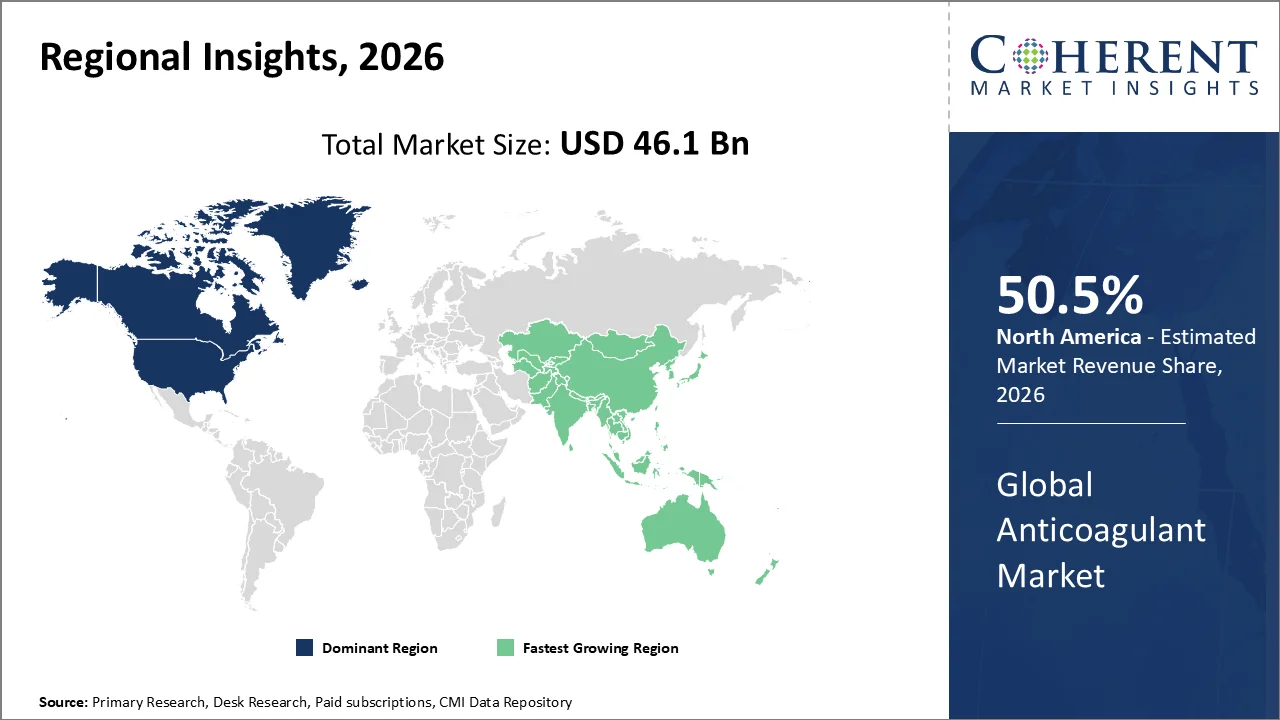
North America Dominates Owing to the High Cardiovascular Disease Burden and Strong Oral Anticoagulant Adoption
The North America region accounts for 50.5% of the market share in 2026. The region’s growth is owing to the high cardiovascular disease prevalence, strong diagnosis rates for AF and VTE, wider insurance coverage, established hospital thromboprophylaxis protocols, and leading commercial presence of Eliquis and Xarelto. The U.S. is the major contributor due to high treatment affordability compared with many regions, large cardiology networks, and extensive use of oral anticoagulants in Medicare and commercial plans.
CDC reported that 919,032 people died from cardiovascular disease in the U.S. in 2023, equivalent to one in every three deaths. CDC also states that up to 900,000 Americans are affected by VTE each year. These patient pools create sustained demand for both acute and chronic anticoagulation.
In June 2026, Sunshine Biopharma announced Canadian approval for its generic Rivaroxaban tablets (2.5 mg, 10 mg, 15 mg, 20 mg), equivalent to Xarelto. The drug is indicated for preventing deep vein thrombosis, pulmonary embolism, and stroke in non-valvular atrial fibrillation.
Asia Pacific Anticoagulant Market Trends
Asia Pacific is expected to witness strong growth in Anticoagulant Market over the forecast period. The region’s growth is owing to the rapid population ageing, increasing cardiovascular disease diagnosis, improving access to hospital-based thrombosis care, and expanding use of affordable oral anticoagulants.
According to UNFPA Asia-Pacific, the population aged 60 years and above in Asia Pacific is expected to triple by 2050, reaching close to 1.3 billion people. This aging trend is directly increasing demand for long-term anticoagulation because elderly patients have higher risks of atrial fibrillation, stroke, venous thromboembolism, orthopedic surgery, and cardiovascular hospitalization.
In October 2025, Lupin launched Rivaroxaban for Oral Suspension, 1 mg/mL, in the U.S., with the product manufactured at the company’s Chhatrapati Sambhajinagar facility in India.
Rising Cardiovascular Disease Burden is Accelerating the Anticoagulant Market in United States
The U.S. remains the most important country market due to its large aging demographic, sophisticated healthcare infrastructure, and the massive prevalence of cardiovascular and clotting disorders. According to the National Institutes of Health (NIH), total individual expenditures for oral anticoagulants in the United States reached USD 17.8 billion, driven heavily by the rapid transition from warfarin to DOACs.
In September 2025, Cadrenal Therapeutics acquired eXIthera Pharmaceuticals’ portfolio of investigational IV and oral Factor XIa inhibitors, including frunexian and EP-7327, significantly expanding its anticoagulation pipeline. This positions Cadrenal to address large unmet needs in acute and chronic thrombotic care.
China Anticoagulant Market Trends
In the China, growth in the Anticoagulant Market is driven by a large cardiovascular disease burden, rising elderly population, improving hospital diagnosis, and increasing focus on secondary stroke prevention. According to NIH, China’s National Centralized Drug Procurement policy accelerated clinical uptake, with NOAC use among hospitalized atrial fibrillation patients rising sharply from 11.39% to 80.92%
In May 2026, China’s Center of Drug Evaluation granted Priority Review designation to Bayer’s FXIa inhibitor, asundexian, recognizing its potential to address urgent medical needs and provide significant clinical value in preventing ischemic strokes. This accelerates its regulatory approval pathway in China.
Who are the Major Companies in Anticoagulant Industry
Some of the major key players in Anticoagulant Market are Pfizer Inc., Sanofi SA, Dr. Reddy’s Laboratories, Aspen Holdings, Abbott Laboratories, Leo Pharma AS, Alexion Pharmaceuticals Inc., Bayer AG, Johnson & Johnson, Bristol-Myers Squibb Company, Daiichi Sankyo Company, and Boehringer Ingelheim Pharmaceuticals Inc.
Key News
- In January 2026, VarmX and Rentschler Biopharma expanded their VMX-C001 collaboration to support Phase 3 and commercial manufacturing, shifting supply from Laupheim to Milford. The anticoagulant-reversal therapy has FDA Fast Track status and PMDA Phase 1 waiver ahead of EquilibriX-S.
- In September 2025, VarmX entered a strategic collaboration and option agreement with CSL to advance its lead asset, VMX-C001, a novel treatment for restoring coagulation in patients on FXa DOACs facing urgent surgery or severe bleeding. CSL will fully fund the global Phase 3 trial, late-stage development, manufacturing, and pre-launch activities.
Market Report Scope
Anticoagulant Market Report Coverage
| Report Coverage | Details | ||
|---|---|---|---|
| Base Year: | 2025 | Market Size in 2026: | USD 46.1 Bn |
| Historical Data for: | 2020 To 2024 | Forecast Period: | 2026 To 2033 |
| Forecast Period 2026 to 2033 CAGR: | 8.9% | 2033 Value Projection: | USD 83.5 Bn |
| Geographies covered: |
| ||
| Segments covered: |
| ||
| Companies covered: | Pfizer Inc., Sanofi SA, Dr. Reddy’s Laboratories, Aspen Holdings, Abbott Laboratories, Leo Pharma AS, Alexion Pharmaceuticals Inc., Bayer AG, Johnson & Johnson, Bristol-Myers Squibb Company, Daiichi Sankyo Company, and Boehringer Ingelheim Pharmaceuticals Inc. | ||
| Growth Drivers: |
| ||
| Restraints & Challenges: |
| ||
Analyst Opinion
- Anticoagulant Market growth is not only supported by cardiovascular disease prevalence but by the expanding long-term treatment pool across atrial fibrillation, stroke prevention, and venous thromboembolism care. According to the CDC, atrial fibrillation increases stroke risk, while up to 900,000 people in the U.S. are affected by venous thromboembolism each year. This indicates that anticoagulants will remain essential recurring therapies across hospitals, cardiology clinics, post-surgical care, and chronic disease management pathways.
- The market is moving from conventional warfarin-based therapy toward direct oral anticoagulants due to easier administration, predictable dosing, and reduced monitoring burden. According to the 2023 ACC/AHA/ACCP/HRS atrial fibrillation guideline, direct oral anticoagulants are preferred over warfarin except in patients with mechanical heart valves or moderate-to-severe mitral stenosis. This suggests that NOACs/DOACs will continue gaining prescription preference as physicians prioritize convenience, adherence, and better benefit-risk profiles for eligible patients.
- Safety management, reversal options, and hospital protocols are becoming strategically important in anticoagulant adoption. According to the FDA label, ANDEXXA is indicated for patients treated with rivaroxaban or apixaban when reversal is needed due to life-threatening or uncontrolled bleeding. This indicates that wider availability of antidotes, emergency-care protocols, and bleeding-risk management tools will support physician confidence, especially among elderly patients, renal-impaired patients, and high-risk cardiovascular populations.
Speak to the analyst
Want personalized insights?
Take the findings above to one of our principal consultants, or have the report rebuilt around the segments, geographies and competitors you actually track.
Market Segmentation
- By Drug Class (Revenue, USD Bn, 2021-2033)
- Novel Oral Anticoagulants (NOACs)
- Heparin and Low-molecular- weight Heparin (LMWH)
- Vitamin K Antagonist
- By Application (Revenue, USD Bn, 2021-2033)
- Atrial Fibrillation/Myocardial Infarction (Heart Attack)
- Deep Vein Thrombosis (DVT)
- Pulmonary Embolism
- Other Applications
- By Region (Revenue, USD Bn, 2021-2033)
- North America
- U.S.
- Canada
- Latin America
- Brazil
- Mexico
- Argentina
- Rest of Latin America
- Europe
- Germany
- U.K.
- France
- Italy
- Spain
- Russia
- Rest of Europe
- Asia Pacific
- China
- India
- Japan
- Australia
- South Korea
- ASEAN
- Rest of Asia Pacific
- Middle East
- GCC
- Israel
- Rest of Middle East
- Africa
- South Africa
- Central Africa
- North Africa
- North America
Sources
Primary Research Interviews
- Anticoagulant Drug Manufacturers
- Active Pharmaceutical Ingredient (API) Manufacturers
- Hospital Pharmacists & Pharmacy Procurement Heads
- Hematologists, Cardiologists & Vascular Medicine Specialists
- Contract Manufacturing Organizations (CMOs)
- Clinical Research Organizations (CROs)
- Regulatory Affairs Consultants
- Others
Databases
- Bloomberg Terminal
- Thomson Reuters Eikon
- IQVIA
- S&P Global Market Intelligence
- Evaluate Pharma
- ClinicalTrials.gov
- Others
Magazines
- Pharmaceutical Technology
- PharmaTimes
- Fierce Pharma
- Drug Discovery & Development
- Medical Device Network
- Others
Journals
- Journal of Thrombosis and Haemostasis
- Thrombosis and Haemostasis
- Blood Journal
- Circulation
- The Lancet Haematology
- New England Journal of Medicine
- Others
Newspapers
- Financial Times
- The Wall Street Journal
- Reuters
- Bloomberg News
- The Economic Times
- Others
Associations
- International Society on Thrombosis and Haemostasis (ISTH)
- American Society of Hematology (ASH)
- American College of Cardiology (ACC)
- American Heart Association (AHA)
- Anticoagulation Forum
- European Society of Cardiology (ESC)
- Others
Public Domain Sources
- U.S. Food and Drug Administration (FDA)
- European Medicines Agency (EMA)
- World Health Organization (WHO)
- National Institutes of Health (NIH)
- Centers for Disease Control and Prevention (CDC)
- ClinicalTrials.gov
- National Health Service (NHS)
- Others
Proprietary Elements
- CMI Data Analytics Tool
- Proprietary CMI Existing Repository of Information for the Last 8 Year
Get access to 250+ pages report
Every segment, forecast, competitor profile and data table behind the analysis above — available for instant download.
- ESOMAR Member
- ISO 9001:2015 Certified
- D-U-N-S Registered
- GDPR & CCPA Compliant
Missing comfort of reading report in your local language? Find your preferred language:
Transform your Strategy with Exclusive Trending Reports
Frequently Asked Questions
The Anticoagulant Market is expected to reach USD 83.5 Bn in 2033.
Major players operating in the global Anticoagulant Market include Pfizer Inc., Sanofi SA, Dr. Reddy’s Laboratories, Aspen Holdings, Abbott Laboratories, Leo Pharma AS, Alexion Pharmaceuticals Inc., Bayer AG, Johnson & Johnson, Bristol-Myers Squibb Company, Daiichi Sankyo Company, and Boehringer Ingelheim Pharmaceuticals Inc.
The high cost of Novel Oral Anticoagulants (NOACs), severe bleeding risks, and a lack of standardization in monitoring tests are the key factors hampering growth of the market.
The rising prevalence of cardiovascular diseases (CVDs), an aging global demographic, and the widespread clinical adoption of Direct Oral Anticoagulants (DOACs) like Eliquis and Xarelto is boosting the demand for Anticoagulant.
The Anticoagulant Market is anticipated to grow at a CAGR of 8.9% between 2026 and 2033.
Among regions, North America is expected to account for a largest market share in the global Anticoagulant Market over the forecast period.
The anticoagulant market includes medicines used to prevent, treat, or reduce recurrence of blood clots. These include direct oral anticoagulants, heparins, vitamin K antagonists, direct thrombin inhibitors, and emerging Factor XI inhibitors used in atrial fibrillation, DVT, PE, stroke prevention, surgery, and cardiovascular risk reduction.