

Global Virtual Goods Market Size and Forecast: 2026-2033
According to Coherent Market Insights, the global virtual goods market is estimated to be valued at USD 9.34 Bn in 2026 and is expected to reach USD 13.86 Bn by 2033, expanding at a compound annual growth rate (CAGR) of 5.8% from 2026 to 2033.
Key Takeaways of the Virtual Goods Market
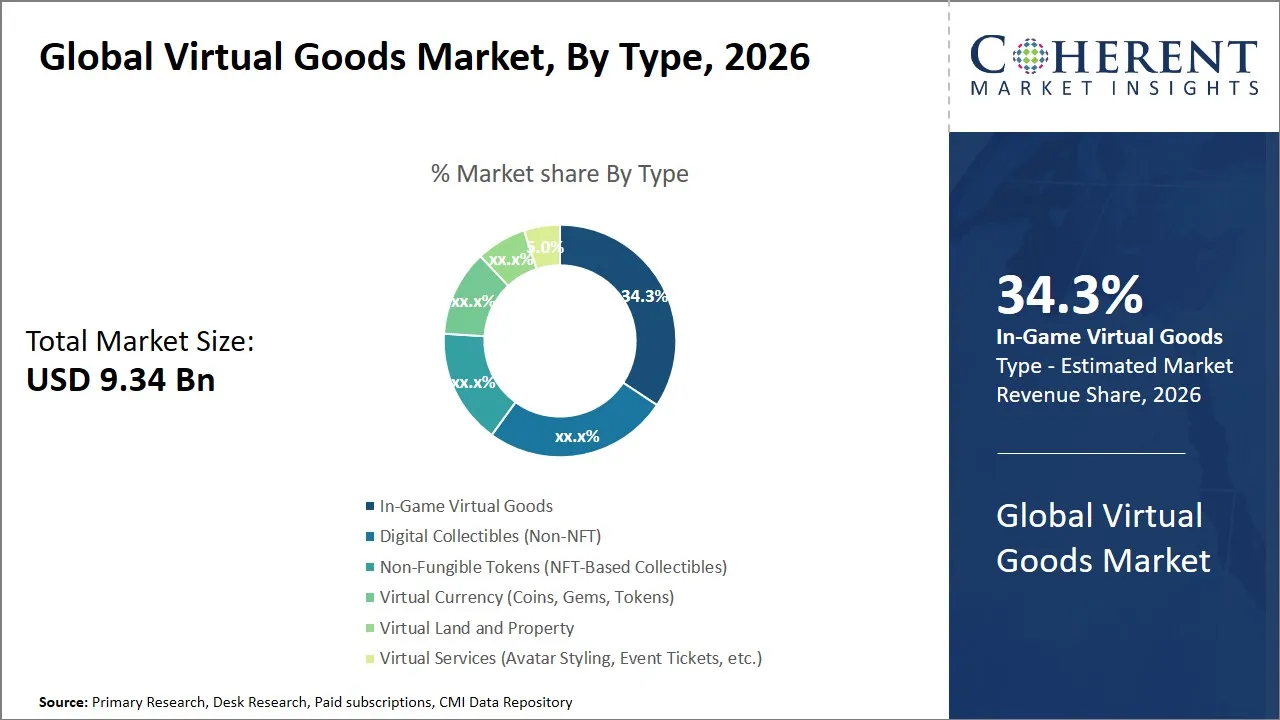
- In-game virtual goods are expected to account for 34.3 % of the market share in 2026, primarily enhancing gameplay and personalizing user experiences.
- Smartphones and tablets are projected to make up 32.7 % of the virtual goods market in 2026, driven by their widespread use and dominance in casual and social gaming.
- Micro-transactions and loot boxes are expected to represent 45.8 % of the global virtual goods market in 2026, fueled by incremental spending and gamified purchasing incentives.
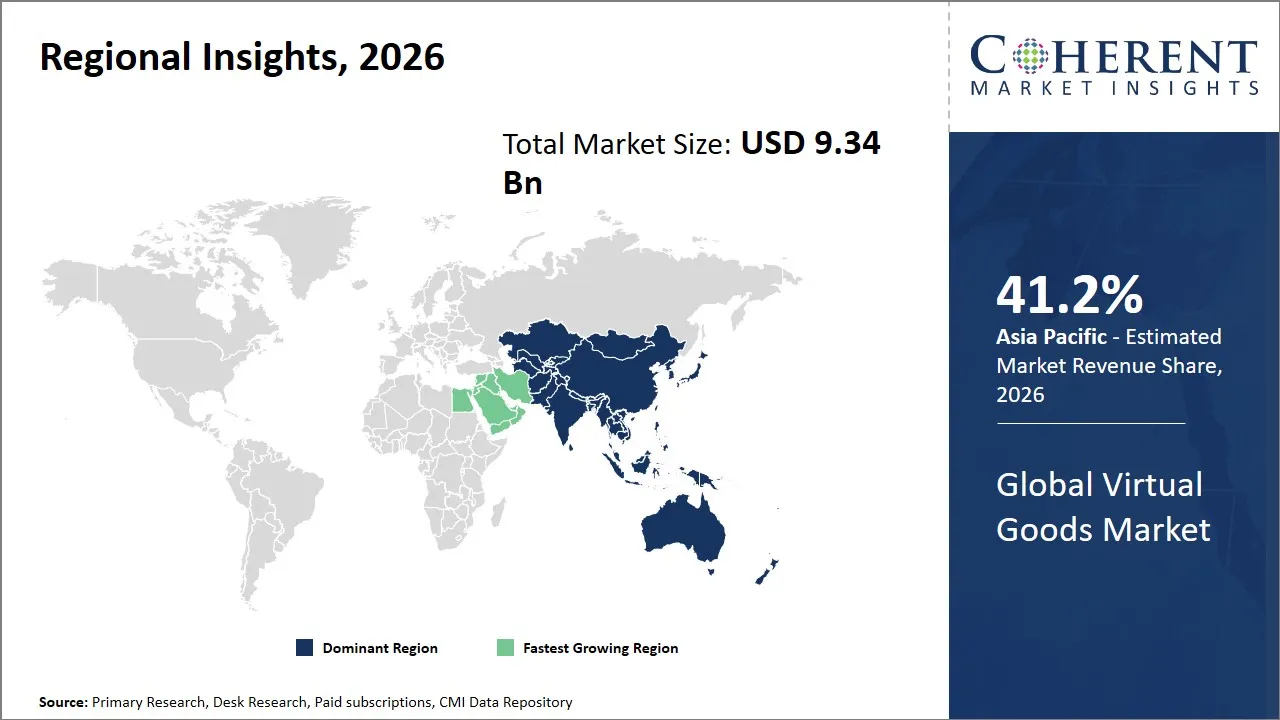
- The Asia Pacific region is expected to dominate the market with a 41.2 % share in 2026.
- The Middle East region is anticipated to show the fastest growth, capturing 13.5 % of the global virtual goods market share in 2026.
Market Overview
- Market trends indicate a strong shift towards immersive technologies such as virtual and augmented reality (AR), which are enhancing user experiences and driving demand for virtual goods.
- Additionally, the rise of Blockchain and non-fungible tokens (NFTs) is revolutionizing virtual goods ownership, creating new monetization opportunities for creators and consumers alike.
- Businesses are increasingly leveraging social media and e-commerce integration to promote virtual goods, further accelerating adoption across various demographics worldwide.
Currents Events and Its Impact
Current Events | Description and its Impact |
Market Value Drop for CS Digital Items |
|
Corporate Adoption of Virtual Brand Experiences |
|
Segmental Insights
- Current Industry Events of 2026
- Market Size Estimation
- Regional Breakdown
- Competitive Landscape
- Customer Intelligence
- Segmental Analysis
- Pricing Analysis
- Key Market Drivers, Challenges & Future Trends
- Customized Insights Section
Why Does the In-Game Virtual Goods Segment Dominate the Global Virtual Goods Market in 2026?
In-game virtual goods segment is expected to hold 34.3% of the global virtual goods market share in 2026, and their usage is largely related to their necessity to improve the gameplay and individualize the user experience. These commodities that start with cosmetic skins and other cosmetic items like skins, outfits and go all the way to functional assets such as weapons, power-ups and character upgrades are valuable as they add to the gameplay and create the incentive to invest in the game. Developers can give the players a feeling of ownership and a sense of attachment through avatars customization and adding functionality to in-game abilities, as well as, repeated interaction and a sense of protracted play-time.
A notable instance of this trend is the rise of Fortnite's in-game purchases. The game allows players to purchase a wide variety of cosmetic skins, emotes, and accessories for their avatars. These cosmetic items not only provide a unique aesthetic appeal but also enable players to customize their gameplay experience, boosting player retention and driving continuous spending.
Why are Smartphones and Tablets Dominating the Virtual Goods Market?
Smartphones and tablets segment is projected to hold 32.7% of the virtual goods market share in 2026, underpinned by their ubiquity and role as the preferred medium for casual and social gaming. The availability of low cost mobile phones and the ever increasing advancements in the ability of hardware capabilities and the internet enabled connection has created access to large numbers of demographics across the globe. This availability is translated into a huge and wide user base that plays games and digital ecosystems on the handheld devices directly.
Mobile platforms are also characterized by the existence of an ecosystem that promotes frequent low-friction purchase of virtual goods. Microtransactions are fast and simple because of the easy payment options supported by the app stores, and this is exactly what the shorter and more frequent playing sessions associated with mobile usage demand. The accessibility of mobile gaming enables users to usually want to add virtual items to real-time experience in order to maintain the needed demand.
Micro-Transactions and Loot Boxes Dominate the Global Virtual Goods Market
Micro-transactions and loot boxes segment is expected to hold 45.8% of the global virtual goods market share in 2026, because they capitalize on incremental spending patterns and gamified purchasing incentives. These models help to allow consumers to buy small and frequent purchases that will seem less expensive individually but add up to huge sources of revenue in general.
This increase in the popularity of this mode of payment can be explained by its psychological attractiveness. Micro-transactions also bring instant satisfaction as the players can purchase particular items or benefits without making huge initial investments. Loot boxes create a sense of mystery and novelty, and are more akin to a system of rewards based on chance that activates dopamine-related mechanisms that are comparable to gambling, which keeps people constantly occupied and making purchases.
Regional Insights
Asia Pacific Virtual Goods Market Analysis and Trends
The Asia Pacific region is projected to lead the market with a 41.2% share in 2026, due to the fact that the region has a high number of internet users, rising smartphone penetration, and the current population having a great interest in gaming and social media. More movements of government activity to provide supporting digital infrastructure and invest in 5G networks also drive the evolution of the ecosystems.
The intense competition in the trade sector in such countries as China, South Korea, and India provokes massive innovation and local content that enhances the involvement of consumers. Tencent, NetEase, and Bandai Namco are considered the key stakeholders in the industry as they have created region-specific virtual goods and games. The companies play on a strong sense of cultural understanding and collaboration with local developers to serve the specific needs of consumers, facilitating a thriving growth and diversifying monetization opportunities.
Middle East Virtual Goods Market Analysis and Trends
The Middle East region is expected to exhibit the fastest growth in the market contributing 13.5% of the global virtual goods market share in 2026. High mobile and internet penetration also stimulate growth, especially in technologically-advanced nations such as the U.A.E., Saudi Arabia and Qatar. Digital innovation and e-commerce are developing an expanding digital environment with the help of the government. The market is being created by some of the leading platforms such as Tencent (PUBG Mobile), Epic Games (Fortnite), and local services such as Ounass, with consumers becoming more interested in purchasing in-game products, virtual skins, and digital goods.
Global Virtual Goods Market Outlook for Key Countries
Why is the U.S. Dominating the Virtual Goods Market?
The U.S. controls the virtual goods market having high consumer expenditure in the gaming, social media, and entertainment industry. The biggest companies like Epic Games (Fortnite) and Blizzard Entertainment dominate the market innovating in-game purchases and cross-platform virtual assets. The presence of a well-developed venture capital in the country guarantees that it may be continual funding of new technologies such as augmented reality and virtual reality that may have an additional influence on the development of virtual goods. Clarity in regulation relating to online transactions and digital currencies also builds up quicker adoption.
China Virtual Goods Market Trends
The virtual goods market in China is flourishing due to a large population of digitally native people aided by the government focus on technology and the development of the digital economy. Domestic giants such as Tencent and NetEase have a huge portion of it through incorporating virtual goods into massively popular and culturally-adapted games and social sites. The well-established e-commerce environment and mobile payment platforms, such as Alipay and WeChat Pay, make the processes of purchases easier, which can make more virtual goods more accessible. Nevertheless, the control of content and gaming hours has a regulatory effect on the markets, companies are forced to be creative, even in a responsible way.
Why is South Korea Leading the Virtual Goods Market in Asia Pacific?
The various online gaming community as well as keeping up with digital trends still keep South Korea on top of the regional virtual goods market. The gaming culture of the country is also backed by high internet connection, high smart phone penetration and proactive government support towards e-sports and digital entertainment. MMORPG and competitive gaming titles have created powerful virtual economies in companies like NCSoft and Smilegate. Also, the gaming titles of the South Koreas that are export-oriented improve international presence that makes its market of virtual goods an important international player.
India Virtual Goods Market Trends
The virtual goods sector in India is a booming venture that has developed rapidly due to the rising internet availability and mobile phone penetration of a youthful market base. Local startups and the known companies such as Dream11 and Nazara Technologies have taken advantage of this growth by developing culturally-relatable gaming content and in-app purchases. Digital literacy and infrastructure in the country are increasing with the help of government programs like Digital India. Although the market is currently experiencing issues like payment gateways and regulatory uncertainty, the future of the market is bright because the current trend of consumption has shifted towards offline and online entertainment.
Germany Virtual Goods Market Trends
The virtual goods market in Germany is represented by an active gaming community and the increased interest to the digital collectibles and social media channels. The nation enjoys a consistent regulatory policy arguably controlling online transactions and privacy of consumer data, which fosters trust in online shopping. Ubisoft and Goodgame Studios are companies that are actively developing in the market and that offer various products such as in-game assets and virtual currencies. Moreover, Germany is at a strategic location in Europe and can enjoy good trade relations that will help import and export virtual goods technology and content.
Monetization Models (Microtransactions, Subscriptions, and Marketplace Fees)
Monetization Model | Description | Revenue Source | Examples |
Microtransactions | Small, one-time payments for virtual goods or in-app purchases. | Single payment per item or feature purchased | Fortnite (skins), Candy Crush (power-ups), Steam (items). |
Subscriptions | Recurring payments for continued access to virtual goods or premium features. | Regular recurring payments | World of Warcraft (game subscription), Netflix (streaming). |
Marketplace Fees | Fees charged by a platform for facilitating transactions in its marketplace. | Platform commissions from transactions | Roblox (developer fees), eBay (transaction fees) |
Market Players, Key Development, and Competitive Intelligence
Key Developments
- In May 2025, Meta launched a USD 50 Mn Creator Fund to sponsor user-generated virtual goods across its portfolio.
- In March 2025, Tencent lifted its stake in Kadokawa Corporation, broadening Japanese IP access for future asset pipelines.
- In March 2025, Tilting Point opened a USD 150 Mn user-acquisition fund aimed at scaling mobile titles with heavy virtual goods monetization.
- In March 2025, Tripledot agreed to acquire AppLovin’s games unit for USD 900 Mn, boosting cross-promotion reach.
Top Strategies Followed by Global Virtual Goods Market Players
Player Type | Strategic Focus | Example |
Established Market Leaders | Heavy investment in R&D and innovation | An example is that companies such as Epic Games and Tencent use their large budgets on R&D to keep on innovating within the gaming industry, and providing increased virtual goods in popular games such as Fortnite and League of Legends. Such organizations tend to form strategic alliances with the major industry players including the major gaming firms, original equipment manufacturing (OEM) firms as well as technology suppliers. |
Mid-Level Players | Balance cost and sustainability | An example of such players is the popular virtual item prescriber companies such as Roblox Corporation and Valve, where virtual items can be purchased in large amounts at low prices in their platforms, including Robux on Roblox or Steam Community Market on Steam. |
Small-Scale Players | Niche specialization & innovative variants | As an example, companies such as Decentraland and Cryptovoxels are small players that specialize in integrating new technologies, including augmented reality (AR), blockchain, and artificial intelligence (AI) in their virtual products. One such example is Decentraland, where users can create, purchase and sell virtual land, operating on blockchain technology, thus, it is a metaverse pioneer. |
Market Report Scope
Virtual Goods Market Report Coverage
| Report Coverage | Details | ||
|---|---|---|---|
| Base Year: | 2025 | Market Size in 2026: | USD 9.34 Bn |
| Historical Data for: | 2020 To 2024 | Forecast Period: | 2026 To 2033 |
| Forecast Period 2026 to 2033 CAGR: | 5.8% | 2033 Value Projection: | USD 13.86 Bn |
| Geographies covered: |
| ||
| Segments covered: |
| ||
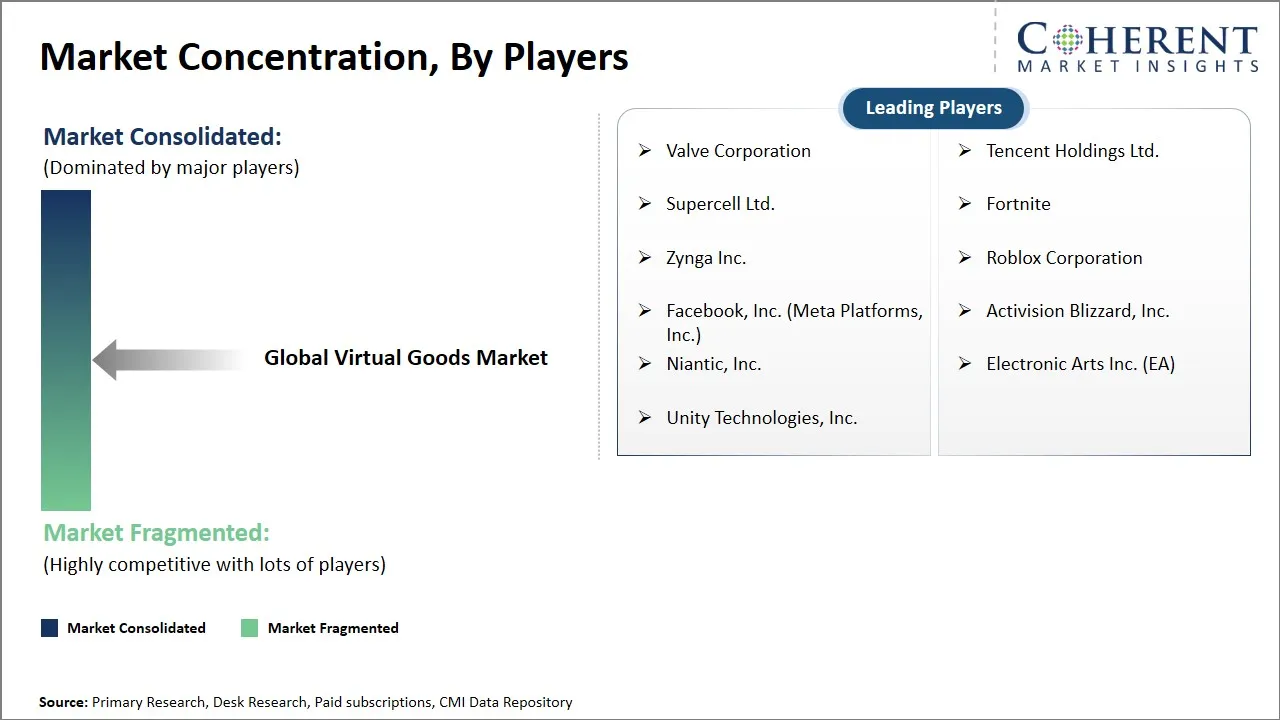
| Companies covered: | Valve Corporation, Tencent Holdings Ltd., Supercell Ltd., Fortnite, Zynga Inc., Roblox Corporation, Facebook, Inc. (Meta Platforms, Inc.), Activision Blizzard, Inc., Niantic, Inc., Electronic Arts Inc. (EA), and Unity Technologies, Inc. | ||
| Growth Drivers: |
| ||
| Restraints & Challenges: |
| ||
Virtual Goods Market Dynamics
Virtual Goods Market Driver - Growing Popularity of Online Gaming and Virtual Environments
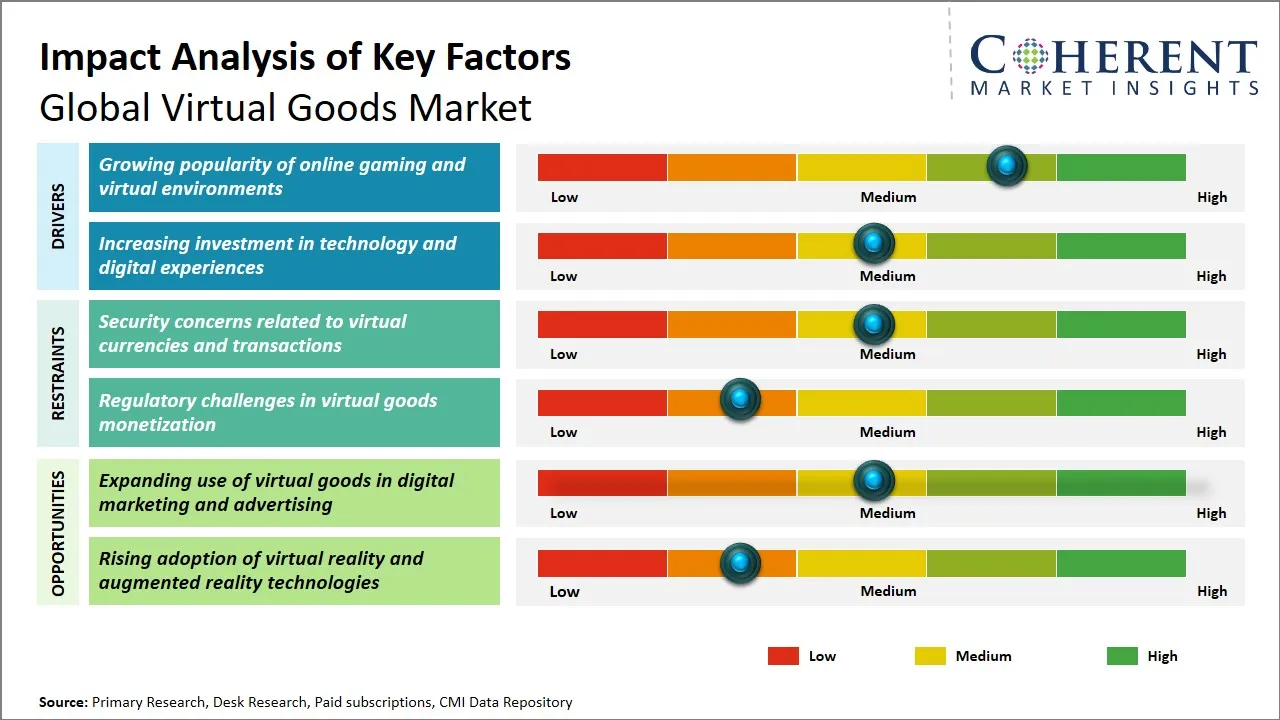
The growing trend of online gaming and deep virtual worlds has become one of the key factors that are fueling the demand of virtual products in all markets of the world. With Mns of players taking up the game and virtual worlds daily, the urge to customize avatars, add to in-game experiences, and own unique digital items increases. This influx is driven by more advanced game styles which encompass socialization, competition, and extensive content patches which motivate people to spend on virtual products like skins, weapons, and mobile phone accessories. Moreover, with the emergence of metaverse and AR spaces, the field of gaming is not the only aspect where digital ownership and customization can be valued highly.
In 2021, Fortnite earned more than 9 billion dollars in revenue, with much revenue being earned through in-game purchases of virtual goods. The constant release of new skins, seasonal changes and exclusive items have enabled the players to be more attached to these virtual items and this has led to a booming industry of the virtual goods.
Virtual Goods Market Opportunity - Expanding Use of Virtual Goods in Digital Marketing and Advertising
The increased integration of virtual items in the digital marketing and advertising has been a great prospect to the virtual goods market all over the world. Virtual goods including branded avatars, virtual merchandise and in-app purchases are rapidly becoming the brands means to explore an engaging and immersive experience that can capture the attention of digitally savvy consumers. These digital properties enable marketers to spawn greater brand resonance by incorporating interactive advertising campaigns via games and social networks and metaverses, through which users are spending meaningful time. Virtual goods can also allow marketers to target their marketing campaigns and make exclusive, limited-edition products that customers will become loyal customers and share with others, thus enhancing organic distribution.
As an example, Gucci has partnered with Roblox to build a virtual store where players can shop digital items with exclusive designs, including virtual clothes and accessories, and these resemble real-world Gucci products. This collaboration did not only increase the brand awareness of Gucci’s among younger, more technologically advanced consumers but was also an example of how a company can reach consumers with the help of virtual products.
Analyst Opinion (Expert Opinion)
- The virtual goods market is experiencing an outburst, as the online gaming market is growing at an alarming rate and the popularity of online experiences is rising on all platforms. The Virtual Economy Summit (2023) and the International Game Developers Conference (2022) provided insights highlighting the trendiness, with such companies as Epic Games and Roblox leading the way of developing virtual products that could better engage the users.
- The recent release of digital fashion pieces that could be easily put on avatars by the creators of Epic Games serves as a good example of how the virtual goods are being used in order to enhance brand loyalty and immersion among users. It was discussed how more money could be monetized in the virtual worlds, especially using microtransactions and items with limited editions resulting in a feeling of exclusivity.
- Those companies, which concentrate on developing the unique, high-quality virtual goods and create the community-based interaction strategies, will probably be able to exploit the new opportunities. In finality, the rise of the virtual goods market will depend on its capacity to be constantly innovative and capable of changing itself to be in line with changing consumer preferences in the ever-connected digital world.
Speak to the analyst
Want personalized insights?
Take the findings above to one of our principal consultants, or have the report rebuilt around the segments, geographies and competitors you actually track.
Market Segmentation
- Type Insights (Revenue, USD Bn, 2021 - 2033)
- In-Game Virtual Goods
- Digital Collectibles (Non-NFT)
- Non-Fungible Tokens (NFT-Based Collectibles)
- Virtual Currency (Coins, Gems, Tokens)
- Virtual Land and Property
- Virtual Services (Avatar Styling, Event Tickets, etc.)
- Device Insights (Revenue, USD Bn, 2021 - 2033)
- Smartphones and Tablets
- PCs and Consoles
- VR / AR Head-Mounted Displays
- Payment Mode Insights (Revenue, USD Bn, 2021 - 2033)
- Micro-transactions and Loot Boxes
- Subscription / Season Pass
- Pay-to-Own (One-Time Purchase)
- Application Insights (Revenue, USD Bn, 2021 - 2033)
- Gaming
- Social Media
- Virtual Reality (VR)
- Augmented Reality (AR)
- Others (e.g., online marketplaces)
- Regional Insights (Revenue, USD Bn, 2021 - 2033)
- North America
- U.S.
- Canada
- Latin America
- Brazil
- Argentina
- Mexico
- Rest of Latin America
- Europe
- Germany
- U.K.
- Spain
- France
- Italy
- Russia
- Rest of Europe
- Asia Pacific
- China
- India
- Japan
- Australia
- South Korea
- ASEAN
- Rest of Asia Pacific
- Middle East
- GCC Countries
- Israel
- Rest of Middle East
- Africa
- South Africa
- North Africa
- Central Africa
- North America
- Key Players Insights
- Valve Corporation
- Tencent Holdings Ltd.
- Supercell Ltd.
- Fortnite
- Zynga Inc.
- Roblox Corporation
- Facebook, Inc. (Meta Platforms, Inc.)
- Activision Blizzard, Inc.
- Niantic, Inc.
- Electronic Arts Inc. (EA)
- Unity Technologies, Inc.
Sources
Primary Research Interviews
- CEO – Leading Virtual Goods Platform (e.g., Tencent or Roblox equivalent)
- Monetization Director – Major Gaming Publisher (e.g., Electronic Arts or Activision Blizzard)
- Product Lead – Metaverse/NFT Marketplace Operator
- Sustainability Officer – Digital Economy Certification Body (e.g., for blockchain/carbon-neutral virtual assets)
Stakeholders
- Manufacturers
- End-use Sectors:
- Gaming Industry (Mobile Games, PC/Console Games)
- Social media & Metaverse Platforms (Roblox, Fortnite)
- NFTs & Blockchain Gaming (CryptoKitties derivatives)
- Regulatory & Certification Bodies (e.g., ESRB for in-game purchases ratings, PEGI compliance in EU, IARC global standards)
- E-commerce Platforms and Retailers (Steam, App Store, Google Play, Roblox Marketplace, OpenSea)
- Technology Integration Players: In-game economy developers and virtual item designers using Unity/Unreal Engine
Databases
- Newzoo Global Games Market Reports (includes virtual goods/IAP data)
- UN Comtrade Database (HS codes for software/digital content)
- SuperData Research (now part of Nielsen, gaming/virtual economy stats)
- App Annie/Data.ai (Mobile app monetization and IAP)
Magazines
- GamesIndustry.biz – Trends in virtual goods monetization
- VentureBeat – Gaming and metaverse economy insights
- PocketGamer.biz – Mobile virtual goods and F2P models
- Newzoo Insights – Market dynamics for in-game purchases
Journals
- International Journal of Information Management – Virtual goods consumer behavior
- Journal of Business Research – Economics of digital goods
- Computers in Human Behavior – Motivations for virtual item purchases
Newspapers
- The Wall Street Journal – Gaming revenue and virtual economy growth
- Bloomberg – Metaverse and NFT virtual goods markets
- Reuters – Price volatility in gaming stocks tied to virtual sales
- Financial Times – Digital economy and in-app purchase regulations
Associations
- Entertainment Software Association (ESA)
- International Game Developers Association (IGDA)
- Interactive Software Federation of Europe (ISFE/Video Games Europe)
- Mobile Gaming Association
- Global Esports Federation (esports virtual goods)
Public Domain Sources
- ESRB – Guidelines for in-game purchases and loot boxes
- PEGI – EU regulations on virtual goods/microtransactions
- FTC – Consumer protection for digital purchases
- OECD – Digital economy reports including virtual goods trade
- ITU – Broadband and digital content consumption stats
Proprietary Elements
- CMI Data Analytics Tool
- Proprietary CMI Existing Repository of information for last 8 years.
Get access to 250+ pages report
Every segment, forecast, competitor profile and data table behind the analysis above — available for instant download.
- ESOMAR Member
- ISO 9001:2015 Certified
- D-U-N-S Registered
- GDPR & CCPA Compliant
Missing comfort of reading report in your local language? Find your preferred language:
Transform your Strategy with Exclusive Trending Reports
Frequently Asked Questions
The global virtual goods market is estimated to be valued at USD 9.34 Bn in 2026 and is expected to reach USD 13.86 Bn by 2033.
The CAGR of global virtual goods market is projected to be 5.8% from 2026 to 2033.
Growing popularity of online gaming and virtual environments and increasing investment in technology and digital experiences are the major factors driving the growth of the global virtual goods market.
Security concerns related to virtual currencies and transactions and regulatory challenges in virtual goods monetization are the major factors hampering the growth of the global virtual goods market.
In terms of type, in-game virtual goods are estimated to dominate the market revenue share in 2026.
Valve Corporation, Tencent Holdings Ltd., Supercell Ltd., Fortnite, Zynga Inc., Roblox Corporation, Facebook, Inc. (Meta Platforms, Inc.), Activision Blizzard, Inc., Niantic, Inc., Electronic Arts Inc. (EA), and Unity Technologies, Inc. are the major players.
Asia Pacific is expected to lead the global virtual goods market in 2026.